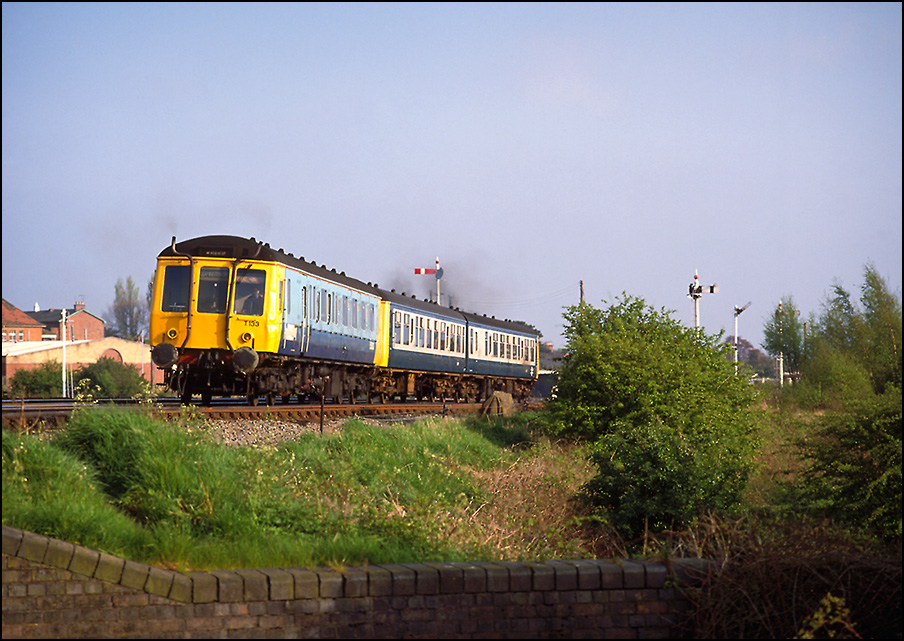
For the purposes of this section I have decided that the admirable InterCity 125 High Speed Trains are multiple units. I realise that this is not strictly accurate but they do, I think, seem to fall quite naturally into this category. For those with an interest in First Generation DMUs and railcars I can heartily recommend this comprehensive website with a huge amount of information and many photographs.
|
|
There is an hourly local service between Birmingham Moor Street to Leamington Spa operated by Chiltern Railways and this is 165024 with the 13.15 departure from Birmingham, 2L47, as it picked up a couple of passengers at Hatton on 15 October 2026. |
|
|
This scene from Smethwick West has changed since the image was taken on 29 August 1986 with Class 116/127 hybrid set TS619 (probably 53854 + 59592 + 53907) passing the signalbox with a Birmingham New Street to Kidderminster service. The single line leading to Handsworth is now the double-track from Birmingham Snow Hill with Galton Bridge Interchange Station in the background allowing passengers to switch between the Snow Hill and New Street to Wolverhampton lines. |
|
|
The roofless former steam shed at Worcester Shrub Hill is in the background of this view with B436 (51334 + 59500 + 51376) and another similar set) about to arrive at the station where it will reverse and head off towards Foregate Street and Hereford. I have never seen the signal arm on the short signal post in anything but the lowered position but never saw a train on its associated line. Adrian Putley has kindly let me know that it's to protect the occasional shunting moves that take place on the goods lines - there's a crossover between them a little further along. The signal is worked from a ground frame near those lines, and left clear unless a train comes in and needs its protection. |
|
|
This was for many years the commonest sight around Hatton; a class 116 unit shuttling between Leamington Spa and Birmingham. On 4 June 1985 TS615 (53850 + 59591 + 53102) was climbing Hatton Bank with a local service and about to pass over the boarded foot crossing in the days before the new footbridge was built. On this occasion I was there to photograph steam locomotive 5051 working the exhibition train northwards. I was alone for the DMU shot but not for the Castle! |
|
|
I can't give many details for this view of a Birmingham Moor Street to Leamington Spa local train about to stop at Hatton on 14 April 1987. The set number was invisible but the set is clearly a class 116, the usual for this line. |
|
|
The late running of 1Q48 with 37419 & 37422 on 29 September 2026 allowed the 21.01 from Stratford on Avon to Worcester Shrub Hill, 2V22, to leave first and as this was led by one of the 3 newly liveried class 172s in the form of 172333 I took this shot as it stopped at Stratford Parkway. I had hoped for a second shot of 1Q48 this time with 37419 leading but it was so late leaving Stratford that the down passenger service 2S15 was still in its platform. Had I had time this still image would have been some video footage to take advantage of the impressive sound as the train was about to climb the 1/75 bank to Wilmcote. |
|
|
There were two visiting trains to Stratford-upon-Avon on Sunday 16 August 2026. The first was the usual 37240 deputising for a GW Castle and the second 153383 on a 2Q14 Derby to Reading Triangle Sidings, that was reportedly a crew training run for Colas. It arrived at Stratford-upon-Avon a few minutes early, probably because of WMR sevices beyond Snow Hill and Stourbridge being cancelled of ruuning as VVR following the dreadful wildfires around Stourbridge. I took this picture from the new footbridge to show the changing background with yet another care home for the town being built on the former yard and site of Stratford steam shed. No doubt the new facility will be left at least half-empty in common with all the others in the area. The scene as 153383 left the station is no more inspiring with the backdrop of hideous-looking 4 and 5 storey apartments looming over it. |
|
|
The second EMR class 810, 810017, ran from Merchant Park Sidings at Doncaster to Long Marston on 10 August 2026 where it is to undergo some form of testing. As it was sunny afternoon I went to Evesham for a record shot of one of these bi-mode units in decent light as I can't imagine that I will ever be likely to go to the Midland Main Line for a picture of one in service. Running as 5Q67 it was a few minutes being late released from Norton Junction, Worcester because an up IET from London Paddington was, unsurprisingly, some 15 minutes behind its booked time. The cab front looks as if it's passed through a washing plant using water containing chalk dust. |
|
|
Chiltern class 165 is the main type of unit to be found on the infrequent shuttles between Stratford-upon-Avon and Leamington Spa. On 7 August 165007 was on this diagram and is seen here pulling away from Stratford-upon-Avon Parkway with 2L44, the 12.29 from the town station to Leamington Spa. |
|
|
West Midlands Railways' 172331 is the first of the class to receive a new livery similar to that carried by class 196 DMUs. I've been keeping an eye on RTT on sunny days in case it was allocated on its own to work to Stratford-upon-Avon at a suitable time of day and on 7 August 2026 it was on 2D47, the 10.40 from Worcester Foregate Street due to arrive at Stratford Parkway at 12.38, when the sun should be about right. Here it is about to stop to drop off a few passengers before making the short journey to the GWR station a couple of minutes down the line. |
|
|
A relatively unusual locomotive-hauled train was due to run up the North Cotswold Line on Saturday 1 August 2026. I went to a field near Clayfield Lane arriving just in time to photograph 800003 with 1P20, the 09.59 Great Malvern to London Paddington from a foot crossing just beyond the level crossing visible under the fourth car of the unit. |
|
|
A new class of unit and a new colour scheme for the North Cotswold Line and the Long Marston branch. On Thursday 30 July 2026 EMR's new 810021 ran from Merchant Park Sidings at Darlington to Long Marston to undergo some form of testing. This is the class of unit that was involved in the dreadful incident at Bedford but I have no information about whether the visit to Warwickshire is in connection with this. Running as 5Q67, 801021 ran under its own power, making a change from the many units hauled in by various locomotives, it ran close to right time but thanks to a late-running down GWR service was allowed to leave Worcester about 10 minutes early and made up an extra minute or by the time I saw it at Honeybourne. |
|
|
This was the better shot of 810020 at Honeybourne on 30 July 2026 is it moved towards the hut in which the single line staff for the Long Marston branch is kept. The colour scheme looks a bit flat in poor light but looks a lot better when the sun comes out which it did a few seconds later. |
|
|
After a clear run from Honeybourne on 30 July 2026 I arrived at Long Marston with nearly 5 minutes to spare before 810020 appeared in the distance. Unsurprisingly with no locomotive on the scene there were no other photographers present, just a couple of enthusiasts keen to record the car numbers as 5Q67 went under the bridge. |
|
|
This would have been a well-lit shot at Long Marston on 30 July 2026 either a couple of minutes earlier or later as 810020 moved slowly along No.1 road towards the test area. The stored class 458 EMUs and other redundant stock can be seen to the right beyond the newly electrified test line. |
|
|
West Midlands Railway class 172 172331 has been put into a new livery and now self-identifies as a class 196. The unit in what I regard as a much better colour scheme than the previous WMR one was allocated, along with 172001, to 2D35 from Worcester Foregate Street to Stratford-upon Avon on Saturday 25 July 2026. I checked on the Kidderminster Railcam that 172331 was leading and than went to Stratford Parkway for a picture. Here is 172331 again at Parkway but in 2013 when fairly new and before the station received its current corporate paintwork. |
|
|
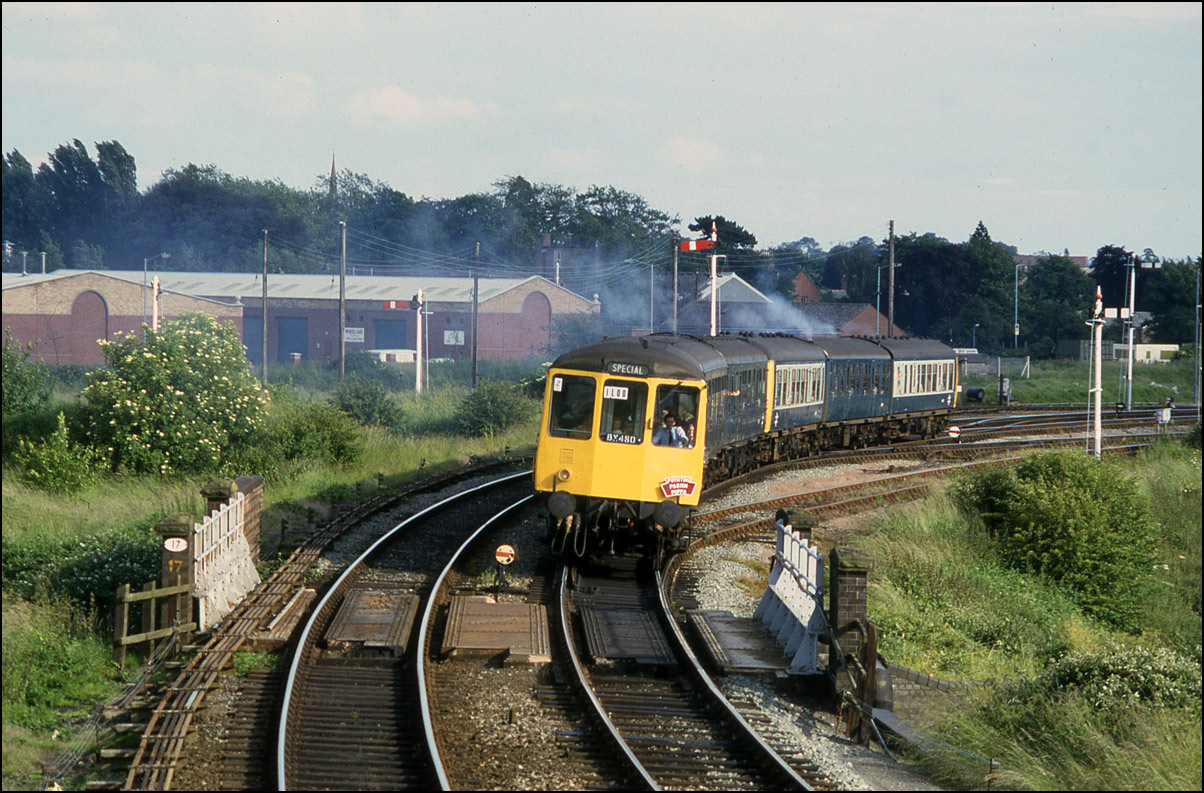
A rare combination of DMU classes about to arrive at Stratford-upon-Avon on 29 June 1985 as class 108 BX496 (51947 + 59155 + 52062) with class 104 BX480 (53420 + 59152 + 53474) passed the rarely used Down Goods Loop. The train, 1L00, started at Poynton in Cheshire bringing passengers from various churches in the town, hence the headboard Poynton Parish Puffer. |
|
|
By the time I had walked from the Down Goods Loop to Stratford-upon-Avon station on 29 June 1985 the train was about to shunt from platform 1 to the now-gone Cold Store Siding. The ground signal just beyond the driving car of the class 104 can just be made out showing that the road was set. |
|
|
The Cold Store Siding at Stratford-upon-Avon was mostly used for the overnight stabling of units in the days when the station had its own crew of drivers and guards. A special working such as this would usually have gone into platform 3 because the pattern of trains from Birmingham and Leamington Spa required just two platforms. on 29 June 1985 another special with 46229 Duchess of Hamilton in charge was scheduled, although I don't seem to have any pictures of it on this occasion. |
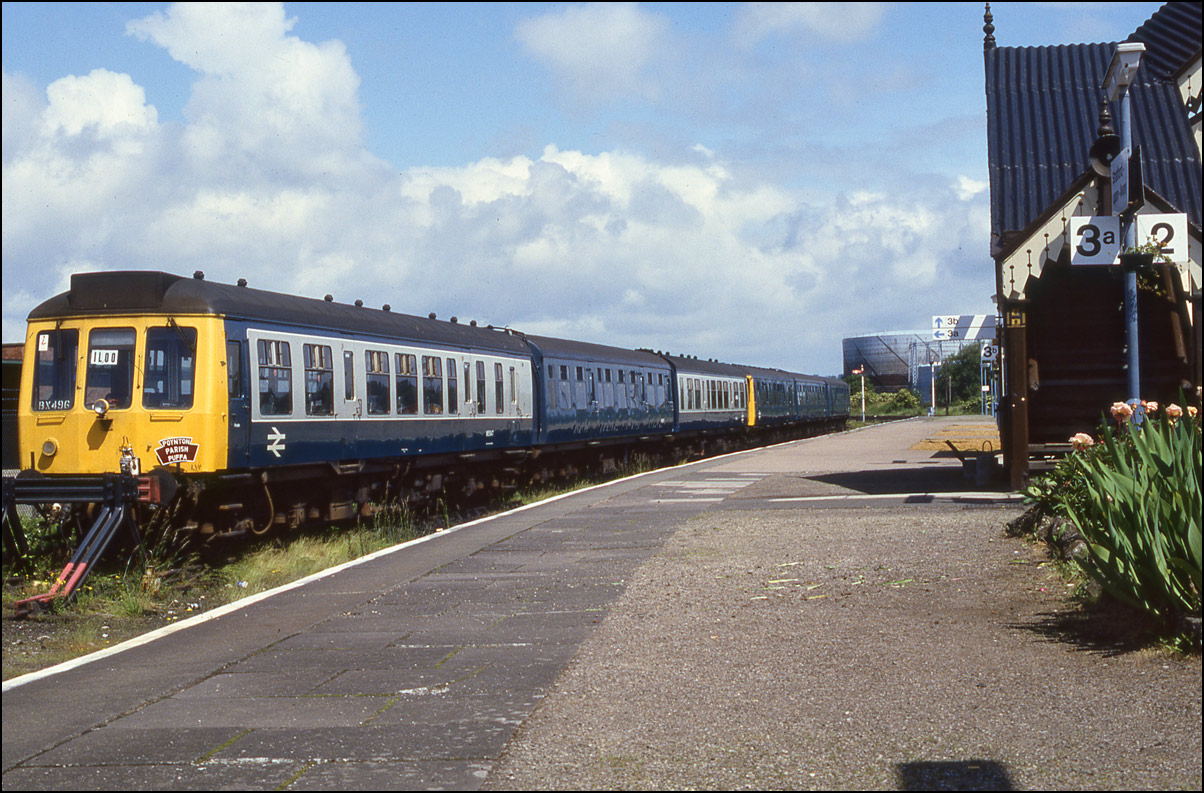 |
Stratford-upon-Avon used to be the destination for many special trains although the number of such workings has lessened in recent years. This picture shows one of these, the Poynton Parish Puffa, standing in the Cold Store Siding on 29 June 1985. This train was formed of class 108+104 combination and, obviously enough I suppose, ran from Poynton in Cheshire, which incidentally is a very attractively decorated station, adorned with many enamel advertisements. The sun came out about 30 minutes before departure time and this sunny shot together with the following image were a bonus. |
 |
The passengers on the Poynton Parish Puffa were treated to a visit by the steam locomotive 46229 Duchess of Hamilton on 29 June 1985 although I don't recall taking any pictures of this. The return working of the steam special left a short while before the DMU went back to Cheshire and I photographed the latter from the window of the signal box. The industrial units in the background are the site of the erstwhile Stratford-upon-Avon shed and coaling stage. The entire backdrop is virtually unrecognisable in late 2026 and the signal box itself was demolished many years ago. |
|
|
The leading car of class 116 set TS580, 53826, has a decent number passengers on board as it waited to depart from Langley Green on 3 October 1986. The large signalbox controlled not only the main line but Rood End Yard which extended quite a distance towards Birmingham and took traffic to and from several rail-connected industrial sites. There were 2 daily trip freights from Bescot and occasional block trains running as required. The line running behind the signalbox served the Allbright and Wilsons chemical works which took tanks of chlorine for use in its processes. |
|
|
Not the greatest shot of a class 110 DMU but living in Warwickshire there weren't many opportunities for pictures close to home. With car 51834 leading 52072 the dirty two-car set was running through Manchester Exchange on 27 February 1986 with "Special" displayed on the destination panel. |
|
|
Another heavily backlit photograph from Manchester Exchange with a class 108 going into Victoria station following a signal check with a service from Blackburn on 27 February 1986. The background was as interesting to me as the train with its mix of residential and industrial properties now, I'm sure, all swept away in favour of modern housing. |
|
|
Following its use on specials between London Paddington and Long Marston for the 2026 Rail Live event the ROMIC HST worked an excursion to Stratford-upon-Avon from Bishop Auckland. I didn't go out for the inward journey but following a message from Chris Morrison saying that the train had run to Dorridge Goods Loop and was about to return to Stratford via Hatton I took a quick drive to Wilmcote station for a shot. Led by 43122 with 7 coaches and 43094 trailing it made a decent enough sight passing under the GWR footbridge. I was later told that the reason for the ECS move, 5Z50, was because with 7 coaches the train did not fit behind the platform signal for platform 3 and having to pass a red to move anywhere could not be shunted into platform 2. There were just 6 coaches when it went to Long Marston and I wonder if the planning had been done with that number and no-one thought to mention that the actual train would be longer? Thanks to Chris for the timely message. |
|
|
Class 121 route learner L103 (TDB 975659 and 55035) was entering Worcester Shrub Hill on 5 June 1986 heading west towards Norton Junction. I also took a colour shot with a longer lens to better show the signals but the sun wasn't especially favourable! |
|
|
Class 116 T511 (53832 + 59649 + 53913) with its black cab window surround passing Stratford-upon-Avonn East signalbox with a train from Birmingham Moor Street on 29 April 1987. The name of the box (East not North as sometimes wrongly stated) was a hangover from the days when Stratford was on the GWR main line from Wolverhampton to Cheltenham and there was a West box just beyond the roadbridge at the end of the station. |
|
|
A two-car class 104 in plain blue leaving Manchester Victoria on 27 February 1986. The trailing car is M53538 possibly with M54176 leding as this pair were listed on Railcar.co.uk as working together at this time. The shot looking towards the station was available as a long freight was heading east and blocking the view but had fortunately cleared for my picture. |
|
|
An exceptionally dull and misty morning at Droitwich Spa on 16 April 1987 with an unidentified class 116 unit about to stop at the station with a Birmingham New Street to Hereford train. Underwoods coal yard was still active with trains of household coal, usually 2 or 3 HTAs, being received as required from Washwood Heath with one of the class 37 Lickey bankers providing the power with the 0-4-0 Ruston shunter moving them on-site. The slightly bizarre effigies of coal miners made the advertising board a lot more noticeable for passing passengers. |
|
|
Class 118 T317 (51314 + 59481 + 51329) was working from Birmingham Moor Street to Stratford-upon-Avon on 2 May 1988 when photographed passing Henley-in-Arden's outer home signal. I took the shot quite early because the light was dreadful and the exposure on 125asa FP4 was 1/125 at f2 on an Olympus OM1n. There is a footpath along the boundary fence here which in 1988 gave clear views from various spots but it's very different in 2026 with the line largely hidden by tree growth. |
|
|
Class 118s weren't seen around Stratford-upon-Avon all that often so it was worth walking back to Henley-in-Arden for another shot as it returned about 40 minutes later on 2 May 1988. The signalbox was usually switched out Saturdays at this time which left a very long section between Shirley and Bearley Junction but this didn't matter much with a basic hourly service in each direction |
|
|
The 17.08 from Stratford-upon-Avon to Worcester Foregate Street, 2V96, was timed to pass Hatton North at around the same time as 60046 with empty stone wagons running from Wembley to Penmaenmawr. The freight had green lights all the way from Warwick to Dorridge so the 5 car DMU formed of 172345 + 172217 followed it. It is seen here about to cross over onto the main down line from the single line to Bearley Juncion and Hatton West Junction. |
|
|
The unique Midline class 121 single car was on the back of 3 car class 108 T902 (53933 + 59387 + 51566) leaving Stratford-upon-Avon on 16 May 1987. Class 108s were not commonplace here, especially those with a cab-mounted headlight and even less so working with a bubble unit in the consist. Here is the train in platform 3 a few minutes earlier while waiting to form a train for Birmingham Moor Street. |
|
|
Two for the price of one at Worcester Shrub Hill on 14 December 1984. An HST terminating service from London Paddington was about to pull out of the station to reverse for the returning up journey (the arm of the appropriate signal can just be glimpsed in the "off" position behind the footbridge) as class 117 B430 (51410 + 59520 + 51368) arrived from Birmingham New Street with a Hereford train. This unit will also reverse here and take the curve towards Foregate Street station. |
|
|
Class 116 set TS624 (51143 + 59615 + 51130) was pictured leaving Stratford-upon-Avon for Birmingham Moor Street on the evening of 24 June 1986. The shot was from the window of Stratford-upon-Avon East signalbox, somewhere I visited most weeks once the weekly Special Traffic Notice had been delivered to have a check through in case anything decent was around the following week. There was something most weeks unlike in 2026... |
|
|
It was getting on in the afternoon of 27 February 1986 when this 3 car class 110 worked through the remains of Manchester Exchange station towards Victoria with a Blackpool to York service. In the background is what appears to be a 2 car class 108 coupled to a class 101. This area has been extensively redeveloped since then and even if such a shot were still possible I very much doubt that the backdrop would have any of the architectural interest so obvious in 1986. |
|
|
Class 156 Super Sprinter 156416 made one of its first runs on 6 May 1998 when it travelled from Washwood Heath to Banubury and return. I saw both legs of the journey at Hatton and this is the up run as the unit went down through Hatton Cutting towards Warwick. This part of the line, like most of it in this area, is completely hidden from view from the footpath thanks to extensive tree planting by the then landowner. |
|
|
This spot by a small oak tree was a favourite for many photographers on Hatton Bank until it was chopped down by someone who wanted a clear shot for a steam special from further along the cutting. The working is the return of the one shown above as 156416 made an early test journey between Banbury and Washwood Heath on 6 May 1988. |
|
|
At least 20 signal arms are visible in this shot of a Nottingham to St Pancras HST about to stop at Leicester on 15 August 1985. Not many photographers bothered with HSTs at this time but as this was my first visit to the city and knowing that the signals weren't going to be around for ever I took everything that came along. |
|
|
The TOC covering the West Midlands in 1988 was branded "Midline" and its enterprising management ran a "Midline Day" on 9 April 1988 with special workings and an exhibition at Birmingham Snow Hill. Among the visiting train was Hastings Unit 203001 which ran the scheduled two-hourly services between Leamington Spa and Stratford-upon-Avon. Here is the 4 car train, as it was then, in platform 3 at Hatton after picking up some passengers and pulling away for the trip down the Stratford branch. |
|
|
There was plenty of time to cross the road for this image of 203001 rounding the curve towards Hatton West Junction on 9 April 1988 while on its way to Stratford-upon-Avon from Leamington Spa. In the background the earthworks for the M40 extension to Birmingham can be seen above the trees in the triangle of lines that was the site of quite an extensive goods yard and sidings. |
|
|
Instead of going down to Stratford-upon-Avon for some shots of 203001 on Saturday 9 April 1988 I chose to stay around Hatton as there were several freights on the line which I was keen to photograph. Here is 203001 accelerating down Hatton Bank after the stop at Hatton station with an early afternoon train from Stratford. |
|
|
The sunshine hung on nicely on 9 April 1988 for the return of 203001 from Leamington Spa and if I remember correctly there was quite a crowd of photographers here for this shot. The Down Goods Loop was very rarely used in those days as can be seen from the rusty tracks. The passenger services between Leamington, Stratford and Birmingham Moor Street was much less intensive than in 2026 and with no main line passenger trains outside peak hours there was little need for a freight to be sidelined. |
|
|
The first class 150 Sprinter to be preserved, 150231, ran under its own power from Derby RTC to Alton on the Watercress Line on Tuesday 23 December 2025. It was routed via Birmingham, Worcester, Evesham and Oxford and gave me the chance for what I think is my first picture of the class on the North Cotswold Line apart from 950001, although I can't be completely sure without going through stacks of negatives from the late 1980s and early 1990s. I have a single picture of class 150 at Long Marston but that doesn't count as the NCL! Today's unit is in the colour scheme used by Regional Railways and I went to the footbridge at Evesham station to ensure that it was obvious that it was on unusual territory. Running as 5Q15 150231 was 2 or 3 minutes late and despite the light needing the use of ISO 3200 the unit still looked pretty decent. Because of the unusal nature of the movement I took a short video as it passed by although the sound is compromised by the shutter noise of my stills camera being so close to the phone. A new much higher parapet has been put on the footbridge so it was difficult to separate the two bits of kit. |
|
|
I have few photographs on the Berks & Hants line and only 3 first generation DMU images. This and the following 2 pictures were taken at Colthrop on 8 April 1989 working what I wrote down as a Reading to Bedwyn service. The car numbers from the invaluable Railcar.co.uk site are 51026 + 59416 + 51099. |
|
|
The huge paper mill at Colthrop, now demolished and replaced with an industrial estate, dominates the background of this picture of class 117 L419 (51356 + 59508 + 51398) on a Bedwyn to Reading train on 8 April 1989. |
|
|
Looking east at Colthrop near Thatcham on 8 April 1989 as class 117 L414 (51350 + 59502 + 51372) went by with another train from Reading to Bedwyn. |
|
|
A class 115 hybrid unit at Banbury on the morning of 4 May 1989. The unit had arrived from London Marylebone and had shunted out of the station and reversed over the crossover to the left of the lighting tower before running into the platform to pick up passengers and returning south again. I had gone to this bridge for some shots of 20901 and 20904 working the weed control train which later worked along the line from Bicester to Claydon Junction, pictured here at Launton. |
|
|
There is no disguising the location for this picture of Tyseley class 116 set TS615 as it arrived at Stratford-upon-Avon on a dull 27 March 1985 with the 12.20 from Birmingham Moor Street. This pair of gasholders was a long-standing feature just outside the station and were obviously part of the town gasworks, clearly visible on the right-hand side of this lovely picture of 7808 Cookham Manor taken by my friend and local photographer James White. |
|
|
I didn't make a very good job of composing this picture of class 101 TS417 formed of 53323, 53307 and 59129. It was standing at Leamington Spa after arriving from Birmingham Moor Street and about to run out of the station on the up line before reversing and coming back into the station for its next trip back to the city. The attraction was obviously the different paint job on the can end which it had carried for a couple of years at this point but had evaded my camera until 16 March 1985. |
|
|
Single unit W55030 (L130) had just passed through Reading on 18 April 1985 when I photographed it running as empty stock in the Didcot direction. The weather was very dull and misty with a light drizzle falling but the lack of sun on the nose (or tail) doesn't matter in 2025 when scenes like this can never be repeated. |
|
|
As was often the case in 1985 I had no idea that this DMU special was running until the signal for the up main line at Leamington Spa on 1 June 1985 flicked to green. It wasn't hard to work out that it was a private charter for the Ffestiniog Railway Society and the station supervisor told the small group of spotters and photographers that it was its way to an event at Didcot Railway Centre. |
|
|
Tyseley class 116 set T626 (53093 + 59115 + 53818) wasn't in the best position for a shot at Stratford-upon-Avon with the shadow of the station footbridge falling over the cab end. The unit was standing alongside 55003 stabled in the long-gone Cold Store siding while the 3 car unit was waiting to form the 08.12 to Leamington Spa. |
|
|
The excitement at Stratford-upon-Avon continued on 14 October 2025 with the arrival of 153311, a Network Rail Video Inspection Unit. Running as 2Q30 it came from Reading Triangle Sidings and visited Stratford twice, the second being a return journey over the North Warwickshire LIne to Birmingham Moor Street. I went for the first visit as it came as booked (for once!) into platform 2 where it stood for about 15 minutes while a class 172, fortunately just a 3 car, left platform 1 for Birmingham Snow Hill and beyond. It was quite a dull and drizzly day; just what was needed for this shot, as the sun would have completely wrong for an arrival here at this time of day. The unit had left Reading nearly 30 minutes late but soon regained the time and reached Stratford 2 or 3 minutes early. |
|
|
One of Network Rail's VIUs, 153311, waited for the road to Birmingham Moor Street in platform 2 at Stratford-upon-Avon on 14 October 2025 and gave the chance for a selection of shots. These units worked between Stratford and Leamington Spa in 1994 but I made very little effort to photograph them. One of the few shots I took is this image of 153334 arriving from Leamington in December 1994. As the view of 153311 was unobstructed I took a video clip as it left the station arguably making more noise than did 37511 a few days earlier. |
|
|
An ROG class 37, 37608, was due to visit Stratford-upon-Avon on 6 October 2025 and and as this was in a new colour scheme for the terminus I wandered down to the station for a shot or two. First to arrive though was 172341 running as 2D31 from Worcester Foregate Street. The unit carries a vinyl nameplate to commemorate Roger Sumner of Worcester shed (85A). |
|
|
There were two trains from Long Marston on 1 October 2025 the first being the Hydroflex unit 799201 running as 5Q61 to Kidderminster. This left the depot on time and is seen here about to pass non-stop behind Honeybourne station and across onto the down main line. A new walkway for railway staff has been laid from the station to the hut in which the single line staff is kept. A benefit of this to photographers is that a lot of lineside vegetation has been cut down so opening up the view. |
|
|
Once 799201 in its latest oolour scheme had passed under the roadbridge at Honeybourne on 1 October 2025 there was just time to cross the road for this image in the small of sunshine before the shadows from the undergrowth started to intrude. |
|
|
Autumnal colours and the Pride flag give some relief from all the green at Honeybourne on 1 October 2025 as 800008 approaches the station with the 10.53 London Paddington to Worcester Shrub Hill. The new walkway for train crews needing to use the single line staff hut can be seen crossing the Long Marston branch. |
|
|
To mark the 100th railtour operated by a preserved Hastings DEMU one of the sets (although made up from cars from both those available) a train, 1Z40, was run from Hastings to Birmingham Moor Street via Stratford-upon-Avon on Saturday 20 September 2025. The weather was very dull but at least the forecast heavy rain didn't appear. For me these trips are well worth some pictures whatever the lighting conditions. Because of rare traction in my part of the world I wanted images in clearly recognisable locations rather than open countryside so had my first shot at Wilmcote with the well-known but oddly coloured GWR bridge. It as good to catch up with my old friend Chris Morrison both here and at Henley in Arden and have a good reminisce about the arguably more interesting times we followed some years ago. |
|
|
The Hastings DEMU didn't spend long at Stratford-upon-Avon on 20 Septemner 2025; just long enough for those passengers to be dropped off to visit the town. There was time to drive to Hanley-in-Arden for a shot of 1Z40 as it headed to Birmingham Moor Street and with the flower tubs and refurbished running-in board it made for an attractive scene even in the very dull weather. It was no better for an earlier visit by 1001 on 8 March 1997 when there had been no chance of a colour shot but digital equipment makes it easy for a decent image in such conditions. In fact, none of today's pictures would have possible had it been a sunny day. |
|
|
I had intended to have four cracks at the Hastings DEMU on 20 September 2025 but during the 15 walk from my home to Stratford Parkway 1Z41 from Birmingham Moor Street to Hastings via Stratford a 2 minute deficit at Whitlocks End turned into a minus 13 so even having allowed for 10 minutes earliness I missed it. The shot would have been the least attractive and interesting of the day as 1013 coasted downhill towards the terminus so I wasn't too bothered. My main aim here was to get video footage as the unit began to tackle Wilmcote Bank so I spent several minutes trying to wrap a mini bendy tripod around a lamppost which was a bit too big fro its short legs. Luckily, it stayed in place on its own so a still shot was also possible. It's good to see these first-generation units on the main line and I really wish that a couple of diesel mechanical sets could be made fit for such runs. |
|
|
Just as I arrived at Barnt Green on 26 September 1991 55032 was stopping in the up platform with a terminating train from Bromsgrove which would pull forward from the station into the turnback siding on the Birmingham side of the line. My 35mm Olympus loaded with colour transparency film didn't fit into my bag with a lens attached so I took only this black & white picture of the class 121 single unit just as it pulled away. I did once ride on one of these units from Bromsgrove to Longbridge and the first part of the journey up the 1/37 gradient of the Lickey Incline from a standing start was a credit to the pair of AEC 150bhp engines. |
|
|
A few minutes after the picture shown above was taken at Barnt Green on 26 September 1991 a 4 car Tyseley with an unclear set number, probably T407, a hybrid formed of classes 116, 116 and 127, was turning off the Birmingham to Gloucester line at on its way to Redditch. Behind it on the main line is another hybrid set going towards Birmingham along with 55032 in the turnback siding waiting for a path to cross over and form the next service from Barnt Green back to Worcester Shrub Hill. |
|
|
Class 121 55032 left he turnback siding at Barnt Green spot on time on 26 September 1991 and ran into the platform to pick 2 or 3 passengers going to Bromsgrove, Droitwich Spa or Worcester Shrub Hill. |
|
|
A very backlit image of an unidentified 4 car hybrid set with a class 115 car leading about to call at Hatton station on 22 September 1987 with the 15.25 Birmingham Moor Street to Leamington Spa local service. The scene here is a bit different in August 2025. |
|
|
The Paddington to Greenford shuttles were a safe bet for fans of single unit DMUs in 1989. This picture is dated 30 November 1989 with class 121 car 129 (55029) passing the Plasser & Theurer staf car car park just before the call at West Ealing station. I wouldn't betting that none of the road vehicles have survived into 2025 whereas 55029 is still around and is likely to see action again. |
|
|
The line between Longbridge and Birmingham New Street saw a 15 minute frequency of DMUs throughout most of the day and threw up quite a variety of classes and combinations of classes within the same set. This is T304 Class 117 set T304 (51365 + 59517 + 51407) a class 117 unit which ended up in the south-west as a 2 car set until withdrawal from Laira in 1993. |
|
|
First generation DMUs were not common on the line between Coventry and Birmingham New Street and this is possibly my only such shot. The train is showing "Special" on its cab paneland that it the only information I have about it. The unit is TS505 (53094 + 59638 + 53066), a class 116 set with a class 127 centre car, passing the car park at Berkswell station on 26 November 1986 The picture was taken using a Ricoh compact camera with automatic exposure on Ilford FP4 film and it appears that the poor light was almost a bit too much for the asa 125 rating. The front of the cab seems to have gained a dent at some point |
|
|
A location here near Bromsgrove that is probably close to useless in 2025. The picture shows Tyseley class 117 unit (51372 + 59490 + 51414 approaching Garrington's footbridge to the south of the station with a Worcester Shrub Hill to Birmingham New Street service on 7 July 1988. Changes here include OHLE masts and track rationalisation which after a quick online image search have made it not worth the effort of a visit. |
|
|
The Shakespeare Express, this time from Worcester Shrub Hill, ran again on Sunday 17 August 2025. Because of the hot and dry conditions steam was banished with diesel being rostered and with good light looking to be guaranteed all day I went for a shot near Bearley Junction. First to pass was 2S06, the 10.27 from Worcester Shrub to Stratford-upon-Avon formed of 172007 + 172340. |
|
|
A very unusual stock move from Southall to the Greatest Gathering at Derby was scheduled for Friday 25 July 2025. It involved green 33012, Sarah Siddons, a preserved 4-VEP and the Midland Railway saloon 45029. The timings were such that a shot at Widney Manor seemed a good bet; I had thought of Whitacre Junction but the eastbound shot there is little more than an anonymous tunnel of trees at the moment. To cut a long story short there was a road closure near Hockley Heath with insufficient information and a ludicrously convoluted diversion being signed. I took a chance and went down the closed road to find that I could get as far as Bentley Heath and then make just a simple loop round to Widney Manor. On checking Railcams 5Z35 was standing in Fenny Compton loop and after a phone call to a friend in the know established that nothing was going move any time soon and that the train was to run to Leamington Spa where Sarah Siddons, suffering with hot traction motors after being dragged, would be taken off and dumped in the down side siding. Just time for a quick shot of 172101 with 2V28, the 09.03 Dorridge to Worcester Shrub Hill before going towards Hatton to see what happened. |
|
|
The news about the 5Z35 stock move on 25 July 2025 was that it had just left Fenny Compton and was to stop in platform 2 to remove Sarah Siddons and shunt it into the siding alongside platform 1. There wasn't enough time to drive to Leamington Spa and walk from the nearest parking spot but a Chiltern Trains service from Stratford-upon-Avon was due within a few minutes so I made the decision to catch this for the 8 minute journey to Leamington. With 33012 etc blocking platform 2 a record-time shunt move, about 10 minutes, was made and 5Z35 passed my train between Warwick and Leamington stations. As expected, Sarah Siddons was in the siding and here is a view of 2 contrasting front ends showing the difference in design since 1922/23. |
|
|
The monthly 1Q48 test train from Derby RTC that calls at Stratford-upon-Avon is booked to arrive at the terminus for reversal at 20.42 and should run into platform 1. On Tuesday 8 July 2025 with a clear sky there would have been a decent picture of it to be had before it left for its run to Leamington Spa but the preceding unit had been put into platform 1 leaving just P2 unoccupied. Options were there limited and this is the only shot available as the driver prepared to move off. I took video clip with my phone as it pulled away with 43357 on the back. |
|
|
A stock move from Burton-on-Trent to Eastleigh, 6Z46, ran on Wednesday 9 July 2025 and was unusually routed along the North Cotswold Line. I went to Honeybourne to make sure that it was obvious that it was on this route and here are 43468 + 43484 leading 2 ferryvans and 2 coaches. I assumed initially that the vans were barrier vehicles but thought that the train would have been a class 5 were this the case. |
|
|
An unusual set at Birmingham Moor Street on 3 May 1985 in the form of Bristol's class 119 set B590 (51087 + 59418 + 51058). I don't know what the next working might have been and wonder if there were no names for stations in the West Midlands on its destination roller blind. This was a time when this part of Birmingham was pretty run down and the backdrop here reflects that nicely. The buildings have all gone in 2025 but the new developments are to my eyes much less interesting and nothing like as photogenic and the DMUs using the station today don't have anything like the character of the first-generation units. At the date of this picture Moor Street was terminus of the lines from Stratford-upon-Avon and Leamington Spa but clearance work on the trackbed to Snow Hill had just commenced prior to its later reopening. |
|
|
An early morning image from Birmingham Moor Street taken on 3 May 1985 with class 116 TS614 having just arrived and being prepared to go out again. The next working was to Stratford-upon-Avon but instead of the then usual route via Henley-in-Arden it was routed via Dorridge and Hatton North and West Junctions . The destination panel was slightly misleading because the train didn't call at Hatton station but had to be used to differentiate it from those running along the North Warwickshire Line. This was the only passenger train to use this route at the time with only the very occasional charter and engineering working also covering the route. |
|
|
As soon as TS614 as shown above had left Birmingham Moor Street on 3 May 1985 another class 116, T613 (53863 + 59594 + 53916) arrived on one of the regular services from Shirley on the North Warwickshire Line. Shirley station was the busiest on the NWL between Tyseley and Stratford-upon-Avon and had a 20 minute train frequency throughout much of the day. There was a crossover just to the south of the station but when the whole line was resignalled the reversal point was moved down the line ome station to Whitlocks End where a huge amount of housing development had taken place and a where a large car park had been constructed, unlike at Shirley where was room for a couple of bicycles and a dog lead. |
|
|
On Tuesday 17 June 2025 one of the very rare daylight ballast trains over the North Warwickshire, 6P50, was shown to run to Stratford-upon-Avon from a possession in the Wood End area before reversing at the terminus and going back to Bescot. A perfect morning was forecast which meant that very few locations would be any good for photography between 6 and 7 o'clock in the morning. I had used this on a farm crossing near Bearley Junction in 2011 so on the previous day walked up the Stratford canal towpath to check it out. It had barely changed so went there on the 17th arriving just in time for this image of 172005 + 172004 leaving the single track at Bearley Junction with 2D01, the 05.51 from Birmingham Snow Hill to Stratford via Dorridge at Hatton North Junction. |
|
|
There was, worryingly, on 17 June 2025 no sign of 6P50 on the Railcams maps anywhere on the North Warwickshire Line by the time it was due out of the possession and this train, the 2L13 06.31 Stratford-upon-Avon to Leamington Spa formed of 168321 already had a green signal with a feather showing that it was routed via Bearley Junction towards Hatton. |
|
|
By the time that the next train out of Stratford-upon-Avon was due on 17 June 2025 it was obvious that 6P50 to Bescot wasn't going to appear and my assumption, later confirmed by a friend in the know, was that it had been turned round at Whitlocks End. The light was so good I decided to stay on the farm crossing for the next couple of trains and the first was formed of 172341 + 172007 working the Stratford to Kidderminster, 2K14. |
|
|
My final shot before making the 20 minute walk to my car at Wilmcote from the crossing near Bearley Junction on 17 June 2025 was this of 172004 + 172006 working 2V16, the 07.08 Stratford-upon-Avon to Worcester Foregate Street via Dorridge. The trailing set, 172006, was the first that I photographed after it arrived at Tyseley for crew training from London Overground seen in the linked image at Edstone, just around the corner on the line to Henley-in-Arden. |
|
|
One train each hour from Stourbridge Junction/Kidderminster/Worcester Foregate Street to Dorridge is extended to run to Stratford-upon-Avon via Hatton North and West Junctions. This is 2D71, the 13.40 from Worcester passing Bentley Heath Crossing on 3 June 2025. The two subclasses of class 172 are represented by 172007 + 172344. |
|
|
Another Sunday outing this time on 1 June 2025 with an LSL move from Crewe to Southall involving class 121 single unit 121022. The DMU was being hauled by 47712 so I wanted somewhere with a decent going-away shot as, heretic that I am, the unit was more interesting to me than the class 47. The ECS was held at Small Heath to allow this service, the 10.35 Birmingham Moor Street to London Marylebone, 1H33, to pass and here it is arriving at the Hatton stop formed of 168218 + 168325. The front of the leading looks as if it has passed through a shower of gravel... |
|
|
The single unit class 121 121022 owned by Jeremy Hosking of Locomotive Services Limited and sometimes called his travelling cocktail bar, was moved from Crewe to Southall on Sunday 1 June 2025 prior to working some private charters from London Waterloo to Windsor Riverside during the week. Bubble cars have always been high on my favourites list so even though it was to be hauled by 47712 a shot or two had to be taken. The priority for me was a going-away shot of 121022 and Hatton station seemed the obvious choice. Despite a mostly cloudy sky the sun managed to be in a clear patch as 5Z21 came under the roadbridge under double yellow signals caused by following a London Marylebone-bound class 168. The locomotive has been reliveried from its DRS colour scheme as seen from the roadbridge at Hatton on 18 August 2008 while towing 37059 + 37423 and the recently de-branded Stobart Pullman set of coaches from Tyseley to Old Oak Common. |
|
|
This was the shot I was after at Hatton on 1 June 2025 as 47712 led 121022 past the station with the 5Z21 from Crewe to Southall. The colour scheme although non-authentic to the class really suits it and is based on, I think, the BR Western Region Carmine and Cream used from 1948 to 1964. I took a short video as 5Z21 went away, but couldn't do a panned shot as I was concentrating on my still images. |
|
|
My reason for being at Leamington Spa on 23 May 2025 was to photograph this, 5Q01, the 13.58 Loughborough Brush to Swindon Transfer. The attraction was the inclusion of 91117 in Europhoenix colours being taken for testing on the Great Western Main Line. The rest of the train wasn't bad; 43301, 4 Midland-liveried coaches and 43303 on the back. The light angle wasn't good for this shot but the rarity value made it worthwhile. |
|
|
I went to Leamington Spa for these shots on 23 May 2025 to ensure a recognisable backdrop for my shots of what was the very unusual appearance of a class 91. The colour scheme suits 91117 and would make a trip to the GWML worthwhile but I imagine that the test runs will be carried out overnight when there is little other traffic, |
|
|
My final shot of 5Q01 on 23 May 2025 was this as 43303 trailed the train along the up main line at Leamington Spa on the way to Swindon. Although the traffic was fine on the way here the 9 mile drive home took 50 minutes... |
|
|
On-track plant has always interested me and this is a Robel Mobile Maintenance Train formed of DR97504 + DR97604 + DR97804 running from Retford to Horsham MDU Sidings pictured at Leamington Spa on 23 May 2025. These trains always run with their own headcode, in this case 6U84, no doubt determined by one of the vehicles in the formation. These sets are quite noisy, more so than many locomotives. |
|
|
A class 769 tri-mode unit converted from a class 319 was due to be taken from Eastriggs MOD to Long Marston on Tuesday 13 May 2025. I was a bit ambivalent about going for a shot because the subject of the move, the class 769, would be largely hidden between HST power cars and barrier vehicles. In the event I went to Evesham and while waiting for the on-time 5Q88 to leave Worcester found a lot of cloud building up on the otherwise sunny day but hoped that some gaps would be around at the right time. Just after the up line signal was cleared for the train I heard a strange noise from behind sounding like a road sweeping vehicle but which turned to be Stoneblower DR80211 running from Honeybourne Sidings to Westerleigh and which had completely escaped my attention despite being booked to wait for 5Q88 to pass here. It stopped well short of the signal but as 43423 + 43467 with their "Vulture Squadron" headboard approached the signalbox the signaller gave 6U21 the green light to move off. A cloud of black smoke did its best to cover the scene, but most of it blew away leaving a reasonable shot of the two trains crossing. For the record the blue 769 was 769959 and the other power cars, not really apparent here, were 43465 + 43484. |
|
|
This picture was taken on 9 February 1991 showing Tyseley class 116/101 hybrid set T042 (53863 + 51509) about to leave Hatton station with a train for Stratford-upon-Avon. The original slide was taken in vertical format but cropped after scanning to make a better fit on a PC screen. The shot was put online on 1 May 2025; the hottest day of the year so far. |
|
|
After taking the picture above I crossed the road to take this one of T042 (53863 + 51509) on the curve from the branch platform at Hatton to Hatton West Junction with a train for Stratford-upon-Avon on 9 February 2025. |
|
|
A third shot from Hatton station on 9 February 1991 with 150135 on a Leamington Spa to Birmingham train, T042 in the Stratford branch on a train to Leamington and T301 in the main line platform also going to Leamington. The footprints in the snow weren't from passengers of which there was a distinct lack but from workers on their way to remove snow from the various sets of points in the vicinity. |
|
|
Picture 4 on the snowy morning of 9 February 1991 is of class 117 T301 (51395 + 59505 + 51353) waiting for no passengers in Hatton station. With 6 or 7 sets of points and parts of the platforms to be cleared of snow the men in the two vans had been busy that morning. |
|
|
My final picture of DMUs from Hatton station on 9 February 1991 is of class 117 T301 (51395 + 59505 + 51353) returning to Birmingham from Leamington Spa. There had quite a prolonged cold spell as can be seen from the iced-up Grand Union canal in the background. |
|
|
Another snowy scene, this time from Wilmcote on 7 March 1987 with T324 T324 (53101 + 59672 + 53053), a class 116 with a class 115 centre car, leaving the station with a service from Birmingham Moors Street to Stratford-upon-Avon. |
|
|
The Hydroflex train converted from a class 319 unit made several runs from Long Marston to Honeybourne Sidings on Friday 11 April 2025, or at least that was what the schedule said. On a sunny day with nothing much else around I thought that a few shots as it left the Porterbrook site and leaving Honeybourne Sidings would be worth a go so went to the roadbridge by Honeybourne station for the return of the first movement. The unit came into view and as expected stopped at the Staff Hut to replace the single line token before running into the sidings for reversal. Instead, the headlights turned into tail-lights and it began to move back from whence it had come. A quick drive to the other end of the line found the gates into the site closed and nobody in sight and sure enough 799201 stopped with half of it under the roadbridge before reversing again. In retrosepct this all made sense and avoided quite a lot of faffing about both for the train crew and the signaller at Evesham would would have had to switch the points and signals all for a few extra yards of running. A small consolation for the lack of pictures was this shot of a muntjac buck which came from the line and walked up to the bridge before deciding to go back into the hedged area. |
|
|
After a disappointing morning around Long Marston things improved at lunchtime with a post on Headsup saying that orange liveried 70020 was working 4O99, the afternoon Leeds to Southampton Freightliner. Bentley Heath seemed the obvious place for a picture and not long after I arrived 177215 + 172342 came along working the 13.15 Worcester Foregate Street to Dorridge local service. The leading unit is losing some new(ish) paint from the cab roof and showing some of the green it carried when new. It is notable for being the first train to call at the new Stratford-upon-Avon Parkway station on 5 May 2013 when door and step clearance trials were carried out. |
|
|
There were some crew training runs between Kings Norton, Long Marston and Worcester using Rail Adventure Power Cars 43465 + 43484 on 3 April 2025. I don't always bother with light engine moves but back-to-back PCs look marginally more interesting and I wanted to check if the Long Marston branch at Honeybourne was free at shadows on a sunny morning. The train, 0T37, ran close to right time but seemed to have been given far too long, 18 minutes, to get from Evesham to Honeybourne North Junction so made sure to arrive in plenty of time. Some 18 minutes before the booked time the pair of power cars crossed over onto the branch from the up main line. |
|
|
Tuesday 18 March 2025 was a completely cloudless day at least in Warwickshire and Worcestershire and Gloucestershire. The prospect of a maroon class 69 taking a pair of 5 Car class 701 units from Long Marston to Eastleigh was more than enough to tempt me out to Claydon for a shot or two and just after I arrived GWR 158765 arrived at Ashchurch station before heading south with 2T45, the 12.53 Worcester Foregate Street to Bristol Temple Meads, running 12 minutes late. The colour scheme of the operating company looks close to black so dark is the shade of green. |
|
|
One of the brightest trains on the system is the Network Rail NMT. On 6 March 2025 43062 topped 43013 on a 1Z49 Derby RTC to Reading Triangle Sidings ready to work to South Devon the following day. I took this shot with an 85mm lens to bring out the woodland on Hatton Bank and to show that this shot won't be worth doing when the leaves have appeared. |
|
|
The service offered to those travelling between Stratford-upon-Avon and Leamington Spa is dreadful, a train every 2 hours which is summarily cancelled every time anything happens at Wembley Stadium needed extra drivers for the main line. This is 165010 forming the 10.29 from Stratford about to pass under the footbridge at Budbrook Junction on 6 March 2025. |
|
|
There is a good service for passengers between Birmingham and London with Chiltern, mostly using 2, 3 and 4 car class 168 units. This is the 10.11 from Moor Street to Marylebone, 1H32, at Budbrook Junction on 7 March 2025 with 168325 leading 168214. |
|
|
A Long Marston to Wimbledon Park Sidings stock movement took place on 4 March 2025 with a colourful locomotive doing the honours. Given just about guaranteed sunshine it would have been rude not to have gone out and I chose a location between Evesham and Pershore for my first shot where it was unlikely a crowd would be present. Even GWR IETs look reasonable in bright sunshine and here is 800034 working 1P28, the 11.57 Great Malvern to Paddington which on this occasion started from Worcester Foregate Street because of previous late running. |
|
|
If the stock move from Long Marston on 4 March 2025 was running to time it would have had to have waited at Honeybourne for this GWR service, the 10.53 Paddington to Worcester Shrub Hill to clear the line. For a change the passenger train was on time and is shown here passing Wyre Bridge in Wyre Piddle village giving some hope that 5Q91 would be too far away although these moves do not often report until passing Evesham. |
|
|
I had just arrived at Defford on 4 March 2025 when the front light of this becamse visible in the distance as it left Eckington Loop. It wasn't booked to use the loop but runnng 10 minutes meant that it was put inside to allow a CrossCountry train to pass. It was running as 6U42, the 12.55 Gloucester Horton Road to Trent Sidings but I don't have any idea about what sort of OTP it is. There was no visible number and the faded lettering on the side looks something like "Multi-Purpose Shredder" but this seems unlikely to be the case. Whatever, OTP has an interest of itd own and I usually have a shot of one when possible. |
|
|
I don't see many Great Western trains and even class 165 units can look reasonable in good light early in the year before the sun is too high. This is 165135 working 2T46, the 13.52 Worcester Foregate Street to Bristol Temple Meads as it approached the roadbridge at Defford, a few miles south of Norton and Abbotswood Junctions on 4 March 2025. |
|
|
CrossCountry class 170s don't look bad when clean and in good light so I took this image of 170102 at Defford on 4 March 2025 while it was working the 12.07 Nottingham to Cardiff Central service, 1V09. This location was the site of Defford station and now houses a compound used to store p-way supplies for when engineering work takes place in the area. |
|
|
A splash of red and a small extra amount of grey paint made all the difference to the appearance of Tyseley class 116 set TS611 (53116 + 59611 + 53055, with appropriate car numbers in two cases!) as it arrived at Stratford-upon-Avon from Birmingham Moor Streer on 1 August 1985. The five coaches in the Down Goods Loop were brought in by 47456 as a private charter using part of the SLOA Pullman stock. |
|
|
My one and only photograph of a class 144 unit. It was taken at Hellifield on 24 August 1988 as it came past the signalbox on the way to Morecambe. The line from Clitheroe, used by cement trains, comes in from the right and here is a view of the goods loop and a few signals. Quite why I didn't take any images of the attractive station buildings during this visit I'm not sure... |
|
|
Another shot from Hellifield on 24 August 1988. It's of an unidentified hybrid DMU with class 101 and 108 cars leading past Hellifield South Junction signalbox. Even with a large hi-res scan of the negative I couldn't make out the set number on the class 101 vehicle and tried several possible combinations and looking on the excellent Railcar website without finding the correct set. |
|
|
Another 1988 shot of a DMU no longer in existence, this time one of two prototype class 151 units. Taken at Water Orton on 28 May with 151004 working a Birmingham New Street service. The sets were originally numbered 151001 and 151002, later renumbered to 151003 and 151004 after modifications. This piece gives a lot of detail about the concept, design and production of the class. |
|
|
Class 116 units were by far the most common to be seen at Leamington Spa and on 10 August 1985 TS526 (53070 + 59626 (class 127 trailer) + 53095) had just arrived from Birmingham Moor Street looking as if it had recently been repainted in the standard blue and grey. |
|
|
The long-gone gasholders to the east of Reading station dominate this view of class 119 L584 (51070 + 59429 + 51098) climbing the 1/100 gradient to the Waterloo platforms with a train from Gatwick Airport. The bank looks a lot steeper in this shot than it actually is because of my use of a 200mm lens to make a more impactful image. |
|
|
I had just arrived at Stratford-upon-Avon station for the picture shown below when 172004 + 172002 left with 2K38, the 09.43 to Kidderminster. The shot of it standing in platform was so heavily shadowed as to make a picture not worth the effort so this was the best bet as it pulled away. |
|
|
Chiltern Railways has taken a lease on a number of class 196/0 units for, I believe, use on the East - West Rail route. Driver training commenced on Thursday 6 February 2024 and the first run was 5S96 from Tyseley to Tyseley via Stratford-upon-Avon with 196011 being the set in use. It's seen here arriving at platform 2 a couple of minutes early at 09.44. The shot I wanted from the footbridge wasn't available as a 6 car class 172 had just arrived from Kidderminster into platform 1. There aren't many options for pictures at Stratford at this time of day but I did take this one from the car park on my way home. |
|
|
Another class 196 DMU went from Tyseley to Long Marston for modifications on Tuesday 14 January 2025. I had still to take a shot of a set working solo on the branch so as it was cloudy but brightish when it left Norton Junction went to the roadbridge at Long Marston for a picture of 196012 arriving. As I drove through the village the cloud cleared leaving a low sun to shine almost straight along the line. Not ideal conditions but I'm usually up for a challenge so... |
|
|
Every cloud has a silver, or orange, lining and the shot of 196012 waiting for the points into the exchange sidings at Long Marston on 14 January 2025 was as well-lit as one could hope for at this time of the year. Plenty of stored stock is also in view including the reflection of a class 458 in the side of a Trans-Pennine coaching set. This was my second sight of 196012 as it came along the North Warwickshire Line on 22 September 2021 on a test run which I photographed at Stratford-on-Avon Parkway. |
|
|
The first class 150 other than the test unit 950001, as far as I know, to run over the Long Marston branch was 150275 which ran from Neville Hill depot as 5Q94 on Monday 6 January 2025. The train was scheduled to arrive for corrosion repairs and a C6 Heavy Maintenance Exam at about 15.20 which on a sunny afternoon is a bit tricky from a photographic point of view with the sun being only just of frame to the right of the line. It's lucky that some hedge trimming has been done on the lineside so there weren't many intrusive shadows. |
|
|
The gates at Long Marston were already open on 6 January 2025 so as soon as the single line staff was handed over to be put into the ground frame to allow it into road no.2 150275 was able to move forward. The amount of rolling stock and at least 1 class 68 locomotive in store here doesn't reflect well on the current railway scene. |
|
|
There were 3 trains on the Long Marston branch on Friday 3 January 2025, usually a recipe for Mr Cock-Up to pay a visit. The second movement was a London Midlands class 196 from Tyseley to Long Marston and I moved over to Clayfield Lane crossing for this one. It's hard to avoid taking shots of the routine traffic in good light and here is 800034 approaching the crossing with 1P26, the 10.59 Great Malvern to Paddington GWR service. There were still quite a few shadows closer to the camera but the sun was getting a bit higher in the sky ready for the next train. |
|
|
The London Midland class 196 DMUs are gradually going from Tyseley to Long Marston for modifications to the wiring in the heaters in the lavatories and new brackets on the bogies. Should these really be needed on brand new trains? The first few were wastefully and expensively taken in by topped-and-tailed locomotives at very low speed because through braking was not possible but sense later prevailed and more recent moves have been with the units going under their own power. Here is 196103 passing the former Crossing Keeper's cottage on Clayfield Lane at high speed as a common buzzard circles above the fields in the background. |
|
|
Class 205 DEMUs were a frequent sight and sound on the lines near Basingtoke. This picture from September 1988 shows 205033 in its blue & grey colour scheme passing the railway cottages at Worting Junction while working a Reading to Portsmouth Harbour service. By July 1990 the unit's appearance had changed completely following a repaint in Network Southeast colours. |
|
|
The other type of DEMU seen at Basingstoke was class 207 as seen here on 28 December 1990. The unit shown here is 207013 working a Reading to Salisbury train on this very wet evening. I was waiting for DCWA 50015 on an up express which unfortunately was long enough to force me and my tripod out of the dry for a picture. |
 |
Saturday 9 December saw an ECS move consisting of 158863 head north through Hatton as 5Z58 08.30 Bristol Temple Meads to Haymarket. I took the photograph mostly to record a member of the class in the Alphaline livery on this line. The colour scheme was common enough on the nearby Cheltenham main line, but this was the first time I had seen an example along here. |
|
|
The livery carried by 158745 was I thought one of the smartest at the time, 24 June 2002. The train was heading towards Worcester Shrub Hill and had just passed under the M5 between Norton Junction and its destination. All trains between Cheltenham and Birmingham were diverted via Worcester because of the failure of a class 56 on the main line a bit further north on the Old Road so this location was much busier than usual with both locomotive-hauled and HST passenger services passing by. |
|
|
Despite the number of trains on the 4 track GW main line in 1989 it wasn't all that common to photograph 2 trains in just the right spot for a passing shot. This is class 117 set L405 (51340 + 59491 + 51381) on the up slow about to be passed by an unidentified class 47 with 7 coaches, probably an Oxford or Newbury to Paddington service. |
|
|
Three two coach units led by class 115 51679 are seen here at Claydon LN&E Junction on 10 November 1990 with the second Aylesbury to Milton Keynes shopper specials of 1990. The train had travelled via Quainton Road and Calvert and was about to pass Claydon Loop on the way to Bletchley and its destination. The signal on the extreme right shows where the line from Bicester enters the loop which at this time was used by such trains as Whatley to Wolverton stone, the Bath and Bristol to Calvert household rubbish containers and the much-missed Akeman Street fertiliser vans. Some of my many pictures of freight traffic from this area can be found here and here. |
|
|
This is a wider view of the picture above as 3 class 115 twin car units round the curve at Claydon LN & E Junction on 10 November 1990. |
|
|
The line from Oxford to Bletchley had an overall speed limit of 20mph so it wasn't any trouble on 10 November 1990 to beat the Quainton Shopper led by class 115 51679 to the bridge just beyond the site of Swanbourne station, now a private house. |
|
|
I was a bit unlucky with the sun for a going-away shot of the Quainton Shopper at Swanbourne+ on 10 November 1990. It would have been much better a few seconds later when the foreground was brightly lit. |
|
|
I don't know much about this picture other than that it was taken at Stratford-upon-Avon in 1988 and that class 122 single unit 55005 is on the back and that the other three cars appear to be from classes 116, 101 and possibly 115. The train is shunting from the arrival platform, P1, with the driver in the cab of 55005 ready to reverse at the switches outside the station appropriate for either P2 or P3. |
|
|
Class 153 units working solo weren't seen very often on the Cheltenham to Birmingham main line although did work in multiple with other compatible classes of units from time to time. This one, 153375, was running ECS as 5Z53 from Bristol to Tyseley LMD on a misty 6 April 2009 when photographed at Stoke Prior a short distance from Bromsgrove. The last time I saw this unit was when it led three other class members through Honeybourne on their way for storage at Long Marston on 29 June 2021. |
|
|
Two more class 196 DMUs went from Tyseley to Long Marston for rectification or maintenance on Wednesday 20 November 2024. For the first time the units, 196006 + 196004, worked under their own power over the North Cotswold Line as 5Q94 rather than running as 7Q or 8Q as before and being expensively and inefficiently dragged by either ROG or GBRf locomotives. This clearly wasn't as attractive to photographers but I wanted a picture to record the first solo run over the line. It was desirable to have the image from a location that made it obvious that the train was on the North Cotswold Line and one of the few on a sunny day in the winter is this one as it approaches Evesham station. I checked out the station itself and the roadbridge at the other end but neither were much good. As is often the case the train left Tyseley LMD late but with two lengthy pauses scheduled and missed out, at Cofton Junction and Worcester Yard respectively, it was back on time by Norton Junction. My video film is here. I have a few pictures of 196006 when it on was test and crew training runs at Stratford-upon-Avon, most notably this one with 66587 in shot while on route learning runs for the short-lived locomotive-hauled RHTTs in 2021. |
|
|
I was at Hatton on 15 November 2024 when Colas tamper DR73947 pulled up to the signal in the down main line platform while working 6J62, the Bicester to Bromsgrove Tamper Sidings. It was booked to stand there for 11 minutes and did exactly that before pulling away and heading towards Dorridge. I was surprised now noisy these units are when accelerating; more so than some modern locomotives. |
|
|
The shuttles between Stratford-upon-Avon and Hatton have for many years been run at completely inadequate 2 hourly intervals giving travellers to the town very poor connections with main line services. On 15 November 2024 168322 was working the trains including this one, 2L32, the 10.29 from Stratford. There has been a lot of vegetation growth over the past 20 years... |
|
|
An image from a couple of weeks ago which was still on my memory card. The Hydroflex unit, 799201, made another test run to Kidderminster and back on 23 October 2024 and I dropped onto the road bridge at the former on the way to a couple of farm shops in the area. There was a lot of shadow around and this picture was the best available as 5Q61 moved onto the branch to Honeybourne. Note the variety of stored stock in the sidings; just a small proportion of that stored all over the site. |
|
|
The failure of 68013 caused many cancellations and delays but newly tarted-up 168003 was only 11 minutes late with 1H51, the 14.11 Birmingham Snow Hill to Marylebone when it left Leamington Spa on 15 October 2024. Here it is just before departure with the passengers from the delayed and cancelled 1H41 now on board. |
|
|
In 1994 it was the norm to see class 153 single car units on the Stratford-upon-Avon to Leamington Spa services although a few weeks earlier class 117 DMMUs had been a welcome sight, as seen below. This is 153326 approaching Hatton station on 12 March 11994 with the 12.12 to Leamington . |
|
|
Monday 2 May 1994 was a sunny Bank Holiday and trains between Birmingham and Stratford-upon-Avon included some first generation DMUs rather than class 150s to increase capacity. In the afternoon I went to Henley in Arden where, if on time, south and northbound services should cross. I was exceptionally lucky as L713 entered the station as another set (see below) was on its way to Birmingham. L713 was a mixed set which appeared to be a pair of power triples, having had a single power car added to a pair of power cars presumably to work to Sprinter timings, led by Network South East liveried L713. |
|
|
Looking towards Bearley Junction from Henley-in-Arden a six car set led by T588 (class 116 DMS 53124 leading with Class 119 51079 + 51107) and a 3 car class 116 trailing. The colour shot I took proved quite tricky to scan and post-process because of the backlighting so I decided to use the black & white version. |
|
|
My final shot on 2 May 1994 shows T351 leading L713 (details above) about to pass under Edstone Aqueduct, the longest cast-iron structure of its type in England. This location is just to the north of Bearley Junction and is better known for the shot looking the other way. |
|
|
A two-car suburban set, with a Class 115 DMBS near Stenson Junction on 4 September 1993 on what I took to be a Nottingham to Birmingham New Street service. The picture was taken from a footpath near the freight-only Sheet Stores line while I was looking for a different viewpoint from the usual spot on the farm bridge near the junction. Thanks to Stuart Mackay of the brilliant Railcar site for giving me the correct details of this unit. |
|
|
The exhausts from three 2 car class 115 units (the leading pair are 51895 + 54274) add to the murkiness at Quainton Road on 12 November 1988 as it leaves the station with one of the annual Aylesbury to Milton Keynes "Shopper Specials" which ran along the freight line via Claydon LN & E Junction to Bletchley. |
|
|
Strong backlighting and a misty morning don't make for great photographic conditions. This is class 116/101 hybrid set T036 formed of 51808 + 53838 approaching the station at Wellington in Shropshire on 7 September 1991 with a Wolverhampton to Chester train. The bracket signal was notable for having quite short arms for the 3 aspects and had been converted from lower to upper quadrant at some point. The arm on the right had side gave access to a bay in the down platform area just visible in this view. |
|
|
I spent a couple of hours at Bentley Heath Crossing on 18 September 1993 and along with quite a selection of freight photographed Regional Railways 117211 (51376 + 51334) working on a Birmingham Snow Hill to Dorridge diagram. It is seen here approaching the footbridge over the road crossing itself before leaving the up main line to run into platform 3 at Dorridge. |
|
|
Trains terminating at Dorridge form connections to local stations further down the line and therefore leave after an express from London Marylebone have passed. This is 117211 (51376 + 51334) just after joining the down main line at Bentley Heath on its journey to Birmingham Snow Hill on 18 September 1993. |
|
|
Class 150s worked most of the local services between Birmingham and Leamington Spa in 1993 so it was a bit of a surprise to see a 5 car DMMU coming around the bend at Finwood (the location sometimes called Rowington or Lowsonford although both villages are a few miles away) on the afternoon of Saturday 25 September 1993. I'm fairly confident that the leading unit is T405(probably 51138, 59611 and 53897) and know for certain that the class 117 trailing is 117210 (51373 + 51415). This was a popular spot at the time as there were 3 southbound intermodals in quick succession including a Leeds to Southampton usually powered by a pair of class 37s along with the chance of a northbound MGR from Didcot Power Station. |
|
|
In contrast to the shot of 153326 shown above this is the 10.12 from Stratford-upon-Avon to Leamington Spa at Hatton on 22 January 1994 formed of 2 car 117213 (51339 + 51382). First generation DMUs were very thin on the ground by this time around here so well worth recording. |
|
|
The roadbridge at Cape Road, Warwick was a good shot for southbound (up) trains in the morning. I stopped here on 8 February 1994 despite it being a cold and misty morning for a shot of 117213 (51339 + 51382) working the 10.12 Stratford-upon-Avon to Leamington Spa train as it slowed for Warwick station. The change of gradient behind the train is obvious in this image and marks the start of the 1/110 climb to Hatton. In steam days a banker or two would have been ready for work in a bay at Warwick station to give northbound freights a shove to Hatton station where they would drop off, cross onto the up line and return southwards. |
|
|
A 1Z58 test train move from Derby RTC to Cardiff topped-and-tailed with 37425 and 37421 ( newly repainted) was running on 17 September 2024. It was a perfectly lit afternoon with little chance of cloud so I went to Claydon arriving just in time to see 166210 leaving Ashchurch station as 2T46, the 13.52 Worcester Foregate Street to Bristol Temple Meads. The test train reached Birmingham's Saltley area where 37421 had issues with the engine shutting down and caused the train to reverse and return to Derby. |
|
|
There were several southbound passenger trains formed of classes 220, 221 and 170 passing Claydon on 17 September 2024 but this is the only shot of them to appear here. The train is 2T47, the 14.50 from Worcester Foregate Street to Bristol TM, formed of 800001. I have few shots of IETs on this line so given the quality of the light took this image. |
|
|
Chiltern Railways' class 168, 168003 has reently received a deep clean and refresh at Crewe along with a new colour scheme. The unit's first run was a 5A68 from Crewe to Aylesbury on 9 September 2024 and I had a quick trip to Hatton for a picture of it. The new livery is not hugely different from the previous version but the red line has gone and there is a bit more blue. It was unfortunate that the sun came out just as 5A68 was due so I crossed the road for another shot as it went through the station. There had just been time before 168003 came along to set up for a piece of video just for the record. |
|
|
Another new colour scheme for the Stratford-upon-Avon line when 43277 in Colas orange led 1Q48, the test train from Derby RTC, into the terminus. I have taken too many shots of this train at the town station so went to the Parkway, where the LED lighting is nice and bright, for a change. It was running early and I just had time to walk to the end of the platform before I heard it coming down Wilmcote Bank. The speed at which it was going was much higher than I had anticipated and although I had set my camera's settings at home by guesswork (ISO 6400, 1/500 @ f2) there was no time for a test shot. There also was no chance to set up my phone for a video clip but as I didn't take a still shot of the return from Stratford was able to capture this short piece instead. |
|
|
The usual diagram for the test train shown above, 1Q48, is for it to run from Derby RTC during the following morning and go via the North Cotswold Line to Oxford and then to Bristol. On 4 September 2024 the light in Stratford-upon-Avon was reasonably good and knowing that the Colas 43277 would be leading 1Q22 I went to a bridge just south of Evesham for a hopefully sunny picture. Wrong again. The cloud built up in the 10 minutes I waited and there was only the faintest shadow when 43277 appeared under the Evesham bypass roadbridge. The cutting sides have seen a huge amount of vegetation growth this year and as I'm not a great fan of "green tunnels" this shot will be off my list until such time as some clearance has taken place. |
|
|
Two trains of interest ran south through Evesham on Wednesday 4 September 2024, the second being a 5Q76 from Kidderminster SVR to Long Marston with 43465, 43484, 43467 and 43423 topping 2 barrier coaches going to collect a class 777 unit for delivery to Warrington. There wasn't long to wait after the test train shown above and after a quick diversion to a nearby fruit farm there was just time to reach Briar Close for a shot. The more photogenic powers cars were on the back of the formation and although they would lead the return from Long Marston I already had a a decent enough image of a previous similar working so didn't bother with another. |
|
|
This picture was taken at Bishopton, just outside Stratford-upon-Avon, on 28 March 1990 long before the Parkway station was built and not long after the A46 link road was opened. It shows class 114 T027 (53019 + 54027) passing Stratford East's fixed down distant signal with a train from Leamington Spa later to form the 12.12 back to the spa town. |
|
|
Class 117 DMU T311 formed from 51376 + 59500 + 51334 was photographed about 10 minutes after the shot of T027 shown above was taken. The train was a Birmingham Moor Street to Stratford-upon-Avon later to return as the 12.26 to the West Midlands. I doubt that it would be possible to take a picture from here in 2024 with only one vehicle on the A46 road. |
|
|
Class 150 Sprinters were gradually replacing proper DMUs by early 1991 and were appearing on Stratford-upon-Avon services by the spring of that year. On 13 July 150214 was on the Leamington Spa circuit and is seen here about to pause at Wilmcote, although there seem to be no passengers to pick up. |
|
|
By April 1990 class 114 units had largely taken over local trains between Stratford-upon-Avon and Leamington Spa. This is T024 (53044 + 54043) in platform 2 at Stratford with the 17.12 departure with a couple of tourists appearing to be asking if this was their service. The people on the platform were waiting for the 17.30 train to Birmingham which was about to arrive in platform 1. |
|
|
This image comes from 14 April 1987 and shows a four car unit with class 121 55034 forming the rear of the train: the evening Birmingham to Banbury service which ran at this time. I seem to recall that it in 1989 it was possible to travel to Banbury and back for the bargain price of £1 after 17.30 from both Birmingham and Stratford-upon-Avon usual an evening rambler ticket although not as early as the date of this picture. |
|
|
Class 108 2 car set formed of 54279 + 51914 stand in Bletchley station after arriving from Bedford on 7 April 1990. |
|
|
The line between Bletchley and Bedford was under the control of mechanical signalling in 1990. On 7 April 2 car class 108 unit 51914 + 54279 arrive at Stewartby from Bletchley with the chimneys of the brickworks prominent in the background |
|
|
Even in 1990 it seemed an anachronism that a crossing keeper was required to open and close gates protecting both a road and the railway. The keeper checks her watch on 7 April to ensure that the train standing in the station was able to leave on time without causing undue delay to road users. |
|
|
A sunny afternoon at Stratford-upon-Avon on 11 April 1987 as two class 116 vehicles sandwiching class 115 TC ( 53053 + 59672 + 53101) arrive with a train from Birmingham Moor Street. The same day saw a visit from steam locomotive 35027, an ETHEL and class 47 47613, the latter of which was on stock shunting and marshalling vehicles duties, waiting in the Down Goods Loop for its next job. The grey lamp-post is still there in 2024, is still inoperable and still a nuisance for photography at this end of the station! |
|
|
Later in the afternoon of 11 April 1987 classes 122 and 121 single units 55034 + 55003 stand in platform 2 at Stratford-upon Avon with a train for Leamington Spa. The train in platform 2 has been put together ready for departure by 47613 and was ready to head off to London Marylebone. |
|
|
Class 116 DMU T607 (53862 + 59600 + 53872) leaving Stratford-upon-Avon on 14 April 1987 with the 08.20 service to Birmingham Moor Street. Nothing of the infrastructure visible behind the train remains with the exception of the GWR footbridge and even this is hidden from this angle by the newer and vast bridge incorporating passenger elevators. |
|
|
The prototype hydrogen-powered unit 799201, formerly a class 119, has seen quite a bit of testing recently. On Thursday 25 July 2024 it made a single return run from Long Marston to Barnt Green and I arrived at Lower Moor in time for this shot of running a 5Q88 and about 10 early. It appears to have been reliable in recent times but ROG sent 37884 to Worcester Shrub Hill to act as a standby thunderbird just in case. I didn't bother with a video clip as there was nothing but a bit of rail noise as it went by. |
|
|
A Sunday run of D1015 Western Champion was enough for me to go to a bridge between Chipping Campden and Moreton-in-Marsh a few yards after the summit of Campden (Mickleton) Bank. The tour was running late and first to come on the up line was 802105 with 1P63, the 14.28 Hereford to London Paddington. I hadn't been here for ages and I didn't know if a shot was still on. Luckily, it was just about OK even though a lot of trees and bushes have grown up since 1994. |
|
|
This is one of very few pictures I have of class 156 units working on the North Cotswold Line with an Oxford to Worcester train. It's dated 17 February 1993 from the roadbridge just to the north of Evesham station before unchecked lineside growth and infrastructure changes including platform lengthening for IETs took place. This view of 230001 on a test run under 100% battery power was taken in October 2021 showing the hugely changed scene from the earlier image. |
|
|
A class 119 Cross-Country set, B590 (51087 + 59418 + 51058) was entering Droitwich Spa station with a Birmingham New Street (via Bromsgrove) to Hereford when I took this image on 6 July 1985. The main point of this viewpoint was to include the centre pivot lower quadrant signals in case they were replaced with colour lights in the near future. They weren't and still are in use in 2024 unlike the trackwork leaving the former coal yard which has long been removed. |
|
|
Class 121 single car 55033 was the unit selected to be painted into a colourful livery marking the Midline brand. The colour scheme isn't really apparent in this picture of T013 in Stratford-upon-Avon on the murky day of 12 February 1992 especially as the light was so poor there was no point in wasting any slide film on a shot. The unit was working the two-hourly shuttles between Stratford and Leamington and was shortly to leave with 12.13 to the latter. I took another view from the platform just as it moved away. |
|
|
Another single unit on Stratford-upon-Avon to Leamington Spa duties, this time class 122 55009 pictured from the towpath of the Grand Union canal on 1 July 1985 just after leaving Hatton and having crossed over both main lines from platform 3. This view from this location is just about open enough for a shot of something standing in the Down Goods Loop although I wouldn't make a specific journey! |
|
|
I was in Stratford-upon-Avon East signalbox on 29 June 1985 having a chat with the bobby when class 101 TS418 (53310 + 59128 + 53326) left the station with a late afternoon train to Birmingham Moor Street. The bridge in front of the unit shows where the line crosses over the Stratford canal. |
|
|
Class 101 TS418 (53310 + 59128 + 53326) was stuck on Birmingham to Stratford-upon-Avon trains for at least 3 consecutive days and on the middle day, 30 June 1985, I photographed it passing Wilmcote on the way to Stratford. |
|
|
A few minutes after taking the picture of 55009 at Hatton shown above on 1 July 1985, class 101 TS418 (53310 + 59128 + 53326) went northwards with a Leamington Spa to Birmingham Moor Street all stations local service. |
|
|
This might almost be a caption competition from Hinckley on 30 April 2005. |
|
|
Two of Rail Adventure power cars, 43468 + 43480. travelled from Kings Norton to Alton to take part in a gala at the preserved line there. Running as 0Q43 the pair were due to pass Evesham at 10.04 but it was fortunate for me that they were running 3 minutes late, because I arrived at the nearest parking place at 10.05 after getting stuck at several sets of temporary traffic lights. This wasn't my first choice of location especially when the sun came out just as the power cars appeared under the roadbridge in the background. |
|
|
The Vale of Evesham in known for its green landscape and on Saturday 15 June 2024 a pair of GWR IETs added to the effect in Evesham station. The set on the left entering the platforms is 800013 working 1P23, the 11.55 Great Malvern to London Paddington which lost 10 minutes between Newland East and Henwick meaning that 802103 on the 10.53 London Paddington to Great Malvern, 1W21, had to wait for the single track from Norton Junction to be clear before it was released. |
|
|
The monthly(ish) test train from Derby RTC to Derby RTC via Stratford-upon-Avon generally arrives at the terminus around 20.45 and is photographable in daylight in June and July. The evening of 11 June 2024 was fairly bright so I wandered down to the station for a shot, hopefully of ex-Cross Country power car leading into platform 1 with some sunshine on it. I was peeved when the passenger train, 2S09, was routed into platform 1 instead of P2 as booked which allowed 1Q48 to run a few minutes early into P2. This stuffed my chance of a decent shot but at least the sun faded as it entered the station which made it a bit easier to approximate the exposure. |
|
|
Power car 43251 was on the other end of 1Q48 at Stratford-upon-Avon on 11 June 2024 and stood for long enough after the driver had changed ends and switched on the headlights for a few images as it stood in the sunshine alongside 168324 on the next Chiltern departure. I wish those who install platform lights would make sure that the lampposts are vertical despite a sloping platform: I have taken the correct vertical from the flats in the background although judging by their build quality this faith may be mis-placed. This isn't 43251's first visit to Stratford; here it is arriving with the same working on 2 November 2021. There was time to take a short video clip as 1Q48 left the station. |
|
|
A lot of green in this shot of 802020 as it slows for the stop at Pershore station with 1W21, the 10.53 from London Paddington to Worcester Shrub Hill. In common with many GWR stations Pershore town itself is quite a distance from the town centre, probably about a brisk 20 minute walk. Although this spot looks fairly rural it is right on the edge of one of the expanding industrial estates of Pershore. |
|
|
One of the class 777 units currently stored at Long Marston was due to be removed and taken to Kirkdale CS on 15 May 2024. As usual the power was provided by Rail Adventure and most interesting to me was the use of former EMR power cars 43423 + 43467 in a scruffy rubbed-down state prior to being put into the RA house colours. These two PCs were on the back of 5Z76 with 2 barrier wagons and other PCs on the front. The best two-way location I could think of was from the Offenham Road just south of Evesham but there were temporary traffic lights all around the bridge and as the train approached I realised that it would not possible to cross the road thanks to a queue of traffic being released at the wrong time. I opted for the better view and was fortunate that some cloud cleared a few seconds before the back of the short formation passed me. |
|
|
There was another train to Long Marston on 15 May 2024 in the form of another class 68 with a redundant TP coaching set but this was stuck in Worcester Yard waiting for the class 777 move to shunt around in Long Marston yard. Two trains scheduled close together there rarely actually happen as planned and as it seemed likely that 5Q77 with the two 777 units ( 777045 + 777043) would use an earlier path which was really for a TP set leaving the site for Longsight I went out again and headed for Lower Moor in the hope that the sun would co-operate. As luck would have it a clear patch of sky came along with a few moments to spare. I imagine that Rail Adventure would prefer this image of power cars 43468 + 43480 to better represent their image taken as the sun began to fade a bit. |
|
|
Thursday 9 May 2024 was clear and sunny and with the prospect of a shot of a class 769 unit being traken from Long Marston to Doncaster I went to Stoke Prior for a picture or two. The first train to come along was a slightly late-running 1M59, the 09.39 Hereford to Birmingham New Street. Most of these units were initially tested on the North Warwickshire Line although this one, 196101, I first saw in the rain at Droitwich on 23 July 2020 while still having yellow boards on the corridor connection. |
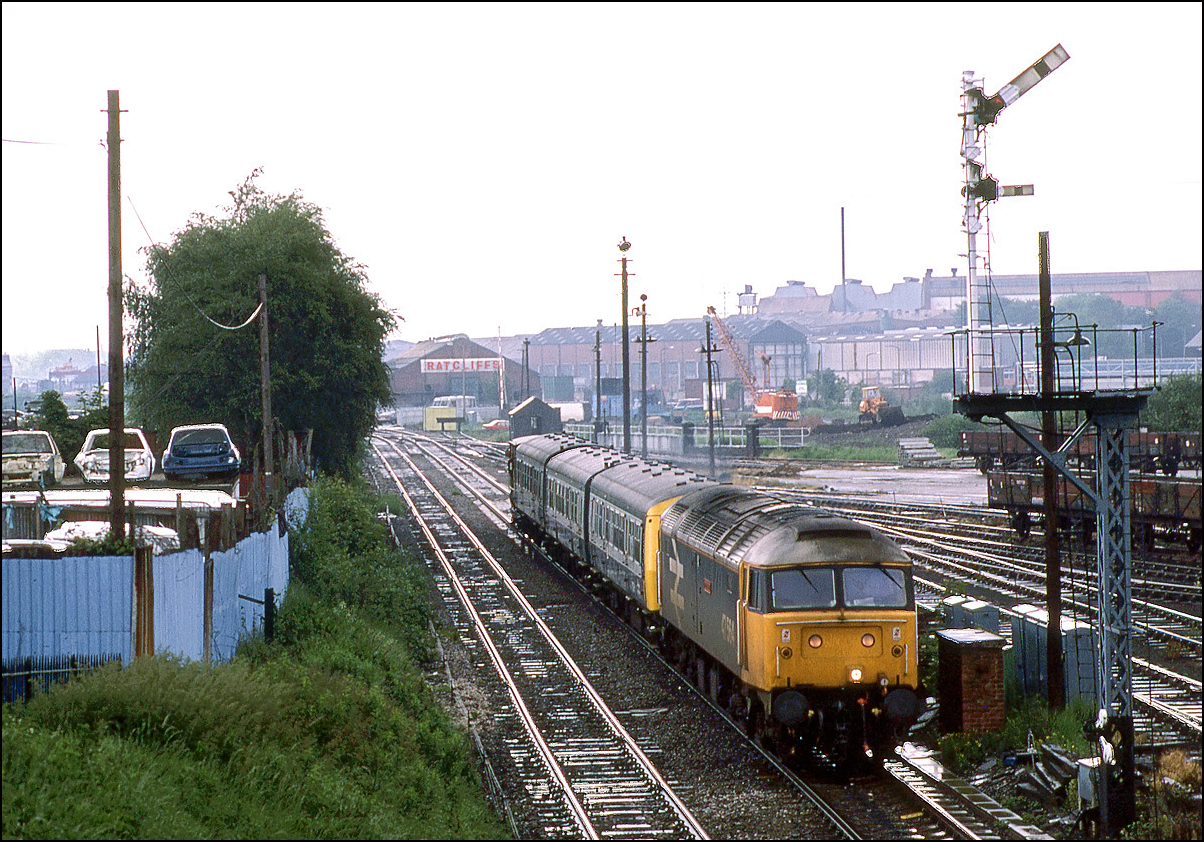 |
This picture was taken at Great Bridge on 17 June 1987 in weather more suitable for November. There was nothing pleasant in any respect about the area around Great Bridge even though I do like the industrial scenery, but in these conditions it was really nasty. 47564 is seen here dragging a class 101 DMU to Gloucester past the semaphore signal controlled by Eagle Crossing box. There is some evidence of activity in the adjacent yard, but at this time it was quite rare to see any movement here. |
|
|
On a murky 13 April 1991 150104 was running along the down through road at Leamington Spa with a 5Zxx from Eastleigh to Tyseley. I assume that it had been sent away for a repaint into Regional Railway colours from its original green livery. The view here has changed in recent years following the construction of large blocks of flats in the left background where the Midland station used to be located. |
|
|
This image was taken on 10 May 1996 during my only visit to Tondu and shows 143617 working a train to Cardiff. The driver is about to exchange tokens at the large signalbox which no doubt had more white levers than coloured. The main for being in the area was to photograph 37412 at Pontycwmmer but the chance for a quick visit to Tondu for a picture of the lower quadrant signalling wasn't to be missed. |
|
|
A portrait view of Tyseley set 528 (53062 + 59715 + 53103) about to leave the Birmingham to Gloucester main line at Barnt Green with a Birmingham Cross City service to Redditch. This picture was taken from the site of the cattle dock in the long-gone goods yard on 20 December 1986. |
|
|
The far from unusual sight of a mixed-up Tyseley set on the Birmingham Cross-City Line with class 122 55012 leading a pair of class 116 vehicles at Five Ways on 6 December 1986. There was rather more shadow than I had envisaged but this really should have been anticipated at this time of year! |
|
|
Chocolate and cream class 117 T305 (W51410 + W59520 + W51368) standing in Leamington Spa station on 13 April 1991 after arriving from Birmingham Snow Hill. At this time trains had to run to a crossover south of the station before accessing the down platform before returning to Birmingham. After the shunt had been completed I took a close-up picture of the trailing cab showing the Bear and Ragged Staff symbol used as Warwickshire's motto. |
|
|
Tyseley's DMUs worked well into the East Midlands and on 14 April 1991 class 108 twin-set T072 was near Lenton Junction, Nottingham while working from Birmingham New Street on 14 April 1991. In pre-digital days I used to take both black and white and colour shots with cameras mounted on an aluminium frame and here is the colour version of this image. |
|
|
Looking towards Nottingham I photographed numerically sequential (to the photo above) class 108 T071 (53930 + 52056) near Lenton Junction at Nottingham on 13 April 1991. A Welsh Dragon symbol is still visible on the cab front and the remnant of a white cab roof hasn't been lost. |
|
|
Class 116/115 hybrid set T323 (53093 + 59670 + 53818) about to call at a gloomy-looking Wilmcote with a Stratford-upon-Avon to Birmingham service on 13 April 1991. A solitary passenger was waiting for the next train to Stratford. |
|
|
A convenient gap for two-car class 114 T026 (54010 + 53006) rolling down Hatton Bank on 17 April 1990 while working an eatly afternoon train from Stratford-upon-Avon to Leamington Spa. This location is just to the north of where Warwick Parkway was later built. |
|
|
Another Network South-East unit, this time class 101 L224 (51445 + 54362), photographed at Melton Mowbray while working a Norwich to Birmingham train on 16 June 1990, not long after being transferred to, I think, Cambridge depot. |
|
|
Class 119 unit L575 (51060 + 59419 + 51088) was pulling away from Radley in Oxfordshire after dropping off some commuters with an afternoon stopping service from London Paddington to Oxford on 4 July 1989. Within 12 months the unit had been replainted into NSE colours as seen here at Wokingham 25 May 1990. The alignment of the long-gone Abingdon branch along with its platform edging can be seen in what was the not very busy car park. |
|
|
Another 3 car class 119, L405 (51340 + 59491 + 51381) leaving Radley on 4 July 1989 while working a Didcot to Oxford local train. The two cyclists would struggle to find a space for their machines in 2024 as modern commuter units don't allow for such things quite as well as did their 1st generation counterparts. |
|
|
The embankment of the M42 nearby Water Orton is the location of this picture of class 101 T216 (51206 + 54054) leading a 3 car class 118 away from Birmingham towards Derby. The working, on 21 May 1988, appeared to be an ECS move probably from Tyseley to Etches park. |
|
|
This picture was taken on 27 April 1990 and is a graphic demonstration of how things just outside Stratford-upon-Avon station have changed over the years. The goods loop, signalbox, gasholders, canning factory and chimneys have all gone and it's next to impossible to reach this spot for a "now" comparison shot in 2024. The train is class 114 set T026 (54010 + 53006) leaving the town with the 08.12 service to Leamington Spa, the return of this, the 07.30 from Leamington. |
|
|
I have very few photographs taken at Crewe and this is certainly my only after-dark shot from there. It shows class 108 set S947 (51567 + 53621) leading another unrecorded set in platform 7 waiting to leave with an evening train to Shrewsbury on 20 October 1990. My notes say that it was a 15 second exposure on medium format 400asa TRI-X film at an aperture of f5.6 with the camera resting on my camera box. I had been out and about on the Network North-West day and hadn't want to lumber myself with the additional weight of my heavy tripod. |
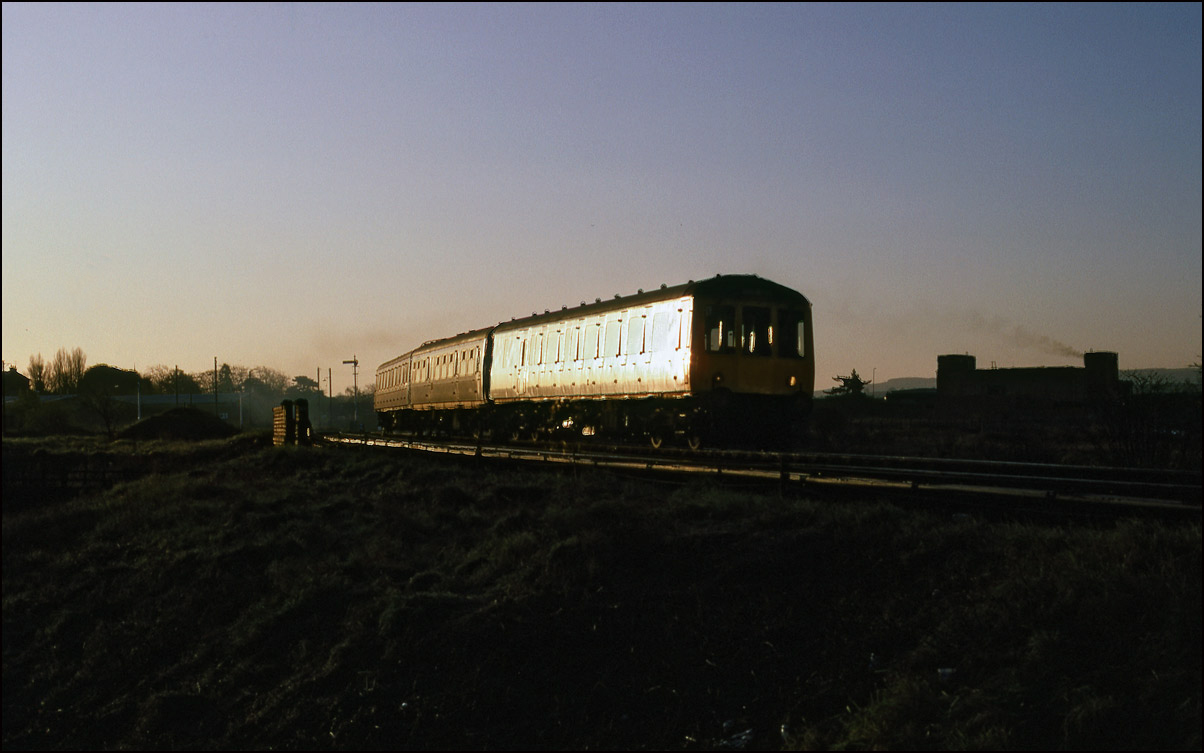 |
For a few days at the end of November it used to be possible in the right conditions to obtain this shot of the class 116 unit forming the 08.20 Stratford-upon-Avon to Birmingham train as it was shunted from the arrival platform, P1, to P2 for departure. I recall 20 November 1986 as being particularly cold and didn't hang around for many minutes. |
|
|
To mark the 125th anniversary of Marylebone station a recreation of The Master Cutler ran from Sheffield to the former Great Central Railway's terminus. Rail Adventure and the 125 Group worked together with power cars 43268 + 43280 powering the former MML coaches. Running as 1Z43 the train was running about 15 minutes late by Hatton which made it perilously close to clashing with a Chiltern Trains unit running on the down line. This was just approaching Hatton station as the back of 1Z43 went out of sight. There is often a lot of noise from the nearby M40 motorway and it wasn't possible to hear the HST coming but I did take a short video clip for the record. |
|
|
Friday 15 March 2024 was Gold Cup day at the Cheltenham Festival of horse racing and while there are nowhere near the number of special trains that there were some years ago, there were a couple which were photographable around Evesham. The first was a 5Z14 Cheltenham to Reading ECS which ran via and reversed at Worcester Shrub. The 9 car unit was 802106, looking no different to any of the service trains on the line, which I photographed just south of Evesham station. |
|
|
Three more class 777 tri-mode units were moved for storage from Walton Old Junction at Warrington to Long Marston on Thursday 16 February 2024. I was unable to get out for this but there was an arguably more interesting train the following day when 43468 + 43480 took the barrier/brake force wagons from the Warwickshire site to Wembley along with green liveried 20007 which had been there as a standby in case the GWR battery unit 230001 had any issues on its test runs. The lighting at Honeybourne at around 09.30 on a sunny morning is a bit challenging and it was a few moments before I noticed 20007 behind 43468 + 43480 along with the wagons so I put on my longest lens and took a few bracketed exposure shots as 6Z79 came to a stop at the hut in which the branch token is kept. A GWR man was already there to take the token back to Long Marston ready to release 230001 from the exchange sidings for its run later in the morning. |
|
|
It's not every day you can get to see a triple-header with 2 HST power cars and a class 20 but on 16 February 2024 that's exactly what what was on the front of 6Z79 from Long Marston to Wembley. The power cars were taking a load of barrier/brake force wagons away after delivering 3 class 777 units for storage. The severe backlighting and unchecked undergrowth didn't help matters but there was no way that I was going to ignore such an unusual working. As soon as the bushes and shrubs come into leaf within a few weeks this shot will disappear unless Network Rail decide to do some clearance work but the chances of that happening are around zero. Or less. |
|
|
There was an up GWR service to London Paddington due within a minute or so at Honeybourne on 16 February 2024 as 6Z79 with 43468 + 43480 + 20007 stopped at the signal protecting Honeybourne North Junction so it wouldn't be held for long; in fact, just until the IET was in the platform. It was fortunate the first two wagons were flats which a half-decent view of green 20007 making for a sight that I can't imagine has happened before. The class 20, which came from the SVR at Kidderminster as a standby in case GWR 230001 had any problems on its test runs, was detached from the consist there causing around one hour delay to the run forward to Wembley via Birmingham and Nuneaton. |
|
|
What was probably GWR battery powered 230001's final run in the Midlands took place on Friday 16 February 2024 when it ran as 5Q23 from Long Marston to Reading Traincare Depot. Several GWR men were waiting at Honeybourne to board the train and they told me that tests over previous days had been succesful with the range achieved being gradually increased from 40 to 86 miles, more than enough for the 70 mile run to Reading. The train managed to catch a spell of sunshine as it drew to a halt on the branch with just enough of a gap in the shadows for a reasonable picture. The "Viva Venturer" nameplate has been retained to mark the unit's origin within the former Vivarail business. |
|
|
The GWR's 230001 was once again out of test on 24 February 2024 with runs from Long Marston to Evesham and Moreton-in-Marsh. I went to the latter because of the lower-quadrant semaphores which are the only ones of the type under which any of these tests have run. The battery unit was working as 5Q11 and left Evesham 6 minutes early which meant that a clash with a down IET spoiling the photograph was possible. Fortunately the 09.52 Paddington to Hereford, 1W01, was on time as it arrived and left promptly leaving the view northwards clear. |
|
|
The down line starter signal was still lowered on 14 February 2024 as 230001, the 10.25 Long Marston to Moreton-in-Marsh, 5Q11, arrived almost silently in the station. The northbound IET that had just left was barely out of sight around the corner as the battery-powered unit came under the Fosseway roadbridge. Appropriately enough, the GWR style and colour totem sign on the side of the building to the right of the train is advertising the Fosseway Business Park. |
|
|
This is the view from the station footbridge, also a public footpath to the town from a nearby park and housing estate, looking south as 230001 stopped by the GWR signalbox waiting for the road to run forward and cross over to the down line. The signal on the right is a relatively recent addition used for any down trains terminating here before returning to London Paddington. |
|
|
The GWR battery unit 230001, now under the headcode 5Q12, standing at Moreton-in-Marsh of 14 February 2024 had to wait until the preceding service train had reached Evesham before it was allowed to leave. I waited at the end of the platform to take this not very good quality video clip on my 'phone as it pulled away. |
|
|
I walked from Moreton-in-Marsh station to the nearby roadbridge in the hope that 230001 would run as scheduled and make another trip up to Moreton. It did not report after leaving Honeybourne North Junction so I was pleased when it appeared and came to a stop at the starting signal just before 800022 arrived giving the chance for a shot of the strange bedfellows side-by-side. |
|
|
It didn't take long for the signal to give the road for 5Q13 to pull forward over the points at Moreton-in-Marsh on 14 February 2024 prior to reversing into platform 1. The weather had deteriorated and some misty drizzle was falling as 230001 moved quietly forward. |
|
|
At the risk of overdoing things I take a final shot of 230001 moving across the switches as 5Q14 prior to entering platform 1 at Moreton-in-Marsh on 14 February 2024.The drizzle was quite steady by this time but predictably enough stopped as made the 5 minute walk to my car and gave to bright sunshine during the drive home. |
|
|
There were some more test runs from Long Marston planned for GWR's battery unit 230001 on Friday 9 February 2024. The weather was dire with dreadful light and heavy rain but I fancied a few shots at Evesham station which retains some original GWR character if the modern platform lights can be ignored. I had been told that 5Q11 should run but you can never be 100% sure although when 2 GWR personnel with company rucsacs arrived on platform 1 it seemed very likely that it wasn't a wasted journey for me. It came to stop some 12 minutes early and stood for long enough to take a picture of one of the battery sets situated under each of the driving vehicles. The unit was first rolled with purely battery power for a visit (by road) as a demonstration train to Scotland in October 2021 as shown here passing Evesham signalbox on the 13th of that month. |
|
|
A reversal at Evesham involves a run to Evesham West Junction which marks the end of the double-track section. This takes several minutes and gives plenty of time to walk off the station and onto the roadbridge at the southern end of the platforms. The rain was still falling on 9 February 2024 at 230001 still running as 5Q11 from Long Marston to Moreton-in-Marsh ran past the wildlife friendly garden on the right that is maintained by local volunteers. All of the former Vivarail class 230s have been tested along this route and here is TFW 230006 in much better weather on 21 May 2020. The first main line outing for 230001 was on the night of 28 November 2016 when running under diesel power it made the journey as 5Z26 to Leamington Spa from Tyseley and return. |
|
|
Something appeared on RTT a few days ago showing an 0Z20 operated by Rail Adventure from Kidderminster SVR to Long Marston on Monday 5 February 2024 with a unit from there going on a couple of trips between Evesham and Moreton-in-Marsh. I had no idea what might be involved so went to have a look only to find that the road from the village to the roadbridge was closed. It was possible to drive to within 50 yards of the bridge where a team of civil engineers were working to establish why part of the road was in danger of collapsing down the embankment into the rail site. They were quite happy to let me stand amongst them on the bridge and within a few minutes I was surprised to see 230001 in full GWR livery come around from the shed area. This shot was my first sight of 5Q11 and here is a picture of the middle coach with some detail of the power source. |
|
|
It took a few minutes on 5 February 2024 for 230001 to move around from the previous picture and reverse into the exchange siding ready to move out onto the branch to Honeybourne. A stack of other stock was visible including classes 701 and 777 together with some of the TPE Mk5 coaches and DVTs that have recently arrived from Longsight. The crew member was unclipping the points before they were shifted to allow egress from the site once the gates had been opened. |
|
|
A bit of weak sun managed to appear as 230001 left Long Marston on 5 February 2024 with 5Q11 to Evesham and Moreton-in-Marsh. It was then time to leave as the civil engineers were preparing to drill a 12 metre hole in the roadside and said that it would soon become very noisy and probably a bit messy, so off to Honeybourne for me. |
|
|
There were very few cars in Honeybourne station car park on 5 February 2024 because of a rail strike so I was able to park right by the entrance to platforms which was handy as 230001 was just running down from the staff hut after dropping off the branch token. With no other traffic on the line 5Q11 was able to leave without delay and was therefore running about 25 minutes early at this point. |
|
|
The best bet on 4 February 2024 for a shot 230001 returning from Evesham to Honeybourne and on to Moreton-in-Marsh was from the footbridge at Honeybourne as there is no doubt about its location. The reversal at Evesham and run back here didn't take long and here is the battery unit passing through at quite a decent speed. |
|
|
GWR's dark green livery looks almost black in poor light as it does here as 230001 returned from Moreton-in-Marsh on 5 February 2024. A bit of lining out in gold would give it a lift but I don't suppose anything will change at this stage. |
|
|
After yet another reversal on 5 February 2024, this time at Honeybourne North Junction, 230001 rejoined the Long Marston branch and sat for a short while before the points were shifted and the shunnt signal lit to show that it was routed into Honeybourne Sidings. I had to leave at this point but saw afterwards from RTT that the second planned run to Moreton-in-Marsh didn't take place with the unit returning to Long Marston. |
|
|
This should have been a picture, albeit taken about one hour earlier, of Rail Adventure's 4 HST power cars topping and tailing 2 class 777 units going to Long Marston for reasons unknown to me. Something went wrong as is usually the case when more than one train is scheduled to go to the Warwickshire site on the same day but 6Z45 festered in Worcester Yard, eventually leaving about 120 late by which time I was at home. The GWR units looked faintly ridiculous with the nose cone open and it must make quite a difference to the drag coefficient at more than a moderate speed. |
|
|
More apparently less than top quality new stock went to Long Marston on Tuesday in the form of Stadler battery unit 777029 from Walton Old Hall Jn. at Warrington. The unit was moved by Rail Adventure using their HST Power Cars in top and tail mode with universal barrier wagons. I chose to photograph it from a boarded foot crossing complete with gates and stairs between Bretforton and Blackminster on the North Cotswold Line. It seemed likely that the train would leave Norton Junction early because a GWR service from London Paddington, 1W02, was running late giving 6Q45 time to get along the single track from Norton to Evesham. The barriers protecting the road crossing were lowered about 22 minutes early and 43465 + 43484 led the ensemble with 43468 + 43480 bringing up the rear. The through air pipe allowing the unit's brakes to be isolated can just be made out between it and the first barrier wagon. There was time to turn around and take this shot of 777029 as it went away to Honeybourne North Junction. |
|
|
Long Marston can be on my home from the Blackminster direction so I dropped in on 20 January 2024 and arrived just as 6Q45 was entering the site. The Rail Adventure Power Cars that had led the train from Warrington were detached and moved into Road No. 2 alongside the other pair. The light had completely collapsed by this time but the sun suddenly found a tiny gap in the clouds and it was almost as if a spotlight had been shone on part of the scene including the many brand-new but still unserviceable class 701 EMUs. The glaring sun really increased the contrast between the sunlit area and the dark sky and I didn't do anything to enhance the sky or background during post-processing of the RAW image. This wasn't Rail Adventure's first visit to Long Marston as 43468 + 43465 + barrier wagon arrived in the evening of 20 June 2022 for display at that year's Rail Live event. |
|
|
The light soon returned to its former dull state as 43468 + 43480 and a barrier coach pulled out of the exchange sidings at Long Marston on 30 January 2024 leaving 777029 in road No.1 of the exchange sidings. I left after this image was taken but these power cars and barrier would have reversed onto their twins in the other road ready to leave for Warrington the following day. |
|
|
Tyseley's two-car class 114 T023 (53036 + 54006) was leaving Stratford-upon-Avon with the 14.26 for Birmingham Moor Street when I shot it on 26 September 1990. The performance of these units was a bit sluggish and the 1/75 climb to Wilmcote would have made its two Leyland Albion engines cough a bit! |
|
|
On your marks... Two different DMU sets with 3 classes of vehicle at Stratford-upon-Avon on 26 September 1990. Class 101/116 hybrid set T038 (51808 + 53838) is in platform 1 forming the 15.26 departure to Birmingham Moor Street while class 114 T025 (53005 + 54039) was on a Leamington Spa service, from memory the 16.12 from Stratford. This picture was taken after the signalling arrangements had been changed to allow arrivals and departures from any of the 3 platforms. This removed the need for shunting every arrival from platform 1 to either 2 or 3 with a new upper quadrant starting signal, as seen in the centre of this image, being provided for trains leaving platform 2, the taller signal on the right being redesignated as the starter for platform 1. |
|
|
An unidentified four car class 115 in blue and grey with NSE flash on the cab front was nearing the end of its London Marylebone to Banbury journey when photographed at Kings Sutton on 14 June 1988. The tower and spire of St.Peter and St.Paul's church in the village is one of the most recognisable features of this scene and has featured in thousands of railway photographs over the years. |
|
|
Hybrid unit T039 formed of class 101 53746 and class 116 53079 was about to call at Small Heath station in September 1991 when it was photographed while working a Birmingham Moor Street to Dorridge service. The set carrying the same number in the following July was formed of different vehicles when I photographed it at Stenson Junction formed of Class 108 set 52044 + 51928. |
|
|
This picture was taken from the window of Stratford-upon-Avon East signalbox on 29 July 1988 and shows class 101 set T217 (51798 + 54358) leaving Stratford station with the 08.12 to Leamington Spa on 29 July 1988. I can't explain the number "85" in the cab window as this was carried by a class 101 allocated to Norwich Crown Point depot at the time. Unit vehicle 51798 was shown at Tyseley only for a brief period in 1988 so it was probably a short-term loan to cover a temporary shortage of units in the West Midlands. |
|
|
Class 114 T024 (53044 + 54043) was in the soon to be lifted Cold Store Siding alongside platform 3 at Stratford-upon-Avon on 24 November 1990. It was unusual to see a DMU here on a Sunday at that date as there was no Sunday service to the station then, so I assume that it had failed and was waiting either for a fitter to arrive the next day or to be dragged back to Tyseley. Class 47 47827 was just arriving to take out the VSOE dining train with 47807 which had come into the station earlier. |
|
|
Longbridge station was heavily shadowed on 3 November 1990 as hybrid set T408 formed of class 116, 127, 127 and 116 (51859 + 59643 + 59617 + 53902) left on the final part of its journey to Redditch on the Birmingham Cross City line. Having a 20 minute frequency throught the day the line was interesting for anyone wanting to photograph first generation DMUs with many different classes of vehicle appearing as Tyseley depot struggled to keep enough sets in service. |
|
|
The front end of blue and grey two car Mett-Camm class 101 set 201 (54070 + 51212) wasn't in the best of condition with several rusty patches showing when it was photographed just after leaving Kings Sutton station on 14 June 1988 while working an afternoon Oxford to Banbury local service. Within a few months it was repainted into full NSE livery and received an "L" prefix to the set number in line with other units operated by NSE. |
|
|
The route-learning vehicle ADB975659 which was converted from class 121 55035 was passing through platform 9 at Reading station when I photographed it on 29 October 1991. The overall blue paintwork was fading badly and the unit didn't have long to go being withdrawn the following April. The former headcode panel has "Old Oak on Tour" chalked onto it. |
|
|
There was just time to wind on my film and take a shot of the other end of L135 at Reading on 29 October 1991 as it ran non-stop through Reading station on 29 October 1991. Although the paintwork of the route-learning vehicle was badly faded it looked as if Old Oak Common staff had made some effort to keep the former 55035 reasonably clean. |
|
|
A class 101 /116 hybrid, T032 (53073 + 53242) was photographed during its call at Wellington, Shropshire on 7 July 1991. The train was a Chester to Wolverhampton working which was still quite often a "proper" DMU at the time although class 150 Sprinters had begun to appear now and again. It's annoying that I cut off the top of the tower of Saint Patrick's Catholic Church but I was using an 85mm lens in order to make the short train appear a bit less lost and didn't notice at the time. |
|
|
Dating from some time in 1987 is this shot of class 108 BX 489 ( 53932 + 59207 + 51569) forming the rear half of a six car excursion train at Leamington Spa. I have no idea why I didn't photograph the whole thing and can only assume that the white roof of the trailing set was of more interest at the time. It as unusual for an excursion from the North-West to be in the platform road here and I imagine that some non-stop class 1 special was about to overtake it although it wasn't photographed. At the time I had just bought my first Mamiya 645 medium format camera and the shop had only a waist-level finder in stock and I struggled a bit with anything moving at more than walking pace because of the upside-down and reversed image on the glass screen. The same class 108 was used on a different charter in June 1987 when I photographed it at Barnt Green while on its way to Evesham with a special for a Lancashire Ramblers group. |
|
|
Looking a bit lost in Worcestershire countryside, class 121 single unit 55034 is seen here between Stoke Works Junction and Bromsgrove on 30 May 1989 while working a Worcester Shrub Hill to Birmingham New Street service. These were the only trains serving Bromsgrove at the time, a far cry from 2023 when there is a 4 train per hour pattern with electric units catering for the increase in passenger numbers fueled by extensive housing development. |
|
|
A bubble in a very different environment with L130, class 121 single car 55030, approaching Acton with a London Paddington to Greenford train in the late afternoon of 19 September 1989. The building work would soon obscure the view of the bridge over the North London Line and much of the capital's infrastructure. I was lucky to get this shot as an empty stone train behind 59003 had just the cleared the freight line from Acton Wells Junction as photographed earlier in the day. |
|
|
Another view of the building site at Acton on 19 September 1989 as class 117 L424 (51404 + 59514 + 51362) passes with a Paddington to Reading local service. This wasn't the nicest place to stand with 4 very busy lanes of traffic behind the camera and probably isn't somewhere I'd go in 2023 given the OHLE catenary and less than riveting traction using the lines. |
|
|
One of Tyseley depot's odder combinations photographed at Northfield in Birmingham on 15 July 1989. Four-car sets were often used on the Cross City services between Four Oaks and Redditch and it seems that the depot was really struggling to find enough sets to go around as this formation was made up of class 121 single unit 55033 (in Midline livery), a 2 car class 108 and and class 121 single car 55034. In retrospect I should have stayed on for the return but moved to the other side of Birmingham to photograph some freight on the Leamington Spa line. Part of this Fuji film suffered in the processing and several frames including this one had a horrible green colour cast which I haven't been able to correct as well as I should have liked. This was the day on which a concerned local resident called the police because they thought that I was about to commit suicide by jumping off the bridge! The main reason for being here was this, 31405 unusually working solo on the Leeds to Tenby summer Saturday train. |
|
|
A misty day in early 1991 doesn't do a lot for Tyseley's class 116/101 hybrid set T042 (53863 + 51509) as it comes from the Great Western main line into the local platform with a service from either Dorridge or Leamington Spa. The station here bears some resemblance to one a bit further up the line at Small Heath with a massive building over the up and down main lines, very much a feature of the larger GWR edifices. Both these Birmingham stations now serve only local traffic with no main line trains serving them. |
|
|
An unusual visitor to Tyseley in about February 1991 as class 117 L412 (51389 + 59499 + 51347) called at the station with a train either from Shirley or Stratford-upon-Avon. The unit was allocated to Reading depot at the time and as far as I can establish was never one of Tyseley's sets. The Midlands depot was well-known at the time for getting hold of "foreign" units to fill in gaps in their own increasingly unreliable trains. |
|
|
Plenty of water at Kings Sutton on 28 September 1992 as class 117 L405 (51340 + 59491 + 51381) working an Oxford to Banbury local service met 60079 on its way to Didcot Power Station. The River Cherwell flows through a floodplain around here and this scene is repeated most years. The floodplain is wide and as the railway line is on an embankment it is rarely closed due to high water levels. |
|
|
It wasn't too difficult to take this sort of picture at Longbridge in 1986. There was a 15 minute local service on the Cross City line with some trains terminating here with others continuing to Redditch. I can't quite make out the unit number on the hybrid set about to leave on the up line but think it may be T526 with class 116 power cars sandwiching a class 127 trailer. If I am correct then the car numbers are 53070 + 59626 + 53095 which were listed as being at Tyseley during 1987 although as a four-car set with another class 127 vehicle. It wasn't uncommon for Tyseley to muck about with their sets as faults developed and all sorts of odd combinations were seen. |
|
|
A stranger in the camp at Bilbrook on the Shrewsbury to Wolverhampton line during the morning of 31 August 1991. The 2 car class 108 still was allocated to Longsight at this time and I imagine that it had been borrowed by Chester depot to fill in for the lack of a set from Tyseley, the usual source for trains between Wolverhampton and Chester. Much of This line was controlled with mechanical signalling at this time and Bilbrook signalbox is just visible behind the bushes on the right hand side of the line. The destination panel in the unit's cab reads "Chester" although the train isn't far from its Wolverhampton destination. |
|
|
This train, class 101/116 hybrid set T038 formed of 51808 + 53838, was photographed on 4 July 1991 as it left the down bay platform at Leamington Spa with a local service to Stratford-upon-Avon. The set number appears to be T036 but part of the final numeral has faded making it appear to be a 6. The offset high-intensity light and scuffed paintwork shown the unit to be T038 and my thanks to Stuart Mackay for giving me this detailed information. It was common at this time for a locomotive to be stabled here for weekend engineering work. |
|
|
The Stratford-upon-Avon to Leamington Spa services saw many different classes of DMU but I didn't see many 108s. This set, T072 (53933 + 51566), was climbing Hatton Bank on 27 June 1992 as it went towards a red signal protecting the 15mph junction for the Stratford branch. |
|
|
The Crewe to Derby trains offered a good chance to photograph first-generation DMUs in 1992. This and the following pictures were taken at Stenson Junction on 10 July with T039 formed from class 108 DMBS 51928 and class 108 DMCL 52044 with the junction to Uttoxeter and Stoke-on-Trent in the right background. The lines on the left are part of MGR loop at Willington Power Station which was still in use at that time. |
|
|
There was quite a quick turnround at Derby for the Crewe trains so after taking the picture shown above I knew it wouldn't be long before T039 returned to Stenson and North Staffordshire Junctions. Here is the set (class 108 DMBS 51928 and class 108 DMCL 52044) passing the bridge at Stenson. The grid-like device on the cab front is a check plate fitted where a loose pipe would have hit and damaged the cab when the unit was at speed. Thanks to Stuart Mackay of Railcar.com for the information about this. |
|
|
A very different first-generation unit from the class 108 pictured above at Stenson Junction on 10 July 1992 in the form of test coach Iris. This was RDB975010 which had been converted from a single car Derby Lightweight unit for the Research Department. This travelled along the North Staffordshire line so was presumably on its way to Crewe. |
|
|
There was a Llanwern to Long Marston train on Monday 14 April 2014 and with largely clear skies I had a ride across to Lower Moor near Pershore. Just after I arrived on the bridge 180103 came into view from the Fladbury direction with 1W29, the 11.20 Paddington to Great Malvern service running 13 minutes late. I quite like these units with their smart styling which the then FGW colour scheme sets off well. This is a nice open location on one the remaining single track sections of the North Cotswold Line, although the greenhouses in the left background are a bit of a blot on the landscape. I found these units quite an attractive photographic proposition and always took a shot or two of one, especially in light such as this. |
|
|
Another image of 180103 on the North Cotswold Line, this time near Norton Barracks between Norton Junction and Worcester. The train was a Paddington to Worcester Foregate Street service which has just passed under the M5 and is approaching what is known locally as Dog Bridge because of a noisy but quite friendly terrier than lived in the house by the bridle path. |
|
|
The final public run of a CrossCountry HST took place on 26 September 2023 with a 1Z43 charter from Leeds to the preserved line at station at Swanage. I have taken very few shots of the last few weeks of the trains' services but felt almost obliged to have a shot of this working. It was clearly not going to be a sunny morning and I drove through torrential rain on the trip from Stratford-upon-Avon but this had eased quite a lot as I walked onto the roadbridge. The HST set was led by power car 43008 repainted into Intercity swallow livery which on a such a dark morning was probably a good thing. Some late running was the order of the day and 1Z43 was 7 minutes late as it crawled towards Hatton station with a Chiltern local from Stratford-upon-Avon to Leamington Spa having been given the road first. There were a couple of cars on the road so I didn't cross for a picture of 43007 on the back of the set. These sets used to work on this with diverted trains as seen in this shot from 1994 with a Bournemouth-bound service perfectly aligned with a class 166 leaving the branch. In 2006 and 2007 Virgin Trains hired a Midland Mainline set as seen here at Hatton station for a 1V36 service to Reading to cater for extra passengers going to the Festival there. |
|
|
After 56096 with 6V54 had passed Ashchurch on 13 September 2023 I decided to hang on for the Round Oak to Margam empty steel train. Running in front of the freight and also from the Worcester line was 165132 with 2T42, the 09.52 Worcester Foregate Street to Bristol Temple Meads, slowing to pick up 3 or 4 passengers at Ashchurch for Tewkesbury station. |
|
|
Another trip to Stoke Prior for me on the morning of 9 September 2023 to take a sunny shot of 43047 and 43046 taking the Midland Pullman from Paignton to Fort William on the first day of a three day trip. Just after I had parked, the 08.50 Birmingham New Street to Hereford appeared which I shot as it went away to wards Stoke Works Junction wih 196005 trailing 196007. |
|
|
I rarely see class 170 units so tend to take a shot or two when I happen to be somewhere on one of their routes if the light is favourable. This example is 170114 working the 07.45 Cardiff Central to Nottingham train formed of 170114 at Stoke Prior and about pass Bromsgrove before climbing the 1/37 of the Lickey Incline. |
|
|
About 30 minutes after taking the picture of 196005 shown above another pair of 2 car class 196 units, 196011 + 196006 came off the single line from Droitwich with 1M58, the 08.40 Hereford to Birmingham New Street West Midlands Trains service. This was a good choice of location on an increasingly hot morning as the roadside trees gave some very welcome shade both to the photographers, not that there were many of us there, and their cars. Thanks to Steve Widdowson for the id of the units I missed noting. |
|
|
The Midland Pullman owned and operated by LSL is always worth a photograph on a sunny morning. I knew that the closest location to home and with favourable light would be Stoke Prior to the south of Bromsgrove. This run was a 15 hour marathon from Paignton to Fort William a journey which despite the beatiful accomodation and food is something, as one who dislikes rail travel, I would never countenace undertaking. The train, 1Z43, was running on time and came into view just as a class 170 on its way to Cardiff came south under the roadbridge. This potential blocking scenario was a possibility but with things running well to time was not a problem. |
|
|
With the prospect of a sunny day on 5 September 2023 and some decent trains on the Birmingham to Gloucester line I took a trip to Stoke Prior to the south of Bromsgrove. First to come south and before the shadows had cleared was 1V24,the 09.50 Brimingham New Street to Hereford with 2 car class 196s 196008 + 196012 and for which the shot needed a long lens to clear the worst of the shadows. Despite having photographed many of these trains on test and training runs including this one of 196012 at Stratford-on-Avon Parkway these was the first I had seen on a revenue earning service. The view towards Stoke Works Junction is much clearer with regular clearance of lineside growth being carried out. |
|
|
Just a few minutes after the class 196s had gone north on 5 September 2023 CrossCountry 170113 ran north the the 08.45 Cardiff to Nottingham, 1M01. The colour scheme of these trains seems to suit them well being distinctive but not garish unlike many others around at the moment. |
|
|
The Porterbrook sponsored Hydroflex unit 799201 was taken out for a long main line run on Monday 5 September 2023 with a trip from Long Marston to Kings Norton OTP Depot and then to Gloucester before returning home. Working as 5Q90 this is the hydrogen cell powered unit just after joining the main line at Stoke Works Junction and then facing the 1/37 climb to the summit of the Lickey Incline at Blackwell. |
|
|
With the approaching withdrawal of the CrossCountry HST sets the company reliveried a couple of their power cars into older-style colours. This has caused a lot of interest amongst photographers but I am not especially keen on the sight of mismatched liveries on what was intended to be a co-ordinated appearance, hence my not having dashed about taking lots of pictures in recent days. As it happened 43008 + 43007 were rostered to work 1V50, the 06.06 Edinburgh to Plymouth on 5 September 2023 and so a shot presented itself as it ran slowly around the curve at Stoke prior on the approach to a red signal at Stoke Works Junction. As it was going so slowly there was plenty of time to cross the road for a picture of 43007 in a copy of the original blue and yellow colour scheme. I don't know why 1V50 was delayed but a mapping app showed delays to northbound trains too. |
|
|
This is the photograph that was my main reason for going to Stoke Prior on 5 September 2023 taken as 799201 now running at 5Q91 approached the approach controlled signal protecting Stoke Works Junction. For some reason the train sat at the signal for at least 20 minutes by which time I had gone home but not before taking the very unusual movement shown below. The Hydroflex made it to Gloucester albeit after the late running but it was failed and was rescued and returned to Long Marston bu 37884 which ROG had thoughtfully sent to Worcester Shrub as insurance. I had planned to go out again in the afternoon but have a lot of shots of 37884 dragging units around Worcestershire so stayed at home under the shade of a tree in our back garden! |
|
|
I was just packing up at Stoke Prior on 5 September 2023 when another photographer who was looking at his mappping apps said that something unusual was about to happen. A CrossCountry Voyager was entering Stoke Works loop so that it could pass 799201 standing at the signal on the main line. The shot of a train in the loop isn't great thanks to the lineside undergrowth but something as unusual as this just had to be photographed. The train was the 10.03 Manchester Piccadilly to Bristol Temple Meads operated with 220015. |
|
|
Following a couple of days when the weather forecasts changed almost hourly Wednesday 9 August 2023 finally looked to be clear and sunny for several hours in the morning. A run of The Statesman train from Reading to Scarborough cried out to be photographed and about the nearest location I think of when the sun would be right was Lea Marston, just north of Water Orton. I don't see many class 170 units and even fewer in the sun so took this shot of 170108 working 1M00, the 07.45 Gloucester to Derby service which passed the roadbridge excatly on time. |
|
|
The monthly North Cotswold Test train, 1Z22, was due at Lea Marston just after 09.00 on 9 August 2023 but quite often runs about 60 minute late so that a prolonged fester in Stoke Works Loop is cut out. On this occasion the Railcams maps showed it to close to right time when I arrived at Lea Marston and the colourful ensemble with 43271 leading 43251 made a decent contrast to the largely green background. It hardly seems credible that I haven't been here since 2014 for at one time my visits were quite regular given the number and variety of freight movements that used to run on the line. Since that visit someone had placed a signal just in front of the roadbridge which means that a slightly longer lens is needed for a clear shot looking north. |
|
|
While on Dark Lane bridge at Hatton on 15 September 1998 I was surprised to see a class 101 DMU coming down the bank from Hatton station. It turned out to be 101842 with cars 53314 + 53321 providing the power and traction for test coach Iris, 975010, the AEC engines in which rarely seemed to be in operation. |
|
|
Class 101 was still active on the main line in 2005 in the form of 901001 (977391 + 999602 + 977392) being used as a test unit for Network Rail. This picture comes from 17 September 2005 as the train operated a 4Z08 from Derby through Hatton. |
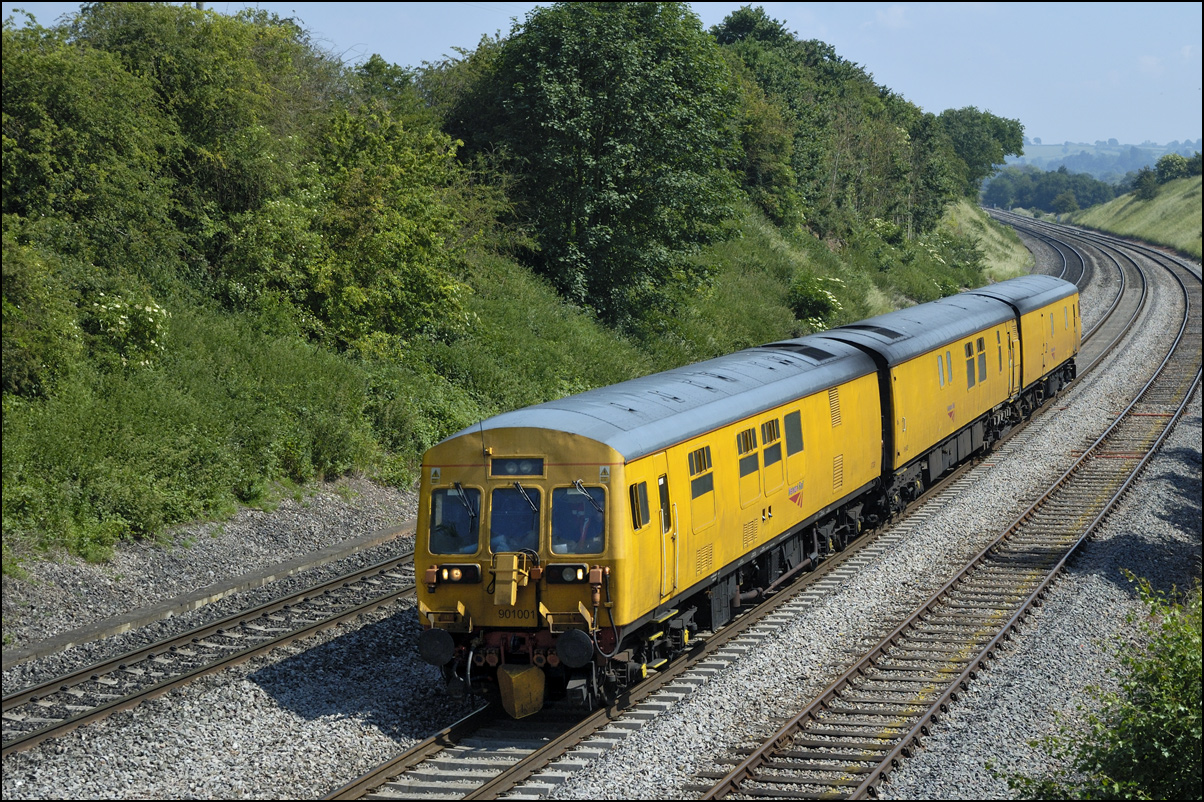 |
Network Rail's class 101 DMMU 901001 (977391 + 999602 + 977392) was booked to run to the south-west from Derby on 17 June 2006. It ran nearly one hour early and is seen here at Stoke Prior having just descended the Lickey Incline. It was good that it was possible to still see a "proper" DMU, albeit in a colour scheme previously alien to the class, so long after most had been scrapped. |
|
|
Another shot of 901001 (977391 + 999602 + 977392) this time taken at Stratford-upon-Avon. I don't know the date on which it was taken as the medium format slide was in a transparent sleeve with no other images from the same film. It is almost certainly from 2004 as 1) the unit had lime and livery at the time and carried the number on the cab front only for a short while and 2) I used only digital equipment from that date. I do remember that the train standing alongside the test unit, 166201, should have been in platform 3 and its presence in P2 really mucked up the chances of a decent shot. I almost gave up the post-scanning processing because of the intensity of the lights needed for the train's video cameras but after about 45 minutes work in Photoshop CS2 arrived at this image. |
|
|
A more conventional shot at Stratford-upon-Avon as class 116 T513 ran past Stratford East signalbox on 7 September 1987. The train was working the 14.10 to the terminus from Birmingham Moor Street. |
|
|
Later in the afternoon of 7 September 1987 2 of Tyseley's 2 car sets led by class 108 T211 coupled to class 101 vehicles was photographed climbing the 1/75 of Wilmcote Bank a short distance from Stratford-upon-Avon. The leading set was possibly unique at the time as it still had operational headcode blinds although I'm not sure what the code carried on this run represented. On the run to Stratford from Leamington Spa it had the set number displayed. These shots were a bonus as I was in this spot for a picture of 47628 with the VSOE on its way from Stratford to London Victoria. |
|
|
An unidentified two-car set with one of Tyseley's 2 class 121 DTS unit (54284) leading a hybrid unit up Wilmcote Bank on the afternoon of 7 September 1987 on their way to Birmingham Moor Street from Stratford-upon-Avon. The high-resolution scan shows the set number to be T25? but thanks to Stuart Mackay of Railcar.co.uk for identifying it as T252. The road in the background is the A46 under construction at this time and the new overbridge visible over the unit's front cab, now right by Stratford Parkway station, was nearing completion. |
|
|
I have just 2 pictures of class 154 second generation DMUs and this one of 154001 shows 154001 approaching Water Orton on 15 August 1987. The remaining parts of Hams Hall Power Station was due for demolition and this image was intended to show as much of the station as possible but in retrospect I wish I'd taken a more conventional view of the unit which is what was done with the other class member, 154001, from the same area later in the year. |
|
|
Class 150 was the design settled upon for mass the introduction of second generation units with 2 varieties being produced. This picture shows brand new 150242 with corridor connections passing Longbridge on 25 April 1987 on a either a test, training or delivery run. |
|
|
The Regional Railways livery suited class 150/2 units quite well in my view. This picture was taken on the late afernoon of 10 July 1997 with 150238 passing Croome Perry near Pershore with a train heading for Worcester Shrub Hill. 645 |
|
|
The Regional Railways colour scheme didn't look quite so good in bad weather conditions as in sunshine but any 1st generation unit was a rarity on the Derby To Birmingham line in 1993 so this shot of 117306 formed of 51411 + 59521 + 51369 at Lea Marston on 3 June 1993 was well worth a frame. This was an empty stock working which I assume was on its way from Derby to Tyseley. |
|
|
By September 1994 any diesel-mechanical unit from the first generation classes were quite unusual on the main line so I was to take a good sunny shot of Tyseley's 117332 passing Catholme, near Wychnor Junction, on the 17th of that month. The depot was really scratching about for serviceable units by this time and this appears to my inexpert eye to be made up up 2 class 117 and a class 116 vehicles. This was an ECS move which was probably on its way to Tyseley from Derby after some attention not possible at the Brimingham facility. |
|
|
Another day and another colourful DMU at Hatton. This time it was 153376 in Network Rail blue working a 2Z19 12.35 from Derby RTC to Reading West from where it went, oddly on a different schedule, to Barnham. Not having a picture of the unit in the blue colour scheme I went to the roadbridge at Hatton for a shot and arrived as 2Z19 was passing Dorridge. The sun was in and out but just arrived in time for a well-lit picture showing off the livery to good advantage. |
|
|
On Tuesday 18 July 2023 there was what for me at least was the first class 142 Pacer to travel over the GWR Leamington Spa to Birmingham line. Locomotive Services Limited's 142003, with Sellafield on the destination blind, worked under its own power from Eastleigh to Crewe in the newly acquired Greater Manchester PTE colour scheme, not something to be missed for anyone with a interest beyond elderly locomotives. In fact, there were a surprising number of folk at Hatton, the ideal place being a thoroughly recognisable location for such a rare move, to see 5Z42 pass even though the weather was very dull with some drizzle falling. There had been a few false stories, presumably from armchair experts, flying around that Pacers were not allowed over the electrified lines between Eastleigh and Basingstoke nor through parts of the West Midlands but there were plenty of photographers up and down the line to disprove these theories. I have very few pictures of class 142 and the only shots I have been able to find both were taken at Manchester, one of them being just the cab of 142001 on Victoria station and the other 142047 passing through the remains of the Exchange station. |
|
|
Stratford-upon-Avon didn't see many vehicles in Network South-East colours. So when I saw from my then kitchen window class 117 L406 (51341 + 59493 + 51383) going towards the station on 15 May 1987 it seemed like a good idea to walk down to the Stratford East signalbox and ask Mick the bobby if I might take a shot from his window as it left a few minutes later. He was always happy for some company so called me up and put the kettle on. I did also take a colour slide but it was so unsharp that no amount of work after scanning made it acceptable. The train was the 17.50 to Birmingham Snow Hill photographed as it passed over the Stratford-upon-Avon canal with a background that has changed beyond recognition with the WW2 cold store having been demolished and the entire site covered with a Morrisons supermarket. |
|
|
The regular shuttle service between Clapham Junction and Kensington Olympia saw quite a variety of power over the years. From classes 33 and 73 with 4TC stock to first generation DMUs and DEMUs there was usually something of interest to enthusiasts. On 30 March 1990 class 101 L200 (54081 ex-Tyseley & 51215 ex-Heaton) were working and I took this picture at Kensington as the driver chatted with some colleagues before the run back to Clapham Junction. |
|
|
Two Network South-East class 108 units operated a farewell to class 108 railtour from Bletchley to Stratford-upon-Avon on 24 March 1993. The train was led by L233 and was photographed on the outward journey passing Wilmcote station. The sun came out of thick cloud at just the wrong moment and although I did take a colour shot as well the light did mess things up quite badly. According to the site the return journey was quite eventful and probably not great for the passengers. |
|
|
Another DMU with NSE-liveried vehicles visited Stratford-upon-Avon on 18 June 1994 and is possibly one with some significance. First, it was the first and only class 119 unit I photographed here and second it is quite likely that this was the last ever first generation unit to come into the station although I have no proof of this. It was certainly the last I saw here as Sprinters had been solid on services for ages with the exception of some specially strengthened services on the May Bank Holiday during the previous month. I must have been given some prior information about this in time to drive from work at Tiddington as I was ready and waiting at the station for its arrival with the 11.22 from Birmingham Snow Hill. It's a real shame that I didn't take any colour shots but through looking at my notebook it seems that I may have run out of slide films at just the wrong time. Unusually for me I wrote down the vehicle numbers; 51107, 51079 and 53124, a class 116 DMS. The Railcar website has once again proved invaluable in providing much of the information for this unit and many other of the photographs of which have been added here today. |
|
|
I took another picture on 18 June 1994 of what may have been the last DMMU to visit Stratford-upon-Avon this time with class 116 DMS 53124 leading as the unit waited to return to Birmingham Snow Hill. The 2 class 119 vehicles had been transferred from Reading to Tyseley in the preceding February and I imagine that the class 116 vehicle had been added to provide extra capacity for the busy Snow Hill lines when covering for unavailable class 150 sprinters which operated virtually all workings in the area by this time. |
|
|
I am not able to date this photograph other than it was taken sometime in mid-1987 because the negative was in the folder for that year but without a corresponding entry in any notebook. The location is clearly Sutton Coldfield station and the class 116 set (53826 + 59329 + 53905) was leaving to cross through the heart of Birmingham on its way to Redditch in Worcestershire. The driver's side of the cab has received a bit of a clout, probably in the crowded Tyseley depot. |
|
|
Sutton Coldfield on the West Midlands Cross-City Line wasn't the place I expected to see one car from Reading allocated class 117 L410 on a misty day sometime in the summer of 1987. The other cars' identity were not noted at the time. It was operating as a 4 car set with 51345 leading. The set must have worked north at some point and pinched by Tyseley, always a bit short of fully functional trains, and put on this major suburban route. The impressive building in the background is the New Hall Hotel which to me is reminiscent of one of the grander Scottish establishments. |
|
|
Showing the flexibility of this era of DMUs is Tyseley set T354 (53890 + 59054 + 53910) with classes 116, 101 and 115 all coupled and working together. The train was photographed at Longbridge 25 April 1987 while it was working a Worcester to Birmingham New Street via Bromsgrove service. |
|
|
First generation DMUs were far from from common on the Birmingham to Derby line by 1993 so it was a surprise when T324 formed of 53055 (class 116) + 59603 (class 115) + 53101 (class 116) appeared at Lea Marston working a Nottingham service, if the headcode panel is to be believed, on 26 March. I can only assume that it was a replacement for an unavailable sprinter and was definitely not an ECS train as there were many passengers visible on board. |
|
|
Rail shuttles operated by ROG between Honeybourne and Long Marston were run for Rail Live 2023. Following on from last week's runs on the branch using 769935 I was expecting that to be in use so was surprised when the unit turned out to be the Porterbrook Hydroflex Mk2 799201 coverted from 319382. Here is the first passenger-carrying working on 21 June 2023, 2Z20, approaching Long Marston on the final stretch of the branch from Honeybourne. I took this telephoto shot mostly because the sun was in and out of heavy cloud and the track nearer to the roadbridge was in shadow. |
|
|
It's not very often that I use multiple shots of the same train but the sun cleared the clouds very nicely as 799201 came closer to the roadbridge at Long Marston on 21 June 2023 with 2Z20 from Honeybourne. The longest day of the year is a good choice for Rail Live 2023 as this time is just about the only chance to take a fully conventionally lit image here. |
|
|
All the time that I was at Long Marston on 21 June 2023 two helicopters were circling and intermittently hovering in the area. Judging by the livery and underslung cameras I took them to be police aircraft but on checking the full-size RAW image saw that they were Network Rail owned and were taking publicity film and photographs. I'm glad they have the resources to spend the very large sums on this judging on the dreadful state of parts of the network and hope that film of the awful traffic congestion was also taken. On my way home the road through Long Marston was at a standstill to the outskirts of Welford-on-Avon, some 3 miles. I hate to think what the Chipping Campden road was like... |
|
|
After leaving Long Marston on 21 June 2023 I went to Honeybourne to see if a shot of 799201 using the temporary platform was possible. It wasn't long before the hydrogen-powered unit arrived in some, um, challenging light onditions. I took a shot for the record and hoped that the back of the train would become the front as it picked up passengers from up and down GWR trains. It didn't because the power equipment was in that coach and this shot in the platform is all that was available with most of the unit being under the roadbridge. |
|
|
A short visit to Bentley Heath on Thursday 15 June 2023 for a colourful 6O01 from Scunthorpe to Eastleigh. Before the freight there were a couple of diesel units including a pair of 172/0s led by 172004 working 2V76, the 15.03 Dorridge to Worcester Foregate Street just after leaving the station. It's not the most scenic shot but at this time of day the sun is directly side on to trains so the illumination is good enough for most people. |
|
|
While at Honeybourne for a test train on 14 June 2023 work was progressing to build a temporary platform to cater for shuttles to and from Long Marston when Rail Live 2023 is open. At the same time a GWR class 769, 769935, was being tested on the branch and as my way home from Honeybourne can be via Long Marston I stopped off to find the unit just beyond the roadbridge. The light was as bad as could be but I took the record shot shown here. Rail Operations Group was operating 769935 and in case of a failure had sent 37884 to act as a standby and had parked it along the 15 or 16 class 701s sent here to be stored. |
|
|
In the 1980s I used to go to the Langley Green area quite frequently to photograph the Bescot trip freights that used Rood End Yard just on the Birmingham side of the station and have been meaning to go back to record the scene some 35 years later. The chance came on 22 May 2023 and this shot of 172006 working 2K42, the 10.47 Whitlocks End to Kidderminster, and it is quite depressing to compare it with this of T615 taken from broadly the same spot on the bridge. One of the regular trippers in the morning was 6T48 conveying chlorine tanks to the Albright & Wilson chemical works on the stub of the Oldbury branch seen here in May 1991 with 37242 running past the now-demolished signalbox. The whole scene has changed almost beyond recogition and other than a roadbridge over the branch no trace of the branch can be seen through many years tree growth. |
|
|
I was a frequent visitor to Stratford-upon-Avon East signalbox when the late Mick Lloyd was on duty. This shot of class 122s 55012 + 55009 was taken looking towards the station on 1 May 1987 as the single car units were on the 12.12 to Leamington Spa. |
|
|
Another picture from Stratford-upon-Avon East signalbox, this time from 18 June 1986 taken as a hybrid unit, the set number of which I can't quite read on the hi-res scan, leaves the station with the 08.00 to Birmingham. The shorter signal lever at the end of the frame operated a power-assisted distant arm on the other side of the Alcester Road bridge from the days when the line was open through to Cheltenham. It was rarely used in steam days as virtually all trains stopped for water but after 1963 some diesel-hauled freights would have been given a clear road. It was still possible to operate the lever even in 1986 when all 3 signals for the up line were pulled off. |
|
|
Although not readily apparent in a backlit black & white image this is the chocolate & cream class 117 unit T305. It was photographed shortly after leaving Hatton station in June 1988 with a local service from Birmingham Moor Street to Leamington Spa. The Stratford canal passes under the line immdediately underneath the line. |
|
|
This bridge just to the south of Bromsgrove station was a popular spot for photography until the overhead wires went up to allow the lines to Bromsgrove station and Redditch to be electrified. The train is Tyseley's class 117 unit (51372 + 59490 + 51414 ) approaching the station on 7 July 1988 with a Worcester to Birmingham New Street service. |
|
|
This is not strictly a diesel unit but I include OTP and other track vehicles in that category to save having to prepare a different section of this site. Taken at Derby on 6 June 1986 the picture shows DX50011, a Matisa Neptune Track Recording Trolley, passing an HST and a class 108 DMU. This is my only picture of one of these vehicles, full details of which can be found here on the E & TVR site. |
|
|
The first of a set of three pictures of the same unidentified class 111 at Settle Junction taken on 27 July 1988. I think that the only difference between class 101 and 111 is the smaller central cab window allowing for a destination panel, or in earlier days, a 4 character headcode. The train was a Leeds to Morecambe service just after leaving the Settle to Carlisle line and on the "Little North-Western". I have few pictures in this area and made only a few trips around this time with a work colleague with the main aim of photographing steam specials but I'm glad in retrospect that I took advantage of the opportunities to shoot some frames of service trains; to my eyes these are now more interesting. |
|
|
As the sun was out at Settle Junction I turned around from the view above and took a second shot of the unidentified class 111 on its way to Morecambe on 27 July 1988. The change in gradient on the Settle to Carlisle main line is very evident and marks the start of The Long Drag north to the summit of the line at Ais Gill. |
|
|
My second camera loaded with black & white film was ready with a 135mm lens on it at the time and this was ideal for the third shot of a class 111 going away from Settle Junction on 27 July 1988 with a service for Morecambe. |
|
|
I was on the S & C on 27 July 1988 to photograph steam locomotive 4498 Sir Nigel Gresley working a BR special, The Pennine Limited seen here at Arten Gill but again had the chance to have some shots of service trains. This one is at Long Marton showing a pair of unidentified units, possibly class 108 and class 101, on the viaduct. |
|
|
There was no difficulty in identifying class 101 set 04 (probably DMBS E51215 and DMCL E53162) with another similar set at Armathwaite later in the day on 24 August 1988. Note the neat platelayers hut on the right of the track which appeared to be still in use at the time. |
|
|
In 1987 there was a Sunday service to Stratford-upon-Avon only in the summer months following the May timetable change, On 22 May 1988 I saw from my then home that what was possibly the first class 150 sprinter to visit the terminus. A photograph seemed a good idea so I took my cameras down and took this view as 150146 with a centre car from 150253 stood in platform 3. By 2 July 1988 150146's usual 2 car formation was in evidence when I took this shot of it at Sutton Bridge Junctiion, Shrewsbury. |
|
|
I think that this is my only photograph of a class 154 experimental DMU, two of which were built in 1984 and used both for testing and for passenger services. This shot of 154002 was taken at Water Orton on a misty morning in 1987 just after the sun was beginning to break through as the unit was on a Nottingham to Birmingham New Street train. Neither of the class members were considered a success and this one, with Rolls Royce engines and mechanical transmission proved troublesome and it was later used as a testbed for the equipment fitted to class 158 DMUs. |
|
|
This image dated 18 April 1987 shows an unidentified hybrid DMU with a class 115 car leading about to the enter Droitwich Spa station with a Hereford to Birmingham New Street via Stourbridge Junction service. The board in the cab windows shows that this is an express with limited calls which missed out the intermediate stations such as Langley Green and Smethwick West. |
|
|
Class 122 55009 was leading class 121 55032 on the morning of 18 April 1987 when I photographed them at Hatton as they left the main line at the Station Junction while on the way to Stratford-upon-Avon. originally a West Country vehicle, 55032 was transferred to Cardiff Canton in October 1982 where it acquired the Red Dragon which it retained after going to Laira in September 1985 and then to Tyseley in May 1986. |
|
|
Not a DMU but I don't have a section for human-powered vehicles! The slide was taken on 24 April 1987 as the 3 man trolley headed south towards Hatton station and fortunately for the "crew" the gradient here was downhill as the descent of Hatton Bank was beginning. I don't imagine that an uphill trip would have been a good idea. Normal traffic was running but there was quite a gap in trains on a Saturday morning and the trolley would have activated track circuits so that the signaller would have been aware of its presence. I think that the journey probably ended at the engineers sidings just to the south of Hatton station where the trolley would simply have been lifted off the track. |
|
|
Class 122 single unit was working a Leamington Spa to Stratford-upon-Avon service when I photographed it on the misty lunchtime of 24 April 1987. The picture was taken from the new bridge being built over the line near Bishopton as a new stretch of the A46 road was under contruction. Behind the camera on the other side of the road is Stratford Parkway station and unusually the shot is still possible in 2023. I was waiting for a Sunday Luncheon Express which was diesel hauled from Banbury at this time but was surprised when it appeared with 47120 piloting 47600 and an ETHEL on the mixed set of stock. |
|
|
Single unit 55009 was still working on the Stratford-upon-Avon to Leamington Spa shuttles on 1 May 1987. This location on the canal towpath just outside Stratford Station was just the job for a bubble as the unit fitted nicely between all the poles and posts without anything appearing to grow out of its roof. I also took a colour slide at the same time but prefer the black & white version. This spot isn't a lot of use in 2023 as the undergrowth has flourished as can be seen in this brief YouTube clip I shot of a class 196 unit taken on my smartphone. |
|
|
An evening train from Leamington Spa to Birmingham Moor Street had just dropped off a few paseengers at Hatton when I photogrpahed it on 24 April 1987. The unit is almost the usual class 116 set TS512, presumably 53063 + 59717 (a 115 TS) + 53119. My thanks to Stuart Mackay of the invaluable Railcar site for correctly identifying the unit. |
|
|
A lineside fire in Hatton cutting had just about been extinguished on 15 April 1987 as 55034 went south on the up line with a Stratford-upon-Avon to Leamington Spa train. I don't know what caused the fire but assume that either it had spread from nearby farmland or been caused by 35028 Clan Line which had worked from Stratford to London Marylebone a couple of days previously. There was a BR man on lookout duties on the down side of the line and he was quite happy for me to join him for a couple of photos with access at the time being easy from an unfenced section of a field at the cutting top. |
|
|
A class 116 DMU, this time T608 with cars 51131 + 59613 + 51144, was climbing Hatton Bank on 15 Aprill 1987 with another Leamington to Birmingham Moor Street train. The fire damage to the cutting is again visible here and it seems that the bridge over Dark Lane was all that stopped it spreading further south. |
|
|
What appeared to be a weedkilling train was due to visit Stratford-upon-Avon during the night of 4 April so I made up my to go for a look as it seemed that it might not be an MPV as had been the case in recent years. I arrived at the well-lit station and took this view of 172342 about to leave with the 23.30 to Birmingham Snow Hill, 2W88. While taking the picture I saw that the unit was named and and here is the plate itself. |
|
|
Two diesel unit moves to Long Marston were shown for the morning of 3 April 2023, a pair of class 769s from Reading Train Care and a class 156 from Derby Etches Park. The 769s left the depoit close to right time and then disappeared from the maps when they apparently went back with a problem of some sort. The class 156, 156907, left Derby on time but with an arrival time of around an hour later than the 769s' path, I changed my plans and went to Honeybourne. In the meantime the now single 769943 running as 5Q10 had left Reading about 90 minutes late and it seemed that both trains would appear ar roughly the same time. As it happened the class 769 made it first to Honeybourne North Junction and went of out sight around the corner. The shot here is becoming very overgrown and it won't be long before it goes altogether. |
|
|
Trains coming from the Evesham direction rarely report in time to know exactly when they will arrive at Honeybourne and it was a surprise on 3 April 2023 when 156907 came onto the Long Marston Branch first. The sun was in and out but just managed to hang on for this shot as 5Q97 ran behind the platforms. There have been a few class 156s along the branch in recent years including 156497 on 26 November 2018 which had been to Long Marston for modifications but today's was the first I had seen at Honeybourne. |
|
|
As soon as the crew in 156907 had collected the single line token for the Long Marston branch on 3 April 2023 769943 was able to leave the down main line at Honeybourne North Junction and join the branch. It's a shame it wasn't a few minutes later because the sun would have been out but it was worth taking a record shot as it passed the bridge. There should have been a second move of class 769s during the afternoon but problems with Nuneham viaduct near Appleford on the main Oxford line were discovered and all trains were cancelled; a situation likely to prevail for some time. |
|
|
Some colourful units were around in 2002, none more so than 150280 in its Valley Lines colour scheme with both Welsh and English language branding. This picture was taken on 19 July 2002 as it climbed the Lickey Incline near Pikes Pool with what I suppose is a Hereford or Worcester to Birmingham New Street service. |
|
|
A general view over the south end of Tyseley Depot onn 16 June 1987 as a class 116 stood on the spur to the up main and North Warwickshire lines. Some other of the same class, the most numerous by far in the West Midlands, are visible along with 2 class 108s, one of which has the Buxton white cab ends, and a class 121 single unit. As usual in the daytime most of the depot is empty with the majority of DMU sets being working. |
|
|
This picture is also from 16 June 1987 with the final all-blue class 116, T702 (53920, 59372 + 53867) leaving the GWR main line to Leamington Spa and joining the North Warwickshire Line on its way either to Shirley or Stratford-upon-Avon. |
|
|
A bit further up the GWR Birmingham to Leamington Spa line is Acocks Green station which is visible in the background of this picture dated 15 June 1987. My note suggests that this was a driver training run using class 108 T204 formed of 51939 + 52063 and this is possible as 2 car units were uncommon on this line at the time. This was part of the former 4 track section and the wide area of ballast on the right of the picture shows where the now-gone lines were situated. This picture from the Railcar.com site was taken looking towards the bridge on which I standing shows the formation to good effect with a train on each of the up lines. |
|
|
I had a few photographic sessions at Shrewsbury in the 1986 and 1987 including a couple on the tower of the castle which gave a great view across the station. On 20 June 1987 I was there as a class 108 was waiting to leave for Wolverhampton with quite a variety of stock visible including classes 08, 37, 47, another 108 a 150 Sprinter plus some Mk2 coaches, not to mention the largest surviving lever-frame signalbox in the country. |
|
|
It was necessary for any train arriving at Shrewsbury from Wolverhampton to reverse for the return journey by leaving the station, crossing over before going back to one of the departure platforms. The class 108 shown above on 20 June 1987 was doing just that with the line to Chester disappearing into the distance. |
|
|
There was a diesel gala at the Severn Valley Railway in the autumn of 1989 and amongst all the locomotive-hauled trains was the chocolate and cream class 117 DMU T305 (51410 + 59520 + 51368). I suspect that fewer photographs were taken of this train than any of the others but I thought it well worth recording. It had just left Bewdley and was heading towards Bridgnorth although the destination board says "Kidderminster". I can't imagine that many of the roller blinds in use at the time had either Bewdley of Bridgnorth available for use! Note the symbol on the former headcode panel showing the Bear and Ragged Staff, this being the emblem of Warwickshire. |
|
|
A bit of paint makes all the difference when applied to a class 116 DMU; the ubiquitous type of unit in the West Midlands in 1987. On 11 July of that year T511 with 53832 + 59649 + 53913 was approaching Bearley Junction when I photographed it working a Leamington Spa to Stratford-upon-Avon train. |
|
|
There was another run planned for the hydrogen fuel cell powered 799201 on 15 February 2023 and with the skies being completely clear I thought that any couple of shotrs would be worth having. I hadn't been in my location long when RTT showed it as having left Long Marston on time at 09.45 so it shoudn'tabindex have been many minutes before it appeared in the distance. Nothing happened until what was clearly a clas 800's lights came it view and 800022 passed by with the 1W17 1002 Charlbury to Great Malvern service, the line beyond Charlbury being closed due to various landslips. By this time the systems feeding RTT had decided that the Hydroflex unit had reached Evesham, reversed and gone back to Long Marston; a ghost train or what?! |
|
|
I was just putting my camera in the car at Clayfield Lane crossing on 16 Febraury 2023 after the nojn-appearance on 799201 when the barriers dropped. There was just time set my camera to 1/5000 second shutter speed at f3.5 and take a series on images as 800023 passed by with 1P24, the 1016 Worcester Shrub Hill to Charlbury which should have started at Great Malvern but was unable to do so as the same unit forming incoming service had gone no further than Worcester. |
|
|
Thursday 9 February 2023 was another sunny day and the hydrogen fuel cell powered 799201, formerly 319382, was making another test run from Long Marston to Evesham West Junction and return. I was busy in the morning but made it to Long Marston just in time to photograph 5Q98 leaving the site, although I had missed 37601 + 37611 with barrier wagons which had come from Derby RTC to collect a class 196 unit and deliver it to Tyseley LMD. Quite a selection of vehicles is visible in the yard although the lines of disused oil tanks have been moved or scrapped. A lot of the site has been cleared of vegetation but unfortunately not the patch to the right of the line just outside the gates. |
|
|
The vegetation at Long Marston I mentioned above is all too evident in this image of 799201 joining the branch on its way to Honeybourne, running as 5Q98 to Evesham West Junction on 9 February 2023. I wouldn't usually have bothered taking this view of 799201 but I wanted to show the water vapour coming from the exhaust vents as the power unit was operating to charge the onboard batteries. |
|
|
After leaving Long Marston on 9 February 2023 I went via the roadbridge at Honeybourne on the way to a location near Bretforton and noticed 799201 standing among the shadows while it waited for the road onto the main line. I thought that there was no prospect of a shot of 5Q98 going to Evesham so took my time but as I getting out my car the klaxons for the level crossing began to sound. I grabbed my camera and took this image leaning over the roadside fence. |
|
|
The former GWR crossing keeper's house at Clayfield Lane near Bretforton looked a bit the worse for wear on 9 February 2023 as HEMU 799201 worked 5Q99 from Evesham West Junction to Long Marston. Following a request from the house owner the klaxons for the crossing are silenced once the barriers hjave been lowered. This is an exceptionally quiet no-through road (for motor traffic) mostly used by cyclists and dog walkers and with some very pleasant countryside it's a good place to spend the odd hour. I really should have waited for the ROG 37s taking 3 class 196 units to Tyseley but there was at least 3 hours to wait and by the time I was at home intertia took over so I stayed put. |
|
|
There was a test run for something from Long Marston to Evesham West Junction on Wednesday 8 February 2023 and I although I had a good idea what it might be there was no actual confirmation. The bridge at Briar Close near Evesham station was the obvious choice of location on a perfect winter's day especially with any early fog having gone. A day with this sort of light is the only time generally speaking that I will photograph a GWR class 800 and here is 800028 with 1P26, the 10.39 from Great Malvern to Paddington passing the signalbox and about to stop in the station. |
|
|
When I saw that a return run between Long Marston and Evesham West Junction on 8 February 2023 was scheduled it seemed possible that a former class 319 EMU now running with hydrogen fuel cells would be out on test. This was made even more likely when 37884 was sent light engine from Derby RTC to Worcester in case of a failure which would block the North Cotswold Line. This is what had happened on 21 September 2020 when 799001 made its first run on Network Rail metals although the 37 was stabled in Honeybourne Sidings on that occasion. Sure enough 5Q98 appeared passing Evesham spot on time and stopping at the signal until the preceding down GWR service had reached Norton Junction. This location seemed far and away the best bet on such a beautiful day and any fears about the early fog still being around were unfounded. This unit, one converted more recently than 799001 is numbered 799201, fitted with an upgraded fule cell set and carries a lighter shade of green on the bodysides than previously. I took a couple of 'phone video clips which can be found here. |
|
|
A DRS working to top the one I photographed at Hatton on 14 January 2023 took place on 20 January when a nuclear flask was taken to KIneton MOD. My first shot from the roadbridge was of 165010 as it left the Stratford-upon Avon branch with 2L32, the 10.34 from Stratford to Leamington Spa. The light was very poor but a large clear patch of sky was coming from the north-east so there was some hope of a result for the DRS train. |
|
|
The GRC & W class 122 single units were often to be found on the Stratford-upon-Avon to Leamington Spa shuttles. On 8 October 1984 55002 with unequal length exhaust pipes was on these duties and is seen here arriving at Leamington with the 10.12 from Stratford. The GWR signal box was replaced within a few years with a new solid-state facility on the other side of line and this was subsequently closed when control moved to the West Midlands Signalling Centre near Saltley in Birmingham. |
|
|
Trains from Stratford-upon-Avon waited in the up platform at Leamington for a path to let them run south out of the station before crossing over to return ready for their next trip. On 8 October 1984 the lights have been changed from white to red and as soon as the class 116 T608 has left for Birmingham Moor Street 55002 will be able to take its place in the down platform. |
|
|
This was the first class 104 I photographed in the West Midlands but that doesn't really excuse the poor job I made of composing the picture. I'm not a fan of pictures without at least some background and the only bit of identity is a small part of Leamington Spa's signalbox. The train is an Accrington to Portsmouth footex on 8 October 1984 formed of BX 488 with cars M53598, M59144 and M53542 running through the station on the up main line. I should love to see any photographs taken of this working somewhere in the Basingstoke area as it would have been quite a rarity on the LSWR. |
|
|
Saturday 26 November 2022 was another day on which many passenger trains were cancelled through strike action although quite a few "1Zs" and some freights ran. There were no passenger services at all to Stratford-upon-Avon but 3S02 the RHTT from Kings Norton did run so I had a walk to Stratford Parkway station. With nothing else on the line it was early and I nearly missed it because one of the feeds to RTT went down but as I was using my lightweight Canon G10 no setting up was needed. There was a little veiled sun when DR 98917 led the train through the platforms as it cleared the down line. |
|
|
The interior of the main line part of Manchester Victoria really suited black & white photography. In this picture dated 26 June 1984 a class 104 is waiting to leave for Blackburn as 40091 passes on the though road with an oil tr5ain from Stanlow to Leeds. The class 25, 25307, is waiting to give the class 40's train some banking assistance up the stiff climb to Miles Platting. |
|
|
The regular shuttle service between Clapham Junction and Kensington Olympia saw quite a variety of power over the years. From classes 33 and 73 with 4TC stock to first generation DMUs and DEMUs there was usually something of interest to enthusiasts. On 30 March 1990 class 101 L200 (54081 ex-Tyseley & 51215 ex-Heaton) were working and I took this picture at Kensington as the driver chatted with some colleagues before the run back to Clapham Junction. |
|
|
On 30 July 1991 I was at Kensington again and this time the shuttle from Clapham Junction was being worked by DEMU 207010 which, thanks to the cloudy day, I was able to photograph arriving at the station from the footbridge to show the signalbox, elegant terraced buildings and a bus boasting that its passengers would benefit from air-conditioning. |
|
|
Kensington Olympia station was on the InterCity network with trains running to and from Brighton calling there for the benefit of passengers for central London. The tube trains made journeys from here around the capital from the station quick and easy and the shuttles to Clapham Junction gave access to the both the Victoria and Waterloo lines. DEMU 20701 was about to leave Kensington for Clapham on 30 July 1991 the road having been set and the lower quadrant signal in the off position. The cable run for that signal must have been one of the shortest on the network... |
|
|
I often had a drive over to Cosford in 1991 because of 1) the MGR traffic to and from Ironbridge Power Station still sometimes with class 20s in charge and 2) for the first generation DMUs on the Chester services. On 14 September 1991 class 108 T072 (51566 + 53933) was photographed in a lucky patch of sunshine on a largely cloudy morning as it slowed for the stop at the nearby station while working a Chester to Wolverhampton service. The bracket signal was the obvious attraction of this location and without it the shot would have been much less photogenic. |
|
|
The sunshine didn't last long at Cosford on 14 September 1991 and by the time that class 108 T072 (51566 + 53933) returned from Wolverhampton towards Chester the cloud and murk had returned allowing a shot from the north side of line thus giving a better view of the signals and other infrastructure. The wind sleeve in the background marks the site as being part of RAF Cosford, a training establishment and museum of many things aeronautical including an unfortunately static TSR2 experimental strike and reconnaissance aircraft, a victim of Governmental dogma. |
|
|
Tyseley's class 108 set T072 didn't work only in the Birmingham and Chester areas. On 14 April 1991 51566 + 53933 were approaching Nottingham station when I photographd them a short way to the east of Lenton Junctions. |
|
|
Later on 14 April 1991 former Strathclyde class 101, now Tyseley set T078 with 53146 + 51249 were calling at Nottingham station while working an eastbound train. The destination blind is blank so I have no idea of the destination but either Lincoln or Skegness are possibilities. Most of the waiting passengers were clearly waiting for a later train as none seem to be moving towards the DMU. |
|
|
Tyseley's four car sets were mostly formed of class 115, 116 and 127 as was the case on 6 May 1991 when I photographed T412 (51867 + 59591 + 59446 + 53055) passing the now demolished Smethwick West signalbox with a Hereford to Birmingham New Street train. The class 47 waiting at the signal was 47813 working a railtour that had just visited Handsworth in the days before the line was re-opened through to Snow Hill. Just behind the camera the Handsworth line crossed the Birmingham New Street to Wolverhampton route. This is now the site of Galton Bridge Station interchange where passengers can change trains between the two lines thus making the old Smethwick West station redundant. It's worth noting that any train leaving the Handsworth branch including this railtour had to run wrong line as far as Rood End Yard between here and Langley Green. |
|
|
On 14 May 1988 it was quite easy to walk around the slightly derelict-looking Washwood Heath area and take pictures of anything that came along. One of the bagful of slides I shot during the morning was this of T036, a class 114 set formed of 53245 + 53054 as it worked ECS from Tyseley and about to pass Washwood Heath No5 signalbox. |
|
|
Barnt Green station is at the junction where the Redditch branch leaves the Birmingham to Gloucester main line. On 26 August 1991 Tyseley set T416 was formed of 51876 + 59609 + 59648 and 53891 from classes 116, 127 and 115 as it joined the branch with a Cross City service from Four Oaks. This formation was the usual for Tyseley's four-car sets at the time but class 150s were not far off mass introduction so scenes like this were well worth recording and in 2021 OHLE masts have changed everything with electric units working both the branch and Bromsgrove terminating trains. |
|
|
An ECS working with 47805 was planned to run south through Hatton on Tuesday 25 October 2022. Before leaving home I was told by a friend that 4O15's class 70 locomotive had failed at Solihull and was causing a bit of a blockage until until the train could be dragged bang road to Tyseley. This opened up the chance of more shots than expected and with the sky looking reasonably free of clouds I set off. A few seconds after I arrived on the roadbridge 168323 came south running as 1H32 some 25 minutes late and having started its journey at Dorrdidge rather than Birmimgham Snow Hill. The combination of sunshine and autumnal colours led to me take and process everything that came along which is not my usual practice when in a single location as in many cases it can be a bit dull to view. I have tried to vary the angles and focal lengths to relieve the monotony in the following pictures. |
|
|
The two-hourly shuttles between Stratford-upon-Avon and Leamington are mostly formed of a Chiltern class 165 as seen at Hatton on 25 October 2022 as 165014 left the branch and about to call at Hatton station. There has been a bit of lineside growth in recent years. |
|
|
The blockage caused by the failure of a class 70 at Solihull on 25 October 2022 was cleared by the time that 168004 left Birmingham Moor Street with 1H33, the 10.54 to London Marylebone. The Chiltern expresses were running as 8 cars rather than the usual 4 because of the expected demand caused by the half-term holiday. |
|
|
I am only too aware that a sequence of pictures from a single location can quickly become tedious and for this reason I rarely upload everything I take. On 25 October 2022 the light went my way for once, there is no other decent location within miles of Hatton roadbridge and the autumnal colours were so impressive that I broke my rule. Using a wide angle lens gave a slightly different perspective as 168324 passed by with 1H35, the 11.15 Birmingham Moor Street to London Marylebone. |
|
| I don't if this was the first class 156 DMU to visit Stratford-upon-Avon but it's the only example I have photographed here. The train, formed of 156451, was a 1Z13 from Hull and and must have left there very early in the morning but that is about I know about it. It's seen here standing alongside 150133 which was about to depart for Birmingham Snow Hill. The light was dreadful and I did attempt a a colour slide but it was really just a waste of film. As it was a first working for the line I did make wander to the station to ask at what time the train was due to leave. |
|
| Just after I arrived at Stratford-upon-Avon station on 28 August 1991 the clouds cleared quite a lot so I took this shot of 156451 standing in platform 2 after the class 150 shown above had left for Birmingham. |
|
| I returned to Stratford-upn-Avon station later in the day on 28 August 1991 and took this shot as 156451 left platform 1 at the start of its long journey to Hull by which time the light had returned to dreadful and definitely suitable only for black and white. The backdrop to the station is very different and much less attractive in 2022 with poorly designed and built apartment blocks dominating the entire area. |
|
|
A class 156 body away from the railway and on the back of a road vehicle. I took this shot at Bromford Bridge, between Birmingham and Water Orton on Saturday 16 May 1988. This was very much a grab shot and had I seen the truck coming I would have crossed the road and tried for a better-lit picture. |
|
|
A more conventional view of a class 156 as brand new 156417 passed Bromford Bridge with an unidentified eastbound working on 16 May 1988. Washwood Heath yard is just visible in the background as full of MGR wagons stabled for the weekend before recommencing their work on power station circuits on the following Monday. |
|
|
The chocolate and cream Class 117 DMU T305 (51410 + 59520 + 51368) was still working around the Birmingham area on 22 November 1991 and is seen here passing Bescot Stadium station with an ECS from the Wolverhampton direction presumably after working on the Shrewsbury line. |
|
|
Another ECS working at Bescot on 22 November 1991 as Class 108 T06 (51568 + 51943) heads towards the station at Bescot Junction. The elevated portion of the M6 is in the background with the line to Walsall and Sutton Park passing underneath it. |
|
|
Single units DMUs were not all that common on the Leamington Spa to Stratford-upon-Avon line by November 1991 so when I saw class 121 55032 (T012) arrive on 22 November I had a few shots. As the train left the station, platform 1 was being cleaned with a steam washer and two of the station staff, Aubrey Wheeler (left) and Roy Smith respectively were watching what was going on and taking a parcel to the Red Star office. |
|
|
As 55032 left Stratford for Leamington Spa I took the opportunity to take a powerfully backlit picture with some exhaust smoke as the unit passed under the GWR footbridge. I took a colour shot just before the train moved away but I think the black & white image works better. |
|
|
Class 117 DMU T311 formed of 51376 + 59500 + 51334 was photographed arriving at Stratford-upon-Avon with an afternoon service from Birmingham in July 1991. Most of the infrastructure in the background has gone and there isn't an equivalent shot worth the effort in 2022. |
|
|
As the sun stayed out at Stratford-upon-Avon after T311 (51376 + 59500 + 51334) had arrived from Birmingham in July 1991 I took another shot as it stood under the GWR footbridge. Class 150 Sprinters were regularly appearing here by this time and T311 wasn't showing as allocated to Tyseley later in the year |
|
|
I don't often take pictures of class 170 units but just occasionally the light is too good to ignore anything moving. This is 170639 with the 08.08 Nottinhgam to Cardiff, 1V05, passing the footbridge at Northway just to the north of Ashchurch station on 11 October 2022. |
|
|
This train was largely ignored by the other photographers present at Leamington Spa on 10 October 2022 but I can't resist a shot or two of MPVs, especially in the sun. The working is the Kings Norton to Kings Norton RHTT, 3S02, which covers half of the West Midlands via a reversal in platform 2 Leamington Spa from where it is seen leaving on the way back to base for a refill of the water tanks. |
|
|
This was my final shot from Leamington Spa on 11 October 2022 and shows 165018 in platform 2 with 2R32 to Birmingham Moor Street, an unidentified CrossCounty Voyager with 1E48 Banbury to Birmingham New Street and 172004 in the down side sidings. The background and platform lamps were radically different in 1991 when 58029 passed through with an empty MGR from Didcot Power Station. |
|
|
The afternoon of Wednesday 28 September 2022 was mostly sunny so I went to Bentley Heath Crossing near Dorridge for another try at the Freightliner RHTT. Just as I arrived at the footbridge the barriers were lowered ready for 172221 with a 3 car 172 set to go towards Dorrdieg station with 2D46, the 14.15 Kidderminster to Stratfor-upon-Avon via Hatton North Junction and Claverdon. |
|
|
On Sunday 9 September 1990 inter-regional trains ran via Lichfield City on the Cross City line in the West Midlands. The usual DMUs were also running and as these terminated here a shunt between up and down platforms was required. In the picture class 117 T314 (51348 + 59677 + 51390), transferred to Tyseley from the Western region in 1988, is and passing the signal box as it entered the station from Birmingham before going out towards Alrewas for its reversal. |
|
|
Another picture from 9 September 1990 with class 117 T314 formed of 51348 + 59677 + 51390 working on the Birmingham Cross City line but only between Lichfield City and New Street. The unit is leaving the station to cross over and run back into the Birmingham departure platform, a move necessary before the line was electrified and equippped with bi-directional signalling. For those liking the sun on the front of their trains it seems that I timed both this and the above shot wrongly! |
|
|
The class 180 Adelante units were, in my opinion at least, stylish trains which suited their original FGW colour scheme well. This picture shows 180110 leaving Croome Perry wood on 22 March 2003 with a Worcester to Paddington train which ran via Cheltenham and Kemble. |
|
|
A bit later on the afternoon of 22 March 2003 180101 working a balancing diagram to the one shown above was photographed approaching the roadbridge at Croome Perry. The lineside had recently been cleared of vegetation but as is always the way with Network Rail it was a one-off and the trees soon grew again leaving only a shadowy and head-on shot. |
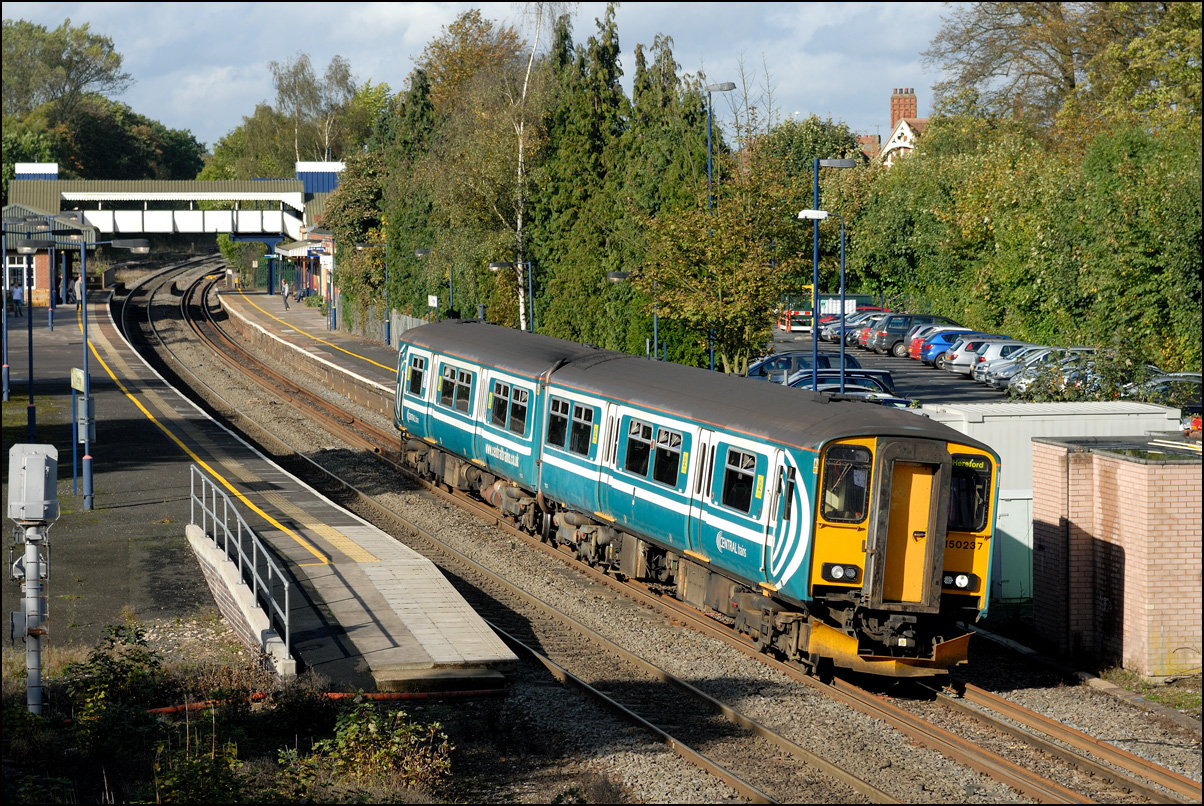 |
Dorridge has long been the station at which a lot of southbound local trains from Birmingham Snow Hill or Moor Street stations terminate. It is normal for the trains to cross over to the down side of the island platform north of the station at Bentley Heath for the turn-round and return to Birmingham, but on occasions they continue through the main up platform to a ladder crossover on the south side. Here, 150237 is heading up to perform the shunt move on 21 October 2006. This is one of the ex-Anglia units recently acquired by Central Trains and still carries a modified form of the now obsolete colour scheme of the previous operator. |
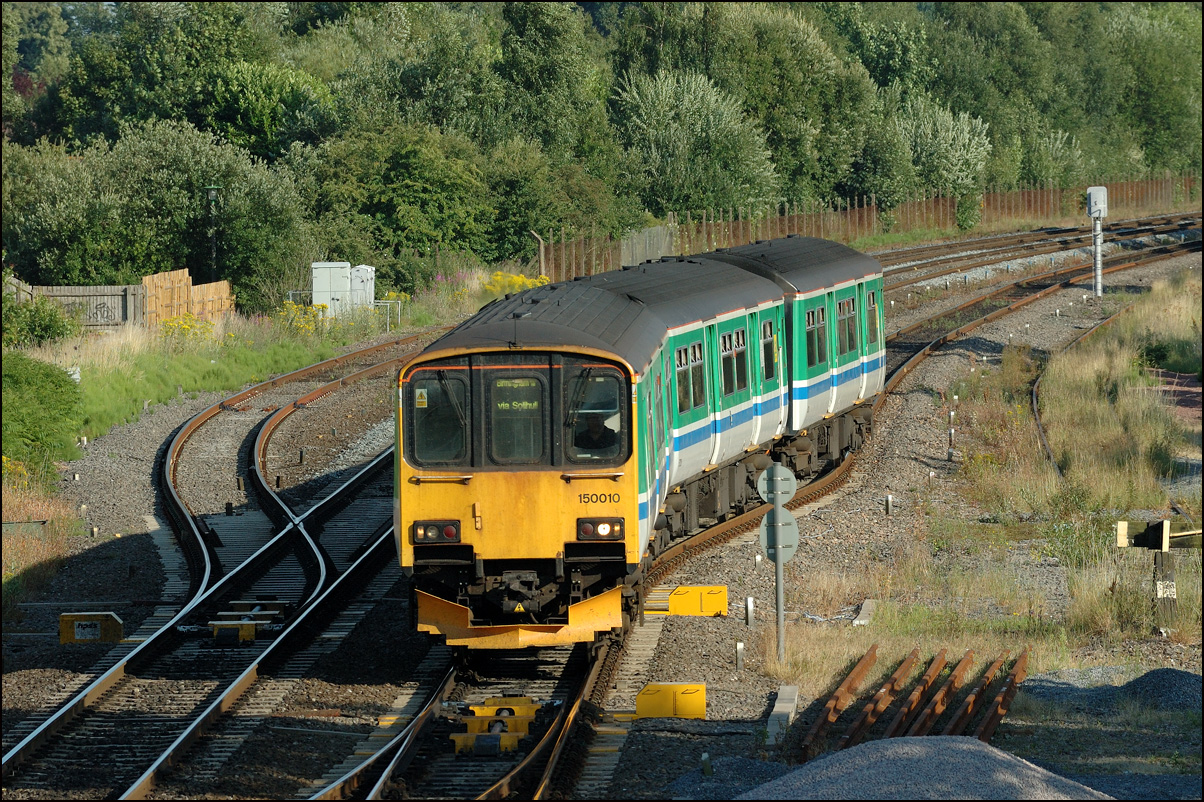 |
Here is the usual move being performed by 150010 during the afternoon of 21 July 2005. The unit is crossing from the up main line to the bi-directional spur to the down island platform at Dorridge, where the overbridge can just be made out in the background. The train will return north within about 10 minutes using the same set of tracks over which it is about to travel. |
|
|
Prior to the mass introduction of class 150 DMUs there were 2 class 151 prototype units unsurprisingly numbered 151001 and 151002. They were a bit elusive in the days before mobile gen but I did drop on them on a couple of occasions. This picture shows 151002 passing Water Orton in fading light at 14.11 on 11 November 1987. According to the timetable it was working a Brimingham to Derby all stations and it lucky for me that it was about to stop at Water Orton station and therefore hardly moving. It was still working on 15 February 1986 when this picture was taken at Stourbridge Junction. |
|
|
Work on the new station at Ashchurch (for Tewkesbury) had not been started on 4 April 1992 when I took this shot of 153305 working from Worcester towards Gloucester. This unit became briefly notorious after being released from Long Marston in a white unbranded livery after losing its GWR colours. It was working to St Phillips Marsh at Bristol from where it worked for some time in this colour scheme. |
|
|
A Manchester Victoria Blackburn to train formed of Class 105 53812 and Class 100 53355 - a pair that outlived other members of their respective classes unidentified class - along with an unidentified class 108 on 27 February 1986. Although I took a large number of pictures here in the 1980s This set was allocated to Newton Heath depot at the time and it's a shame that the class 100 vehicle wasn't on the front as this is my only picture of a class member. Thanks to Stuart Mackay of Railcar.co.uk. for the unit information. |
|
|
Despite the number of trains on the GWR from Paddington to Didcot in 1993 it was quite unusual to take a passing shot of two sets in the right place unless the one on the relief line was standing at a signal. On 7 May 1993 class 101 set L835 formed of 51498 + 59530 + 51432 was working a Paddington to Oxford or Banbury train as it was passed by a down HST at full line speed. |
|
|
The test and/or crew training runs using new CAF class 196s still visit Stratford-upon-Avon from time to time and on 6 September the mid-morning run operated as 5T22, instead of the usual 5QXX. On my way somewhere else I dropped into the station for a couple of shots despite the weather being very dull and drizzly. Here is 196108 arriving into platform 1 and although I don't keep records of which units or locomotives I have seen the number sounded familiar. On checking my images this unit was one of those taken for storage to Long Marston and which was dragged there by on 10 February 2022 by 50008. The steps by each bodyside door appear quite odd in my opinion and look as if they are an unplanned late addition to the design because those bodysides are too high for British platforms. |
|
|
While the driver was changing ends on 196108 at Stratford-upon-Avon on 7 September 2022 the light improved a little so I took another shot of 5T22 as it stood under the twin bridges between platforms 1 & 2. |
|
|
I quite often used to have an afternoon at Kings Sutton in the late 1980s and early 1990s when there was an impressive variety of different types of trains to photograph. This picture of NSE Class 101 L204 (51220 + 54371) was taken on 8 May 1989 as the unit worked a peak hours Didcot to Banbury service.645 |
|
|
Another shot from the roadbridge at Kings Sutton but this time taken on 14 June 1988 and with a standard 80mm lens on a Mamiya 6456 rather than the 150mm used for the picture above. The train is an unidentified class 115 set in standard blue & grey livery but with a NSE flash on the cab end working a London Marylebone to Banbury train.645 |
|
|
This is a colour version of this B & W shot of class 114 T026 (54010 + 53006) at Stratford-upon-Avon dated 11 January 1990 but after the staff member had moved away. The colour of the sky hasn't been manipulated but is a consequence of the long exposure, 20 seconds at f5.6 on 100asa film, needed to get a well-exposed image in the days before very bright LED platform lights.645 |
|
|
Class 117 DMU T312 (51338 + 59504 + 51380) was working a Birmingham Moor Street to Stratford-upon-Avon service on 19 June 1988 when I photographed it shortly after leaving Wilmcote station. This set wasn't at Tyseley for much longer after this date because class 150 Sprinters were beginning to appear in the West Midlands and "proper" DMUs were starting to be transferred elsewhere for their final year or two. This picture was taken on medium format film stock in vertical format but I've cropped it to better fit a web page. 645 |
|
|
Over the second Bank Holiday in May 2000 freight workings were diverted from their usual route and ran over the Central Wales Line. I was at Buckley waiting for a class 66 on a cement train when 153355 arrived at the atractive station and as the sun came out I took a couple of shots as it stopped for the solitary passenger with his bike. |
|
|
Railtrack acquired a class 150 DMU for use as a track testing unit and painted it into a striking blue and yellow colour scheme. I was near Burton on Trent on 9 February 2001 when it appeared running south past the fertiliser depot a short distance to the north of the station. 645 |
|
|
One of the more unlikely colour schemes seen on the railway was this carried by 170399 promoting Birmingham's bid to be 2008 City of Culture 2008. I photographed at Whitacre Junction on 6 March 2003 while it was working a Nottingham to Birmingham train. This was the first I knew of the unit's new colour scheme and it did come as a bit of a shock to the system! 645 |
|
|
I was still at Whitacre Junction when 170399 returned from Birmingham New Street to Nottingham so I took another shot on the basis that the unit might not turn up again in front of my cameras. |
|
| Class 170 DMUs carried quite a range of one-off colour schemes including 170513 which carried decals advertising the newly reopened Robin Hood Line. I photographed it at the site of the yet to built Coleshill Parkway station on 13 September 2003. 645 |
|
| Another class 170 but this time one without much of a colour scheme rather than something eye-catching. The unit is 170398 wihich was owned by Porterbrook and intended for spot hire by any TOC in need of a spare train. On this occasion it was working a Nottingham to Cardiff service photographed at Stoke Prior. The unit was subsequently acquired by Chiltern Railways by whom it was reformed as a two-car set and renumbered as 168329 as seen here at Bentley Heath in 2016. In 2022 it is better known as Chiltern's hybrid unit which was used for shuttling passengers between Honeybourne and Long Marston for the year's Rail Live event. 645 |
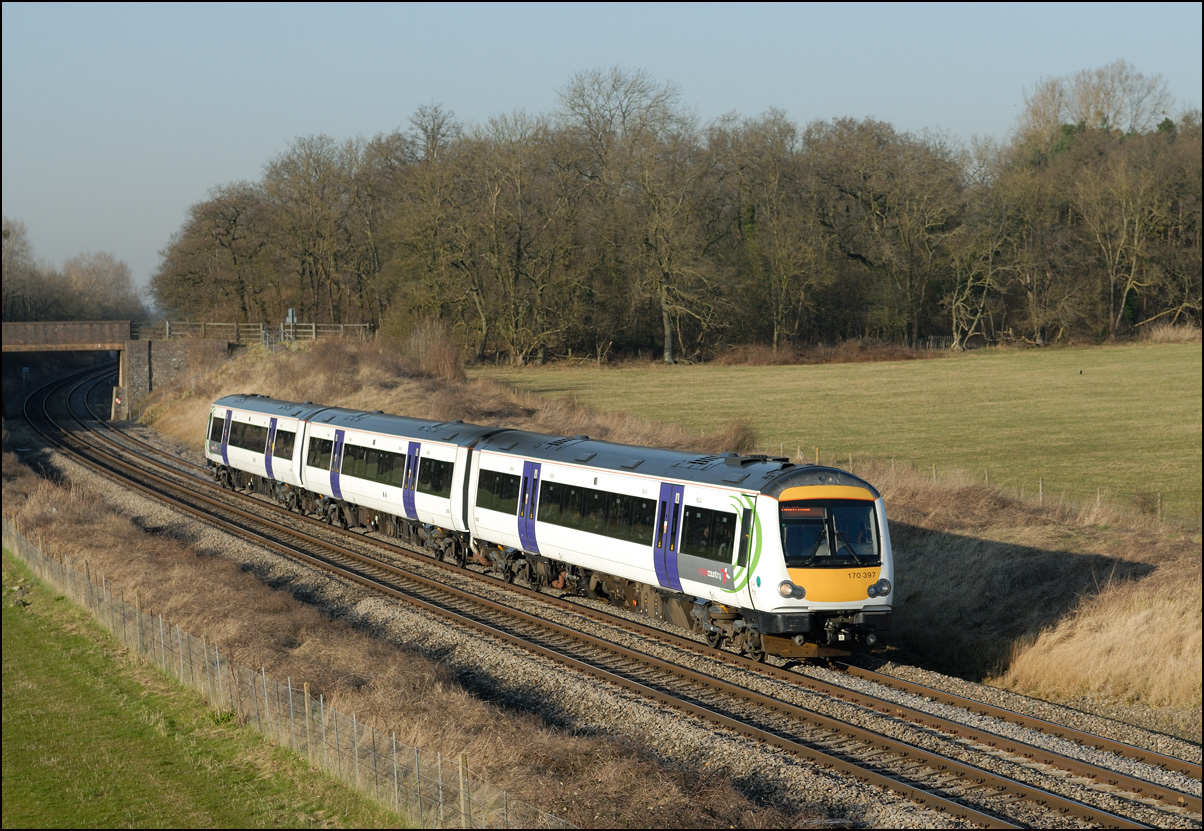 |
Class 170 DMU 170397 carried a slightly amended Porterbrook livery with CrossCountry decals at a time when it was on hire to cover a shortage. The location is, of course Croome Perry wood near Pershore and the image was taken on the sunny afternoon on 12 February 2008. |
|
|
A more brightly coloured unit in the form of 150232 working a Worcester to Weymouth train was next along at Croome Perry on 12 February 2008. The decals were advertising various attractions in the South-West of England although the grubby state of the bodysides didn't do a great promotional job for either the operator or the destinations. |
|
|
The 10.12 Stratford-upon-Avon to Leamington Spa service on 20 June 1992 was made up of class 116 vehicle 53838 leading followed by Class 101 53267 as I pictured it going slowly around the curve from Hatton West Junction into platform 3 of the station. The leading vehicle had recently received a high(ish) intensity headlight to supposedly increase visibility for those working on the track. The up main line had just been relaid and re-ballasted and it looks as if a few yards of the branch had had a bit of spare material dropped around it. |
|
|
A mixed industrial scene between Cradley Heath and Lye stations on the Birmingham to Droitwich line on 4 July 1987 as class 116 T629 formed of 53079 + 59592 + 53114 worked from Birmingham New Street to Stourbridge Junctions where it would have reversed and gone back to the city. |
|
|
In the late 1980s I took so many pictures of DMUs around Stratford-upon-Avon that it was difficult not to duplicate shots. This one, which I'm sure worked too well, from 29 June 1988 was shot from the doorway of Stratford-upon-Avon East Signalbox as class 116 T612 (53866 + 59593 + 53902) arrived with a mid-morning train from Birmingham Moor Street. |
|
|
This picture was taken on 29 June 1988 when I was scoping out a few locations for shots of steam workings on a weekend of intensive specials between Tyseley and Stratford-upon-Avon. The train is a Birmingham Moor Street to Stratford formed of class 116 T513 and comprising 53077 + 59650 + 53120. Henley station can just be made out in the background and it appears that the leading cab of the unit has taken a bit of a clout in the recent past. |
|
|
There was an 0Z10 from Rugby CS to Stratford-upon-Avon on 17 August 2022 which appeared to be a road-learning run for Colas crews but with no locomotives available at Rugby it as cancelled. At about the same time a VSTP appeared for a 3Z17 from Kings Norton using a Balfour Beatty MPV on what seemed to be another road-learner for the RHTT season. I walked to Stratford station for a shot and arrived just as 172104 + 172101 arrived running about 5 minutes late from Kidderminster and as 172101 had recently been revinyled in to WMT colours from its previous Chiltern Railways livery I took an image as it left with the 10.26 return, 2K31. Chiltern's 165002 was alongside waiting for its departure to Leamington Spa. |
|
|
As soon as 172001 + 172004 had cleared the section after leaving platform 1 and crossing to the up main line at Stratford-upon-Avon on 17 August 2022 3Z17 formed of DR98995 + DR98905 from Kings Norton was allowed to come into platform 3. There isn't much of a shot for anything arriving here and this rather messy wide-angle view is about the best of a bad job. The light was dreadful but these units are unusual down here in daylight so worth a couple of frames. |
|
|
The MPV formed of DR98905 + DR98955 was due to stand in paltform 3 at Stratford-upon-Avon for about 20 minutes on 17 August 2022. The best of the available views was another wide-angle shot with one of the planters sponsored by FOSL prominent in the foreground. In the meantime 165002 was leaving platform 2 on the way to Leamington Spa. After leaving Stratford 3Z17 ran to Hatton before coming back to Stratford and then back to Kings Norton voa the North Warwickshire Line. |
|
|
The only freight coming south for quite a while at Ashchurch on 9 August 2022 was 6V05, the Round Oak to Margam train of empty steel carriers. This was showing about 30 minutes early at Noton Junction on the Railcams map so I hung on in the bright sunshine for a picture of it. Coming the other way was a 6J89 formed of Colas Rail Plasser & Theurer 08-4x4/4S-RT Switch & Crossing Tamper DR73907 on what appeared to be a crew road learning run from Gloucester Horton Road to Kings Norton OTP Depot and return. It made a colourful image going away towards the level crossing and in the meantime 6V05 was still waiting at Abbotswood Junction where it would stay until 6J89 had passed by. |
|
|
There were 2 charters along the Worcester to Gloucester line on Saturday 6 August 2022 and with a clear sky just about as guaranteed as they can be I went to the footbridge at Northway, near Ashchurch for Tewkesbury station. As I arrived one of the 7 class 166s still in blue livery was pulling out of the station with 2E51, the 06.38 Bristol Temple to Worcester Foregate Street. It's always worthwhile getting a shot of these units before they are re-liveried into the bland and difficult to photograph GWR green. |
|
|
Running between the 2 "Zs" at Northway on Saturday 6 August 2022 was one of the remaining CrossCountry HST workings, the 06.09 Leeds to Plymouth, 1V44. The leading power was 43304 with 43239 on the back and with these superb trains not likely to be around for much longer it was well worth having a picture of this one on such a sunny morning. |
|
|
I didn't intend to go out again after a couple of photographs around lunchtime on Sunday 24 July 2022 but there were quite decent patches of blue sky appearing at around 14.30 so as there seemed to be a chance of a well-lit shot of 20189 + 20142 working from Birmingham Snow Hill to Stratford-upon-Avon I made the short drive to Wilmcote station. This is an attractive although very well-known location but if the sun did come out at the right time it would be spot on. Running a few minutes in front of 1T52 was 2S12, the 13.26 from Worcester Foregate Street which was formed of 172004 + 172334. It was a worth a shot in the sunshine much to the apparent bemusement of the solitary passenger. |
|
|
I don't have many pictures of Regional Railway liveried first generation DMUs and this is one of the few. The location is the roadbridge a short way to west of Cosford station on 10 April almost alongside the RAF Museum. This type of units was a bit thin on the ground around here by this time with class 150 Sprinters forming most of the West Midlands fleet. |
|
|
Looking towards the station at Cosford from the same bridge as the picture above this image shows ex-Clydesdale class 101 T078 (53146 + 51249) working a Shrewsbury to Wolverhampton train on 29 November 1991. The shot looking towards Shrewsbury is equally interesting with a nice bracket signal but at this time of the year the cutting is too heavily shadowed for a picture on a sunny day. |
|
|
A shot at Cosford later on the same unrecorded day in January 1991 as the picture below as class 101 set T066, probably formed of 51228 + 51506, arrived for the stop at Cosford station. The signalman had been very prompt in returning the inner home signal to danger on this occasion. In addition to the first generation DMUs I was also at this spot to take pictures of class 20s on Ironbridge power Station MGRs such as this one of 20021+20132 opening up through the station having been checked at the outer home signal. |
|
|
The morning of an unrecorded date in January 1991 (I can't read the scrawl in my notebook!) saw bright sunshine and a sharp frost at Cosford. I do recall that the wooden platform was quite slippery as Class 108 T066 (51943 + 51568) left the station with a train from Shrewsbury to Wolverhampton, the driver having forgotten to change the destination blind. The attractive wooden buildings have now been replaced with prosaic bus shelters and the platform surface brought up to modern standards. The station is also unmanned although that is arguably better than when an especially grumpy individual was on duty who clearly didn't much like enthusiasts invading his territory. He didn't seem keen on passengers either! |
|
|
An added bonus for the photographer visiting Cosford was the presence of conveniently placed semaphore signals. It was a shame that the majority of the GWR-style lower quadrants had been replaced by the time I was going here but they were still better than the modern alternative. On 29 November 1990 class 117 DMU (51413 + 59509 + 51371) were pictured about to stop with a Chester to Wolverhampton service. Neither of the loops here were much used at this time and I was never fortunate enough to take pictures with the appropriate signals in the "off" position. |
|
|
When this picture of class 117 T307 (51412 + 59522 + 51370) approaching Cosford station on the Wolverhampton to Shrewsbury line was taken on 29 November 1990 class 150 Sprinters were beginning to make their presence felt across the West Midlands. At the same time class 20s on MGRs serving Ironbridge Power Station were in the process of being replaced with class 58s and it was to record both types of train that I went onto this line on several occasions. It's not hard to work out where the DMU was going having left Wolverhampton a bit earlier in the morning. |
|
|
Here's another view of class 117 T307 (51412 + 59522 + 51370) as it paused at the completely wood-built Cosford station on 29 November 1990 with a Wolverhampton to Chester service. This station was largely built to accomodate servicemen and women based at the RAF station here. Little RAF flight activity uses the place now but it is a major training service and the home of a truly outstanding RAF museum hosting many attractions and an annual airshow. |
|
|
A misty morning at Cosford on 29 November 1986 made the use of black & white film a better bet than Kodachrome 64. The subject is class 108 DMU T072 (51566 + 53933) complete with headlight and a red dragon emblem on the cab front. The train is about to stop at Cosford station with a Wolverhampton to Chester service stopping at all stations at least as far at Shrewsbury. |
|
|
The original subject of this image was 56048 arriving at Small Heath on 5 March 1986 to collect a train of scrap metal but the 2 DMU sets made the picture in retrospect. The train receding from the camera and going towards Birmingham Moor Street was a hybrid set of classes 116, 101 and 122 and the furthest away a class 116 on its way to either Dorridge or Leamington Spa. |
|
|
An everyday scene on Hatton Bank on 11 April 1986 as class 122 single car 55003 climbs the 1/110 average gradient with an afternoon Leamington Spa to Stratford-upon-Avon service. This was a popular location for railway photographers with many different viewpoints being available to vary the pictures during an afternoon's photography. It is completely overgrown and the line is not visible from the footpath running along the wooden fence. |
|
|
The Chiltern class 168 hybrid powered unit, 168329, made its first passenger-carrying trips away from its home lines on 22 June 2022. It has worked timetabled Aylesbury services over the past months but is notable for being the first of its type both on the North Cotswold Line and the Long Marston branch. There have been a few Chiltern class 165s on these lines but no 168s as far as I know until this one arrived on 20 June. The unit was due to operate shuttles between Honeybourne and Long Marston for Rail Live attendees and I thought that the first train would be the best for good light and before the weather became too hot for comfort. As soon as the ECS had left the site 3 men started work on the track just inside the gate, doing a spot of what appeared to be grinding the check rails beyond the pointwork. The main picture shows 168329 arriving with the first of the day's trains just as the shadows had cleared the track. Thanks to David Ive and John Turner for the information about 168329's work on the Aylesbury line |
|
|
Long Marston's Rail Live event in 2022 is again seeing a range of rolling stock from various companies including Chilern Railways' hybrid powered 168329. The unit is to work shuttles between Honeybourne temporary platform and Long Marston on the first day of the event to cater for attendees at Rail Live arriving by rail. On 20 June it was sent from Aylesbury depot as 5Q68 and is seen here arriving at Honeybourne almost completely surrounded by encroaching trackside vegetation. |
|
|
Before going to Long Marston on 20 June 2022 168329's platform clearances at the temnporary structure had to be checked and here it is at Honeybourne with the engineers completing their required jobs. |
|
|
Here is another closer-up view of 168329 as it left Honeybourne after platform clearance checks were completed. The unit does look smart in its special livery; completely different from how it looked approaching Bentley Heath in 2016 complete with a bloody mark and a few pigeon feathers just below the number. Here also is a more broadside view of one car as it goes along the branch to Long Marston. |
|
|
My final shot of hybrid 168329 was this as 5Q68 moved, on battery power alone, away from Honeybourne to collect the single line token before heading off to Long Marston. One of the advantages of at this location on a sunny day at around 13.00 is that the light is in the right place for views in either direction. |
|
|
There were several trains other than 168329 going to Long Marston on 20 June 2021 but as is the way of things nothing went smoothly. A class 321 electric unit topped and tailed with class 69 locomotives followed by the Rail Adventure HST power cars with a trailing load should have arrived in the mid-afternoon but the former was retimed to be inconvenient and needing a 90 minute drive to the Kemble area which I just couldn't be bothered to do. The latter was initially cancelled through a problem at Kings Norton meaning that the power cars weren't able to leave the OTP depot. A revised schedule was later used with 43465 + 43468 going to Burton on Trent in the afternoon to collect a couple of barrier wagons for display at Rail Live. The arrival time at Long Marston was around 21.00 and on nearly the longest day of the year I knew that a shot from the public footpath near the roadbridge would be on so went there, as I thought, in plenty of time. As I fought the undergrowth leading to the crossing the train's horns were sounded just around the corner as 6Z43 approached one of the farm crossings just around the corner. I had a minute or so to set up before the unusual-looking ensemble arrived in the only mostly clear patch on this part of the branch. |
|
|
This slide was taken from the roof of a Land Rover complete with ladder and appropriate roof rack with the permission of the friendly owner and shows 3 class 115 sets crossing just outside London Marylebone on 13 September 1986. Steam in the background gives a clue for the presence of photographers on this day. A Marylebone to Tyseley special, The Tysleley Connection, was preparing to leave but by the time it left the terminus lighting levels had deteriorated to the point that black and white was the best bet for a picture. |
|
|
On Sunday 2 November 1986 I went to a spot on Ardley Bank, a few miles north of Bicester on the then single track Chilterm line. The first train along was a class 115 DMU working a Marylebone to Banbury service and although there were many other photographers present I doubt if anyone else took a picture of it. The main focus of attention was on 4472 Flying Scotsman working a Marylebone to Stratford-upon-Avon dining train which came along a short while after the DMU had cleared Aynho Junction. |
|
|
Looking the other way at Fritwell, on the Chiltern Line's Ardley Bank on Sunday 2 November 1986, there were more photographers and once again I suspect that I was alone in taking this picture of a class 115 returning to Marylebone from Banbury. We all were waiting for another steam special heading for Stratford-upon-Avon this time hauled by 4468 Mallard which passed by with its chime whistle sounding. |
|
|
Tyseley class 116/101 hybrid unit T032 formed of 53073 + 53242 was working a Birmingham New Street to Lincoln service when I photographed it at Whitacre Junction on 17 ay 1992. Waiting for a path from the loop with a loaded Croft Quarry to Bescot ballast train were 31512 + 31158 along with 2 pieces of OTP which had come from the Bescot direction, crossed over and entered the loop prior to going back from whence they had come when another path was available. |
|
|
The last surviving all blue class 116 set, T702, formed of 53920, 59372 and 53867 looked a bit scruffy when I photographed it on a Four Oaks service leaving Longbridge on 4 October 1986 with the long-gone British Leyland Motor Works in the background. It was looking better on a few months earlier on 1 July 1986 as it left Stratford-upon-Avon with a late afternoon service heading to Leamington Spa. |
|
|
A later departure from Longbridge on 4 October 1986 was this hybrid set of single unit class 122 55006 coupled to 51962 (probably) + 53100 (class 127 and 116 respectively). These mixed-up sets were from unusual at Tyseley at the time as the depot was suffering with reliability problems from much of its ageing fleet of DMUs. Probably not much fun for the depot staff but it gave photographers with an interest in DMUs some odd combinations to record. |
|
|
I have very few pictures of DMMUs in Regional Railways livery and even fewer in sun. This one shows 101679 (51224 + 51533) with an evening Leamington Spa to Stratford-upon-Avon train on 13 May 1992. In the background are the Round Tower of Warwick Castle and the tower of St Mary's church, Warwick. This view has become so overgrown that a shot here from the field path is no longer possible; a great shame as this was just about the best loocation for an evening northbound train of the GWR Leamington Spa to Birmingham line. |
|
|
The first chance to photograph the monthly test train in daylight at Stratford-upon-Avon occurred on Tuesday 18 May 2022. The HST PCs 43274 and 43272 provided the power for 1Q48 and the train was due to arrive into platform 1 at 20.46. It ran very early and I went to the station where I suspected that it might use P2 because of a following passenger service from Kidderminster so placed myself on the footbridge where it was easy to switch sides if necessary. My hunch was correct and here is 1Q48 with former EMR 43274 drawing to a halt some 53 minutes early. |
|
|
It took the driver of 1Q48 only a few minutes to get into the cab of 43272 and switch the lights from red to white ready for the journey towards Leamington Spa. There was no chance of it moving for some as both Chiltern and WMR services were on their way to Stratford so pausing to take a quick a shot of the coach containing the track recording equipment as the crew took their break and another of a banner marking The Queen's Platinum Jubilee placed here by the SLPG, I left for home. I later saw that the train was held to to its booked departure time, 20.51. |
|
|
I wouldn't go out especially to photograph a GWR IET but if by the lineside for something else and one turns up in sunshine then I might have a shot. On 7 May 2020 I was near Evesham to photograph Hastings unit 1001 and this one, named Queen Elizabeth II, came south working 1P21 to London Paddington. The hawthorn blossom here is just beginning to bloom in the shallow cutting on the up side of the line. |
|
|
The preserved Hastings Line DEMU 1001 (230001) ran from its base at Hastings to Worcester on Saturday 7 May 2022. As far as I know this is only the second of the class to have travelled over the Noth Cotswold LIne so it was worthwhile taking an image even though on a sunny day the light was backlit for most of the route. I went to a road bridge just to the south of Evesham and found on checking RTT that 1Z65 ws running late because the preceding GWR service, 1W14, was delayed.. As soon as this had reached Evesham, 1001 (mostly!) was released from Moreton-in-Marsh and came slowly into view. This location was the site of some farm sidings on the down (left) side of the line and a signal box on the up. The box was switched out for most of the time being operated only at busy times for the local growers producing vast quantities of fruit and vegetables. On these occasions a travelling shunter and signalman travelled with the train to do the necesssary jobs. I wasn't able to photograph the return of 1001 to Hastings because of a long-booked organ recital so had to miss the chance of another shot, probably passing the signals at Moreton-in-Marsh. |
|
|
One of my favourite times of day for photography was when it was dark enough to require a tripod for time exposure (pre full-frame digital equipment!) but with some light left in the sky. This image from Stratford-upon-Avon was taken at Stratford-upon-Avon on 11 January 1990 as class 114 T026 (54010 + 53006) stood in platform 2 waiting to form an evening train to Leamington Spa. One of the Stratford drivers, Oliver, is on P1 while the train driver relaxes for a few minutes as he has nearly 30 minutes to wait until departure time. |
|
|
A short while after I took the picture shown above at Stratford-upon-Avon on 11 January 1990 another train was in platform 1 made up of class 117 T309 formed of cars 51372 + 59490 + 51414 was preparing to leave for Birmingham Moor Street. The length of the exposure can be judges by the "ghosts" of passengers jostling around to join the train. I didn't make a note of the camera settings at the time but it was taken on 400asa Tri-X film in a Mamiya 645 and I guess that the shutter was open for 3 to 4 seconds. |
|
|
Another picture of class 114 T026 (54010 + 53006) at Stratford-upon-Avon and taken on the late morning of 19 March 1990. The unit would have later formed the 12.12 to Leamington Spa. Prominent in the picture are the gasholders, still in use at that time, and the mix of lower and upper quadrant semaphore signals every sign of which have now gone. |
|
|
Here is another picture of the SO Stratford-upon-Avon to London Paddington train formed of a pair of Tyseley class 116 units led by T627 (53061 + 59596 + 53092) and kindly sent to me and used with the permission of 6089Gardener. I imagine that the scene here in 2022 is very different with the construction of the HS2 line being carried out in the area. There certainly won't be any lower quadrant semaphores in view... |
|
|
This 2 car class 108, formed of 51916 + 54194, looked as if it has recently been painted into Network South-East livery as it stood in the rain at Bletchley on 19 March 1990. As the destination blind suggests the train was on the regular diagram to Bedford Midland which has seen quite a variety of motive power over the years. In 2022 the service is operated with Vivarail 2 car class 230s, although staffing issues mean the buses are used on many journeys. |
|
|
A bit later on the same day as the picture above class 108 vehicles 51916 + 54194 were pictured again about to stop at Fenny Stratford station on the single line section. As soon as it had the cleared the line a trainload of contaminated soil from Chatham Dockyard came the other way with 31209 + 31308 in charge. These locomotives would have taken over from either a class 56 or class 33 at Gillingham Yard. |
|
|
My original plan was to head for a bridge near Chipping Campden for another shot of 5Q70 but with the sky clearing and the early mist burning off the sun would have been completely wrong. I therefore went to Thistley Hill between Middle Norton and Mickleton where the sun would be more favourable. While waing, the driver of a car stopped and said that there had been some sort of incident near the station at Honeybourne with the roads closed and the place swarming with police. I wondered if trains were affected but both a down and up GWR service appeared, the latter of which, 1P26, formed of an unidentifiable unit is pictured here. |
|
|
During a morning walk between Stratford-upon-Avon and Wilmcote on 24 March 2022 I happened to see a pair of the Chiltern Railways class 172/1s just beyond Stratford Parkway on 2K31, the 10.26 to Kidderminster. This type of unit is relatively unusual on the trains via the North Warwickshire Line, 172/2 or 172/3 being more usual, so I made a mental note to go out for a photograph of the return 2D34. Wilmcote station was the obvious location and here is 172101 leading 172103 as it runs non-stop towards Stratford. A plaque has recently been placed on the station marking the huge contribution made by the late Douglas King of Wilmcote who, along with Michael Brockington, was instrumental in the keeping the North Warwickshire Line open for traffic at a time that BR wanted to close it. This date marks the 100th anniversary in 1922 of a tragic accident just beyond the station when 4 members of the local track gang were killed by a a locomotive running light engine. |
|
|
Just as I arrived at Wilmcote to photograph 172101 + 172103 another class 172, 172007, was in the station forming the 13.26 from Stratford-upon-Avon to Kidderminster. Again, this is quite unusual on the diagram so went to Stratford for a shot as it arrived from Kidderminster into platform 1 at the terminus with 2D52. On my walk home via the canal towpath I paused to take a couple of shots of the buildings adjacent to the line, at one time Stratford Canners, being demolished to make way for an entirely innappropriate housing development of 5 floor apartments which is being built despite an almost complete lack of road infrastructure. Just as I lined up a shot 172007 came by on its way back to Kidderminster. |
|
|
I was told that a pair of GWR class 769 tri-mode units was due to leave Long Marston for Eastleigh on 25 March 2022. The booked departure was 09.33 and as I drove towards the roadbridge at 09.20 saw the train, 5Q11, formed of 769938 + 769959 as they ran through the exchange sidings and towards the gate. This meant a run straight to Honeybourne for me to wait for them as the went away from the camera and onto the North Cotswold Line before reversing and going south towards Oxford. As soon as an up GWR express was in the platform the calling-on lights on the signal were lit and 5Q11 moved away passing the rapidly growing buddleia which will obscure this view within a few weeks. |
|
|
There was a plenty of time for a walk to the far end of the down platform at Honeybourne on 25 March 2022 while it reversed at North Junction and waited for the preceding GWR train to arrive at Moreton in Marsh. The 8 car formation fitted nicely into the gap between the platform and signal as 769959 + 7699938 accelerated away towards Oxford. |
|
|
Just after 66707 had passed Hatton on 22 March 2022 the signal for the up main line from the Stratford-upon-Avon branch platform was cleared. This was despite 2L33, the 10.40 from Stratford to Leamington Spa, still being at Bearley Junction and showing just how quiet the GWR main line is at some times of the day. Running spot on time here is 165007 about to pass under the roadbridge and make its stop in platform 3. The view here is just about clear enough for a two-car train at the moment but the foliage will soon appear and cover some of the train. |
|
|
A four-car Tyseley DMU, set 401, passing the signalbox at Bearley Junction on 11 March 1989. This unit is a right hotch-potch with a class 115 DMBS 51662, the centre cars being class 115 TS 59743 and class 127 TSL 59610 with a rear car from a class 116 set. This mixture of types was far from unusual at Tyseley around this time with the depot using whatever they had available to keep trains running at a time of dreadful reliablity. A note, with thanks for Eddie Knorn writing on Railcar.co.uk, about the composition of this unit. The T400 series sets at this time were intended to be a mix of classes: Class 115 MBS at one end Class 116 MS at the other with two gangwayed suburban trailer cars in the middle, one of which had a lavatory. Trailers could be from classes 115, 116 and 127. |
|
|
There was a series of special trains on Saturday 20 October 1990 operating in connection with a Network North-West day sponsored by Motive Power Monthly Power Monthly magazine. It was a good opportunity to photograph some odd workings, including a class 26 + 31 combination, so unusually for me I had a ride around on a discounted ticket. One of the special trains visited Barrow in Furness where this photograph of class 108 (54265 + 53954) was taken. It was only after scanning the negative that I noticed the wording "Auto Gear" on the front cab end and on checking the the brilliant Railcar.co.uk website found full details of the unit which I saw passing the impressive North signalbox with a terminating service. |
|
|
Class 108 DMU (54238 + 53956) is standing alongside a Pacer unit at Barrow in Furness on 20 October 1990 just before it leaves the station via the crossover in the foreground. The day was marked by a number of unusual locomotive-hauled services run in connection with a Network North-West day and 26025 + 31434 had just left the station and 20057 + 20140 + 31461 were next to visit on a return trip from Manchester Victoria. |
|
|
Birmingham Snow Hill was reopened as a terminus station on 5 October 1987. On 26 November of that year I took this picture of class 116 T322 (53880 + 59114 + 53071) standing in the platform that was later taken over by the tram system. I don't know why it was at the buffers so far along the platform nor why there is a tail-lamp on it; the engines were clearly working but there may have been a problem with the transmission which caused a failure. |
|
|
Right at the other end of the Birmingham Snow Hill to Stratford-upon-Avon line this image shows class 121 55034 standing in platform 1 in the summer of 1991. Judging by the direction of the sun the unit would have formed the 14.10 to Leamington Spa. |
|
|
Class 117 DMU T305 (51410 + 59520 + 51368) was repainted into a chocolate and cream livery for the GWR celebrations in 1985 and was still in those colours on 1 April 1989 when I photographed it near Soho Junction in Birmingham. Most the of the local services were operated with electric units so I assume that this one heading to Birmingham New Street had come from beyond Wolverhampton on the Shrewsbury line. |
|
|
An unidentified class 110 DMU with a class 108 TBS as a centre car was photographed arriving at Long Preston station on the "Little North Western" on 28 March 1989 while working a Morecambe to Leeds service. The platelayers' hut on the left had clearly seen better days and was probably not long for this world...My thanks as ever to Stuart Mackay of the Railcar website for some extra details and corrections to my caption. |
|
|
Another picture of the same class 110 unit is shown here as it pulls away from Long Preston on 28 March 1989 with the Morecambe to Leeds train. Note the steps here to assist passengers join and leave the train on the lower than usual platform. |
|
|
Another of my very few images on the "Little North Western". The train is a class 101 DMU on its way from Morecambe to Leeds on 28 March 1989 photographed at Eldroth, between Clapham and Giggleswick, looking east from School Lane in tricky conditions with sun on the hills and murk in the valley. My thanks to Kenneth Leiper and Iain Reid on the invaluable Railcar website for information on the location of this picture and . |
|
|
David Ive has been kind enough to allow to use this photograph of the Saturdays-only Paddington to Stratford-upon-Avon DMU, unusually formed of set T603, 2 class 116 cars sandwiching a class 101 trailer, rather than the usual 6 cars which he took from the platform at South Ruislip. Someone has changed the destination board to Birmingham Moor Street possibly to ready it for work the following day. I doubt if this caused too much confusion at least until the train reached Leamington Spa! |
|
|
A class 150, 150146, in original condition at Sutton Bridge Junction, Shrewsbury. I suspect that not many photographs of these units on their way to the Cambrian Line were taken here, especially in dull weather, the class 37s going on the same route accounted for most pictures. This train was going to Pwllheli on the Llyn Peninsula although it seems likely that most passengers didn't do the full journey but got off at intermediate stops. |
|
|
Next along at Hatton North Junction on 7 March 2022 was 172214 running as the 2W82, the 14.03 from Stratford-upon-Avon to Kidderminster. I had hoped for one of the Chiltern 172/1 units coupled to a 172/0 but had seen these on the previous train as I drove towards the road bridge at Bearley so knew that there was no chance on this diagram. |
|
|
The first of my targeted workings on 7 March 2022 wasn't far away by the time 168113 with the 14.10 London Marylebone to Birmingham Moor Street, 1R37, so it was photographed largely to check exposure settings and the camera's histogram. |
|
|
A shot from a couple of weeks ago which somehow wasn't downloaded at the time. It shows GWR 802020 with the Thank You Key Workers vinyls approachiong Honeybourne on 28 February 2022 with a London Paddington to Great Malvern service. This is the only example of the special livery IETs I have photographed hence its inclusiom even though I usually photograph these units only in sunshine because of their generally drab colour scheme. |
|
|
An early morning text message on 1 March 2022 told me that 172101, one of the class on hire from Chiltern Railways to West Midlands, was on one of the diagrams to Stratford-upon-Avon. I planned to photograph the 16.21 arrival but was walking into town with my wife just after 2pm and saw it coupled to 172007 in platform 1 so took this picture with my 'phone as it waited for the 14.03 departure time. Within a few seconds a Chiltern class 165 arrived and allowed 2W80 to leave the station. It turned out later that the working I had planned to photograph was cancelled due to engine problems on 172101 and had to reverse at Whitlocks End. Thanks to Steve Widdowson for the information. |
|
|
Another GWR class 769 looked as if it would move from Oxford Carriage Sidings to Long Marston on Monday 28 February 2022. Working on the assumption that it was actually a class 769 moving, once 5Q19 had left Oxford I went to Honeybourne and arrived just as it was passing Moreton-in-Marsh. The light had collapsed altogether since leaving home but as I was there I went onto the up platform for a shot as 769922 slowed ready for its reversal at Honeybourne North Junction. |
|
|
The turnaround time for 769922 running as 5Q19 on 28 February 2022 allowed the light to deteriorate further and for a light rain to start falling. The GWR plain dark green paintwork isn't great for low-light photography and with several of these tri-mode units having gone to Long Marston in the dark it's for a sunnier shot to present itself... |
|
|
Having taken a batch of sunny pictures involving 50008 and 196108 inside Long Marston I probably won't bother with any of the 3 runs here so include this closer-up view of the unit for the record. The crew member is still wrestling with the air pipe used for the through brake to the rear barrier wagon! |
|
|
While waiting at Wilmcote for 47197 on a DMU replacement local service on 16 September 1989 the daily Stratford-upon-Avon to Paddington HST came through the station. Through having to be at work I didn't take nearly as many pictures of this working as I should have liked and almost none in anything approaching good light. |
|
|
Despite having taken a lot of photographs over the years from this bridge at Hatton this is the only one where 2 trains coincided perfectly. The date was 3 March 1994 and 166205 was leaving the Stratford-upon-Avon branch as a diverted HST on an inter-regional express went past on the up main line. |
|
|
Two car class 114 T226 (53018 + 54010) is leaving the Stratford-upon-Avon branch at Hatton in 1988 just before making its stop for any passengers and then crossing to the up main line for the rest of the journey to Warwick and Leamington Spa. As with everywhere on the network this loaction has suffered from largely unchecked vegetation growth and there isn't a clear shot here in 2022. |
|
|
Tyseley's set T305 was at one time a 3 car class 117 set painted into GWR chocoloate and cream livery but in this photograph from 1989 the centre coach has gone missing. I shot it at Shirley as it was working a terminating service from Birmingham Moor Street and waiting for the road to proceed and cross over to the up line before returning to Moor Street. These trains have since been extended to Whitlocks End following resignalling and some housing development in the area. |
|
|
A 2 car class 108 unit with vehicles 54279 + 51914 is pictured here about to stop at Stewartby station on the Bletchley to Bletchley line on 7 April 1990. The crossing here was still hand operated by a crossing keeper at this time which indicated that the road here wasn't especially busy. Trains on this line are worked by Vivarail class 230 units 230003, 230004, and 230005 the third of which is seen here at Evesham while undergoing initial testing. |
|
|
This and the following picture were taken just beyond Wokingham station on 25 May 1990. Class 119 set L575 formed of 51088 + 59419 + 51060 is working a Reading to Gatwick as it passes the junction for the electrified London Waterloo line in the late afternoon. Fond though I am of First Generation DMUs it wasn't these that were my target on this occasion; the Theale to Northfleet empty cement tanks hauled by 33009 + 33029 was my primary reason for me being there and unlike on a couple of subsequent visits I was lucky that it ran. |
|
|
The shadows were lengthening as class 101 L838, presumably 53308 + 59125 + 53331, approached Wokingham station on the late afternoon of 25 May 1990 with a service from Gatwick to Reading. This image isn't as sharp as I should have liked but the high resolution scan needed to be heavily cropped to cut out a vast area of shadow |
|
|
An overview of the scene just to the north of Aylesbury on 3 March 1991 at a time when the through line was freight-only and used mostly by trains going to and from Calvert. In 2022 passenger services travel through this site, albeit drastically changed, on their way to Aylesbury Parkway station. I wasn't able to identify any of the vehicles in this picture which was taken with a 135mm lens |
|
|
While walking along the Stratford-upon-Avon canal towpath on Monday 7 February 2022 I saw the 10.26 from Stratford to Kidderminster, luckily running late, with a hired-in Chiltern class 172 along with a West Midlands Trains unit shortly after it had left the station. After checking the diagram I walked down for a shot of the pair as they returned as 2D34 still managing to be a few minutes late and took this image as the train slowed down at the terminus. The light was very poor and the grubby units didn't exactly help to lift the scene but this was only the second time I had photographed one of these since they arrived at Tyseley for work with WMR and the first time while coupled to a class 172/0. |
|
|
I thought it worth taking a picture of 172008 + 172001 at Stratford-upon-Avon on 7 February 2022 as they stood in platform 1 ready to form 2W80, the 14.03 departure to Kidderminster. |
|
|
It isn't always possible to take a shot from the Alcester Road bridge of a train in platform 1 at Stratford-upon-Avon as the train is sometimes drawn too far forward but on 7 February 2022 172101 with 172008 were in just the right spot. A fairly head-on view is all that possible these days as there is a lot of undergrowth around including masses of ivy on the bridge itself. |
|
|
The third GWR class 769 to travel from Oxford Up Carriage Sidings to Long Marston made its run on Friday 28 January 2022. This time it was 769938 working as 5Q09, the 13.13 from Oxford, and it gained 5 or 6 minutes as soon as it reached the North Cotswold Line at Wolvercote Junction. The weather was sunny when I left home and for a short while after my arrival at Honeybourne which was the bet bet for a shot in good light but the sky clouded up within minutes. It was still bright with a bit of shadow as 769938 dropped down Campden Bank towards Honeybourne Junction so all in all it wasn't too bad. |
|
|
It takes about 6 minutes for a unit to reverse at Honeybourne North Junction and join the Long Marston branch. It's simply a matter of crossing the roadbridge and waiting for the train to reappear passing around back of Honeybourne station for this shot taken amidst the rapidly encroaching buddleia bushes. I didn't want to go to Long Marston for another picture on this occasion, 28 January 2022, and here is my final image for the day with 769938 approaching the Staff Hut to pick up the single line token. |
|
|
Stratford-upon-Avon's monthly visit from 1Q48, the test train from Derby RTC, took place on the evening of 25 January 2022. After a late start the train made up all the lost time and then some and looked to be about 10 minutes early arriving at the terminus. I knew that the power cars were 43251 + 43274 and hoped that the latter would be on the back as it came into the station but the picture as it slowed in platform 1 was better than expected and showed off the purple colour scheme of EMR, it's former operator. |
|
|
A young enthusiast and his father were on Stratford station for 1Q48's visit on 25 January 2022 and the boy kneeling to take his photograph adds some interest to the scene as the driver of 43251 prepares to leave for Leamington Spa and a later return here. This PC has been here on another occasion and it was a lot cleaner on 2 November 2021. |
|
|
A photography lesson from dad as 1Q48 left Stratford-upon-Avon on 25 January 2022. |
|
|
The usual diagram for the test train pictured above at Stratford-upon-Avon is for the same set to go from Derby RTC, or sometimes Tyseley LMD, to Bristol HLS on the following morning. Wednesday 26 January 2022 became clear and sunny and as I had yet to take a shot of theformer EMR power car in good light during the daytime I had a quick trip to Evesham for 1Z22. I chose this location in order to get this unique colour scheme in a spot that couldn't be anywhere but the North Cotswold Line and within 10 minutes of my arrival 43274 came into view leading the train with 43251 bringing up the rear. |
|
|
Great Western's tri-mode (diesel-electric, 25kv overhead and 750 third rail DC) class 769930 was transferred on 7 January 2022 from Oxford Carriage Sidings to Long Marston for storage until such time as it is required for main line testing. This was, as far as I know, the first of its class to travel both over the North Cotswold Line and Long Marston branch so despite the virtually dark afternoon I went to Honeybourne for a picture or two. Here is 5Q09 approaching the station from where it will run to Honeybourne North Junction a short distance to the south before reversing onto the branch. The light was dreadful but the train was barely moving as it slowed for a red signal at the end of the down platfrom before being allowed forward to the junction. |
|
|
It generally takes 5 or 6 minutes for a unit to reverse at Honeybourne North Junction and so it was on 8 January 2022 when 769930 went to Long Marston. A driver change was also carried out judging by the position of the hi-vis clothing in the cab. Although this is the first class 769 to visit the Long Marston branch another class 319 conversion in the form of Hydroflex 799001 worked along here in September 2020 as shown here as it left Honeybourne Sidings. I took another shot of 769930 as it ran towards the hut in which the single token for the branch is kept. |
|
|
There is a choice of routes to go home from Honeybourne and I unsurprisingly chose the one via the roadbridge at Long Marston on 7 January 2020 in the hope that I would be able to score another shot of 769930 as it arrived for storage. I made it with a couple of minutes in hand and even though the light had gone into the "go home" category a shot was taken as 5Q09 slowed to stop prior to entering the site. Here also is the view as it goes into number 1 road to work around to the storage area. Nothing has happened to the area of ground cleared during 2021... |
|
|
Given the number of trains on the Birmingham Cross City Line and the reliability problems being suffered by Tyseley depot it is hardly surprising that quite a few mixed-up sets were around. In 28 June 1986 T201 formed of classes 101 and 108 along with class 122 55002 was about to stop with a service from Four Oaks to Redditch. |
|
|
Turning around from the shot shown above, before the passengers had left the stopping service in the down platform on 28 June 1986, a 6 coach class 116 led by T624 went towards Birmingham New Street at high(ish!) speed on the up through road. I don't know the working but assume that it was one of the infrequent Cheltenham to Birmingham trains or possibly a service from Hereford to Birmingham New Street via Bromsgrove. |
|
|
A final shot for now from Longbridge showing a bit of a mixed bag of class 116 with 52130 leading away from the station on the Cross City Line to Lichfield City. This is an interesting set as the middle car is a Class 121 DTS. A sister unit is in the down platform with a train for Redditch, the other end of the line. |
|
|
An unusual visitor to Barnt Green on the Birmingham to Gloucester line on 16 June 1987 in the form of 2 Buxton DMUs. The leading unit was BX489 made up of classes 108 + 104 + 108 and the 2 car being a class 101. One of the vehicles was later noted as 51569 but apart from that I have no details. The train was a Blackpool to Evesham private charter which was run by Lancashire Rail Ramblers with connecting buses to the Cotswolds. I must have had prior knowledge of this train from the weekly STN and was probably disappointed when either a class 45 of 47 failed to appear. Given the number of both locomotive classes available to photograph on this line in 1987 I am now far happier to have had this shot than a locomotive and stock. The little girl watching the train is now in her late 30s! My thanks to Paul Stewart and members of the BLS for information on the reason for the train's visit to Evesham. |
|
|
Class 116 DMUs were the commonest sets found in the West Midlands with Tyseley having a large allocation. In this picture from Kidderminster taken on 7 May 1988 set T325 formed of 51142 + 59757 + 53060 was approaching Kidderminster station with a Worcester to Birmingham New Street service. The background has changed since this date with the Severn Valley Railway having built various structures including a large carriage shed on the land on the right hand side. |
|
|
My only other shot of class 116 T325 (51142 + 59757 + 53060) also came from Kidderminster but a year earlier on 9 May 1987 and taken from the platform as the unit prepared to stop while on its way to Birmingham New Street. The sidings on the left were still in use at the time but were subsequently lifted. |
|
|
Not a very inspiring picture from Derby taken on a dull 6 June 1986 and which I took only because of the marker spots on the headcode panel of the unidentified class 108 DMU. The HST stood there for ages and I couldn't be bothered be wait any longer for a clearer shot from the platform in which it was standing after it left. My thanks as alwayws to Stuart Mackay for much of the correct detail and additional information on some of these units. |
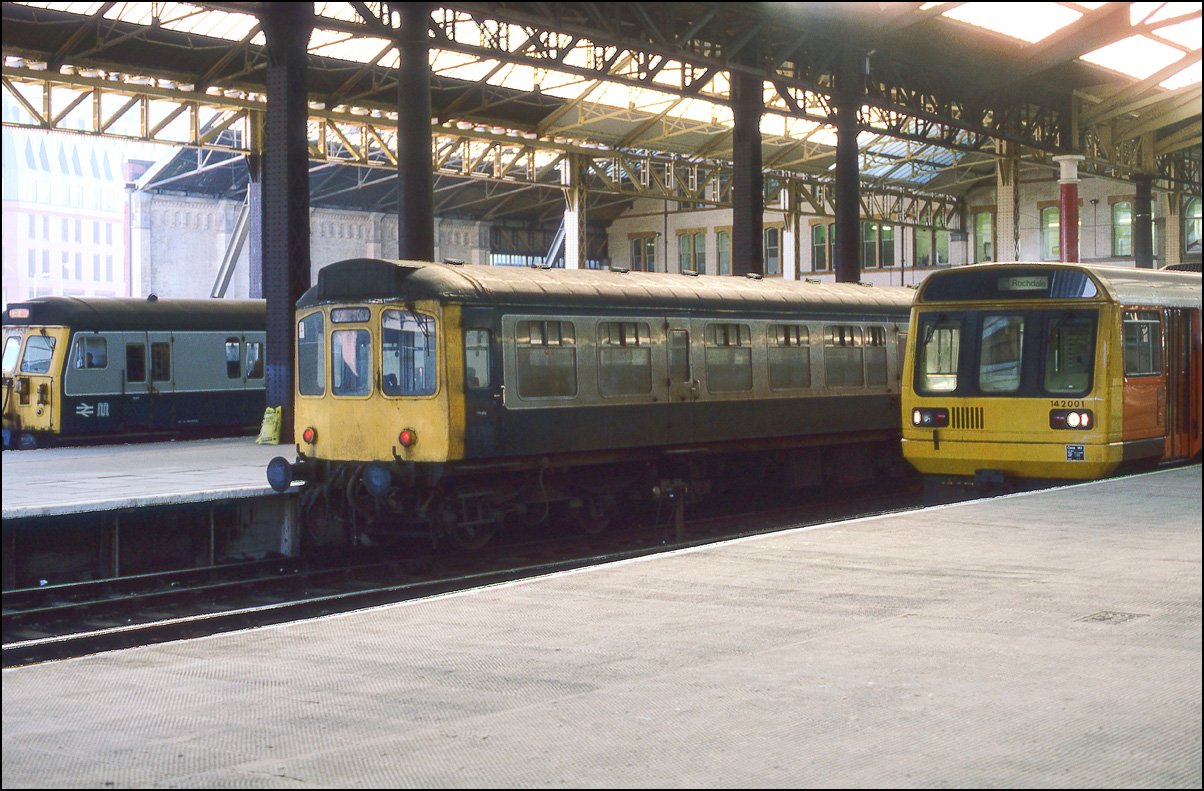 |
This shot shows not only a class 110 unit, but 142001 and one of the unique third rail Bury electrics inside Manchester Victoria on 27 February 1986. It is to my lasting regret that I didn't make any effort to record this DMU class or the electric units, particularly as a lot of the line to Bury retained semaphore signalling right to the end. |
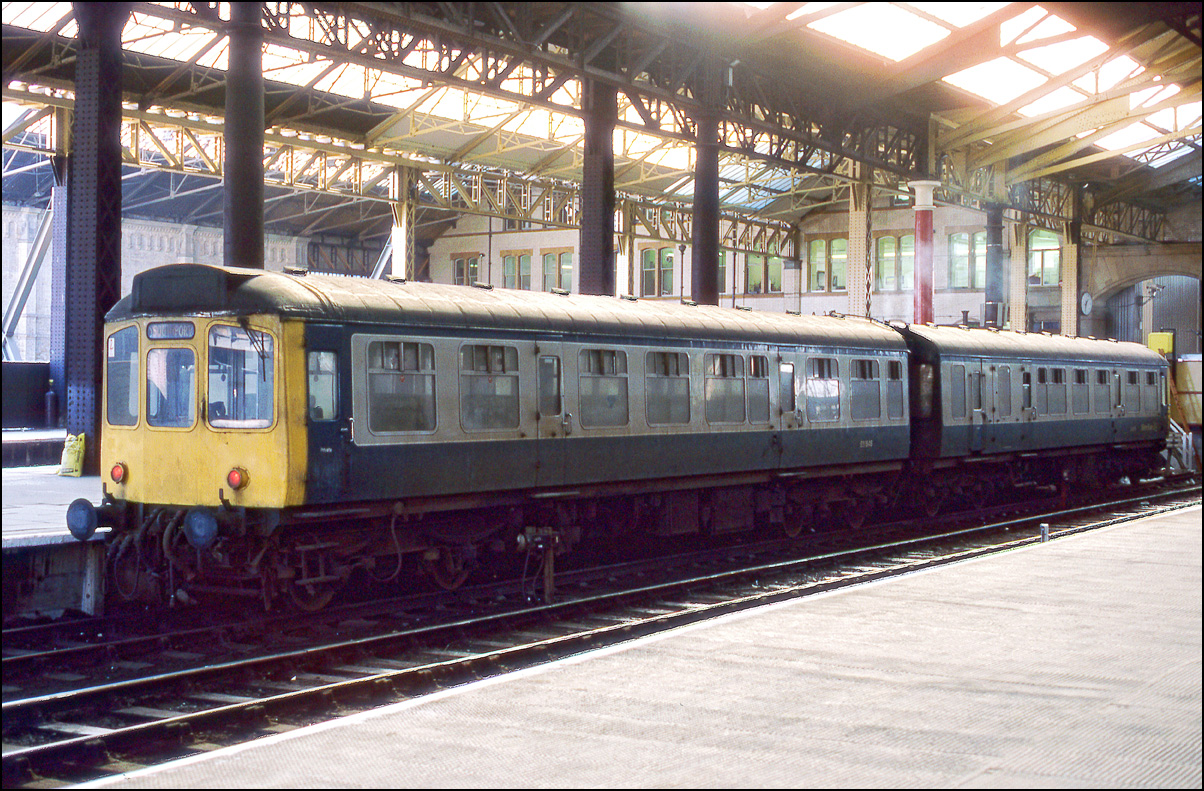 |
The class 110 Calder Valley units were not long for this world by February 1986 so I took the opportunity for a couple of shots in the bay platforms at the east end of Manchester Victoria on the 27th of that month. The light was very low inside the cavernous station, but I was quite pleased with the atmospheric outcome. The destination blind on this somewhat grubby unit states it is off to Southport. |
|
|
The first HST to visit Stratford-upon-Avon arrived at the start of the May 1988 timetable working as a morning departure from London Paddington. The arrival was at lunchtime which was good as far as getting out of work for a photograph was concerned but less so on a sunny day with the sun in exactly the wrong place. The colour shot I took as the train drew to a halt was hopeless but a black and white negative was, after a lot of fiddling about, able to produce a reasonable image. |
|
|
It was necessary in 1988 for a train arriving at Stratford to shunt from platform 1 into either P2 or P3 before departure and here is the first HST to come to the town as it arrived in P2 on 16 May 1988 before the long wait, some 2 hours or so, before departure to Paddington. I used the return train on several occasions and it was usual to have a carriage to myself as far as Oxford which may explain why it ran for only one season. The hoped-for influx by rail of day visitors to the town didn't materialise and as today the vast majority arrived in road coaches on organised trips. |
|
|
I was surprised that the HST ran quite so far along platform 2 at Stratford-upon-Avon on 16 May 1988. In retrospect it was a good thing because the train's position alongside a flowerbed and a slight dip in the light allowed this picture to be taken without extreme back or top lighting. There were a few other photographers about and a couple of them can be seen on the Alcester Road bridge in the background. |
|
|
By 1986 class 45s on passenger traffic on the Midland Main Line had all but disappeared and the staple power was the HST. On 25 April 1986two such trains were photographed crossing at the north End of Leicester station but for me the main attraction were the semaphore signals and Leicester North signalbox which all were due for early replacement. |
|
|
Four Northern Rail class 153s travelled from Newton Heath depot in Manchester to Long Marston where they are to be stored by Porterbrook probably prior to be being scrapped. There was a similar move with 3 units on the previous day but Thursday's run was more convenient for me so even with the weather being dull in the extreme I went to a bridge a little way south of Evesham. The train, 5Q94, was running close to time when the signal protecting the Blackminster Road level crossing was cleared and it soon appeared under the Evesham bypass bridge. The units pictured are 153363, 153358, 153332 and 153330 although not necessarily in that order. |
|
|
This picture was taken in the early Autumn of 1985 on a misty day with 3 Tyseley class 116s DMUs adding to the general murk at Saltley, Birmingham. The train was a Birmingham New Street to Skegness service and I assume that this was a regular timetabled working that would cease from the September timetable change. The buffer stops between the two running lines on the left mark the rear end of the headshunt used by banking locomotives required to give heavy freights a shove up the bank near St Andrews. This was a daily sight when loaded MGRs ran this way from East Midlands coalfields to Didcot Power Station which were banked on the approach to Bordesley Junction. |
|
|
The shuttles between Leamington Spa and Stratford-upon-Avon were generally operated with 1 or 2 single units in 1985. On the afternoon of 4 June class 122s 55012 + 55003 were in use and I photographed them climbing Hatton Bank from the field adjacent to the boarded crossing by Hatton Locks. The crossing was subsequently closed and replaced with a tall steel structure as were the other 2 similar crossings in the area. This picture would be impossible in 2021 as the growth of lineside vegetation has been so rampant that one can walk along the paths here and not know that a railway line existed unless a train passed by. |
|
|
On 11 April 1986 Tyseley class 116 set T620 was climbing Hatton Bank with an ECS working from Leamington Spa to either Tyseley depot or Birmingham Moor Street. Hundreds of tress were later planted along the fence line by the landowner who was concerned that birds from his pheasant shoots would fly too low when being driven from the adjacent field of cover crops. The result today is a linear wood hiding the line altogether. |
|
|
A few minutes after the picture shown above was taken this class 101/116 hybrid set formed of 53245 + 53054 was pictured descending Hatton Bank forming the 14,12 Stratford-upon-Avon to Leamington service in place of the usual single or double class 122 set. The Down Goods Loop was very rarely used at this time as there was plenty of time between local trains, the only passenger services on the line at the time, for the frequent freight workings. |
|
|
Class 122 single unit 55003, Tyseley set T053, was in the Cold Store Siding at Stratford-upon-Avon on the sunny early morning of 1 June 1985 alongside a hybrid set led by a class 116 DMBS and numbered T626. The latter had just been started before forming the first train of the day to Bimringham Moor Street, the 06.20 departure from Stratford, while the class 122 would be next with first train to Leamington Spa. Stratford station was both a stabling and signing-on point at the time with several train crews being based here. |
|
|
On a wet day 11 April 1985 I photographed Pressed Steel class 121 sun, also known as 55035 and ADB 975659 leaving a signal stop at Newport. Since 1978 the unit had been operated as a route-learning train based on the Western Region, finally being withdrawn from Old Oak Common in April 1992. |
|
|
For the 1985 Summer timetable an 06.37 Saturdays Only Stratford-upon-Avon to London Paddington train was introduced. Contrary to a rumour started by one of the station staff at Stratford this was not a class 50-hauled train to match the weekdays Paddington to Birmingham express which ran via Hatton but a DMU formed on most occasions of a pair of 3 coach Tyseley class 166 units. On 25 May 1985 I saw the ECS arriving from my then home's kitchen window and went to the station to capture this view of a pair of Derby-based class 120s led by EP510 (probably 50713 + 59257 + 50667) in platform 2 with 55012 heading a 3 coach class 116 in P3. It was common practice at the time for Tyseley to use whatever resources they had available but this was the only time that I saw anything but class 116 units on this train. |
|
|
The routing of the Stratford-upon-Avon to Paddington train was unusual in that it ran along the Chiltern Line, then partly single track, and Northolt Junction to Old Oak Common West Junction. Although using the service several times as a cheap and easy way for a day's photography in London I didn't take any pictures of the train except in Warwickshire but Geoff Plumb has been kind enough to supply me with this shot taken at the site of Haddenham & Thame Parkway station on the morning of Saturday 9th May 1987. This was the last day of that year's winter timetable and the train was withdrawn after the summer timetable making this was the last time it ran. It was the Saturdays Only 06.40 from Stratford-upon-Avon to Paddington working, the Saturday equivalent of the Monday to Friday loco-hauled train which at that time ran from Leamington Spa at 06.55 to Paddington. Here the train is operated by a Tyseley based Class 116 DMU set No. T322 plus an unidentified set forming a six-coach unit. Work started on the site to build the new station the following Tuesday, 12th May 1987. The copyright of this image is held by Geoff Plumb to whom my thanks for scanning, processing and sending me this picture. |
|
|
This picture of the down Saturday DMU from Paddington to Stratford-upon-Avon was taken by Paul Davis in May 1985 and shows T614 leading another class 116 into High Wycombe. I regret not having visited this station whilst the array of lower quadrant semaphores was still in use. My reason was for the lack of a trip was probably because there very few trains other than Chiltern Line DMUs in the area at the time and I mistakenly considered that my time would be better spent elsewhere. My thanks to Paul Davis for sending me the hi-res scans of these 2 images. Copyright is held by Paul. |
|
|
This earlier picture of the Stratford to Paddington train also comes from High Wycombe but was taken on a snowy morning in February 1985 as T606 leads another class 116 into the station against the backdrop of the massive brick-built retaining wall. The view of the other end of the train is almost impressionistic with the sun glinting along the bodysides of the unit and making virtual silhouettes of the signals. |
|
|
There were diversions of Inter-City expresses through Worcester Shrub Hill on 29 March 1986 and amongst all the locomotive-hauled traffic were the usual DMUs. This picture shows class 117 set B432 formed of 51412 + 59522 + 51370 arriving at the station with a Bimingham New Street to Hereford service. Note that the calling-on arm of the signal part way down the post is in the "off" position rather than the main arm to allow access to the platform prior to a reversal and journey through Foregate Street towards Hereford. This signal has been replaced, and moved further back towards Tunnel Junction to improve overlap, with an LED version with white position lights for calling on purposes. My thanks to Paul Stewart and Ian Hatton for the up-to-date information on the Worcester signalling. |
|
|
Another Birmingham to Hereford train is seen arriving at Worcester Shrub Hill on 29 March 1986. This time it is class 119 set B596 (51099 + 59416 + 51076) which will reverse in the platform. The driver has been a bit quick in changing the lights on the leading vehicle from white to red prior to coming to a halt. The small signal arm on the gantry was lowered to allow 08781 to leave the station a few minutes later to the site once occupied by the shed which can be seen in this view of 37429 running light engine from the Hereford line. |
|
|
After reversal at Worcester Shrub Hill on 29 March 1986 class 119, identifiable by the red stickers denoting extra luggage space when uised on trains to Gatwick Airport, set B596 was routed around the sharp curve towards Worcester Foregate Street and onwards to Malvern and Hereford. The structure unfortunately only part-visible in the foreground is thought to be the remnants of a World War 2 air-raid shelter, complete with flue for a heating stove, for use by railway staff. My thanks to Robert Pritchard for the information on the shelter. |
|
|
A class 116 made unidentifiable by the board telling passengers that it is a an express between Worcester Shrub Hill and Birmingham New Street was photographed in about 1986 passing non-stop through Langley Green station. The magnificent buildings in the background are the Langley Green maltings know as Showall's Maltings after the brewer Walter Showall who brewed beer nearby for distribution across the West Midlands. The Maltings were built in 1898 alongside the Titford Canal and continued in use until 2006. |
|
|
Taken from the other side of the line at Langley Green in 1986 is Tyseley's class 117 set T632 pictured pulling away from the stop in the station heading for Birmingham New Street with a train from Worcester. The signalman has wasted no time in returning his inner home to signal to danger. |
|
|
A rural-looking scene taken from the Down Goods Loop looking over the Stratford-upon-Avon canal as class 122 single unit 55005 leaves Stratford with the 08.12 to Leamington Spa in the summer of 1986. The tall upper quadrant signal in the left controlled the train's exit from platform 2 while the lower quadrant semaphore had just been cleared to let a 3 coach class 116 enter platform 1. |
|
|
My real reason for being at Hatton on 22 November 2021 was to take an image of Network Rail's 153385, their most recent Video Inspection Unit. Part of the attraction is that the EM colour scheme has been retained for the time being although I imagine that the overall yellow livery will be applied at some future date. The unit running as 2Q11 should have passed this location at 09.56 but it was 163 minutes later when it finally appeared after leaving Eastleigh 130 minutes late. There are very few locations for anything coming north in the middle of the day and a going-away shot here was just about the only option although it would have better about 40 minutes earlier to have shown a clearer view of the video cameras. |
|
|
The original Birmingham Moor Street station was closed on 26 September 1987 when the line through the tunnel to the redeveloped Snow Hill came into use. In January 1987 I had a few visits to the old Moor Street station to get some representative shots before the idea became too popular later in the year! This picture from 29 January 1987 shows class 116 T524 entering the station with a service from Leamington Spa. The adjacent car park with its waist-high wire fence was a convenient location for pictures which also gave a view of the industrial area around Bordesley. |
|
|
Later on the same day as the picture shown above T524 was again in Birmingham Moor Street station having arrived from Stratford-upon-Avon and was being prepared to return to the same town. I don't know what the two vehicles to the left of the DMU were doing in the siding but assume that they had been left there after some sort of engineering work over the previous weekend. Freight traffic to the yard here had ceased from 1972; before I started railway photography or even owned a camera other than a plastic Kodak Brownie 127. |
|
|
This is another shot from the car park at Birmingham Moor Street which I took on 29 July 1987 and shows class 116 T524 through a 200mm lens approaching the station with a train from Leamington Spa. I don't much like the over-use of long lenses but the compressed perspective does work well in some locations with an interesting background. The line to the left is that going to Handsworth, then just a truncated branch line used by a few trip freights but in 2021 is the two-track main line between Birmingham Snow Hill and Worcester. |
|
|
A general view of Birmingham Moor Street on 29 January 1987 with class 116 T615 waiting to leave for Leamington Spa and a similar unit behind it probably on a terminating train for Dorridge. |
|
|
Tyseley's class 116 T620 formed of vehicles 53878 + 59612 + 53056 was photographed near Smethwick West in June 1987 with a Birmingham to Worcester fast service. The shot nearly didn't make the cut because of the poor framing caused by me pressing the shutter release too late! The redeeming feature was the information board in the central cab window telling the public that this train was an express. |
|
|
This is a poor quality image but is included here because it shows a newly painted class 116, T624, approaching Small Heath with a Birmingham Moor Street to Stratford-upon-Avon train on 22 March 1986. I never felt entirely comfortable in this location if no other photographers were present as there was a bit of a dodgy pub immediately to the left of the road bridge but on this occasion there wasn't an issue because 2 steam-hauled workings were working away from Birmingham... |
|
|
It was quite common on the 1980s for a 3 coach DMU to be strengthened with the addition of a single coach unit largely to improve the power-to-weight ratio of the train. On this occasion the leading unit was carrying the ID board T034 in the cab window but this was, as far as I am aware, a 2 coach class 114 set. I photographed it at Hatton North Junction on 30 April 1986 before the junction was upgraded and a tall footbridge erected to carry the public footpath across the line. The boarded crossing was made of old sleepers and was slippery in wet conditions - not great for a line with a lot of quite fast-moving freight! |
|
|
Metro-Cammell built two prototype class 151 diesel-hydraulic DMUs intended to replace 1st Generation DMUs trains but for various reasons the design was not considered a complete success and were dropped in favour of class 150. I have a few pictures of the class 151s and this possibly the best showing 150001 entering Derby station on 4 June 1986 with a working from Matlock to Nottingham. The other class member is seen here at at Stourbridge Junction on 15 February 1986 while on trials. |
|
|
The other prototype 2nd generation DMU was the ultimately successful class 150 with 150002 seen at Derby on 13 June 1985. Units of this type are still operating 2021 although no in the West Midlands where they were ubiquitous until a few years before the introduction of class 172. I photographed 150001 again approaching Bentley Heath, Dorridge on 19 March 2009 not long after it had been painted into the then new colour scheme for West Midlands suburban stock. |
|
|
Although I don't much enjoy travelling by rail I did have a return trip in 150002 between Derby and Matlock on 13 June 1985, probably because the weather was a bit grim for colour photography in the days of Kodachrome 64. |
|
|
I've had it in mind to go to Stratford-upon-Avon station for a picture or two of 3J04, the Freightliner operated RHTT, now that it is dark by the time it arrives. On Thursday 4 November 2021 I noticed that in addition to 3J04 one of the class 196 test runs, 5Q27, was running about 70 early because most of the WMR passenger services were cancelled. This meant that it would be in the station at around the same time as the RHTT. I miscalculated how quickly it would run down from Bearley Junction and get ready to reverse, so much so that it was pulling out of platform 2 as I arrived. My camera was already set up for after-dark photography so a grab shot was taken as 196002 receded from the lens. |
|
|
Even the most mundane scene is transformed into something more interesting by after-dark photography. This picture shows 165003 just about to leave Stratford-upon-Avon on 4 November 2021 working 1U71, the 17.38 to Banbury. There were some very frustrated customers on the station waiting for trains running to Birmingham Snow Hill and beyond. All the peak hours West Midlands Railway services between 16.23 and 18.58 were cancelled. |
|
|
The regular test train, 1Q48, ran to Stratford-upon-Avon on Tuesday 2 November 2021. The previous month's run had been cancelled because the stock was under maintainance and for the November train the usual locomotives, 67023 + 67027, were unavailable through being on RHTT duties and were substituted by Colas HST power cars still in LNER livery 43251 + 43272. This was the first visit of HST PCs in this colour scheme to the terminus so I went to the station for a shot or two. Here is 1Q48 arriving in platform 1 with 43251 leading in a pool of light from the station's LED lamps. For anyone interested the techincal details for the picture are Nikon D800, ISO 6400, 1/200 sec @ f2.8 on a Nikon 50mm prime lens. |
|
|
On 2 November 2021 test train 1Q48 from Tyseley LMD was about 8 minutes late arriving at Stratford-upon-Avon with Colas/LNER power cars 43251 + 43272. The latter was to lead from Stratford and here it is after the crew had swapped ends ready for reversal. They were keen to get going after the late arrival but were kind enough to give me the chance for a set of bracketed exposures and can be seen watching for my thumbs-up before they moved. In reality, this took only about 20 seconds and this image was taken on ISO 4000, 1/125 @ f2.8. |
|
|
On an exceptionally murky 27 February 1988 155317 and an unidentified similar unit approach Droitwich Spa station with a Birmingham to Worcester (via Bromsgrove) service. Most of these 2 car trains were converted into single car class 153s which were used to replace the increasingly aged single unit DMMUs. |
|
|
This picture is dated 6 May 1986 and shows 55000 shunting from platform 1 at Stratford-upon-Avon into P2 after arriving from Leamington Spa to where it would return as the 08.12 to the spa town. The time-consuming shunt was necessary because, before major signalling work here, only ECS movements were permitted over the crossover which 55000 is using. |
|
|
As soon as 55000, shown above, was safely in platform 2 at Stratford-upon-Avon on 16 May 1986 an arrival from Birmingham Moor Street was allowed to enter the station ready to form the 08.26 back to Birmingham. Tyseley class 116 unit T627 formed of 53061 + 59596 + 53092 is shown here passing the inner home signal with the starters for platform 3 and the Cold Store siding on the right of the picture. Half of Stratford East (sometimes wrongly called Stratford North) signalbox is just visible at the back of the 3 car unit. |
|
|
Friday 16 May 1986 was a working day but before going to my office I hung on at Stratford-upon-Avon just long enough to take this shot of 55000 leaving the terminus with the 08.12 to Leamington Spa. It was originally taken vertically but I've cropped it to a nearly square format so that it better fits a web page. Class 116 T627 is in platform 1 ready to make a shunt move ino platform 2 before forming the 08.26 to Birmingham Moor Street. The signalmen, station staff and many of the train crews knew me at this time and were happy enough to let me wander around the station area at will knowing that I probably wouldn't get myself squashed! |
|
|
On Monday 5 May 1986, a couple of weeks the 2 shots shown above were taken, I dropped into Stratford-upon-Avon station while walking home from work and took this picture of class 116 TS618 (vehicles 53073 + 59592 + 53891) moving between platforms 1 and 2. It would head to Birmingham Moor Street as the 17.26 service from Stratford. The background is very different in 2021 although the units used by small local businesses in Western Road are still fully occupied and busy. |
|
|
Network Rail's class 150 test train 950001 ran from Derby RTC to Bristol Temple Meads Motorail Platform on Wednesday 20 October 2021. The itinerary included a run along the North Cotswold Line and the Long Marston branch and given the time of day and the chance of a sunny shot I chose Evesham station as the best location. The train, 2Q08, was running a few minutes late but this was a good thing as a large patch of cloud cleared away just as 950001 passed under the road bridge at the other end of the station. The garden alongside the up platform is a real treat and a tribute to the volunteers who have worked hard to make it a valuable habitat for many insect species. |
|
|
Tyseley's DMUs, mostly class 116s, were seen at Kings Norton every few minutes while working between Four Oks, Longbridge and Redditch. Clas 108s did appear now and again but this 5 coach pair were working an Adex on 19 April 1986 which accounts for their presence on the down fast line. My notes simply mention that was a 5 coach 108 working an Adex with no detail from or to where the train was working. |
|
|
Tyseley depot has for many years hosted other regions' DMUs when fuelling is required as was the case on 22 March 1986 when 3 all-blue Cravens class 105 units were photographed heading towards Birmingham New Street ready to go east on a Norwich service. The trailing set is number 42, probably formed of 51272 + 54443, with the instantly recognisable Birmingham city skyline in the background along with the well-used freight yard on the left. This scene has changed since the date of this picture with new housing on the right, a rationalised yerd on the left and many changes to the city buildings in the background. |
|
|
This is a shot of the usual 3 coach class 116 forming a Birmingham New Street to Kidderminster service approaching Stourbridge Junction on 8 March 1986. The set number is T514 and in this period the black boards in the cab window had the TS prefix, so they are listed under that on the railcar website. The vehicles in this picture should be 53870 + 59629 + 53923. Also of interest is 25205 in the sidings which would have been on standby duties should a northbound freight have needed banking assistance on the now-closed line through Dudley towards Bescot. There must have been such a train expected on this Saturday morning because there certainly wasn't a locomotive stabled here every week, at least on the weekends that I visited. Thanks to Stuart Mackay of the Railcar UK website for the additional information about the Tyseley set numbers. |
|
|
On a sunny morning it was all too tempting to photograph everything that moved so here is another class 116 at Stourbridge Junction, this time T506, making the same journey as the set in the picture above on 8 March 1986. Despite the frequency of passenger trains on this route and the relatively large number of trains from the Bescot to Stourbridge freight line, the Down Goods Loop wouldn't have seen a huge amount of use. This was because anything from the fright line needing to have been held would simply have waited at Stourbridge North Junction. Freights from the Old Hill line, although fewer in number, may well have been turned inside here although the coating of rust on the rails suggests that this wasn't a daily occurrence. I also think than ECS workings, especially when the single coach set used on the Stourbridge Town shuttles was swapped for fuelling and maintenance at Tyseley, would have been routed along the loop to await a path across the main lines to the sidings. |
|
|
Vivarail is taking a Battery Electric Multiple Unit (BEMU) to Glasgow to demonstrate the technology at the COP 26 climate summit in November 2021 and testing of the unit commenced on the North Cotswold Line on 12 October. I was annoyed with myself that after a non-show in the morning the afternoon run went unnoticed until it was too late. The following day I was hopeful of the scheduled run starting at 09.29 taking place so went to Long Marston in time for this first departure. Despite a lot of orange suits both in and around the repurposed original ex-D Stock prototype 230001, nothing happened until 10.17 when the light on the top of the front end came on. By then it was raining and misty with poor visibilty but I still took this shot as it ran into road 1 before the gates were opened to allow it out onto the branch to Honeybourne. I had been across to Long Marston during the previous morning but 5Q01 was cancelled and all that moved was D Stock car 7601. It looks as if it were under battery power but there was a fork-lift truck alongside out of view providing the power. |
|
Within a few moments on 13 October 2021 230001, running as 5Q01 despite being shown as cancelled, was on the branch and thus being the first BEMU on the national network for quite some time, possibly since the unit used on the Aberdeen to Ballater branch from 1957 to 1965. The final livery will understandably not be unveiled until the train is demonstrated at the COP 26 climate summit in Glasgow in 2021 but I guess that the colour green may make an apprearance! |
|
|
There was plenty of time for a drive to Honeybourne for another shot once the crew of 230001 had deposited the single line token in the hut. The signal to join the North Cotswold Line was given straight away and 5Q01 passed non-stop around the back of the station before going across Honeybourne North Junction and onto the down main line. |
|
|
Several runs between Honeybourne and Evesham West Junction were planned for 13 October 2021 so I went to Evesham for the next movement, due about 40 minutes later. The sky had cleared considerably by the time that 230001 returned, so much so that this picture was taken against the light as it passed through the station on the way to Evesham West for reversal. |
|
|
While 230001, now running as 5Q06, was reversing at Evesham West Junction on 13 October 2021 before returning to Honeybourne Sidings the sun very nearly managed to come out. It wasn't fully out as the train accelerated towards the station but it was enough to cast a shadow and show off the changing colours in the lineside vegetation. |
|
|
A different sort of RHTT on Saturday 9 October 2021. I think this was the first run this year of the North Warwickshire Line's daylight rail spraying train 3S53 and as with the locomotive-hauled version on the Hatton line to Stratford-upon-Avon it seems a bit premature as the leaf-fall season hasn't started around here at least. I did think that some Autumnal colours might be in the background at Edstone Aqueduct near Bearley hence a trip out for a picture but with the exception of some hawthorn berries everything was still green. The train was running about 15 minutes early because of the cancellation of a Kidderminster to Stratford passenger service. It is usual for at least one diagram not to run each day at the moment through a shortage of train crews. |
|
|
Stratford-upon-Avon's service from Chiltern Railways is patchy to say the least. Although there are direct trains to London Marylebone no-one in their right mind would use them for the entire journey as it is much quicker to change at Leamington Spa or Banbury and thus avoid the all-stations stopping programme suffered by the former. A waste of time - more frequent trains connecting at Leamington Spa would be better but some dogma seems to suggest that a direct train is more prestigious for the town. What nonsense. Anyway, it gets worse; this is 2D16, the 16.48 from Hatton to Stratford, at Stratford Parkway meaning that any through passengers from beyond Leamington, not many it must be said, would have to change both at Leamington and Hatton, the latter being about the least hospitable on the line. |
|
|
No room in the bays. This was the scene one Saturday morning in April 1985 with every bay road on the down side at Leamington Spa occupied. The train on the left has a window board reading T619 but it appears to be a single unit as was the practice at the time, preparing to head off to Stratford-upon-Avon within the next few minutes. Next in line is 58016 which was also getting ready to move out onto the main line. This was a weekly occurrence at the time and I seem to recall that the locomotive involved may have taken over a northbound freightliner with the other engine coming off the train but I didn't make any notes and can't remember exactly what happened. To the right of 58016 is T623, probably formed of 53838 + 59603 + 53893, and then a second class 116 with no set number visible. The latter 2 units were stabled ready to work trains to Birmingham Moore Street later in the day. |
|
|
Class 117 DMU T311 ( 51334 + 59500 + 51376) were pictured arriving at Stratford-upon-Avon with an early afternoon train from Leamington Spa on 26 April 1991. The signalling arrangements had recently been changed here with a new starting signal for platform 2 and alterations to the point locking arrangements for the exit from platform 1 meaning that trains were able to depart directly from there, under the control of the tall starter, rather having to shunt to P2. Trains were still not able to arrive directly into P2, this not being possible until later signalling changes when control was shifted to the West Midlands Signalling Centre at Saltley. |
|
|
Four coach class 116 sets were relatively unusual at Stratford-upon-Avon but on 26 April 1991 set T420 (53092 + 59607 + 59032 + 51892) visited the terminus with an afternoon arrival from Birmingham Moor Street. The white and red lights on the front of the unit shows that it was about to shunt into platform 2 to allow a Leamington Spa service to use platform 1. |
|
|
In 1991 only a few trains between Birmingham and Worcester ran via and stopped at Bromsgrove which then had just one platform on the up side meaning that a line-blocking move was required. The trains were mostly operated with a single unit DMU such was the low demand for seats. On 27 April of that year 55032 was on duty and I photogrpahed it approaching Droitwich Spa after travelling along the largely single track from Stoke Works Junction. There are 9 semaphore signals in view along with the remains of the rail-served coal depot which was in the process of closure and removal by this date. |
|
|
Another shot at Droitwich Spa shows a 2 coach class 114 DMU formed of 53019 + 54027 working a Birmingham via Kidderminster service again on 27 April 1991. When I took this photograph the garden on the station was well-tended and looked after by the staff but in 2020 the undergrowth and trees along the platform had taken over. |
|
|
Wednesday 22 September was a largely sunny day and after after noticing that the class 196 test runs from Tyseley to Stratford-upon-Avon were working went for a walk including Stratford Parkwat station with a view to taking a shot of whatever was on 5Q24 heading to the terminus station. Running in front of the class 196 was 2S42, the 12.45 from Kidderminster formed of a single 2 coach class 172, 172006. Although looking quite smart in its current colour scheme I much prefferd how it looked just after arrival at Tyseley when still in London Overground colours as seen near Bearley Junction on 27 February 2019. |
|
|
As soon as 2S42 shown above had cleared the section into Stratford-upon-Avon station on 22 September 2021 196012 running as 5Q24 from Tyseley LMD was released and soon passed Stratford Parkway. I picked this location only because the sun's angle was good and not for any aesthetic considerations. The number of lighting and other poles isn't pretty and finding a true vertical isn't easy as the lamp posts have largely been planted in the sloping part of the platform meaning that they lean to some extent. I took the abutments of the road bridge as a guide as they should, in theory at least, be vertical. |
|
|
The Stratford-upon-Avon to Birmingham Snow Hill and beyond services have, after a spell of bus replacements, reverted to trains. It seems hardly worth the effort outside peak hours giving the very poor loadings especially when 5 coaches are rostered, each passenger quite possibly having a coach to his or herself at least as far as Dorridge! This is the 14.03 from Stratford to Kidderminster, 2W80, about to join the Birmingham main line at Hatton North Junction formed of 172221 + 172333 on Monday 20 September 2021. |
|
|
There was a most unusual working on Friday 17 September 2021 in the form of Western diesel D1015 piloting a GBRf 66 on a freight train between Avonmouth and Gloucester so even with a dull morning forecast a trip to somewhere south of Gloucester was called for. I joined the already large group of photographers on the bridge at Gossington some 90 minutes before the freight was likely to appear and took a few shots of the regular passenger traffic. This image of GWR 158956 on 2E56, the 08.41 Westbury to Gloucester was the best of the bunch. It was running a few minutes ahead of the Western which had been recessed in Charfield Loop and was probably the most photographed unit on the line all day! |
|
|
GBRf's regular charter train in support of a nominated charity ran for four days, ending on Sunday 5 September 2021 with the first passenger working for their class 69 locomotives newly converted from class 56s. The real bonus was that the train was routed from Bescot to London via the North Cotswold Line and I fancied a shot around Moreton in Marsh where lower quadrant semaphore signals are in use. I went initially to the road bridge adjacent to the station and took this image of 800107 leaving with the 15.31 from Hereford which has the headcode, sort of appropriately for the day, 1P69. The charter was running late and it soon became apparent that shadows from nearby properties would be quite an issue by the time that the charter arrived so it was time to move. |
|
|
The trackside near Dunstall Bridge, a short distance to the south of Moreton-in-Marsh station is clear of vegetation with the light, if the sun stayed out, being usuable for at least another hour or so and well before the GBRf charter would arrive on Sunday 5 September 2021. Various bits of information came through suggesting that 69002, the pilot engine, had failed with fuel supply issues in the Honeybourne area but the train was able to continue with 69001, the train engine providing all the power. When the time for it to arrive came the signals both for the up and down lines were lowered leading to a certain amount of angst for the 3 of us there about the scheduled train from Paddington, 1W51, getting in the way of 1Z35 especially as it had a lost a few minutes since leaving Oxford. All was was well and here if 802010 pasing Dunstall Bridge on the approach to Moreton in Marsh. |
|
|
I was mildly surprised to see the "Midline Bubble" on the main line from Derby to Birmingham in the May 1988 when it was photographed approaching Water Orton. Mechanical DMUs were not common on this line at the time with Sprinters having taken over most services. The destination board said that the unit was "Not in Service" but wasn't able to find out where it had been but assumed that it was going to Tyseley LMD. I hoped that I might have a colour slide of the working but after a search was disappointed that I don't. The relatively new M42 and part of the long-gone Hams Hall Power station can be seen in the background of this picture. |
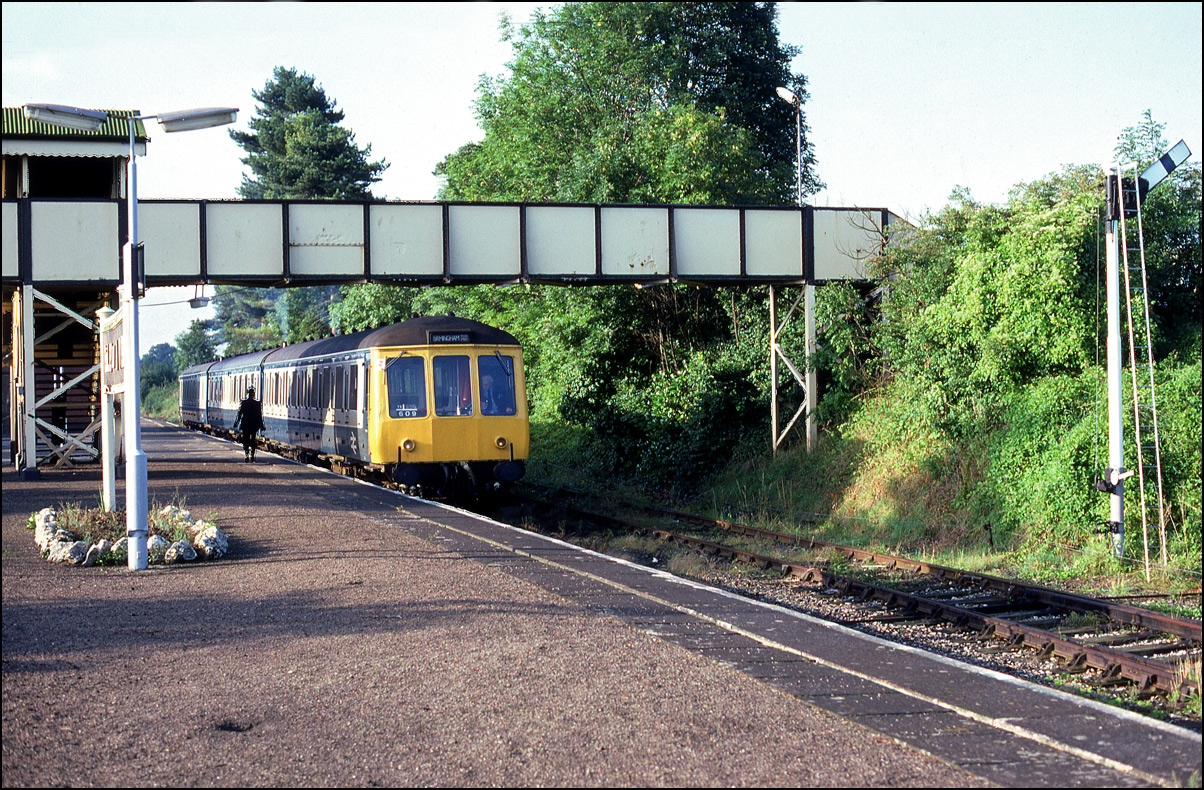 |
An interesting train on the North Warwickshire line to Birmingham in 1986 was the daily train booked to start at 08.13 from Henley-in-Arden which had arrived earlier and was routed into the bay platform; the only service so to do. This gave the rare opportunity to photograph a unit in the otherwise unused platform 3 and to take a picture with the signal in the clear position. The train, formed of the usual class 116 3 car set on this occasions T609,, is seen here on 29 August 1986 with the guard returning to his van in order to give the right of way to the driver. I should like to have had a picture of the DMU nearer the signal but wanted to catch it for the onward journey. A different view of the signals, including the second one controlling the exit from the siding, can be found via the link and an extremely rare shot of a entering the bay not long before it was lifted and one of it standing in platform 3 with 66156 on the down main line |
|
|
This isn't the greatest shot of Smethwick West signal box but I was keen to have a few pictures of trains passing it as even in 1986 there were reports of its closure. This finally happened in 1990 when the line was resignalled. Here is my only picture of a DMU passing the box with T621 passing by on a Birmingham New Street to Great Malvern service on 29 August 1986. I once spoke to a relief signalman who worked the box on occasions and was told that the frame interlocking area had a large population of rats in residence and that the relatively isolated location made it a target for vandals from the surrounding area. Few signalmen mourned its passing. Here is another view of it from 6 May 1991 when unused and awaiting demolition with The Velvet Glove railtour passing by on the single to and from Handsworth. This is now the main route for trains to and from the Worcester line following the opening of Snow Hill station and the upgrading of the former GWR line. |
|
|
Mechanical DMUs were becoming a bit uncommon in the Shrewsbury area by mid-1987 so I was pleased to take this picture of class 101, set 809 leaving the town at Sutton Bridge Junction with a Crewe to Swansea service on 25th May of that year. In 2021 most of the semaphore signals survive but the bracket on the right has lost its low-speed arm controlling the entrance to the down loop as the track was lifted some time ago. |
|
|
A bit later on the same day as the slide shown above was taken, 25 May 1987, I moved to the tower of Shrewsbury Castle and made ready for a shot of D200 working a Cardiff to Crewe service. Shortly before this came along a BR blue single unit forming part of the departmental fleet, 975042, appeared which was easily identifiable by the pattern of flaky paint in the cab roof dome, and possibly the only working LMR Class 122 router learner at the time. As it arrived at the station looking a bit dwarfed by its surroundings, including the Severn Bridge Junction signal box, there was no other traffic in sight save the 08 shunter. In the 2021 the signal box benefitted from a £250,000 refurbishment which, in times gone by, would quite possibly have meant imminent closure! Thanks to Stuart Mackay for the information on 975042. |
|
|
A train from Kings Norton OTP Depot to Long Marston ran on Tuesday 31 August 2021. I assumed that it would be a tamper and that given the poor weather that it wouldn't be worth a trip out but on looking at Railcams I saw that someone had kindly noted that 6X81 was an electrification train formed of DR 76922 (99 70 9131 022-4) and DR76901 "Brunel" (99 70 9131 001-8) and therefore a bit more interesting. The train ran the long way round via Gloucester, Swindon, Didcot and Oxford and after a start around an hour late it was soon back on time after missing out a long stay in Abbotswood Loop. A few minutes were lost along the North Cotswold Line but it soon came into view as it approached Honeybourne for its reversal. |
|
|
There was no rush to get to Long Marston for 6X81's arrival at Honeybourne on 31 August 2021 as it would take at least 25 minutes for the train to reverse and make its way along the branch. Within a few minutes of my arrival the Porterbrook class 01 01544 came from the left-hand side of the site and the crew were very good and parked it in the only gap in the vegetation after exchanging waves with me. The locomotive was built by Thomas Hill in 1977 and was at the Wensleydale Railway before coming to Long Marston carrying the Defence Logistics Organisation Purple and White colour scheme. |
|
|
There is a 5mph speed limit over parts of the Long Marston branch despite much of the track having been renewed in recent years and seemed to take an age for 6X81 to get to the road bridge. Signs of Autumn are clearly apparent in the hedgerows with hawthorn berries giving a touch of colour amongst the green vegetation. |
|
|
The gates were already open at Long Marston on 31 August 2021 as the men visible on the pile of aggregate on the left of the picture were involved in replacing the pallisade fence removed when the trackbed of the GWR main line to Stratford upon Avon was cleared and flattened. Nothing seems to have happened with the land and I wonder if was just a speculative move by the current owner to tempt Porterbrook into buying or leasing the land for extra sidings or a runnng loop. The electrification train is due to be here for 3 days and I guess that it may be involved in some work either on the existing 25kv OHLE track on the site or installing a new section. |
 |
The class 101 DMMU known as Iris was taken from Derby to Bishops Lydeard on Tuesday 18 March 2008. The power provided was 31459 which, in its black livery, provided a nice contrast to the two different yellows of the unit. I wanted to be in the Evesham or Pershore area at some point during the day so just went to the nearest point to my home where a reasonably wide view could be obtained so as to show all 3 vehicles. Here is 5Z08 passing Croome Perry wood after being in the loop at Abbotswood for some time to allow the passage of a class 170 on a Cardiff service and an Arriva Voyager on a Cross Country train. I came very close to being bowled out by a northbound Arriva-liveried 170105 which was outside the frame by no more than a few inches. Another colourful unit, or to be more accurate pair of units had also gone south a little earlier, these being FGW's 158750 with an unidentified FGW class 150 on a train from Worcester. |
|
|
The two-hourly shuttles between Stratford-upon-Avon and Leamington Spa were worked by single-unit DMUs for many years. Now and again a pair would turn up as is seen here when 55012 + 55009 formed the 08.12 to Leamington on 25 July 1984. This picture as taken as I stood on the WW2 air-raid shelter which was a large diameter concrete pipe buried in the ground and reinforced with a couple of feet of earth on top. |
|
|
The trailing unit of this set was the more interesting to me on 25 July 1984 as it left Stratford-upon-Avon for Leamington Spa as it ws 55009, one of the few remaining in the all-over blue livery. A colour picture of it at Leamington Spa a few weeks later just before it was repainted. The background to the Stratford image has completely changed in the intervening years. The football ground just visible to the left is now a Morrisons supermarket, the warehouses and chimney stacks above the train have gone although the office block, probably the ugliest building in the town, is still extant and Stratford East Signal box has been demolished. |
|
|
Bentley Heath crossing is a few hundred yards to the north of Dorridge station and the footbridge there offers a decent viewoint in either direction. This picture shows 2 coach 117211 crossing over the pointwork from the up main line to the down platform loop with a local train from Birmingham Moor Street to Dorridge. These still ran at regular intervals throughout the day with one per hour being extended to Stratford-upon-Avon although in August 2021 these are replaced with buses between Dorridge and Stratford because of train crew shortages. |
|
|
Another class 117, this one formed of 3 coaches, is pictured here climbing from the Birmingham Snow Hill LIne towards St Andrews Junction and Birmingham New Street. The train is running ECS from Tyseley depot to New Street where, according to the destination panel, it would make the long run to Skegness. |
|
|
In 1993 there were hourly local trains between Oxford and Banbury operated by Network SouthEast DMUs. On 7 May, 3 coach class 101 in full NSE colours was allocated and it is seen here between Banbury and Kings Sutton stations shortly on an early afternoon working. I didn't take many slides of NSE class 101s and by some coincidence I photographed the same set, albeit still in blue and grey with only an NSE flash on the cab end, at Redhill on 5 March 1988. |
|
|
I visited Redhill in Surrey on 5 March 1988 en-route to Penshurst to photograph class 40 D200 on a railtour. Only after arriving at Redhill was it announced over the tannoy that the tour had been cancelled and so this picture of Class 101 L839 was my sole reward for the journey. The people standing by the unit were other photographers as yet unaware in those pre-mobile 'phone days that D200 wasn't on its way. |
|
|
Vivarail/TfW 230010 was scheduled to leave Long Marston for the last time on 12 August 2021 on its journey to Wrexham for crew training and further testing. As always with these moves there was an element of doubt as to whether it would go but it was worth a drive over to Aldington just in case. While waiting for something to happen a GWR passenger service went in each direction and here is an unidentified 9 coach class 800 passing under under the Evesham bypass with 1P34, the 15.18 Worcester Foregate Street to London Paddington. In the event 230010 didn't run. |
|
|
From the kitchen window of my then nearby home on a date I can't find in my notebooks but probably in 1985 I saw 31426 arrive at Stratford-upon-Avon with the Derby Lightweight Ultrasonic Test Train (TDB975007/8) in tow. It went into the Down Goods Loop where the class 31 was detached, ran along the up main line to the crossover before being coupled to 6Z08 and prepared to leave. Here, the second man watches the locomotive approach along the by then rarely used loop which was taken out of use within a few weeks. |
|
|
It wasn't many minutes before 31426 was coupled to the Ultrasonic Test Train in Stratford-upon-Avon Down Goods Loop and a brake test carried out. After establishing that the crew were OK with my crossing the line I moved to a mound of earth for a slightly higher viewpoint and took this picture as 6Z08 left the loop to use the crossover (which the signalman maintained wasn't fit to use!) and joined the up main line towards Bearley Junction. The set has entered preservation and details can be found here on the brilliant Railcar.co.uk website: essential viewing for anyone with an interest in first generation DMUs. |
|
|
The western exit from Manchester Victoria was an excellent spot for photographing a large variety of traffic including several different classes of DMU. On 27 February 1986 a 3 coach class 120 was pictured on the start of its journey to Blackpool with the well-known background of some industrial buildings adding to the scene. |
|
|
I didn't see or photograph many class 127 Diesel Parcel Units but do have this shot of set 914, formed of 55974 + 55984 shortly after it had passed through Manchester Victoria on 27 February 1986. Irritatingly, this one one of a small handful of slides that weren't taken in sun during the whole period I was here, on the platform of the former Exchange Station. A class 120 unit is about to enter the terminus platforms at Victoria and the end of a journey from Blackpool. |
|
|
It was back to sunshine for this photograph of 2 coach class 101, with MetroTrain branding, formed of E51503 + 51433 passing Manchester Exchange platform on 27 February 1986. I wasn't able to take the conventional angle with the unit approaching teh camera as a class 45 hauling a long freight was in the process of going eastwards and about to pass Victoria station. |
|
|
This was the view around the back of Banbury North signalbox on 25 January 1986 as an unidentified class 115 DMU approached Banbury station following a reversal in the siding on the extreme left of the picture. The train would have left London Marylebone to where it would shortly return. The GWR marshalling yard, once operated on the "hump basis", was officially closed in 1970 although it still received and despatched a small amount of traffic in the 1980s until the land was sold for housing development. The Great Central Railway's Banbury Branch joined the GWR opposite the signalbox and some excellent photographs can been found within this website. |
|
|
Stratford-upon-Avon had several visitations by Buxton based DMUs in the mid-1980s and on the cold and damp 26 October 1985 there was a iL04 from Manchester Piccadilly listed in the weekly STN. I spent a few minutes chatting to Mick, the signalman at Stratford East, only crossing to the other side when he pulled off the outer home signal. The train consisted of a six coach class 104 (plain blue) + 108 (blue & grey) combo with vehicles 53507, 59195, 53029 + 51943, 59388 & 52058 and it was pleasing that that the class 104 was leading as these were less often seen in the West Midlands than class 108. |
|
|
The warmth of the signalbox at Stratford-upon-Avon was welcome on Friday 26 October 1985 and this picture was taken from the window as the 6 coach 108 + 104 DMU shunted from platform 1 to the Cold Store Siding alongside platform 3 where it spent the rest of the day before returning after dark to Manchester Piccadilly. |
|
|
After a warm drink in the signalbox at Stratford-upon-Avon on 26 October 1985 I went out into the cold and took this shot of the contrasting front coaches of class 116 coach M53818 and class 108's M52058 in platforms 2 and the Cold Store Siding respectively. The training tower of the nearby fire station is still extant in 2021 albeit updated to have some uPVC window frames installed to bring this up to date. |
|
|
It's been a long time since there was a clear view of Stratford-upon-Avon station from the Alcester Road bridge but I took this view of BX482 + BX495 on 26 October 1985 as the pair stood in the Cold Store Siding wit a 6 coach class 116 set about to depart from platform 2 on its journey to Birmingham Moor Street. The visitors would later shunt into P2 before making the long journey back to Manchester Piccadilly after the passengers had spent a chilly day in Stratford in the days before all-day opening! |
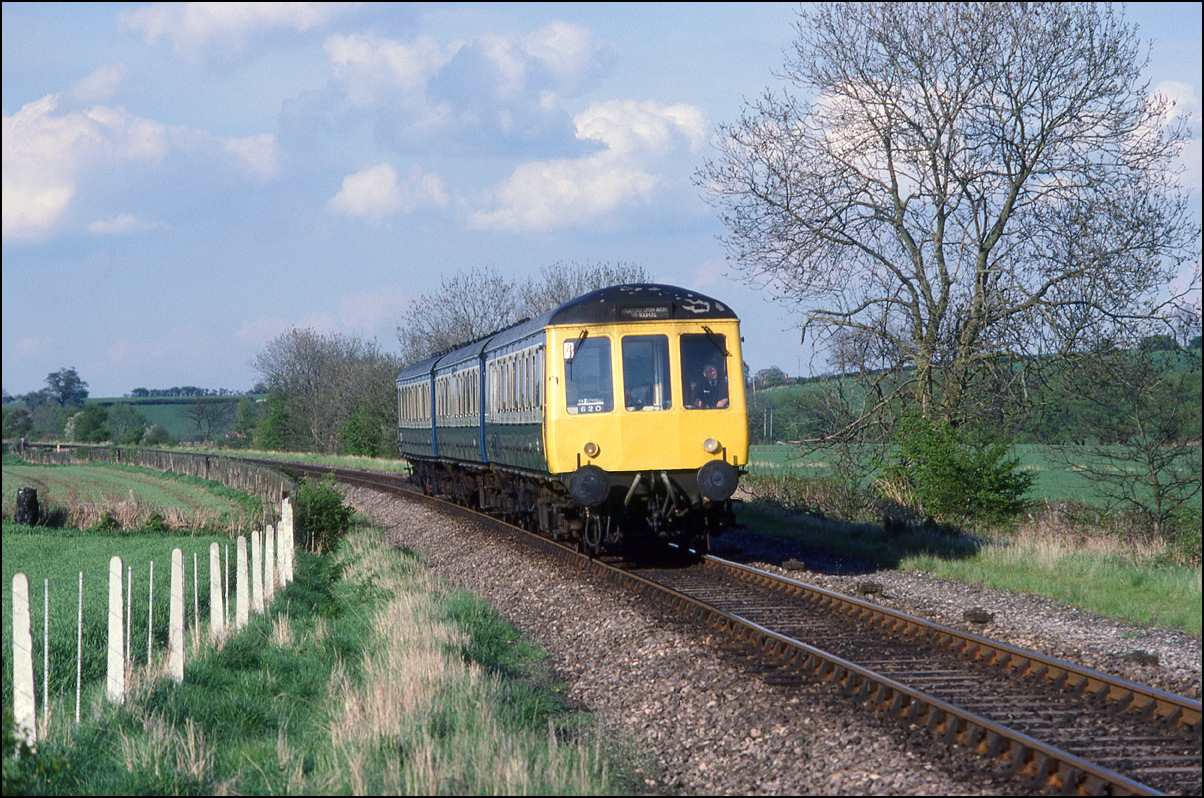 |
In 1986 all but one train each way per day between Birmingham and Stratford-upon-Avon ran along the North Warwickshire Line unlike in later years when an hourly service ran on the route via Hatton North curve and Solihull. On 16 May 1986 a class 116 is seen on the single line near Claverdon with the 17.25 from Birmingham Moor Street to Stratford. The photograph was a bonus on the evening that steam locomotive 777 Sir Lamiel was operating a private charter to Stratford. |
|
|
I shouldn't think that a class 168 arriving at Stratford-upon-Avon has previously been the subject of so much attention as it was on 8 August 2021. This 2 coach unit was forming 2D20, the 10.40 from Leamington Spa and fitted nicely enough between 2 of the photographers who were, of course, there for the class 20s working the Shakespeare Express. |
|
|
I was crossing the road bridge at the south end of Stratford-upon-Avon station on 27 July 2021 and noticed that the usual 5Q21 proving run from Tyseley for a class 196 DMU was for the first time in weeks a 4 coach set. The signal for it to leave was green but there was just time to grab a shot of 196102 befoe it moved away making a change from 2 coach 196002 which has been on these runs for a few weeks. |
|
|
I saw from a mapping app that 5Q21 from Tyseley LMD to Stratford upon Avon was approaching the station on 20 July 2021 and took this image as 196006 ran into platform 2 with 66587 alongside in P3. This unit has now made many trips to Stratford and appears to have run reliably unlike the 4 coach versions which have been down here on previous occasions. |
|
|
Single unit parcel vans were a common sight sight around Birmingham in 1986 and here is 55995 passing under the impressive station building at Small Heath on 3 October of that year. I don't know where it had been working but it went into Tyseley depot a few moments after this picture was taken. |
|
|
I took this picture of class 114 T227 (53019 + 54027) in the bay platform at Rugby station on 16 September 1989 shortly after it had arived from Coventry. It was quite an experience to travel on this unit as it ran flat out up the main line for the whole journey instead of its usual stop-start saunter between stations on suburban lines. The smell of vey hot engines was very evident in the bay as was the sound of them clicking as they cooled. |
|
|
This picture from 2 June 1990 shows T033, a class 108/116 power twin, one of of Tyseley's sets intended to cope with Sprinter timings, passing Smethwick Rolfe Street station with the 09.30 Birmingham New Street to Hereford service. Judging by the young trees by the lineside I very much doubt that this viewpoint is possible in 2021. |
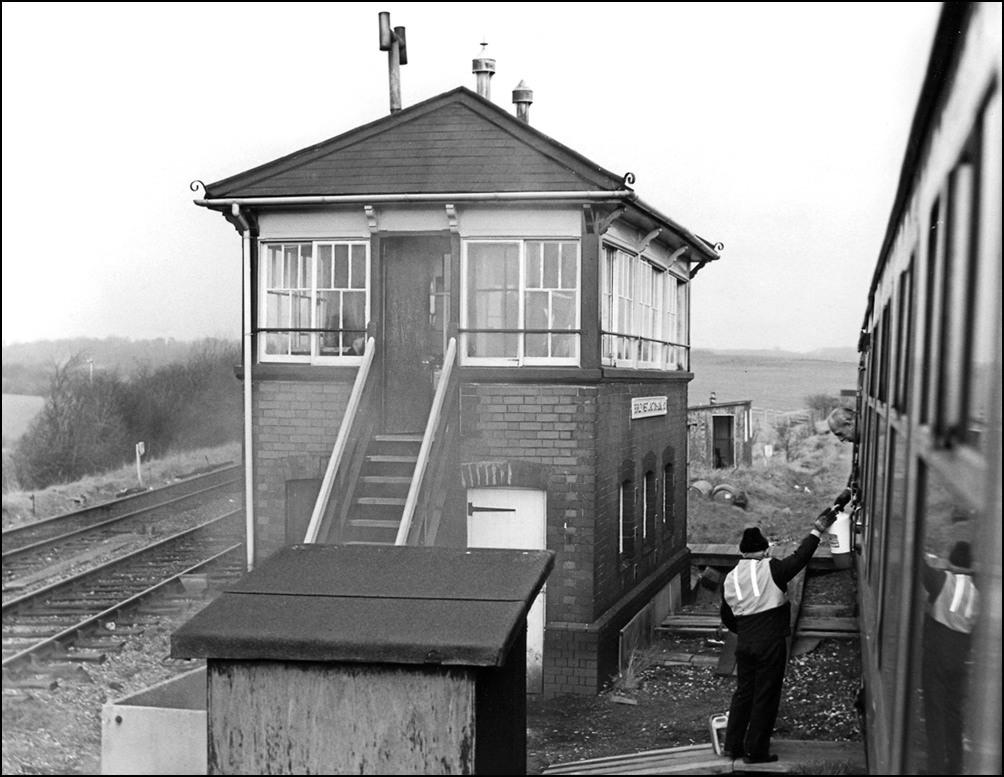 |
As late as 1991, essential supplies of water and coal were delivered from Stratford-upon-Avon to the signal box at Bearley Junction by means of a Leamington Spa bound train. Although an electrical supply was used for the signalling system, lighting and the cooking facilities were still powered by gas using pressurised containers. On the misty and cold morning of 24 January 1991 I travelled on the 08.12 from Stratford with the express purpose of obtaining a photograph of the process in action and here is a water container being handed to John Overfield, the signalman, by the guard of the class 114 DMU. It is scarcely credible that what was esentially a Victorian practice was still going on in the final decade of the 20th century. The nameplate of the box calls this 'box "Bearley West Junction" as, at one time, there were three signalboxes operational here. North Signalbox was situated close to Edstone Aqueduct and controlled both the Alcester branch and a single track curve to Bearley East Junction which was to be found a short distance along the Hatton Branch. This curve was used for diverted traffic on occasions that the Leamington Spa to Birmingham line was under possession and, on at least two occasions, was used to stable the Royal Train overnight. The late Tom Williams took several pictures showing traffic on the curve and these can be found in various publications. This 2010 picture was taken from a broadly equivalent spot and shows the numerous changes both to the 'box and the nearby environment. |
|
|
Three two coach units led by class 115 51679 are seen here at Claydon LN&E Junction on 10 November 1990 with the second Aylesbury to Milton Keynes shopper specials of 1990. The train had travelled via Quainton Road and Calvert and was about to pass Claydon Loop on the way to Bletchley and its destination. The signal on the extreme right shows where the line from Bicester enters the loop which at this time was used by such trains as Whatley to Wolverton stone, the Bath and Bristol to Calvert household rubbish containers and the much-missed Akeman Street fertiliser vans. Some of my many pictures of freight traffic from this area can be found here and here. |
|
|
On 3 January 1987 I had a trip to London Marylebone with the intention of photographing SR 777 Sir Lamiel leaving the station with a special to High Wycombe. LNER 4472 Flying Scotsman (or Flying Moneypit as it often called today) was also involved and is seen here waiting for a path to the stabling point. Of more interest in this section of my site are the two unidentifiable class 115s pictured in heavy backlighting as they form up and down Banbury services. Backlighting really works well for steam on a cold day and here is 777 just after starting its journey and about to enter Lords Tunnel. The parapet of this road bridge is particularly high and it was necessary to either have high steps, or as I did, stand on the roof of a Land Rover complete with a platform and access ladder owned by another of the photographers present! |
|
|
I took this shot of another anonymous class 115 as it performed a shunt move, shown by both red and white lights being lit, at London Marylebone on 3 January 1987. This shuffling about is no longer necessary in 2021 as changed signalling arrangements mean that there are no longer dedicated arrival and departure platforms at the terminus. |
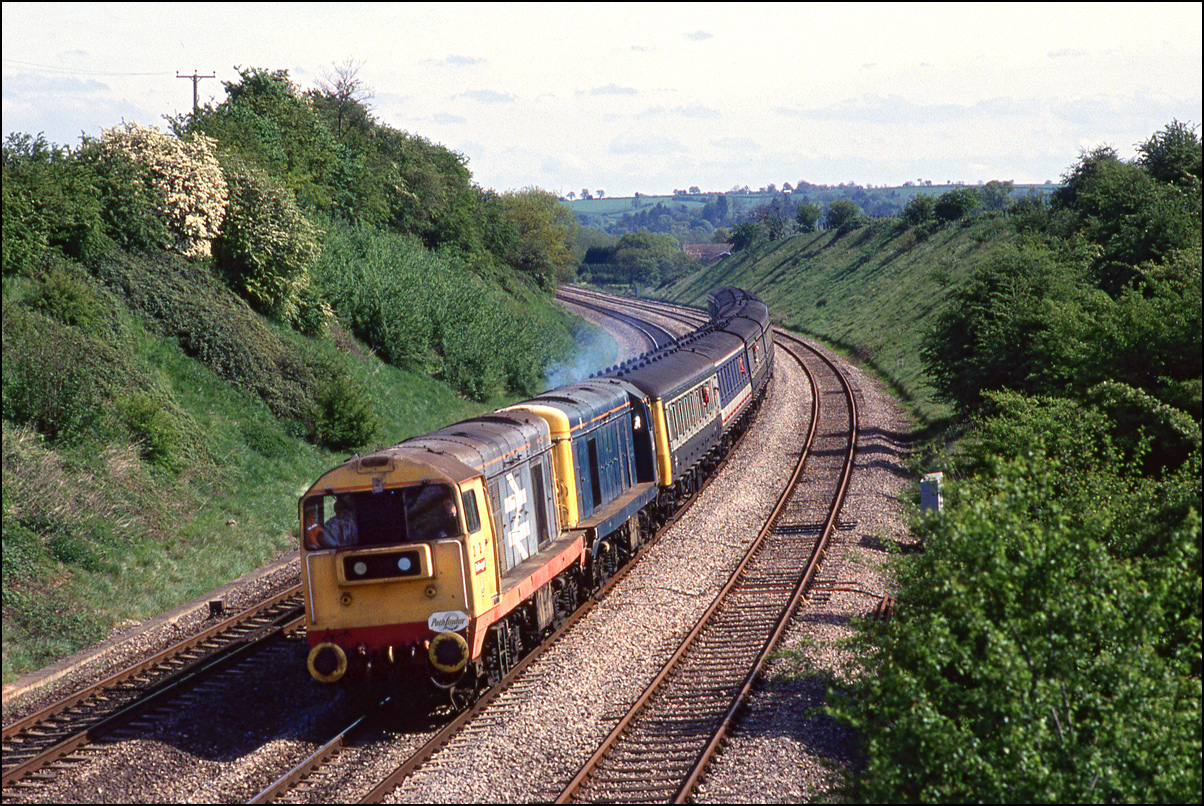 |
The next 4 images show a mini-railtour run by Pathfinder in connection with an open day
at Worcester on 2 May 1993 using 20138+20066. The 2 locos were, unusually, hauling 2 4 car DMUs, T404 (51853+59735+59604+53919) + T412 (51860+59591+59446+53116) which ran from Birmingham New Street to Worcester via the Lickey
incline, and then on to Hereford and back via Great Malvern. 3 out of the four shots I took of the train were in full sun, the
only which was not was the return from Hereford. This caused me some amusement due to the comments from certain characters about the
day being a complete waste of time as this one shot at Stoke Edith (out of 7 for the day which they attempted) was not in sun. As you can see below the colour shot was still quite acceptable,
at least as a record of 20s on this line.The first shot was taken as train slowed for the junction at Stoke Prior before it turned onto the single line to Droitwich and Worcester.
|
 |
After a quick drive down to Ashchurch with a couple of minutes to spare, the second shot presented itself. It is interesting to note that the trees on the up side of the line were still quite small in 1993. They subsequently grew very tall and last year, 2004, were felled. |
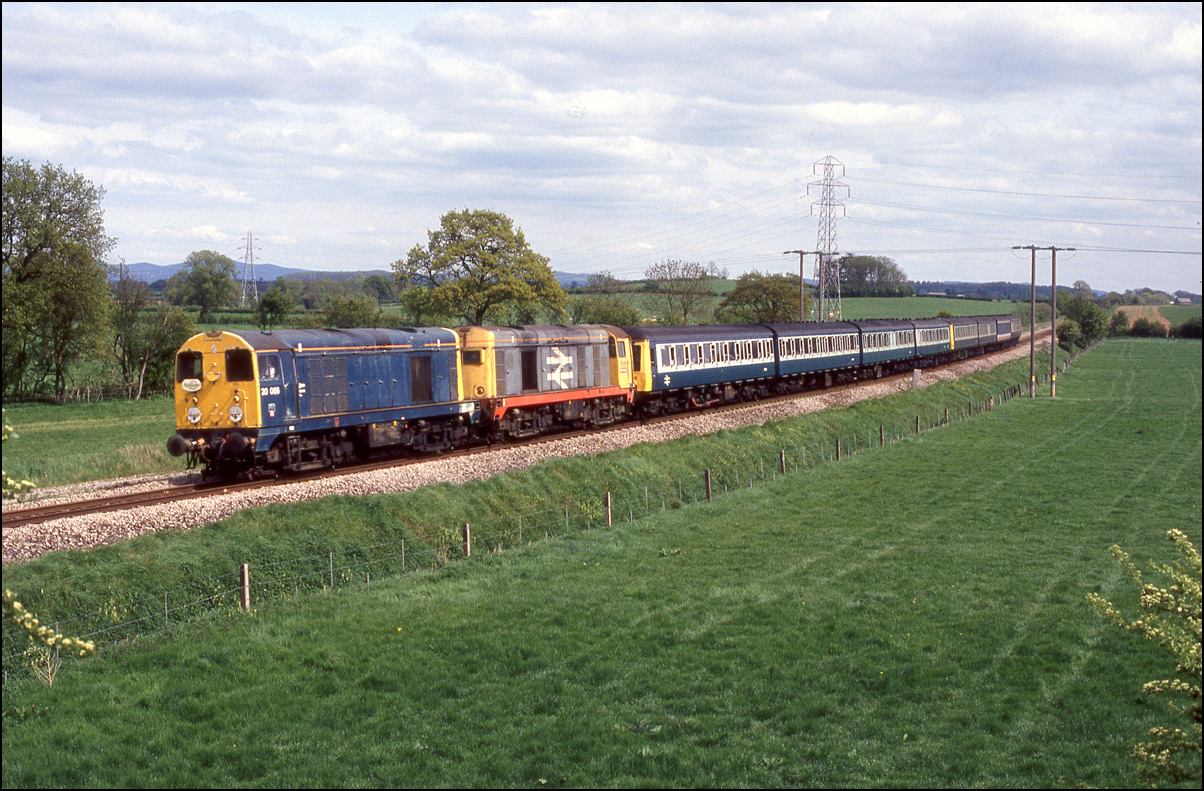 |
There was plenty of time to run over to Stoke Edith, on the Worcester - Hereford line, to obtain the next shot. The sun still co-operated for this pleasantly rural view. |
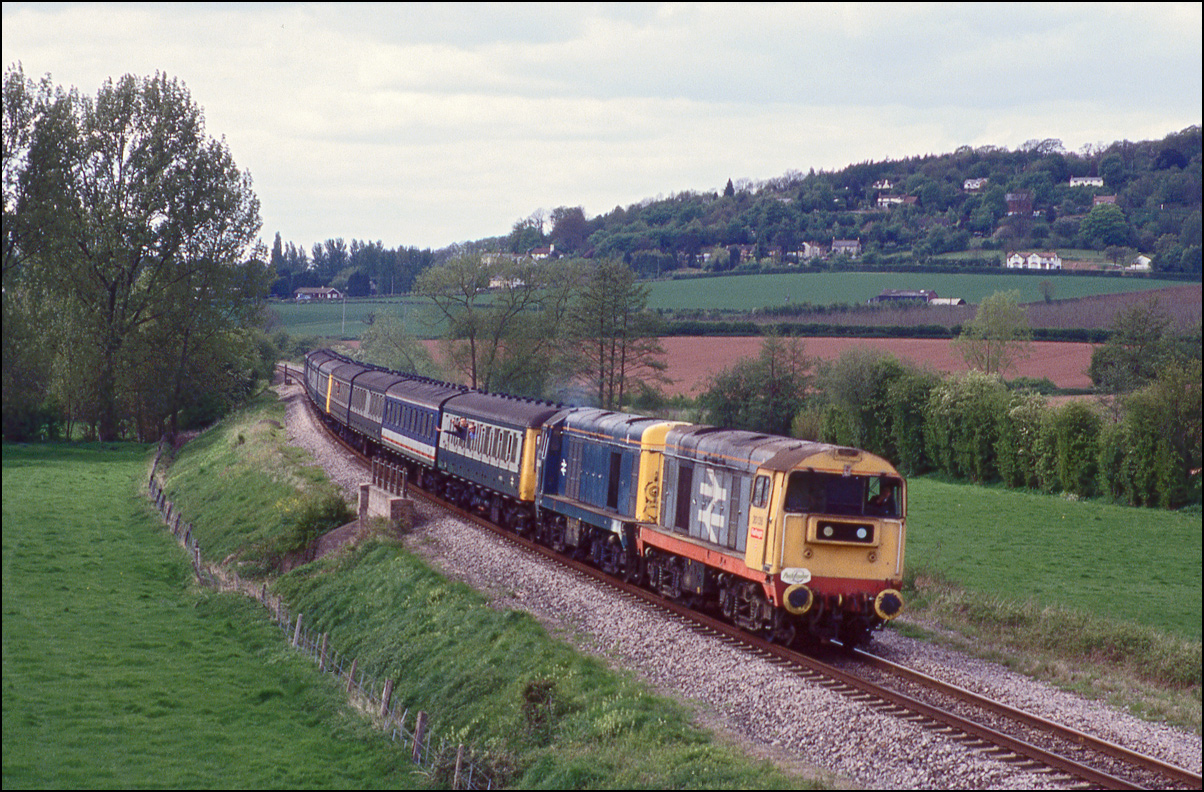 |
This was the final shot of the day - the one I mentioned above without sun which so infuriated some of the more vocal enthusiasts. It is the classic view at Stoke Edith which I expect is now so overgrown as to be unusable. |
|
|
Wednesday 14 June 2021 started off bright and sunny so I had another walk to Stratford-upon-Avon station for a well-lit shot of the Freightliner road learning trip from Lawley Street. First to arrive though was 196006 with 5Q21 from Tyseley LMD and even though it ran into platform 1 I thought it worth a shot. The 2 coach variants of the class seem a lot better than the 4 coach sets and seem to be running reliably whereas the longer trains are, I believe, grounded and one has been towed from Tyseley to Donnington for storage. |
|
|
I had hoped that 66501 would be allowed to run into Stratford-upon-Avon before the passenger train 2D11, the 08.27 running from Stourbridge Junction via Dorridge and Hatton North Junction. Despite this being being no closer than Lapworth on the Leamington line and 66501 being at Bearley Junction the passenger train was given precedence. I was expecting the usual class 172/3 to appear but was slightly surprised when 2 coach 172003 ran into the station, especially given that sister unit 172006 running as 2K25 to Stourbridge Junction had left only some 20 minutes earlier. These units aren't a daily sight at Stratford at the moment. Incidentally, 172003 was first of the class to see revenue-earning work in the West Midlands when it ran to Hereford on 7 May 2019. |
|
|
It's not often that the chance come along to photograph a class 196/0 2 coach DMU alongside a class 66/5 at Stratford-upon-Avon but that is exactly what happened on 13 July 2021. On my way into town I dropped into the station with my Canon G10 in my pocket for a record shot of 66501 working 0B44 road learning special from Lawley Street. The new 196006 on a mileage accumulation trip arrived first and while it was standing in platform 1 66501 was allowed into the station and came into P2. Within a few moments the signal giving 196006 the road was cleared and the opportunity for this shot presented itself. |
|
|
A Network South-East 3 coach DMU formed of single unit 55022 (L122) with 2 coaches from what appears to be a class 117 made a pleasant change from the by then more usual class 165 Thames Turbo set as it worked the 15.30 Reading to Banbury service on 7 March 1993. The location is one of the best known in the area; a few hundred yards north of Kings Sutton station with the distinctive spire of the church of St Peter and St Paul prominent in the background. |
|
|
Still carrying its Tyseley set number T203 on 13 January 1990 this class 108 was photographed about to pass Barnetby station just after I had arrived on my one and only visit to the area. Early morning frost was still in evidence on the sleepers as the DMU, one of only 2 I saw during the day, was highlighted amongst the misty background with the famous signal gantries of Wrawby Junction in the background. Most passenger services were in the hands of Sprinters by this time so a proper DMU was a welcome addition to them and the constant flow of freight seen here. |
|
|
Class 114s were quite a rare sight at Stratford-upon-Avon by 26 April 1989 so when I saw T221 arrive at the station from my then nearby home I took a camera down for a shot. It is seen here leaving platform 2 with the customary exhaust smoke as the 08.13 to Leamington Spa with the familiar figure of staff member Aubrey Wheeler silhouetted on platform 1. I had good relationships with most of the staff here and Aubrey in particular who always put aside a copy of the week's Special Traffic Notice (STN) for to collect on either Friday evening or Saturday morning. This picture was taken in vertical format on a Mamiya 645 but a large scan has allowed me to crop it to landscape format without any significant loss of quality. |
|
|
The towpath of the Stratford-upon-Avon was a good spot to photograph a short train on a sunny evening such as that of 2 May 1989 when the Midline bubble 55033 (T133) was coupled to a class 114 to work the 18.13 to Leamington Spa. This view has now gone in common with many others throughout the country thanks to completely uncontrolled growth of lineside vegeation. The semaphore signals (one complete with a pigeon on the arm!) and the Victorian hospital were still extant at the time but were not to last much longer. 645 |
|
|
The footbridge on the down side of West Ealing station was a popular spot for railway photographers although not always the easiest place to stand on occasions due to one or two dubious characters who used it for peddling illegal substances! I spent most of a day there on 30 November 1989 and took an bagful of pictures including quite a few DMMUs on local trains. This one shows class 117 L413 working a Paddington to Slough service away from the station stop. Of interest in the background is the former GWR milk dock shelter now used as a partly-covered storage area. |
|
|
I believe that the Greenford branch was the last in the London area to use single car DMUs on a diagrammed basis. This picture shows 55020 (L120) taking the switch from the down relief line line to the branch at West Ealing on 29 November 1989. The diminutive vehicle looks a bit dwarfed by the large 1960s office block complete with huge communications dish. |
|
|
Later on the same day as the image above, 30 November 1989, I took another view of 55022 heading from Greenford to Paddington but this time with a 135mm lens as it rounded the curve towards West Ealing station. This unit survived at least until 2014 as DB977873 used for Sandite operations. I'll wager that the Mk3 Fordm Cortina alongside the boarded staff crossing in the background didn't last as long! |
|
|
Four more class 153 DMUs were taken from Burton on Trent for storage at Long Marston on 29 June 2021. The headcode again was 5Q94 and the timings much the same as the previous day but the weather was slightly better so I changed my mind and did decide to go for a shot. Here are 153375, 153381, 153371 + 153383 passing Honeybourne station on the Long Marston branch; possibly one of the last to be on for a while before the buddleia takes over completely once the flowers have come out. |
|
|
A 5Q94 from Burton-on-Trent to Long Marston was down to run on Monday 28 June 2021 which unusually was timed for 50mph operation. There was no clue to the train's composition until someone kindly added the appropriate data to the RailCams mapping app. It showed that 4 class 153 DMUs were on their way and as these have never been especially commonplace on the North Cotswold Line I went over to Evesham for a shot. I had previously taken a few images of solo 153s on the Long Marston branch including this one of 153305 but a set of 4 units needed a bit of a wider angle. Here are 153356, 153365, 153354 and 153334 in the old London Midland colours passing the signal box at Evesham running about 4 minutes early in very dull conditions with a light drizzle falling. |
|
|
West Midlands Railway 196011 was again doing mileage accumulation and test runs on 23 June 2021 and having missed a shot of it in platform 2 at Stratford-upon-Avon on its first run of the day through not keeping an eye on things I went to Wilmcote station for 5Q24 from Tyseley LMD in the early afternoon. Everything was running well and 196011 passed under the GWR footbridge, albeit painted in an unpleasant of dirty pink, some 5 or 6 minutes early. |
|
|
There was a rare locomotive movement from Lawley Street to Stratford-upon-Avon on Tuesday 22 Jun 2021 involving only the 3rd Freightliner to visit the terminus. Running in front of it was WMR's new 196011 on 5Q21 from Tyseley LMD and as usual this arrived into platform 3. This isn't the best angle for photography but it is what it is so I took one as it slowed for the stop before the crew changed ends and went back to Birmingham. |
|
|
Next to arrive at Stratford-upon-Avon station on 22 June 2021 was 172343 working 2D11, the 08.27 from Stourbridge Junction via Dorridge and Hatton North Junction. Platform 1 here is still out-of-use after several months until some part or other for the pointwork has been manufactured and delivered so most Birmingham services use P2 as is this one. |
|
West Midlands Railways has recently acquired some of Chiltern's class 172/1 units to bolster their services. On Saturday 19 June 2021 I had a message saying that 172104 was working the 08.57 from Birmingham Snow Hill to Stratford-upon-Avon, 2D11, and as this was the first time I had seen a 172/1 on a WMR service had a walk to the station for a shot or two. Here is the train arriving into platform 2 instead of the booked P1 as the pointwork allowing access to it has still, after several months, not yet been replaced. This unit was the first that Chiltern used and here is my picture of it at Hatton running as ECS under the headcode 5Z74 which worked from Derby to Marylebone (via St Albans) and back on Monday 16 May 2010. |
|
Class 172/1 172104 working with WMR arrived at Stratford's platform 2 on 19 June 2021 while Chiltern Ralways' own 168325 was waiting in platform 3 to form the 10.39 to Hatton which a bit oddly runs ECS to Leamington Spa to return to Stratford later. The chance for a picture of two Chiltern liveried units side-by-side here was unusual to say the least but their positions relative to each other needed a wider angle lens than the 50mm on my Nikon D800. This picture was therefore taken on my 'phone with the inevitable distortion caused by the very short focal length. To show the current operator of 172105 to passengers decals have been placed on the bodysides. |
|
|
Just as I was about to leave Stratford station the sun appeared and offered the chance of another shot of the 2 units but from the other end of the platform. The Train Manager is about to desptach 2W72 to Kidderminster with 168325 framed between the trees masking Morrisons supermarket from view. Thanks to Steve Widdowson for news of this working. |
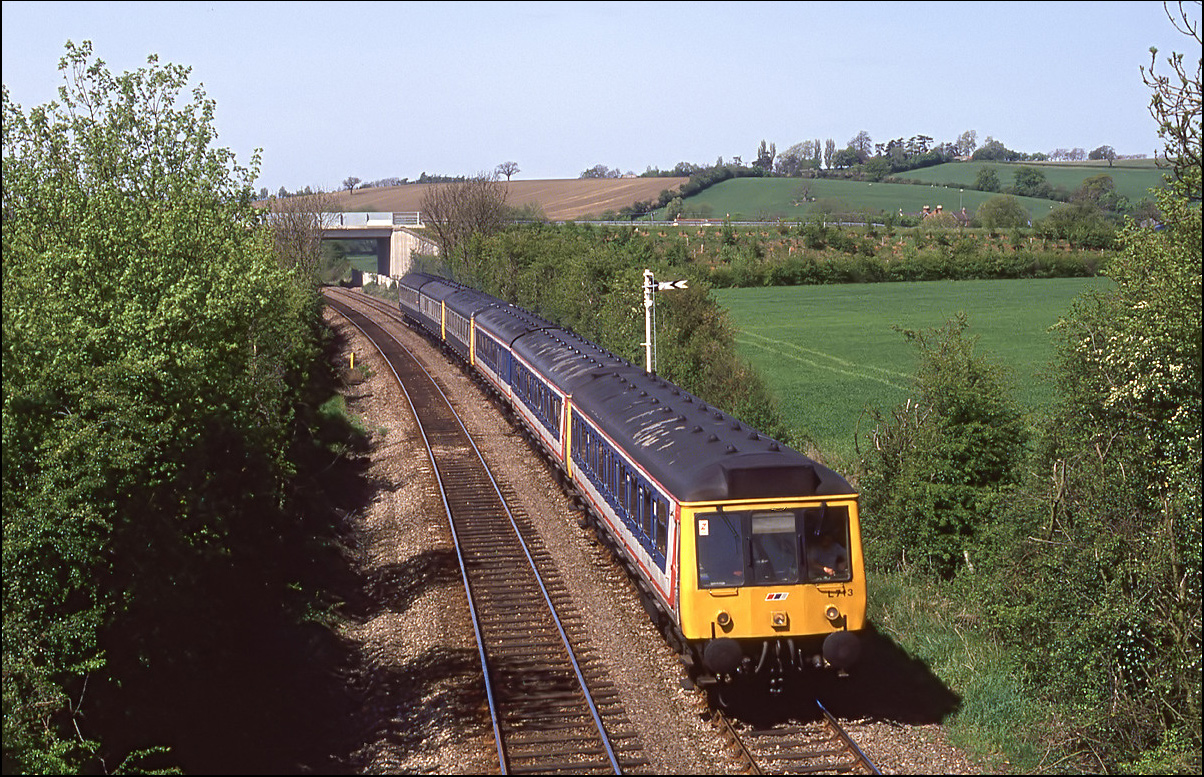 |
The Bank Holiday Monday on 2 May 1994 saw some Birmingham to Stratford-upon-Avon trains formed of DMMUs rather than the usual class 150 sprinters. Here is a mixed set which appears to be a pair of power triples, having had a single power car added to a pair of power cars presumably to work to Sprinter timings, led by Network South East liveried L713, The train was pictured passing the long-gone Stratford down distant signal between the two bridges at Bishopton in the days before Stratford Parkway station was even a vague thought in someone's mind. This signal was rarely raised to the clear position; in steam days virtually everything stopped at Stratford either for water or to pick up passengers and even in the days when the line saw diesel hauled freight it would have been necessary for the Evesham Road crossing gates to have been closed and the road set to allow this to happen. In practice, this would have meant that the busy Evesham Road would have been blocked for far too long, so trains were generally checked as they approached the station. One of the signalman told me that he would never have pulled the distant off for anything other than the Royal Train; with no power assistance it would have been a real gut-wrenching effort! By this time, of course, the signal was no more than the statutory fixed distant. The view looking towards Straford was less photogenic as a rusty fronted T351 leads the way back to Birmingham. Thanks to Stuart Mackay for the information on the train's composition. |
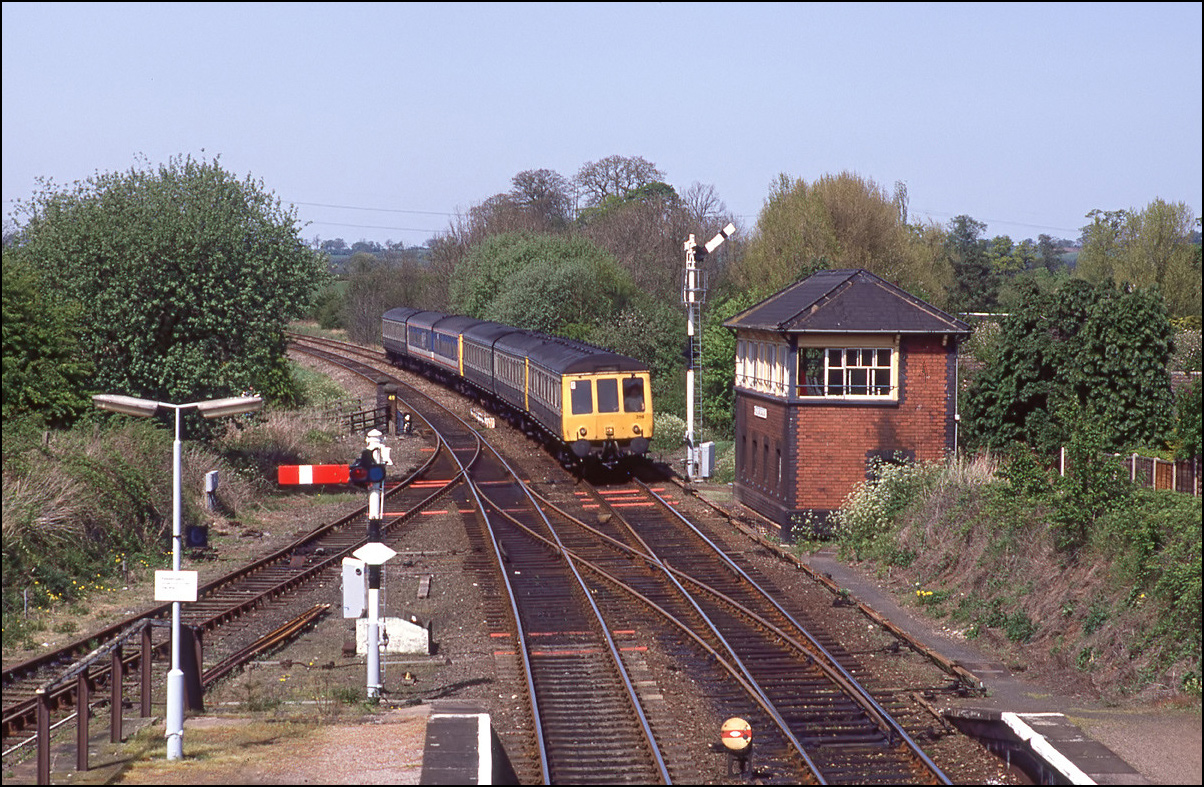 |
Another Bank Holiday dated 2 May 1994 shows a real hotch-potch six car DMMU about to make the Henley-in-Arden stop. The leading coach was from class 116 set T356 with a 2 coach class 116, a 2 coach NSE set with a single driving coach from another class 116 on the back. This Bank Holiday Monday saw first generation DMUs replacing the usual class 150 sprinters presumably to cater for the influx of visitors to Stratford from the West Midlands conurbation. The police were always out in force on these holidays to keep an eye on any would-be tourists who had drunk more than was good for them (and for anyone else within earshot) on the inward journey. These characters were usually unceremoniously dumped in a van and taken away to Stratford police station to sober up before being put back on a later train without being allowed into the town. |
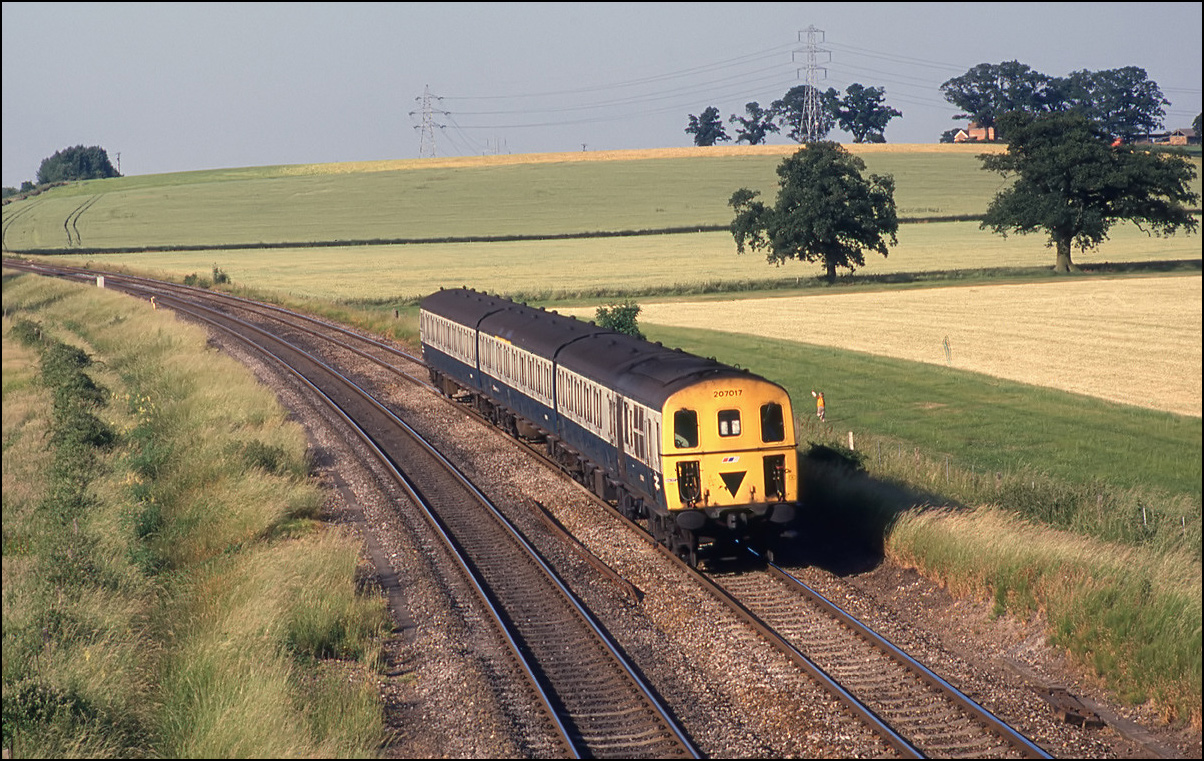 |
The standard units for Reading to Basingstoke trains in 1989 were 3H diesel-electric "Thumpers", named of course after the characteristic sound of the low-revving English English engine contained, in this case, in the compartment behind the driver. These were not especially powerful trains and their acceleration could best be described as ponderous. They had oodles of character with quite comfortable seats and I enjoyed every one of the miles I travelled in them. Here is 207017 approaching the stop at Mortimer station at 17.07 on 23 June 1989 to the accompaniment of a wave from a walker in the adjacent field. I have often wondered why people wave at trains; I have never seen anyone wave at a coach on the road. |
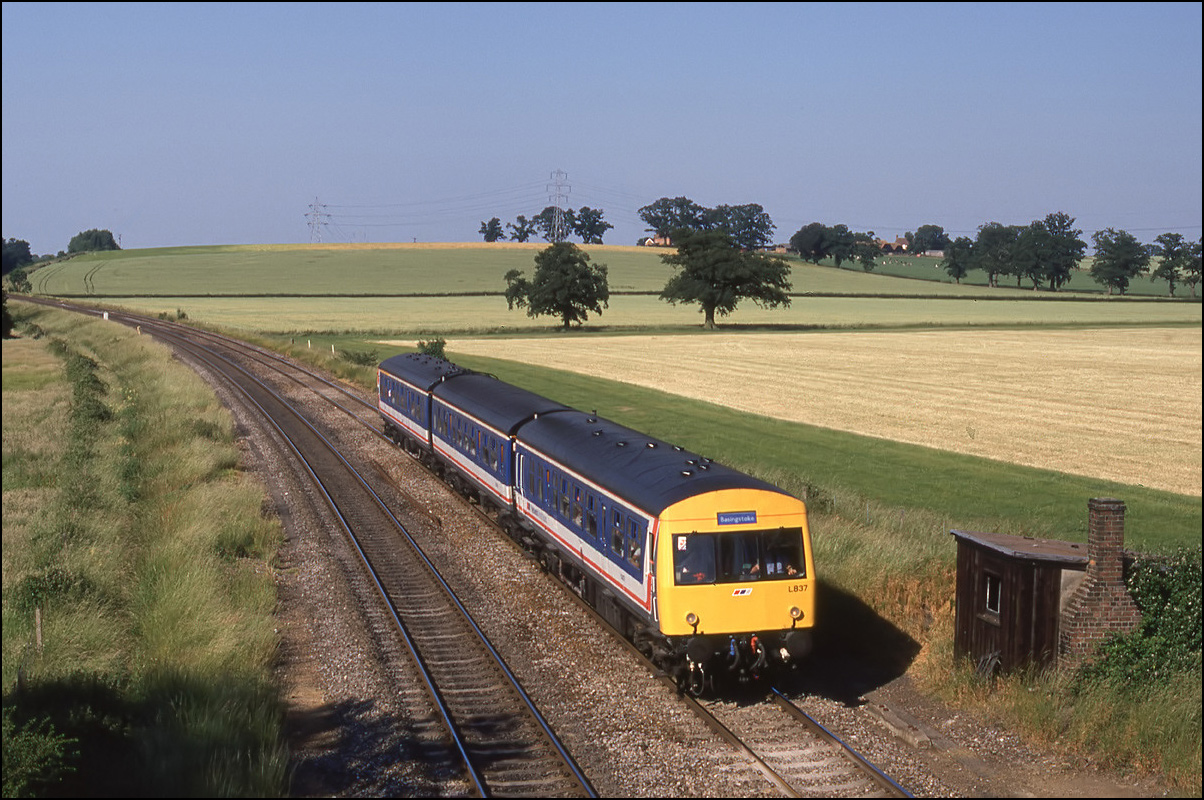 |
Less commonplace on the Reading to Basingstoke line than the DEMU shown in the picture above, but giving a welcome splash of colour on the beautiful evening of 23 June 1989 was class 101 unit L837 led by 51437. The well-preserved platelayers hut was a bit of a rarity even then with most of these structures having long since become derelict. It looks as if the original brick-built hut has been lost but replaced by a newish garden shed although the chimney and fireplace survived. I guess that this was still in use at the time and I do recall talking to a ganger on this stretch of line who said that the good state of the track was a matter of considerable pride to him and his colleagues. |
|
|
This is another shot from near Mortimer station on the Basingstoke to Reading line taken on 1 May 1990 but in the morning and after a short walk along a convenient lneside footpath. The DEMU is 207010 in NSE colours and it was accelerating in its usual leisurely manner away from the station filling air with the characteristic thumping noise from the English Electric power unit. |
|
|
An hour or so before the picture shown above was taken class 101 set L840 with 53311 leading was on a similar diagram between Reading and Basingstoke. The peformance of these diesel mechanical units was a bit more lively than the DEMUs but the exhaust note wasn't quite so pleasing to my ears. |
|
|
Going back to Warwickshire this is a photograph of Tyseley's T316 with what appears to be a class 117 centre coach climbing Hatton Bank on 20 June 1989. The train is the 18.44 from Leamington Spa to Birmingham Moor Street and the brakes will soon have been applied in preparation for the stop at Hatton station. I don't recall having seen another unit with this style of Midline branding and wonder if this was only one so treated? |
|
|
Wilmcote Bank, the 1/73 northbound climb out of Stratford-upon-Avon is the location for this shot of class 114 formed of set T021. It is on the 17.XX from Stratford-upon-Avon to Leamington Spa and one of the lineside gasholders near Stratford station station is clearly visible in the picture which I took from a convenient farm crossing. |
|
|
Vivarail/Transport for Wales' 230010 was used in a first for its type to carry passengers on 16 June 2021. The unit worked on battery power between a temporary platform at Honeybourne and Long Marston to convey attendees at the Rail Live event at Long Marston who had arrived by train at Honeybourne. This picture shows the first train of the day with a good load of punters on board as it approached the end of the branch and before it made a trip along road 2 of the exchange sidings to the on-site platform constructed some years for one of the open days held here. |
|
|
The Long Marston to Honeybourne shuttles were in a broadly hourly pattern and here is the 10.20ish train leaving the site on 16 June 2021 to collect another batch of passengers. The unit is carrying a headboard, SLC Operations, the name of the group responsible for the design and construction of the trains. |
|
|
After taking the picture shown above I had a drive down to Honeybourne to see if there were any worthwhile photographic opportunites. There weren't other than this record shot from the main lines up platform showing 230010 and some of the crew and stewards preparing to leave. The passenger information sign has probably never before shown a departure for Long Marston. Not a vey clear shot but these matrix screens tend not to photograph too well... |
|
|
Another exhibit for the 2021 Rail Live event at Long Marston arrived on 15 June in the form of the New Measurement Train with power cars 43012 + 43290. The former LNER power was on the back of the formation and as I hadn't yet taken a picture of it wanted a good clear two-way view. The nearest to my home is Honeybourne so at the risk of being repetitive went there once again. As on the previous day the warm weather, not to the mention the single track between Evesham and Norton Junction, was causing speed restrictions and delays and 1Q74 was some 30 minutes late arriving. There was no danger of the sun going behind cloud on this occasion and here is the train passing the temporary platform at Honeybourne which had just been completed ready for the following day's shuttle service. Power car 43013 has bean a regular visitor to the North Cotswold Line over the years and here is a shot from Evesham taken on 4 October 2007 when even more of the line was still single track. |
|
|
The road bridge at Honeybourne is the ideal spot for a two-way shot at around 14.30 at this time of the year especially for HSTs as the sun's angle is OK whichever way the train is heading. Here is 1Q74 with 43013 leading 43290 and the New Measurement Train towards the staff hut and Long Marston on Tuesday 15 June 2021. The NMT is to be one of the exhibits at Rail Live where visitors will have the opportunity to have a look inside the coaches and see the range of measuring equipment used by the engineers. |
|
|
Following a charter between Bristol and Carlisle on Saturday 12 June 2021 the Locomotive Services Limited's Blue Pullman HST returned to Crewe during the following afternoon. The sun looked to remain out and with the timings being being convenient I had a run out to Defford. I wanted a two-way shot that wasn't Croome Perry and this location fits the bill nicely. The ECS, running as 5Z17, was a few minutes early crossing the River Avon at Eckington and made a decent sight as it contrasted with the largely green background. |
|
|
Not contrasting nearly enough with the largely green background at Defford on 13 June 2021 was GWR's 2E42 Bristol Temple Meads to Worcester Foregate 2E42. Formed of Castle set 42097 + GW09 + 43160 the train does its best to disappear into the undergrowth. |
|
|
This is one of my favourite shots of 55033 after it was repainted into Midline livery. It was taken on 31 May 1989 while working the two-hourly shuttles between Leamington Spa and Stratford-upon-Avon and is seen with driver Wilson in charge passing Stratford East signal box where the line crosses the Stratford Canal.645 |
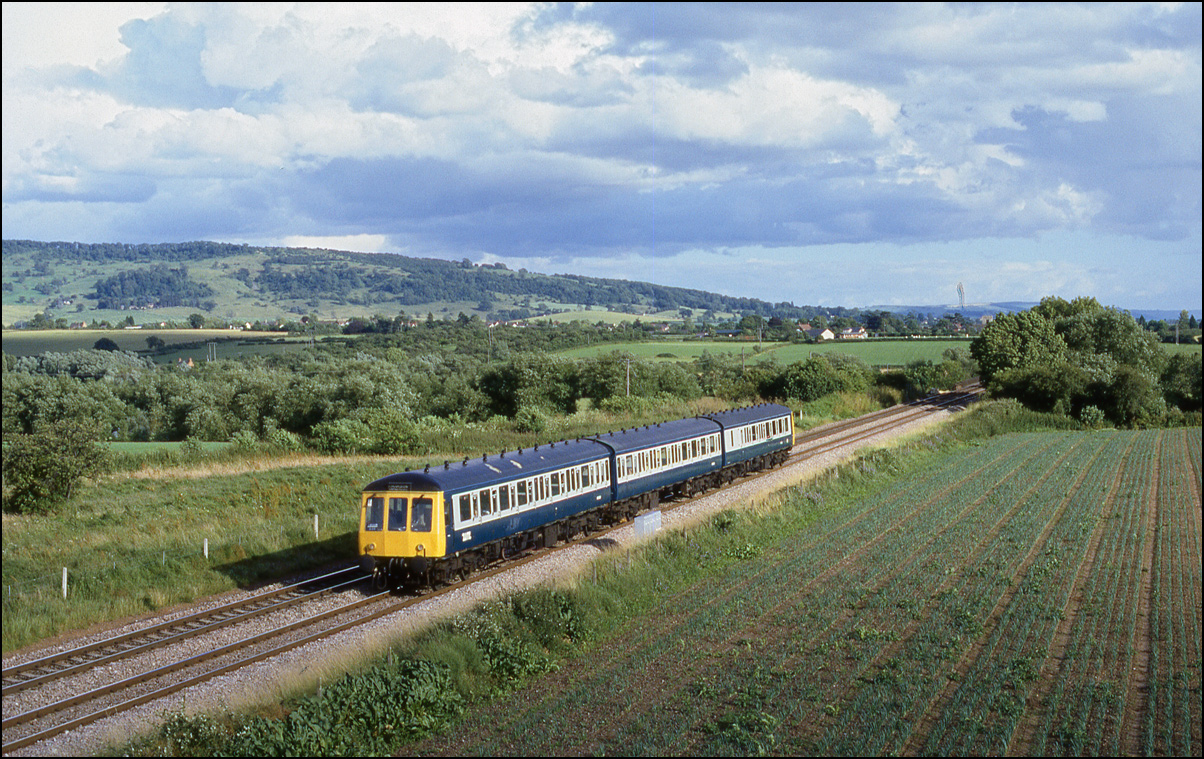 |
In the heart of the Worcestershire countryside and overlooking the River Avon at Eckington is this location near the village of Defford. this picture shows an unidentified Tyseley class 116 heading north with a Gloucester to Birmingham train. The date was 19 July 1985 and was my first visit of many to this pleasant spot. |
|
|
Barnt Green station is the junction on the main Birmingham to Gloucester line where the branch to Alvechurch and Redditch, and formerly Evesham, diverges. On Saturday 16 August I was standing on the site of the old Goods Yard when a 6 car DMU came from the Birmingham direction with a New Street to Barry Island train formed of Tyseley's T632 and another class 116 unit with a centre car from a different class; far from unusual at this time. |
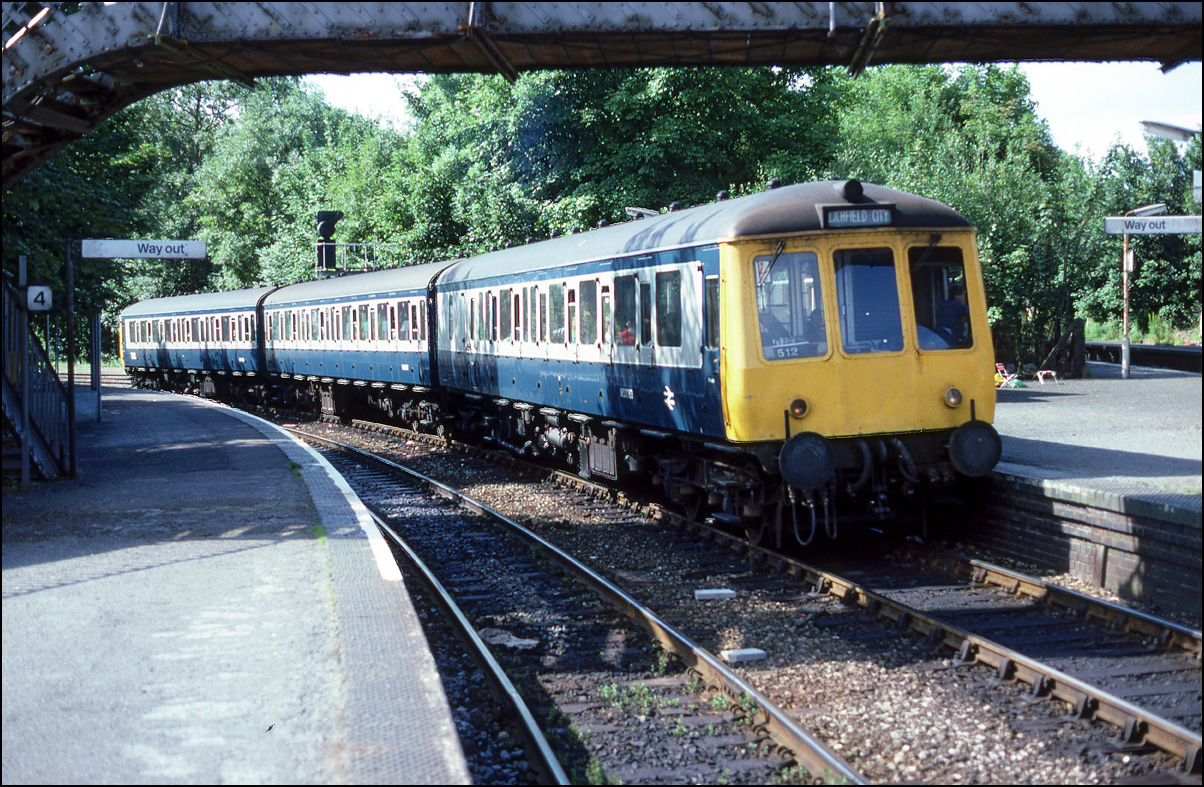 |
As mentioned above Barnt Green is the junction for the Redditch branch, the line for which curves sharply away from the Birmingham to Bristol line. Line occupation, especially in the summer, meant that trains from Redditch often had quite a wait in the platform until Saltley Power Box found them a path, especially if they were a minute or two late arriving. The usual class 116 is shown here on 16 August 1986 waiting at the signal before heading off to Lichfield City via Birmingham New Street. |
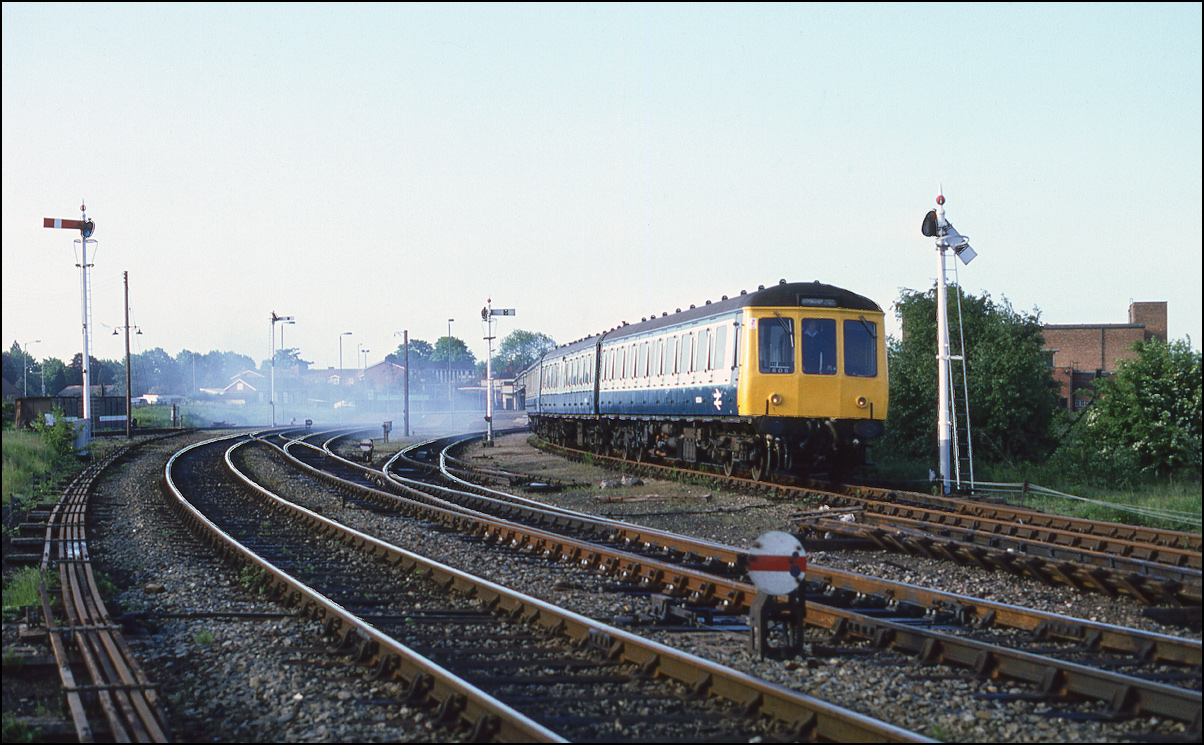 |
Early in the morning of 4 June 1986, once the weedkiller with 47013 had done its stuff at Stratford. While waiting for that to arrive I took this shot of a class 116 leaving the siding to form the 06.30 to Birmingham with the driver Oliver, whose surname I forget, standing in the cab. At this time, Stratford was a signing-on and stabling point and if one was lucky a unit would have been put in this siding on the previous night. This piece of track was not regularly used and I was pleased to get this shot with the lower quadrant signal in the "off" position, even though the sun was not yet properly on the track. |
|
|
Tysley's class 166 T615 working a Birmingham New Street to Hereford service approaches the stop at Langley Green station on a dull and misty 5 June 1986 as 31142 takes chlorine tanks from Allbright and Wilson's through the yard at Rood End to Bescot and eventually ICI Wilton. |
|
|
Class 117 B427 (51407, 59517 + 51365) were pictured at Droitwich Spa with a Hereford to Birmingham New Street train on 6 Jul7 1985. In all honesty I took this shot largely because of the presence of some loaded wagons in the siding alongside the up loop; the first and indeed only time I saw anything on either line. |
|
|
You go for a quiet shot of a DMU on a Sunday afternoon and look what happens! Tyseley's class 116 T567 with a class 101 centre coach was approaching Stratford-upon-Avon on 2 August 1987 when 4771 Green Arrow muscled into the shot. The shot was taken from a convenient industrial site to which access was allowed if the right security guard happened to be on duty. The other photographers alongside me were sweating a bit when they heard the DMU approach but it cleared in plenty of time as Green Arrow put up a good display with Gordon White, the Leamington Spa driver usually driving these specials, clearly full of confidence in both his and the engine's capabilities. |
|
|
For some reason I have never taken a shot of a TfW class 230 leaving Long Marston on one of the test and mileage accumulation runs. On Saturday 5 June 2021 there was one of these scheduled for 230010 to make a trip to Moreton-in-Marsh and then Stourbridge Junction and return. On arrival some 15 before the departure time the unit was visible outside the shed so thiongs were looking good. About an hour later as just as I was preparing to leave it began to move and slowly made its way around to the exchange sidings ready to move onto the Honeybourne branch. The trackbed of the former line to Stratford-upon-Avon has now had several lorryloads of aggregate dumped on it but there is still no news about the purpose to which it may be put. There is room for 3 tracks as was once the case when an up loop was in place alongside the main lines. Here is 230010 as it recedes from the camera on the way to Evesham and Stourbridge, the leg of the journey to Moreton having been cancelled. |
|
|
One of the few passenger trains worth photographing on the Gloucester to Birmingham line is the 15.35 Bristiol Temple Meads to Edinburgh formed on a CrossCounty HST set. On 3 June 2021 the train had power cars 43207 + 43378 and is seen here having just crossed over the Warwickshire Avon between Ecckington and Defford. |
|
|
The late Spring bank holiday for 2021 fell on 31 May, the last day of meteorological Spring and after a murky start the skies cleared nicely. The Theale to Humber empty oil tanks, 6E45, was running via Hatton and with a sunny shot just about guaranteed I went over to Hatton North Junction for a shot. First along was 220003 with 1E48, the 1431 Banbury to Birmingham New Street, running as a variation, and although these units are one of the least photogenic on the network I took this image as a test shot before the freight arrived. |
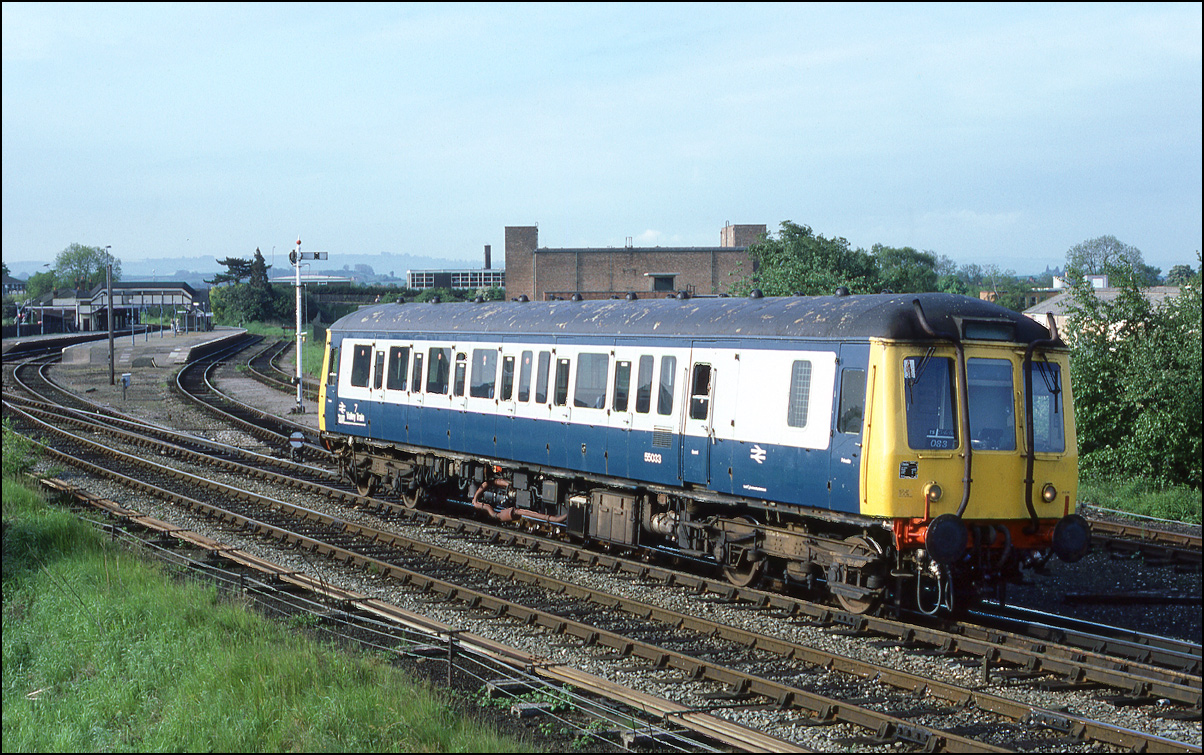 |
On sunny mornings, I quite often used to leave home for work at around 08.00 and walk to my office, then in the town centre, via the railway line. I did this on 4 June 1986 because 55033 had recently been allocated to Tyseley after a spell in South Wales. It is seen here leaving the station as the 08.12 to Leamington Spa. Virtually everything in this photograph has changed. The Ministry of Food cold store has been replaced with a supermarket, the college of further education has been rebuilt and extended, and, of course, the semaphore signals have gone, being replaced with colour lights operated from Bearley Junction. Even the World War II air raid shelter, a concrete pipe buried in the ground, upon which I was standing, had disappeared. The class 116 unit in platform 2 will follow the bubble as far as Bearley, this being the 08.20 to Birmingham Moor Street. |
|
|
In 1986 Stratford-upon-Avon's platform 2 was the main departure platform into which arriving trains had to shunt after dropping off any passengers, On 28 August 1986 single unit 55002 was on the two-hourly Stratford to Leamington Spa shuttle and it's shown here leaving with 10.12 alongside a class 116 which had just arrived from Birmingham Moor Street. The exhaust smoke from 55002 clearly shows the individual firing strokes of the engines: the amount of smoke being typical after the long layover between trips. |
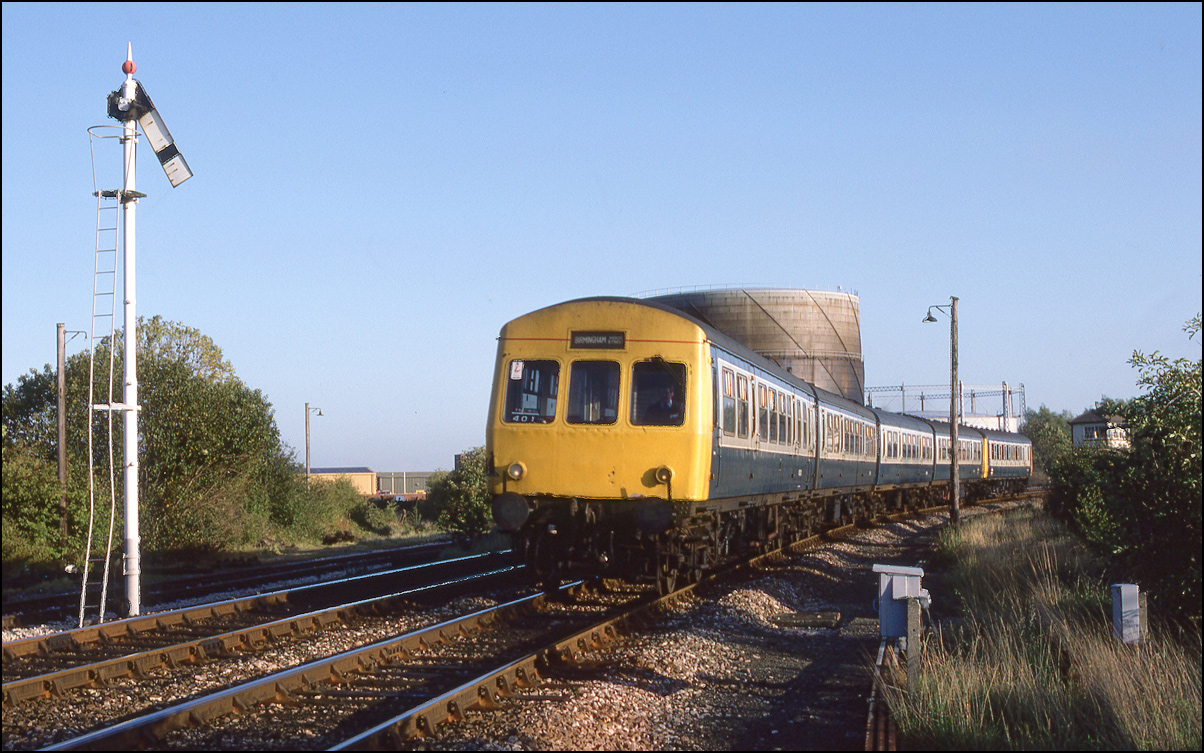 |
I saw this 5 coach set arrive at Stratford upon Avon from my nearby home on the afternoon of 23 October 1986. I picked up a camera and went to the line, after speaking to the signalman, to take this shot of the return working showing a 4 car class 101 set coupled to single unit 55002 forming the 16.30 to Birmingham Moor Street. Stratford's well-known gasholders, not to mention the semaphore signalling and the associated signal box, have long since disappeared. |
|
|
The testing and mileage accumulation runs of 2 coach class 196 DMUs over the North Warwickshire Line have continued in recent days. Thursday 27 June 2021 was warm and sunny and in the hope that the first train from Tyseley to Stratford-upon-Avon, 5Q21, would use platform 3 at the terminus I walked down to the station. A staff member was on hand to tell prospective passengers that trains were currently cancelled due to a signalling fault and this of course included 5Q21. I kept an eye on a mapping app and saw that 5Q22 a couple of hours later was running so went to Edstone Aqueduct near Bearley Junction arriving just in time to photograph 196010 running some 10 minutes early. Some of the undergrowth between the tracks has been cleared since my last visit here to photograph 196104 on 16 September 2020 and this has opened up the view nicely. |
|
|
This image shows 47429 with stock in filthy exterior condition on a diverted York to Paddington inter-regional express getting in the background of my picture of one of Tyseley Depot's numerous class 116 DMUs on the way from Birmingham Moor Street to Stratford-upon-Avon 1 March 1986. The reflected sunlight at Small Heath, Birmingham, on the windscreen of the DMU made it impossible to identify the set number. |
|
|
In 1986 the line from Smethwick West to Rowley Regis was still controlled by semaphore signals. This picture taken at Langley Green on 1 March 1986 shows Tyseley class 116 T524 passing the platform-based signal box and lower quadrant bracket signal as it towards Birmingham New Street from Kidderminster. The low speed arm of the signal controlled access to Rood Ends Goods Yard which served several industrial sites with daily trips from Bescot. |
|
|
This picture taken a few minutes after the one shown above on 1 March 1986 is of class 116 T516 on a Birmingham to Kidderminster train passing the untidy area around the back of Langley Green signal box. The branch to Albright and Wilson's chemical works is prominent to the left of the picture. |
|
|
The view looking towards Kidderminster at Stourbridge Junction station on a dull day in March isn't one of the finest in the West Midlands. On 1 March 1986 the unusual sight of Cardiff's class 101 C805 coupled to a class 105 with one all-over blue coach made taking this shot worthwhile. The train was a Kidderminster to Birmingham New Street service long before these went to the rebuilt Snow Hill station. |
|
|
Two class 116 units stand in the background at Birmingham Moor Street on 7 February 1987 as passengers leave their train through the manned barriers. The station was due to close in September 1987 and I took a few shots in and around it for the historical record. |
|
|
The terminus platforms at Moor Street station in Brimingham closed in September 1987 and the GWR's principal station in the city, Snow Hill, was rebuilt in a less attractive but more modern style and took over services along with 2 through platforms at a reconstructed Moor Street. This was the scene in 1986 while the civil engineering works were taking place on the renewed track bed leading to Snow Hill tunnel. A class 116 DMU is in one of the platforms and a BL Morris 1800 stands next to a Lada estate in some spare land. The terminus platforms at Moor Street were later reinstated to provide extra capacity for Chiltern Trains' services between Birmingham and London Marylebone. |
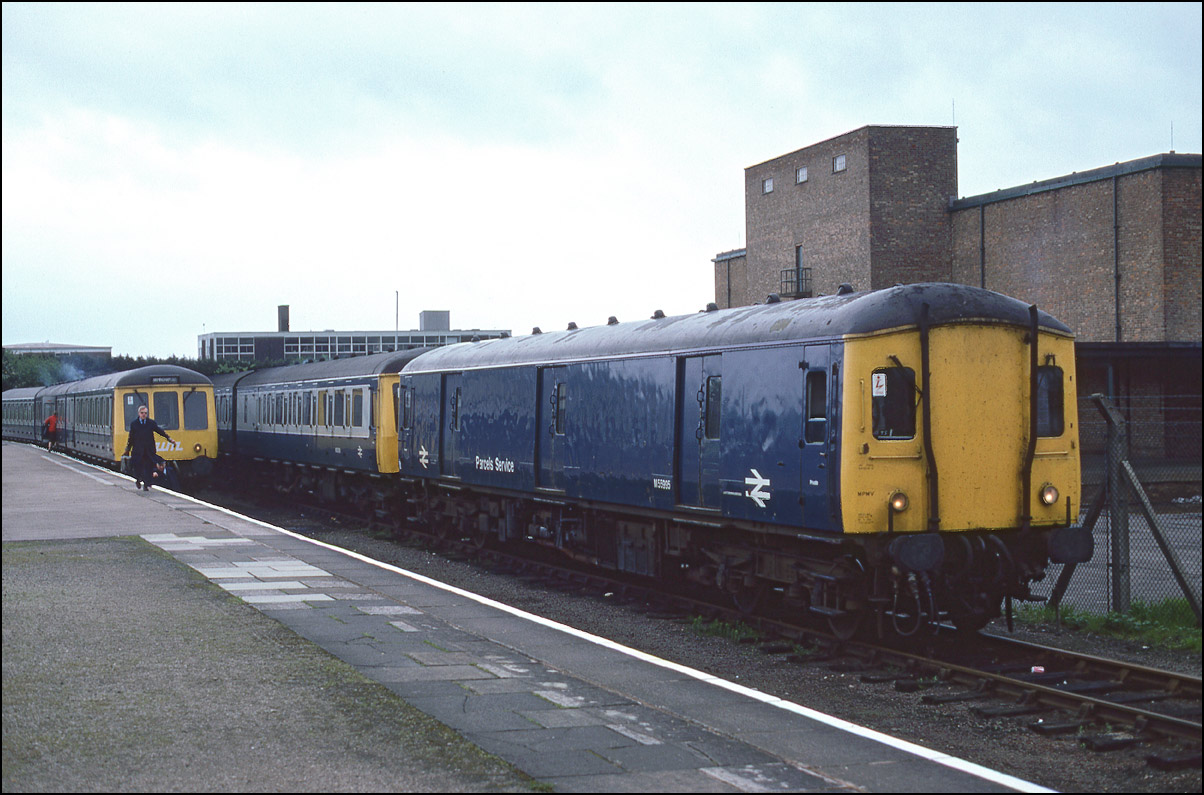 |
While I was eating my breakfast on the morning of 18 May 1986, I saw a plain blue parcel unit, 55995, head towards Stratford-upon-Avon station. "What on earth...?". I thought and grabbed a couple of cameras and dashed down to investigate. A class 116 had failed in the cold store siding and Tyseley sent 55995 down to effect the rescue. I was sort of disappointed at the time that a locomotive hadn't come, but in retrospect this unit was much more interesting. The parcel unit has been attached to the errant unit and as the crew are about to top up the 116's cooling system, I assume this was the cause of the failure. Sadly, I didn't have time to photograph the departure as I hadn't finished my breakfast or dressed in an entirely suitable fashion for a day at work! |
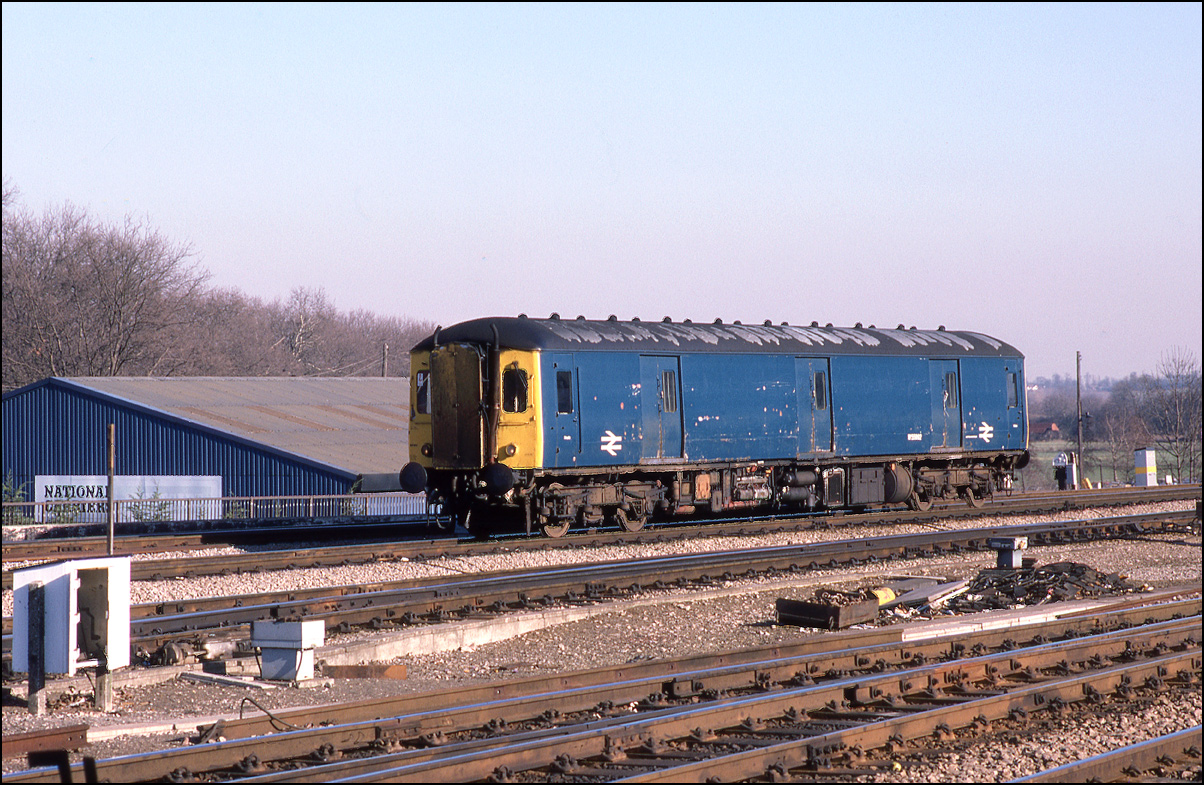 |
It was possible to see various parcel units around Reading in 1987 including class 128 single units. This beauty which I photographed on 30 January 1987 is 55992 in gloriously tatty rail blue arriving from the London direction on an unknown working. Note the differences from 55995 shown in the picture above - the corridor connections for starters. |
|
|
Also taken at Reading on 30 January 1987 was this picture of 55022 leading class 115 driving vehicle 54280 towards Reading station. The destination blind said Marlow which gave to where the unit had been working but on this occasion it went straight though Reading towards Didcot. Here is 55022 bringing up the rear of the short formation. |
|
|
A GRC&W class 128 parcel unit is seen here descending from Miles Platting towards Manchester Victoria on 25 September 1984. I have no idea of the working but with no local timetables it wasn't easy to get hold of such information for diesel unit workings. It was a different matter for the class 40s, my main reason for being in the area in the early 1980s, with every turn of their wheels being documented. |
|
|
This image was taken at Bescot on 25 February 1987 and shows a 2 coach class 108 comprising vehicles 53921 + 51562. I was told on the day that the unit was being used as a route learing special covering various lines in this part of the world. DMUs were not especially common here at the time as all local trains to Walsall were in the hands of EMUs so I'm glad that I used a frame of colour transparancy film on it. |
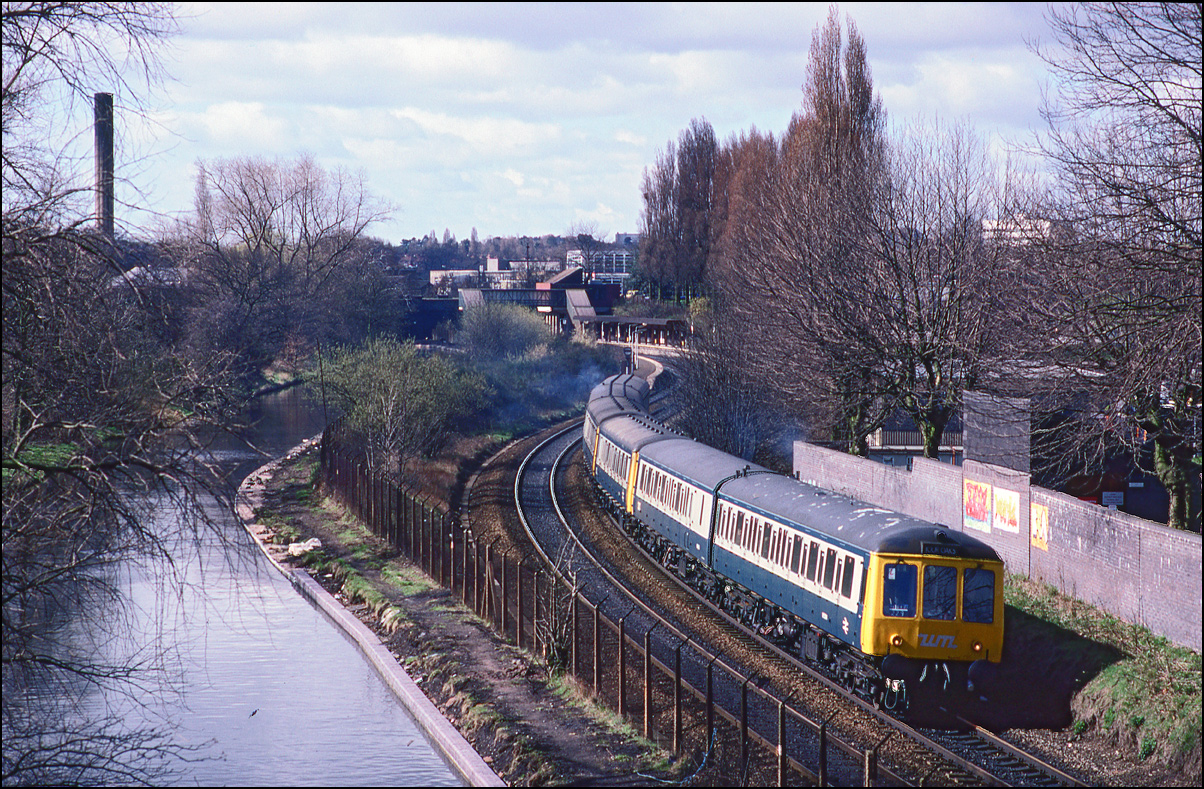 |
Birmingham University station is situated on the stretch of line between New Street and Kings Norton. Running alongside the canal it used to offer some interesting locations but whether this is case since the advent of overhead electrification I could not say. On Saturday 7 February 1987 a Longbridge to Four Oaks service was composed of a class 116 unit with the trailing driving coach replaced with a single unit bubble car, and a normally-formed 3 car class 116 set bringing up the rear. This type of mish-mash setup from Tyseley Depot was far from unusual and added to interest of the unit scene around Birmingham. |
|
|
I arrived at Stratford-upon-Avon on Saturday 19 July 1985 to catch the 08.12 train to Leamington Spa to find an unusual replacement for the usual single unit or pair of single units in the form of class 117 set B431 comprising 51411, 59521 and 51369. I assumed that this had been pinched by Tyseley to cover a shortage of their own sets after it had arrived at Birmingham New Street during the previous day. I sat in the first class compartment to take full advantage of the thicker padding and better backrests of the seats... |
|
|
The class 117 shown above stuck on trains between Leamington Spa at Stratford-upon-Avon on 19 July 1985. The procedure at the time was for trains arriving into platform 3 from the north to leave the station on the up line and then use the crossover just around the corner to reverse and come back either into platform 2 for Birmingham services or to run through the station before reversing again to gain bay platform 1 for Stratford. This picture shows B431 having completed the first reversal as it ran past the flower beds on platform 2. |
|
|
Another rare visitor to Leamington Spa on 19 July 1985 was single car set L101 operating a crew road learning run. This unit was W55001 by now in the Departmental fleet and numbered TDB 975023 and still carrying the overall blue livery from its previous days in passenger service in the London area. |
|
|
The DMU related fun at Leamington Spa continued on 19 July 1985 when a Marylebone based class 115 passed on the down main line with am 1L04 High Wycombe to Matlock charter operated by Chiltern Trains, long before privatisation and the official adoption of that name by the TOC. The set comprised of vehicles 51675, 59763, 59649 and 51671 and with 4 coaches was a relatively unusual sight at Leamington. The signal for the up main was on green so there had been a reasonable chance of a really messy picture with a third train in shot as the special passed a class 116 unit in platform 2 but all was well on this occasion. |
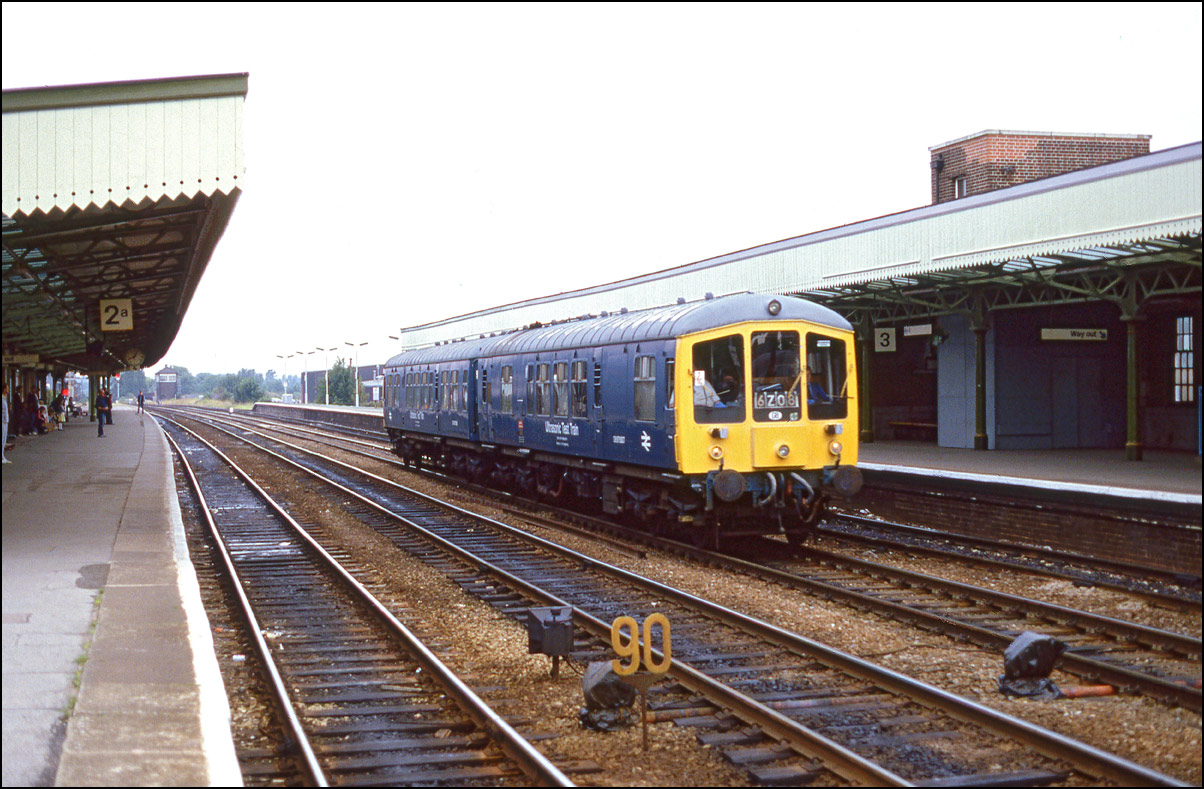 |
This is what the Ultrasonic Test Train looked like in 1985. It consisted of two Derby Lightweight DMU vehicles carrying the numbers 975007/8 and on 10 August of that year was carrying the reporting number 6Z08 while running from Derby to Marylebone when I photographed it passing Leamington Spa station. |
|
|
Testing runs between Tyseley and Stratford-upon-Avon continued on 7 May 2021 with 2 coach 196005. The morning started clear and sunny so I had a walk to Stratford station for 5Q21, the first train of the day. I suspected that it would go into platform 3, the worst for photography, so went to the end of platform 1 where a shot of some sort is just about possible. My caution was justified and here is 195005 about to enter the station spot on time. |
|
|
The train forming 5Q21 to and from Tyseley sits in the platform at Stratford for several minutes so there was time for a shot or two in the warm sun as it was there. A crew member is about to get into the rear cab a few moments after the signal at the end of platform was set to green and 196005 started its journey back to Tyseley LMD. |
|
|
New platform signs have recently been installed at some stations in the West Midlands Railway area marking them as "Heritage", whatever that is meant to mean. It's just about as meaningless as labelling old locomotives with the same epithet. Nice enough sign though... |
|
|
My final shot from Friday 7 May 2021 was taken as 196005 left platform 3 at Stratford for Tyseley LMD with the second leg of 5Q21. Those who like the sun to be on the front of their subjects will find this tricky with these units in some circumastances because of the size of the corridor connection. |
|
|
Sunshine appeared during the early afternoon of 5 May 2021 after a dark and wet morning. I noticed from an online mapping app that one of the testing run paths from Tyseley to Tyseley via Stratford-upon-Avon was a goer and wondered if it might be a 2 coach class 196/0. In the past these had been 4 coach 196/1s but the quality of these is abysmal and and far as I know they are currently not allowed to run. One run had been made on the previous day under a VST path but I didn't see this on RTT until too late so I looked a bit earlier today and after returning from Hatton had a walk to Stratford station to see 5Q24 with 196005 arrive into platform 2. Platform 1 would have made a better picture but this has been closed for weeks because of a dropped point blade on the switch allowing access to the up main line. This image was taken using my Canon G10 which was already in my coat pocket rather than a Nikon DSLR, my usual choice of hardware. |
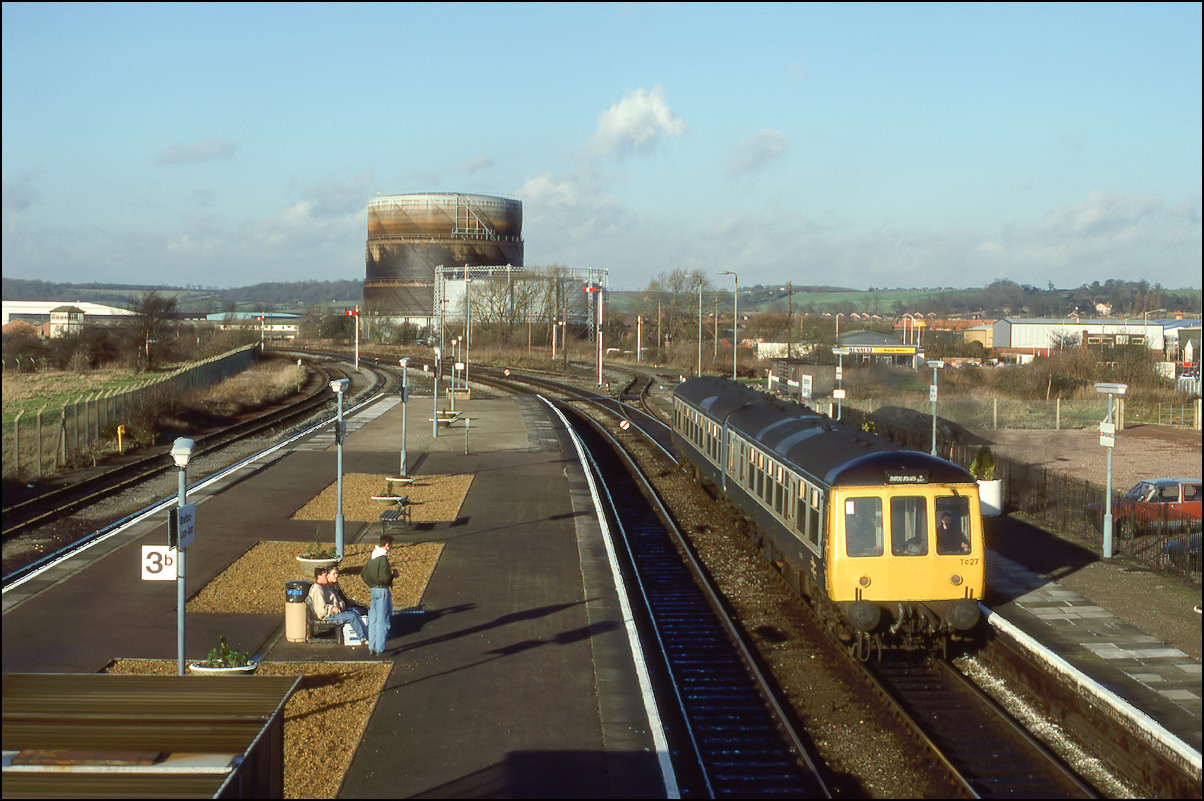 |
One of my favourite classes of DMMU was the Derby Heavyweights, class 114. Several sets ended their days at Tyseley Depot and spent a lot of time shuttling between Stratford-upon-Avon and Leamington Spa. With only 1 car powered, their performance could best be described as ponderous, but the seats were comfortable and the ambience, in my opinion at least, much better than the class 150s currently used in the area. This picture was taken during the afternoon of 28 March 1990 and shows T027 arriving at Stratford from Leamington. Note that the signalman has already set the ground signals and the points for the train to reverse out and run back into platform 2 for the return to Leamington; this was before the track and signalling was altered to allow departures from platform 1. The whole scene here has totally changed, the gasholders, signalbox, goods loop, siding alongside the platform 3 tracks and semaphore signals all have gone, there is an anti-trespass fence at the far end of the platform, and a Morrison's supermarket has been built on the ground to the left. |
_sona_280390.jpg) |
Here is another view of T027 after shunting into platform 3 at Stratford-upon-Avon on 28 March 1990 and prior to departure for Leamington Spa. The upper quadrant starter is in the off position but the guard hasn't changed the destination blind, probably realising that it wasn't worth the effort as the few passsengers using the train in the mid-afternoon would have had as good a knowledge as him where the train was going. The signal to the left of the starter controlled the exit from the down goods loop which ran behind the signalbox; this was still occasionally used at the time for stabling the stock of excursion trains. It wasn't long for this world though, being severed the following year and removed altogether within a few months. When the line was open to Cheltenham, virtually all down steam-hauled freights used the loop as there was a water column at the station end of the line. There were no water troughs on this line so station stops were necessary for water-taking and the loop was used to avoid the platform road being occupied for too long. |
|
|
On 19 October 1985 I was chatting to a friend at Leamington Spa who said that once of the last locomotives he was yet to see was stabled at March Yard and would I like a trip over there? On the way we called at Bedford where this class 104 + 101 combination comprising vehicles 53500 + 59206 + 53444 were stabled in the electrified siding alongside the virtually empty car park. |
|
|
Our next stop on the way from Leamington Spa to Ely on 19 October 1985 was Cambridge where I photographed all-blue class 105 DMU, 51268 + 54422, receding from th camera probably making a shunt move between platforms at the station. |
|
|
On the way to March Yard on 19 October 1985 where my friend scored his "cop" we called at Ely station where this class 120 unit, EP514 with vehicles 53687 + 59264 + 53785, was on its way to Birmingham New Street while passing Ely South signalbox with the diminishing range of semaphore signals showing how much track rationalisation had been carried out in the recent past. |
|
|
More evidence of imminent resignalling is obvious in this photograph at Ely North taken on 19 October 1985 as a class 105 led by E54429 arrives at its destination. The light had all but caved in by this time but looking at the slides of classes 20, 31, 37 and 45 I took at March it had cleared by the time we reached there. |
|
|
There were several single unit DMUs around Aylesbury in 2001 and here at the stops of the stabling roads on 24 February 1991 is 960002, formerly 55020. It was in use for some time as a Sandite and route learning vehicle and was in the Departmental Pool. Behind is probably Class 117 51411, another 117 can just be seen on the extreme left, presumably 51369, behind is 977723 and 977858. |
|
|
This was the scene just to the south of Bromsgrove station on 27 July 1989 tkaen from the bridge known to most local photographers as "Garringtons". At the time the station had a single platorm on the up side meaning that the few trains that called there had to cross over to collect passengers, as seen here as 37223 + 37242 leave the loop after taking over after the failure of class 31s on the Saturday Paignton to Liverpool service. A single unit, on this occasion 55034, was the usual accomodation for the modest number of passengers on the Birmingham to Worcester services that called here: a situation that had been the case for a number of years. Prominent in the picture are the Lickey Bankers, 37071 + 37032, waiting either for a freight that needed a shove up the 1/37 of the incline or an ailing locomotive or unit needing assistance. The view here in 2021 has changed almost beyond belief with electrification of the line, a new 4 platform station, the removal of the oil terminal and the inevitable construction of multiple housing estates.645 |
|
|
A few weeks before the shot shown above was taken 55034 was on the same service on 3 June 1989 but this time photographed from the next road bridge south from Bromsgove station near Stoke Prior. This is a decent location with good views available in both directions and with a shot still available of a train in the down goods loop in 2021 thanks to some much needed clearance of some vegetatiom from the lineside. |
|
|
By 10 August 1992 single unit DMUs were not an everyday sight on the inadequate 2 hourly trains between Leamington Spa and Stratford-upon-Avon so it was worth a walk to the station when 55034 + 55032 were working the 17.05 to Leamington. This shot was taken just as the units were leaving the station and not long after resignalling had meant that a shunt from platform 1, historically the arrivals platform, to P2 was no longer necessary. The rust on the then little used tracks on P2 can been clearly seen. |
|
|
On 3 July 1986 55033 + 55004 + 55032 were on a diagram that included the 18.30 from Stratford-upon-Avon to Birmingham Moor Street. I lived near to the line in those days and seen the train arrive from my kitchen window so had grabbed a camera, had a quick chat with the signalman and made my way to this spot with the gasholders, still in use at the time, and the middle starter signal prominent in the picture. The leading unit, 55033, was the one selected to receive Midline livery and it is seen here at Stratford on 22 December 1986 with local driver Geoff Davies in command as it passed Stratford East signal box the stove of which had just seen some attention from signalman and former locomotive fireman Mick Lloyd. |
|
|
Thursday 22 April 2021 was another clear and sunny day and with Vivarail/TfW's 230010 running between Long Marston and Stourbridge Junction via Moreton in Marsh I went to the latter for an image with the lower quadrant semaphores in the picture. There is clearly some overnight engineering work planned for the near future as these Road-Rail vehicles parked just outside the station show. |
|
|
My arrival at Moreton in Marsh on 22 April 2021 coincided with that of 802010 working 1P22, the 08.56 from Great Malvern to London Paddington. Although my interest in these units is limited it seemed worthwhile to take a shot with the semaphore signals, signalbox and station in view. |
|
|
I didn't know for sure that 230010 was oeprating its test and mileage accumulation journey on 22 April 2021 but 5Q23's schedule was manually activated which is usually a good indication. I wanted a shot of the diesel/battery hybrid at Moreton in Marsh which still has lower quadrant semaphore signals and the road bridge at the south end of the station is the perfect spot at around 10.30 at this time of the year. A GWR IET working the 08.50 from London Paddington to Great Malvern had just arrived with 230010 getting to the station spot on time a few moments later at 10.20 ready for its reversal. Once the IET had left 230010 was able to cross over to the down main line for the journey to Stourbridge Junction via Worcester. |
|
|
There were about 10 minutes before 230010 left Moreton in Marsh on 22 April 2021 which gave plenty of time for a walk through the adjacent park to the station for another shot of it standing, or to be more accurate, just pulling out of the platform under a clear lower quadrant semaphore signal on the way to Stourbridge Junction. It's hard to believe that every shot I have taken of this unit has been in perfect light. Time to stop while the going's good! |
|
|
There were more local runs for 230010 on Monday 19 April 2021 and with a sunny day just about guaranteed I took my Morris Minor out for a run and found myself near Evesham just before the first run was due. I had no idea if 5Q01 would actually turn up so was pleased when it appeared just about on time and put myself in a decent location for 5Q02, the return to Honeybourne. Here it is about to pass under the Evesham to Offenham road with the busy Evesham bypass bridge in the background. |
|
|
The next shot of 230010 I had planned to take on 19 April 2021 was from the tall occupation bridge just to the Evesham side of the bypass shown above. On arrival there it was clear that the sun wouldn't be quite high enough as the track was still in shadow from the lineside trees so I walked the short distance to a footbridge on the Evesham side. First along was an unidentified IET working 1P24, the 09.54 from Great Malvern to Paddington. In the background are the tower of Evesham Abbey and the spires of All Saints' and St Lawrence churches along with a less attractive building site. |
|
|
The final run of 230010 I photographed on 19 April 2021 was as it left Evesham going towards Honeybourne now under the headcode 5Q04. The footbridge on which I was standing is about 105 miles from London Paddington as shown by the milepost adjacent to the stonework reinforcing the cutting sides. Since the lineside vegetation was cleared in about 2010 prior to the line being redoubled there has been the usual unchecked growth. Here is a shot from 2010 with 66724 and another of 230010 from the same spot on 19 April 2021 taken just to show how things have changed in 11 years. |
|
|
Paths have been showing all of the week commencing 12 April 2021 for Vivarail's final train for TfW, 230010, to operate mileage accumulation and test runs between Honeybourne and Evesham. The first time it moved was on Thursday 15 April when 5Q01 actually ran and it was only by good fortune that I checked my 'phone while working in the garden and saw that it was at Evesham West Junction. I reckoned that there was just time to get to Honeybourne, the nearest location for me, for the return and so it was, 230010 arriving on the Long Marston branch as I walked down the ramp. The sun was in a good clear patch so I reeled off a few shots including this close up view of the cab. |
|
|
Two GWR passenger trains had to pass Honeybourne on 15 April 2021 before 230010 now running as 5Q05 was able to return to Evesham on its second run of the day. The only option on the up platform is for a going-away shot and it looks as if even this will disappear or much higher steps will be needed when the buddleia and other vegetation grows up over the coming summer. |
|
|
There was only a little over 30 minutes to wait before 230010 returned from Evesham to Honeybourne on 15 April 2021 and as the sun appeared likely to stay out I hung on for the train to reappear now with the headcode 5Q06. It's difficult to vary the views here but as the unit had run close to the footbridge ramp's landing I went for a wider angle close up. The train crew have a lunch break before the next outing to Evesham so after a chat with them in the car park I headed off to return home. |
|
|
As I drove over the road bridge at Honeybourne I saw that 230010 was in an eminently photographable position for another shot. I don't much go for endless repetitive shots of a single subject but on this occasion did park just around the corner and walk back to the bridge with the thought that it might not be sunny for future runs. This is possibly the best location here on the occasions that a large gathering of other photographers isn't present on the landing. No-one was there today: probably a reflection on the limited appeal of something that isn't a locomotive! |
|
|
I did all too little photography of the South Wales branches and my only pictures on the line from Lime Kiln Junction near Newport to Oakdale Colliery are those showing The Caerwent Cannonball 2 DMU tour that ran on 12 May 1990. My notes give no indication at all of the various locations visited so the captions are necessarily vague. Two DMUs, a three car Class 116/108 hybrid and a two car Class 118, were used and a headboard was carried on each end to make life easier for the crew during the several reversals on the other branches coverted during the day. Full details of the stock and itinerary can be found on the excellent Six Bells Junction site. This view was taken not far from the start of the branch passing some architecture typical of the area. |
|
|
The branch to Oakdale Colliery passed through some dense woodland as seen in this image of the tour in a heavily overgrown valley. The lack of recent traffic is shown well both by the rusty trackwork and the weeds beginning to encroach on the rails themselves. |
|
|
The vista on the Oakdale branch opened out a bit at a few locations and the sun did manage to appear at times thoughout the afternoon. The hawthorn blossom is prominent in this view as the train receded from the camera. |
|
|
This was such a decent location that it seemed worthwhile to wait for the train to come back from Rhiw-Syr-Daffydd level crossing, the furthest point reached by the Caerwent Cannonball 2 on 12 May 1990. I just changed to an 85mm lens in order to give a slightly different viewpoint. |
|
|
I do know that the location of this shot was as the train was about to enter Penar Tunnel. The structure immediately in front of the tunnel mouth appears to be a cast iron aqueduct carrying a stream across the line which would have had to have been diverted when the branch was cut out of the hillside. |
|
|
Plenty of heads watching the way ahead as the Caerwent Cannonball 2 runs back towards Newport on 12 May 1990. The walker on the well-used track seemed to be more bemused by the sight of photographers on the bridge more than the presence of a train on the by then unused railway line. |
|
|
My last shot on the Oakdale branch on 12 May 1990 was as the Caerwent Cannonball 2 ran downhill and about to pass the Eagle Inn. I recall that the learner driver in what I think is a Talbot pulled out into the road making the white Fiesta make a rapid avoiding move to avoid an incident! |
|
|
One of my favourite morning shots at Stratford-upon-Avon was this taken with the bracket signal prominent in the picture. The DMU is Tyseley set 611 which stood out amongst the other bacause of a slightly different paint jb on the front window surround and the West Midlands PTE logo on the yellow front end. The date was 3 July 1986 with the unit was arriving at Stratford forming the 06.20 from Birmingham Moor Street. There was a special working into the terminus a short while later that morning when 47632 came down with the ECS for a private charter to Blackpool. |
|
|
On 8 June 2007 I was asked to go to Long Marston to take some pictures of a demonstration of Rowe Hankins' equipment which provided on-train facilities for greasing the flanges of wheels while on the move. The vehicles used were class 117 DMUs 51352 + 51376 which had come here from the South Devon Railway and where they eventually returned in 2020. Details of 51352 can be found here on the excellent Railcar website and those for 51376 here. This image shows the train arriving at the short platform on the Long Marston inner circuit ready to pick up the invited guests and officials of Rowe Hankins before doing several circuits to show the equipment in operation. |
|
|
The developers of the system are seen here showing the location of their equipment on the train and giving brief details of how it operated. Two cameras are visible so that live monitoring could be carried out from screens in one of the coaches. |
|
|
Once the equipment had been inspected the train moved away and returned to the platform to pick me up for a ride around the circuit and show the flange greasers in operation. There was monitoring equipment showing a lot of data in one of the coaches but this cannot be shown here. In practice the release of lubricant could be controlled by GPS so that there was no waste and with the grease being carried on board a train there would be no need for railway staff to visit the many locations where conventional fixed equipment was to be found. |
|
|
This is just a general broadside view of the class 117 DMU at Long Marston as it stood on the inner loop before making another run to demonstrate the automatic flsnge lubrication system. I was lucky enough to have a cab ride on this run which brought back memories from childhood of sitting in the front seat of the leading vehicles of similar vehicles on trips to Leamington Spa or Birmingham. |
|
|
On the day following the flange greaser demonstration, 9 June 2007, the class 117 DMU was used for public trips around the inner loop during the Open Day operated by Motorail Logistics. Here are 51352 + 52376 leaving the small platform on one of the runs with the second man making sure that the points had been negotiated correctly. The section of the train containing the monitoring equipment was securely locked. The lights and cameras used for this purpose are clearly visible in this view. |
|
|
When at Honeybourne on 30 May 2021 waiting for 37510 with ATW DVTs GWR's 800025 working 1P24, the 09.24 Great Malvern to Paddington stopped in the station. I didn't photograph the whole train but noticed that it was the set named for Sir Tom Moore. No further comment is needed but another view of the vinyls is shown here. |
|
|
The preserved Hastings Line DEMU with an added standard width centre coach made its first visit to Stratford-upon-Avon on Saturday 8 March 1997. It was an extremely dull and misty day with a persistent drizzle and even TRI-X 400asa in my Mamiya 645 struggled a bit for exposure. The first shot was taken as it slowed to a stop in platform 1 with all the old-style signalling still in place although with an upper quadrant starter for platform 2 which meant that arriving trains didn't need to shunt from P1 to P2 prior to departure. The taller signal controls P1 whereas before the alterations it was for P2 and exit from P1 was done with a ground signal. |
|
|
After arriving at Stratford-upon-Avon on 8 March 1997 1001 travelled along the North Warwickshire Line to call at the newly reopened Birmingham Snow Hill station. I wanted a shot with a semaphore signal included so went to Henley in Arden where the weather was slightly worse even than it had been at Stratford. The train had run from Hastings via Kensington Olympia, Reading, Oxford, Leamington Spa and Warkwick to Stratford-upon-Avon and the reopened Birmingham Snow Hill before returning to Stratford where any passengers who had wanted to visit the town were collected. |
|
|
Even though the weather continued to deteriorate on 8 March 1997 the sight of a Hastings DEMU on the GWR line from Birmingham to Hatton was so unusual I felt it worth the drive to Rowington for a third shot after it had left Snw Hill to return to Stratford via Hatton North Junction and Bearley Junction. The standard width Mk1 coach inserted into the train to increase capacity is clearly noticeable here even through the rain. |
|
|
I can't recall at what time 1001 was due to leave Stratford-upon-Avon on 8 March 1997 but it must have after the already dire light had deteriorated even more and wasn't worth the effort of going out further along the line. Departure wasn't imminent when this shot of the train was taken and those people who were on the leg of the tour from Birmingham Show Hill had gone off into the town for refreshments. I hadn't beaten it back here from Rowington but did snatch a quick shot from the Alcester Road bridge while a few stragglers were still around and the crew added water to the lavatory tanks. The DEMU made a later trip to Stratford on 4 July 2015 when the light was much better. |
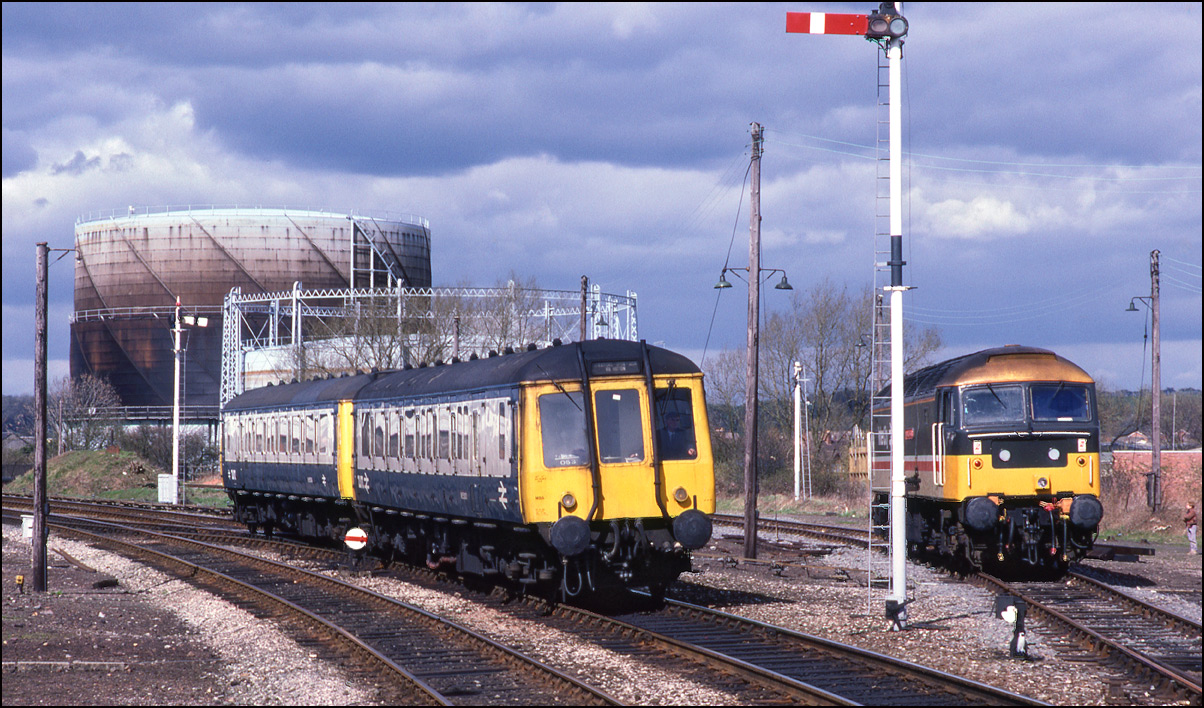 |
Saturday 11 April 1987 saw a steam special hauled by 35028 Clan Line come to Stratford-upon-Avon. As the train included an ETHEL, some fairly complex shunts were required, so Saltley shed sent down 47610 to help out. The class 47 is standing in the long-gone down goods loop as a Leamington Spa to Stratford service arrives at its destination under a dodgy looking sky. My notes don't reveal the identity of the 2 bubbles, but 55003 is the leading unit and it's a good bet that the other is 55034. The gasholders and semaphore signals have disappeared from this scene and it seems that I have caught the inner home signal just before it reached the horizontal position. |
|
|
Later in the afternoon of 11 April 1987 I walked up to the Alcester Road bridge as a 3 car class 116 DMU waited to leave Stratford-upon-Avon for Birmingham Moor Street. The steam locomotive 35028 now had the ETHEL marshalled behind the tender and was pulling its train forward in platform 2 after being watered before leaving for London Marylebone. |
|
|
A slightly more modern but less characterful DMU is shown here at Manchester as it passes through the remains of Exchange station before going into one of the terminus platforms in Victoria. This pacers are little more than buses on railway bogies having diesel engines identical to some road vehicles. |
|
|
Another scene at Manchester Victoria on 6 December 1984 shows 25284 dragging a failed class 104 DMU formed of 53448 + 53503 into the station. Another class 104 unit and 2 class 120s can be seen in the suburban part of the station and another class 25 acting as station pilot is just about visible on the through lines in the darkness of the station. |
|
|
A couple of contrasting front ends at Stratford-upon-Avon on 18 June 2004. A Stratford to Stourbridge Junction train formed of 150106 is standing alongside 47854 which had appeared during the previous afternoon. I have no idea why it was here but someone on the station told me that the occupants of the saloon had been collected in a limousine of some description and taken off for the night. |
|
|
An everyday scene at Worcester Shrub Hill from 15 December 1984 with 4 coach B436 entering the station with a train from Birmingham New Street which will reverse here before turning left towards Foregate Street and Hereford. In 2021 the gantry of semaphore signals is still extant but a class 37 would not be seen in the former shed while waitng for its next job, along with a fellow class member, as a banker on the Lickey incline. |
|
|
A bit of smelly exhaust smoke at Bordesley Junction as two class 116 DMUs climb from the Moor Street lines towards St Andrews Junction and Birmingham New Street with an ECS from Tyseley depot which will later work on the Cross City Line between Blake Street and Redditch. This amount of smoke was commonplace with these DMUs when their engines were cold. |
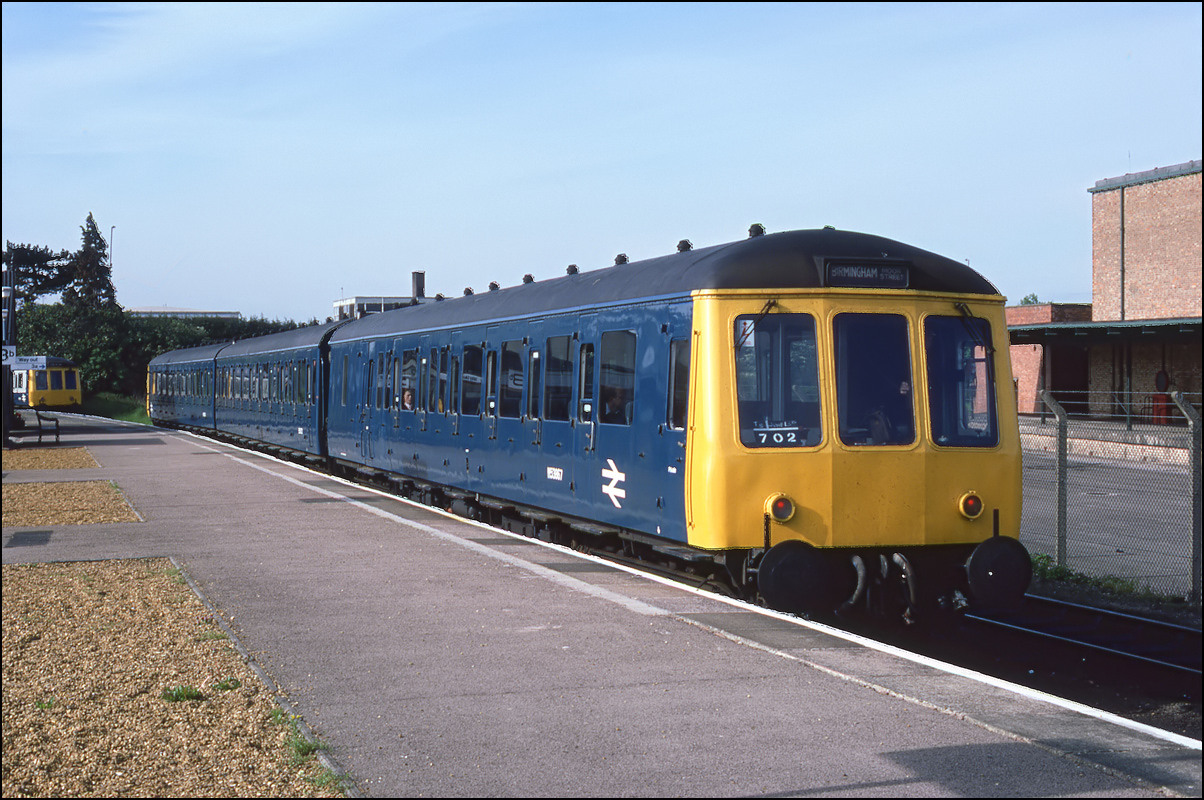
| This picture was taken on 7 June 1986 and shows Tyseley's class 116 unit T702 standing in platform 3 at Stratford-upon-Avon with the 08.30 to Birmingham Moor Street and before the driver had returned to the cab after shunting the train from platform 1 and changed the lights to white. This unit was the last class 116 to remain in all blue livery and at this date was not to remain unpainted for much longer. At this time several DMUs were stabled overnight in the platforms here as the station office was a crew signing-on point with its own allocation of drvers and guards. A class 121 single car unit is just visible behind T702 waiting to shunt into platform 1 and work Leamington Spa trains. In the winter the units were left with their engines idling all night, possibly because they wouldn't have started on a frosty morning, and a cloud of dense stinking diesel exhaust often hung over the station area. Virtually everything in this scene has changed; the Ministry of Defence cold store has been replaced by a Morrisons supermarket, the college building on the far side of the Alcester Road has been extensively extended and the siding to the right of T702 has been lifted. Trains to Birmingham no longer leave from platform 3 after shunting from No. 1, but now simply reverse. The Chiltern Railways trains to Leamington Spa and London Marylebone use platform 3 from time to time although they are more often routed into platform 2. |
|
| In 1986 I lived within sight of the railway line at Stratford-upon-Avon and from my kitchen window on 1 July 1986 saw the last all-bllue class 116 arrive from Birmingham Moor Street to form the 08.00 departure back to the West Midlands. I grabbed a camera and asked the signaller, a good friend, if I might take a shot from his window as the unit crossed the Stratford-upon-Avon canal alongside a good show of elderflower on the embankment. A class 121 single unit had fortunately for me just gone towards the station with an arrival to leave a few minutes later as the 08.12 to Leamington Spa. I didn't have time to wait for this to leave as it was time to head off to work in town. |
|
| After work on 1 July 1986 I kept an eye open for T702, the last all-blue class 116 DMU, to appear again at Stratford-upon-Avon. The diagrams weren't straightforward for any particular unit and involved trips over several different routes. This unit had clearly switched to the Leamington Spa line as it arrived at Stratford ready to form the 18.35 service back to that town. I had a word with the signalman on the 2nd shift and established that he was happy for me to take a lineside shot as the train left the station. The signal in the foreground is the lower quadrant controlling the exit from the Cold Store Siding by then used only for the overnight stabling of stock and, as shown here, failed units awaiting rescue. |
|
| Vivarail 230009 was sent for reasons unknown to me from Birkenhead North to Long Marston on Friday 19 February 2021. I had only a single shot of this unit and as the road bridge at Long Marston is only a few hundred years from the foot and cycle path, formerly the GWR line to Cheltenham, from Stratford-upon-Avon, I used my wife's electrically assisted bike for a spot of exercise with an ulterior motive. The train, 5Q23, lost a lot of time around Hereford because of signalling problems but this was picked up by the time it had reached Worcester Shrub Hill. It was about 5 minutes early at Evesham and appeared through the rain at Long Marston a few minutes after I had. The yard along the exchange sidings has recently seen a lot of clearing out with the departure of a lot of stock for scrapping as this view shows as 230009 entered the site. |
|
| This is a scan from quite a poor quality print I recently found in an old album and it needed nearly 2 hours work in CS2 to get even to this point!. It shows Stratford-upon-Avon station taken from the Alcester Road bridge in about 1978 and must have been shot on my Ricoh fixed lens compact camera using FP4 film, probably processd at Boots. The train in platform 3 appears to be a hybrid unit of one coach a class 105 and two of class 116. Note the different number of white painted door steps of the class 116 showing that these units had a greater number of doors for suburban use. The other DMU in platform 1 had just arrived and is one of the "reverse colour" class 116s. This will be going to Birmingham Moor Street after shunting into platform 2, while in the Down Goods Loop is a charter headed by a pair of class 25s. I have no details at all of this and it's a mystery to me now why I didn't walk the few yards to the station for another look and picture. On the left of the picture is the site of the food store with the canopy of the loading bay just visible. Goods for the cold store were taken by rail to the then loop line, known locally as the Cold Store Loop, to the left of the blue DMU and then shunted into the store's own line for unloading. See this picture from the wonderful archive of the Warwickshire Railways website. |
|
| The first ever visit of HST stock to Stratford-upon-Avon took place on 16 May 1988 when the town's service to London Paddington was inaugurated. From a photographic point of view the timings weren't great with the sun being in just the wrong place but a first is a first and all that so here in the train moving forward in platform 2. Quite why it had backed down so far is unknown to me but at least the flower bed gives a splash of colour as it passes. The train wasn't a great success in terms of passenger loadings. I travelled on it as far as Reading on several occasions and it was invariably possible to have an entire coach to oneself as far as Banbury. It was soon withdrawn... 645 |
|
| There were are probably still are plenty of class 156s on the Stoke on Trent to Derby line and here is 156407 on a Crewe to Nottingham train rounding the reverse curves near the interestingly named villages known as The Bents on 2 May 1995 while working a Crewe to Nottingham service. The bridge adjacent to the upper-quadrant distant signal also provided a useful shot and here is 56035 witth some empty steel wagons heading in the other direction earlier in the day. The signal was so close to the bridge that this was about the best shot possible: even with a wide-angle lens it wasn't a lot better. 645 |
|
| Another class 156 is seen here at Peachfield Road at Great Malvern working a Birmingham to Hereford train sometime in the mid 1990s. The medium format slide was in the sleeve still as returned by the processor and without trawling through several notebooks I have no idea of the date on which I took it. A possibly more interesting train was in front of the camera here when I photographed 60089 with a diverted 6V05 Round Oak to Margam steel train on 22 May 1998.645 |
|
| In 1990 some Derby Heavyweight DMMUs were allocated to Tyseley and were often used on the infrequent shuttle service between Leamington Spa and Stratford-upon-Avon. On 27 April 1990 I went to the lineside near where I lived at the time and took shot of T026 about to arrive at the station with the 07.30 from Leamington. The Down Goods Loop was about to be disconnected and then lifted and the associated smaller arm on the signal gantry removed. There were few opportunities to take a shot with this arm lowered in my time photographing there and this picture of 47013 with the weedkiller on 4 June 1986 is one just 2 mor 3 I have. This was done for me by a kind signalman with whom I was friendly.645 |
|
| I was standing at Stoke Prior in summer 1997 when an unfamiliar yellow end appeared in the distance. It turned out to be buffer-fitted HST power car 43068 leading a down Virgin Cross Country service when painted in the original and short-lived version of the company's livery. I'm not surprised that it didn't last long given the ease with which it became dirty.645 |
|
| On 18 October 1993 I had a drive over to Frampton Mansell on the Gloucester to Swindon line to take a shot of the double-headed class 47s on the morning Longbridge to Swindon car parts vans. As I parked I noticed quite a lot of exhaust smoke hanging in the still air over the line - a bit of a clue that I was late! A short time later 37239 went south light engine but not long afterwards it came back having reversed where the line becomes single. Its arrival coincided with a Gloucester to Swindon passenger service formed of an unidentified class 153 and even though the lighting was indifferent I thought a shot worthwhile. |
|
| In the middle 1990s I had several trips to the North Stafforshire Line, specifically the bits around Uttoxeter and Tutbury. This picture was taken at the former on 2 May 1995 and shows 150105 approaching the station with a local service from Crewe to Nottingham. I believe that the signalbox was the last mechanically operated one built on the LMR and is, as far as I know still in use in 2020. The factory on the right of the line is part of the huge JCB facility the products of which are used all around the world. |
|
| Another class 150, this time 150120, is seen here on 15 May 1995 this time working a Crewe to Skegness train. The location is a few yards to the east of Hockley Crossing where the elaborately decorated crossing keeper's cottage is partly visible. I wish now that I had taken a separate picture of this as it would have been of at least as much interest as the train and semaphore signals. Running about 20 minutes of front of 150120 was 47760 with the Pilkington coaching stock running empty to Derby for use on a railtour later in the day. It was too early in the day for either of these shots as the sun was a bit too straight but I didn't know the area at all and miscalculated the sun's angle. My thanks to Colin Hill and members of the Stafford Railway Circle for details of this location. |
|
| Class 156 units were also used on Crewe to Derby trains and here is 156409 approaching Tutbury and Haton station on 2 May 1995. I well remember the first time I went to this footbridge because although I knew roughly where where it was, it took me a while to find anywhere to park nearby and even longer to find the snicket between the bungalows leading to the footpath! |
|
| The view looking towards Tutbury and Hatton station is much more often seen than the one shown above because of the much better backdrop even though it the Nescafé factory doing something unspeakable to coffee beans to make a brown drink. This shot was taken on 13 April 1995 and shows 153325 on a Derby to Crewe local service shortly after leaving the staggered platforms. The real purpose of the visit was for 33109 + 3316 and 4TC stock going to Ayr and running nearly 4 hours late. |
|
| This picture is from Hatton without any added Tutbury! Class 153 units were used on the two-hourly Stratford-upon-Avon to Leamington Spa shuttles for a relatively short time and I have all too few pictures of them. Here is one of them showing 153384 on the 10.12 from Stratford at Hatton Station Junction and about to stop at the station on 12 March 1994. This shot is barely visible in 2020 thanks to the almost unchecked growth of lineside vegetation. |
|
| Another class 153 is seen here arriving at Stratford-upon-Avon in December 1994 with an aftrnoon train from Leamington Spa. The light was a bit weak but worth a shot because of the railway infrastructure and the backdrop both of which have since changed almost beyond recognition. |
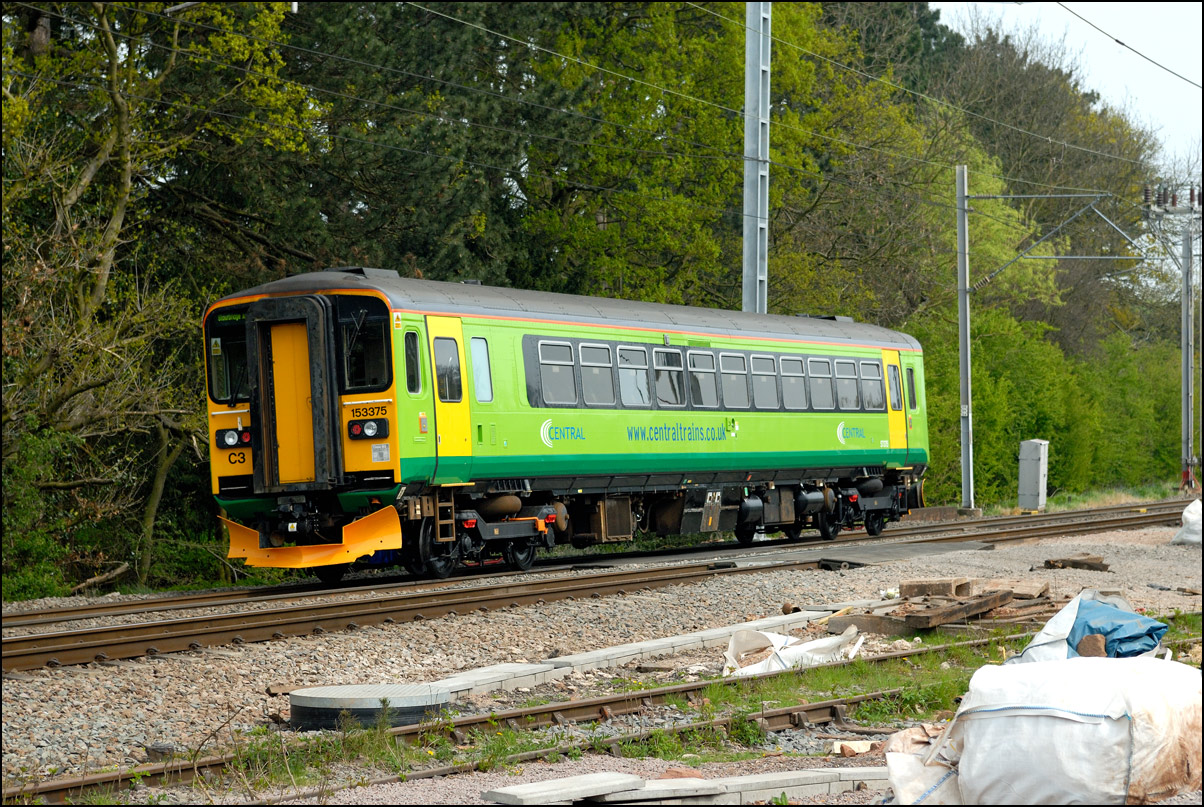 |
While I was chatting to an old friend, Gerald Robinson, at Berkswell on 21 April 2007, 153375 tried to sneak past the camera. The working was 5G49 1400 Tyseley-Coventry, the unit heading off for a spell on the Coventry to Nuneaton servive. The single unit looked to have been recently painted into Central Trains green livery. It's a shame about the horrendous mess in the foreground but the train was running very slowly towards an adverse signal and wasn't exactly announcing its presence for a better view... Thanks to Mike Hollick for the train ID. |
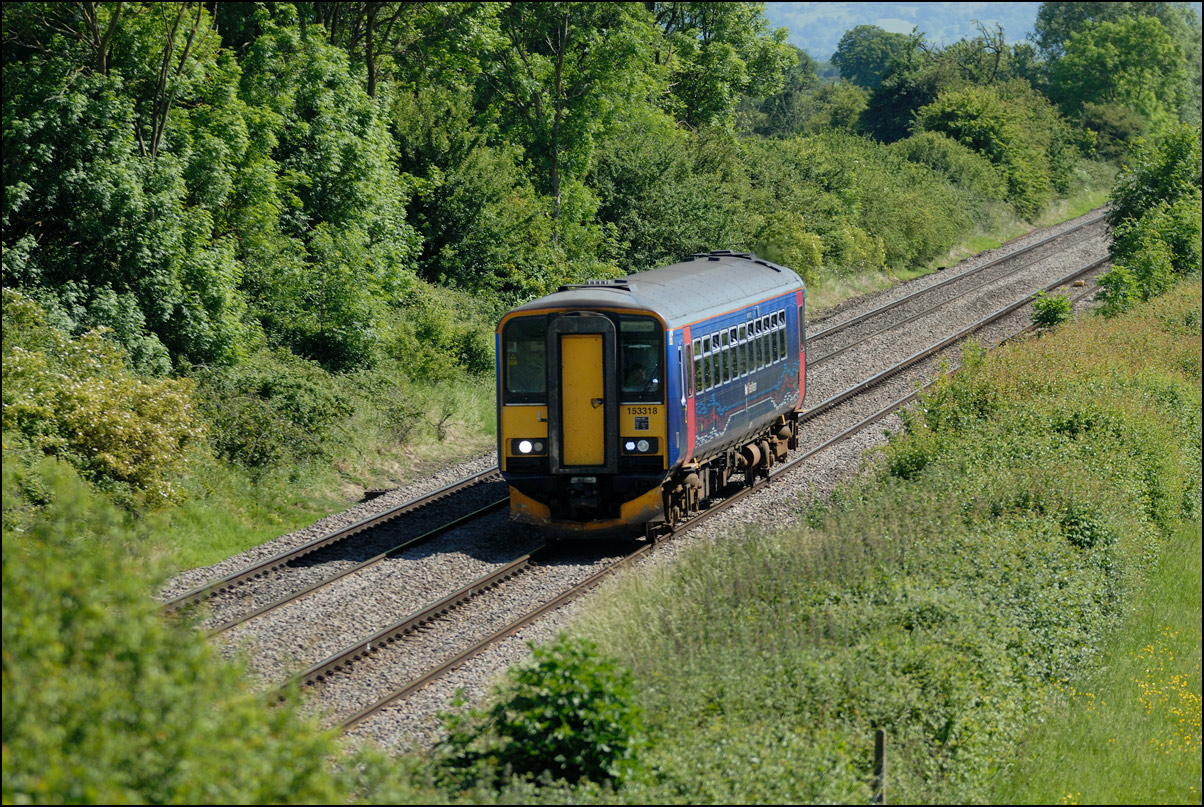 |
The use of class 153 single units on their own isn't all that commonplace in the West Midlands, the best known being the shuttles from Coventry to Nuneaton. First Great Western also use the modern-day "bubbles" and on some long distance runs. Here is 153318 on the 12.26 from Southampton Central to Worcester Foregate Street on the final approach to Ashchurch station. There isn't much of a northbound shot at this location but with a long lens a train-sized gap (for a small train!) in the lineside undergrowth can be found with the escarpment of the Cotswold just visible in the background. Not really my sort of shot but if you are there and the sun's out... |
|
|
Another picture of the unit shown above and possibly the first shot of a class 153 in GWR green after it was repainted at Long Marston. The car park at Honeybourne on 27 March 2017 had plenty of spaces so I was able to park easily and made my way to the roadbridge where 153318 had just moved away from the hut containing the single line token, after running from Long Marston, thus giving me about 20 seconds to arrange my shot. All was fine and a nice sunny shot of the smart paintwork was achieved. This colour scheme isn't the easiest to photograph in some lighting conditions so it's good to have a decent one in the bag. at an early stage. |
|
|
This scene on Hatton Bank was so commonplace that most photographers didn't "waste" a frame of film on it but I took a lot of shots of DMUs in my local area and these are now at least as interesting as some of the freight and locomotive-hauled passenger traffic. This one shows Tyseley's class 116 T323 working one of the then frequent leamington Spa to Birmingham Moor Street local trains on 19 March 1993. The impressive building in the background is what was once called the Hatton Lunatic Asylum but this has long been demolished and replaced with a housing estate. |
|
|
On Sunday 9 September 1990 I spent a few hours around the station area at Lichfield City as inter-regional trains were diverted from the main Derby line where an engineering possession was in place. This and the following pictures are a few of the many I took. Here is Tyseley's class 116 T328 after it had shunted from the station for reversal; the ground signal, which can be seen in front of the unit, had just been pulled off after the points were set to allow movement into the platform for Birmingham and Redditch-bound services. |
|
|
The diverted inter-regional trains at Lichfield City on Sunday 9 September 1990 were a mix of HST and locomotive-hauled trains. The first of the former i saw was this of a Newcastle to Cardiff working taken as it was about to pass behind the signal box and run along the since-lifted through road. Part of the attraction here was the array of semaphore signalling. All semaphores are good but in my opinion these weren't the best I had seen as by this time, unlike in the past, there were no split level arms for speed differentials and no distants. I do like to see distant signals on a post as 1) the bit of yellow always brightens things up a bit and 2) in some places it could mean that something non-stop and potentially more interesting than a local stopper was coming. |
|
|
This shot of T419 is one of those so ordinary that at the time it hardly seemed worth taking and if it hadn't been for the HST in the background disappearing to the north the shutter release probably wouldn't have been pressed. Since my picture was taken the semaphores have gone to eplaced with colour lights and the route has been electrified with 25kv overhead catenary. Here is a broadly equivalent view from 2010. In June 1990 the station was in the news after a trainee soldier, William Robert Davies, aged 19, was shot and killed and two other new recruits wounded by two IRA gunmen while the servicemen were awaiting a train to Birmingham. |
|
| On 20 November 2020 one of the as-required paths between Tyseley and Stratford-upon-Avon was activated and as one of the 2 coach 196/0 DMUs had recently been delivered I thought that it might have been out for a run. In the event it was 4 coach 196103 that arrived into platform 2 at Stratford so I just had one quick shot of it before continuing with my walk. |
|
| I was standing on the bridge at Lea Marston on 18 August 2003 when this appeared and in common with one or two of the photographers also there hadn't a clue what it was. Fortunately one chap knew that it was a Loram Railgrinder and that it was en-route from Paignton to Derby after a stint of overnight work on the Torbay branch line.645 |
|
| Class 168 DMU has been the mainstay of Chiltern's expresses between London Marylebone and Birmingham Moor Street or Snow Hill for over 20 years. Here is 168002 climbing Hatton Bank on 3 March 2000 with a late morning express going towards Birmingham with a beautifully dark sky forming the best part of the picture. As far as I can remember the patch of sun didn't last long so it was quite lucky that anything at all came along at the right time.645 |
|
|
Most of the suburban passenger trains on the Birmingham Cross City Line were class 116 units but odds and ends turned up from time to time. On this occasion a BR blue centre coach, probably one of the few remaining at this time in 1986, made a contrast with the standard blue and grey colour scheme. I took this slide at Longbridge where most of the trains from either Lichfield or Four Oaks terminated and then crossed over and reversed for the return journey. The British Leyland car factory dominated the background. Following the collapse of BL the whole site was closed and is now a retail park while the railway infrastructure has changed with the advent of OHL electrification going to Redditch and Bromsgrove. |
|
|
Another mish-mash DMU is seen here between Langley Green and Smethwick West in the Black Country in October 1986 while working a Stourbridge Junction to Birmingham New Street service. There was, and still is, a 15 minute service frequency on this line so any number of pictures could be taken in a variety of locations. I particularly liked this area because of the industrial backdrop and on this occasion was waiting for 31132 working 6T48 from Bescot conveying chlorine tanks between the mandatory barrier wagons and brake van from Albright & Wilson's chemical works a bit further down the line. |
|
|
Before the advent of the Parry People Mover single car Tyseley DMMUs were used on the shuttles between Stourbridge Town and Junction stations. Here is 55032 approaching the Junction station in about 1986 although I can't find the actual date in my scrappy notes. What is clear though is that the unit had recently arrived from South Wales judging by the Red Dragon logo on the cab front. |
|
|
Class 158 DMUs were never a common sight on the Gwr line south of Birmingham but in 1998 there was a Liverpool to Portsmouth Harbour and return service operated by a single example. I had a few shots of them but this of 158747 was the only one I had in decent light and which was taken from the road bridge over the line and M40 near Rowington in Warwickshire.645 |
|
|
The Pacer DMUs of classes 143 and 144 have, in late 2020 and early 2021, received more attention from enthusiasts than they ever managed in their operational lives. This is, of course, because they have been steadily withdrawn and largely sent for scrap. I have a few pictures of them including this of 143624 passing Stonehouse a few miles south of Gloucester with a Gloucester to Taunton train. The sidings visible to the right of the main line used to be a small coal yard which received trains of domestic fuel and which in turn was the site of the junction with the long-gone branch to Nailsworth. Thanks to Richard Davies for the historical information.645 |
|
|
In common with Pacers, class 153 units converted from coach 155s didn't see a lot of publicity. I have quite a few pictures of them as they used to oeprate Stratford-upon-Avon to Leamington Spa services but this one is a bit further afield showing 153369 at Catholme while working a Derby to Birmingham New Street train. This site had just seen the start of work to build both the Central Rivers CrossCountry depot and a road distribution warehouse complex.645 |
|
| The newly refurbished HST set operated by Locomotive Services Ltd and known as the Midland Pullman went from Crewe to Eastleigh on Friday 18 December 2020. I hadn't seen the train on its other runs in my area so thought that a image was well overdue. Running as 5Z36 and using power cars 43046 + 43055 it left Crewe nearly 90 minutes late and although some time was made up en-route it increased before it reached Coventry. I had decided on Leamington Spa station on such a dull day so as to have some tangible background to the shot and after moving from the down to up platforms as couple of times because of potential conflicting moves from other trains my original choice of the end of platform 2 proved to be fine. Running under double yellows 5Z36 is seen here passing the station on the up main line in exceptionally dull and drizzly conditions. |
|
|
My wife and I were doing our weekly round of farm shops, in order to avoid supermarkets, on Thursday 12 November 2020 and on driving over the road bridge at Honeybourne station caught a glimpse of the latest class 230, 230009, pulling away from the staff hut and running towards the station. I keep my original DSLR, a Nikon D70, in the car just in case so diverted to the station car park as the unit pulled up to the signal and stood waiting for the road towards Evesham. It was fortunate that a down GWR service was due so there was time to walk to the appropriate spot on the bridge and take this image of 230009 as it stood in the sun. I later saw from RTT that it was 31 minutes late. Lucky that! After leaving the first farm shop on our journey I saw a D Stock car from Long Marston on a low-loader just joining the main road from the access road and assume that it was on its way to Southam for conversion work to part of a class 484 set. It went in the opposite direction to us otherwise I should have had a shot of it further down the road. |
|
|
The monthly test train from Tyseley to Stratford-upon-Avon was due to run on Tuesday 3 November 2020 and with it using some previously unseen traction for the line I went to the station for a few shots. I arrived just in time to try out some varying exposures on 172340 as it prepared to leave the station with 2K77, the 20.27 to Kidderminster. |
|
|
Colas Rail has recently acquired 2 of the former EMR power cars for use on trains with, I believe, more to follow with a view to dispensing with most locomotive haulage from the Network Rail test trains which they operate. On Tuesday 3 November 2020 the monthly test train from Tyseley, 1Q48, utilised 43050 + 43060 still in the EMR livery but with vinyls showing their new operator until they can be repainted. As this was the first time that HST PCs have been to Stratford-upon-Avon on such a working I went to the station for some shots and was surprised to be the only photographer there. The new station lighting here very effective and I used my Nikon D800 hand held with settings of ISO 4000, 1/125 second with a 50mm lens set at f2.8 to achieve what I think is an acceptable result. |
|
|
The test train 1Q48 had arrived at Stratford-upon-Avon some 15 minutes early on the evening of 3 November 2020 and not long after the driver had walked from 43060 to 43060 and changed the lights to white the starter signal for platform 1 was cleared. I thought that on departure there might be a bit of smoke so took another shot as the train began to move even though it was quite similar to the previous image. |
|
|
After photographing 50007 + 50049 at Wyre Piddle on Wednesday 4 November 2020 there should have been about on hour to wait for 1Z22 from Tyseley to Bristol via Oxford. Even though it had left Tyseley about 60 minutes late I thought it would be close to right time on the North Cotswold Line by missing out the booked stop in Stoke Works loop. Wrong! It seemed that the crew's break had still to be taken and 1Z22 sat in the loop for the thick end of an hour. Even though I have taken too many shots from Briar Close in Evesham the clearly identifiable location seemed the right place for this shot of the former HST power car 43060 leading the formation. The return working of 50007 + 50049 from Long Marston had been retimed to leave an hour earlier and there was a real prospect that 5Z51 would be sitting at the down line signal as 1Z22 approached. With this in mind I had a long lens handy and was prepared to move a few yards to my left if this should happen. Luckily, all was well and the envisaged shot was fine. |
|
|
The daily RHTTs in Warwickshire are formed of MPV stock unless, as happened once in 2014, a unit failure results in locomotive substitution. On Wednesday 28 October 2020 3S02 ws led led by MPV DR98920 as it passed through Hatton station after clearing any leaf-fall debris from Hatton Bank and as any photographer knows there are more than enough lineside trees all the way up the bank from Warwick. The names written in the muck on the front of the unit can be read on the original RAW image and resulting TIFF and are "Mo, Carl and Precious"... This train reverses in platform 4 at Leamington Spa and is booked to follow 4M71, the 09.49 intermodal from Southampton which on this occasion was hauled by 66133. |
|
|
Paths betweenTyseley LMD and Stratford-upon-Avon for the testing and crew training of class 196/1 DMUs were increased in October 2020 to allow for the use of 2 different trains. On 20 October both sets of paths were used for the first time and I fitted in a diversion to Stratford Parkway station during a walk with a view to taking an image of 196104 running as 5Z03, the 14.40 to Stratford. An unexpected piece of clear sky appeared just as 194104 was due and although Parkway isn't the most photogenic spot on the line it at least was mostly clear from shadows and easily identifiable. |
|
|
Yet another train of redundant coaching stock was scheduled to be taken from Long Marston on Tuesday 6 October 2020 with GBRf liveried 50049 + 50007 providing the power. They were timed to join the branch at Honeybourne a few minutes after Vivarail's 230008 had gone onto the main line, reversed and gone up to Moreton-in Marsh. Here is the diesel/battery hybrid unit after reversal and accelerating very rapidly on battery power alone through the up platform at Honeybourne station. |
|
|
The multi-mode 799001, formerly a class 319 dual-voltage unit which is now able to run on 3rd rail DC, 25kv overhead power or inboard hydrogen fuel cells, made its second main line trips between Long Masrston and Evesham West Junction on Friday 25 September 2020. The weather forecast was excellent and the sky was clear of cloud when I left home but on the way to Blackminster, between Honeybourne and Evesham, banks of heavy cloud built up. I wasn't planning on taking a shot as 799001 approached Mutton Bridge in Station Road but as there was no sun when it approached it seemed worthwhile having one from the north side of the line. The signal for the up line was on green which indicated that an up GWR service had Left Evesham for London Paddington. |
|
|
The up train mentioned above was 1P23, the 11.55 Great Malvern to Paddington seen here approaching Blackminster on 25 September 2020 with 799001 on its way to Evesham making for a strange bedfellow. I suspect that there aren't many images around with a class 800 alongside a class 319 or its derivative. It's a great shame that the sun failed to co-operate. |
|
|
Porterbrook's 799001 was booked to stand in Evesham station for some time before it went to Evesham West Junction to reverse and return to Long Marston on 25 September 2020 but I thought that it might get away early. While it was at Evesham the sky cleared almost completely and I stood in some very pleasant sunshine hoping for a well-lit shot when it came back. It stuck exactly to schedule by which time the cloud had returned. I don't mind taking shots in poor light, especially for this sort of subject, but it was a bit galling to have sun in the background and which arrived at the bridge as I put my camera into the boot of my car... |
|
|
The first daylight run for DRS's recently repainted 37425 took place on Monday 21 September 2020 with a light engine move to Long Marston. While checking the times for this on RTT I saw that there was another train out of Long Marston which appeared at first sight to be another trip for 230008. On looking at the details there was no mention of a class 230 as there is usually so after a bit of thought I surmised that the only other option was a first journey out for the hydrogen powered class 319 conversion 799001. A few minutes before the booked departure time what had clearly been a class 319 EMU could be seen moving around the circuit before entering the exchange sidings. As soon as the gates were opened it made its first ever movement on Network Rail tracks as a zero-emission hydrogen powered multi-mode unit. The pantograph has been retained and can be seen on the third vehicle. |
|
|
The Hydrogen Flex train powered by hydrogen fuel cells 799001 made its first main line journey on Monday 21 September 2020 with a return trip between Long Marston and Evesham West Junction. It had to recess in Honeybourne Sidings because of another train, headed by 37425, needing to use the single track branch. As soon as 4Z67 had cleared onto the main line 799001 was released for the run back to Long Marston and here it is dropping down the gradient from the sidings to the Long Marston branch. I took a broadside view of part of one of the coaches as it passed by. |
|
|
Vivarail's 230008, destined for use by TfW, was out for mileage accumulation runs between Honeybourne and Evesham on Friday 18 September 2020. This wasn't the unit's first set of runs but these are my first photographs of it as I have been waiting for a sunny day having had plenty of dull shots of the other trains in this series. Evesham was the obvious starting point even though it wasn't definite that it was running but with an early morning activation on the systems it seemed likely. In the event it appeared running through the station towards its reversal at Evesham West Junction a few minutes early and it wasn't long before it came back on the return journey to Honeybourne. |
|
|
It doesn't take long to drive to Honeybourne from Evesham and on arrival 230008 was waiting for the road to Evesham on the Long Marston branch where both up and down GWR trains were approaching. Once these had cleared, the unit left for the 7 or 8 minute trip to Evesham before retracing its steps and coming to Honeybourne for the crew's lunch break. This image shows 230008 passing behind the up platform before stopping on the Long Marston branch prior to pulling forward into Honeybourne Sidings. |
|
|
I waited for a few minutes at Honeybourne on 18 September 2020 to take a shot of 230008 going into the sidings and although the signaller at Evesham had switched the points the train didn't move. After walking along the platform I saw that one of the crew was standing at the open cab door so asked him if they were going forward for their break. He said that they weren't on this occasion as there was no other traffic using the branch so I just went back to the station bridge for this picture as it stood ready for the next journey. ROG's 37800 arrived here on the evening of 17 September 2020 for reasons unknown to me at the moment and it's just about visible in the far distance in the sidings. I didn't have a long lens with me and bushes obscured the locomotive from the end of the platform so I didn't take any closer views. |
|
|
West Midlands Railways' brand new 196104 made its first test runs on Wednesday September 2020 with 3 journeys between Tyseley LMD and Stratford-upon-Avon. The second trip, 5Z22, was the only one that I was able to photograph and just about the only location on the North Warwickshire Line where the sun is useable is from the towpath of the Stratford canal at Edstone aqueduct so that's where I went hoping that no narrow boats would get in the way. Luckily, 5Z22 was running early and arrived nicely between 2 boats heading for the Wilmcote flight of locks on the way to Stratford. |
|
|
One of the more unusual-looking trains I have photographed ran on Tuesday 15 September 2020. It involved 2 HST power cars, 2 HST coaches, a barrier wagon and 47815. The latter two vehicles were tagged onto the back of 5Z23 to save a path following a previous stock move. Today's working originated at Laira and was on its way to Doncaster when I took this image at Defford, near Pershore. The power cars are 43029 (under power) with 43027 and 43022 dead in train. In happier times here is 43029 leaving the single track section of the North Cotswold Line at Norton Junction with a Paddington to Worcester train on 3 March 2008. |
|
|
On Sunday 13 September 2020 there was an empty stock move from Southall to Crewe operated by LSL using their green class 47, 47805, and the timings were such that Hatton North Junction was a good bet for a decent photograph. A class 156 going to Eastleigh for refurbishment was also in the area at about the same time and this, running as 5Q86, came past on the up line a few minutes before the class 47 and its train was due in the other direction. The only possible shot of 156485 given my location in the field at Hatton North was as it went away and here it is on the way south for some new paintwork and interior fittings. |
|
|
Monday 14 September 2020 should have been a busy day on the North Cotswold Line and Long Marston branch with trains from Crewe and Worcester Shrub Hill (actually from Bescot but it changed ID at Worcester) along with Vivarail's 230008 out on mileage accumulation runs. It started to go wrong when the train from Crewe with 2 DRS class 37s including 37425 newly outshopped in Regional Railways colours was cancelled shortly after departure to due locomotive problems. The train from Worcester with 66713 and 2 barrier coaches went to Long Marston to collect more HST vehicles for scrapping at Newport and left there nearly 90 minutes early. In the meantime I had go Evesham for a sunny shot of 230008 but the early running of the ECS meant that the unit move from Honeybourne Sidings was cancelled and my only consolation prize was this shot of 800001 running as 1P26 from Great Malvern to London Paddington. These lighting conditions are, in my view, really the only time these trains in their uninspiring green livery are worth a shot. |
|
|
During the early afternoon of 9 September 2020 the sky cleared and bright sun with a blue sky appeared. As 196101 had continued its booked diagram at least as far as 5Z25, the 15.40 departure from Tyseley TMD, I walked down to Stratford-upon-Avon station for another crack at the unit and to take the image I prefer of something arriving into platform 1 during the afternoon. As I crossed the Alcester Road bridge 172103 was just leaving the station with 2L64, the 16.18 shuttle to Hatton. There was just time to take a single shot as it began to move with a platform full of students from several nearby establishments waiting for the West Midlands Train 16.26 to Stourbridge Junction via Henley-in-Arden. |
|
|
The 16.26 from Stratford-upon-Avon to Stourbridge Junction via Henley-in-Arden is popular with youngsters heading home from school now that the proper education has restarted after the COVID-19 lockdown forced their closure. Their train was formed of 172336 on 9 September 2020 and it is seen here entering platform 1 at Stratford under a perfectly clear blue sky. |
|
|
My main reason for being at Stratford-upon-Avon on 9 September 2020 was to take an image of 196101 as it stopped it platform 1 with 5Z25 from Tyseley LMD. This is my favourite afternoon shot here as the GWR footbridge is prominent, albeit with the more modern foot and lift bridge appearing to be part of its structure, and because the planters sponsored by the Friends Of Stratford Station (FOSS) can be included in the picture. This was the first time that 196101 has come to Stratford on this part of the diagram when the sun was shining and I was keen to take this one. |
|
|
The new West Midlands Trains CAF class 196101 did some more test/training runs to Stratford-upon-Avon on 9 September 2020. The first part of the diagram, 5Z21, left Tyseley LMD some 20 minutes late which meant that there was a strong possibility that the 08.59 from Birmingham Snow Hill via Dorridge and Hatton North Junction, 2D11, would arrive first and occupy platform 1 leaving 5Z21 to use the photographically favourable platform 2. This is exactly what happened and 196101 is shown here drawing to a halt just as the light began to pick up a bit after a patch of lighter cloud passed over the sun. |
|
|
The earlier arrival at Stratford-upon-Avon, 2D11 from Snow Hill, was formed of 172004 + 172003 on a regular diagram for class 172/0 units. This gave the chance for a picture of contrasting front ends as 196101 prepared for its reversal and return to Tyseley TMD, standing alongside the 172s. The sun just managed to make an appearance at the right moment showing that late running and a consequent platform alteration can occasionally be a good thing. |
|
|
After taking the shot shown above I wandered along the platform at Stratford on 9 September 2020 to line up a final shot as 196101 moved away. Before I had gone far it started off and so this is very much a grab shot and not quite what I had in mind. |
|
|
The new CAF DMU 196101 has been running between Tyseley and Stratford-upon-Avon on a regular basis. On 2 September 2020 its diagram continued later than previously and 5Z25 operated, due to arrive at the terminus at around 16.30. It's a pity that it hadn't run on the previous afternoon as it was clear and sunny then, as it had been for my previous outings but on the 2nd if was just the opposite. I still walked down to the station for a few images and this is the first taken as it slowed for the stop and reversal in platform 1. While it stood I took this view to show some detail of the front end. For some reason all the lamp posts on the station have recently been replaced with taller versions of those already there. I'm don't know why this was done but some governmental dogma has no doubt been enforced. At least the lamps are an attractive design unlike the utilitarian lights in some areas, notably stations on the North Cotswold Line. |
|
|
The newish foot and lift bridge at Stratford isn't the station's most attractive feature but at least the design gives a nod to the GWR aspect by having nicely produced valances on the porches sheltering the lift doors. The original footbridge is still in use but I do wish that a decent colour scheme had been specified rather than the muddy pink currently in favour. Still running as 5Z25 196101 had just received a green light to leave Stratford on 2 September 2020. |
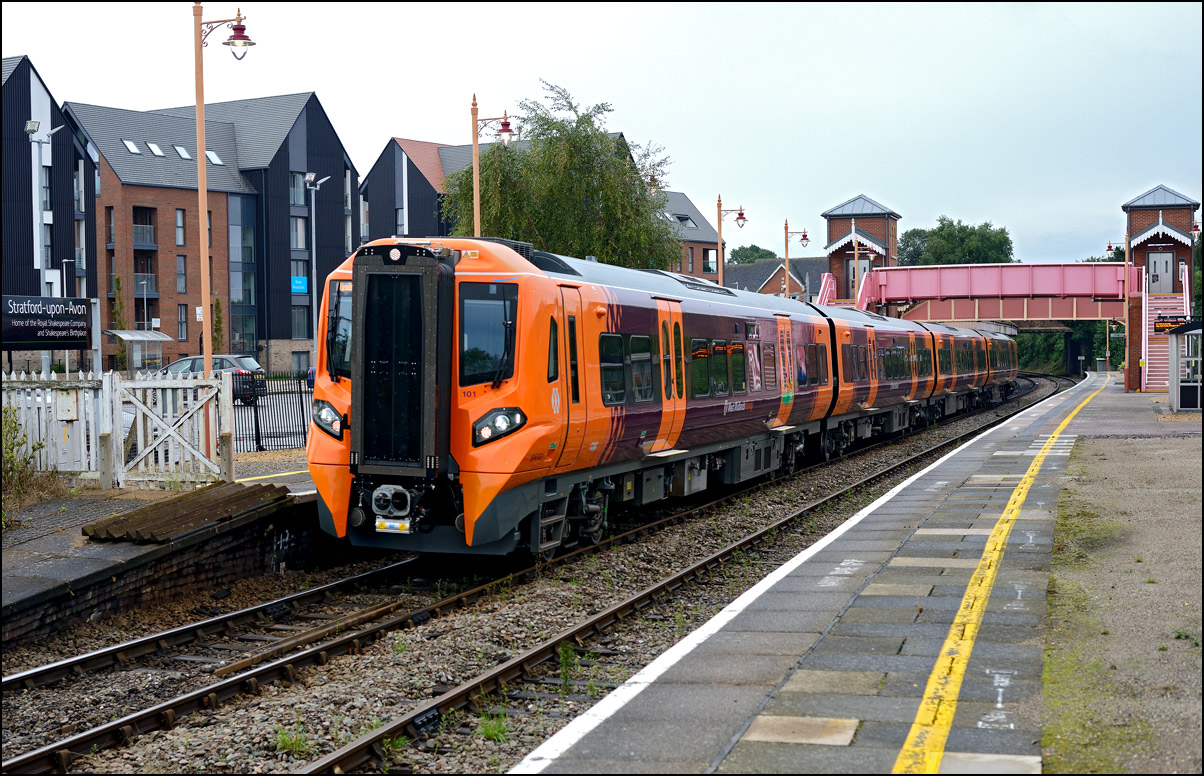 |
There was just time for me to walk to far end of the platform on 2 September 2020 before 196101 pulled away on its journey to Tyseley. As it left the station I noticed the numbering system on one of thje coaches. Quite a lot for those enthusiasts who collect numbers to record... |
|
|
Chiltern class 165/0 DMUs are still unusual enough over the North Cotswold Line and the Long Marston branch to warrant a trip out for a photogrph although if many more are sent over this may change. On Saturday 29 August 2020 165032 ran from Aylesbury to Long Marston and as the weather had brightened up during the afternoon I started out for Honeybourne where 2 shots would have on the cards before a quick drive to Long Marston for a third. I stopped in Long Marston village to chech 5Q94's whereabouts and saw that it was 13 minutes early which, along with a road closure in the area, meant that only the arrival shot on the branch was on. As I waited on the road bridge the sky became very dark and some quite heavy rain began to fall, luckily enough blowing from behind the camera. The light was at its worst when 165032 arrived, now some 19 minutes early despite a 5mph speed restriction slowing it down on the final few hundred yards of track. |
|
|
Once 45020 had run-round its stock at Stratford-upon-Avon on 25 July 1984 the shunting of a DMU for the the 07.30 to Birmingham Moor Street took place. A couple of sets spent the night in the cold store siding and were moved as required. In this view shunter and general station factotum Roy Smith is keeping an eye on things and was ready to give the driver in the rear cab a single buzz on the intercom once the unit had cleared the points so that it could be switched to run into platform 2. |
|
|
Two trains involving old locomotives were due to pass Hatton within a few minutes of each other on Wednesday 19 August 2020. The weather was quite unpleasant with dark skies and heavy rain but rainy scenes often record quite well so I made the short journey from home and arrived just in time to photograph 165001 working 2R25, the 12.32 Leamington Spa to Birmingham Moor Street as it arrived for the stop where 4 passengers were picked up. |
|
|
Here's one that nearly sneaked under the radar on Friday 14 August 2020. Midland Mainline power cars 43043 + 43081 sandwiching buffet car 40728 ran from Neville Hill to Long Marston under a VSTP path as 5Z62. I noticed it only when idly checking to see if 230008 was out on afternoon test runs and then, within seconds of looking at RTT, when a friend messaged me with the news. There was plenty of time for a run over to Evesham and when I arrived on the bridge at Briar Close the train was just leaving Norton Junction, Worcester. It took just 7 minutes to appear and here it is in really horrible flat light with a misty background. I can't admit to a lot of enthusiasm for these HST moves but felt that some of them should be recorded. |
|
|
Two of the paths for 196101's runs to Stratford-upon-Avon were used on Wednesday 12 August 2020. The first train, 5Z21, was the one in which I was interested so I walked down to Stratford station for the 09.30 arrival and before the weather became unpleasantly hot. The new unit arrived on time and just about the only spot where the sun is any good for an arrival into platform 1 at this time is by the fence at the end of the platform. It is very noticeable that the brakes produce a loud squealing noise when applied and it is to hoped that a solution will be found for this before the class enters day-to-service, especially for the sake of rail staff working as train despatchers. |
|
|
There isn't much of a shot as a morning train leaves Stratford-upon-Avon from platform 1 but at least the sun at 09.40 is just about broadside on to the subject and high enough to stop most of the shadows being cast by the station and car park infrastructure being too intrusive. |
|
|
Paths for test or crew training runs between Tyseley and Stratford-upon-Avon featuring West Midlands Trains' 196101 have been showing up for about two months. There has been a single outing to Hereford, seen here at Droitwich and it went to Crewe during the night of 10 & 11 August 2020. The first working to Stratford on 11 August 2020 for the unit was cancelled so I assumed that the rest of the diagram wouldn't be used and when I checked for the second run at 10.40, a few minutes after the scheduled departure time from Tyseley LMD there was no sign. However at 11.15 I had another look at a mapping app saw that 5Z22 was at Earlswood some 8 minutes late and reckoned that with light traffic I was in with a shout of getting to Edstone Aqueduct, near Bearley Junction in time. Just as I set up on the canal towpath 2 boats were heading towards me and it was fortunate that the second of these cleared with a few seconds to spare before 196101 appeared. The undergrowth between the up and down lines has flourished this year but an 85mm f1.8 lens and a bit of cropping in the raw convertor tidied the scene a bit. |
|
|
There was a shorter return journey between Tyseley and Whitlocks End planned for 196101 on 11 August 2020 but this was cancelled. The next train to Stratford, 5Z24, did set out from Tyseley and given the 30ºC temperature I had no intention of standing in a sunny spot so went to Wilmcote to 1) take advantage of the shade from a tall hedge alongside the platform and 2) take my image with a recognisable and classic background. Here is 5Z24 drawing to halt in the station presumably to allow trainee drivers get a feel for the train's brakes and thus pull up in the correct spot. It was only at this point that I realised that the corridor connection was black whereas on the unit's first run it was yellow. I imagine that there must be some piece of yellow board available to insert in the front as required.The next run due to arrive at Stratford-upon-Avon at 16.30 was cancelled and I can't pretend to be too disappointed given that the temperature and humidity had kept on rising throughout the afternoon. |
|
|
One of the new class of DMU, 196101, has been at Tyseley depot for a few months now and paths have been in place for it to make runs to Stratford-upon-Avon and back for weeks. Nothing happened with these but on 23 July 2020 a VSTP appeared showing a return trip from Tyseley to Hereford. I had decided that should it run I would have plenty of time to drive to Droitwich Spa for a shot under the lower quadrant semaphores. There was the dreaded auto-activation 2 hours before departure time but on this occasion 5Z37 did operate and left Tyseley a few minutes early so off I went. Once the preceding clas 170 to Hereford had cleared the station the outer home signal was lowered and 196101 appeared and moved slowly towards the station. There was time to cross the bridge and take a second image as it crawled towards the starter signal situated just beyond the road bridge in the background. |
|
|
Running only a few minutes behind 196101 was Vivarail's diesel/battery hybrid 230007 on another mileage accumulation return run between Long Marston and Stourbridge Junction Goods Loop. Here it is taken through a long lens to emphasise the bracket signal and signal box and showing, on the right-hand side of the frame, part of the rail-connected coal yard which is part wilderness and part car park. |
|
|
Vivarail's 230006 made what is probably its final journey in the Vale of Evesham on Monday 20 July 2020 when it was moved to a new home with TfW. If the sun had been guaranteed I would have gone a bit further afield perhaps to the Colwall or Ledbury area but with more cloud than clear sky stayed local and went to Wyre Piddle between Evesham and Pershore. It came into view on the single track some 9 minutes early and gave me my only image of the unit not in full sun my having been lucky on all the other outings for it. |
|
|
Whilst at Hatton on 16 July 2020 I took this image of 172001 + 172007 as they left the Stratford-upon-Avon branch. On the following morning as I walked over the railway bridge at Stratford the pair were in the platform on the same diagram so decided to go for a shot later in the day. The sun was perfect and even though 2D46 is booked to use platform 2 a shot seemed worthwhile and, you never know, my apparent "platform 2 curse" might work in reverse for once. It didn't and here are the two 2 car units arriving into the photographically less favourable island platform. |
|
|
A Chiltern Trains class 165 has been in Long Marston for some modification work after having been taken there by road. I saw from RTT that it was due to leave under its own power on Saturday 18 July 2020 and with it being a first for the branch and the North Cotswold Line went across to get a few shots. On arrival some 20 minutes before departure time the unit was at the open gates preparing to leave but there was time for a quick photograph of this driving car of a former D Train in the throes of being converted by Vivarail into a class 484 for the Isle of Wight. The paint shop is just out of shot to the right and this car is either waiting to go in there or has just come out. I wasn't able to get a completely clear shot without any hawthorn bushes in the way because I hadn't taken anything with me to gain a bit more height on the bridge. |
|
|
Chiltern's 165027 is seen here leaving Long Marston at about 11.30 on Saturday 18 July 2020 on the way to Honeybourne and then Aylesbury Depot via Moreton in Marsh, Oxford, Islip and Bicester. I was glad that I had decided to arrive early even without knowing if would actually run, the activation on the systems having been triggered automatically 2 hours before departure time; not always a good sign. As soon it passed it was into the car for me and off to Honeybourne for a shot in a recognisable North Cotswold Line location. |
|
|
Once the single line staff had been returned to the cupboard on the other side of the road bridge at Honeybourne 165027 moved towards the station and unusually stopped under the bridge. The reason for this became apparent when a Chiltern Railways driver appeared and joined the ROG men in the first coach. The sun appeared briefly so enabling one reasonably lit shot. I thought that as it still well before the booked time a quick departure would be on the cards but the signal remained on danger and nothing happened. Eventually it was obvious that it wouldn't be able to leave before the next GWR passenger service, 1P23, had come and gone. The reason for the delay became obvious when a GWR driver arrived nearly 30 minutes late and went onto the up platform to wait on his own before 165029 was able to run forward and await the road to Honeybourne North Junction. |
|
|
The signalling section on the up road is long; from Honeybourne North Junction to Moreton in Marsh so it was about another 10 minutes before the Chiltern Railways unit was able to enter Honeybourne station on Saturday 18 July 2020 now 46 minutes late to collect the GWR driver who would take it forward to Oxford before handing over to the Chiltern man also on board for the run to Aylesbury. He would later return with another unit going into Long Marston. I thought that a shot with both the station running-in board and a GWR-style seat would make nice additions to the first picture, as far as I'm aware, of a Chiltern unit on the North Cotswold Line. It was only when converting the RAW (NEF) image to TIFF ready for final work in CS2 to make a jpeg for the web that I noticed that the train was now numbered 165027. I assume that the work carried out at Long Marston was needed only on the powered vehicles hence the most unusual pairing of coaches from different sets. |
|
|
Just as 60024 with 6E45 approached Hatton North Junction on 15 July 2020 172007 + 172001 pulled up at the signal protecting the exit from the Stratford-upon-Avon branch. The units were working 2W84, the 16.03 from Stratford to Stourbridge Junction. This image was taken after they had been released and were on the curve to Hatton North Junction, just behind the camera beyond the footbridge. |
|
|
An STP train was on the schedules for Hatton on the afternoon of 27 June 2020. The detail said that is was a locomotive-hauled service but as it was running from Eastleigh to Heaton it seemed far more likely that it would be a DMU going to its home depot. It tunred out to be just that in the shape of 156496 in the new colour scheme of Northern Rail. This was enough to get me out of the house and I thought that hatton station would be the best bet as the sky was dark with another heavy shower imminent. A good choice as there was a downpour as 5Q12 passed Warwick although it cleared within a few momenst leaving a little brightness to lift the scene. |
|
|
I can't raise much enthusiasm for GWR's IETs but will photograph one on occasions either reasonably early or late in the day when the sun is right. Here is 5 car unit 800015 accelerating away from Evesham on Tuesday 23 June 2020 working as 1P22 Great Malvern to London Paddington. Thanks to Steve Widdowson for the unit's id. |
|
|
Just before 66735 with its mixed train went towards Long Marston from Evesham on 23 June 2020 Vivarail's 230007 went in the opposite direction on the second day of its test runs between Honeybourne and Evesham West Junction. It wasn't long before it returned and here it is climbing the bank after stopping on the bend in the background to test the acceleration capabilities on a hill start. The speed rose quickly showing the advantages of electric traction; these units being hybrids with diesel engines under the centre car charging batteries providing the power. The range on batteries is up to 60 miles allowing for emission-free travel over quite large proportions of the journeys these trains will make. |
|
|
I decided to wait for the second run of 230007 on Wednesday 23 June 2020 and drove my 1969 Morris Minor a short distance to another bridge just to the west of my previous location. It doesn't take long for the runs to and from Honeybourne and the unit soon went towards Evesham for a reversal before coming back. A long lens makes for a shot with a bit more impact on occasions and a short train fits nicely into the space between the A46 and the bridge on which I was standing. The time was just after 11am and as the sun would very soon be too high I didn't bother with a shot of a Colas 37 on a test train on the main Gloucester line and so went home. |
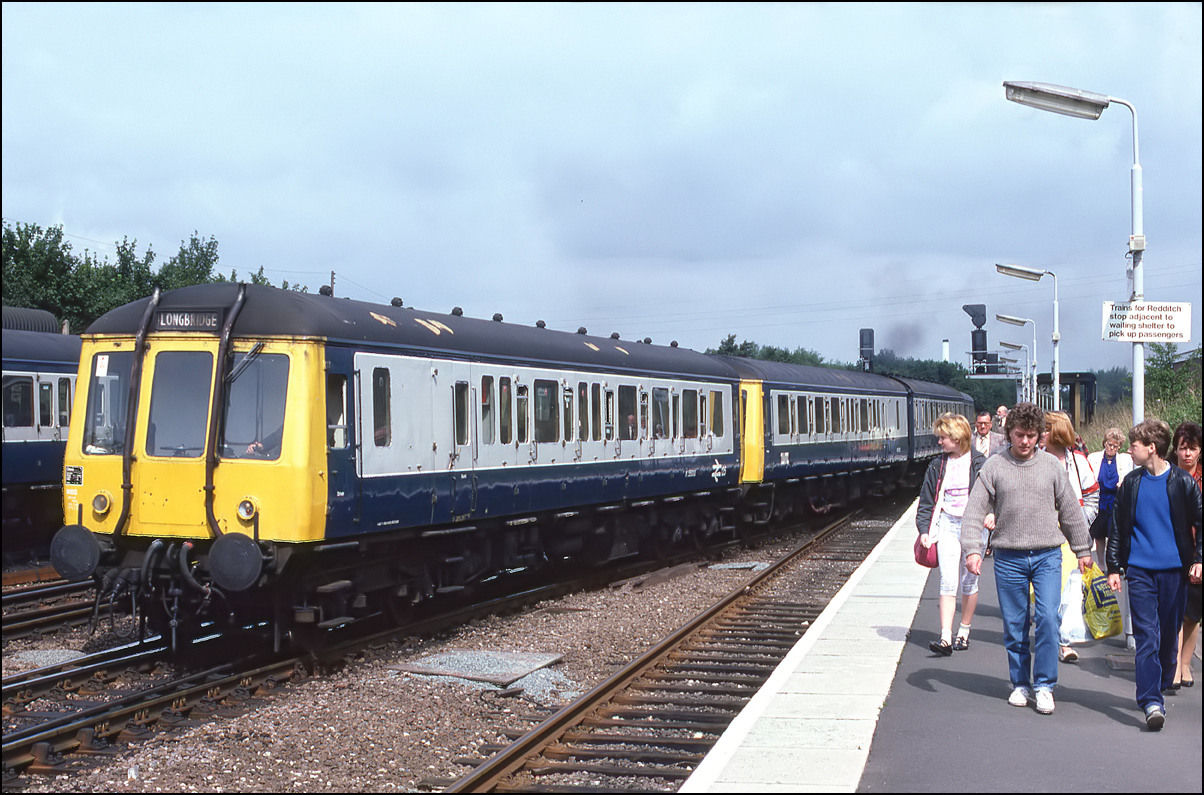 |
The Tyseley-based single units were not only used on the Stourbridge branch and Stratford-upon-Avon to Leamington services, but often strengthened other suburban trains. 55000 is seen here leaving the platform at Longbridge on 28 August 1986 with a terminating train in the process of crossing over to the refuge siding on the up side of line until its departure time for either Four Oaks or Lichfield at the other end of the Birmingham Cross City line. Here is another view incorporating 55000, this time in the middle of the train, taken at Stratford-upon-Avon on 1 July 1986. |
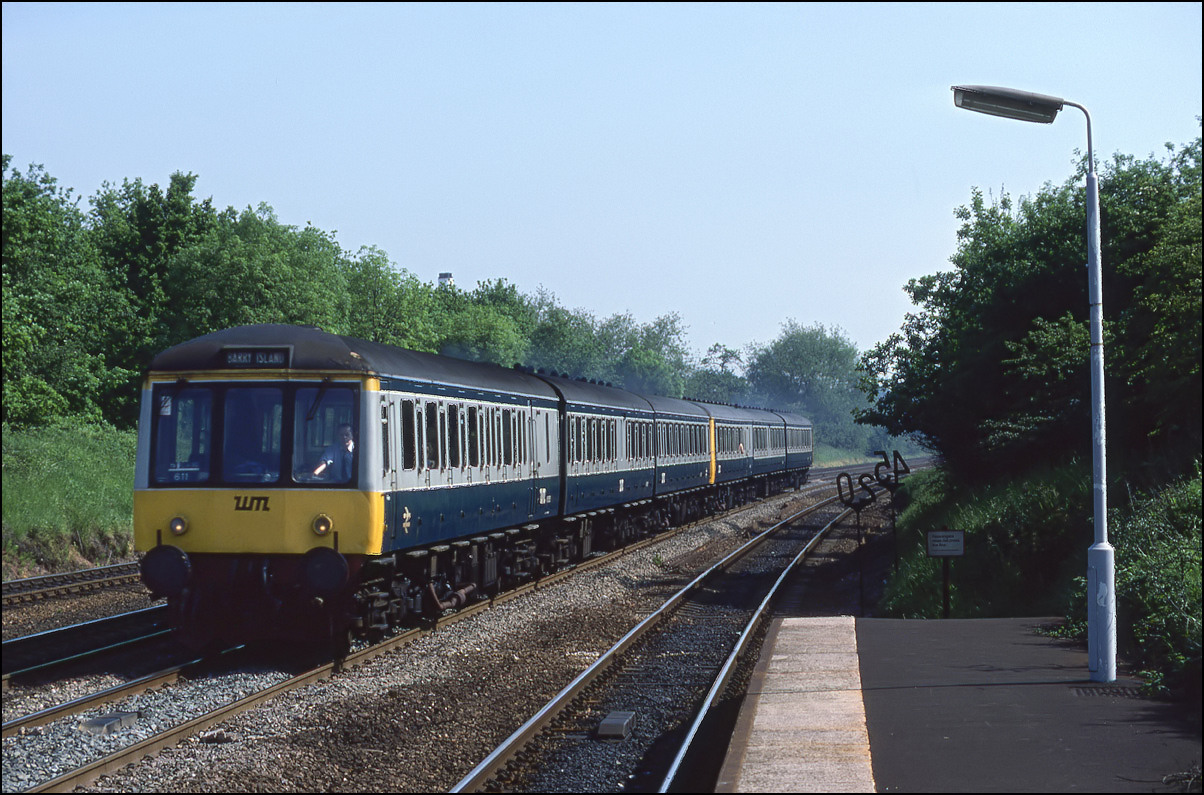 |
In the summer of 1986 there was a dated train between Birmingham New Street and Barry Island. Two 3 car class 116s from Tyseley were used for this service and on 14 June 1986 the leading set, pictured at Longbridge, was one of the sets with a slightly modified paint job on the front end. It's amazing what a difference a few brush strokes makes to the appearance of an otherwise standard unit. I suspect that the passenger accomodation for this long journey was a sight more comfortable in 1986 than would be provided in 2020 for an equivalent trip. |
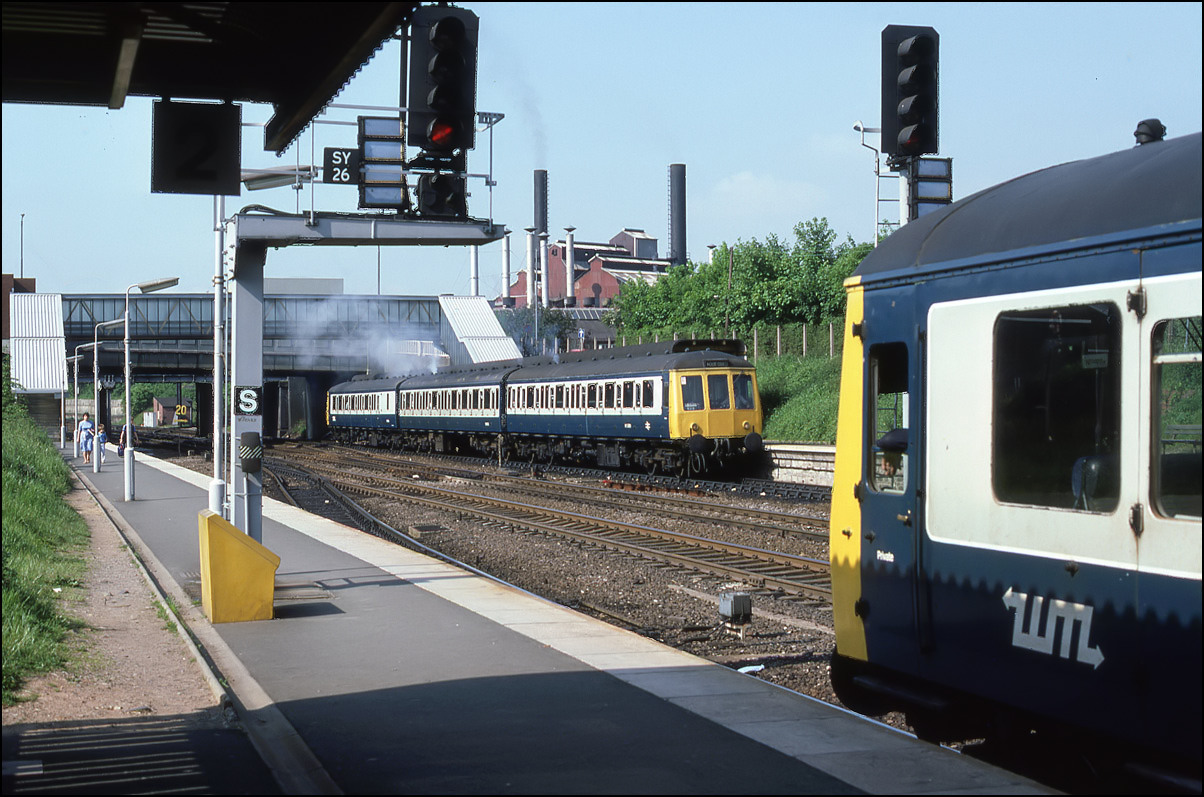 |
I spent a couple of minutes lining up this shot at Longbridge on 14 June 1986 and whilst waiting for the Four Oaks bound on the far platform train to move, heard the unmistakeable racket of a pair of 37s thundering south. I was, of course, completely bowled by this train, which must have been an additional working as everything else due had turned up as expected. Still, if the loco-hauled train hadn't been occupying the down main, then the unit closer to me would have been on its way to Redditch thus, lessening the attraction of the shot, by this time. The background in both the station and beyond has changed beyond recognition with overhead catenary in place to the west as far as Bromsgrove and the huge BL complex having been demolished to be replaced with the inevitable out-of-town shopping complex. |
|
|
Some more HST stock was moved to Long Marston for storage on Wednesday 3 June 2020. This time it was a pair of EMR power cars, 43083 + 43054 with a single coach sandwiched between them and after the long and sunny spell we have enjoyed it was a shame that 1) it was a cloudy day with light drizzle and 2) that the train was so short as to be almost inconsequential. Despite this and solely because it was a new colour scheme for me in the area having not bothered to go for the previous move of just 2 power cars which ran without stock I made up my mind to have a shot or two. Given the conditions there was no inclination on my part to travel any further than the bare minimum distance so I went just to the road bridge over the entrance to the Long Marston site. The train, 5Z56, was a few minutes early arriving and it gave a little colour to the predominantly green background unlike some of the GWR vehicles already in the site which would been rendered virtually invisible. |
|
|
The Long Marston ground crew was already on hand to open the gates when 5Z56 turned up on 3 June 2020. This took only a few seconds and once the branch staff was in the ground frame 43083 led the short formation into road 2 to join the host of other HST stock already on site. Just beyond the bushes on right of the picture one of Vivarial's class 484 units destined for the Isle of Wight can just be glimpsed adorned with a lot of masking and boarding prior to going into the paint shop, a former rail-connected shed with new exhaust and filter equipment, which is now situated off-frame to the right of the image. |
|
|
Another set of runs for 230006 was in the system for 29 May 2020 although the original routes between Moreton-in-Marsh and Stourbridge Junction Goods Loop were changed for 3 runs between Honeybourne and Evesham West Junction. I stayed at home until the first run was under way before going out and then headed for Park's Bridge between Evesham and Aldington. The footbridge in the background is the more usual destination for photographers but on this occasion I favoured the taller bridge which gives a better view of Evesham town and Bredon Hill. The Transport for Wales liveried unit was already ariving at Evesham when I parked nearby and it wasn't long before the distant signal behind the camera on the up road was cleared and the train, 5Q03, appeared as it accelerated up the bank. |
|
|
The next shot of 230006 I had in mind on Friday 29 May 2020 was a short distance to the south and to be taken from Mutton Bridge on the outskirts of the village of Blackminster. This bridge is close to the site of the stangely named (but typical of the GWR) Littleton and Badsey station both of which villages are some miles away. The train had to reverse and cross over at Honeybourne after having to waiting for both up and down IETs to clear. It was a few minutes late and made me wonder if this run was actually going to happen but the barriers protecting the road in the village eventually dropped and 5Q04 went towards Evesham West Junction where it again reversed and came back past the greenhouses and other buildings of a nearby nursery. Another train of interest was due going up through Evesham about 90 minutes later and I was tempted to stay but on this hot day my water bottle was empty, I was hungry and had no money with me! This meant a trip home to refuel myself. |
|
|
Vivarail's 230006 was out again on Thursday 21 May 2020 and as it was another sunny day I went to get a couple of images I had in mind to take. The first was at Evesham station as the diesel/hybrid unit started one of its many journeys of the day between there and Honeybourne. This first one gives a panoramic view of the scene as 230006 paused for a few seconds in the up platform with some moronic graffiti prominent on the road bridge in the background. |
|
|
After its brief stop in Evesham's up platform on 21 May 2020 230006 set off towards Honeybourne. The very brisk acceleration was noticeable as it left the station passing the attractive garden complete with with bird feeders, ponds and insect refuges. |
|
|
The other shot I wanted to obtain on 21 May 2020 was at Honeybourne so I had a gentle drive there around the lanes from Evesham. I arrived to find 230006 at the signal protecting Honeybourne North Junction waiting for the passage both of up and down GWR trains. It's hard to resist taking an image of something standing in the sun so I increased my already excessive collection of class 230 shots by one. |
|
|
There was one particular shot of 230006 at Honeybourne I was keen to take on 21 May 2020. This was when the unit took a break at lunchtime when it ran into the sidings there and I thought that a picture there would be a little more unusual than the standard ones. First though there was this one as it came along the branch from Honeybourne North Junction prior to reversal (I hoped!) and going into the sidings. |
|
|
Once 230006 had entered Honeybourne on the Long Marston branch as shown, it stopped behind the signal and within seconds I heard the points being switched which confirmed that it would be going into the sidings for a lunch break. It's strange how we railway enthusiasts like to get pictures of trains on odds and ends of track but I know that I'm far from alone in this! Here is 230006 climbing the gradient into Honeybourne Sidings which is usually used only by OTP between work on the North Cotswold Line. |
|
|
Vivarail's 230006 was out again on Wednesday 20 May 2020 and with the weather set fair I went to Lower Moor for the afternoon run from Moreton-in-Marsh to Kidderminster. First along was 800106 with 1W27 from London Paddington to Worcester and with full sun making photography easier than cloudy weather I took one of my rare views of these uninspiringly coloured liveries. |
|
|
Before this week starting 18 May 2020 Vivarail's class 230s had not been north of Evesham on their test runs, being confined to the lines between Long Marston, Honeybourne, Evesham and Moreton-on-Marsh. I understand that 2000 trouble-free miles are needed before delivery to TfW and in order to accumulate mileage on 230006, from Tuesday 19 May 2020 the journeys have been extended to go as far as Stourbridge Goods Loop. On the following day I fancied another shot of the afternoon train from Moreton and went to Lower Moor on the single track between Evesham West and Norton Junctions. Running under the headcode 5Q86 it left Evesham on time and was soon running past the vegetable fields and greenhouses. The leading cab has a toy dinosaur placed just behind the windscreen; slightly reminiscent of the liveries once carried by the units on the Isle of Wight which are soon to be replaced by class 484s from the Vivarail stable. The yellow ends of the unit are a new addition and I'm glad to have some shots in the original colour scheme. |
|
|
A day of test runs for Vivarail's 230006 hybrid unit was sneaked out on Tuesday 19 May 2020. An early morning message alerted me to the timings and I was ready to go out during the morning as, unusually, it was running between Kidderminster, Moreton-in-Marsh and Stourbridge Junction loop. Something happened during one of the runs and 230006 went into Honeybourne Sidings where what I was later told was a minor brake issue was solved after a part was driven down from Long Marston and fitted on the spot. This left the afternoon runs and although Honeybourne wasn't where I would have really chosen I ended up there because a shot would still be on the cards even if further scheduled runs didn't happen. In the event everything went to plan and here is the unit pulling up in the station where a crew change took place. |
|
|
Since 230006's last run yellow panels have been added and to show the one on the back of the train I took this as it receded from the camera under the road bridge and off to Moreton-in-Marsh. |
|
|
The return journey between Honeybourne and Moreton-in-Marsh takes around 30 minutes and I spent most of that time chatting to the driver who had been relieved on the up run. The train left Moreton about 10 minutes early and soon appeared in the distance rolling down Campden Bank towards Honeybourne station. This isn't the best location for a shot of a down train in the afternoon but the bright sunshine and the clear relatively unpolluted atmosphere made for a reasonable view with the northern end of the Cotswolds in the background. |
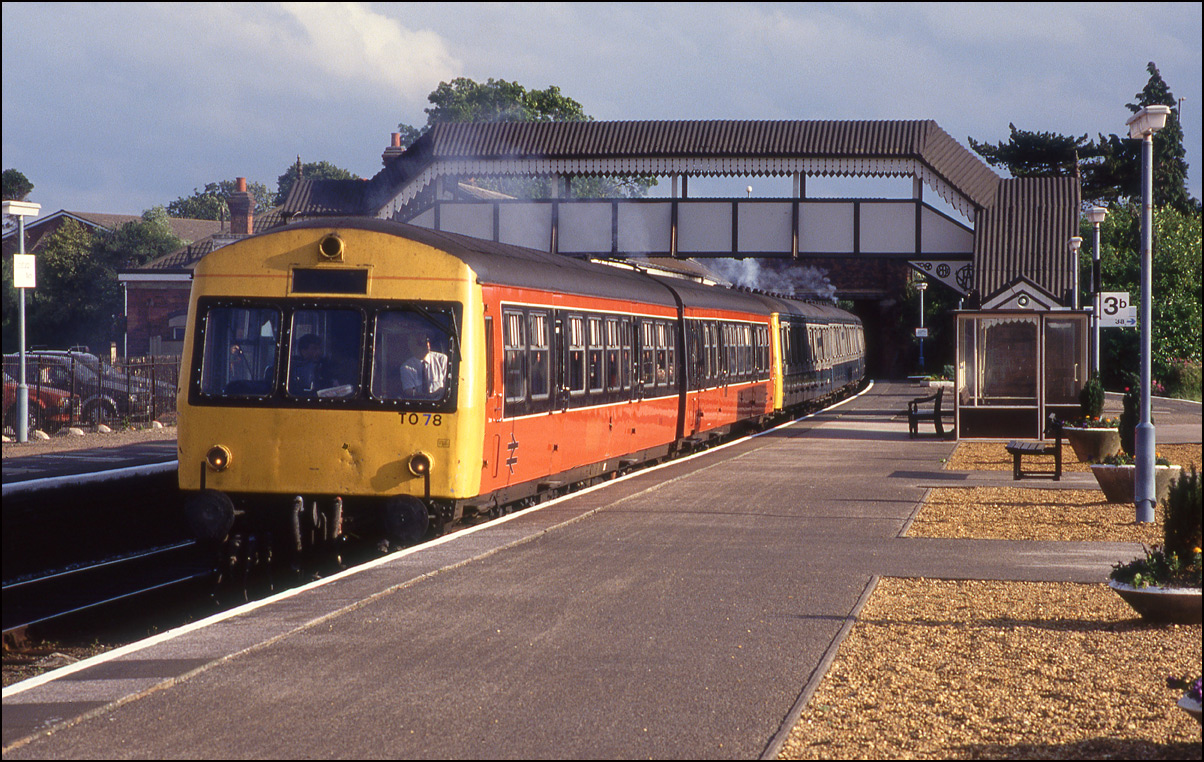 |
One of the more colourful units to arrive at Stratford-upon-Avon was this ex-Clydesdale class 101. I saw it on the morning of 1 July 1991 but was unable to get out of the office during the day to record it on film. However, it stuck to diagram and is pictured here leaving the Warwickshire terminus in the company of a mis-matched 116/118 unit still in corporate blue and grey. The Tyseley unit unit number appears to been applied in a rather amateurish fashion, as does the paint covering the front-end damage - the colour there is more akin to the bodyside shade rather than the normal yellow. Still, I suppose that this were the final months of DMMU workings in the area, so it probably wasn't worth spending too much on the cosmetic appearance of local trains. |
|
|
The class 101 unit fitted nicely between various posts at the end of Stratford-upon-Avon's platform 2 on 1 July 1991 so I thought that another shot worthwhile. The scene has changed a lot since this photograph was taken in that the gasholders have been demolished, the semaphore signals have been replaced with electric lights (twice) and a white paling fence has been erected to deter trespassers from getting onto the line. |
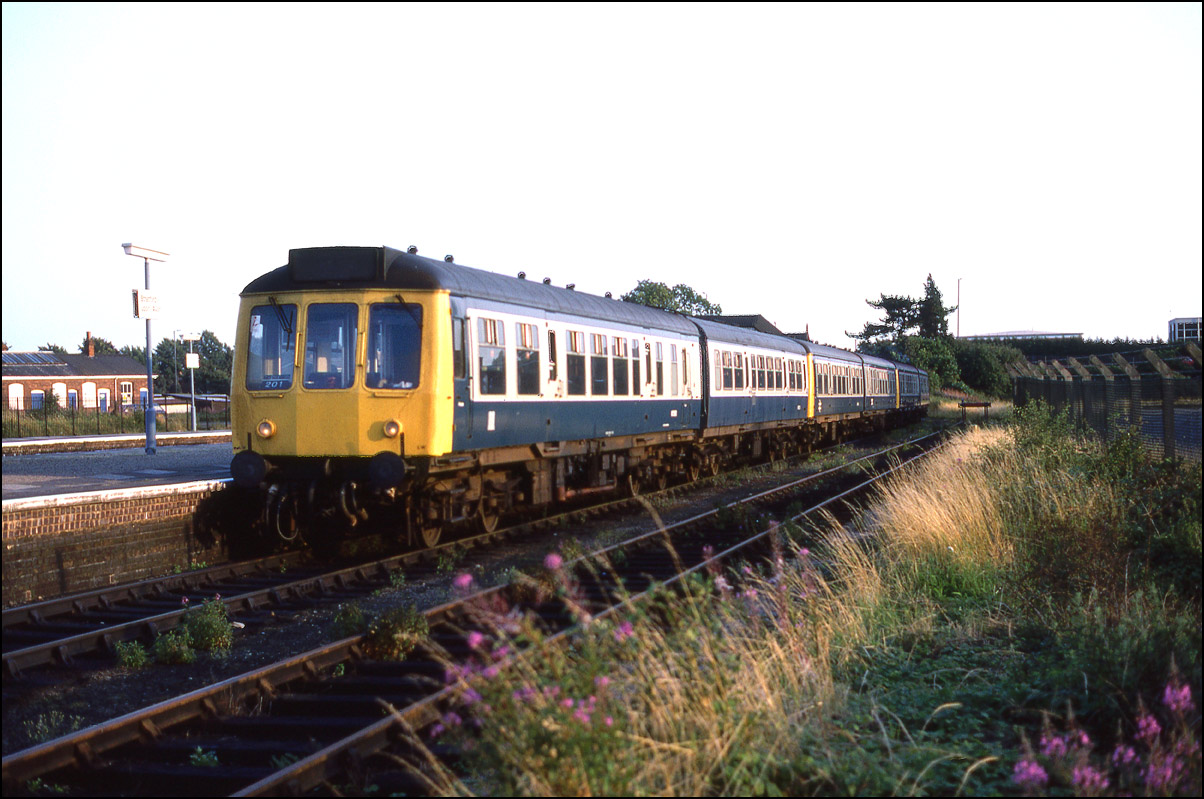 |
Tyseley depot acquired several DMU twin sets in 1986. Three of these, the leading set of which had been in Birmingham since May, are seen here in platform 3 at Stratford after a proving run from Birmingham. They were about to return as ECS to Tyseley before entering normal service. |
|
|
Some more of Tyseley depot's DMUs of classes other than class 116 are seen here pictured in platform 3 at Stratford-upon-Avon. A 3 car class 108 numbered T902 is on the front of the Midline Bubble which is conveniently positioned on the platform's curve so that its unique colour scheme is visible. |
|
|
Vivarail's first battery/diesel hybrid train built for Transport for Wales, 230006, has been out on the North Cotswold Line for mileage accumulation runs. I was very keen to take some pictures of it and the opportunity came on Friday 10 April 2020 when my wife's e-bike was pressed into service. I hadn't ridden it for more than a few minutes when I bought it for her but gritted my teeth, charged the battery and headed for Honeybourne. It's not as comfortable as the static bikes in the gym but my arrival was without incident and in time to see 230006 arrive at Honeybourne station on the first run as it headed towards Honeybourne North Junction to reverse and go to Moreton-in-Marsh. I thought that a close-up view of the leading coach might be of interest too. |
|
|
It doesn't usually take long for a reversal at Honeybourne North Junction to be accomplished and I hoped that this would be the case on 10 Aptil 2020 because the signal for the down main line had been on green for a few minutes and a blocked view would have been irritating to say the least. Everything was fine and here is 230006 passing the station with its first trip of the day to Moreton-in-Marsh. One of the diesel engines kicked-in as the unit entered the platform and the small plume of smoke from the exhaust is visible; this very soon cleared to a normal intensity. |
|
|
The usual time needed for one of these train's journeys up to Moreton-in-Marsh, down to Evesham and back to Honeybourne is about an hour. This gave me time for a walk around Honeybourne village and a visit to the nearby Co-op to buy something to eat while my wife's bike battery recovered a bit from the journey over here. I should have bought a solar charger to go with the bike! Anyway, 230006 reappeared a few minutes earlier than the schedule suggested and it's shown here from the end of the down platform with yet another clear signal for the down line. This time there was no chance of the shot being obscured as it had only just been cleared. |
|
|
A Colas operated 6Z49 from Carlisle New Yard to Long Marston ran on Wednesday 11 March 2020. The weather was reasonable so after swimming I went to a road crossing between Evesham and Honeybourne arriving about 30 minutes before the freight's due time. Before many minutes had passed the barriers were lowered and 800035 appeared while working 1P26, the 11.35 Great Malvern to London Paddington. Although these units don't have much of a following they can make a reasonable picture in decent light when the sun isn't too high in the sky. |
|
|
Vivarail's battery/diesel hybrid unit 230002 has really been putting in the miles between Moreton-in-Marsh and Evesham West Junction over the past few weeks. It was out again on 11 March 2020 and I had 2 shots of it, the first being this as it worked 5T04 towards Evesham. This isn't the greatest angle and the tree apparently being carried on the roof doesn't help but it does show the flat landscape of the Vale of Evesham to advantage with the escarpment of the Cotswold Hills visible in the background. |
|
|
It doesn't usually take long for 230002 to reverse at Evesham West Junction and head back along the up line towards Honeybourne. On 11 March 2020 this appeared to be the final run of the day as the distant signal visible at caution in the picture above stayed on yellow which usually indicates that the train is to take the Long Marston line at Honeybourne North Junction. As there were at least 2 other trains using the branch on this occasion this was probably the pragmatic solution to avoiding congestion and delays to and from Long Marston. |
|
|
Ever since most of the Long Marston was relaid there is no guarantee that a chase to Honeybourne will be successful but on 20 March 2020 there was time and my arrival on the road bridge coincided with Vivarail's 230002 on another test run, 5T05, from Moreton in March. It was a piece of luck that 47813 was poking its nose around the corner in the background. while some strimming of the lineside takes place. Maintenance of the rapidly growing vegetation? Surely not... |
|
|
Just before leaving Long Marston for Honeybourne on 3 March 2020 there was time for a quick shot of some ex-D Stock which appeared to just have received a coat of grey primer and with the masking materials still in place. This is presumably one of the vehicles destined for use by TfW in due course. I understand that these coaches may be the first of the class 484 vehicles destined for the Isle of Wight and are presumably on their way to the main shed for finishing. |
|
|
While waiting for 57301 + 319337 to appear at Honeybourne on 3 March 2020 I had 2 shots of 230002 on its return journeys between Moreton-in-March and Evesham This view shows the battery/diesel hybrid running solely on electrical power on the approach to Honeybourne station on the final part of the diagram for the day. There was a slight problem in that 57301 hadn't made an appearance meaning that 230002 wouldn't be able to join the Long Marston branch and it was becoming clear that the 319 would not be taken to Northampton today. |
|
|
It seemed to me that the only option for 230002 would be for it to be shunted into Honeybourne Sidings so that 57301 would be able to leave the branch light engine or wait for another day when whatever had happened at Long Marston could be rectified. The unit ran forward beyond the branch signal in the only bit of sunshine I saw all day and then reversed and headed into the sidings - a very rare event for passenger stock which I have seen on only ome previous occasion. |
|
|
To move from the road bridge to the up platform at Honeybourne takes several minutes mostly because of the enormous size of the station footbridge. By the time I had made the walk on 3 March 2020 230002 was just about as far away in the sidings as it was possible for it to be. I didn't have an especially long lens with me so had to make do with this, achieved with quite a lot cropping in Photoshop CS2. The rarity of the visitation by the Vivarail unit made it worth a go... On the way home I stopped off at Long Marston where there was no sign of 57301, which had left light engine, and 319337 was where it had been left earlier. I don't know what happened to 230002 as my lunch was well overdue. |
|
|
I was at Hatton on 8 January 2020 to photograph an HST power car move running as 0O86 and took this shot of an unidentified CrossCountry Voyager with the headcode of 1O86 running a few minutes in front of the STP train. It seems odd that fast and comfortable trains with 7 or 8 coaches are being withdrawn and stored all over the place when long distance passengers are subjected to crowded, noisy and uncomfortable conditions such as offered by this Voyager which has about 3.5 coaches worth of seating. Either that or class 800s with seats about as comfortable as a cloth-covered wooden plank. |
|
|
A pair of off-lease LNER HST power cars were sent for storage from Papworth's Sidings, Ely to Eastleigh on Wednesday 8 January 2020 and ran via Birmingham, Solihull and Leamington Spa. Any HST vehicles are unusual on the line through Hatton so I went across for a shot as 43239 + 43208 in their red and white colour scheme but with no LNER branding approached the station. The short formation ws running under the headcode 0O86 and coincidentally the preceding CrossCountry Voyager was running as 1O86 from Newcastle to Southampton. |
|
|
I wasn't far from Honeybourne for reasons unconnected with railways on 20 November 2019 and after checking saw that Vivarail's 230002 had just passed Evesham with 5T03 to Moreton in Marsh. A quick diversion found me at the station where a small group of orange jackets was gathered around the waiting shelter so surmised that the test train would probably stop there. It did and this picture shows it drawing to a halt so that the passengers were able to get on board before the journey to Moreton was continued. |
|
|
This 4 coach class 115 NSE DMMU is on the way from Amersham to Marylebone and is approaching Neasden South Junction on 8 March 1991. The long lineside building to the left of the down line is the sidings then used by Christian Salvesen for various type of rail-borne food traffic. I don't think this was especially regular traffic at this time and the line entering the site had a good coating of rust to confirm this. |
|
|
A slightly shadowy view of an LUL unit passing between Neasden Depot and the BR, as it was then, line between Amersham and Marylebone. I took a lot of pictures during the 4 or so hours I was on the bridge alongside the North Circular on 8 March 1991 and have tried to pick a variety for this section but as I mentioned above have no knowledge of what I was shooting. |
|
|
Vivarail's class 230 test train was out on the main line on Thursday 31 October 2019. I took the opportunity to take another couple of shots as not many more of these will be running around Warwickshire and Worcestershire as Vivarail is to move its operational base to a site, not rail-connected, at Southam near Leamington Spa. It will be using test facilities at Barry in South Wales necessitating I imagine, much additional mileage by Allelys road haulage contractors. This first image shows 230002 passing Evesham station as 5T02 from Moreton-in-Marsh before going to Evesham West Junction to reverse and form 5T03 back to Moreton. |
|
|
After reversing at Evesham West Junction on 31 October 2019, 230002, the battery/diesel test unit, went back through Evesham towards Moreton-in-Marsh. As this was a cold and windy day I didn't hang around for any more shots and went home. |
|
|
The Gloucester to Birmingham line had a few interesting workings on the afternoon of 31 October 2019 and even though the weather was a bit on the dull side I drove to Defford for a short session. First along was 158798 forming 1V94, the 0948 Portsmouth Harbour to Great Malvern. These really aren't the conditions for photographing FGW's all-over green livery but it was the first of the class I have seen carrying it. In my opinion the previous colour scheme looked a lot more attractive as the unit approached Ashchurch in September 2014. |
|
|
First Great Western's 5 car 800015 is just about to pass over Clayfield Crossing between Evesham and Honeybourne on 20 September 2019 as it forms 1P27, the 11.00 Great Malvern to Paddington service. This is one of the better ground level shots in the area with the former crossing keeper's house prominent in the scene. Indeed, the countryside around here is typical of the Vale of Evesham; flat and open meaning that the house can be seen from quite a distance which is helpful for anyone not familar with the area wanting a shot here. |
|
|
Vivarail's diesel/battery hybrid was on crew training duties both on Thursday 19 September and the following day. I wasn't able to get out on Thursday but was available on the Friday altough missing the first run because the unit ran from Long Marston to Evesham rather than to Moreton in Marsh. I had plenty of time for the next trip and decided on the level crossing at Clayfield Lane and arrived just as 800015 ran south. A few minutes later the barriers dropped again and 5T04 formed of 230002 appreared with about 30 seconds. This isn't a shot I would take as a first choice but is typical of the scenery around here; flat and with a view of the Cotswold escarpment in the background. |
|
|
The crew training runs with Vivarail's 230002 go between Moreton in Marsh and Evesham West Junction where the double track ends meaning that a reversal is straightforward. On Friday 20 September 2019 the process didn't take long and 5T05 passed Clayfield Lane crossing at 12.01 some 6 or 7 minutes early. Honeybourne's distant signal was on caution which suggested to me that this train was last of the day's movements and that it would turn left at Honeybourne North Junction and return to Long Marston. The countryside hereabouts is flat and open and slightly reminiscent of East Anglia, especially on a bright and sunny day. It can't be said that the crossing keeper's house here is especially attractive these days. The pebble-dash, trailing wires and 3 generations of TV antennae spoil the look to some extent but the building does provide a recognisable backdrop which I find preferable to bland countryside. |
|
|
A sunny morning with perfect light almost guaranteed on Friday 13 September 2019 so a drive over to Moreton in Marsh was on the cards. I had planned to arrive in time to photograph 2E20, a terminating service from Reading as it stood in platform 1 prior to reversal and departure as the 09.50 to London Paddington, 1P23. The attraction for this shot is the relatively new lower quadrant semaphore signal allowing the train to depart directly without a shunt to platform 2 being necessary as was previously the case. Here is 165112 just about to take the crossover to the up main line. This is just about the only lighting to make the drab First Group GWR livery even remotely attractive. |
|
|
Just to complete the move of 165112 from the down platform at Moreton in Marsh to the up main line on 13 September 2019 here is the unit forming 1P23 actually on the crossover. This is one of the few remaining pockets of lower quadrant semaphore signalling in the Midlands and the other railway infrastructure makes for an attractive scene despite the skip and modern flats overlooking the mostly empty car park. |
|
|
My real reason for being at Moreton in Marsh on Friday 13 September 2019 was to score a sunny shot, at the third attempt, of Vivarail's 230002 on another test run from Long Marston. I understood that the train was definitely running but one can never be quite sure that a slight delay hasn't caused the unit to miss out the first run to Moreton and head towards Evesham. All was well on this occasion and the signal at the end of platform 2 was pulled off just as 5T01 arrived in the station. A bit of judicious cropping has cut out some of less attractive distractions in the scene as 230002 is about to pass the platform starter signal. |
|
|
Another view of 230002 forming the 09.23 from Long Marston on 13 September 2019 as it's about to pass under the road bridge before using the crossover to gain access to platform 1 so that it was ready to head off towards Evesham on the second part of its test run. The 3 car unit is formed of the 2 car battery train together with another vehicle with 4 diesel gensets providing power to charge the batteries which in turn provide the means to operate the traction equipment. It also has regenerative braking to charge the batteries under braking which reduces fuel consumption by around 25%. The production units will be going to Transport for Wales and I look forward to seeing those, in their distinctive red and white colour scheme, when they are on test. |
|
|
If I had been told even 5 years ago that a London Underground train would be running under GWR style sempahores in 2019 it would have seemed like a flight of fancy. It is happening though and here is 230002, now running as 5T02, using the crossover at Moreton in Marsh on 13 September after arriving from Long Marston and preparing to travel to Evesham for another reversal. This shot reminded me slightly of one that I took on the Isle of Wight on 11 August 1989 as 486031 crossed over just outside Ryde Esplanade station on 2 August 1990. My final image of 230002 was this one as it entered platform 1 for a 20 minute wait before heading north. I had hoped to take some other shots of the next up run, 5T03, further down the line but I had a delivery scheduled at home so had to leave. |
|
|
Several paths for test runs for Vivarail's new battery train have been in the system for a while and the first run actually took place on Monday 9 September 2019. The train, the original 2 car with a third car inserted containing a diesel powered generator set, was given the headcode 5T01 and made its main line debut by running from Long Marston to Honeybourne and thence, through slight lateness, going to Evesham rather than Moreton in Marsh as planned, before taking up the diagram as scheduled. This picture, possibly the first of it on Network Rail metals, shows the 3 car 230002 approaching Honeybourne station. The weather was filthy with low cloud, drizzly rain and very low light levels but there's only one first run... |
|
|
Because of the late start on 9 September 2019 230002 had to sit at the signal protecting Honeybourne North Junction for some time to allow both down and up GWR services to go by. This gave time for a walk down to the station from the road bridge and take a few more images including this one as 5T01 stood among the ever-burgeoning undergrowth. I don't generally like the photo-journalism approach (multiple largely irrelevant images!) to railway photography but this view of part of the front car took my eye. |
|
|
While waiting for 230002's path from Honeybourne to become available I had a 'phone call making my early return home necessary. After some under-the-breath mutterings I worked out that I would just have time to photograph the train leaving the Long Marston branch at Honeybourne and just as I was thinking that the points switched and 5T01 was released a few moments after an up express, partly visible, had arrived into the station. It's not a great view over the fence but at least the rain had stopped and light levels had improved from a "go home" state to something a little brighter. |
|
|
Vivarail's innovative diesel/battery hybrid 230002 was out again on Tuesday 10 September carrying out more test runs in preparation for the production models to be made ready for Transport for Wales' use. I again had limited time available but went to Evesham to take a pair of images as the train arrived at the station and then, after reversal, going back towards Moreton in Marsh. The first photograph shows 5T02 slowly passing the recently extended platforms complete with extraordinarily ugly and utilitarian light standards. Why something more pleasing to the eye could not have been used such as those at Stratford upon Avon is a mystery. The extra cost, in the scheme of things, would have been a drop in the ocean. |
|
|
After passing through Evesham station on 10 September 2019 with the 5T02 test run from Long Marston and Moreton in Marsh 230002 ran to Evesham West Junction where it reversed and began its return journey, now running as 5T03. I had originally intended to go to a bridge further south where a shot from the north side of the line on a cloudy day is possible but there was quite a lot of blue sky around as I neared the bypass junction where a choice had to be made. When 230002 appeared after reversal the sky was brightening but the cloud was a bit stubborn until it was too late. |
|
|
There are couple of CrossCountry HSTs to be found each day on the Birmingham to Gloucester line but on Saturday 24 August 2019 there were two hired-in LNER sets in use. The first, 1V46, clashed with something else I had to do but 1V50 to Plymouth from Edinburgh some 2 hours later was more convenient. I didn't want to go south of Worcester because there were 2 steam workings with the associated crowds in the area so instead went to Stoke Works Junction. The train formed of 43290 + EC64 + 43367 lost time for most of the run from Edinburgh and was 34 minutes late leaving Birmingham New Street. Still, it was pleasant in the warm sun chatting to another couple of photographers and the time soon passed. Here is the colourful ensemble going by with much horn blowing and a friendly wave from the driver. Why on earth could FGW not have done something half as good with the livery for their high speed units instead of the dull overall green they settled upon? I hope that the uncle of the gentleman to whom I was talking here earlier likes the picture! |
 |
Here is one of my few shots on the Stourbridge town branch, taken on 5 March 1986. It shows 55004 arriving at Stourbridge Junction after a journey of just a couple of minutes from the town station. Another single car unit is just visible behind the signalbox, indicating that the daily changeover was imminent. The size of the signalbox is testament to the area's importance in earlier days, with considerable numbers of freights heading for Brierley Hill and Dudley sites, or to the Handsworth line via Langley Green. Even at this relatively late date a class 25, 25205 is in position ready to bank freights along the now-closed line to Bescot via Wednesbury. |
|
|
This was for many years one of my favourite locations for northbound trains on the GWR line between Leamington Spa and Birmingham. It was somewhere around half way up Hatton Bank and was a very pleasant and quiet location for an afternoon's photography. There was plenty of freight traffic interspersed with regular DMMUs between Leamington, Stratford-upon-Avon and Birmingham along with ECS moves such as this one formed of a class 116 coupled to a class 108 2 car unit which I took on 28 August 1986. Around 10 or 12 years after this view young trees were planted along the fenceline and have now, in 2019, completely obscured the line so much so that one can walk along the permissive footpath and not know that there is railway line alongside. |
|
|
The bits of early morning cloud soon burned away on Saturday 29 June 2019 and temperatures soared. The prospect of an unusual train running north through Hatton made me go out in temperatures just exceeding 30° Celsius, far too warm for my liking. The location I chose was the 3 arch bridge on Dark Lane, Hatton because 1) it's the nearest spot on the line to my home, 2) it's possible to stand under the shade of some trees and 3) most importantly there was no way that I wanted a 15 minute each way walk to Hatton North Junction. The first train along was 168218 running as 1R29, the 12.10 from London Marylebone to Birmingham Moor Street which was followed within a few minutes by 165021 with 2D29 from Leamington Spa to Stratford-upon-Avon. |
|
|
Saturday 22 June was a warm and sunny day and as I had been to a farm shop in a remote part of Worcestershire it seemed sensible to retunr via Evesham to take a picture of the Northampton EMD to Long Marston class 350/1 movement. Just a few seconds after I arrived at Briar Close 800318 was approaching the signal box with 1P47, the 12.04 from Worcester Foregate Street to Paddington. There was already another train in the station waiting for the road and this was another class 800 forming the 10.54 Reading to Hereford, 1W02, which hadn't started as booked from Paddington because of "an issue with the crew". The newly extended up platform still isn't long enough to accomodate a full-length train which didn't help the composition of this image. |
|
|
The excitement at Long Marston is never ending! [End sarcasm tag] The Rail Live event commenced on Wednesday 19 June 2019 and now that much of the branch from Honeybourne has been relaid FGW consider it safe enough to allow one of their trains along it. The working is question was 1Z19, the 07.05 direct service from Paddington, operated by 5 coach class 802 unit, 802008. As I don't live far away, it was another first for the branch and it wasn't raining I went across for a record shot arriving some 30 minutes before the booked time because I thought that there was no way it would take as long as booked to cross over Honeybourne North Junction (the first service so to do) and traverse the branch. This proved to be correct and it arrived some 25 early making for a picture of almost overwhelming greenness. I was alone on the road bridge unlike last year when 73962 + 73963 topped and tailed 4 coaches on a similar move and even better, in 2017, Vivarail's 230001 ran a shuttle service between Long Marston and Honeybourne. |
|
|
The gates into the site at Long Marston were already open on 19 June 2019 and various members of the ground crew had stationed themselves along the exchange sidings to keep an eye on 802008 as it moved around the circuit towards the small platform used on these occasions. From the road bridge it was possible to see part of the display area in the background. In a piece of spectacularly bad timing given that the Rail Live has been in the calendar for about 12 months Warwickshire County Council had given permission for 3 sets of temporary traffic lights to cover roadworks in Station Road, Long Marston, where the road entrance to the event was situated, and these caused huge backlogs of traffic, not only on Station Road but on the main road to Chipping Campden too. I was sat with my engine switched off for several minutes and just behind this vehicle waiting to gain entrance to the Quinton Rail Technology Centre a few yards further on. |
|
|
Tuesday 18 June 2019 saw another couple of stock moves to Long Marston for the Rail Live event. The first was 2Z08 from Derby RTC which, as the headcode suggested, was the former class 150 unit now numbered 950001 which looked as if it had cleaned for the occasion. I went to Honeybourne so as to take a picture of the unit as it joined the Long Marston and for this one went to the "landing" on the enourmously over-engineered footbridge. The light was as good as it ever became and a few wild roses and some elderlowers lift the greenness of the scene. |
|
|
The next train to visit the Long Marston branch on 18 June 2019 was a first; a LNER Azuma class 800/1 IET, 800113 running as 5Q80 from Doncaster Carr IET Depot. The light had deteriorated a lot since the previous movement and some heavy drizzle had begun to fall. A similar train from the GWR stable would have virtually disappeared into the gloom but the LNER version has a much better colour scheme and does manage to stand out reasonably well from the background. I had moved onto the adjacent road bridge for this shot for a bit of variety and to be able to take another image as it waited at the Staff Hut for the single line token to be driven from Long Marston. The van arrived as I walked back to my car so on this occasion there would be no problem with getting to the bridge at Long Marston for yet another picture. |
|
|
I didn't need to burn any rubber to reach Long Marston from Honeybourne for another picture of LNER Azuma 800113 on Tuesday 18 June 2019. The man with the token would had to walked from Honeybourne station to the Staff Hut and then 5Q80 would have to travel the length of the branch. I had a good 6 or 7 minutes in hand before the train appeared in the distance and made its way through the increasingly heavy rain to the end of the branch. The gates were already opened and I took the almost obligatory image as 800113 entered the exchange sidings. It makes for an interesting contrast with the FGW HSTs just visible in the background through the murk. |
|
|
I'll be the first to admit that I haven't photographed many FGW HSTs in their final months of service so had resolved to make the effort for the farewell railtour, The Flying Banana, when it ran on 1 June 2019. The only convenient part of the tour for me was 1Z23 from Paddington to Carmarthen which ran via the North Cotswold Line and with a sunny forecast there was no point in going much further north than Moreton in Marsh especially as I was interested only in a shot with some identity to it rather than open countryside which could be anywhere. The London Road bridge just to the south of Moreton in Marsh station has some lower-quadrant semaphore signals in view so was a good choice as far as I was concerned. Here is the train approaching its booked pathing stop with the oldest extant power car, 43002, leading with the newest by some 7 years still available, 43198, bringing up the rear. |
|
|
With the sunny being fully out it would have been rude not to have taken a further shot as 1Z23 entered Moreton-in-Marsh on 1 June 2019. Power car car 43198 brings up the rear as the train passes the signal box and associated semaphores including a recent additiion on the down side which allows for terminating arrivals from the south to return without a shunt being necessary. A few seconds before departure I took a final panoramic view of the station. The next section of the tour, to Worcester, was delayed for around 20 minutes by a points failure at Norton Junction but most of the lost time was picked up quite quickly. |
|
|
The test train which I photographed at Henley-in Arden on 21 May 2019 ran on the following day from Tyseley to Bristol and on Thursday 23rd returned to the West Midlands via Oxford and Evesham. There seemed to be about a 50% chance of sun judging by the clouds over Stratford-upon-Avon so I thought it worthwhile to go somewhere on the North Cotswold Line for a shot, this time with 37610 leading assuming that the usual practice had been followed. Just as I arrived on the road bridge near Evesham I saw a double headlight approaching from the West and just had time to grab this image of a class 800 DMU forming 1W23, the 11.20 Paddington to Worcester Foregate Street. |
|
|
A few minutes after taking the photograph shown above on Thursday 23 May 2019 a southbound class 802 came along which is seen here passing underneath the A46 Evesham Bypass and the higher bridge carrying a much quieter road to some private houses and a hotel. A recent addition to the lineside here is a solar farm which although a bit unsightly has to be better for the atmosphere than burning fossil fuels to generate electrical power. Much of the earlier cloud had cleared so a fair wattage was being fed into the grid today. |
|
|
Just before 6O30 came south at Hatton North Junction on 16 May 2019 172335 had arrived at the signal on the branch from Stratford-upon-Avon. Two northbound passenger trains on the main line were allowed to pass before 2W82, the 15.03 to Stourbridge Junction, was given the road and came around the sharp curve between Hatton West and North Junctions. |
|
|
I have been following the transfer of class 172/0 DMUs from Ilford to Tyseley with some interest so when the first of the transferees to work a passenger train was confirmed for Tuesday 7 May 2019 I was keen to have a shot of it. I decided on this working rather one with several old locomotives and stock going to a diesel gala as, as I expect someone has said, "There's only one first run"; so the DMU won. I went to Stoke Prior for 1V25, the 10.50 Birmingham New Street to Hereford because 1) it's not far to go and 2) if the early sunshine happened to linger the train would be well lit. It very nearly worked out with just a trace of high cloud in the sky but hey-ho, who cares?! |
|
|
On the same day as shot shown above, Tuesday 7 May 2019, some more class 172/0s were scheduled to leave Ilford for Tyseley running via the WCML, Coventry and Leamington Spa. There was some doubt over whether 5M66 would happen as 172001 had apparently derailed in Ilford Yard during the previous day but after returning home from Stoke Prior I saw that it was running, and close to right time. This gave me time for a slow coffee and trip over to Hatton station. It wasn't many minutes before 172004 appeared on the final few yards of Hatton, luckily just before the sun came out fully. |
|
|
I returned home from the gym on Wednesday 24 April 2019 and eventually had a look at my 'phone only to see that the crew training runs involving a class 172/0 between Tyseley and Stratford-upon-Avon were again running. I had plenty of time to drive the few miles to Wilmcote station where I arrived in time to see from a mapping app that the 12.40 Stratford to Leamington train, 2L45, had just departed the terminus. Here is 165006 arriving at Wilmcote where a solitary passenger was waiting to board. Wilmcote is a classic example of a GWR wayside station with substantial and currently well-preserved station infrastructure along with the large stationmaster's house which is just visible behind the station building's chimney. |
|
|
As soon at 165006, shown above, had cleared the between Stratford-upon-Avon Parkway and Wilmcote on 24 April 2019 the signal for platform 3 at Stratford-upon-Avon itself was set to green and 5T75 left for its final run of the day to Tyseley. I didn't know which unit was involved and hoped that it might be 172003 which is now in the orange and purple livery of West Midlands Trains. In the event it was 172006 and here it is passing under the well-kown but distinctly tatty GWR footbridge in its dreadful non-authentic "mucky pink" paint scheme with liberal helpings of rust only too evident. On the plus side, not many stations have a modern bicycle shelter built in the style, in not the colours, of a GWR building. |
|
|
While waiting for 172006 at Wilmcote on 24 Spril 2019 the 11.28 Stourbridge Junction to Stratford-upon-Avon via Dorridge, 2D28, went south formed of 2 class 172/2s in the new colour scheme of West Midlands Trains. As these were the first of the 2 coach units I had seen in this livery I waited a few minutes after 172006 had gone to have a record shot as they returned non-stop through Wilmcote station. The light had really caved in by the time 172212 + 172221 passed me but I took the shot anyway just as heavy rain began to fall. Here's a reminder of the train's former colour scheme as it arrives at Stratford-upon-Avon in July 2016. |
|
|
There were 3 train movements at Long Marston during the morning of 16 April 2019. The first of these was a class 165 DMU from Reading Traincare Depot which was scheduled to arrive at around 10.30 with the second, a EMT class 156 due to leave the site a few minutes later. While waiting for 165136 to arrive from Honeybourne I saw 156498 move slowly around the loop and despite the misty and murky weather took the opportunity for a broadside view. A few minutes later 3 roe deer wandered into view and it was only then that I noticed that 165204 was also making its way around the circuit towards the exchange sidings prior to departure later in the morning. In the meantime 165136 was about to arrive through the misty background. |
|
|
As soon as 165136 had arrived at Long Marston it joined 156498 in the exchange sidings where its lights were switched from red to white and offered an unusual chance for a shot of the 2 very different classes of DMU standing side-by-side. |
|
|
As is clear from the image shown above EMT 156498, running as 5Q67 to Derby Etches Park , was ready to leave Long Marston on 16 April 2019 and soon began the run along the branch to Honeybourne. This train should have run on the previous Saturday but was cancelled an hour or so after the booked departure time. |
|
|
On your marks, get set... As soon as 156498 had left Long Marston for Derby 165204, which had been waiting behind the bushes just beyond the road bridge, moved into the sidings ready for its own departure some time later offering the chance for an unusal image of 2 class 165s standing together here. The booked time for 165204 was 13.39 but I later saw that it actually went at 11.53 although it had to sit at Honeybourne until close to the booked time. Because the branch operates under a One Train Only rule with a single line staff which by now was in the Staff Hut at Honeybourne having been left there by the crew of 5Q67, someone would had to have driven there to collect it before the unit could leave on its journey to Reading via Moreton in Marsh. |
|
|
After a short break the 5T7X training runs using a class 172/0 recommenced on Monday 8 April 2019. I wasn't able to photograph the first run and the second was curtailed at Whitlocks End following 172006 suffering a coolant leak which ran onto a hot exhaust initially causing fears that an engine was on fire. On Tuesday 9 April I was out walking and timed things so that I arrived at Stratford-upon-Avon station just before 5T72 was due. I lined up a shot for a platform 2 arrival but 172002 was instead sent into P3 which isn't the best for photography. I waited until the headlights had been turned on before taking a single image just before departure. Another of these units, 172003, has received the vinyls of its new operator and I had hoped that it might had appeared today, but no... One of the benefits of the station's ongoing refurbishment is the presence of a new café in the car park serving some of the best coffee that money buy, roasted just outside Stratford by Monsoon Estates the owners of which, Anne and Chris, are pictured extreme left and right in my picture of the café. Thanks to Steve Widdowson for the information on 172003/006. |
|
|
Monday 25 March 2019 was a largely clear and sunny day and with the prospect of a well-lit shot of large logo liveried 66789 I went to Hatton North Junction for a short session. First along was Chiltern Railways 168219 with 1R37, the 1410 London Marylebone to Birmingham Moor Street and as it was running just a few minutes in front of 66789 it was an obvious candidate for an exposure and histogram check. |
|
|
The third HST set to travel for storage to Long Marston under its own power ran on Sunday 24 March 2019. The day was clear and sunny and offered me the chance to take a picture of the train from the platform end at Honeybourne as it joined the Long Marston branch. I'm not interested in taking a shot on the North Cotswold Line itself as HSTs have been running up and down there for years. Departure from Laira was about 30 minutes late and another 20 were lost when 5Z43 was routed in the loop at Tiverton even though nothing overtook it in the time it sat there. Some time was later saved by the reversal taking place at Norton Junction rather than Worcester TC but arrival at Honeybourne was still close to one hour late. |
|
|
I just had the time to walk the full length of the up platform at Honeybourne to take this view of 43040 + 43087 as they pulled away from the staff hut after collecting the single line token for the Long Marston branch. |
|
|
A large proportion of the track on the Long Marston branch has recently been renewed making a chase from Honeybourne to the road bridge across the end of the branch a bit more tricky. At this time of day it doean't matter as the sun is completely wrong but it may be a nuisance on a dull day. There was a return working to Long Marston in the system for 24 March 2019 and I did read something saying that 2 of the power cars from a previous train were to go to Laira. This was incorrect and 43050 was detached from the coaches while 43087 took the stock around the loop and stabled them next to the other sets already there. |
|
|
The stock stabling took quite a while but 43087 eventually returned to the exchange sidings at Long Marston on 24 March 2019 and the two power cars were coupled together. This was my cue to return Honeybourne for a shot of the diminutive train as it was about to leave the branch and rejoin the NCL. |
|
|
The run down to Honeybourne didn't take long whether by road or rail and 0Z43 soon appeared on the curve in the background at stopped at the staff hut. It was unfortunate that its departure from the hut coincided with a 9 coach class 800 pulling out of Honeybourne station but on this sort of occasion you just have to make the best of it! |
|
|
I had just photographed 6G01 at Hatton when 2D37, the 15.32 Leamington Spa to Stratford-upon-Avon pulled into the branch platform. It is usually a class 165 turn but on this occasion 172101 had been allocated so I paused for a few seconds to take a shot as it pulled away. |
|
|
Another set of class 172/0 test runs between Tyseley and Stratford-upon-Avon took place on 14 March 2019. After some heavy showers the sky at Stratford began to clear so I walked to the station in the hope of getting a sunny shot. When I arrived 165018 was in platform 2 waiting to for the 10.37 to Leamington Spa, 2L33. I can rarely resist a good cloudscape on a sunny day so took this view framed in the footbridge as the unit left the station. |
|
|
The next movement at Stratford-upon-Avon on Thursday 14 March 2019 was the arrival of 172341 from Stourbridge Junction via Dorridge and Hatton North Junction. There isn't much of a photograph for a platform 1 arrival on a sunny morning but a head-on shot makes the best of a bad job. These trains via Hatton North have a layover of nearly 20 minutes here so there was nothing to delay the class 172/0's arrival into the station. |
|
|
Just after 172341 as shown above had arrived at Stratford-upon-Avon on 14 March 2019 the sun went behind a large black cloud. My mapping app showed that 5T72 was somewhere between Wilmcote and Stratford Parkway stations and as a large clear patch of sky was getting close I was hopeful that I would have a sunny shot. Just for once everything went right and 172002 arrived into platform 2 in good light and with a dark sky. The sky was so good that I took another view as 172002 left, now running as 5T73. The second return run was cancelled so that the end of things for the day. |
|
|
Class 172/0 172006 was again out for crew training runs on 12/13 March 2019. The weather on the earlier day was foul but by Wednesday 13th was much better with sunny spells. I wanted a shot of the former GOBLIN unit passing Wilmcote station with its GWR bridge albeit in poor condition and with the dreadful muddy pink colour scheme inflicted on much of the Midlands' infrastructure. Stations across the West Midlands Railway area are gradually being refurbished to some extent and the platform signs at Wilmcote have been replaced. Back to 172006, here it is running as 5T74, the 11.45 from Tyseley LMD, passing under the bridge running 4 minutes late having been delayed by the preceding Stourbridge Junction to Stratford-upon-Avon service. |
|
|
The second HST to traverse the Long Marston branch under its own power ran on Monday 11 March 2019 when off-lease 43197, 8 coaches and 43193 formed 5Z43 from Laira. The train arrived at Worcester Shrub Hill for reversal a few minutes late at which point I left home for what is usually a quick journey to Honeybourne where I intended to take a shot from the end of the up platform as it joined the branch. Because of heavy and slow traffic and 2 sets of temporary traffic lights on what are usually fast roads my arrival in the car park was timed just as 5Z43 could be heard climbing away from the main line. An undignified sprint followed which ended on the appropriate spot on the over-sized footbridge with 3 seconds to spare as the de-branded stock approached. |
|
|
A rare Sunday train into Long Marston ran on 3 March 2019 when Chiltern's 165037 was sent from Aylesbury for some sort of modification. The weather was very poor with heavy showers and a gusty wind but as this was the first time that a Chiltern unit had been along the branch I went across to take a record shot, leaving home as 5Z56 reached Evesham. This usually gives plenty of time for me to arrive for an arrival shot but on this occasion I was caught out by the apparent removal of the severe speed restriction following the laying of new track and sleepers over the past week. I would have been in time had I not turned my car around before getting out so that I wouldn't have to step out onto a wet and muddy roadside! Not all was lost and I did get this view as 165037 moved into the yard just after the gate had been opened. |
|
|
Even though it was pouring with rain I stayed on for a few minutes while the crew of 5Z56 changed ends and prepared to take 165037 around the loop at Long Marston to the area where the work on it will take place. |
|
|
After the warm and sunny weather of the previous few days Thursday 28 February was much cooler and wet. The class 172/0 training specials between Tyseley LMD and Stratford-upon-Avon were again running but in view of the conditions I made no more effort than a quick walk to Stratford station in the pouring rain just in time to witness 5T72 arrive into platform 2. |
|
|
I scarcely had time to walk along the platform after 172006's arrival at Stratford-upon-Avon on 28 February 2019 before the crew had changed ends and responded to the green signal at the end of the platform. The other class 172, 172333, had arrived from Stourbridge Junction (via Dorridge and Hatton North Junction) a few minutes before 172006 but has a layover here of nearly 20 minutes before returning; this gives the crew a decent chance for a break. |
|
|
Back to normality for me on 27 February 2019; possibly the last one in the current spell of atypically warm Winter weather. I went to Edstone Aqueduct near Bearley Junction for a couple of DMU shots and first to come along was 172334 with 2S30, the 1057 Stourbridge Junction to Stratford-upon-Avon. This is one of my favourite locations in the Stratford-upon-Avon area being quiet, peaceful and with a good and clear view of the railway but with that view being completely identifiable. |
|
|
Although I am perfectly happy to take images of DMUs in day-to-regular traffic there was another reason for me to be on Edstone Aqueduct on Wednesday 27 February 2019. Tyseley LMD has recently taken delivery of their first class 172/0 units from London Overground and paths for crew familiarisation between there and Stratford-upon-Avon have been in the schedules for a couple of weeks. The first runs took place today and I missed the inaugural one as I was in my health club's swimming pool when it left Tyseley but was back home in time to get out for 5T74, the 11.45 train to Stratford. I didn't know if the unit involved, 172006, had been repainted but was pleased to see that it hadn't as it came towards the cast-iron aqueduct. This was the best location for the time of day; I should have liked a shot in Stratford station but it seemed a shame to compromise my picture with light in a much less favourable position as would have been the case there. |
|
|
Vivarail's 230005 made what should be its final test runs over the North Cotswold Line on 19 February 2019 and after a slightly late start rectified by missing out the first trip from Honeybourne to Moreton in Marsh regained the scheduled paths. As I didn't have a shot of the unit anywhere but Honeybourne I went to Briar Close at Evesham arriving just as FGW's 165113 turned up for the stop there with 1P27, the 10.59 Great Malvern to Paddington. The sun was just appearing from some cloud as the unit passed the signal box and I hoped that this would bode well for a shot of 230005. |
|
|
As soon as 165113 had left Evesham station for London 230005 ran straight through and headed for its reversal at Evesham West Junction. Within 3 or 4 minutes it was on the way back with 5T05 to Moreton in Marsh running a few minutes early and luckily in the last minute of so of clear sky. There are a couple options for here where one can take an image with a short telephoto as the train passes the 'box or a tighter view as it approaches the bridge. I went for the former on this occasion so as to have a wider view of the unit but taken with somne care to ensure that the radio mast on top of the box, hideous though it looks, is shown in full. I have a bit of a thing about cutting off part of any infrastructure if it's possible to avoid doing it (although have straightaway broken my rule by chopping signal E2457 in half!) so have cropped the image slightly to achieve some balance. I could easily have removed the mast altogether but... no. It might be of interest to some to see this picture from the excellent Warwickshire Railways site showing the same scene in the late 1950s just after construction of the signal box. |
|
|
Going home from Evesham to Stratford-upon-Avon via Honeybourne isn't exactly the most direct route but I decided to call in there for a final shot of 230005 as it left the North Cotswold Line and joined the Long Marston branch. It was unfortunate that the sun went behind some thick cloud just before 5T06 ran through the platforms for its reversal but as I was there... |
|
|
A complete HST set including power cars was sent for storage from Laira to Long Marston on Friday 15 February 2019. It has been a long time since such a train has worked over the Long Marston branch under its own power although a couple have recently been along there with locomotive haulage. Given the weather and the cult status afforded to HSTs at the moment I was really surprised to have been alone at Honeybourne for my photographs. I went there because 5Z43 was off the main line which made it far more interesting because HSTs have been up and down there for years. Compare the scene today with the view from the road bridge in 2006 when Cotswold Rail's power cars took some Virgin Trains' stock for storage. The view looking towards Long Marston from the road bridge has also changed in the intervening years. |
|
|
There is currently a 5 mph speed restriction over parts of the Long Marston branch because of the poor state of the track. This gives the photographer plenty of time to get to the other end of the line from Honeybourne and I arrived with about 5 minutes to spare. The light at this time of day, just before 14.00, is challenging to say the least but does give, to my eyes at least, a pleasingly impressionistic quality to the image. |
|
|
As 43069 + 43052 arrived at Long Marston on 15 February 2019 the gates were opened and 5Z43 ran into number 1 road of the exchange sidings. It seems an absolute travesty that such high quality and above all comfortable stock is being set aside when its replacement, the 800s, are apparently so uncomfortable and the equuivalent trains on the Cross County routes are too short and almost universally unpopular. |
|
|
My final shot of 5Z32 at Long Marston on 15 February 2019 was as it stood in the yard just before it was taken around the inner loop to the storage sidings. The other FGW stock stored here can just be made out in the background. Just for comparison here is the equuivalent view from 17 March 2005 as CR's Hornby liveried power car was about to couple up with its sister car after delivering some Virgin Trains' stock. |
|
|
Following test runs on 13 February 2019 Vivarail's 230005 was due to travel to Bletchley over the North Cotswold Line via Moreton-in-Marsh during the following afternoon. The obvious location for me was Moreton largely because the sun was just about guaranteed and the lower-quadrant semaphore signals are still extant around the station. After parking I walked to the bridge and checked my 'phone for the train's location only to find a message from a friend saying that 5Q13 was cancelled because of a problem with the train. The only consolation was that 43097 + 43122 were heading this way with 1W25, the 12.09 from Hereford to London Paddington and as I have been a bit remiss about photographing HSTs during their final months I was more than happy to score a shot of the fully blue set as it pulled away. |
|
|
After photographing the HST shown above as it left Moreton-in-Marsh I stayed on the bridge as a down train was approaching the station. This was 800310 with the 12.21 London Paddington to Worcester Shrub Hill whioh I shot as it came to a halt in platform 1. In decent light I find these reasonably photogenic and will happily take images of them, unlike some who seemingly refuse to take anything that is either new or not a locomotive. I rarely travel by train but do understand that the 800s are not good because of their uncomfortably hard seats. For trains intended largely for long distance traffic this is inexcusable and shows the contempt in which the operating company, First Great Western, hold their customers. |
|
|
The third and final Vivarail class 230 DMU destined for use on the Bedford to Bletchley line made its first test runs on the North Cotswold Line on Wednesday 13 February 2019. Having been caught out by non-running of tests in the past I waited until RTT showed some movement before leaving home and eventually saw that 230005 had left Long Marston for Moreton in Marsh some 37 minutes late. This gave me plenty of time to go to a road bridge near Aldington to the south of Evesham where I arrived just in time to photograph 800004 with 1W19, the 09.21 London Paddington to Worcester Foregate Street. There was no sign of 230005 having reached Moreton and after a short while the next couple of its runs were cancelled. This being the case I left for home but stopped in a lay-by near Bidford on Avon to check for any updates. I saw straightaway that the unit had reached and left Moreton and was close to Evesham so headed straight for the nearest spot on the NCL. |
|
|
I had no intention of going anywhere near Honeybourne on 13 February 2019 as I already have enough images of class 230s in and around the station there. As outlined above I had little choice on this occasion and after dumping my car in the car park took my camera from the boot just as I heard the distinctive whine of the unit's traction motors. I reached the platform as 230005 appeared on the curve in the background and peeled off a quickfire round of shots; this time, at least, in the sun. |
|
|
It doesn't usually take long for a train to reach Moreton in Marsh, turn around and return to Honeybourne. This was the case on 13 Fenruary 2019 and 230005 was soon seen approaching the bridge at reduced speed, a sign that it was following the schedule and would cross over at Honeybourne North Junction and join the Long Marston branch. |
|
|
One of the good things about Honeybourne is that there is no need to return to the station after taking an image of a down train for a second shot as it heads along the Long Marston. This was my choice on 13 February 2019 after 230005 had reversed at Honeybourne on the way back to the Vivarail facility after a couple of return test runs. On this occasion I used some differential focusing to try and make the subject stand out by deliberately make the background slightly blurred. There would have plenty of time to drive to Long Marston for an arrival shot but with largely clear skies this would have been a waste of time as the sun would be shining straight into lens so I made do with this shot as the unit receded from the camera towards the hut in which the single line staff is kept. |
|
|
The second class 230 DMU ordered by WMT for use on the Bedford to Bletchley line should have made some test runs over the North Cotswold Line on Friday 1 February 2019. These were cancelled but were due to be repeated on the following Monday so I went over after swimming to hopefully get a well-lit shot of 230004. The first movement was of 166216 leaving the site for St Phillips Marsh after modifications to allow them to work in the Bristol area. I took a few shots as the unit prepared to leave Long Marston but preferred this one, showing the moment that the single line staff was handed to the driver, to the others. The Vivarail unit was due to leave shortly after this and I saw it in the distance as it left the shed. That was where it stayed with a lot of activity going on around on around it which I later learned was the changing of some electrical equipment. |
|
|
As I mentioned above 230004 was standing outside the shed at Long Marston on 4 February 2019 and it is just about visible in this general view of the yard I took showing some of the stock stored there. |
|
|
Further or indeed first test runs for 230004 were showing in RTT for Tuesday 5 February 2019. I was busy with a gym class until 10.30 but checked to see if they were running as soon as I was able. There had been no movement so I went home and didn't have another look at my 'phone for about another 40 minutes or so. It was then clear that 5T01 from Long Marston to Moreton-in-Marsh had run so I legged it as fast as I could to Honeybourne; the best spot when one doesn't know if all the runs will happen because it is the location for the Long Marston branch. It wasn't long before 230004 now running as 5T03 came up from Evesham West Junction and ran through Honeybourne station on the way to Moreton. The light was dreadful but it's always good to get an early move of a "new" train early in its life. |
|
|
It isn't far from Honeybourne to Moreton-in-Marsh so a return journey doesn't take long but as a cold wind was blowing I sat in the basic waiting shelter on the up platform wating for 5T04 to arrive. It was interesting to find a couple of small plastic bags on the ground with a distinctive logo visible and with some coarse brown contents. I wonder if the owners were disturbed and had to leave in a hurry?! I resisted the temptation to sample the contents of the bags and soon had another shot of 230004 in the bag as it passed a couple of workmen making some modifications to the newly extended down platform. |
|
|
The light was getting worse at Honeybourne on 5 February 2019 and this was my final image of 230004 as it ran south to Moreton in Marsh before returning to base at Long Marston. It is, at the time of writing scheduled to run to Beltchley on 7 February and should go via Moreton and Oxford. |
|
|
There were two DMU moves at Long Marston on Monday 14 January 2019 with class 166s coming from and back to St Phillip's Marsh HSTD. I left home when I judged that the incoming train, 5Q94, was passing Evesham and arrived at Long Marston to find the on-site crane just about to move to wherever it was required to work. The driver was just climbing back on-board after changing the points just in front of the vehicle |
|
|
It wasn't more than two or three minutes before 166213 came around the curve on the branch from Honeybourne on 14 January 2019 and moved slowly towards the bridge. This wasn't the unit's first visit here; indeed it was first of its type to work along the line when on 27 April 2015 and in much better weather it was sent here for work on the air conditioning system and before it was put into the slightly more bland GWR colour scheme. Once the gates had been opened 166213 reversed prior to its short journey around the circuit and is seen here just as it began to move. |
|
|
The unit returning to Bristol from Long Marston on 14 January 2019 was ready and waiting in the workshop area and soon came around the loop at the required 5mph. This time it was 166215 which is still in the earlier and more colourful livery of its operator and it left about 15 early on the booked time, 11.15, and went straight off towards Honeybourne. |
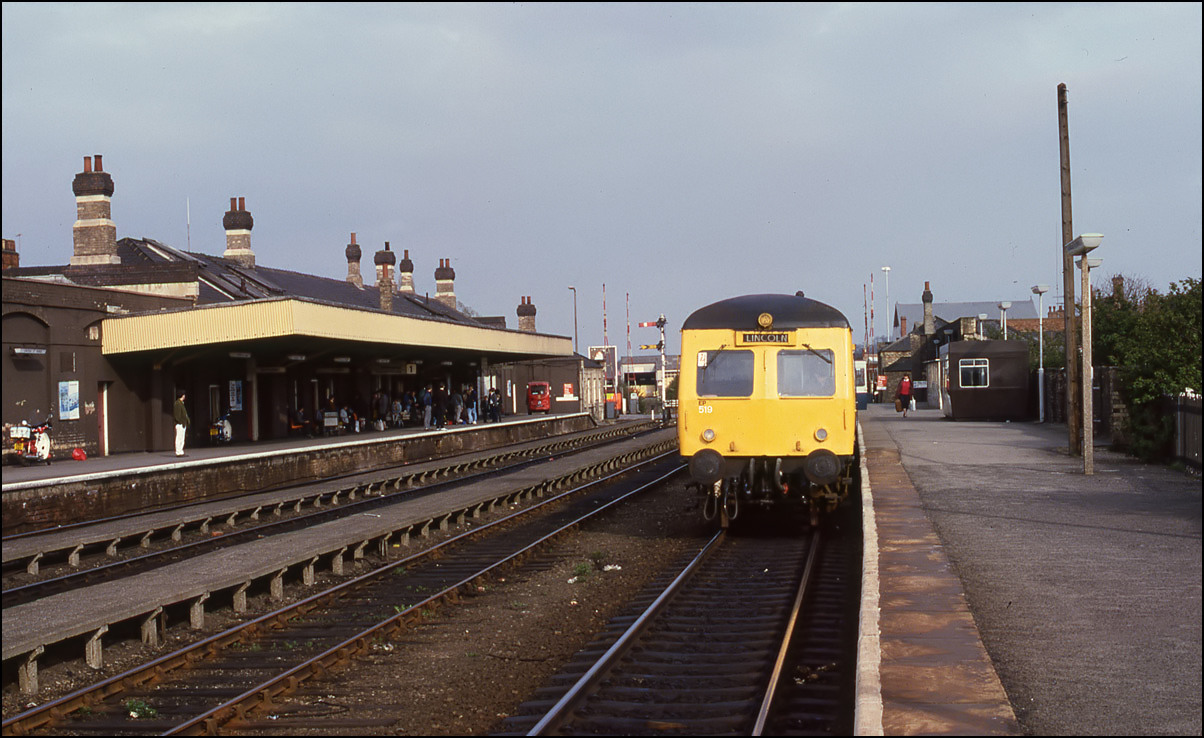 |
This is one of just two photographs I have that were taken at Lincoln St Marks station, on 3 May 1985, during a day out with my old friend Mike Chinnock, just a couple of weeks before it ceased operation. It shows a class 120 with an arrival from Derby and which was about to return to the same town. Also of interest is the red GPO vehicle on the platform which were a common sight at one time but have long been consigned to history, and a red Honda C50 Scooterette, very similar to my first motor vehicle! My other image here was taken from the other platform and shows 31433 with an ECS train, destination unknown. |
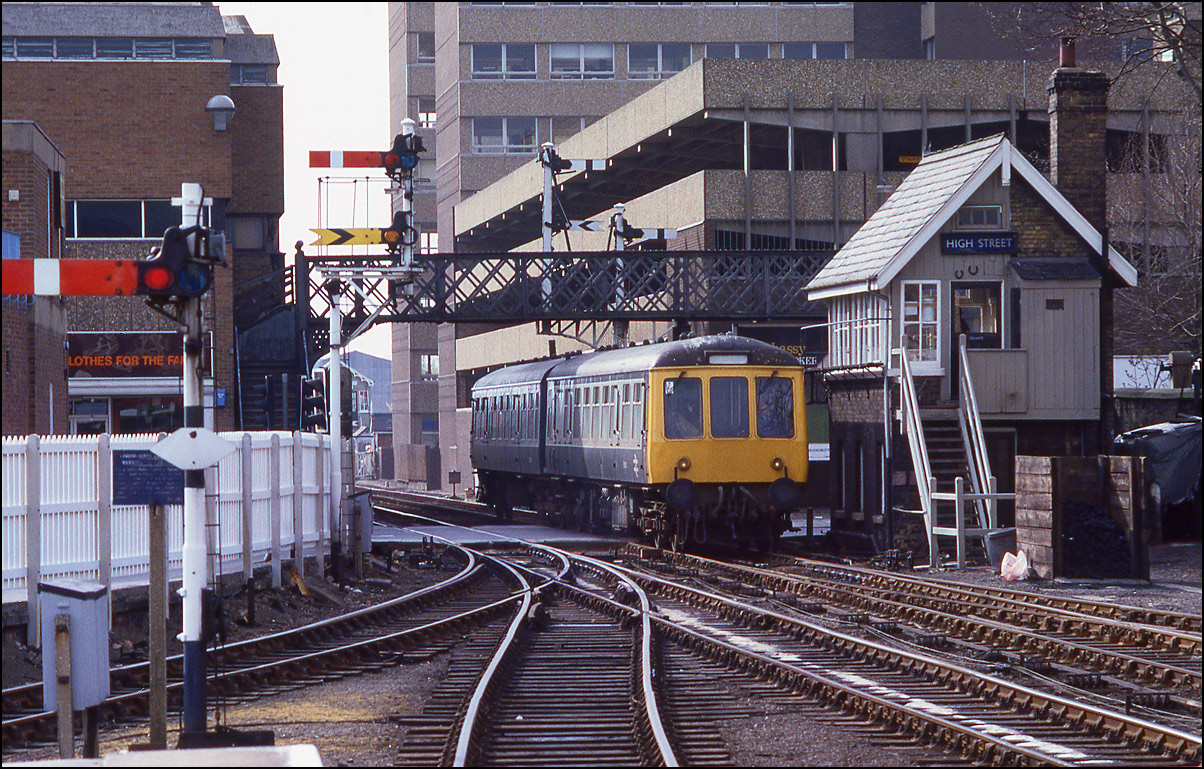 |
Lincoln Central is the location for this photograph taken on 3 May 1985 just before the shot from St Marks shown was captured. The signals protecting the crossing have already been replaced to danger by the signalman in the High Street box in preparation for opening the gates over the busy road. Note the horseshoes nailed to the wall to retain good luck within the box. Shortly after the DMU had passed 31445 + 31205 went down the through road with a short CCE train with 08249 back-to-back with 08324 following. These went, I think, into a siding just around the corner judging by the position of the signal arm. I think that the semaphore signals have, in 2019, been replaced with more modern equipment. |
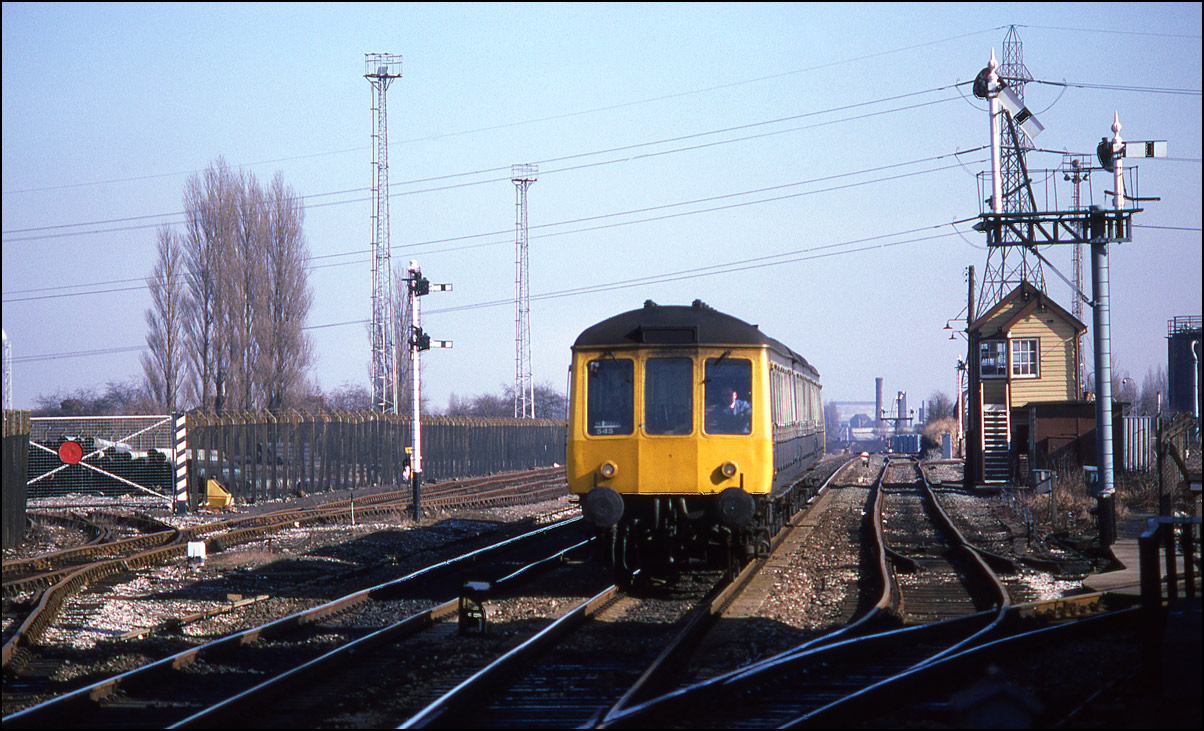 |
A few miles to the south-west of Langley Green is the station at Rowley Regis. By the time this photograph was taken on 8 March 1986, freight traffic to the various industrial termini hereabouts had finished, but the trackwork and and signalling were still pretty much intact. This picture shows the inevitable class 116 DMU on a Birmingham New Street to Stourbridge Junction stopping train approaching the station. |
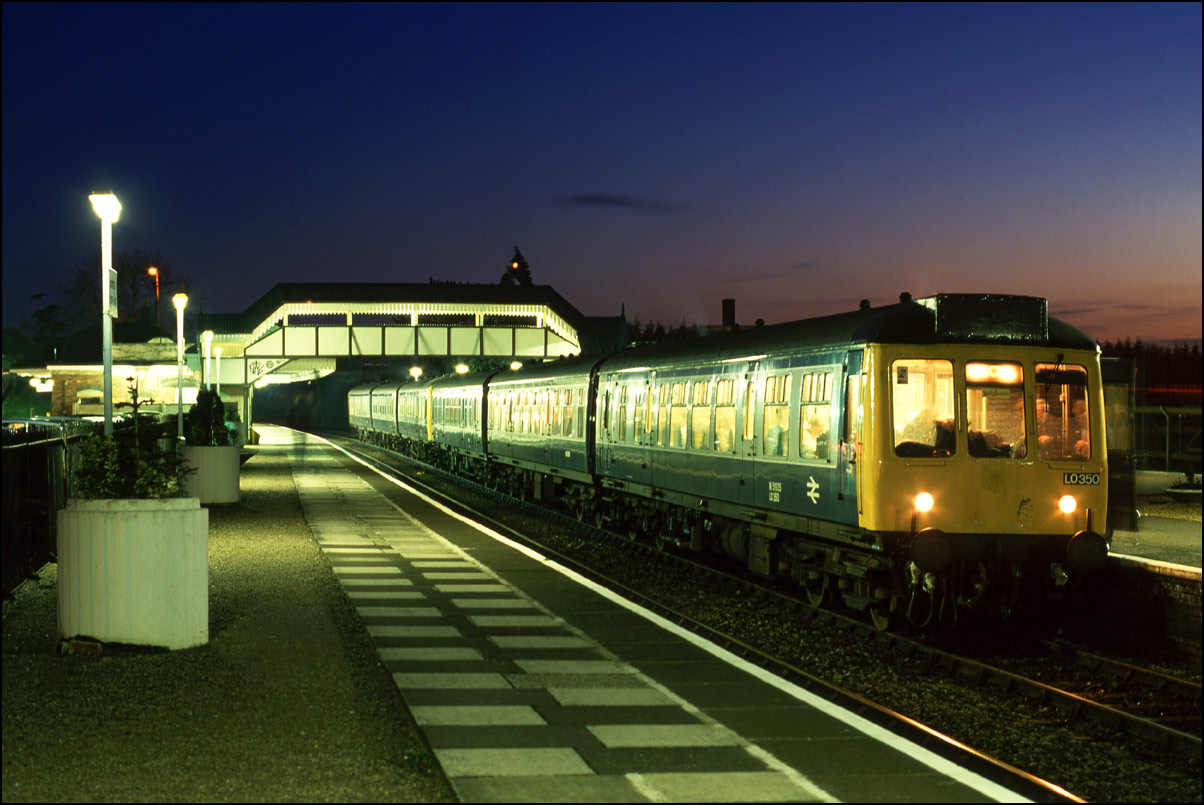 |
As I've mentioned elsewhere on this site, Stratford-upon-Avon used to see a lot of day excursion traffic. This time exposure shows Longsight allocated LO 350 + 349 standing in platform 2 awaiting departure time before returning to Blackpool on 3 February 1990. For those interested, the exposure on 100asa transparency film was 12 seconds at f8. I always took several exposures when shooting after dark to try and ensure that there would be at least one with the correct light and shadow balance. It's much easier (and cheaper) with digital hardware! 645 |
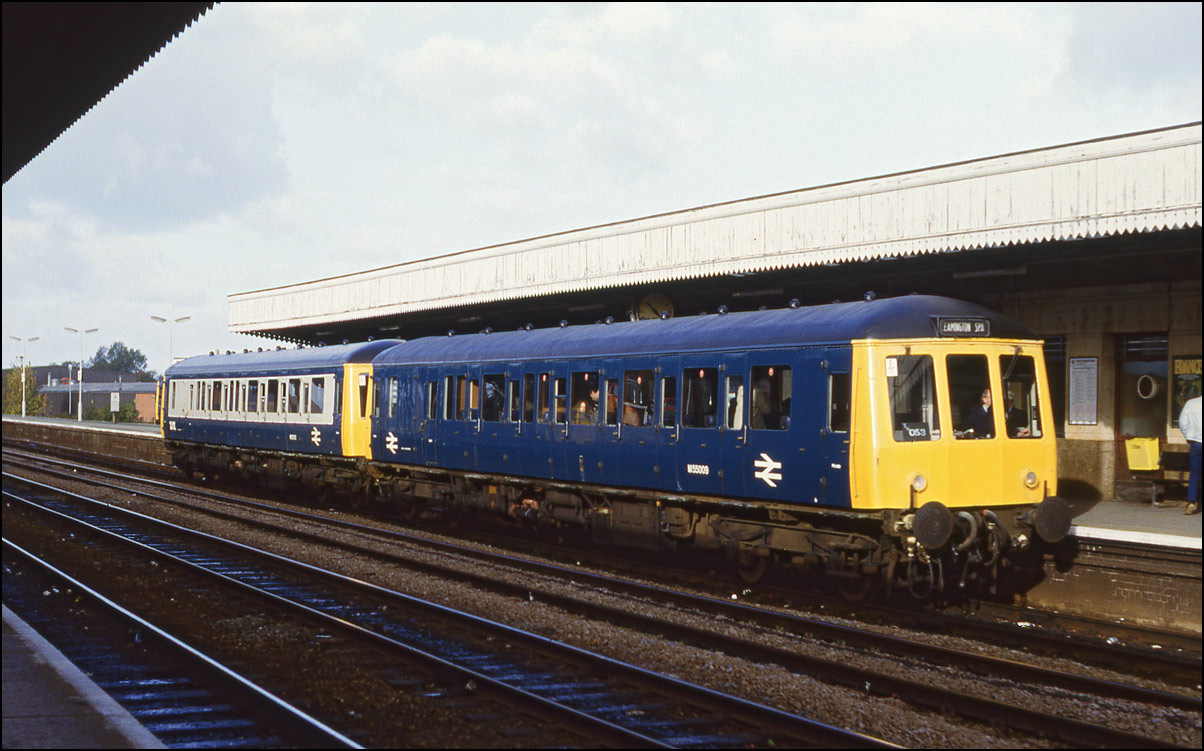 |
This was my first transparancy of diesel units and was taken at Leamington Spa on 20 October 1984. The train is the 09.50 Stratford-upon-Avon to Leamington Spa formed of 55009+55012. The leading unit was repainted into the blue and grey carried by 55012 within a few weeks of the date of this photograph. |
|
|
Stratford-upon-Avon used to be the destination for many special trains although the number of such workings has lessened in recent years. This picture shows one of these, the Poynton Parish Puffa, standing in the long-gone "cold store" sidings on 29 June 1985. This train was formed of class 108+104 combination and, obviously enough I suppose, ran from Poynton in Cheshire, which incidentally is a very attractively decorated station, adorned with many enamel advertisements. |
|
|
The passengers on the Poynton Parish Puffa were treated to a visit by the steam locomotive 46229 Duchess of Hamilton on 29 June 1985 although I don't recall taking any pictures of this. The return working of the steam special left a short while before the DMU went back to Cheshire and I photographed the latter from the window of the signal box. The industrial units in the background are the site of the erstwhile Stratford-upon-Avon shed and coaling stage. The entire backdrop is virtually unrecognisable in late 2018 and the signal box itself was demolished many years ago. |
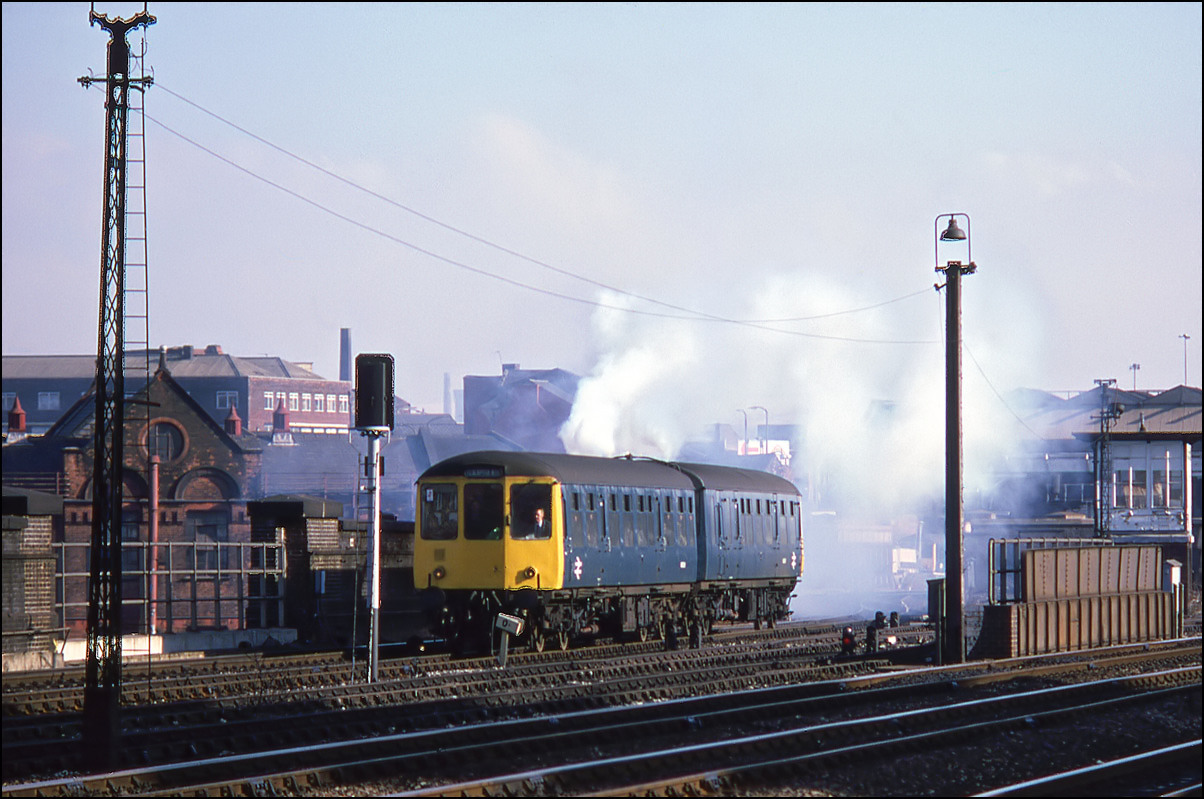 |
Manchester Victoria is the location for this photograph of a class 104 unit bursting out of the station with the 10.15 to Blackpool. This was a strange train, at least in my limited experience as I saw it hauled on different occasions by classes 40,45 and 47 as well as the smoky unit pictured on 27 February 1986. |
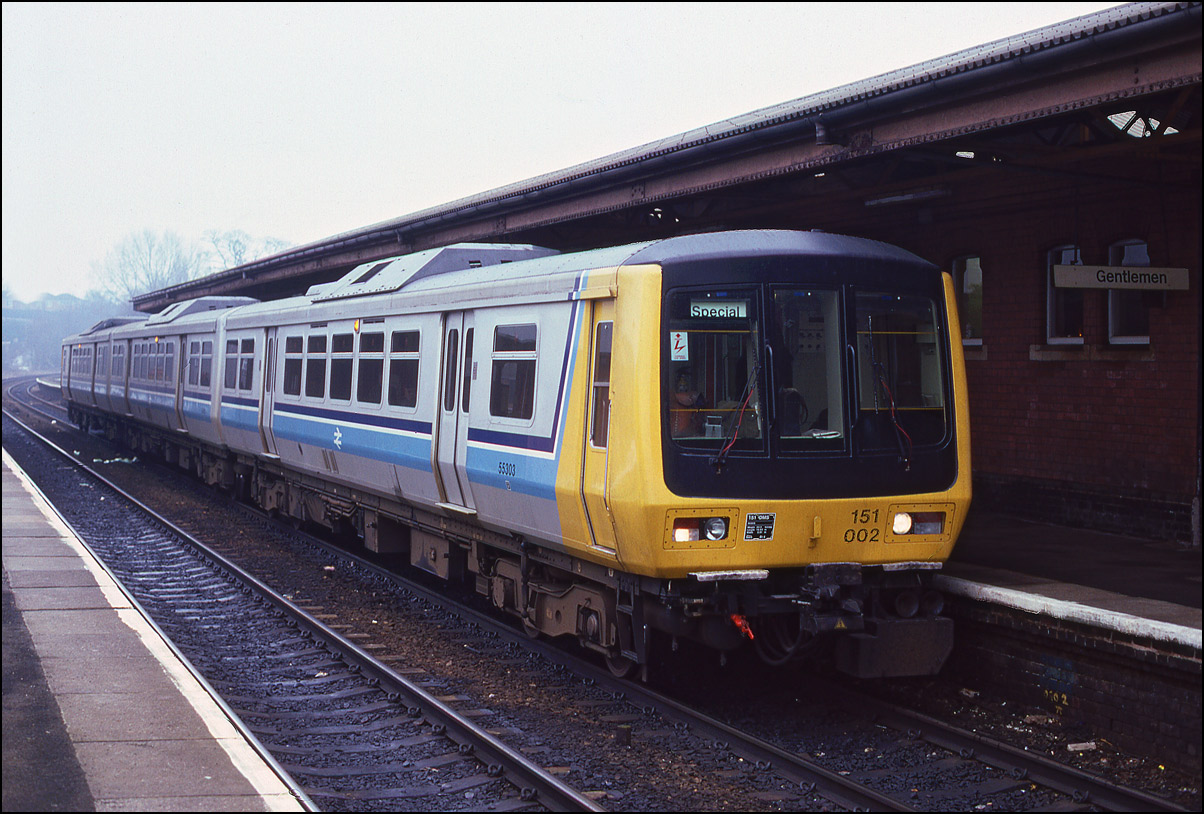 |
This somewhat anonymous scene shows the prototype 151002 standing at Stourbridge Junction while working on a trial run on 15 February 1986. It is shame that these stylish second generation units were not produced in greater numbers. In my opinion, this design was much more attractive than than ubiquitous class 150, which formed the core of the diesel unit scene in the West Midlands for many years and in 2018 can still be seen on the network. |
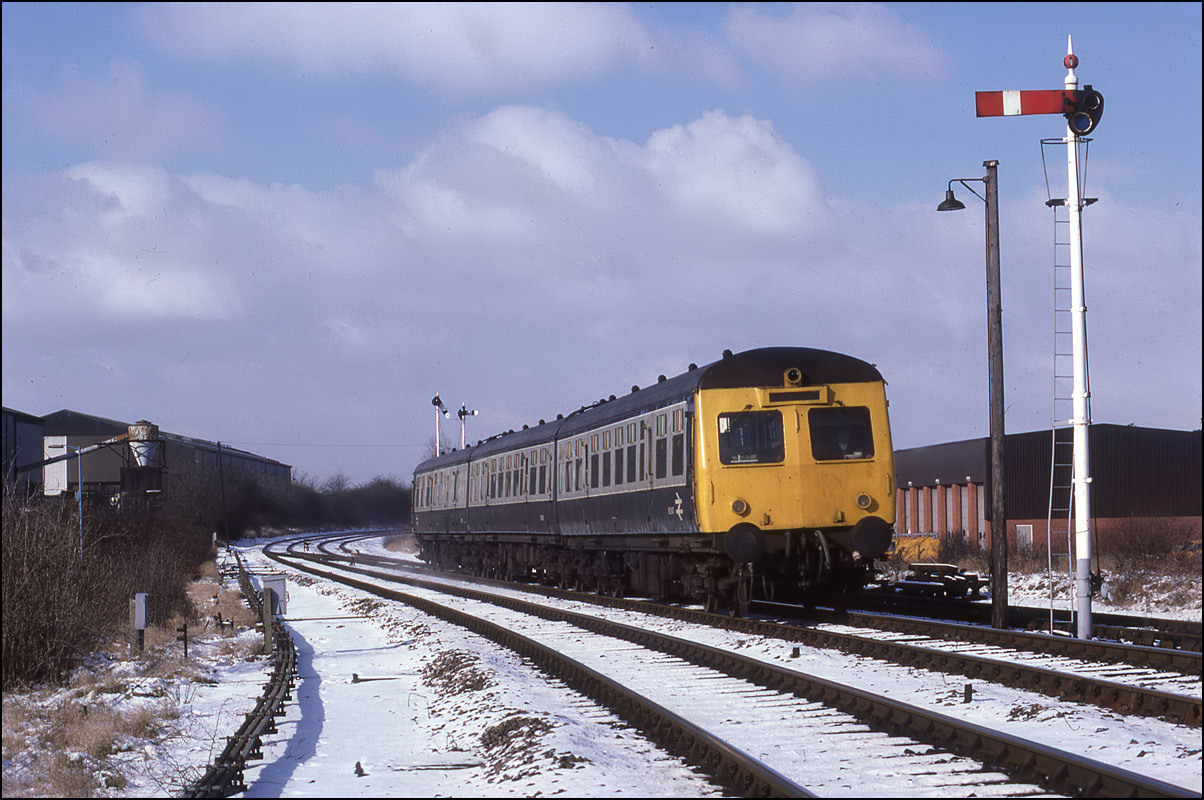 |
Class 120 units were not frequent visitors to Stratford-upon-Avon, especially after a light snowfall with strong winter sunshine. When this happened on 8 February 1986 the unit stuck to its diagram between Birmingham Moor Street and Stratford, which gave me the opportunity for a few shots around the station area. I had good relationships both with the station staff and the regular signalmen and was able to walk around the best photo spots as I wished. This picture shows the 11.10 from Birmingham passing the intermediate starter signal before arriving at the terminus. |
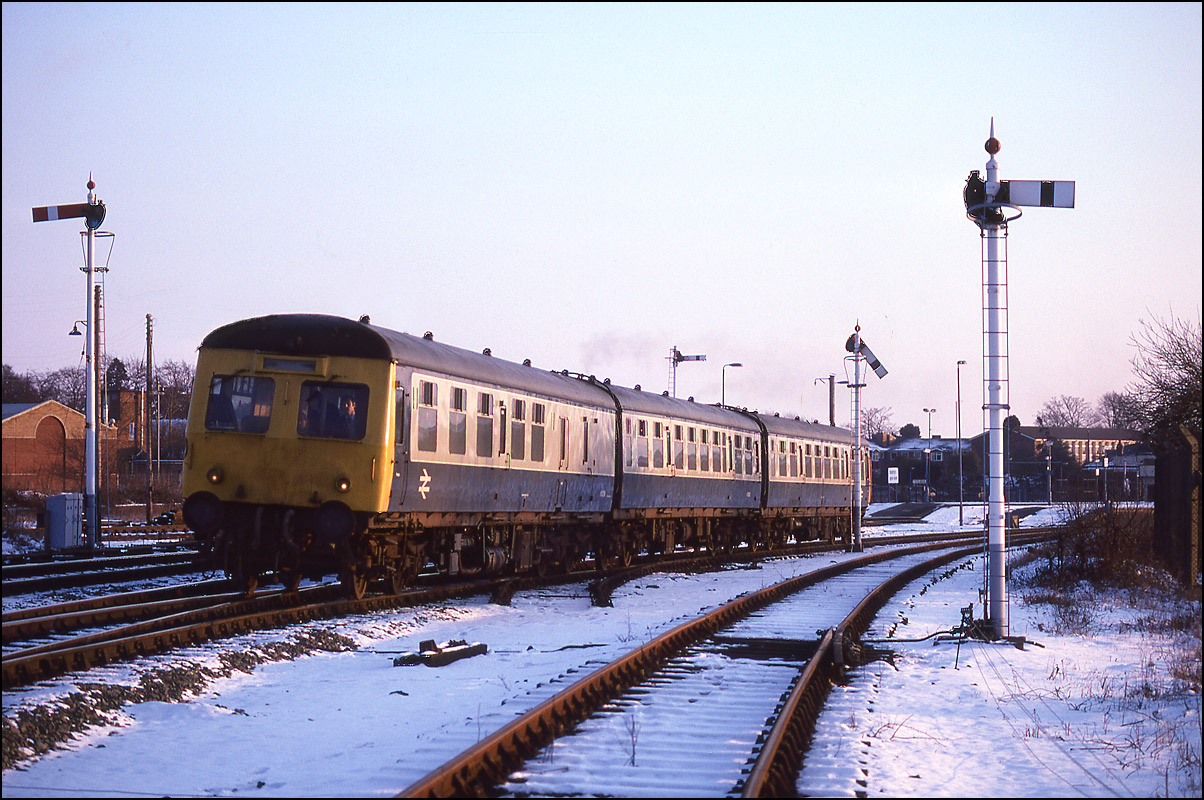 |
The return working of the train shown above, the 12.20 Stratford-upon-Avon to Birmingham Moor Street is seen leaving from platform 3, as shown by the lower quadrant signal being in the "off" postion. Platform 2's starter was the tall upper quadrant signal protruding from the centre car of the train. |
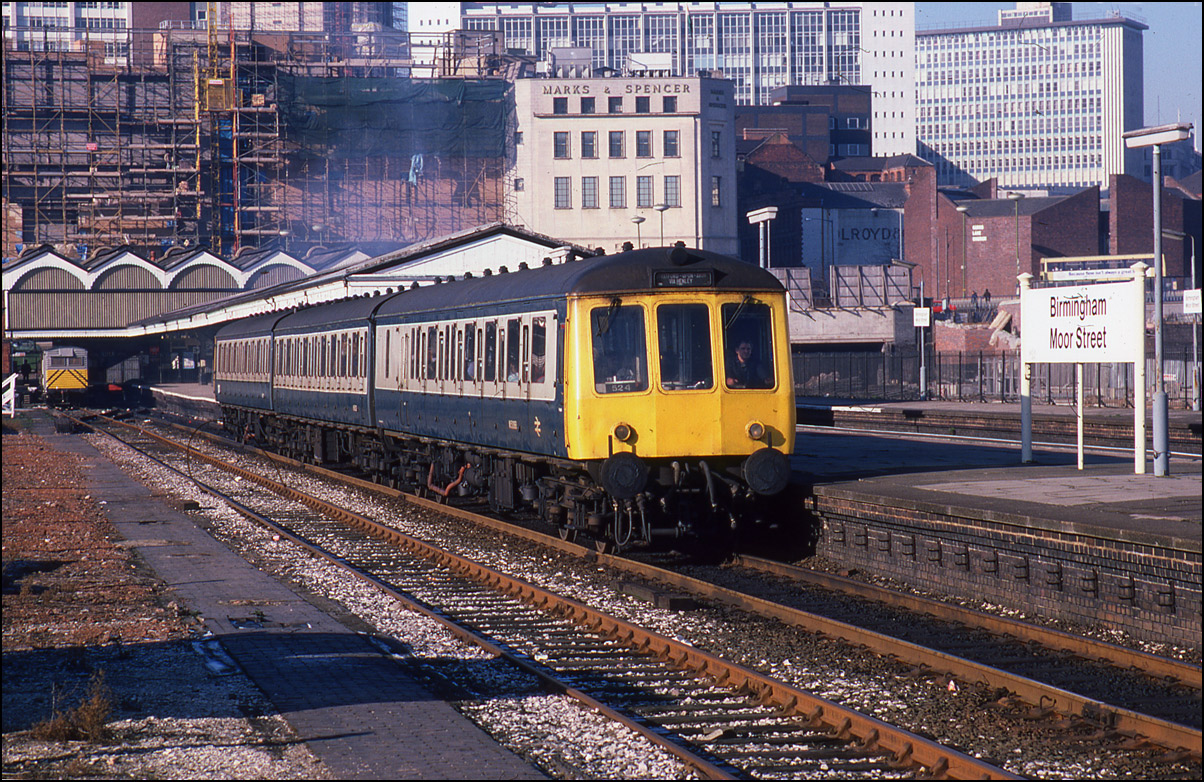 |
Until 1987, the GWR's Moor Street station was the terminus for trains both from the Leamington Spa and Stratford-upon-Avon lines. When Snow Hill was reopened a two platform through station was constructed adjacent to the terminus, which then became redundant and was closed. On 7 February 1987 the 12.10 to Stratford departs from Moor Street in the capable hands of driver Geoff Davies. An image of the train, just after arrival from Stratford, is shown here with a bit more detail of the city backdrop. The high resolution scan reveals a workman on the scaffolding; not a hi-ves jacket or hard hat in sight. For a view of the interior of the station, click here. Moor Street lay derelict for many years, but now has been restored and is now used again by trains to relieve pressure on Snow Hill and to provide shoppers with a more direct route to their destinations. The car park is now part of the new Moor Street station with its own terminus platforms used by many of Chiltern Railways' Marylebone services including those using class 68 power in push-pull mode. |
|
|
Prior to the introduction of Chiltern Railways' services to Stratford-upon-Avon there were some route familiarisation runs for crews. On 11 November 2004 single car DMMU 960014 was in use and this image shows it shortly after arrival at Stratford. The opportunity was taken for a bit of advertising on the unit's sides although it is oopen to debate how much notice prospective passengers may have taken of it. |
|
|
During the layover of 960014 at Stratford-upon-Avon on 11 November 2004 I took the opportunity to drive to Wilmcote station for another shot as it went north to Hatton on its route learning run. Here it is passing under the GWR footbridge, albeit in an odd shade of muddy pink. |
|
|
It doesn't take long for a train to travel from Wilmcote to Hatton, reverse, and then return. Despite the gloomy weather I must have thought int worthwhile on 11 November 2004 to hang on for 960014 to return for its second visit of the day to Stratford-upon-Avon. |
|
|
I saw over the weekend of 24/25 November 2018 that a DMU of some description was going from Etches Park at Derby to Long Marston on the following Monday and had it in the back of my mind to go over if it was convenient on the day. The arrival was showing as 12.37 but when I arrived home at 12.00 after a swim I saw that it was running 15 minutes early at Evesham so decided it would be a bit tight. I then saw a a solitary email about 5V94 from someone at Northfield saying that the unit was 156497 and as I wasn't aware that another of its class had been along the branch grabbed my camera and had a "sports mode" drive over. My arrival at 12.18 was just in time to see the unit on the long straight section of track alongside the Pebworth Road and it was only a few moments before the East Midlands liveried train slowly approached the gates into Long Marston. |
|
|
The weather at Long Marston on 26 November 2018 was largely overcast but there was a bried glimmer of light as 156469 stood at the gates while the ground crew unlocked them. I understand that Chrysalis Rail are doing some work on 156s here so there will probably be more moves of this nature to come. Within a few minutes the gates were closed, the driver had switched ends and 156497 was ready for its trip around the loop to the workshop area. |
|
|
Tuesday 9 September 2018 was a clear and sunny day in the Autumn, or Indian Summer as it seems to be at the time of writing. There was the prospect of an unusual train over the North Warwickshire Line so after a gym class I went over to Edstone between Wootton Wawen and Bearley Junction where the cast iron aqueduct (the longest in England) tales the Stratford-upon-Avon canal across the flood plain of the diminutive Rive Alne. First along was newly painted, or vinyled, 172338 running as 2D22 from Stourbridge Junction to Stratford-upon-Avon, its colour scheme matching the changing colours on the surrounding trees. |
|
|
A trip to Hatton North Junction was in the offing for the sunny afternoon of 9 October 2018 with a few decent bits and pieces at which to aim the camera. Just a few minutes after my arrival on the footbridge along came DR98908 with the daily RHTT from KIngs Norton to Kings Norton via large chunks of the West Midlands. I never mind taking the occasional image of a MPV and used to cover their workings along the North Warwickshire Line in some detail before the advent of the West Midlands new signalling system when the signal boxes and their associated limited opening hours pushed the trains' operation into the nighttime hours. The odd substition was welcome though; albeit not actually on the NWL. |
|
|
The train due to pass Hatton North on 9 October 2018 which interested me the most was a 5L46 from Bristol Temple Meads to Ely Papworth MLF Sidings. This was a FGW HST with just 2 coaches led by 43175 and destined for storage; not so much HST GTi but HST M-Sport! There was some early running in the Thames Valley but this was knocked out by a fester in Hatton DGL where its booked path was regained. This wasn't the first FGW HST to pass here nor was it the first 2+2 formation I have photographed but very much worth going out for. |
|
|
Several years ago it would have been possible to take around a dozen shots of freight workings on the Birmingham to Gloucester line but in 2018 there are far fewer and sheer boredom makes it moe likely than photographs of passenger units will be taken. Here is 170109 working 1V10, the 13.04 Nottingham to Cardiff Central service on 25 September 2018 passing Croome Perry near Pershore. |
|
|
Following 50008's late departure from Long Marston there was a knock-on effect with a delay caused to 230003 running as 5Q13 to Bletchley. The Long Marston branch is a One Train Only line and after the token had been dropped at the Staff Hut it was necessary for it to be collected and driven back to Long Marston. A West Coast man was ready and waiting to do this to minimise any further delay. As the unit appeared in the distance a 5 car IET moved away from the Honeybourne stop giving the chance for a shot of the two very different trains; a shot that will be difficult to repeat! |
|
|
There is currently a severe speed restriction over most of the branch but it wasn't long before 230003 appeared in the distance, dropped off the token and made its way into the station area ready for a reversal at Honeybourne North Junction. The light had picked up a little but wasn't strong enough to cast anything but the lightest shadow. Still, there is only once chance for these moves and one has to take what's available on the day. |
|
|
I was keen to take my final shot of 230003 in a recognisable location and in any event there wouldn't have been enough time to drive to another decent location especially as I had gone over in my Morris Minor; not built for belting around country roads! I was happy enough to get a record shot as 5Q13 passed through Honeybourne station even though the light had collapsed altogether by that time. |
|
|
Vivarail's first production unit, 230003, made its debut on the main line on Monday 17 September 2018. It should have run the previous week but there was apparently a small problem with the fuel system found while on test within Long Marston. To avoid the possibility of a fruitless wait as happened when the run was aborted before, I waited at home until I saw from RTT that 5Z01 had actually moved. The original plan was for a run from Long Marston to Moreton-in-Marsh, thence to Evesham before returning to Long Marston so I arrived at Honeybourne in good time for 5Z03 from Evesham and planned to take a shot as the train ran along the branch line but it struck me that it seemed to be taking an awfully long time to come the short distance from Evesham and wondered if it had stopped to arrange an alternative path back to Moreton. With this in mind I stood on the footbridge over the up main line just in case. This proved to be a good choice as 230003 came from Honeybourne North Junction on the main rather than the branch line. I waited on the platform for the return to Evesham, now 5Z04, but the sun came out at just the wrong time making for a poor result. |
|
|
The next stage in 230003's test programme on 17 September 2018 was shown to be another trip from Evesham to Moreton in Marsh. As there wasn't time to move to another location I stayed at Honeybourne to take an image from the down platform as 5Z05 headed south. Once again though things went differently from the plan and the first thing I saw was 230003 moving slowly along the Long Marston branch rather than on the up main line. A quick sprint was needed to get up and over the enormous footbridge and I made it with no time at all to spare so this is very much a grab shot as it ran slowly towards its current home base. The unit is in its final livery ready for a new life on the Bedford to Bletchley line and here is some bodyside detail clearly showing this. |
|
|
At the time of writing there is a severe speed restriction due to poor track condition over the whole of the Long Marston branch so there was no need for a high speed dash from Honeybourne to record 230003's arrival. The light stayed poor but I was more than content to have scored some reasonable shots on the train's first outing. I took another view as it entered the yard mostly to show 230003 with an unrestored example of the same original class in a siding. |
|
|
My interest in all railway related matters has been waning recently, so much so that I couldn't be bothered to go out for topped-and-tailed class 47s with some ECS at Hatton on Saturday 1 September 2018. The most I could be bothered to do was to walk to Stratford-upon-Avon station for a single shot of 172335 as it arrived with 2D40 from Stourbridge Junction. The novelty of the new colour scheme will wear off quite soon as more units are repainted from the current green colour scheme... |
|
|
I was walking along the towpath of the Stratford-upon-Avon canal on the morning of 18 August 2018 when I saw a reliveried class 172 about to enter Stratford station. I assumed that it was the 08.21 arrival from Stourbridge Junction and after returning home worked out that the same unit should return on the 14.21 arrival. Luckily, a friend texted me to say that it was actually on 2D40, the next service which ran via Dorridge and Hatton North Junction which meant that the train I had seen earlier was 5D70 from Tyseley depot running early. I had a walk to the station in the afternoon taking my Canon G10 and arrived a few minutes before 172335 in its new colour scheme arrived with 2D40. |
|
|
To my eyes the colours applied to 172335 by West Midlands Trains really suit the lines of the class, more so than the original green as seen here at Bentley Heath on the same unit in 2012. I don't know if this will become the standard livery for the class but intend to kep an eye on this example in the hope of getting a sunny shot next time. There were no Chiltern Railways services on 18 August 2018 as engineering work caused their replacement by a fleet of buses such this being loaded with passengers and their luggage against the new backdrop of Stratford-upon-Avon's hideous new high-density housing scheme. Thanks to Chris Morrison for letting me know the correct train that 172335 was working. |
|
|
D'oh, a deer; but not a female deer. A roe deer buck crosses the exchange sidings at Long Marston on Monday 13 August 2018 as 230001 approaches with 5Z01 to Moreton-in-Marsh. I saw from RTT that something was making some test runs between Moreton and Evesham and wondered if it might be one of the class 230s earmarked for use on the Bedford to Bletchley line. With that in mind I thought a shot or two would be in order so went across to Long Marston to see what was running. There was nothing in view until a few moments before the booked departure time, 09.40, when I saw some movement in the background before 230001 came around the curve in the background. |
|
|
It didn't take many seconds for the gates to be opened and for 230001 to exit the Long Marston site and head for Honeybourne. I have many images of the this unit in good light and with little prospect of much sun in the short term I left and headed to my health club for a swim. Had one of the later units been in use I should have had a good chase around to get a few pictures in the bag but on this occasion... I later saw from RTT that 230001 ran to Moreton-in-Marsh and Evesham West Junction but then returned to Long Marston with further runs for the day cancelled. |
|
|
After photographing the first Mk5 stock move on Friday 25 May 2018 I stayed at Defford for a few minutes as the NMT HST was heading from Reading Triangle Sidings to Derby via Paddington and South Wales. I hadn't seen this train for ages so waited, despite the dire conditions, for 1Z20 to come along led by 43013 and tailed by 43062. |
|
|
The prototype class 230, 230001 made some more runs from Long Marston on Thursday 17 May 2018. I had intended to take some pictures of all the trips but had a message before leaving home saying that something even more unusual was running on the line through Hatton a bit later on. I still went to Long Marston for the first part of 5Z01 and arrived a few minutes before 230001 came into sight as it ran along the exchange sidings. Within a vey short time the gates were opened and it started on the short journey to Honeybourne. Over to the right and out of shot the diesel shunter was on the loop moving a class 319 EMU around towards the exchange sidings in preparation for its journey to Wolverton during the afternoon. |
|
|
Vivarail's 230001 paused on the Long Marston branch at Honeybourne for a few moments until the signal was cleared to allow it to go to Honeybourne North Junction and to reverse on the main line and head off to Moreton-in-Marsh, Honeybourne isn't the most attractive station in the area but it does at least have a GWR-Style piece of ironwork on some of the platform's benches. The sun was at full strength but still a little straight at this time of the morning, just on 10.00. There were some more moves during the rest of the day along with another Long Marston to Wolverton class 319 drag but I went home for some coffee before going to Hatton. |
|
|
Vivarail's 230001 made some more runs between Evesham and Moreton-in-Marsh on Tuesday 16 May 2018 and as I had limited time went to Thistley Hill near Mickleton for the second up run although knowing that the sun would be too straight for most people's taste. First along was am IET forming 1P25, the 0954 Great Malvern to London Paddington which was running about 10 minutes late and certainly not being pushed to make up considering how slowly it passed me. I don't know which unit it was; I don't bother much with numbers and don't separately record them. Recent vegetation clearance has really opened the view along this stretch of line; this shot would have been impossible until the clearance works. It won't last... |
|
|
This was the train I went out to photograph near Mickleton on 16 May 2018. Vivarail's 230001 was making some more testing and mileage accumulation runs and had already gone from Long Marston to Moreton-in-Marsh and then down to Evesham and I was here for 5Z03 from Evesham West Junction back to Moreton. RTT showed that it had arrived at Evesham but whichever system activates the train on the railway computer systems hadn't done so and until I saw it coming up Campden Bank wasn't sure that it was on its way. The next run due in about an hour would have been better for the light but I couldn't wait so was sort of relieved to see later that it had been cancelled with 230001 returning to Long Marston from Evesham. |
|
|
During the late morning of 15 May 2018 a schedule appeared suggesting that a class 143 pacer, running as 5Z43, was on its way from Cardiff Canton to Long Marston. As the afternoon was clear and sunny and as my previous shots of 143s here had been in poor light I went across to Long Marston for a shot or two. This one taken as 143601 ran the final few yards along the branch from Honeybourne from the top of a pile of earth left in the field during works to update Pebworth's sewage facilities by taking the village's waste to the nearby Milcote sewage works. |
|
|
The usual procedure for moving a class 143 at Long Marston ws followed on 15 May 2018 when 143601 entered the exchange sidings and immediately reversed to reach the workshop area by running anti-clockwise around the circuit. This shot was taken just as it began to move and against a backdrop of a variety of stored stock. |
|
|
The first run of a 9 car IET over the length of the North Cotswold Line was on Monday 15 May 2018 when 800302 worked 5X23 between Stoke Gifford and Oxford and back again. The afternoon leg of the test was better for me and I went to Lower Moor between Evesham and Pershore, a spot where the full length of the train could be seen to advantage. The bland overall green blends all too well with the background as the train passes the hydroponic glasshouses growing various salad crops. |
|
|
The roadbridge at Defford is one of the few in the area where a decent two-way shot can be had. I like the northbound view because of the attractive vista of the valley of the River Avon and the mass of Bredon Hill in the background. If standing on the bridge ready for a southbound shot it is easy to keep an eye for anything coming the other way on the long straight through Eckington and when a headlight is seen there is time to cross the road. On this occasion, 15 May 2018, the light was on the front of 43301 leading 1S61, the 12.25 Plymouth to Glasgow Central, the HST being in what I think is by far the best of the current crop of colour schemes on that class of train. |
|
|
My second shot of 800302 on 15 May 2018 was as it returned to Stoke Gifford from Oxford via a reversal at Worcester. It is shown here passing the site of Defford station still running at 5X23 once again matching the green background. I think the colour could have been a shade or two lighter and much more like the Middle Chrome (Brunswick) Green with a contrasting lining-out used by the GWR on its express passenger locomotives. |
|
|
Vivarail's 230001 was shown as running between Moreton-in-Marsh and Evesham on Tuesday 8 May 2018 and with what appeared to be guaranteed sunshine I went over to Evesham for the second of the day's runs. I arrived at Briar Close just in time to see 165113 forming the 10.39 Great Malvern to Paddington, 1P27, approach the signal box for a stop in the station where a class 800 was waiting to head north. The new GWR colour looks smart but it's not easy to achieve a good photographic result of it even in strong sunlight. |
|
|
I'm always keen to take a photograph of Vivarail's 230001 on its various test runs and must admit that I find it a more interesting prospect than yet another 37 hauled stock drag. On Tuesday 8 May 2018 230001 made some runs on the North Cotswold Line and unusually it started from Honeybourne sidings where it had been stabled, for reasons of which I am not aware, since the previous weekend. I wasn't able to get out for the first run between Moreton-in-Marsh and Evesham but did make it to Evesham in plenty of time for the second. Here it is arriving at Evesham station as 5Z04 and after a short wait at the signal just on the other side of the bridge until a preceding class 800 had reached Norton Junction went down towards Evesham West Junction before crossing over to the up main line. |
|
|
Now running as 5Z05 after its reversal at Evesham West Junction 230001 is about to pass non-stop through Evesham on the way back to Moreton-in-Marsh. It would reverse again there before the final journey of the day and its return to Honeybourne Sidings. |
|
|
A sunny morning on 5 May 2018 and the prospect of an unusual triple-headed freight on the Solihull line saw me head to Hatton for a few minutes. Running in front of the freight was 165011 forming 2L27, the 11.34 Birmingham Moor Street to Leamington stopping train. When I left home the sky was cloudless but during the drive over a lot of cloud bubbled up; inevitable on a warm morning after some wet weather earlier in the week. There was still more blue sky around than cloud so I wasn't going to turn this image of a 2 car unit. |
|
|
The engineering work on the Long Marston branch continued over 2 and 3 May 2018 with another 6X04 from Fairwater Yard on the Tuesday afternoon. Knowing that a lot of vegetation had been removed from the North Cotswold Line I went, in hope, to a spot near Mickleton where a clear shot would be available. The location had seen significant clearance work and I was hopeful of a decent outcome at shortly before 20.00. Running in front of 6X04 was 1W36, the 17.52 Paddington to Worcester Shrub Hill which was 2 or 3 minutes late when it passed me formed of 165109. |
|
|
Some much-needed engineering work is, at the time of writing, taking place on the Long Marston branch following a few days of road learning by Freightliner drivers with several light engone runs having taken place the previous week. The first train to run on 30 April 2018 was a 6Q53 from Reading Triangle Sidings and althought this was inevitably going to be a track machine I thought it worth the short trip to Honeybourne to have a record shot. On arrival on the roadbridge I was pleased to see that a lot of clearance to the heavily overgrown trackside vegetation had taken place with the result that a shot of an up train from the south side was again available after a gap of many years. The tamper (or whatever it is) ran to time and is seen here approaching the end of its journey and will go through the station before a reversal to cross over to the up main line and then on to the Long Marston branch before another reversal to gain the sidings. |
|
|
After the first reversal at Honeybourne on 30 April 2018 the OTP waited at the signal for the road to be set for the sidings by Evesham signal box. The driver was about to exit the cab and walk to the other end of the unit when I took this image and within a few moments the move was complete. |
|
|
A Great Western HST was scheduled to from from Okehampton to Stratford-upon-Avon on Saturday 21 April 2018, the charter being organised by Okerail, the group dedicated to opening for full passenger use the line from Cowley Bridge Junction via Crediton. This wasn't the first HST to visit the terminus at Stratford but rare enough to warrant some pictures. The arrival was shown as 11.32 and I chose the roadbridge near Stratford Parkway station for a shot of 1Z44, formed of 43188, LA15 and 43093, as it approached its destination. Running a few minutes in front of it was 172335, the 09.57 from Stourbridge Junction and this unit nearly made a nuisance of itself as it returned to Stourbridge. The charter was running 2 minutes early which made a clash at Parkway possible and it very nearly went all wrong as this image shows. I don't know if the timing of the charter for this day was deliberate but the participants would have the town solid with people taking part in the annual Shakespeare's Birthday celebrations which takes place on the nearer Saturday to his birthday, 23 April. |
|
|
After disgorging the passengers from Okehampton at Stratford-upon-Avon the HST set went to Banbury on 21 April 2018 either for servicing or to avoid clogging up one of the relatively short platforms at Stratford. This meant that a picture of the train leaving the Stratford branch at Hatton was on the cards. For reasons of which I am not aware the train ran as 1Z56 rather than the class 5 one would expect for what seemed to be an ECS movement. It is seen here with 43093 leading about to pass under the roadbridge at Hatton, run non-stop through the branch platform, cross over onto the up main line and thence on towards Leamington Spa and Banbury. Not long before 1Z56 was due a Birmingham Moor Street to Leamington Spa stopping service was due and here is 165002 forming the 11.34 to Leamington formed of 165002. |
|
|
The stock for the return charter to Okehampton ran from Banbury as 5Z45 and I decided on a shot of it entering platform 1 at Stratford-upon-Avon. Had the sun been out
this would have been a really good spot for it but unfortunately the sky had clouded over with some light rain having just fallen. This is, therefore, no more than a record
shot. It was few minutes early because a West Midlands train from Stourbridge Junction was missing. There was considerable disruption to all services from Stourbridge on 21 April 2018 caused by the failure of 47749 on a railtour from Newport (South Wales) to York and Scarborough when it died at Old Hill. It took, almost unbelievably,
nearly 4 hours to find an assisting locomotive and get the failed train into Rowley Regis loop. Somewhere in excess of 20 passenger services were cancelled and the charter itself
had to miss out out York and go straight to Scarborough. I wonder if there will be repercussions about the use of single |
|
|
After shooting 47749 at Hatton North on 19 April 2018 it was time to move slightly to the right to take advantage of the greater angle currently available from the adjacent field before it is obscured by rampant undergrowth. Having so far ignored passenger trains I took this image of 168107 working 1G41, the 15.10 from London Marylebone to Birmingham Snow Hill. |
|
|
Some paths between Long Marston, Moreton in Marsh and Evesham West Junction appeared on RTT on Friday 13 April 2018 and were, I guessed, some test runs for Vivarail's class 230 DMU. On Monday 16 April I went to Long Marston to see what, if anything, happened and arrived at 09.20 some 20 minutes before the departure time. Nothing was in sight and it stayed like that for some time until a van appeared and after a short break the driver unlocked the gates protecting the site. A bit of a clue there and 230001 soon came into sight, ran along no.1 road, and stopped by the ground frame just as the sun came out. |
|
|
After a short pause 230001 moved onto the branch and given the amount of cloud blowing around I was lucky to take this image in a patch of good sunshine. The light was just about high enough to leave the majority of track unshadowed and the Spring blossom has begun to flower in the warmer temperatures of the past few days. The train, running as 5Z01, stopped under the road bridge while the single line token was collected from the ground frame and this was my cue to head for Honeybourne. |
|
|
The usual simple drive from Long Marston to Honeybourne was more of a trial on 16 April 2018 as 1) I had a lengthy wait in Pebworth while a bin lorry negotiated a long line of parked cars and 2) the direct road was closed for resurfacing. After a lengthy diversion I arrived at Honeybourne and was surprised to find several parking parking spaces in the station car park. The train was just coming from the staff hut and stopped at the signal protecting Honeybourne North Junction. Worryingly, some of the many staff on board alighted and appeared to be examining something adjacent to the front bogies. |
|
|
While 230001 was standing around the back of Honeybourne station on 16 April 2018 an up passenger train arrived, this being 1P25, the 09.54 Great Malvern to Paddington formed of 800012 which picked up a solitary passenger. I have a feeling that this may be the first picture taken showing an IET with a class 230 in the background... |
|
|
It soon became apparent that not all was well with 230001 and the lights were switched from red to white. At about the same time RTT showed that all the runs on 16 April 2018 were cancelled so the only option was for the train to return to Long Marston. This image was taken as its journey began and this one was taken from the down platform as it ran towards the staff hut. |
|
|
The class 166 for which I was waiting at Honeybourne on 14 April 2018 had just pulled away from the signal just down from the station when 1P51 from Hereford to Paddington approached for its stop. The sun failed to stay out quite long enough for this but I took a shot anyway as HSTs won't be on the North Cotswold LIne for much longer. |
|
|
Class 165s and 166s are being sent on a regular basis from Reading Train Car Centre for some work or another the details of which I don't know. On 14 April 2018 166221 was the unit involved and this picture shows it shortly after joining the Long Marston branch. Just after I took this image 5Q66 stopped to wait, I think, for the single line staff to be delivered from Long Marston where it had gone with 37601 and 350258. The sun came out a few moments later and I did attempt a static shot but the angle wasn't especially favourable and a very wide angle lens was needed which inevitably created some distortion. As the train went past I noticed the nameplate which seemed appropriate given 5Q66's originating point. |
|
|
After photographing 37601 at Evesham on 24 February 2018 I waited on the bridge to take a shot of whatever turned up (if anything given the shocking service GWR has provided in recent weeks) on 1P47, the 12.27 Worcester Foregate Street to Paddington. I have just bought a used Canon G10 compact camera, on of those with a proper zooming optical viewfinder and importantly, the ability to shoot in RAW format. I took this image of 1P47 formed of an IET slowing down for the Evesham stop and for the first shot I had taken with the camera was pleased with the result. I've no idea of the unit's number and I don't know where to look for it anyway but as they all look the same, who cares! An HST was waiting for the road to Norton Junction in Evesham station and this is that scene with the two generations of express passenger trains in the platforms. |
|
|
The monthly 1Q48 test train from Derby to Tyseley via Stratford-upon-Avon ran on 20 February 2018 but in a much more user-friendly set of timings than those to which we have bencome accustomed. The North Warwickshire Line was covered at the ideal time for a shot from the Edstone Aqueduct and I arrived in time to take an image of the preceding passenger train, 2S24, the 09.57 from Stourbridge Junction to Stratford-upon-Avon. This location is one of the few on the line where the sun is in a decent position and which has a good background rather than just some anonymous undergrowth. The sun was in cloud when I heard 172323 approaching but the brisk wind blew it away just in time. |
|
|
Some of the express workings operated by Chiltern Railways are followed a few minutes by a local service stopping at the less busy stations between Leamington Spa and Birmingham. Following 68015 on 1R33 was a very clean 165019 on the 14.32 Leamington Spa to Moor Street, 2R33 photographed passing Hatton North Junction on 7 February 2018. |
|
|
While waiting at Stratford-upon-Avon, in the wrong place as it turned out, for 37116 + 37057 on a test train during the evening of 23 January 2018 I took this shot of the general scene at the station showing a class 172/3 in platform 1 and a 165 in P3. I really took this image only because of the attractive sky in the few minutes before complete darkness arrived. |
|
|
The former London Midland franchise was taken over by Abbellio who now operate services as West Midlands Trains. At the time of writing just one of their class 172 DMUs has been reliveried into a distinctive purple, grey and orange colour scheme. This unit visited Stratford-upon-Avon on Saturday on Saturday 23 December 2017 and having been told about during the morning went down to the station to photograph its arrival as 2S30, the 10.57 from Stourbridge Junction via Henley in Arden and the subsequent departure, 2J43 at 12.26. The weather was dull to say the least but I thought it worth the walk to record 172339's first visit to the terminus in its new coat. |
|
|
The turnaround time at Stratford-upon-Avon for Stourbridge Junction trains is only about 5 minutes so I hung around until it left as 2J43, the 12.26 return. Chilern's 165004 wasn't in the best place for this picture so I took a third shot as the train went past with the intention of showing the centre carriage's advertisements. |
|
|
I took my first shot of a GWR IEP on Tueday 19 December 2017 when 800014 ran from Stoke Gifford to Hereford Diesel Sidings and back via the North Cotswold Line. The down run was early in the morning but the return was convenient for me as it was due to arrive at Evesham at about 10.30. I wanted an image with a decently solid background on a misty morning and the road bridge near the signal box seemed to be the best bet. The train, 5Z26, ran a few minutes early and arrived in between patches of good sunshine thanks to some low cloud and banks of mist floating around. Turning around from this shot found 166217 standing in the down platform forming the 08.21 Paddington to Hereford, 1W00, waiting for the right-away and making an interesting contrast with the sleeker lines of the newer vehicle. |
|
|
The 40 plus year-old HSTs aren't going around on the North Cotswold Line for many more months if plans to introduce the new class 800s run smoothly. On 30 November 2017 I was at Lower Moor for yet another shot of a test train but made sure that I was there in time to photograph 1W23, the 11.22 Paddington to Great Malvern service. I was pleased that it was formed of a standard liveried set as I am not keen on those with oddly coloured power cars. The location is Lower Moor, near Pershore, one of the few spots with a clear enough trackside to avoid too many shadows on the track. |
|
|
The 2 single unit DMMUs until recently operated by Chiltern Railways left Aylesbury on 13 October 2017 to make their final main line journey to Tyseley before starting new lives on preserved lines. The train, running as 5T01, was due to pass Hatton at 11.04 and I felt that an image of 121020 + 121034 taken with a easily identifiable background would be best and with no prospect of any sun went to Hatton station. There were a few Autumnal tints on the lineside trees as the train passed the platforms and given the low light levels I was pleased that the blue example was leading. The desintation blind showed "Stratford", an appropriate location as single units were an everyday sight at Stratford-upon-Avon for many years as shown in this shot from 1 July 1986 which shows 55034 sandwiched between 55005 and 55000 with the 18.30 to Birmingham Moor Street. Another shot, this time showing 55034 numbered as T014, was taken on 10 August 1992 as it left Stratford upon Avon in the company of 55032 running as the 14.12 to Leamington Spa. |
|
|
After photographing a pair of single unit DMMUs at Hatton on 13e October 2017 I hung for a couple of minutes for a shot of DR73929 on its way from Kings Norton OTP Depot to Bicester presumably in connection with some weekend engineering project. The train, 6J40, was running 13 minutes late after a short fester in the loop at Dorridge to allow 68013 on 1H33 to London Marylebone to pass it. I don't usually bother with going-away shots of these Chiltern services but took an image on this occasion to show the developing Autumnal colours around Hatton station. |
|
|
For the first time since the signalling at Stratford-upon-Avon and the North Warwickshire Line was transferred from mechanical signalboxes to the West Midlands Signalling Centre, on Tuesday 3 October 2017 an RHTT ran to the terminus during daylight hours. The train was 3S02 from Kings Norton and was timed to arrive at Stratford at 10.50 and with it looking likely that the sun would be fully out I went to the station for an image or two. Running a few minutes in front of 3S02 was 172340 forming 2D16 from Stourbridge Junction to Stratford via Dorridge and Hatton North to West Junctions which as usual was routed into platform 1. The RHTT was held on the North Warwickshire Line at Bearley Junction for 2D16 to pass and as soon as the section was clear was released to run into the terminus and as booked came into platform 2, the best for photography at this time of day. |
|
|
Once DR98908 had stopped in Stratford-upon-Avon's platform 2 the driver had to walk to the other end before a reversal could be made prior to a run to Hatton before returning here and then off again to the West Midlands via Henley-in-Arden. There was plenty of time for this posed portrait before I left for home, pausing for a moment to take a final view from alongside 172340 just before 3S02 pulled away. |
|
|
The Arriva class 143 DMU that went into Long Marston on 29 July 2017 left the rail facility on its return to Cardiff Canton on 27th September after a false start on the previous Saturday for when a schedule had appeared but was later cancelled. Despite the gloomy and misty weather I went across to take a few images as it left but thought, as the departure time, 09.20, came and went with no sign of movement that another cancellation was on the cards. However, at 09.30 there was a movement in the yard and 143606 soon appeared through the murk and made its way past Pandora before reversing and going into the exchange sidings. In this picture the train, 5Z78, is actually coming towards the camera despite the impression given by the red lights. |
|
|
It was some 15 minutes later that 143606 made its ways onto the branch where it was stopped to await a member of the ground crew who brought the single line token to the driver so that he had the authority to travel to the staff hut at Honeybourne. I don't know the reason for the visit but there is a new vent and metal patch on the roof which may indicate that some new equipment has been fitted. A similar unit was due to leave Canton for Long Marston later the same day and this seems to indicate an odd railway practice. The driver for 5Z78 was presumably brought in to Long Marston by road to take the train out and another driver will bring the next unit in and then leave by road. Wouldn't it make more sense for the inward train to run first and for the same driver to take the outward working back and so avoid wasted money and road journeys? Maybe I'm missing something or is this just a case of railway dogma? |
|
|
After taking 2 shots at Croome Perry on the afternoon of 28 August 2017 I called in at Lower Moor to photograph another Bedford Cauldwell Depot to Long Marston move of class 319 EMUs. First along though was an HST forming the slightly delayed 1P57 14.25 Great Malvern to Paddington led by power car 43169. I was pleased to see that none of the tarted-up power cars were on the train; I much prefer the overall uniformity of a single colour scheme. In contrast to the pony at Croome Perry the 2 grey horses at Lower Moor have been able to keep the vegetation in their field under control! |
|
|
The 13.21 Paddington to Worcester Foregate Street, 1W27, is usually formed of an HST set but on Bank Holiday Monday 28 August 2017 the arrangements were changed and the working was given over to FGW's green liveried 166213. The field to the left of the railway hasn't yet ripened and the whole green effect is a bit overwhelming. I had a play with the image in Photoshop and came up with this in order to make the unit stand out a bit. Incidentally, 166213 was the first of its type to use the Long Marston branch when, on 27 April 2015 it went into the facility for upgrades to its air conditioning system. |
|
|
The Network Rail test unit, 950001, was due to run north through Hatton on the morning of Saturday 26 August 2017 and with one or two other trains of interest in the area I had a shot of it. The train, the headcode of which escapes me, sat in Hattin DGL for a while to allow some passenger workings to go by before being released onto the main line, on this occasion via the Stratford branch platform and spur just on the other side of the bridge. This isn't the greatest shot ar around 09.40 but the sun wasn't fully out which made life a little easier. I took another view as 950001 went away across the sour onto the down main line. |
|
|
There was another first for the Long Marston branch on Saturday 29 July 2017 when Arriva's 143606 ran there as 5D94 from Cardiff Canton. The unit ran early throughout and I was alerted that an early arrival at Long Marston might be on the cards when a booked stop at Gloucester was missed and departure from Worcester Shrub Hill was 96 minutes early. Unusally, 5D94 did not report at Norton Junction and didn't appear until it had passed Evesham. I made a quick exit from home and made it to the road bridge over the end of the branch just as 143606 came into view along with, to my surprise, 3 other photographers. Who would have thought we all had gone out for a Pacer; one of most derided trains on the network! The gate into the site was already open and the unit entered the facility within a few seconds. The reason for the visit is currently unknown, to me at least, but may be apparent when it leaves. |
|
|
Following the test run of The Vivarail prototype DEMU 230001 over the North Cotswold Line on 14 June 2017 the unit was scheduled to provide a shuttle service for visitors to the Rail Live event between temporary platforms at Honeybourne and Long Marston. I had a rough idea of the shuttle times based on arrival times of FGW services at Honeybourne and arrived at Long Marston just in time to see 230001 running along the exchange sidings and out onto the branch. The early morning mist and murk hadn't dispersed completely but a bit of weak sun did manage to illuminate the train. |
|
|
There was no point in chasing 230001 to Honeybourne as the light there would be all wrong at around 10.00 so I stayed at Long Marston to await the first arrival of the day and the unit's first ever run with members of the public on board. By the time it came back from Honeybourne the light was close to perfect with the lineside shadows having cleared the track. Some new sleepers have been installed in recent weeks along with other work having been carried out to ensure that the branch was up to standard for passenger use. |
|
|
I don't very often take more than one image of an approaching train as in most cases there is an optimum spot for the best shot and any viewers will be bemused by one taken too far away with bare track in the foreground and a third taken with such a wide angle lens as to create distortion of the subject. Just now and again though a particular location can offer maybe two sufficiently different views and this one at Long Marston does that through having a slight kick in the track just before the road bridge. |
|
Once the first shuttle was inside the Long Marston site I had a gentle drive to Honeybourne to see what sort of photographic opportunties were available as 230001 arrived and then stood at the temporary platform awaiting its second load of punters. Not many, as this image shows with some of the Vivarail staff ready to welcome passengers on board. The micro platform was close to the road bridge and as the train stopped with the first doors in the correct place the other end was on the other side of the bridge. |
|
|
I waited at Honeybourne until the FGW turbo had dropped off its passengers, most of whom crossed the footbridge to board 230001. The branch to Long Marston isn't over-endowed with photographic locations but there are a few foot crossings where footpaths cross the line and this is about the best for a train heading towards the site. On the longest day of the year the sun is too high for really good images much after 11.00 so this was my last picture of the day as 230001 ran the last half-mile or so to the gates at Long Marston. |
|
|
My real reason for being at Honeybourne was to take some images of Vivarail's prototype class 230 DMU, 230001, which was due to make some runs over the North Cotswold Line before being used for Long Marston to Honeybourne shuttles during a RailLive event the following week. Running as 5Z23, the train came along the Long Marston branch towards Honeybourne at its booked time carrying a revised colour scheme which has been applied since its previous main line run. |
|
|
Vivarail's 230001 ran non-stop along the Long Marston branch at Honeybourne using the calling-on lights on the signal to gain the up main line on 14 June 2017. During the RailLive event there is to be a temporary platform here, on the branch, to allow passengers to board and be transferred to Long Marston. There is no sign of it at the moment and I imagine that some work over the weekend will take place to put it in place. |
|
|
It didn't take long for 230001 to reverse at Honeybourne North Junction before it ran up the main line towards Moreton-in-Marsh for another reversal. Although the sun was too high for good photography I was pleased to take another shot in a completely recognisable location; in my view important for a first run of anything. |
|
|
Following 230001's journey to Moreton-in-Marsh I went to Evesham for some more pictures as it ran through the station, down to Evesham West Junction and back after reversal. On arrival at Briar Close bridge I could hear an HST waiting in the station until an up train cleared the single track from Norton Junction. Bearing in mind that both HSTs and Adelantes (Adelanti?!) are not long for this line a shot of the two crossing seemed worthwhile. The HST was forming 1W01, the 10.22 Paddington to Hereford and 180102 the 12.06 Worcester Foregate Street to Paddington, 1P47. |
|
|
Following the departure of 1W01 it wasn't long before 230001 entered Evesham and ran under clear signals to Evesham West Junction for another reversal. Since Long Marston reopened for traffic a lot of traffic never before seen on the North Cotswold Line has appeared but an ex-LUL train converted for main line use was probably never envisaged until Vivarail started their project to convert the former D Stock. |
|
|
As soon as 230001's reversal at Evesham West Junction had taken place 5Z24 ran back past the signal box towards Moreton-in-Marsh. As this was not a locomotive-hauled train it generated relatively little interest with just a handful of photographers being around to witness the moves. I'll wager that a class 47, running light engine to Long Marston a little while earlier, passed more cameras than 230001... On the run to Moreton-in-Marsh to Evesham a problem was encountered which meant that the unit achieved only 15mph on Campden Bank and so, after leaving Evesham, it ran into Honeybourne Sidings and thence back to Long Marston. I was later told that the problem was no more than a slight issue with electrical mapping of the engine control software which was quickly rectified. The engineers felt that the runs had provided sufficient data and that would be no need for further running. This freed the Long Marston branch to allow the temporary platform to be built. Thanks to Steve Widdowson for the initial information regarding the termination of the train. |
|
|
There is a Rail Live event at Long Marston during the third week of June 2017 in connection with which the former D class train, now 230001, is to run run a shuttle service for attendees between Honeybourne and Long Marston. On 12 June and for subsequent days RTT showed that some paths were available between Honeybourne, Moreton-in-Marsh and Evesham to allow for main line acceptance and mileage accumualation runs. It's only a short drive for me so I went to Long Marston on the MOnday morning and as soon as I arrived I heard flanges squealing as the unit made its way around the loop in the site, running in a clockwise direction. As it went around the loop there was a gap just large enough to take this broadside view of the train as it left the heavily wooded area and passing the often-seen roe deer in the midground field. More wildlife was in evidence near the bridge in the form of a juvenile fox sniffing around for food. |
|
|
One of the withdrawn single unit DMMUs, latterly 960011 Pandora is parked close to the road bridge at Long Marston. On 12 June 2017 I took this image of it looking a little the worse for wear compared to when I photogaphed it at Hatton North Junction on 4 September 2007. |
|
|
It had become obvious by 10.30 that the main line runs for 230001 were not going to happen on 12 June 2017. The unit had made some clockwise runs around the circuit but switched to anti-clockwise which gave the chance for a slightly better image as it ran along the exchange sidings towards the camera. I imagine that the Vivarail staff and management are keen to ensure complete reliability before allowing 230001 onto the main line between Moreton-in-Marsh and Evesham and the mileage today would have provided some valuable data for the engineers. |
|
|
I went to Long Marston on the morning of 10 May 2017 because an MPV from Kings Norton was working a road learning special from Kings Norton, 6Z13, before the weedkilling season gets underway. While waiting for it to arrive I heard a whistle and saw that a single car from one of the trains of D Stock owned by Vivarail was running around the circuit. This picture won't win any prizes but it does show a battery powered version of a class 230 unit undergoing tests. The lighting at this time of day couldn't have been less favourable but here is another view as the car runs away from the camera along the exchange sidings. |
|
|
An MPV weedkiller, 6Z13, on a crew training run from Kings Norton to Kings Norton via Long Marston and Moreton-in-Marsh arrived at Long Marston about 10 minutes early led by DR 98960. There have been far fewer MPV moves along the branch than locomotive hauled trains so I was more than happy to get a few shots in the warm sunshine of 10 May 2017 but predictably enough was alone on the road bridge. |
|
|
The MPV from Kings Norton was due to stand at Long Marston's gate for nearly 2 hours on 10 May 2017 but one of the crew arranged with Evesham signalbox that 6Z13 would run back to Honeybourne to await its path to Moreton in Marsh. This shot was taken just before departure and also shows Vivarail's battery test unit in the far background in the exchange sidings. |
|
|
I wanted to go to Honeybourne after visiting Long Marston on 10 May 2017 to photograph a test train so tied this in with a few more shots of 6Z13 as it stood behind the up platform while awaiting its path, via a crossover and reversal, to Moreton-in-Marsh. There was a pathing stop here of nearly 2 hours which must make life a bit boring for the crew but on this occasion at least the weather was perfect so some time could be spent soaking up some sun. This train has been scheduled to run several times but on each previosu occasion has returned to Kings Norton after covering just a few miles. |
|
|
On Thursday 4 May 2017 a friend pointed out to me that a special VSTP working was running along the North Warwickshire Line from Tyseley to Stratford-upon-Avon and back. The timings were such that the only location where the sun was at a half-decent angle was around Stratford-upon-Avon Parkway station so I walked up there, arriving just before the preceding service train, 2D34 from Stourbridge Junction to Stratford via Dorridge formed of 172345 pulled in for its booked stop where a few passengers joined the train for the short trip to the terminus. |
|
|
The original 645 transparency of this image was found in an old developing tray in the spare room once used as my darkroom and I thought it worth scanning it to show here. I've no idea when it was taken but think it must be around 1992/1993 and was obviously from Kings Sutton, taken in the early evening on a slightly misty day. The collection of vehicles heading for Banbury is best described as a mish-mash both of colour schemes and classes. |
|
|
A DBC-operated train from Immingham to Long Marston ran on the morning of Monday 27 March 2016 but with cold, dull and misty weather and no idea of what comprised the load I didn't turn out. Later in the day I noticed from RTT that a very late addition to the schedule was a 5D67 from Bristol SPM to Long Marston with a correspong 5D81 return. These were, I guessed the class 153 moves that were arranged but then cancelled on the previous Saturday. The weather had improved so I made the short journey across to Long Marston arriving just as 153368 came around the curve in the background, still a bit misty but clearing quite quickly. The lineside blossom is beginning to show well so I made the shot a little unbalanced to include as much as possible. |
|
|
I had hoped that the repainted unit would be waiting in the exchange sidings and that a quick changeover would be made but the crew of 153368 changed ends and set off, with a man walking in front, all the way round the inner loop to the workshops on the far side of the site. I hung around in the warm sunshine for nearly an hour with some light entertainment being provided by some local wildlife and a microlight buzzing around the area. At 17.09 I heard a horn in the distance and soon saw some movement, expecting this to be a class 153 in light grey paintwork as on the previous occasion. This time though the unit was in FGW green and I took this shot of it on the loop with 5 roe deer and 4 rooks feeding on the field. |
|
|
The Long Marston site has an overall speed limit of 5mph so it took a while for 153318 to arrive at the exchange sidings but once there the crew soon changed ends and moved the unit onto the branch to Honeybourne. As the sun was now quite strong this was my clue to head off to the roadbridge adjacent to Honeybourne station for a final image. |
|
|
The car park at Honeybourne on 27 March 2017 had plenty of spaces so I was able to park easily and made my way to the roadbridge where 153318 had just moved away from the hut containing the single line token thus giving me about 20 seconds to arrange my shot. All was fine and a nice sunny shot of the smart paintwork was achieved. This colour scheme isn't the easiest to photograph in some lighting conditions so it's good to have a decent one in the bag at an early stage. |
|
|
The second of the 2 movements to Long Marston this week of class 319 EMUs took place on Tuesday 21 March 2016. The light looked promising so I went for a shot at Evesham to make the location recognisable. The same invalid path as the previous day was used so first along was the 12.09 Hereford to London Paddington, 1P51. HSTs aren't going to be this for much longer once the introduction of class 800s has started so a few more images are welcome. I was glad on this occasion that a standard set was in use as I'm not a fan of the power cars in one-off liveries. |
|
|
Here is one of the hourly Stratford-upon-Avon to Stourbridge Junction trains about to join the main line at Hatton North Junction on 9 March 2017. The unit, 172336, had to wait for a few minutes to allow an early running 6M40 to pass but was still on time as it passed under the footbridge. I have included more sky in this view than is usual for a balanced composition because the blue with thin white clouds superimposed looked so attractive. |
|
|
For my final 2 shots at Hatton North on 9 March 2017 I moved from the footbridge to the bank at the edge of the field. This view disappears when the undergrowth gets going and has gone altogether by May so it's worth having a few shots on a sunny day. I don't bother with day-to-day traffic if the weather is dull as there's usually something better to do! This image shows 168004 forming 1G39, the 14.40 from London Marylebone to Birmingham Snow Hill, framed by a variety of still dormant vegetation. The sun was just passing through a thin piece of cloud which took the edge off the light - what, for some reason, used to be called "soft light", a euphonism for slightly dull... |
|
|
First Great Western's 153305 has been in Long Marston since 11 February 2017 and the story was that it was having a repaint into the current corporate green colour scheme. A train from Long Marston to Bristol St. Phillips Marsh on Saturday 4 March 2017 appeared on RTT during Thursday 2 March and with a departure time of 08.07 was photographable given a reasonably bright morning. I arrived at 07.40 in case of some earliness and within a few minutes saw some movement in the distance as the single unit moved around the loop at the regulation 5mph. It was soon in the exchange sidings and ready for an on-time departure. Rumours of a repaint were correct although it seems that a bit more work will be needed before the train is ready for public use. The FGW green livery isn't the easiest to photograph in most lighting conditions but this light grey undercoat is a much easier prospect. |
|
|
As soon as the single line token for the branch to Honeybourne was handed to the driver 153305, running as 5D657, left Long Marston and headed off on the first leg of its journey. I had planned to go to a foot crossing just around the corner but as the single line token was in the cab there was no need for a stop and thus no chance to drive half-a-mile or so and make the 2 minute walk to the crossing. |
|
|
The first working on the Long Marston branch of a class 153 DMU took place on Saturday 11 February 2016 when FGW's 153305 ran as 5D67 from St. Phillips Marsh, Bristol to receive a repaint, presumably into FGW's green colour scheme. As it was a first for the line I had a drive over despite the very cold afternoon and filthy light with low cloud and mist predominating the scene. I don't think that anything other than a first run of something on the branch would have tempted me out and predictably enough I was alone for the few minutes spent on the road bridge largely because, of course, a locomotive wasn't involved... I arrived just as the gates into Long Marston were being opened so knew that 5D67 wasn't far away and took this shot from the north side of the line as such a short formation seems to fit better on the kink in the track. There was just time for me to cross the road for another view as 153305 paused for a few seconds while the single line token was placed in the ground frame to allow it into the exchange sidings. |
|
|
Vivarail's 230001 made another daylight run on Friday 30 December 2016; this time the schedule showing it go from Tyseley to Nuneaton via a reversal at Leamington Spa in order to perform platform acceptance tests at the stations between Coventry and Nuneaton. It was spot on time for my photograph at Hatton but a late running Chiltern service from Marylebone, 1R25, very nearly blocked the shot as the unit was right underneath the road bridge as I pressed the shutter release. Sadly for Vivarail things went very wrong shortly afterwards. Smoke was seen coming from the front car as 5Z30 passed Old Milverton on the Coventry branch and by the time it reached Kenilworth, unfortunately before it managed to get into the loop, a serious fire had broken out. The fire brigade attended but had some difficulty in accessing the scene presumably because the building works at the site of the new Kenilworth station were secured for the Christmas holiday. This picture at Kenilworth taken by Mike Hollick and used with his kind permission shows 230001, the evacuated Vivarail personnel and the fire brigade. I'm glad to have seen reports that there were no injuries to any of the on-board staff; clearly this was the main concern of all. |
|
|
The Viva Rail class 230 unit, 230001, had been in the Civil Engineers Sidings at Nuneaton for the thick end of a week as I write this on Sunday 18 December 2016. It should have made several mileage accumulation runs to Coventry Yard on the previous Wednesday, Thursday and Friday but paperwork issues between the DfT and London Midland prevented it from turning a wheel. On 18 December it was shown to run to Tyseley, a more secure location, the route being via Kenilworth and Leamington Spa where a reversal was to take place. As this was its first daylight run I made up my mind to have a shot of it at Hatton and waited for 5Z23 to begin its journey. It started out about 30 minutes late and I had an idea that the 31 minute layover at Leamington might be curtailed so left earlier than may have seemed sensible. In the event 230001 had just passed Warwick Parkway when I arrived at Hatton station so only a short wait was needed before the 3 car unit came around the curve. |
|
|
The bright and sunny morning of Tuesday 29 November 2016 saw a light engine move from Bescot to Long Marston scheduled along with a return loaded train. Just as I arrived on the road bridge over the end of the branch from Honeybourne I saw movement on the tracks in the background and within a few moments this appeared. I first thought that it was a single car "bubble" DMMU but it was in fact the driving and motor car of a 3 car set running around the complete circuit. It made a further 2 trips before the locomotive from Bescot arrived and stopped the exercise, presumably some testing after repair or maintenance work. |
|
|
The class 230 DMU which Vivarail, based at Long Marston, has converted from "D" class tube stock made its main line debut on the evening of 28 November 2016. The unit, 230001, ran as 5Z26 from Tyseley to Leamington Spa where it arrived into platform 4 at 21.48 and stood there for about 20 minutes allowing for a small variety of shots to be taken. This platform is a little restrictive for photography but was the only possible option given the amount both of freight and passenger traffic using the station at this time of time. The train was well loaded with staff and a number of Dutch engineers on hand to attend to any problems with the traction equipment. |
|
|
The train was constructed as a 3 car unit but ran without the centre carriage on this occasion presumably while additional work is carried out on it. This picture was taken just before 230001, now running as 5Z30, left Leamington Spa on the return to Tyseley. A London Midland class 172 was sharing platform 4 ready to form an early morning service to Worcester the following morning. There were just 3 photographers recording the event but some of the crew members took the opportunity to takes some mobile 'phone footage. The unit's lights were switched off for a few seconds and this allowed some colourful reflections of Leamington Spa's platform lights in the windscreen. |
|
|
I had already been out photographing on 7 November 2016 but turned out again after seeing a message saying that 56104 was en-route from Washwood Heath to Worcester to assist 56105 and, importantly from a photographic point of view, lead 3S34 from there to Gloucester Horton Road. This was sufficient incentive for me to return to Worcestershire and went initally to the road bridge at Lower Moor. The RHTT was due to follow 1W02, the 10.22 from London Paddington to Hereford formed of a FGW HST led by power car 43030. I'm always happy to photograph an HST and I'm probably in the minority by saying that I much prefer the uniformity of a standard set rather than one with power cars repainted into old-style colour schemes. |
|
|
I was vaguely aware that FGW had begun to repaint their small stock of class 150 DMUs into the new green colour scheme but had yet to see an example until this one appeared at Croome Perry on 19 October 2016. The train is 2O90, the 12.51 Great Malvern to Weymouth a service which I imagine rarely if ever sees a passenger aboard for the whole journey. The green livery will probably look quite reasonable in fully sunlit conditions but appears a bit dull in the poor light extant on this occasion. I had not before seen a bicycle logo on the corridor connection of a train and assume that this means that accomodation for bikes is available at this end rather than suggesting that a saddle may be more comfortable for long journeys than the seats provided in the DMU... |
|
|
Another trip to Defford on 12 August 2016 largely because the sun was shining and because there were 3 freights running within a few minutes of each other. Before the freights there were a couple of southbound passenger trains of which the most photogenic was FGW's 158960 forming 2O94, the 14.50 Great Malvern to Weymouth which passed a few minutes after an unidentifiable CrossCountry Voyager running as the 13.07 Manchester Piccadilly to Bristol Temple Meads, 1V57. |
|
A "first" for the North Warwickshire Line looked to be likely on Sunday 24 July 2016 when a 6Y56 Bescot to Hall Green ballast train with Freightliner locomotives was booked to run to Stratford for a reversal before retracing its steps to enter a possession. I am fairly sure that no Freightliner locomotives had previously been to Stratford so was keen to take a record shot. I left home when a friend sent me a text message when he saw the train pass Shirley with 66506 + 66513 topping and tailing about 20 four-wheeled wagons. After arriving at the station I took this shot of a pair of class 172/2s leaving as 2V28 to Worcester, the last NWL train of the day. The ballast train should have been just around the corner but on checking an online system saw that 6Y56 was still standing just to the south of Whitlocks End station and it didn't take a lot of working out to realise that it would reverse there and not make the journey down to me. My friend at Shirley confirmed that that was excatly what happened despite the systems feeding RTT using their alogorithms to "fill in the gaps" and show it arriving at departing from Stratford a few minutes early. The whole thing really was a bit of a shame as a shot of something new down here would have good on such a sunny evening... |
|
|
Class 172 172344 arrives at Stratford-upon-Avon station on 12 July 2016 with 2S54, the 14.57 from Stourbridge Junction, the photograph being taken from the relatively new footbridge which incorporates lifts. Much as I like taking pictures here I usually wait for sunny conditions for these everyday scenes but on this occasion there was a Network Rail test train, 1Q48, with topped and tailed class 37s just a few minutes behind the DMU. |
|
|
While waiting for a main line train to move onto the Honeybourne branch at Long Marston on 26 May 2016 the VivaRail test unit, 230001, converted from a redundant D Stock LUL train, was having a run out around the inner circuit. This was the first time that I seen it moving and although a completely clear view was not possible this shot between the masses of blossom does give a decent idea of how the train looks. I don't know what the prospects are of seeing these units on the main line but I should have thought that there are branch lines suitable for them; perhaps including a reopened Honeybourne to Stratford-upon-Avon line should this happen. |
|
|
If there's a sunny afternoon with little chance of cloud in the Spring I like to make to a trip to Hatton North Junction to photograph a few trains that run around 17.00. As these are routine everyday workings I don't see the point if there's no sun as the results will be worse than others I have already. The first train along shortly after my arrival on 12 May 2016 was an unidentifiable CrossCountry Voyager; I rarely press the shutter for these but in such nice light it seemed worthwhile for once if only to check that my camera was working properly. The train was the 15.45 Reading to Newcastle, 1E56, which was running about 10 minutes late after meeting some delay in the Didcot area. |
|
|
I was at Hatton North Junction waiting for a northbound freight when a fellow photographer told me that Chiltern single unit 121020 was coming south within the next few minutes working from Tyseley to Aylesbury. After a swift move from the field to the footbridge the newly repainted bubble car appeared under the Shrewley Road bridge and stopped at the up line signal to allow a Chiltern Railways train from Stratford-upon-Avon to leave Hatton station for Leamington Spa. A longer lens might have been a better bet for this shot given that there is no scope here for a more broadside view but I had only the one piece of glassware with me on this occasion. |
|
|
I spent a short time at Bentley Heath crossing near Dorridge during the afternoon of 19 April 2016. One of several units I photographed was this, 168329, forming the 14.55 from Birmingham Moor Street to London Marylebone, 1H53. Until the train passed the footbridge and I noticed the number I had no idea that there was such a sub-class numbered 168/3 although I must admit that the numbers of any stock rarely make any impression on me so I may well have seen others without noticing. I inderstand that the 168/3s were originally Northern and Trans-Pennine class 170s which Chiltern acquired for own use. Thanks to Chris Morrison for this information. |
|
|
A rare daylight run of a test train over the North Warwickshire Line was shown as running on 19 April 2016 and with a passing time for Henley-in-Arden of 17.16 I thought that a shot here would be well worth the 10 Minute drive from home. Earlier in the afternoon 1Q48 with 37609 + 37612 met some delay in the Burton upon Trent area because of the failure of a class 60 on a Kingsburty-bound oil train. I had already planned to be in place for the preceding unit and here are 172211 with a sister unit running as 2S60. the 15.57 from Stourbridge Junction to Stratford-upon-Avon. The test train should have been a section or two behind the units but in fact was the thick end of 30 minutes late and managed to coincide its passing through Henley exactly at the same time as a train from Stratford to Stourbridge Junction. It was a bit of a pain but at least it wasn't the hoped-for pair of Colas class 37s which I had previously thought might be on the working. As it was just a pair of DRS 37s I didn't bother with a night shot later in the day as 1Q48 made another visit to Stratford shortly after 11pm as I would have had it been in the hands of Colas locomotives. |
|
|
While I was at Stoke Prior to photograph 56098 on 8 March 2016 I thought that a morning shot from here on a sunny day would look good to take advantage of the wider vista recently opened up by the vegetation clearance. Unfortunately, there is little northbound freight on the line at the right time of day but I happened to notice from RTT that a Cwmbran to Bescot empty ballast train was due to run on Sunday 13 March, due to pass at around 09.55. Just as I arrived I saw a passenger train leave the branch from Droitwich and 170502 with a class 153 on the back soon passed by forming 1M06, the 08.54 Worcester Foregate Street to Birmingham New Street. The background was a little hazy with some morning mist but this I quite like as it gives the atmosphere of early Spring. |
|
|
A new bridge combining passenger lifts and stairs has recently opened at Stratford-upon-Avon station; not replacing the listed GWR bridge although the latter is rather overshadowed by the new contruction. The new bridge is of the standard modern design but with some welcome embellishments such as brick facias and wooden valances to reflect the Great Western character of the station as seen here just before completion. This is marked contrast to similar examples at Shirley and Henley-in-Arden which are less sympathetically finished. I hadn't been onto the station for a while and was curious to find out if any photographs of trains arriving at the station were available from the new structure so with there being little of any interest around, apart from the sun, on 16 February 2016 I walked down to have a look as 2D12, the 09.40 from Leamington Spa, pulled in platform 2. A perfectly reasonable shot is on offer so all that is now needed is a slightly more interesting working to visit here. As the Global Gathering Festival seems unlikely to take place this year the chance of a Chiltern class 68 coming seems rather remote and diesel-hauled trains here are rarer than hens teeth so long wait is likely. I intended to return later in the day when the sun on the other side for an arrival into platform 1 but the sun had faded by the optimum time so another visit will be in order at a later date. |
|
|
Thursday 11 February 2016 was a rare sunny day with just odd wisps of cloud in the sky so with the prospect of a test train running south along the GWR line from Birmingham to Leamington Spa I planned a trip out. My original idea was to go to Bentley Heath but the test train was 40 minutes early just north of Birmingham and with no way of knowing if it would be allowed a run or turned as booked into Bordesley Loop I went instead to Hatton to make sure of a photograph. In the event the test train was held and so I first had this image of 168219 heading south with 1H40, the 11.12 Birmingham Snow Hill to Marylebone service. |
|
|
Next along, or at least the next train I photographed at Hatton on 11 February 2016 was 165001 forming 2L41, the 11.34 stopping service from Birmingham Moor Street to Leamington Spa. Chiltern Railways provide the off-peak trains to stations such as Lapworth and Hatton with London Midland adding to the stoppers in peak hours for commuter traffic. In all honesty, these stations have a very poor level of service compared to pre-privatisation days when many more trains stopped and therefore carried more passengers. |
|
|
Tuesday 19 September 2016 started off with patchy fog but this had cleared by late morning leaving a beautifully clear blue sky. It seemed almost rude not to take advantage of this even though there was little of any real interest on my local lines. I went to Defford, near Pershore, on the Birmingham to Gloucester line and first along was 1M99, the 12.45 Cardiff to Nottingham operated on this occasion by a pair of Arriva Voyagers. I don't often photograph these but the longer than usual train gave the opportunity to show the new signal adjacent to the road bridge. This is probably no more than 100 yards to the south of the existing installation but regulations deemed that it was necessary. Luckliy, it has not been positioned in an awkward place for photography and can easily be omitted from the picture altogether by using a slighly longer lens. |
|
|
Whilst on the road bridge at Long Marston on 16 December 2015 some sort of diesel powered unit was running around in the distance, too far away to allow any sort of identification. After visiting Honeybourne I went back past the yard at Long Marston just as a 2 car unit was running slowly along the exchange sidings. I did a quick turn around in a convenient gateway and went back for a closer look. The vehicles turned out to be some sort of tram-like contraption with Turkish wording on the bodysides. I have zero interest in European railways and despite visiting Paris and Rouen on quite a regular basis have never pointed a camera at any French trains. On this occasion though, it would have been rude not to have taken a few shots as whatever it is stood in the sun on No 1 road before going away to the right and around the inner loop towards the main working area of the complex. |
|
|
Wednesday 11 November 2015 initially had the potential to be a bit of a red-letter day with the news that 50007 and 50017 were scheduled to work a 3Q13 Derby to Kings Norton test train via the North Cotswold Line. In the event things changed and the less than inspiring duo of 37602 and 37604 were allocated instead. This held no interest for me so I just had an brief and earlier trip to Long Marston to take a couple of images of some MPV powered vehicles leaving the site after spending just over one week there. The departure time for 6Y54 was 09.30 and it a few minutes after this time that the COLAS Rail branded van delivered the driver carrying the single line token to the sidings. The token was put into the ground frame to allow the points to be switched for the branch to Honeybourne and within a few seconds the train departed for Crewe. The sun, which had been out for quite a while, managed to be behind some thick cloud and this really dampened the Autumnal colours in the undergrowth. |
|
|
A relatively rare southbound locomotive-hauled train, with a locomotive leading, ran through Hatton on Friday 18 September 2015 which managed to leave its originating point some 2 hours late. Had it run on time I wouldn't have seen this COLAS Rail OTP in Hatton station, running as a 6J02 Banbury Tamper Sidings to Washwood Heath RMC. It was just getting back on the move after having been checked by the signal adjacent to the road bridge because a Stratford-upon-Avon to Stourbridge Junction train, via Dorridge, was just passing Hatton North Junction and joining the main line. |
|
|
I was just in the process of grinding some beans for my coffee on 16 September 2015 when a friend 'phoned urging me to get over to the Hatton area as soon as possible because 960014 and 55020 were heading north from Aylesbury to Tyseley and were already near Fenny Compton. Having always been a fan of single car DMMUs I grabbed my camera bag and drove over to the 3 arch bridge in Dark Lane, Hatton. As soon as opened the car door I heard a train coming and just had time to take my camera from its bag and grab a rather unsatisfactory shot without checking any camera settings and without noticing that it was set to manual focus after taking some astronomical photographs a few nights ago. The shot is just about acceptable as it shows the rare sight of two "bubbles" in the Down Goods Loop. |
|
|
The single car DMMUs running as 5T00 from Aylesbury to Tyseley on 16 September 2015 weren't booked to stand in Hatton DGL but rather to wait for their path north in platform 3. Through early running it had to routed along the loop because a train from Stratford-upon-Avon, 1H47, had no choice but to use that platform for the scheduled station stop. After the Stratford train had gone south and 3 trains had gone north 960014 + 55020 were allowed to leave the loop and resume their journey. It was a bit of a shame given the sunny conditions that they were routed through the branch platform but it was fortunate that some trees cast a complete shadow over the line thus avoiding an unpleasant shot in contre-jour. This is far from being 960014's first trip along here; I photographed it in the area on at least 3 previous occasions including on 23 June 2008 when it was running a timing trial before WSMR started locomotive-hauled operations. |
|
|
The modifications to FGW's class 166 units continue to be carried out at Long Marston with the trains usually running on Tuesdays and Fridays. On 4 August 2015 I took my Morris Minor out for a run and found myself at Honeybourne some 20 minutes before the time that 5Z11 from Oxford Carriage Sidings was due. Just as I was reversing into one of the few remaining parking bays 166204 ran slowly past the down platform. I had no idea that any of these units had been painted into a green livery. I walked up to the ramp on the footbridge adjacent to the Long Marston branch and within a minute or two 5Z11 came up the branch just as the sun cleared some cloud. It was unfortunately at least an hour too early for a well-lit shot here as the sun was not round far enough to illuminate the side of the train properly. I went straight to Long Marston but it was a frustratingly slow journey because of traffic lights in Honeybourne village and a delay while someone reversed out of his drive onto the road in a dangerous location on a blind bend. Because of this I arrived too late for a sunny arrival shot and just as 166204 moved into the sidings the sun went in. |
|
|
The scheduled departure time for 5Z12 to Reading Traincare Depot is 12.00 but it was about 45 earlier than this that 166203 pulled out of Long Marston on 4 August 2015. The sun had shone for several minutes as 166203 stood in the exchange sidings but disappeared behind thick cloud as soon as it began to move. |
|
|
Despite having thousands of colour transparencies I can rarely be bothered to spend much time scanning and post-processing my now historic and largely unrepeatable images. Here though is a shot of a class 116 DMU about to enter Droitwich Spa station with a Birmingham new Street to Great Malvern service on 18 April 1987. Although the semaphore signals and their controlling signal box survive in 2015 much else, including the coal yard, the Ruston 0-4-0 shunter and the up loop have disappeared. |
|
|
The vegetation at Hatton North Junction has seen a lot of growth this summer but there still are gaps sufficiently large to enable a clear shot of a train to be taken. There is quite a lot of colour amongst the undergrowth so I took this image of 168216 forming 1G52, the 16.06 London Marylebone to Birmingham Snow Hill, on Saturday 25 July 2015 to show as much as possible. The sky in the background includes a lot of cloud but there was fortunately a lot more blue behind me with only a few small fluffy clouds threatening to spoil the fun. |
|
|
The sole remaining Hastings Line gauge DEMU, 1001, made its 3rd visit to Stratford-upon-Avon on Saturday 4 July 2015. I had photographed the previous visits so had no intention of missing this trip as it arrived at the terminus. The arrival time was just after 11.30 and 1Z40 was booked to run into platform 3, the one furthest over from the station buildings and car park. The best option for an arrival shot is from the extreme end of platform 1 after the train has crossed over from the down main line. On this occasion there was a short wait outside the station to allow 172335 to start its journey to Stourbridge Junction from platform 2 where it had been standing alongside 168001 waiting to leave for London Marylebone at 11.37. Unlike the previous occasion that 1001 came to Stratford, 8 March 1997 there was a little bit of brightness although a complete lack of semaphore signals. This shot is now impossible because of the new lift and bridge which is approaching the end of the construction process. It does seem likely that it will be possible to use the new bridge for a shot of something arriving into platform 1 although I can't be sure at this stage. |
|
|
I don't often take multiple shots of trains as I'm not keen on the "photo-journalism" approach because, as the saying goes, less is usually more, but on this occasion I did hang around for the passengers to disperse a little and then take a few static images. Here is 1001 standing in platform 3 at Stratford soaking up the warm and rather high sun before its departure to Tyseley for refueling and presumably some attention to the on-board services. To me, this unique train is of far more interest than a mundane locomotive-hauled working although, judging by the lack of postings on various email groups, my view isn't widely held! |
|
|
There was just enough time for a walk along the island platform to take a final shot of 1001 complete with its "Warwickshire Wanderer" headboard. The sun was into a big clear patch of sky by now and I joined the orderly queue on the platform end for my turn to take this image in the rather restricted available space. The ECS movements to and from Tyseley was shown as running along the Noth Warwickshire Line but as is often the case this didn't happen and both runs were via Solihull. |
|
|
The returning ECS from Tyseley to Stratford, 5Z41, was a few minutes late leaving and was routed via Solihull and Hatton North Junction instead of the booked route though Henley in Arden. This didn't bother me too much as I had planned to go either to Wilmcote or Stratford Parkway to make sure that my photograph of 1001 was in a recognisable location rather than in open countryside; I don't really see the point in taking an unusual or one-off shot in a spot that could be anywhere in the country. Anyway, I went for the latter option as although there is an attractive footbridge at Wilmcote it is, to say the least, very well photographed and perhaps slightly clichéd. Just after I arrived at the Bishopton Lane roadbridge 172102 with an unidentified sister unit arrived for its booked stop at the station. This meant that 1001 was on the way from Bearley Junction and it soon came into view as it coasted down Wilmcote Bank, just a couple of minutes late. |
|
|
During a glance through one or two RTT pages I noticed that a Tyseley to Long Marston train was booked to run on Thuirsday 25 June 2015. My initial feeling was that it seemed likely to be some form of OTP movement as no return schedule was shown but a couple of postings from the Stourbridge line said that it was a 2 car DMMU, presumably one of the Chiltern Railways sets used for RHTT work. I couldn't recall having taken a picture of a diesel mechanical unit on the branch so went off for a shot or two. I had a quick look at RTT from a layby in Long Marston village and decided that I probably hadn't left enough time to get across to Honeybourne and be sure of a photograph as class 117 960301 joined the branch so just waited on the roadbridge at the site's rail entrance. The train soon apppeared in the background and its arrival unfortunately coincided with the only completely clear patch of sky; just what one doesn't want at just after 14.00 in June. I would never normally take a picture with the sun overhead and on the wrong side but here, for a one-off of a new class for the branch, I compromised... |
|
|
The gate into Long Marston had already been opened so there only a brief pause before 960301 was allowed into the site where it now appears that No.1 road is back in use. I understand that the new owners of the unit are to move it by road to Radstock, a preserved line in Somerset. Long Marston is a much easier location at which to load railway vehicles onto a low-loader than many main line depots hence its run down here. If you don't look too closely today's views might very roughly resemble the scene when DMMUs were used on this line when it was still open to Stratford-upon-Avon. The chances of the line being re-opened in the foreseeable future took another turn for the worse today when the Government announced that projects expected to take place soon, such as Midland Line and Trans-Pennine electrification, are to be "paused". It hardly seems likely that a marginal scheme such H2S (Honeybourne to Stratford) will be high on the agenda given such major funding problems. |
|
|
RealTime Trains showed that a 2Z01, operated by London Midland, was to visit Stratford-upon-Avon on 21 May 2015 as part of a run between Birmingham New Street and Shrewsbury. It was obviously going to be a multiple unit of some sort although probably the not ubiquitous class 172 as it was timed for 75mph running and as a Sprinter. A friend saw it near Solihull saying that it was a 2 coach class 170; a type that I hadn't photographed at the terminus although I do have a single shot of 170508 on the North Warwickshire Line at Edstone Aqueduct. Always happy to take a picture of a "new" class at Stratford I walked down to the station, arriving about 5 minutes before 2Z01's booked time of 09.54 and with time to take a picture of the new and nearly completed footbridge complete with lift access for any disabled (or possibly lazy!) passengers. It good to note that some concession has been made to the GWR heritage of the station with brick facing and wooden valances rather than the more utilitarian examples of a similar same type found at Henley in Arden and Shirley. Anyway, 170504 rolled into platform 2 from Hatton North and West Junctions, narrowly missing a patch of sun, and came to a stop before the crew changed ends and took the train towards Shrewsbury via Henley and New Street. Another "Z" was due into Stratford later the same day, this time steam locomotive 5043 on what I guess was a test run of some sort. I bet that there were more folk around for that... |
|
|
There was another "first" for me, at least, on the Honeybourne to Long Marston branch on Monday 27 April 2015 when FGW's 166213 ran there as 5Z11 from Reading Traincare Depot. I didn't know about about the first of these trains but it appears that it ran on or about 9 April 2015. The purpose of the visit is for modifications to be made to some on-train equipment including the air-conditioning. All of the company's class 166s are to be modified so this will be a common enough sight over the coming weeks. I do like to get anything new or unusual on the branch so made the short trip from home to record 166213 arriving a few minutes early and shortly after a patch of cloud had receded from the sun. |
|
|
As soon as 166213 arrived at Long Marston the waiting ground crew opened the gates and gave instructions to the train crew before allowing the unit to move into the sole remaining road directly accessible from the branch. I don't know if the former No 1 road has been removed for good or will be relaid in the future but the lack of it must lead to some loss of flexibility. There was no return train and the train crew returned to Reading by taxi. |
|
|
The Stourbridge Junction to Stratford-upon-Avon via Hatton North and West Junctions trains become less frequent in the late afternoon and the last service to the terminus via this route is the 17.27 from Stourbridge. Here on, 23 April 2015, it is formed of 172213 and an unidentified sister unit receding around the curve towards the Stratford branch. Not many minutes earlier another class 172 unit, 172342 had run on the up main line as the 16.53 Kidderminster to Leamington Spa London Midland service, 2H24. I don't think that either this train or the one an hour later return but stable at Leamington to form morning services the following day. |
|
|
Tuesday 21 April was another day of clear skies and with a few odds and around I had a hour or so at Bentley Heath crossing and footbridge just to the north of Dorridge station. First along was Chiltern Railways' 168002 forming 1H58, the 13.55 from Birmingham Moor Street to London Marylebone. The new livery really suits the lines of these units and is a huge improvement on the previous colour scheme as seen on the same example passing the construction site shortly to become Stratford upon Avon Parkway Station is December 2012. |
|
|
Once some morning mist and cloud had burned off Tuesday 14 April 2015 turned out to be a glorious Spring day and with a few trains in mind I had a trip to Hatton North Junction. I like the Chiltern Railways livery on these units; it's quite stylish and nicely understated to my eyes. Just after I arrived at about 17.00 168215 came north as 1G50, the 14.45 from London Marylebone to Birmingham Snow Hill. The lineside trees have just started to show some greenery after the winter but this shot is still much more oprn than it will in a few weeks time. |
|
|
The popular view of the GWR footbridge at Stratford-upon-Avon is no more. A new and additional bridge containing passenger lifts is now being constructed to aid disabled passengers to cross from platform 1 to platforms 2 and 3. At the monent it is a bit of a monstrosity but if the "artist's projection" of the completed bridge to be found at the station's entrance is to be believed the finished article will have a more attractive appearance with some nods to the GWR heritage of the station in the form of brick cladding and some detailing with wooden valances over the steps similar to those on the old bridge. The train leaving platform 2 is 168109 forming a shuttle service, 1L47, to Leamington Spa where any passengers for stations south of there will have to board a coach to Banbury. This is, of course, a result of the calamitous landslide in Harbury cutting which effectively although not literally blocked the line. |
|
|
It is just over 12 months since London Midland started running trains to Stratford-upon-Avon to Stourbridge Junction via Hatton North and West Junctions. Here is 172214 with a sister unit about to join the down main line with 2W78. the 12.03 from Stratford. As a very occasional train passenger I prefer this route to Birmingham rather than the seemingly endless run via Henley-in-Arden and Shirley as the fast run from Stratford Parkway to Dorridge seems less tiresome than the constant stop and start of the North Warwickshire route. |
|
|
A variation on the Chiltern Railways theme was provided here by the 10.12 Birmingham Snow Hill to London Marylebone service, 1H40. This was formed of 2 coach 172103 with 3 coach 168115 bringing up the rear and is seen about to pass through Shrewley cutting a few hundreds north of Hatton North Junction on the sunny morning of 13 December 2014. This isn't a brilliant location, especially in winter when the shadows are lengthy, but it does make a change from the shot from the roadbridge adjacent to Hatton station which is far more popular with photographers because it avoids a rather muddy 10 minute walk along an uneven and overgrown public footpath. |
|
|
Chiltern Railways' class 172/1 units quite often visit Stratford-upon-Avon and here on Thursday 6 November 2014 is 172101 approaching the stop at Hatton station while working 1H37, the 0914 to London Marylebone. This TOC isn't especially popular in this part of Warwickshire as they are cutting most of the direct services to London leaving passengers with a very infrequent shuttle service to Leamington Spa. Perhaps London Midland could cash in by running an hourly service to Leamington Spa giving a same-platform connection into London trains. The Autumnal colours at Hatton haven't been as, well, colourful this year because of the extremely mild weather conditions but without sun the reds, browns and oranges don't quite have the same appeal. Through not concentrating properly I missed another class 172 on the up main line a few moments later as 172104 led a class 168 on an express service to London. |
|
|
There were a few freights along the Birmingham to Cheltenham line I wanted to photograph on the sunny morning of 9 September 2014 so went across to the footbridge at Northway, next door to Ashchurch station. On the way over there was quite a lot of early morning mist but the sun was high enough to burn some of it away before 1V44, the 06.00 Leeds to Plymouth HST appeared. In my opinion, these are still just about the best trains operating on the UK network so it was good to get a new picture of one even though the light was yet to reach full strength. |
|
|
Most passenger trains on the line through Ashchurch are operated by CrossCountry, but there are some First Great Western services adding a splash of colour to the scene. Here is 158798 slowing for the Ashchurch stop on 9 September 2014 watched from the adjacent field by one of the many dog walkers to be found here. If the image looks a little noisy then this may be because I somehow raised the shutter speed to 1/4000 and thereby under-exposed the picture by about 5 stops and had, on this occasion, to do some work on the RAW file! |
|
|
Another bit of colour on the Cheltenham line in recent weeks has been the use of a South-West Trains class 159 on one or two Great Malvern services. Here is 159017 leaving the Ashchurch stop on 9 September 2014 with 2E17, the 07.23 Warminster to Great Malvern. It's hard to believe that these units were originally used to replace class 50s and coaching stock on Waterloo to Exeter trains - not a lot of progress. I'm not a great one for going-away views but with units there isn't a lot of difference. The signal protecting the level crossing in the middle distance had been on red until this second as the p-way crew had been working on the gates until then. |
|
|
Chiltern Railways' class 172 work occasional services between London Marylebone to Stratford-upon-Avon, usually in the late afternoon. Here is 172102 coupled to 172101 standing in platform 3, the Stratford branch platform, with the 15.18 to the Warwickshire terminus. The undergrowth has really taken over on this line in recent years and many shots, including this one, are becoming impossible. Here is a shot of 66549 in the same spot a few years ago with an HOBC train and before the trees took over. |
|
|
Much of the machinery on display at the Long Marston rail event was OTP of some description most of which left en-masse with locomotive haulage. One or two, however, worked under their own power such as this Plasser & Theurer macine which I pictured leaving the site at 11.58 on 20 June 2104 on the way to Retford. Some 50 minutes earlier a different specie of machine had left but I have no idea of its destination. Quite why these two machines could not have been coupled together and taken to Honeybourne as one thus saving a path and couple of road trips to collect the single line token is not clear but pragmatism isn't always to the fore in today's railway. A clue to the identity of the next train to leave the site can be seen in the exchange sidings where COLAS Rail liveried 60087 is recovering the track machines to which I referred earlier. |
|
|
COLAS Rail has had one of its class 60s, 60087, refurbished and painted into the house colours. The locomotive was moved from Crewe to Washwood Heath during the afternoon of 17 June 2014 and was then booked to go to Long Marston with 37219, also repainted, where it was to go through a naming ceremony. It is a very rare event when I specifically go out for a light engine move but did go over to a field-side footpath at Long Marston when I saw that 0Z61 had passed Norton Junction. The locomotives went by Evesham a few minutes late and clearly reached Honeybourne, there being no loops or sidings between the two places. As I arrived a COLAS 66 left Long Marston light engine on the way to Westbury TRaffic Centre and with luck I thought that 60087 would come the other way in around 30 minutes or so allowing for a token exchange or two and some faffing about. I left shortly after 19.00 just after this unidentified piece of OTP had come down from Honeybourne and later saw that 0Z61 finally made it at 20.52. Light engine moves? Waste of effort! |
|
|
After a cloudy start on 2 April 2014 the skies cleared at lunchtime so I decided on a trip to Hatton North Junction to see what turned up. Just after I arrived 172336, forming the 13.27 from Stourbridge Junction, came slowly under the Shrewley Road bridge and crossed over to join the line to Hatton West Junction and the Stratford-upon-Avon branch. The best shot for a train crossing over from the up main line would be from the north side of the footbridge first thing in the morning but I quite like this view and have included as much of the as yet bare-branched oak tree as possible. The unit returned from Stratford later on having left the terminus at 15.03. |
|
|
The most frequently seen diesel multiple unit seen on the Birmingham to Leamington Spa is class 168 from the Chiltern Railways stable. These stylish trains are currently going through a refurbishment programme and one of the newly done-up examples, 168218, is pictured here just beginning the descent of Hatton Bank while running as the 14.12 to London Marylebone from Birmingham Snow Hill. One of the unrefurbished examples, 168111, albeit from a different sub-class, is seen later on the afternoon of 1 April 2014 as it runs north to Birmingham. |
|
|
One working that looked quite interesting on the afternoon of 19 March 2014 was a High Marnham to Swindon Transfer job. The originating point meant that it would be on-track plant of some description and as modern OTP can run at 60mph there was clearly not going to be any locomotive involvement. I had no real idea what sort of machine 6Y62 would turn up, but the destination suggested that it might be something to do with the imminent electrification of the Great Western Main Line and so it was, this outfit being a new electrification train which I assume had been on test at High Marnham, once the site of a busy rail-served power station. |
|
|
While 56312 was approaching Hatton North Junction the 15.13 Stratford-upon-Avon to Stourbridge Junction was waiting at the signal controlling the exit from the curve from the Stratford branch and Hatton West Junction. The train was led by 172218 and was pictured a few minutes after 56312 had gone towards Dorridge. This is a favourite location for photographing the steam-hauled Shakespeare Express later in the year and I wonder if (and hope that!) someone with long arms and a strong back will do a bit of gardening... |
|
|
Tuesday 5 March 2014 started off bright and sunny and as the sun is now high enough for shadows at Hatton station bridge to be no problem I had a trip there to photograph a locomotive hauled test train. I arrived with some time to spare in case of early running and first along was Chiltern Railways' 168216 running as 1H38, the 09.55 Birmingham Moor Street to London Marylebone. There are now a few refurbished class 168s running around the system and I do think that the paint scheme looks very good; a definite improvement on earlier liveries. |
|
|
Although not the most interesting motive power, London Midland class 172s on Stratford-upon-Avon to Stourbridge Junction via Solihull trains add another aspect to a photographic session at Hatton North Junction. It's only in the past week or so that the sun has been high enough to lift the shadows on the branch and 172342 is clear as it runs by with the 15.03 from the terminus on 4 March 2014. |
|
|
Chiltern Railways has reliveried one of its class 168 units into an attractive silver colour scheme and although I have seen it a few times I hadn't, until 4 February 2014, had the opportunity for a decent shot. I was at Hatton on that morning and was pleased to see that 168218 was allocated to the 09.55 Birmingham Moor Street to Marylebone. The sun was fully out despite there being a few clouds beginning to build up in the south-west and another train has just gone north so there was every chance that a satisfactory outcome was on the cards. |
|
|
Three class 121 single diesel units, "bubble cars", were set for transfer from Tyseley Steam Trust to Aylesbury on Tuesday 4 February 2014. I have always had a soft spot for these as it was in one of them that I had my first-ever rail trip when a youngster when being taken by my father to Leamington Spa on an early spotting trip. I didn't know which units were being moved and was pleased when the multi-coloured cavalcade came around the surve from Hatton North Junction. The train, 5A00, left Tyseley 51 minutes late but after being able to miss out a scheduled stop in Dorridge loop was only 18 minutes down when I pressed the shutter. The sun was fully out at the scheduled passing time of 5A00, went behind some thick cloud for a few minutes around the actual passing time and, naturally, was fully out again by the time I drove out of Hatton station's car park... |
|
|
Photographing the 3 single units shown above reminded me that this wasn't the first time that I seen a similar combination. During the evening of 1 July 1986 I saw 55005, 55034 and 55000 leave Stratford-upon-Avon with the 18.30 to Birmingham Moor Street. I often to used to spend half-an-hour around the station and signal box in those days and knew all the staff who were happy to let me stand at the side of the track for mt photographs. That wouldn't happen today... |
|
|
There was the possibility of a late-running move of the Amersham to Derby S stock move on 14 January 2014 after the leading class 20s failed at Fenny Compton. With this in mind I went to Hatton North Junction in case 7X10 managed to escape after attention from the GBRf fitters who had been despatched to try to effect repairs. Just after I arrived 172334 came from the Stratford-upon-Avon with 2W80, the 14.03 from the terminus to Stourbridge Junction via Solihull. The sun nearly cooperated but disappeared behind some clouds just as the train came into view on the spur between Hatton West and North junctions. |
|
|
The majority of passenger trains along the GWR's Birmingham to Leamington Spa line are operated by Chiltern Railways who use classes 165 and 168 along with locomotive hauled (or propelled) coaching stock with class 67 locomotives. One of the former is seen approaching the stop at Hatton station on the sunny afternoon of 13 January 2014 while forming 2L47, the 12.01 local service from Birmingham Moor Street to Leamington Spa. Now that the shortest day has passed the shadows at this location are gradually becoming less intrusive although those on the branch from Stratford-upon-Avon still make photography a little difficult as seen in this image of 168112 coming around the curve with the 11.55 Stratford to Marylebone train. |
|
|
Stratford-upon-Avon sees occasional test trains, sometimes locomotive hauled and sometimes formed of the Network Rail class 150 unit, 950001. On Thursday 9 January 2014 the latter worked a 2Q08 Tyseley to Derby via Stratford and as it was a sunny day I made my first photographic trip of 2014 by walking down down to the station to photograph 950001's arrival into platform 2. This image shows the unit drawing to a halt amidst various shadows prior to reversal and a trip to Hatton along the single track via Bearley Junction and Claverdon. The orange sheeting to the left of the train marks the site of a new bridge incorporating lifts for the use of disabled passengers. This will make a decent photograph of anything arriving in the terminus' platforms just about impossible. I should have thought that a better location for the new structure would have been adjacent to the Alcester Road bridge where disruption to operations when under construction would have been minimised and where users would have been under shelter for more of their trip to platforms 2 and 3. |
|
|
The test train 2Q08 had run to Stratford-upon-Avon down the North Warwickshire Line via Henley-in-Arden and its next trip was to Hatton, back to Stratford and then along the North Warwickshire to Birmingham before visiting Round Oak. I hadn't planned for a second shot but watched the train's progress on RTT and saw that it had arrived, as booked, into platform 3 at Hatton. It didn't report again and I have no idea what happened: did it fail or go off route under another schedule? Anyway, it left Stratford on time and made for a challengingly backlit picture alongside a pair of London Midland class 172/2 units waiting to run to Stourbridge Junction via Hatton North Junction and Solihull. |
|
|
Sunday 29 January 2013 was a perfect winter's day and in the course of a walk along the towing path of the Stratford-upon-Avon Canal my wife and I made a short diversion to the roadbridge overlooking Stratford Park & Ride Station just as 172216 pulled away whilst forming 2S06, the 10.10 Great Malvern to Stratford service. The shadows were rather intrusive but I hadn't taken a shot here for some time and thought that a seasonal photograph would make a reasonable update to my collection. |
|
|
On Monday 16 December 2013 London Midland started to operate a new hourly off-peak service from Stratford-upon-Avon to Stourbridge Junction via Dorridge and Solihull this giving a regular working over the curve betwen Hatton West and North Junctions. Although used by an early morning ECS and the odd charter train, the line hasn't seen a timetabled passenger train for probably close to 30 years. I imagine that this will be relatively popular with shoppers given that, according to my wife, the retail opportunities in Solihull are considerably better than the dismal town centre in Stratford which has been ruined by out-of-town and very unattractive retail parks. My first chance for a photograph or two was on Thursday 13 December, a particularly misty and murky morning although with just enough awkward backlighting at the wrong moment to make things difficult. Here is 172216 about to join the GWR main line at Hatton North Junction with 2W74, the 11.03 from Stratford to Stourbridge Junction. |
|
|
The new hourly Stourbridge Junction to Stratford-upon-Avon trains running via Solihull simply extend one of the 3 trains per hour that formerly terminated at Dorridge. The up and down workings cross somewhere around Lapworth to allow time for Hatton North Junction to be cleared and here is 172344 crossing from the up main line to the branch with 2D22, the 10.27 from Stourbridge Junction. The opportunities for photographs are limited at this time of the year to say the least but I was keen to take a few shots during the first few days of the service. Oak trees are generally amongst the last to lose their leaves and this fine example has plenty remaining, until the first sharp frost and subsequent wind. In the few minutes since the corresponding up train had passed the light had deteriorated with a bank of low cloud and mist moving in the from the North-West. |
|
|
Over the course of a few minutes the light at Hatton North Junction on 12 December deteriorated to the point where photography wasn't worthwhile. Several freights went north unrecorded and then 172344 appeared on the branch from Stratford-upon-Avon while forming the 2W76 to Stourbridge Junction. The London Midland unit was held until 67012 passed running some 5 minutes late and passing on its delay to the following train. |
|
|
Shortly after 172344 had left Hatton North Junction on 12 December 2013, 172219 + 172220 appeared through the mist shrouding the Shrewley Road bridge and were routed onto the branch to Stratford while running as 2D28, the 11.27 from Stourbridge Junction. The best train for this shot, on a sunny morning in June at least, would be the first of the day, 2D00 to Stratford which passes here at just 06.30. We'll see... |
|
|
On Monday 25 November 2013 I had a couple of hours walking along the canal towpath and nearby footpaths around Hatton. I took my camera and ended up at the station car park just in time to record DR73930, a Colas-operated switch and crossings tamper, coming off the Stratford-upon-Avon branch with a Banbury Tamper Sidings to Rugby DED working. I don't know what the purpose of the train was but assume, having looked at the routing, that it was a crew training run to familiarise staff with the lines in this area. The sun had just gone behind some cloud otherwise this shot would have been virtually impossible given the time of day. There are some attractive autumnal colours around at the moment but these will disappear as soon as the first windy day comes along. |
|
|
The 2013 Railhead Treatment season has started and there is a daily train from Kings Norton OTP depot to Leamington Spa utilising Multi Purpose Vehicles. The timings are quite convenient with the train passing Hatton in the up direction at 13.42 and returning some 30 minutes later. I like to take the occasional photograph of these workings and as I was out and about on Tuesday 8 October decided to get to the station roadbridge at Hatton in time to do just that. Here is the MPV with DR98958 leading passing the up line's banner repeater signal 2 minutes late with the line-cleaning jet of water clearly visible. |
|
|
Chiltern Railways' class 172 units appear at Stratford-upon-Avon on an almost daily basis but until Monday 12 August I had yet to photograph one on the line. I was at Hatton during the early afternoon when 1H60, the 14.35 from Stratford to London Marylebone formed of 172101 appeared under the bridge and entered platform 3. The light was poor so a grab shot, just for the record, from the north side of the roadbridge was possible. There were no passengers on this occasion and the train was soon on its way, crossing over the down main line and off towards Leamington Spa and London. |
|
|
Saturday 25 May 2013 was forecast to be a bright and sunny day but there was much more cloud about than promised. Even so, I went over to Hatton for a couple of photographs and took this view of 168003 running as 1H15, the 10.55 from Birmingham Moor Street to London Marylebone. The sun held on nicely for this one as the train rounded the curve towards Hatton station passing the rapidly growing lineside vegetation which is much later in reaching this stage of ts development than is usual, following the exceptionally cold weather earlier in the year. Running a few minutes earlier was 168113 forming 1D17, the 09.09 from London Marylebone to Stratford-upon-Avon photographed, as it joined the branch to the terminus. |
|
|
The first public trains booked to use the new Stratford-upon-Avon Parkway Station were booked for Sunday 19 May 2013. I wasn't able to photograph the first actual arrival, the 09.30 from Stratford to Kidderminster, so decided to wait until when the sun would hopefully be a lot more favourable than at the earlier time. I arrived in time to see 165038 forming 1D19, the 09.36 from London Marylebone pull into platform 1 and a short time later move away towards the GWR terminus after dropping off a couple of passengers. When it returned as the 11.58 to London, several passengers boarded after arriving on foot from a nearby new housing estate. I was told by a friend who went to film the first train here that there was no fuss, no paper banner broken to mark the occasion, very few photographers and not even a bouncy castle in the car park! |
|
|
After photographing 165038 at Stratford-upon-Avon Parkway I hung on for a few minutes to obtain a slightly different picture, this time of 172331 running as 2S06, the 10.40 from Kidderminster to Stratford. The light had picked up a bit since the Chiltern unit and I was pleased enough to get a sunny shot on the first day of the station's operation. It wasn't all going exactly to plan as some of the automated information equipment wasn't fully operational but that aside everything seemed to to be finished to a high standard including the huge disabled passenger-friendly footbridge built on similar lines to that at Honeybourne. For completeness, here is a view of the outside of the station pictured from the new footpath leading to Bishopton Lane. Just as a reminder of how the site looked before any work was even envisaged, here is a picture of 67001 with the Northern Belle in October 2009. |
|
|
I have been meaning to go to the Bicester to Oxford line for a while now to have another go at the Calvert to Didcot empty flyash train. The weather on Tuesday 7 May 2013 looked to be perfect so I made a spur of the moment decision to drive to a quiet location just to the south of Islip. I hoped that I would arrive in time to photograph 2T10, the 11.00 from Oxford to Bicester Town and I had only just crossed Mill Lane via the gated crossing when the red warning light was illuminated to warn of the approach of 165024. Once the train had reached its destination at 11.25 it reversed and came back along the single track forming 2T11 which departed Bicester for Oxford at 11.30. |
|
|
The first train to stop at the new station at Stratford-upon-Avon Parkway ran on Sunday 5 May 2013 where it was booked to sit for about thirty minutes. The schedule said that it should arrive at 12.15 at which time I was still playing the organ at a nearby village church but I managed to make a sharp exit and arrived on the road bridge overlooking the station in time to see 172215 sitting in platform 1 with engineers apparently ensuring that the door and platform clearances were adequate. Within a few seconds I heard a train approaching from behind and took this shot, probably the first to show trains crossing here, as 172219 headed off towards Birmingham and Stourbridge Junction. |
|
|
The platforms at Stratford Parkway are on a slight curve so it was necessary for 172215 to be drawn forward a few times to ensure that all was well for the full length of the station. As the sun stayed out for my entire visit I took plenty of photographs to ensure some variety and this is the penultimate one before 5T15 went to the GWR station to reverse. It can be seen in the right background that an approach road and small roundabout leading to a drop-off point have now been completed and it seems that little construction work remains to be done. The remainder of the time before opening on 19 May will hopefully see the ground around the station see some landscaping work to make everything look neat and tidy. |
|
|
My final picture from Stratford Parkway on 5 May 2013 was a wider view taken as 172215 pullled away from the platform. This photograph shows more clearly the area surrounding the station and where some work remains to make it look more attractive. The sun clos to midday at this time of year is already too high for good photography and this effect is exacerbated by the layout of the running gear of class 172 units which is virtually hidden under the bodywork, hence the area of dark shadow in those areas. |
|
|
Since my last update from the new Stratford-upon-Avon park & Ride station there have been a few changes. The posts for the platform lighting and travel information loudspeakers have been installed along with the rear fencing for the platform edges and access steps for permanent way staff. This photograph was taken on Saturday 20 April 2013 as 172334 headed towards the GWR station at Stratford with 2S30, the 10.55 from Stourbridge Junction. The station is due to open on 19 May 2013 and work is ahead of schedule at the time of writing. It looks as if landscaping remains to be tackled but this will be done only when there is no further infrastructure work requiring heavy machinery to be carried out. There should be a reasonable photograph available of incoming trains from the Bishopton Lane bridge when, or if, anything out-of-the-ordinary visits the town. I'm not so sure about the picture from the A46 bypass bridge visible in the background; a favourite haunt of people wishing to see the Shakespeare Express steam-hauled trains on summer Sundays. I may have a look on the next sunny evening. |
|
|
An unusual looking movement from Bescot to Bescot via Hereford (twice) and Long Marston was booked for Sunday 7 April 2013. I initially had no idea what it might be but thought that it might be a route learning or refresher exercise. I was told in the morning that it was actually a weedkiller operated by a couple of MPVs and as the only other times these vehicles had previously visited the Long Marston branch was, as far as I know, under cover of darkness I decided to have a couple of shots to fill in the gaps in my photo collection. The train, 6Z10, formed of DR98909 + DR98959 ran a bit late as far as Honeybourne but had picked up some time by the time it reached the end of the branch as here shown. The light was a little tricky with some soft sun coming from directly behind the train but a picture felt worthwhile as it was the first time that I had seen MPVs here. |
|
|
The weedkilling train from Bescot to Long Marston was booked to stand at the latter for thirty-five minutes but I wasn't at all surprised when the crew simply changed ends and went back towards Honeybourne within two or three minutes. I just had time to walk from the roadbridge to the public foot crossing before the lights came on and 6Z10 moved away on its way to Worcester, Malvern Wells and then back to Bescot. I have no problem at all with photographing MPVs as they are nothing like as common on the system as locomotive-hauled trains and often reach parts of the system where not much activity is seen. I always used to make a point of taking some images of MPVs when they ran to Stratford-upon-Avon with RHTTs but since the abolition of signal boxes along the North Warwickshire Line these have run in the dead of night. |
|
|
When driving over the Bishopton Lane railway bridge in Stratford-upon-Avon the other day I noticed that a few changes had taken place at the new Parkway station so on 14 March 2103, the next sunny day, I had a walk up there to update my small portfolio of record shots. The train here pictured, passing the newly tarmacked platforms at 11.17, is 172215 with an unidentified sister unit forming 2S24, the 09.55 from Stourbridge Junction. This is quite a good time to be here as it is possible to see two trains within the course of a few minutes. Only five or six minutes before the London Midland train went by, 168216 as seen in this slightly wider view from a higher viewpoint, had passed on the way to the terminus with the 09.10 from London Marylebone. The positions of the platform lamps can now be seen and although much work remains to be done the local press has reported that things are ahead of schedule so the May 2013 opening is not in doubt. |
|
|
There was a late night test train with a Network Rail class 31 due to pay a visit to Stratford-upon-Avon on Friday 8 March so bearing in mind that these locomotives are not expected to have much future on these workings I went down to station for a look. As I arrived, 165029 was preparing to leave for Oxford with 2V92, the 23.15 departure; the only Chiltern train from here to go to that destination, the others going either to Leamington Spa or London Marylebone. It seemed a good idea to get an idea of the exposure needed before the test train arrived so I took this shot and then this one from the footbridge as it pulled away. I'm not generally one for the more bizzare type of photograph and am not convinced that it really worked but possibly worth a go. Incidentally, views of and from this footbridge will soon be a thing of the past when a new and additional bridge with passenger lifts is put in place to cater for disabled users. |
|
|
Progress at the new Stratford-upon-Avon Park & Ride station has been quite noticeable during the month of February and by the 28th of that month both up and down platforms had been constructed. Here is a four-car class 172 led by 172222 passing the site as it forms 2S24, the 09.55 to Stratford from Stourbridge Junction and just missing the sun which was starting to burn off some misty high cloud. My previous assertion that the platforms would be sufficiently long for just four coaches seems now to be inaccurate as there actually seems to be plenty of room for a six-coach set to call; possibly useful on Bank Holiday weekends. The probable location of the station buildings can be made out judging by what appear to be concrete foundations just to the left of the up platform. |
|
|
Saturday 26 January 2013 was the first sunny day for what seemed like weeks and with the prospect of some snow remaining on the ground around Hatton I decided to go over and take a few photographs of whatever turned up. Arriva CrossCountry run a regular service over the line with trains going to, I think, Reading. Here is four-coach 220026 about to pass non-stop through Hatton station on the way from Birmingham New Street to Leamington Spa and beyond. I rarely photograph Voyagers but do take a shot now and again if the conditions are right. |
|
|
My final shot from Hatton on Saturday 26 January 2013 was of Chiltern Railways' 168219 as it leaves the Stratford-upon-Avon branch with the 11.36 from Stratford to Marylebone. The Leamington Spa and London service from the terminus is currently sparse to say the least with no trains from the capital to Stratford at a decent time in the evening meaning that a drive to and from Warwick Parkway is necessary for anyone wanting to visit London for the day. This may change once Stratford's new Park & Ride station opens in May 2013. |
|
|
By the time I had made my way to the roadbridge at Ashchurch, 66002 was out of the loop and passing through the station ready to stop beyond the points for the sidings before propelling 6B36 through the second road and onto the Ashchurch branch. While this process was ongoing FGW's 150124 was approaching the station from the south with a stopping train on its way to Worcester so I took a photograph of this showing the sidings with quite a bit of on-track plant around ready for the next Sunday blockade and, more interestingly, the Network Rail man walking in front of the train as it joins the branch. This unusual arrangement is necessary because the branch is sharply curved and crossed by two public footpaths which would obviously be out of the drivers sight with the propelling move. |
|
|
A chilly Honeybourne station greets FGW's 166219 as it forms the 11.15 Great Malvern to London Paddington service on Sunday 13 January 2013. I was surprised how many passengers joined the train here, probably about a dozen, which I supposed goes to show how much busier this line has become over the years. When I first photographed the area in the 1980s I seem to recall that the first train of the day didn't leave Paddington until the early afternoon. Above and behind the train can be seen the engineers' sidings and the Long Marston branch which leaves the down main line just out of sight around the corner. A fairly recent addition to the platforms here has been the GWR-style seats, a reminder of the days when Honeybourne was a busy interchange station for local services from Stratford-upon-Avon and Cheltenham along with Worcester and Oxford. |
|
|
One of the roughly half-yearly Network Rail test trains ran to Stratford-upon-Avon on Thursday 10 January 2013. On this occasion 2Q08 was formed of Sprinter unit 950001 so there were, naturally enough in this locomotive-obsessed hobby, no updates about its progress along the North Warwickshire Line from Tyseley to Stratford but it was a reasonable bet that it would run close to the booked times as it was scheduled to use platform 2 at the terminus and as this was occupied by a Chiltern Railways Marylebone service until 11.38 there was little chance of an early run. Here it is arriving at a gloomy and misty Stratford just about two minutes ahead of the booked time, having waited outside the station for 168216 to clear the line. I wonder if Network Rail buy the yellow bin liners to protect the couplers from winter weather especially to match their colour scheme? |
|
|
The weather for 950001's visit to Stratford-upon-Avon on 10 January 2013 was dull in the extreme with a lot of mist and low cloud. If it had been brighter I would have had a drive out along the North Warwickshire Line but as it was virtually dark I just made the short walk from my home down to the station. The booked time for 2Q08's departure was 12.05 after an arrival at 11.41 and as it was getting quite cold I didn't hang about for a shot of it passing under the station bridge but made do with this static view alongside the rather unattractive but probably lucrative BT advertising hoarding on platform 2. After departure, the unit ran Hatton and back to Stratford before going to the West Midlands and visiting Round Oak and other Black Country locations. |
|
|
Work on the new Stratford-upon-Avon Parkway station is continuing with progress on both the up and down sides of the line. This scene is from Monday 10 December 2012 amd shows 168002 passing the site with the 09.10 from Londson Marylebone. A lot of the area is quite heavily shadowed but there was a fairly clear patch in just the right place for a reasonable shot. |
|
|
I hadn't planned to do any railway photography on Saturday 8 December 2012 because of a commitment with some of my wife's family but as we were walking to the station to catch a train to Birmingham the lunch appointment was cancelled because of someone suffering with a heavy cold. As the day was clear and sunny and with the prospect of a very unusual move on the Birmingham to Gloucester line I had a drive over to a farm crossing near Eckington. The first train to come along was FGW's 158955 leading a class 150/2. The top windows of the cab of 158955 appear to have been smashed and some black and yellow tape is holding things together on the left hand side. |
|
|
I occasionally step onto the Stratford-upon-Avon just to take a record shot of day-to-day trains. This picture of 168107 waiting to leave Stratford as the 11.20 to London Marylebone was taken on Monday 29 October 2012 as I waited to catch the 11.27 to Birmingham. The next year or so will see a change to this viewpoint when a second bridge with lifts is installed to enable easier access to latforms 2 & 3 for disabled passengers. The fairing on 168107 is quite badly damaged, just as it was on 13 May 2011 when I photographed it at Knightcote, near Fenny Compton. |
|
|
Test trains of one sort or another cover all railway lines in the UK on a regular basis. They add a bit of variety to the scene, none more so that Network Measurement Train which is formed of HST stock. I have a few photographs of the train but only one on the GWR Leamington Spa to Birmingham line in what could be regarded as perfect light so knowing that 1Q21 was running from London Paddington to Derby on the sunny afternoon of Friday 27 July 2012 was hopeful of increasing my stock. In the event the sky was rapidly becoming cloudy by 16.00 and with the train, led by power car 43062, on the way I wasn't hopeful. My pessimism was well founded and the train came around the bend at Hatton North Junction in quite poor light with just a suggestion of shadow showing on the ballast. |
|
|
First Great Western has recently reintroduced class 180 Adelante trains to some of its Great Malvern and Worcester services. On 18 July 2012 a special train, 1Z28, using 180103 was run from Paddington to Evesham conveying invited guests and associated hangers-on to a ceremony at Moreton-in-Marsh. I decided to avoid Moreton as photographs of suits aren't really my thing so went to Evesham where the train would be clear of intrusive bodies. The weather was awful and I drove through an enormous thunderstorm on the way over which hadn't quite reached Evesham as I made the short walk from the nearby road. That soon changed and the storm was centred on Evesham station when the special arrived four minutes late with the rain bouncing off its roof. The station looks really attractive with all the hanging baskets and other flowers all around. The gentleman responsible for the displays, Bob Carr, was too busy trying to keep a flash flood out of the booking office to see 1Z28 arrive! |
|
|
Another Adelante, 180108, was working 1P57 from Great Malvern to Paddington on 18 July 2012, and was due to pass 180103 at Evesham. The rain had become even heavier by the time it was due and I was glad to have been sheltering under the canopy on the up platform as it arrived. I deliberately used quite a slow shutter speed to accentuate the falling rain and quite like the result, something that I would miss out on if I shot only in three-quarter full sun. In the down platform, 180103 has just been given the green light to proceed as far as Evesham West Junction where the single line to Pershore and Norton Junction commences and where 1Z28 would reverse ready for the return journey. |
|
|
I don't usually take multiple shots of a single train or working as the results often become tedious but the way that the weather was evolving at Evesham on 18 July 2012 made me hang around for longer than usual. After joining the up main line at Evesham West Junction 180103 stood in the up platform to await the booked departure time of 15.20. As it pulled into the up platform the sun was beginning to clear the scudding clouds in the background although the temporary stream passing through the booking office, despite Bob's best efforts, can be clearly seen on the down platform. |
|
|
Just a couple of minutes before 1Z28's departure from Evesham on 18 July 2012 the sun finally broke through. The thunderstorm was still rumbling away in the background and rain was falling within a few hundred yards but even so, the hoped for rainbow didn't appear in the dark sky. Looking at this picture, I can't help but think that when new lighting and security cameras were put in place it would have been much nicer had some effort been made to make them a more attractive design such as has been done at Stratford-upon-Avon where a more traditional style resembling gas lamps has been used. Just for the record, here is a view of 180103 taken in 2007 near Norton Barracks during its first incarnation with FGW. |
|
|
While at Norton Junction for a shot of the Royal Train on 11 July 2012, I took the opportunity for a photograph looking south as a FGW clas 165 came off the single line before making the final part of its journey to Worcester. The view here has also been compromised with largely unchecked undergrowth and the attractive signalbox is partly obscured. The unit, 165130, is about to pass over the boarded crossing used by the Norton Junction signaller if a token exchange is required here for the single line to Evesham. Another FGW train, running a little earlier is pictured here having passed the soon to be hidden bracket signal showing that the train is routed along the North Cotswold Line. |
|
|
Chiltern Railways provide a service of sorts between Stratford-upon-Avon, Leamington Spa and London Marylebone. The trains are infrequent and at the time of writing in June 2012 about to be reduced in number as a current late night train is to be axed. The train in this photograph, formed of 165008, left Stratford at 13.06 and is here seen on 15 June 2012 approaching the stop at Hatton station. As the sun was behind some thick cloud it was possible to take a shot from the north side of the line which shows the layout of the line much better than the picture from the "sunny" side. |
|
|
First Great Western has, with effect from 28 May 2012, started to use class 180 DMUs again on one of their Worcester to Great Malvern diagrams. The train selected was 1W29, the 11.21 from Paddington and the unit in use on the first day was the un-numbered 180103. It ran a little late and is here seen passing a milepost near Lower Moor between Evesham and Pershore telling us that it is 110.5 miles from London Paddington. The sky was mostly clear but there were some cumulus clouds building up in the area; luckily, these kept away from the sun while 1W29 came along. I have always liked these units and think that they look especially smart in the current FGW colour scheme. |
|
|
During the afternoon of Saturday 26 May 2012 I was told that a DBS class 66 was hauling a steam locomotive, 6201, and support coach from Southall to Tyseley and that it would come to Stratford-upon-Avon to reverse as the turntable at Tyseley is too short for the particular class of locomotive in question. There is no way that I would have gone to photograph such a movement without the diesel locomotive on the front but thought that with the 66 a shot of the train arriving at Stratford in perfect afternoon light would be well worth the short walk from my home. Unfortunately, the trip down the branch from Hatton was missed out but as I was already in place I took a few shots of the usual fare to be seen at the station. This is 172333 arriving either on time at 17.21 or one hour late, with a train from Stourbridge Junction - the one due at 16.21 having failed to appear much to the irritation of the many unhappy campers on platform one waiting to go home after a sunny day in the town. Chiltern Railways' 168108 is in platform 2 waiting to form the 17.40 to London Marylebone. |
|
|
London Midland's 172333 leaves platform 1 at Stratford-upon-Avon with the 17.26 to Stourbridge Junction with a double load of passengers after the previous train failed to turn up. This shot is due to change dramatically in 2013 when a second bridge, incorporating passenger lifts, is built between platforms 1 and 2 to facilitate the movement of any disabled passengers. At the moment, any such passengers in wheelchairs have to be escorted by a staff member to the end of platform 1 where a gate is unlocked to allow access to a flat crossing beyond the platforms. The gate on platform 2 has also to be unlocked; all in all quite a time-consuming procedure. Welcome though the new bridge will be from a humanitarian point of view, I doubt that it will quite as photogenic as the existing GWR structure which, although remaining, will be hidden from view at this end of the station. |
|
|
My final photograph from Stratford-upon-Avon on the afternoon of 26 May 2012 shows 168108 preparing to leave the terminus with the 17.40 to London Marylebone. The Chiltern Railways service to and from Stratford is quite sparse but it is hoped that this may improve when the new and additional Parkway Station is built near the existing Bishopton Park & Ride facility. This, with its abundant parking and easy access should encourage more passengers to use the line and will hopefully allow the TOCs to put on mopre frequent trains running later into the evening. |
|
|
For the third day in a row Friday 25 May 2012 was clear and sunny so in the afternoon I trekked over to Stourbridge Junction, largely to try out a new camera and lens combination. It's not possible to stand on the station here for many minutes without seeing one of London Midlands class 172 DMUs such id the frequency of the service during most of the day and this is 172344 arriving with a service heading for Worcester Shrub Hill. This line is due to be resignalled in August 2012 and I had assumed that the signalbox was to be demolished but was told that Chiltern Railways are to acquire it for use as a mess room for their staff. |
|
|
First Great Western are planning to reintroduce class 180 DMUs on their London Paddington to Worcester services to replace the current class 165 and 166 units. The week commencing 20 May 2012 saw 180106, in the latest livery for the class, work ECS from Paddington to Worcester and back to familiarise drivers and guards with the stock. On 22 May I went over to Blackminster, a few miles to the east of Evesham, to obtain a shot of 5Z31 as it returned to the capital and the train is here seen accelerating towards Honeybourne and Oxford. I should like to have taken a photograph in a more recognisable location such as Evesham station but the sun would have been too straight at this time of day, just after 10.30. |
|
|
First Great Western is to recommence using class 180 Adelante units on Worcester trains from the Spring timetable change. The first to appear on the North Cotswold Line was 180106 which ran from London Paddington to Worcester and back on Sunday 1 April 2012 to check clearances on the new platforms installed when parts of the line received double track. Because of my recent appointment as organist of a local church I wasn't able to see the down run but arrived at Evesham in plenty of time for the return, 5Z38, running in perfect light at the optimum time of day for the sun's direction. Things don't always go to plan and through a chain of events involving a late running Worcester-bound HST and a very speedy run by 180106, this unsatisfactory shot of 5Z38 passing Evesham station was the best I managed. |
|
|
After a fairly dull start the morning of Thursday 8 March 2012 turned out, by 09.00, to be favoured with clear blue skies. I made my way over to the Worcester avoiding line and just after I had arrived 170106 came around the sweeping curve with an service probably going to Cardiff although I must admit that I can't be bothered to check the online timetable to find out the actual working. This version of the Arriva CrossCountry livery looks, to my eyes at least, quite reasonable in good light although the white panels on the sides of the coaches with the company's name do break up the tidy lines to some extent. |
|
|
Class 172 DMUs have taken over from the older class 150s on the majority of suburban routes to and from Birmingham Snow Hill. I don't mind photographing these now and again and here is 172335 on 5 March 2012 at Bentley Heath crossing, near Dorridge, about to cross over to the bi-directional line which the majority of trains terminating at the station use. Dorridge is as far south as these units travel outside peak hours, the stations between here and Leamington Spa (Lapworth, Hatton and Warwick Town) relying on an hourly service from Chiltern Railways. |
|
|
Most passenger trains on the Birmingham to Gloucester line are operated by CrossCountry Trains as shown here but those to and from Worcester and Great Malvern are run by First Great Western. Here is one of their class 158 units, 158798, passing Eckington with a service from Worcester to Weymouth. The vinyls on the sides of the coaches are formed of labels showing some of the destinations served by FGW. |
|
|
Occasional test trains run to Stratford-upon-Avon and this one, 2Q08 from Tyseley to Derby, should have run a couple of weeks ago. At that time 950001, the Network Rail sprinter, wasn't operational due to an equipment failure and DRS 37s opertaing in top-and-tail mode were used on the previous day of the diagram. For reasons outwith my knowledge the train didn't run on the day it should have come to Stratford and so ran on 26 January 2011. The yellow sprinter was back in service by then and is here seen arriving at platform 2 of the terminus of the second of its two visits. It didn't stay long and before I had packed away my camera 172218 with another of the same type was arriving from Stourbridge Junction ready to form the 14.27 departure back to the West Midlands. |
|
|
I quite like taking the odd picture of Chiltern Railways' units if the location and the sun are favourable. Here is 168005 about to leave the Stratford-upon-Avon branch at Hatton on 16 January 2012 forming the 11.40 departure from the terminus to either London Marylebone or Leamington Spa; I can't recall at the moment if this is one of the services that goes all the way or just forms a local making a connection for the capital and can't be bothered to look it up at the moment. The trees to the left of the train are a bit of a nuisance in the winter as they cast shadows over the main lines. Don't they restrict sighting for branch trains and need a good trim?! |
|
|
It struck me on Sunday 15 January 2012, another completely sunny day, that I hadn't yet taken a photograph in good light of a class 172 DMU at Stratford-upon-Avon station. I therefore wandered down to the station to record the arrival of 172217 just after 14.00 when I knew that the light would be in just the right place. Here then is the train about to come to a stand in platform 1; a view that will change within a couple of years when a second bridge is constructed to accomodate a lift to facilitate the movement of disabled (and no doubt some lazy!) passengers to platforms 2 & 3. At the moment, anyone unable to used the stairs of the existing footbridge has to be escorted by station staff to the crossing seen at the end of the platforms where the gates need to unlocked. If the station is unmanned at the time, tough... These were the equivalent views on 27 November 2011 and 28 March 1990. |
|
|
Friday 13 January 2012 wasn't especially unlucky as it turned out to be the first properly sunny day of the year. With this in mind I had a trip across to a spot near Eckington on the Birmingham to Cheltenham line with a view to photographing anything that came along. The first train to appear, just a few minutes after I had arrived, was 150102 which had recently been acquired by First Great Western after many years of working around the West Midlands on local services from Birmingham's stations. The train here seen heading south towards Ashchurch was going to Weymouth although I very much doubt that any passengers would be so indiscriminating as to travel for such a long journey in such an unsuitable mode of transport. These DMUs are just about all right for a short run of perhaps thirty minutes or so and I'm sure that most passengers from Great Malvern or Worcester use this service for just that purpose rather than the whole of the scheduled trip. |
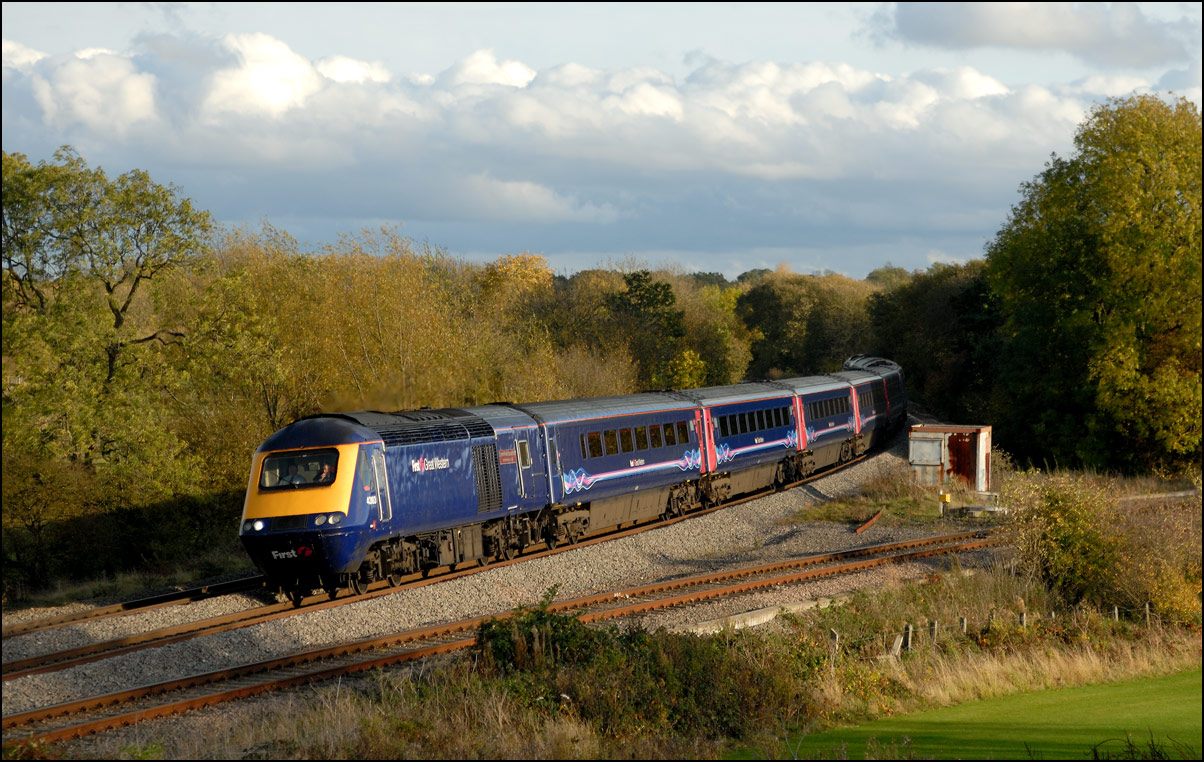 |
The afternoon of Sunday 30 October 2011 saw an unusual train at Hatton North Junction when a First Great Western HST set led by power car 43163 worked as 5E43 the 12.30 Old Oak Common to Ferme Park transfer, the set being hired by East Coast to fill a gap. Although the two depots are probably fewer than five miles apart as the crow flies HSTs are not permitted to work over certain London lines resulting in this move involving perhaps a couple of hundred of miles of travel. I had not previously seen a FGW train on this line, other than a pair of back-to-back power cars a few years ago so thought the trip worthwhile. The sun was behind thick cloud until 43163 passed Hatton North's favourite landmark, the rusty white shed, when it popped out. This meant a frantic effort on my part involving changing the zoom setting, focus and exposure in order to avoid having the leading power car and coach in shade whilst the rest of the set would have been in the sun. The shadow just in front of the train comes from a large nearby oak tree and the edge of the cloud was just in front of that. This explains to some degree the slight lack of sharpness evident in the picture. Running a few minutes ahead of 5E43 was the daily RHTT, formed on this occasion of DR98909. This is the first RHTT I have seen this year, as the other local lines are covered in the middle of the night. |
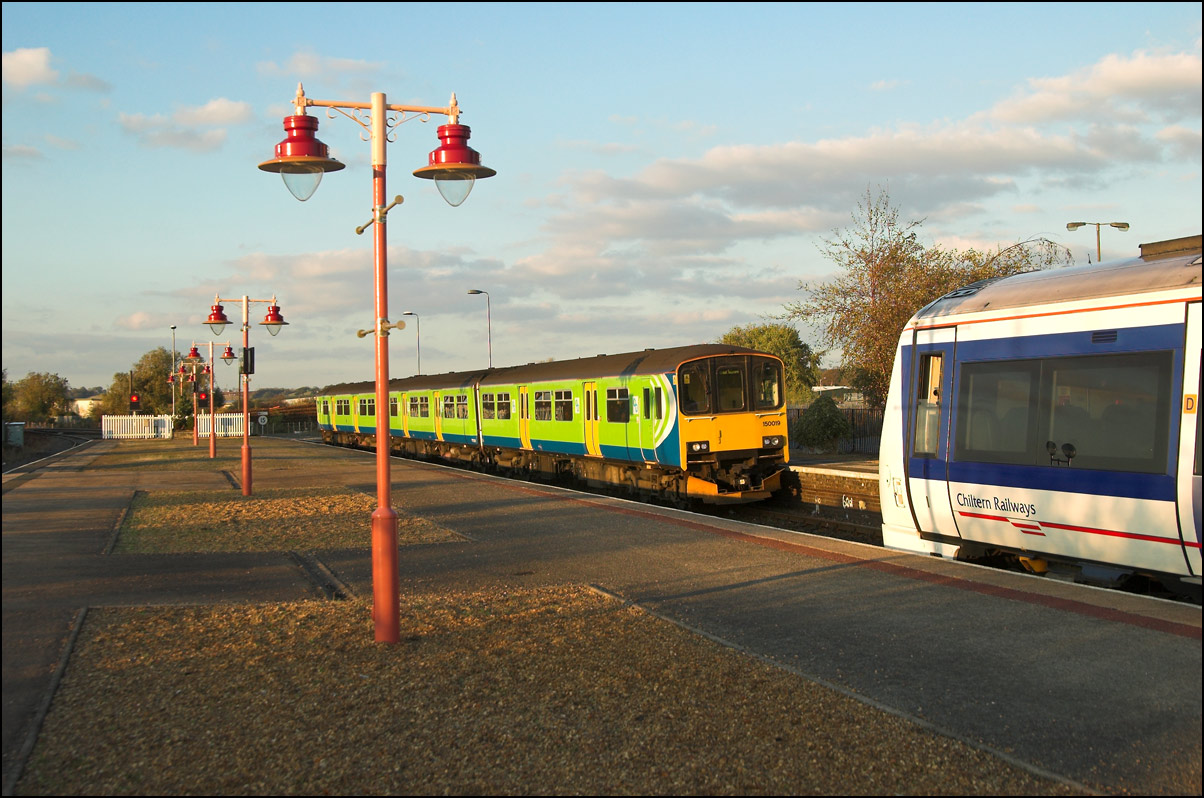 |
This picture shows 150019 arriving at Stratford-upon-Avon from Stourbridge Junction at 17.20 on Saturday 22 October 2011 whilst an unidentified (which means I couldn't be bothered to have a look at the number!) class 168 waiting to leave in twenty minutes or so for London Marylebone. I thought that it was worth recording this everyday scene because the class 150 DMUs won't be working around for much longer as new class 172s gradually come on stream giving North Warwickshire Line passengers some much needed relief from the grubby and uncomfortable older units. Incidentally, I suppose that some will be dubbing the 150s "Heritage Units" before much longer in the way that everything more than 10 years old on the railway now seems to be called that these days. |
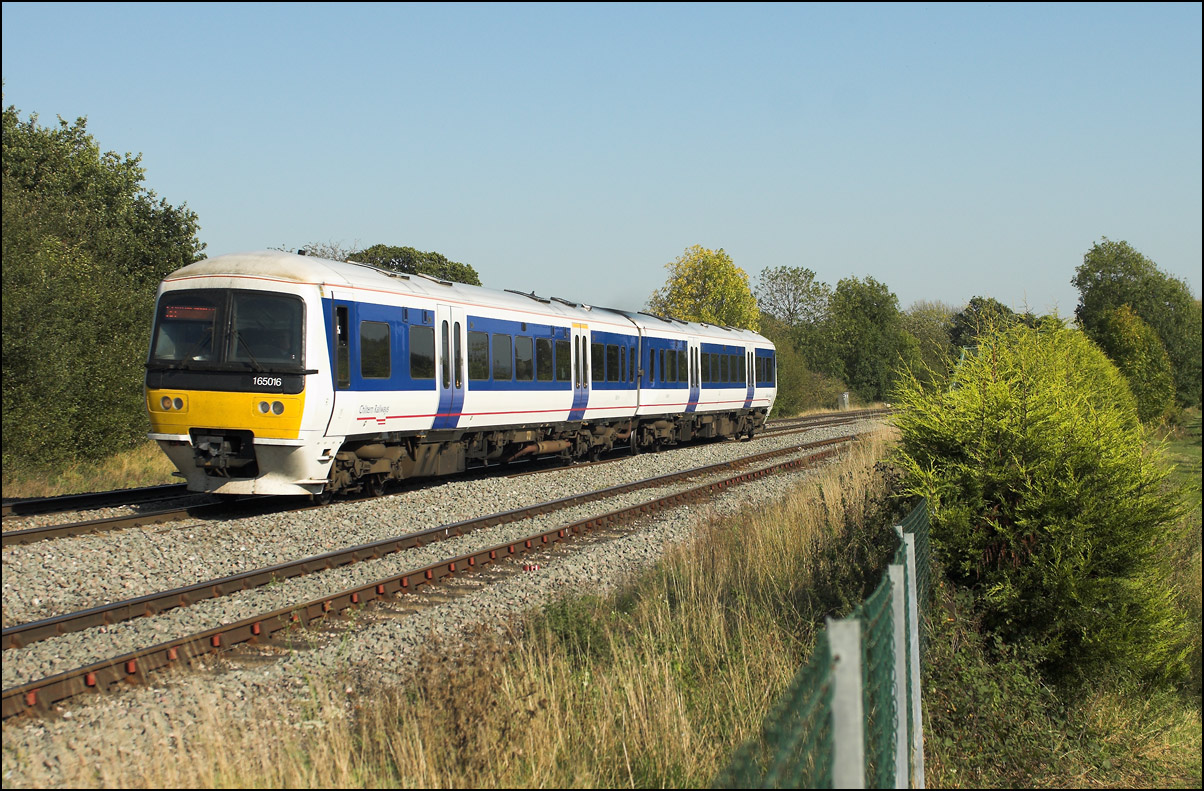 |
Most of the passenger trains on the GWR route from Leamington Spa to Birmingham are formed of Chiltern Railways' class 168 units but examples of class 165 do turn up, especially on the shuttles between Leamington and Stratford-upon-Avon. This unit, 165016, is heading for Stratford on 30 September 2011 and will have just received some adverse signals telling the driver that he is be turned off the down main line and into the branch platform at Hatton station. Arriva CrossCountry trains also use this route and here is 221132 on its way to Manchester. I was expecting a four coach unit, hence the back of the train being partly hidden in the adjacent undergrowth. |
 |
London Midland's new class 172 DMUs have been running from Stourbridge Junction to Stratford-upon-Avon for a couple of weeks so I thought it high time that I went out and took a shot or two when a sunny afternoon came along. The sky was reasonably clear at 14.45 on Friday 23 September 2011 so I drove over to Henley-in-Arden to photograph the 13.55 from Stourbridge. Just before the train was due a cloud blew across the sun and hung around as 172337 drew to a stop in the platform. Fortunately, it largely cleared just as the train moved away towards Stratford and although this shot isn't quite what I had planned the light was perfectly acceptable. |
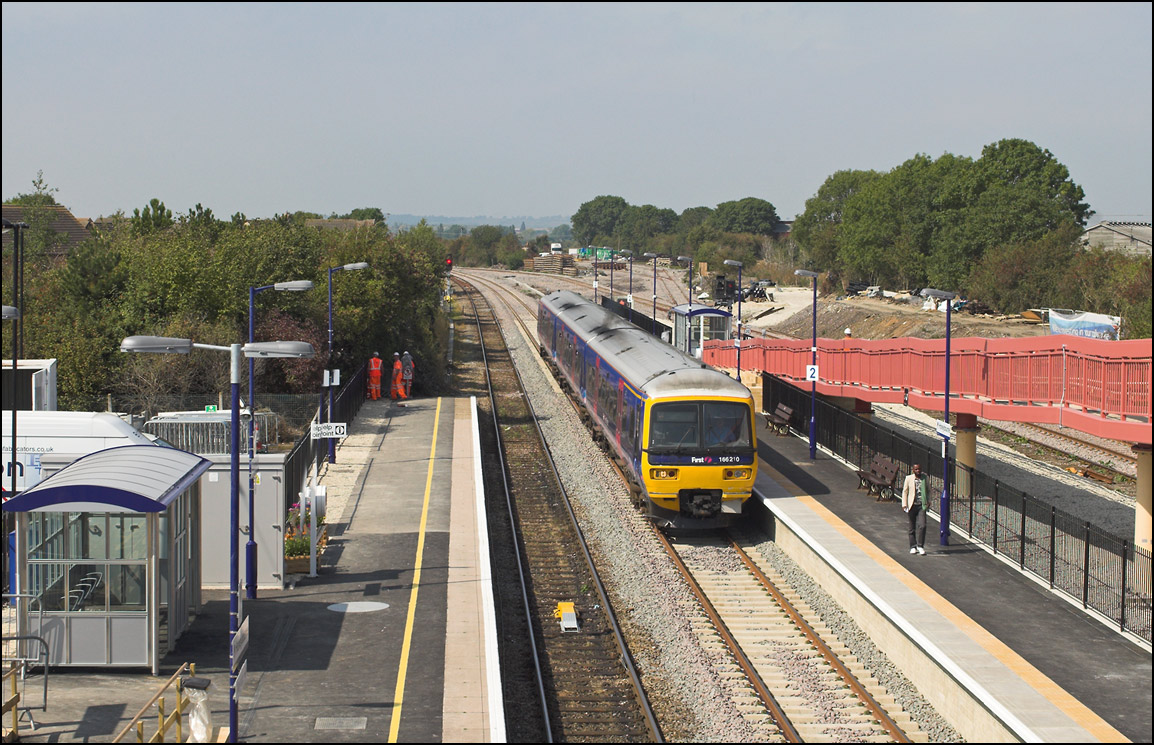 |
Honeybourne station has recently seen the most radical changes to its track layout since the North Cotswold Line was singled. A new up platform has been constructed along with, obviously, a newly relaid up line. I have been waiting for a decently sunny day to photograph a train using the new facilites since the platform opened on 22 August 2011 and an opportunity presented itself on Friday 2 September. Here is FGW's 166210 standing in platform 2 with a train bound for London Paddington while a single passenger makes his way to the new and very substantially built footbridge which has been designed both with steps and ramps to allow access by able bodied and disabled or infirm passengers. This picture isn't quite as sharp as I should have liked as, much to my embarrassment, there was a large set of greasy fingerprints on the lens filter which I must have touched at some point over the past few days. A gentle rub with a lens tissue sorted that out... |
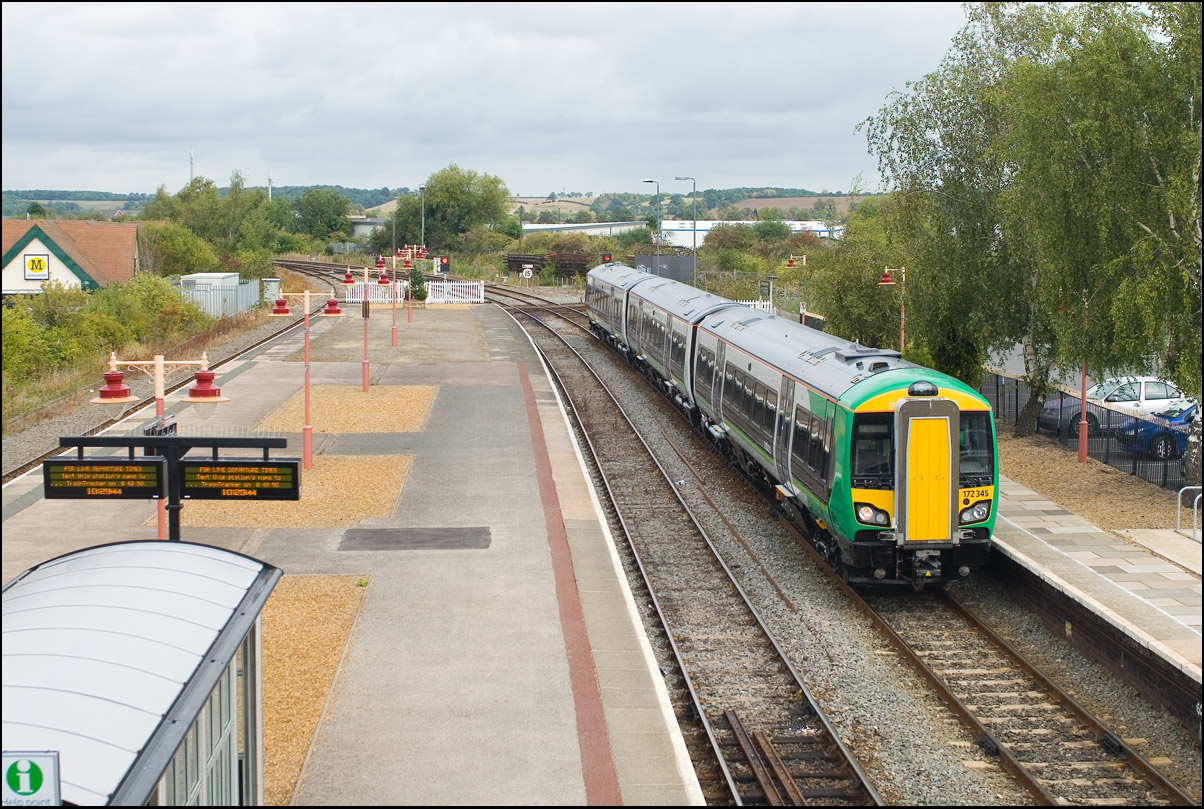 |
The first run of a class 172 DMU to Stratford-upon-Avon with passengers on board took place on Tuesday 30 August 2011 when London Midland gave its staff, friends and families the chance for a run from Birmingham Snow Hill before the new trains enter service from 5 September. Here is 172345 arriving at the terminus's platform 1 spot on time at 10.30 with the first run of the day which didn't seem to have generated a lot of enthusiasm amongst those eligible to travel; I doubt that there were more than a dozen or so passengers on board although there was a second run at lunchtime with a much longer layover at Stratford which may have been more interesting to potential passengers . The view from this footbridge has changed a little in the last twenty-odd years; here is a picture of a class 114 unit taken in 1990. |
_SonA_300811.jpg) |
The first passenger carrying class 172 to visit Stratford-upon-Avon had a break of around twenty minutes before returning to Birmingham Snow Hill. This gave the passengers the chance to visit the coffee shop and other facilities on the platform and for the crew to record the event. The driver of 172345 poses for a photograph beside his cab before returning north on 30 August 2011. There have been almost daily mileage accumulation runs of these units to Stratford for some time now and it is is good to be able to take a few photographs while they still are clean and shiny. My final picture of 172345 was taken as it left the station, passing the new London Midland station sign and running-in board. |
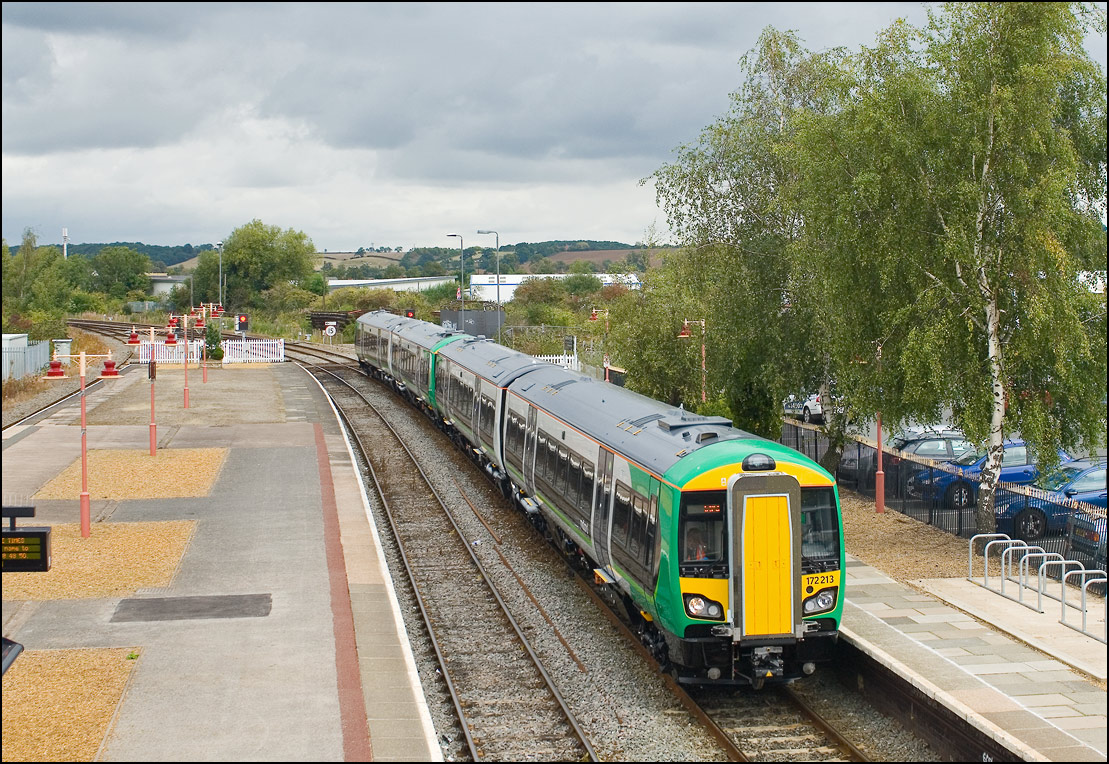 |
As I mentioned above, there have been many mileage accumulation runs of class 172 DMUs to Stratford-upon-Avon. Just after the first passenger carrying train had left the station two twin coach sets, 172211 + 172213, ran in on a such a duty. All the other units of the type that I have seen have been three coach sets and having differing capacities will enhance the flexibility of the type in commuter and outer suburban use as they can be couple into various formations. This train stayed in platform 1 for about fifteen minutes and is seen again just prior to departure along the North Warwickshire Line to Tyseley. |
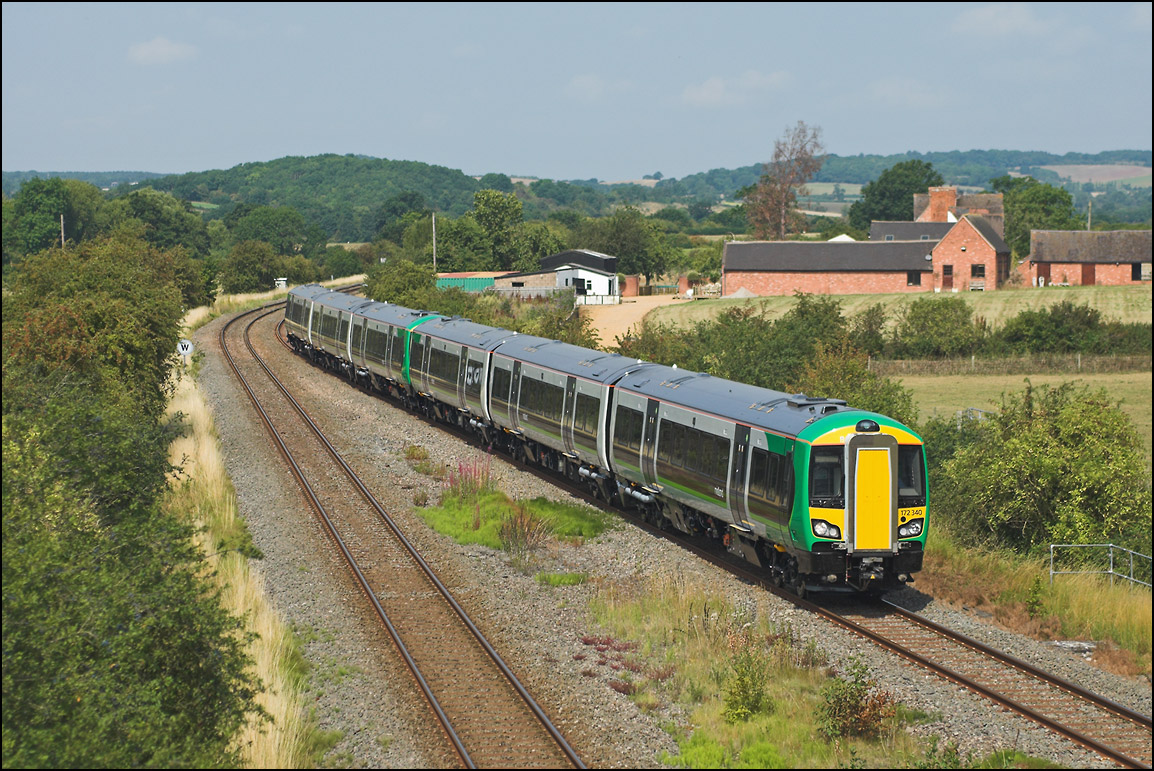 |
I was just about to make a pot of coffee at around 10.15 on 3 August 2011 when I received a text message from a friend in the Birminhgam area saying that a pair of class 172 DMUs were heading towards Stratford-upon-Avon on a mileage accumuculation run. I hadn't taken many photographs of these new units in the sun so as the weather looked good I made the short journey to Edstone aqueduct. The train appeared about at the time expected formed of 172340 + 172339, both units now fitted with their seats. The new trains were introduced to the press a day or two earlier and I imagine that they made a better impression than the class 150s widely used in the area at the moment. |
 |
The last day of June 2011 was notable in railway terms for the running of a charter train from Stratford-upon-Avon to Edinburgh. Inward charters are relatively frequent but it is unusual for one to commence at the terminus and even with a departure time of before 06.00 I was keen to obtain a photograph if the weather was half decent. It was more than half decent so I drove to Wilmcote and then had a very pleasant fifteen minute walk along the canal towing path to a foot crossing over the railway about half way to Bearley Junction. First along was a pair of Chiltern Railways units, led by 168005, heading for Stratford. I can't remember whether this runs as an advertised service or ECS but I do know that it is the only scheduled train that runs from Birminhgam via Hatton North and West Junctions and is here seen accelerating away from Bearley Junction. |
 |
Chiltern Railways are planning to operate some of their inner suburban services with new class 172/1 multiple units. In connection with this, 172104 ran from Derby to Marylebone (via St Albans) and back on Monday 16 May 2010. The train, 5Z74, the front end of which bears more than a passing resemblance to one of the company's class 168 units, is here seen climbing Hatton Bank spot on time and no more than a minute or so before the rapidly increasing cloud cover became a nuisance. |
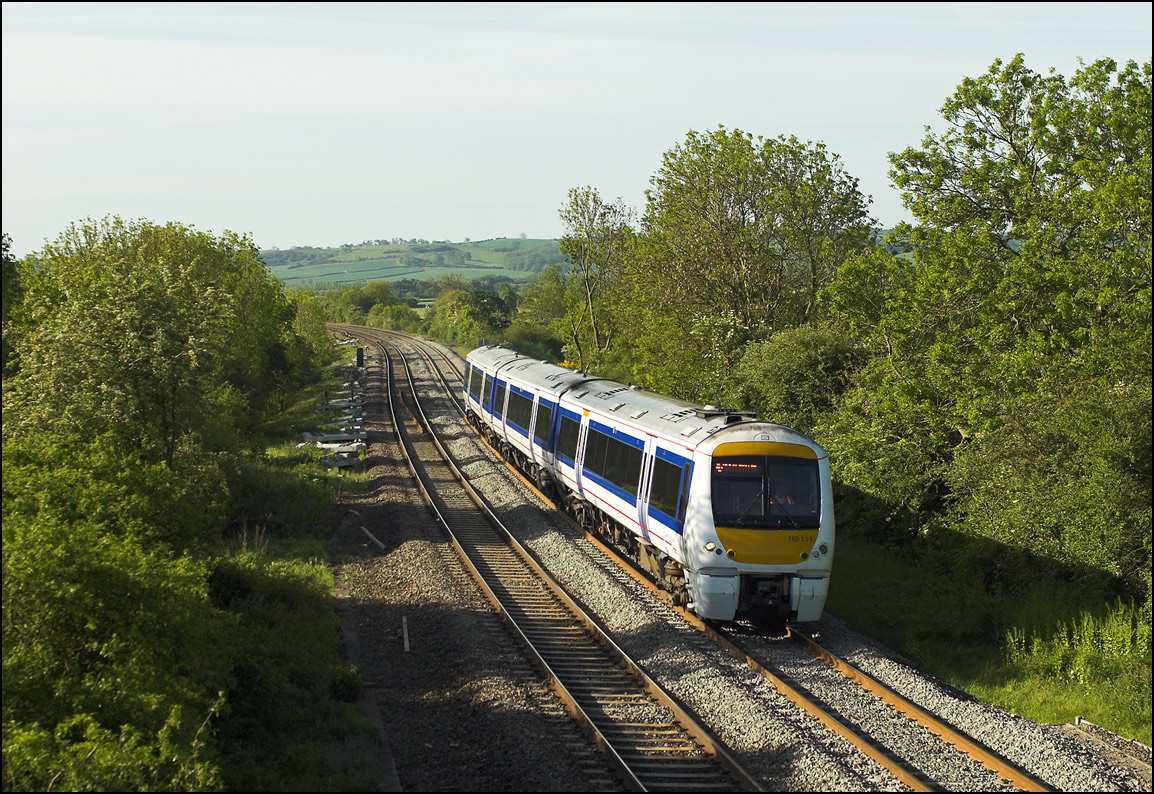 |
The view looking south from the occupation bridge at Knightcote towards Fenny Compton is seen much less frequently than that from the other side, probably because the sun is "off the front", as some say, not much after 08.30 in the morning. To redress the balance a little here is Chilern Railways' 168111 heading north towards Leamington Spa with a Marylebone to Birmingham service on the morning of Friday 13 May 2011. The train to Kineton COD, 6M19, obviously followed the DMU as it was audible, althougb hidden by the background trees, as it ran along the branch towards its destination. |
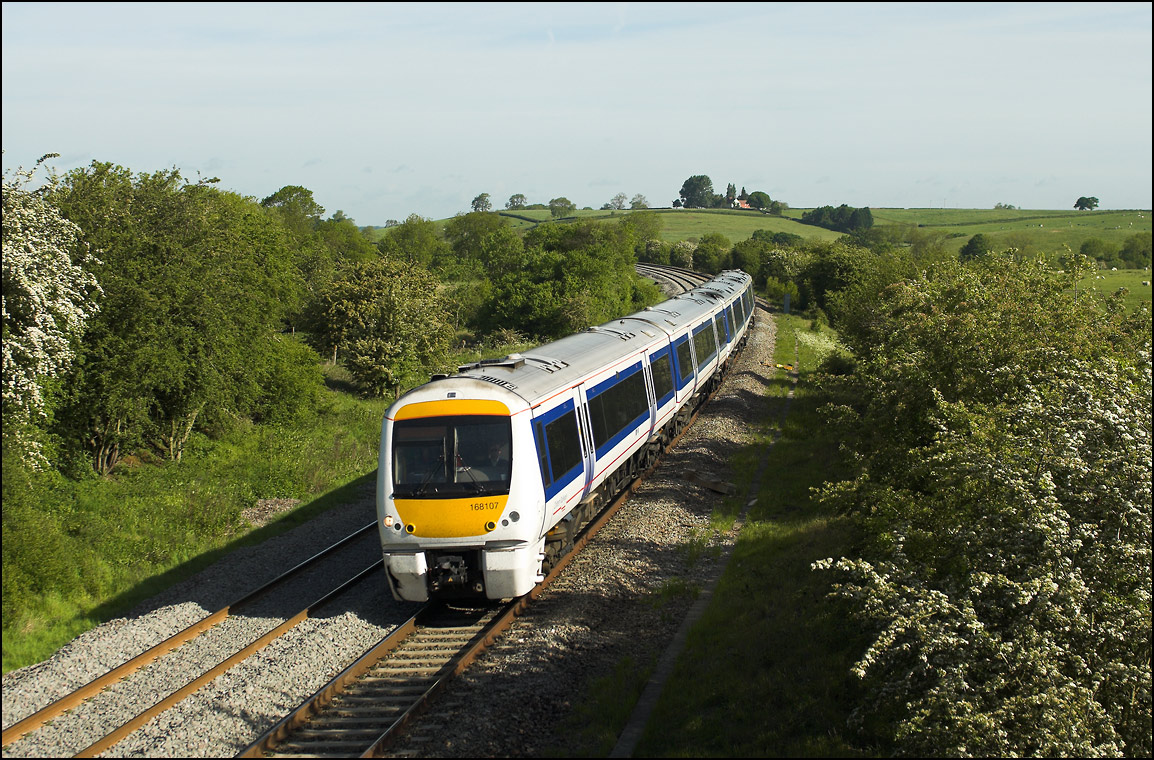 |
By the time that 168107 came south from Birminhgam towards Fenny Compton on 13 May 2011, the shadows across the track had virtually cleared with just a few vestiges left on the wheels of the DMU. This is a very pleasant rural location with little noise other than a distant rumble from the M40 if the wind is in the wrong direction. It's not the sort of place I tend to visit very often because it is a little anonymous but now and again it does make for a nice change, especially for up trains, in the earlier part of the morning. |
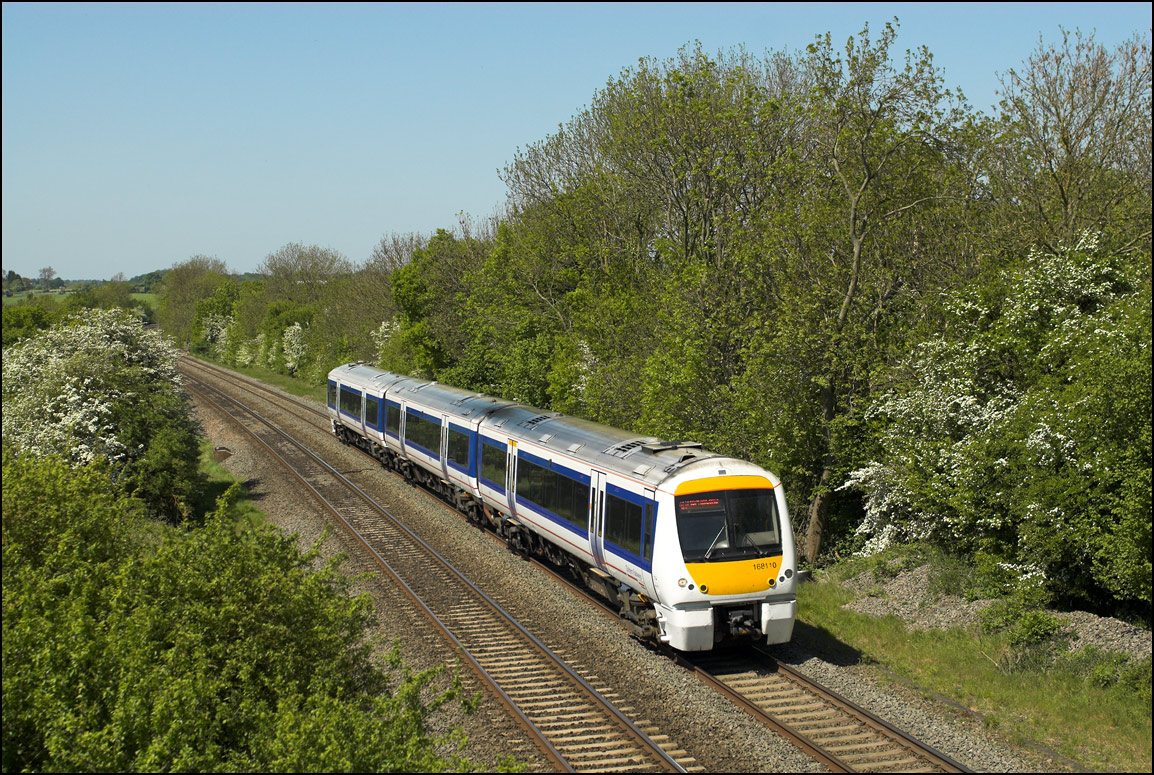 |
The spell of warm and sunny weather continued on 3 May 2011 so, with a few freights scheduled to appear on the GWR Birmingham to Leamington Spa line, I went to a location just north of Hatton North Junction. It's a pleasant spot which rarely sees any other people unless a kettle is around but I still don't visit it very often as it doesn't have enough identity for my taste. Still, on a sunny day it makes for an attractive picture and first along was Chiltern Railway's 168110 heading towards Leamington Spa and London Marylebone. I quite like these units and their predominantly white colour scheme shows up well against almost any background, snow excepted. |
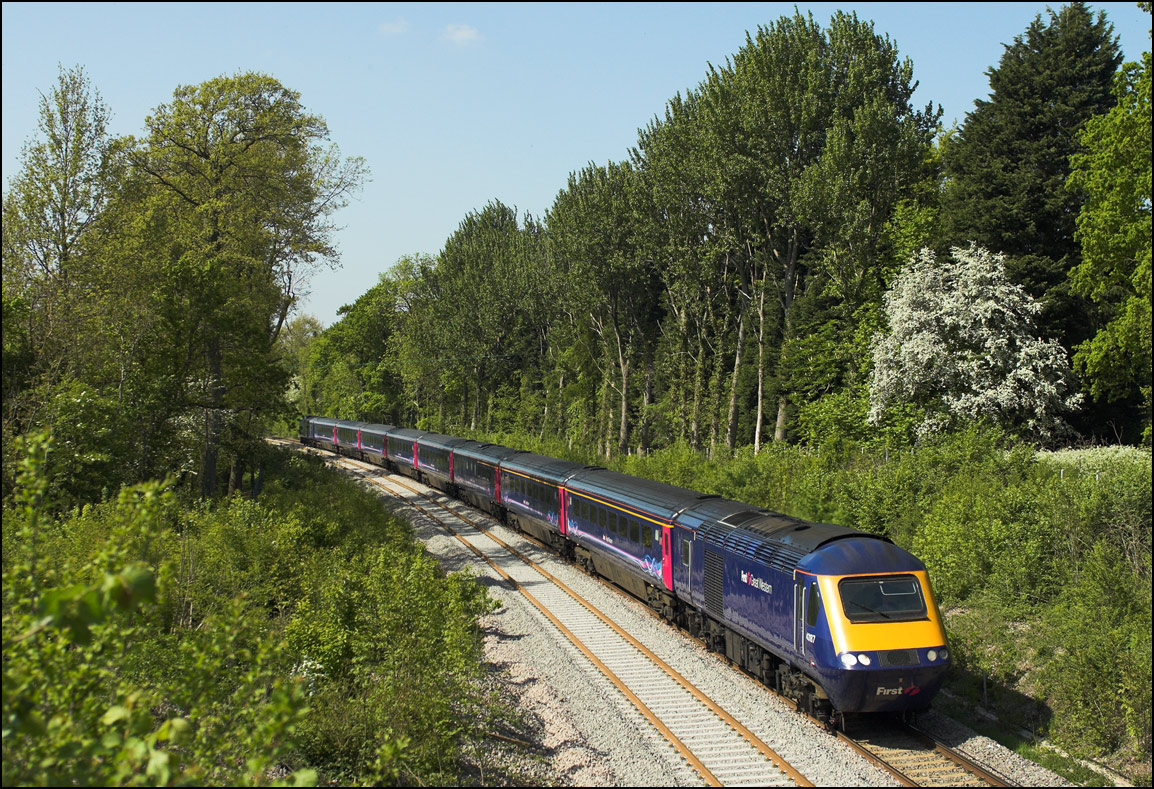 |
Before going home on 27 April 2011 after photographing 31602 I decided to wait for a few minutes so as to photograph a FGW HST climbing away from Honeybourne and up towards Moreton-in-Marsh. In the fairly still Spring air the train, led by power car 43187 was audible for some time, although not quite as loud as a GWR Castle would have been some 40 years ago! The newly laid down track is now in place although not yet in use and the recently cleared undergrowth to the left of the train is growing up again at quite a rate. I don't imagine that it will be long before the up photograph is once again obscured as it was for many years before the recent work took place. |
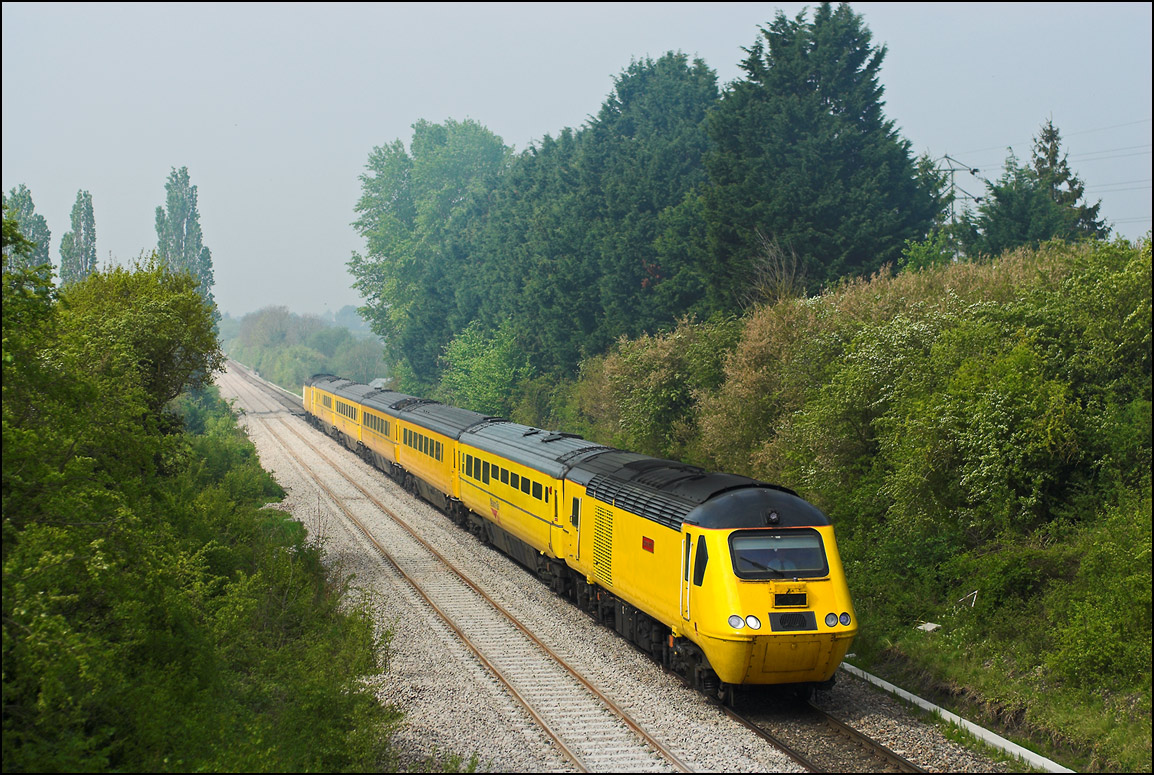 |
The New Measurement Train did a return run over the North Cotswold Line on Thursday 21 April 2011. Running as 1Z15 09.00 Derby to Derby via Oxford the train, topped and tailed by power cars 43013 + 43062, is here seen a few minutes after leaving Evesham and just before crossing the Blackminster Road level crossing. The newly laid but still uncommissioned down track with its clean new ballast is in the foreground of the picture and the misty background is partly the result of the high pressure weather system over the most of the country and partly because a smallholder had just lit a bonfire in an adjacent field. The new track has been laid on both sides of the crossing behind the camera but the major work needed to put it across the road itself has still to be done, as can just be made out in this photograph of FGW 166219 heading towards Evesham, Worcester Foregate Street and Great Malvern. |
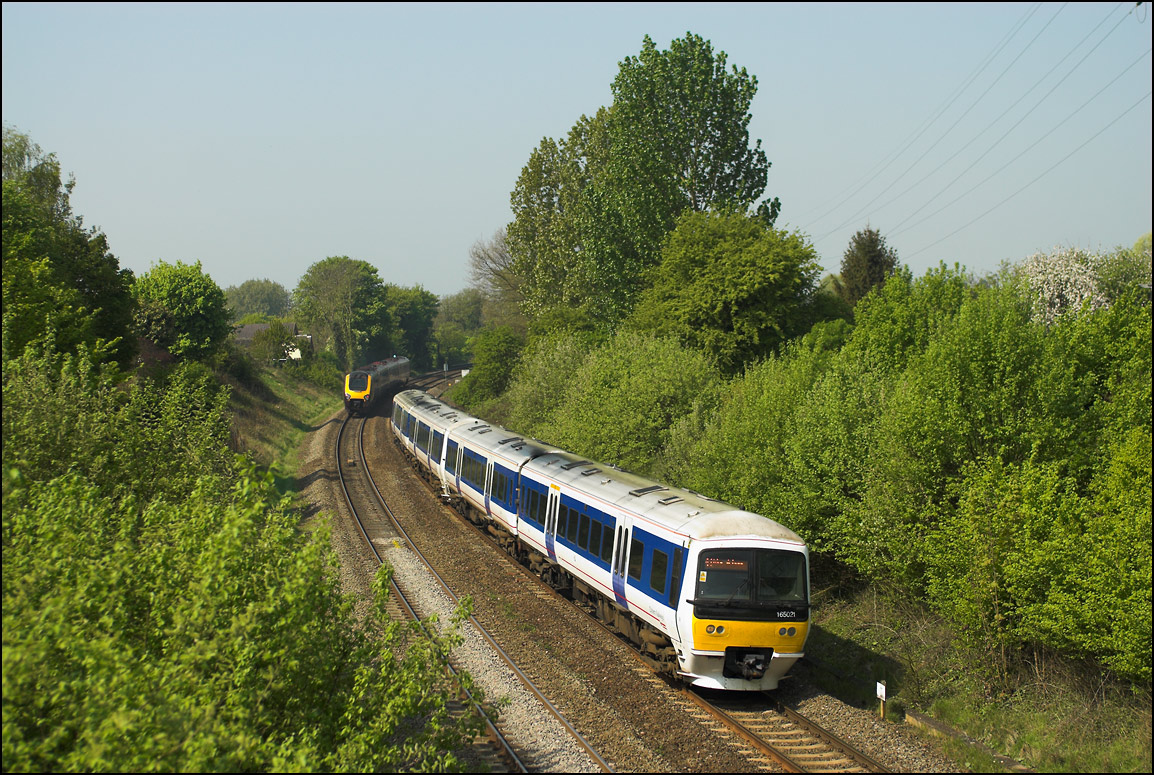 |
The GWR line between Birmingham and Leamington Spa sees regular passenger traffic from both Chiltern Railways and Arriva CrossCountry. An example of each is seen in this picture taken near Wawick on 19 April 2011 as 165021 heads towards Leamington with a Moor Street to London Marylebone service and a Voyager heads north with a Reading to Manchester train. The trees on the left are a bit intrusive but I have been to my usual haunts around Hatton far too often recently so thought that a change was about due. |
 |
The Network Rail New Measurement Train runs along the Birmingham to Leamington Spa quite regularly but a southbound run in the early afternoon is unusual so I took the chance on 23 March 2011 to try for a well lit photograph at hatton North Junction. The train, 1Q16 from Derby to Old Oak Common, was led by a newly repainted power car which was yet to receive any branding or, I think, numbers. There are many lineside trees at this location and it is difficult to avoid a picture with shadows over part of the train but I still think that this is an atractive spot with refreshingly few passers-by enquiring if a steam train is coming... |
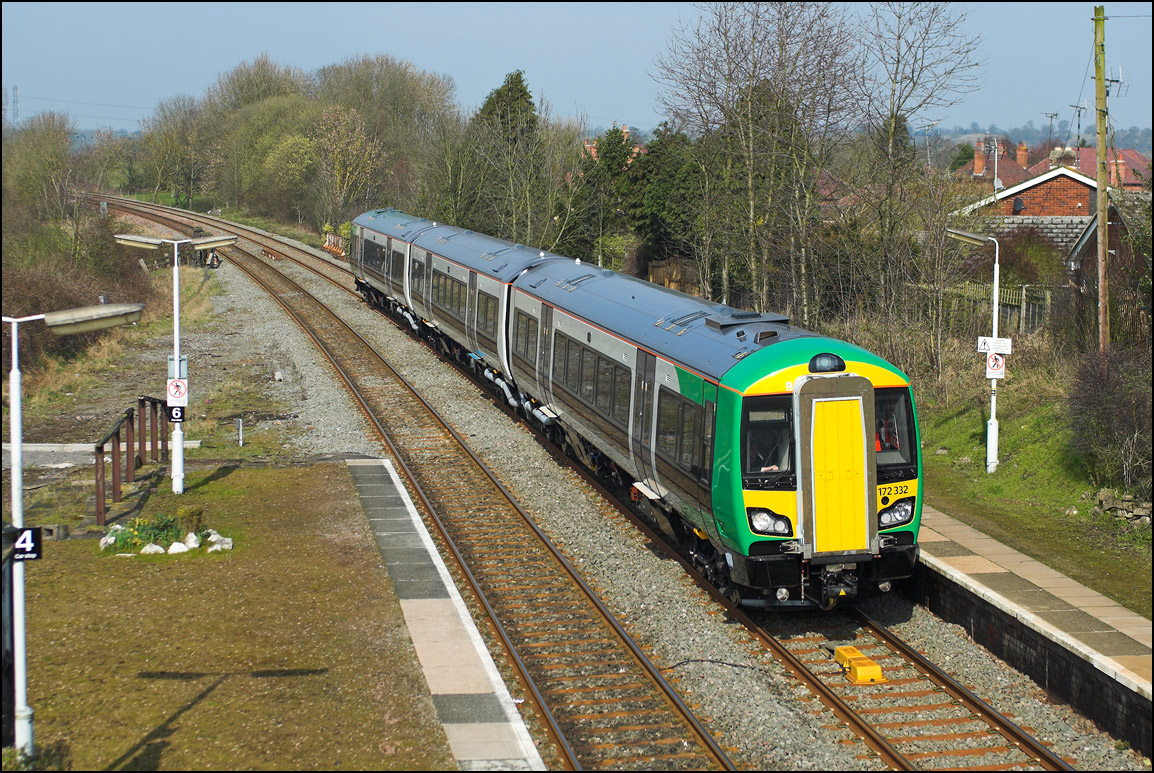 |
The class 172 mileage accumulation runs continued on 16 and 17 March 2011 with 172332 working with GBRf crews between Tyseley and Stratford-upon-Avon. The sky began to clear at lunchtime on 17 March so I thought that a sunny shot of the new unit might be possible, unlike the one that I had taken earlier in the day at Edstone, just north of Bearley Junction when the preceding class 150 was in perfect light but the 172 managed to come in a thick bank of low cloud blowing in from the west. My afternoon shot was at Henley-in-Arden where the sun was perhaps a little too straight at that time but just about about acceptable, especially when compared with my earlier efforts. |
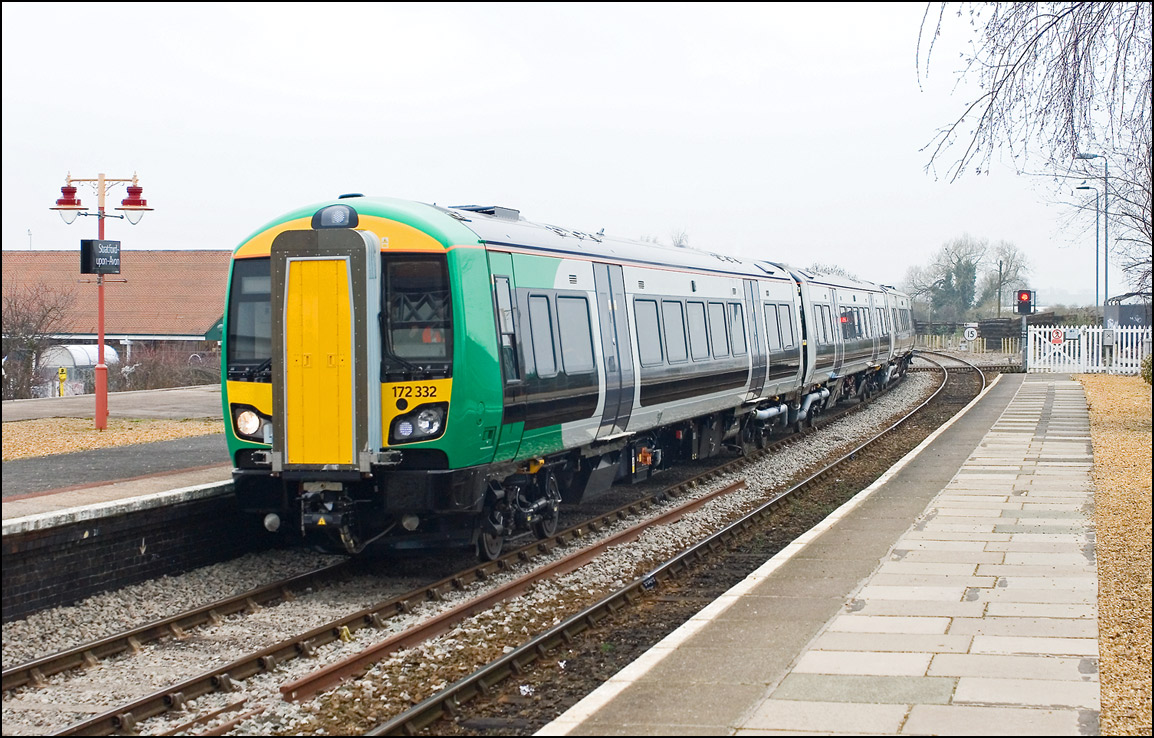 |
London Midland, who operate the suburban railway services throughout the West Midlands, are soon to replace their ageing and increasingly decrepit class 150 DMUs with new class 172/3 units. One of these, 172332 visited Stratford-upon-Avon for, I think, the first time on 15 March 2011 on a mileage accumulation and test run. The train is here seen arriving into platform 2 at Stratford as the usual arrival platform for trains from Birmingham, No.1, was under possession by a gang carrying out refurbishment work on the canopy. It is only within the past few months that train have been able to run directly into platforms 2 and 3, the required work having been carried out when the resignalling of the whole line took place late in 2010. It's a pity that the sun wasn't out at the time because it would have been in the perfect place for this move. |
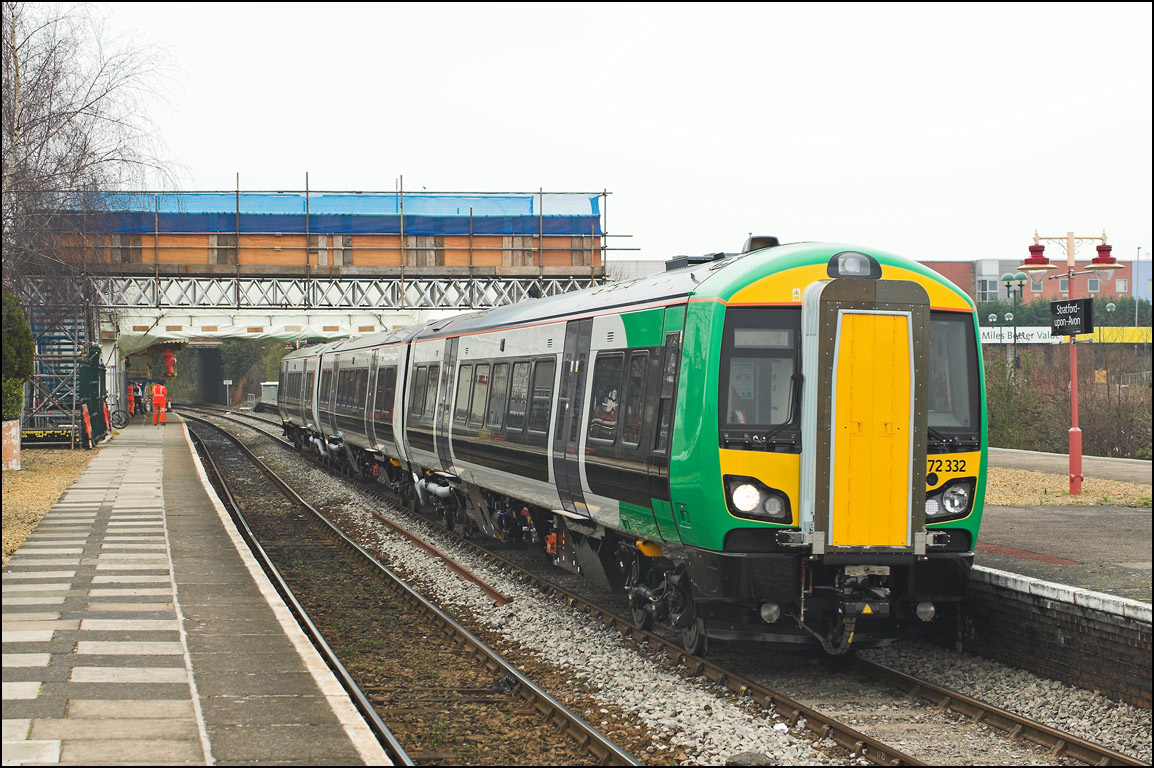 |
There was a turnround time of about ten minutes at Stratford-upon-Avon for 172332 before it retraced its tracks over the North Warwickshire Line to Tyseley, the main London Midland depot for the area. Here it is leaving the terminus with evidence of the work being carried out to the platform canopy and GWR footbridge, the latter having required the construction of a temporary footbridge so that passengers can access platforms 2 and 3. The corridor connection to be used when units are coupled will make revenue protection easier for the on-train staff and will generally increase the flexibility of the trains when compared to the existing class 150 DMUs. |
 |
Once 172332, as shown in the two pictures above, had returned to Tyseley on 15 March 2011 it was sent on another trip to Stratford-upon-Avon. The new unit is here seen passing Wilmcote station with its distinctive GWR footbridge and buildings before dropping down the 1/75 of Wilmcote Bank before having to wait outside the terminus for the 13.27 from Stratford to Stourbridge Junction to clear the crossover. The return of 172332 happened in an unfortunate patch of bright sunshine; unfortunate because at this time of day it is in exactly the wrong place for photography so I didn't bother with another picture. |
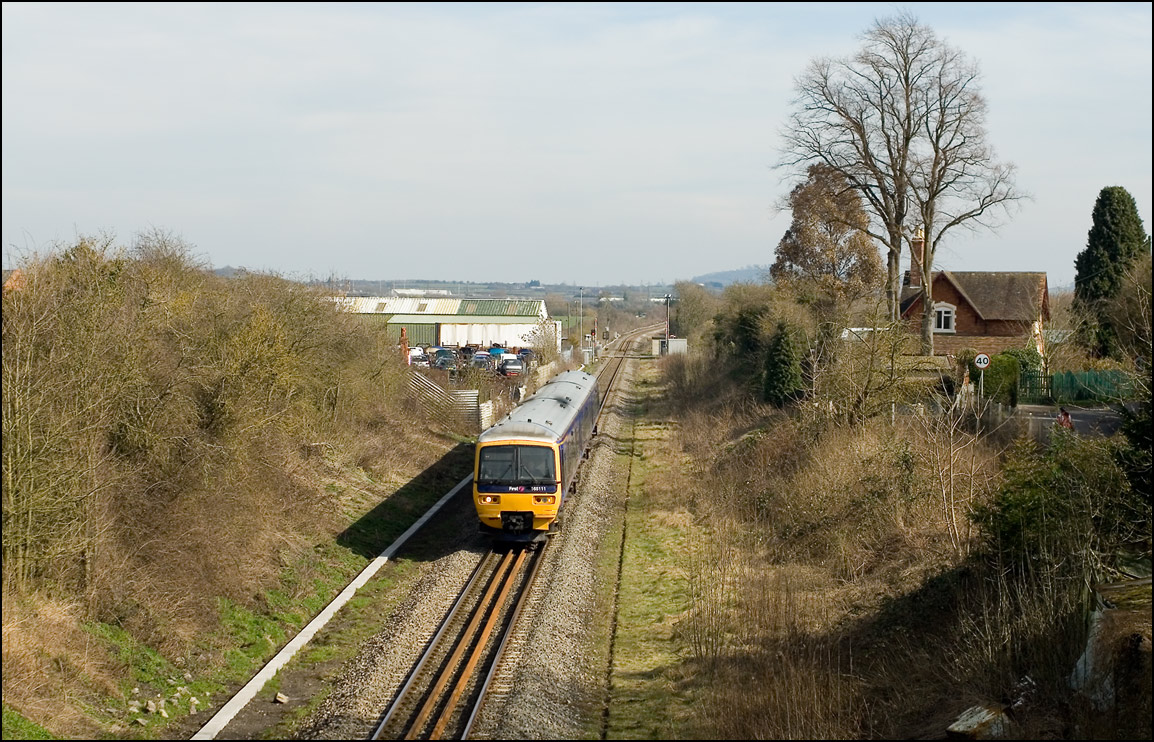 |
The Cotswold Line, between Oxford and Worcester, is currently undergoing a lot of change as much of the single track is replaced with double in order to improve timekeeping. The secton of line between Moreton-in-Marsh and Evesham is due to be doubled although there is, is mid-March 2011, little sign of much happening; the work currently being concentrated on the more southerly area, south of Moreton. One of the level crossings that will have to be adapted for double track is that at Littleton and Badsey, visible in the background of this photograph taken on 14 March 2011 as 165111 heads towards Evesham, Worcester and Great Malvern. The GWR station here was on the far side of the Blackminster Road, although a goods yard was situated where the scrapyard dealing with defunct cars is now to be found. |
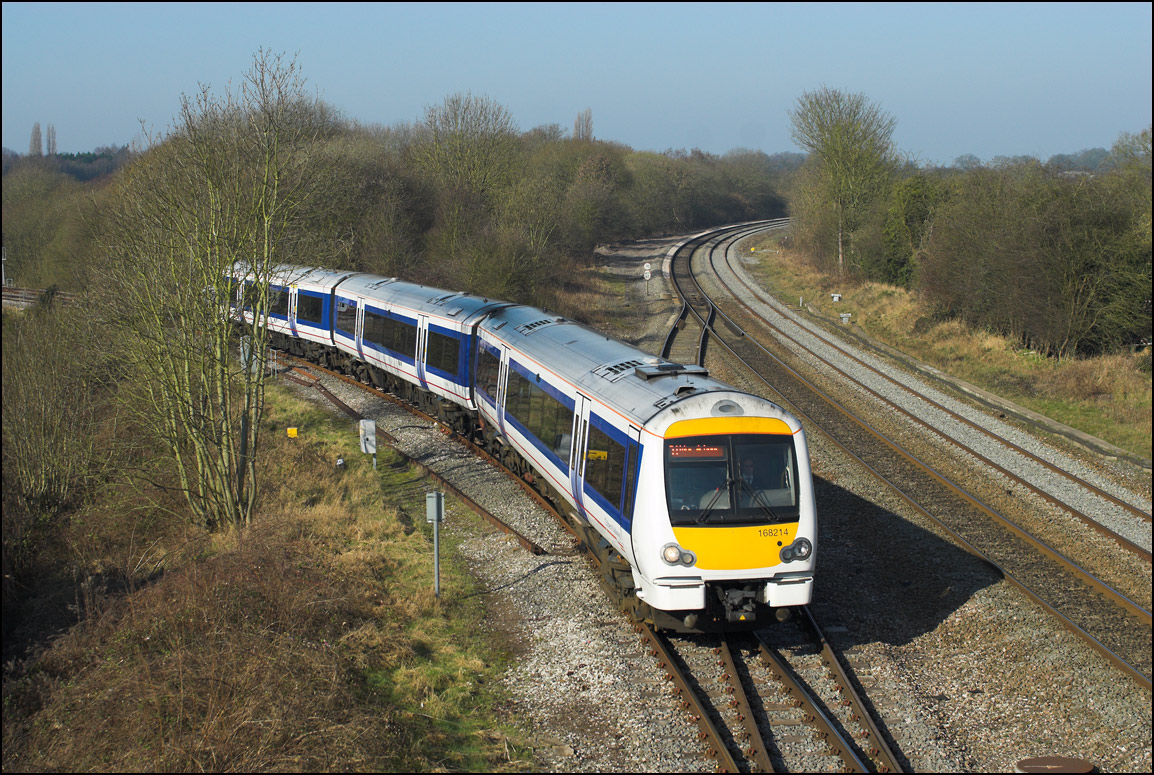 |
Tuesday 8 March 2011 was the second sunny day in a row for which I was free to take whatever photographs took my fancy. I knew that Chiltern Railways were running crew familiarisation trains using 67013, a five coach and DVT with the first run, 5Z50, scheduled to leave Birmingham Moor Street at 09.43. As the sun would be in just the right spot at Hatton Station Junction at about 10.20 I went there, arriving just in time to take this shot of 168214 leaving the Stratford-upon-Avon branch as the 09.35 from the terminus to London Marylebone. Much as I like seeing trees around the countryside I do wish that Network Rail would decide that the one doing its best to hide the third coach were too close to the line and remove it. |
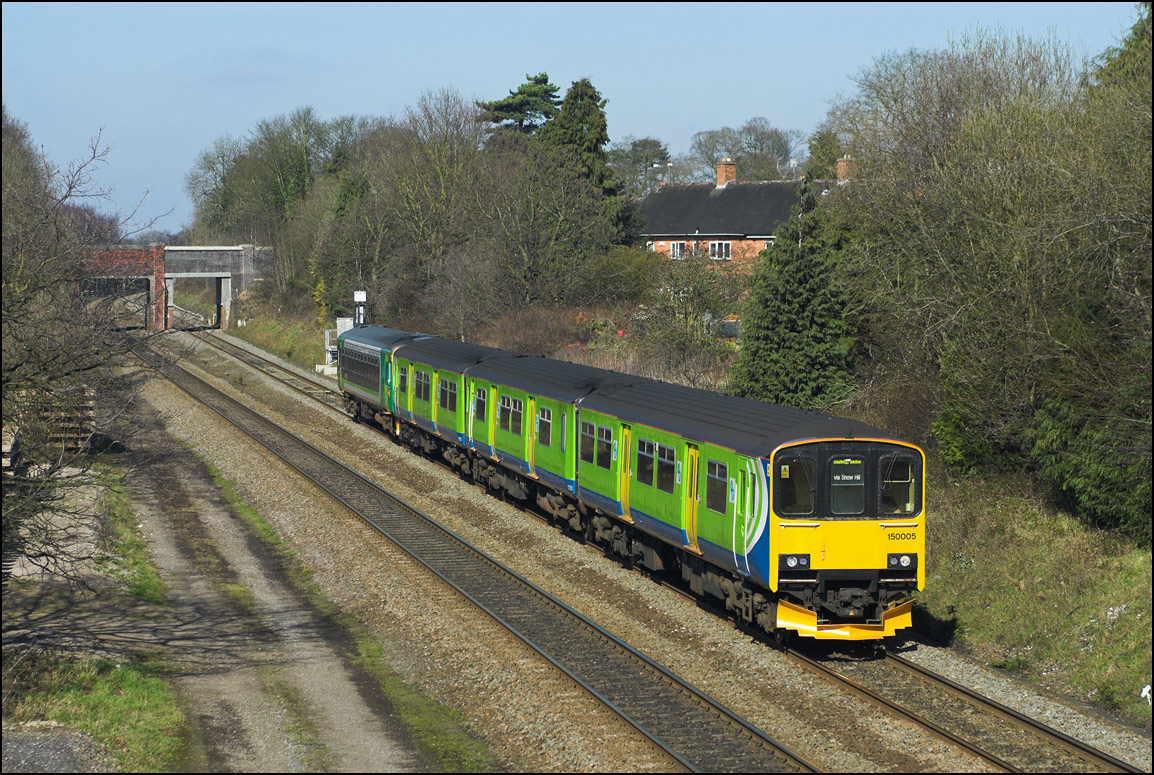 |
The weather forecast for Monday 7 March 2011 was for blue skies and unbroken sunshine in the area south of Birmingham. With this in mind I went to Bentley Heath crossing, just north of Dorridge station, with the intention of taking whatever came along. I no longer go out for ordinary or scheduled traffic such as Freightlineers if the conditions aren't close to perfect as I won't achieve anything that I haven't bettered on a previous occasion. However, when the light is as good as it was on this day I will happily take anything and just as I arrived on the footbridge 150005 with 153325 tagged on the back came south forming a train due to terminate at Dorridge. These DMUs won't be around for ever as London Midland are due to take on a fleet of much more comfortable class 172/3 units so it does no harm to have a few record shots in the bag. The light was still a little too straight but the inclusion of the 153 in the formation made the shot worthwhile. |
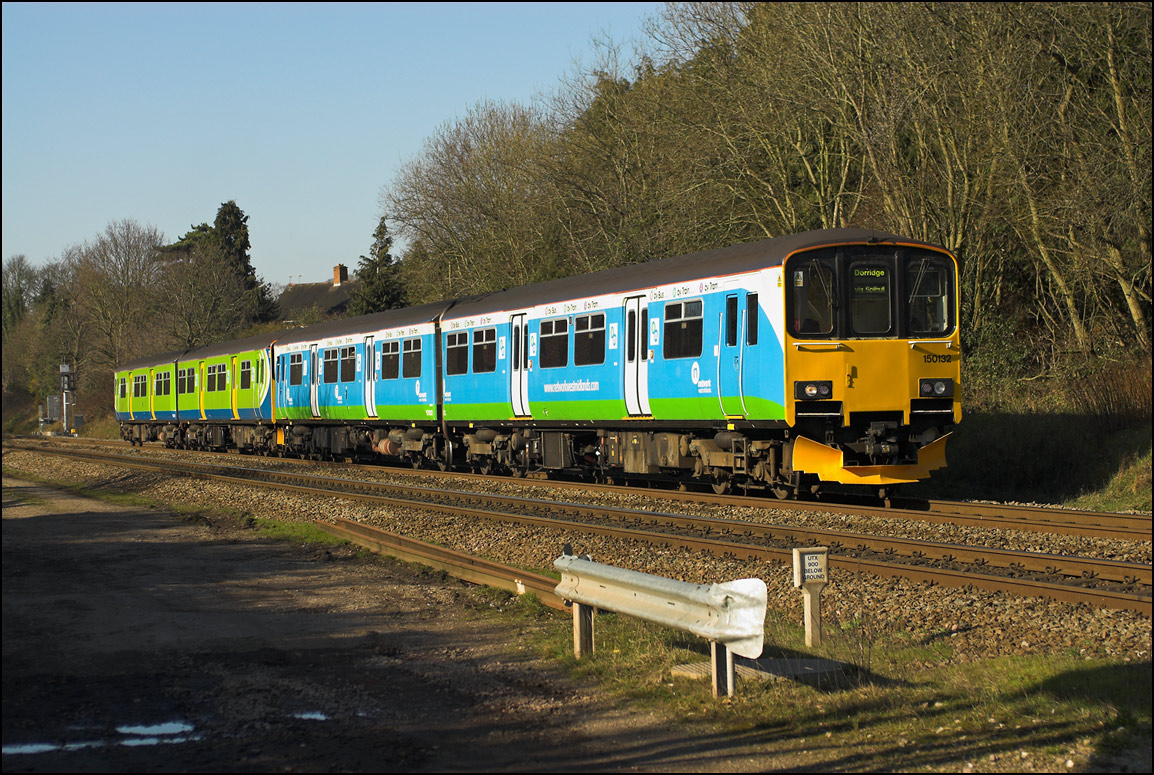 |
The local trains to be found on the Brimingham Snow Hill to Dorridge line aften give the chance to photograph some colourful combinations, none more so than this blue and green medley, with 150132 leading, on the approach to the crossover giving access to the local platform at Dorridge station on 7 March 2011. I'm generally not much of a fan of ground level shots but I do quite like the picture here, taken from the fence alongside the road as the train passes under the footbridge from which the previous photograph was taken. |
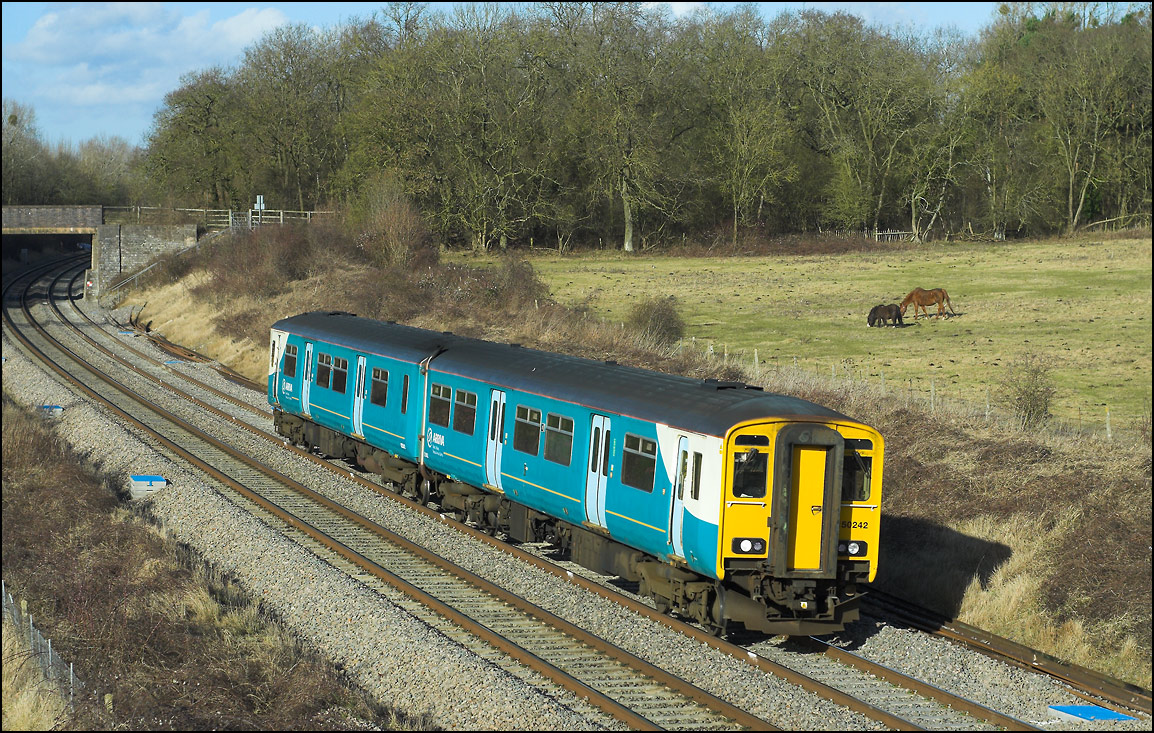 |
First Great Western are currently hiring an Arriva class 150 on a day-by-day basis to cover one of their diagrams to Great Malvern. Here is 150242 passing Croome Perry at about 13.15 on 3 February 2011 with a train from Malvern heading south. I'm always happy to photograph DMUs especially when an example in an unusual colour scheme for the area. The blue grids covering the lineside drains are a bit of a distraction here but at least, in this photograph, they nearly match the train's colour. |
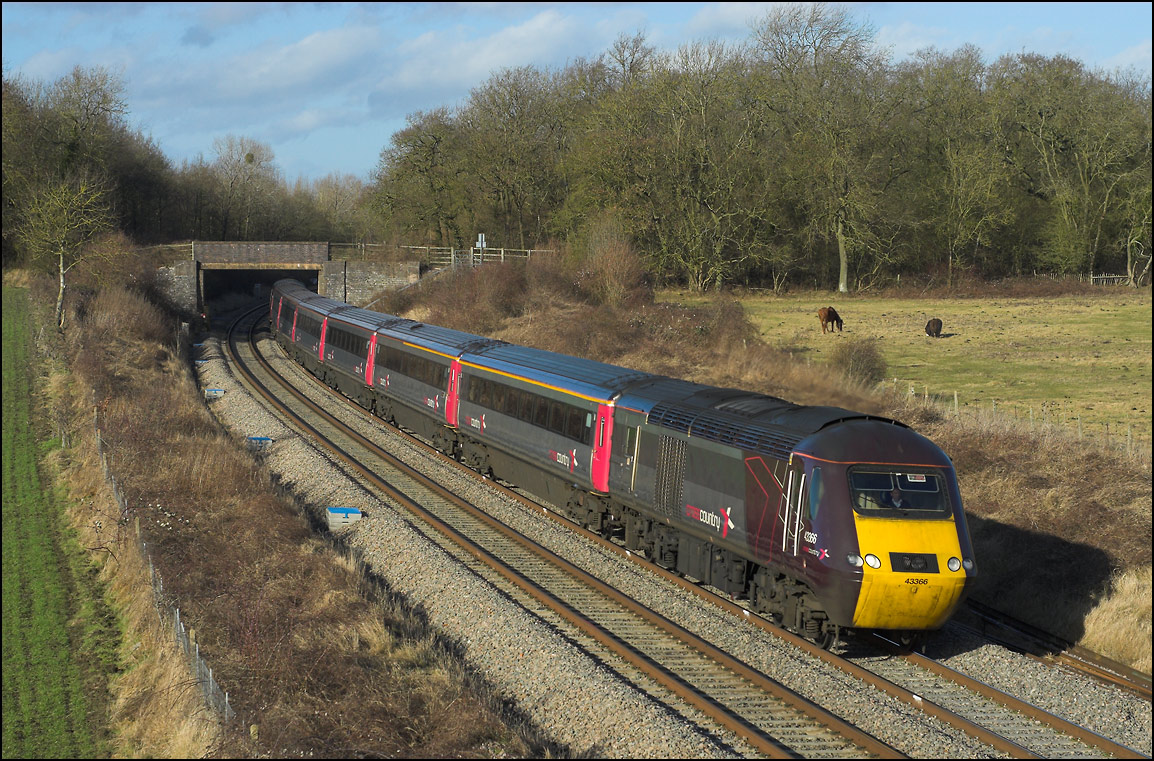 |
Arriva CrossCountry's HSTs still make welcome appearances on the NE - SW corridor, providing decent accomodation for passengers in stark contrast to their Voyager fleet with their noisy, cramped, vibrating environment and poorly positioned seating. On 3 February 2011 power car 43366 led the 06.32 Dundee to Plymouth service, 1V39, through Croome Perry wood a couple fo miles south of Abbotswood Junction. This was the second such train I photographed during my short session here but the earlier one was not as well lit as this which ran about ninety minutes earlier when the sun's direction was less favourable. |
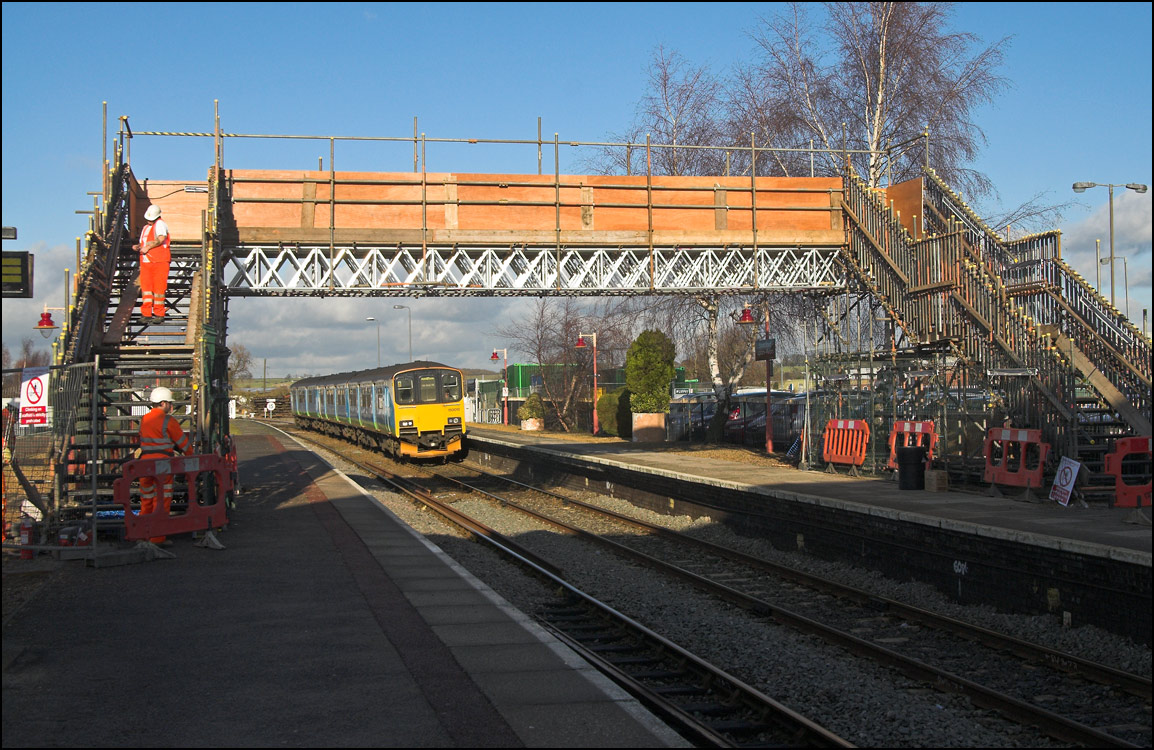 |
Following work to renew the station roof at Stratford-upon-Avon, attention has now switched to refurbishing the Great Western footbridge. So that this can be carried out without closing platforms 2 & 3, a temporary footbridge is in the process of being installed. On 18 January 2010 I wandered down for a look and arrived just in time to photograph the arrival of 150010 as it was about to pass under the new bridge which was having the final touches applied. |
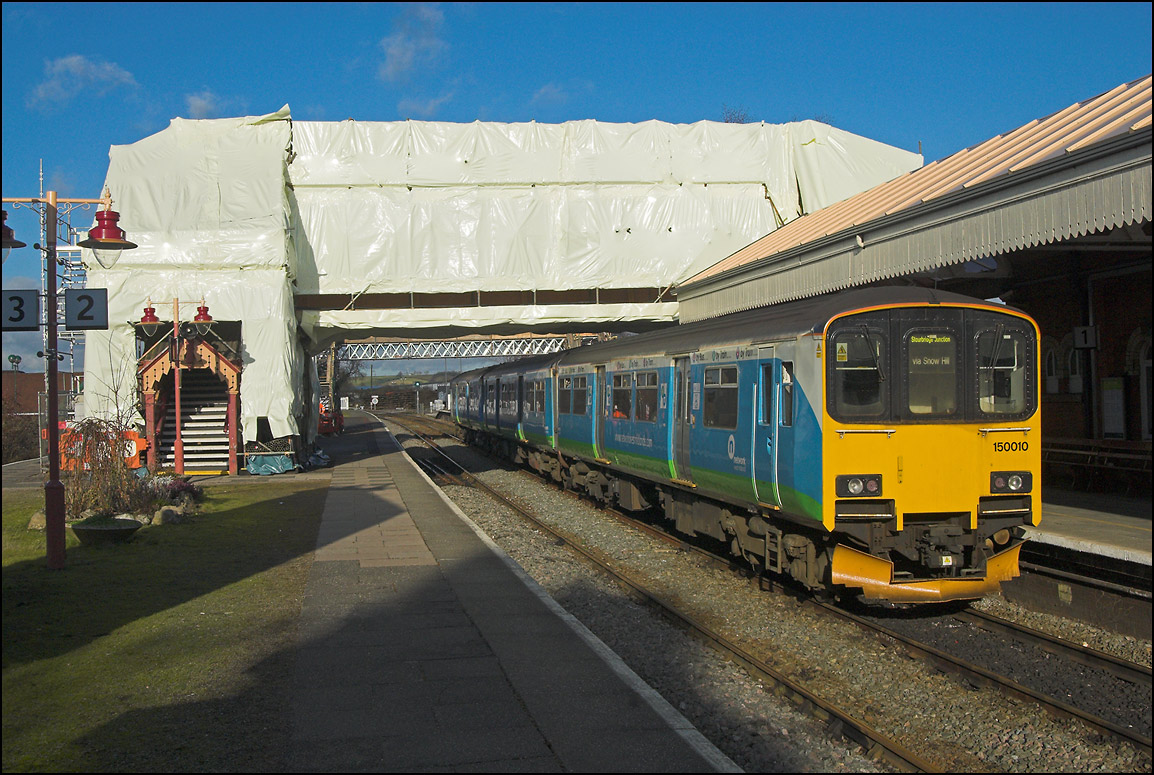 |
The original Great Western bridge, whilst still in use on 18 January 2010, was shrouded in plastic sheeting ready for, presumably, the metalwork to be shot-blasted before repainting. It isn't hard to see that the woodwork will need quite a bit of remedial work as much of it, particularly at ground level, has become quite rotten. Here, 150010 is leaving the station as the 13.27 to Stourbridge Junction. |
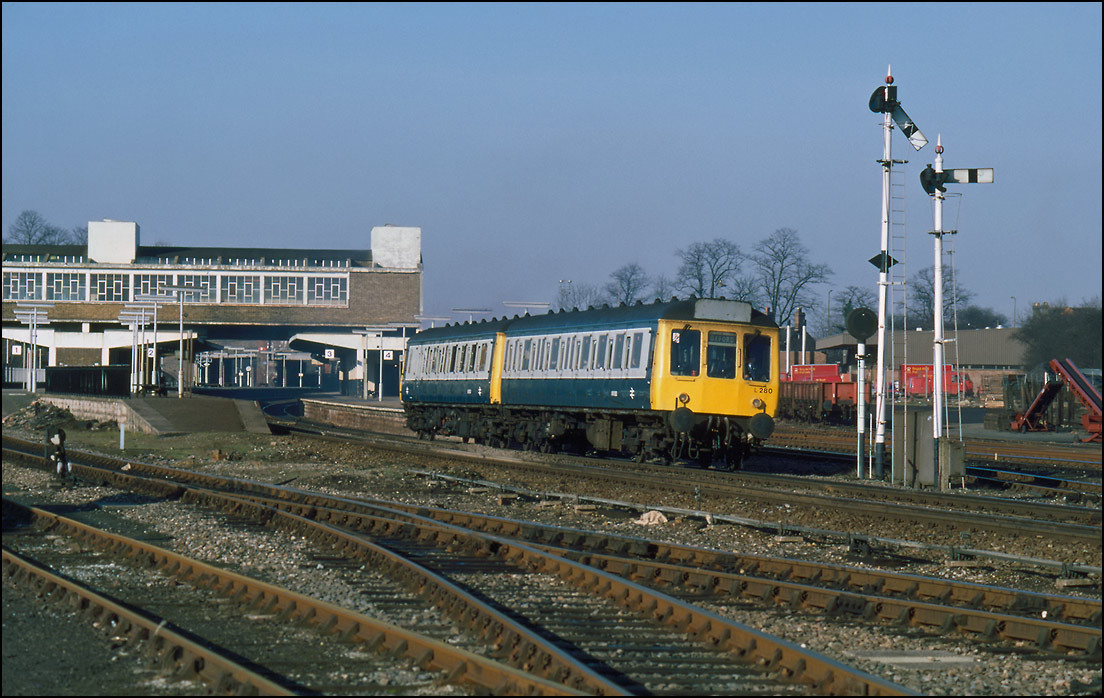 |
This photograph and the one following were taken at Banbury on 25 January 1986. At the time, there was no fence obscuring the view from the trackside just to the south of platforms and no-one seemed to mind if one stood there to take pictures. It was, of course, the ideal spot on a sunny Saturday afternoon when there was quite a variety of movements, both unit and locomotive hauled. This shot shows a pair of single unit "bubble cars" leaving the main line platform at Banbury on their way to Oxford as an all stations stopping service. |
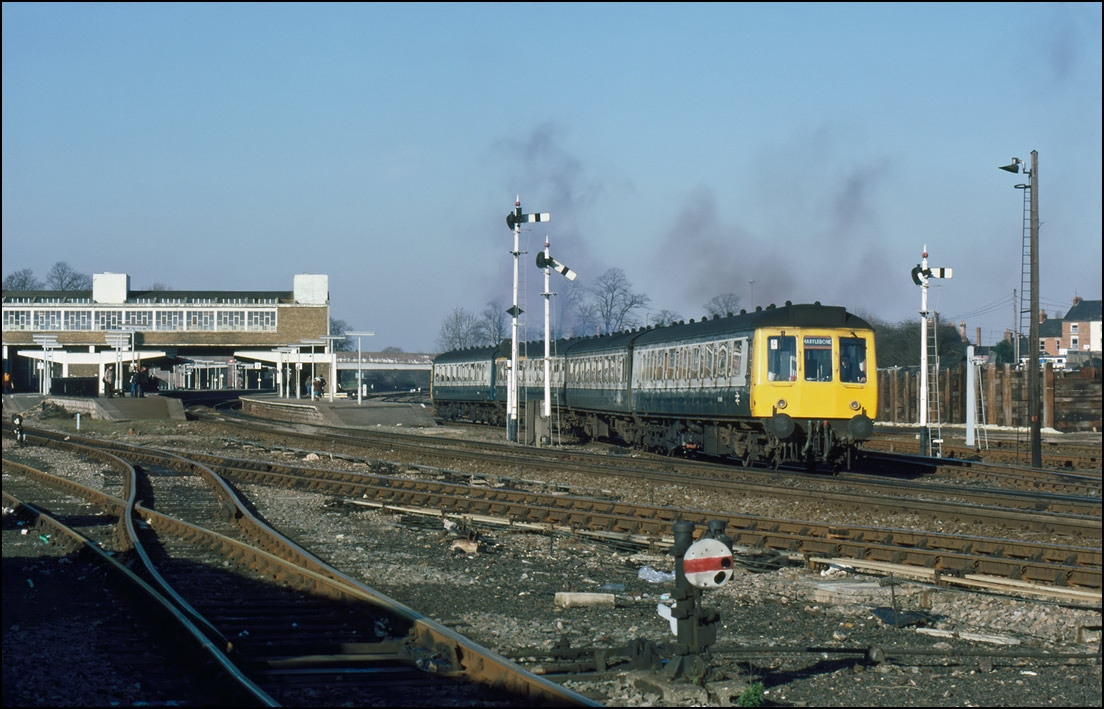 |
In contrast to the picture above, this one shows a four car DMMU leaving Banbury station's platform 1 for London Marylebone. The scene here has changed in the intervening years but not as much as one might expect. The signal controlling this train's departure is still in the same place but the starter for platform 2 is now a three aspect electric variety whilst the lower quadrant signal operating the up loop has been moved a few yards further south. The clock just visible alongside the taller of the two starters, very much a Great Central feature rather than Great Western, has gone as has its counterpart at the north end of platform 3. One of the main changes is the recent, at the beginning of 2011, appearance of two new lower quadrant signals at the south end of platform 2, not to mention the erection of a row of portacabins just about where I was standing on 25 January 1986. |
_Ban_010111.jpg) |
Banbury station has recently seen a couple of very unusual new arrivals in the form of two new signals operating in the lower quadrant intended to faciliate the reversal of First Great Western HSTs diverted from their usual route because of major engineering work at Reading station. Network Rail must have dug deep into their spares cupboard to find the necessary hardware, including the finials, and the result is pleasing for those, me included, who like semaphore signalling especially those following the Great Western pattern. I wanted a shot or two of the signals and because of their position in relatiion to the sun's position, needed a cloudy day. January 1, 2011, was exceptionally dull with a nasty drizzle falling on the way up the M40, although it has cleared a little by the time that I had reached Banbury. The first train to appear was 168219 on a Marylebone to Birmingham Snow Hill service and this is seen entering the station with the new equipment alongside. |
 |
The first of the diverted FGW HSTs that I photographed on 1 January 2011 was led into Banbury by power car 43069 and is here seen about to enter the down loop prior to reversal amidst a lot of recently erected lineside clutter in the form of communication antennae. These trains, the details of which I couldn't be bothered to find out, ran in the down direction from Paddington to Banbury via the Chiltern Line and then onwards via Oxford and Didcot West Curve to regain their normal route, up trains following the reverse procedure. To be quite honest, I probably wouldn't have made a lot of effort for these diversions had it not been for the new signalling arrangements at Banbury, especially in such awful light.Having said that, when another possession takes place later in the year and in decent sun, a shot or two on the Chiltern Line itself, in particular in and around some of the stations, will be on my "to do" list. |
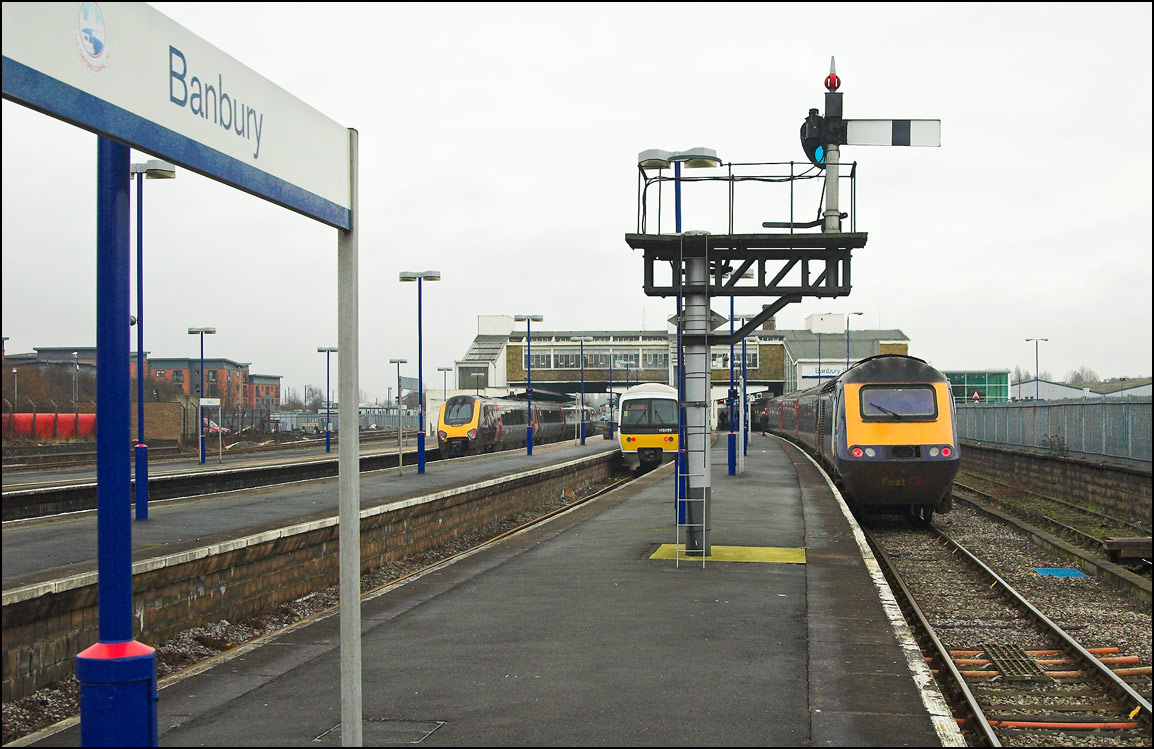 |
As I mentioned above, the diverted HSTs ran along the down loop at Banbury, where the crew changed ends before taking their train back towards Aynho Junction. The exit from this loop is protected by an earlier example of a lower quadrant signal from Western Region times, this having replaced the original Great Western structure at some point in the 1960s. The light was truly dreadful as this train stood waiting for the Arrival CrossCountry Voyager to get out of the way but even so, I think that this wide-angle view was worth the effort. The conductor of the FGW train can just be made out ensuring that passengers, of which there were very few, neither joined or left the train here. |
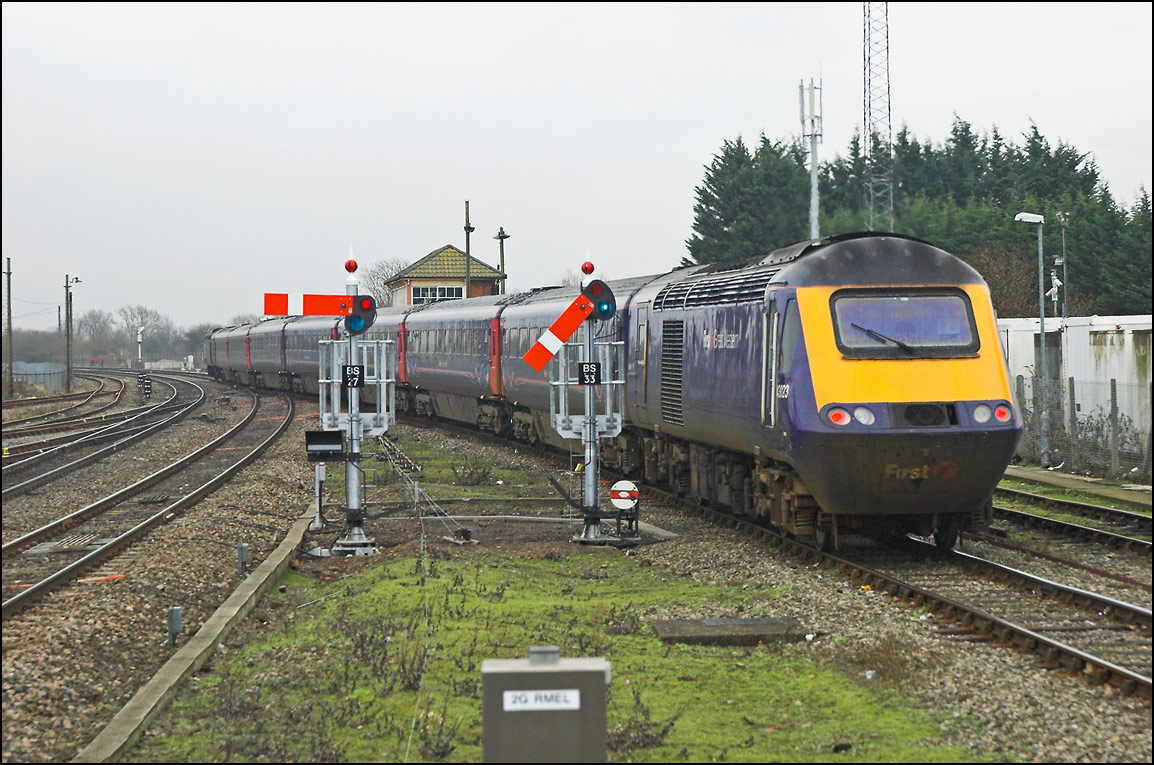 |
When the trains were ready for departure from Banbury's down loop, the appropriate signal was pulled off to give it the road from there onto the up main line. The new signal replaced a disc used for shunting Chiltern terminating services and therefore has a long term future here even when the diversions for which it was put into place have finished. Here, power car 43023 is seen at the rear of the train as it pulls forward on the down main line before crossing onto the up line and heading south either to the Chiltern Line or Oxford. |
 |
Not all of the diverted HSTs used the loop at Banbury for reversal. Here is power car 43135 standing in platform 3 ready to head south as a member of staff gives the right-away after checking that no passengers have made unauthorised entrances or exits from the train. This wrong-road procedure is facilitated by the new signals just off the plaform end, the right-hand of which is pulled off in this shot of the train moving away. The picture is unfortunately a bit blurred as I sneezed at the precise moment that I pressed the shutter release... |
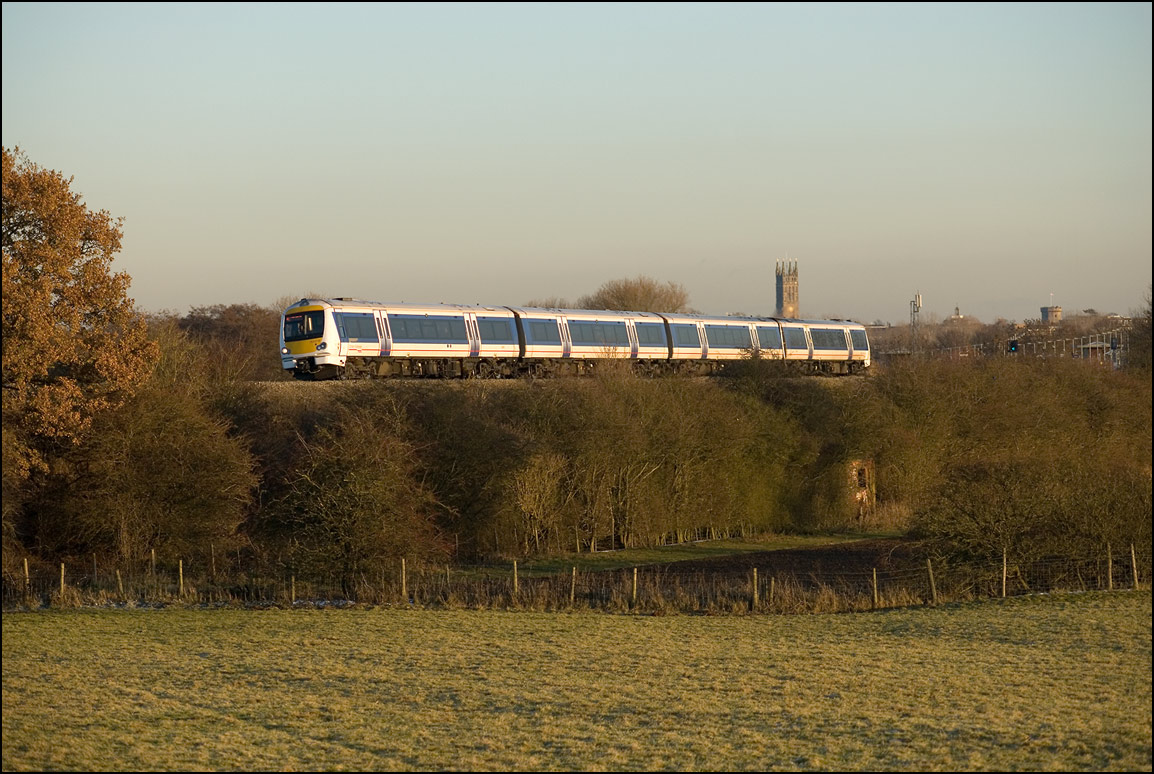 |
After a cloudy start the afternoon of Wednesday 8 December 2010 was one of those when the light was perfect. The latest class 60 to casue widespread fuss is 60099 which has received the house colours of Tata, the Indian steel company that now seems to operate much of the world's steel industry. I should quite like a picture of the locomotive before it expires and without having to make any real effort such as driving half-way across the country, so with it being scheduled to work 6E55, the Theale to Lindsey empty oil tanks which left Theale close to an hour early, I thought that a chance might present itself. I reckoned without the seemingly dogmatic approach of Reading signalling panel whose determination not to allow any freight to run earlier than its booked path is legendary. It seemed particularly bloody-minded today when an available path caused by the non-running of 6M22, the Westbury to Stud Farm stone empties, might easily have been used. The upshot was that this picture of 168218 leaving Warwick Parkway was the only northbound train to appear in the perfect light. My only other shot was of 66403 on a very late 6O96, the GBRf operated 10.25 Mountsorrel to Eastleigh Virtual Quarry loaded ballast train. I wouln't normally take such a picture but a class 66 in the DRS livery of its former leaser is rare on this line. |
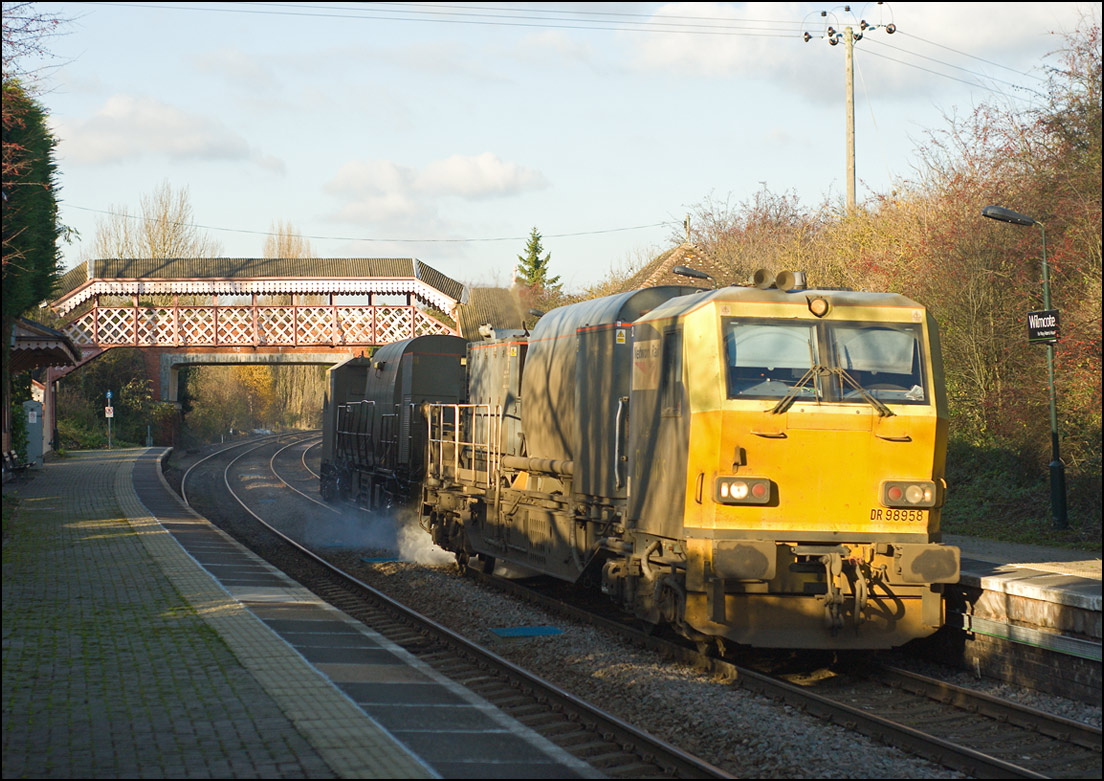 |
Having spent a few minutes at Hatton over lunchtime on 23 November 2010 I returned home via Wilmcote and dropped into the station there just in time to take a photograph of the daily Rail Head Treatment Train which runs down and up the North Warwickshire Line. I knew that shadows from trees in the garden of the old station house would be a problem but thought that there might just be a clear enough patch of sun in the middle of the platform. There was, just, as DR 98958 led the formation south towards Stratford-upon-Avon and I think that the spray of water from the middle of the train just catches enough light to be an effective highlight. |
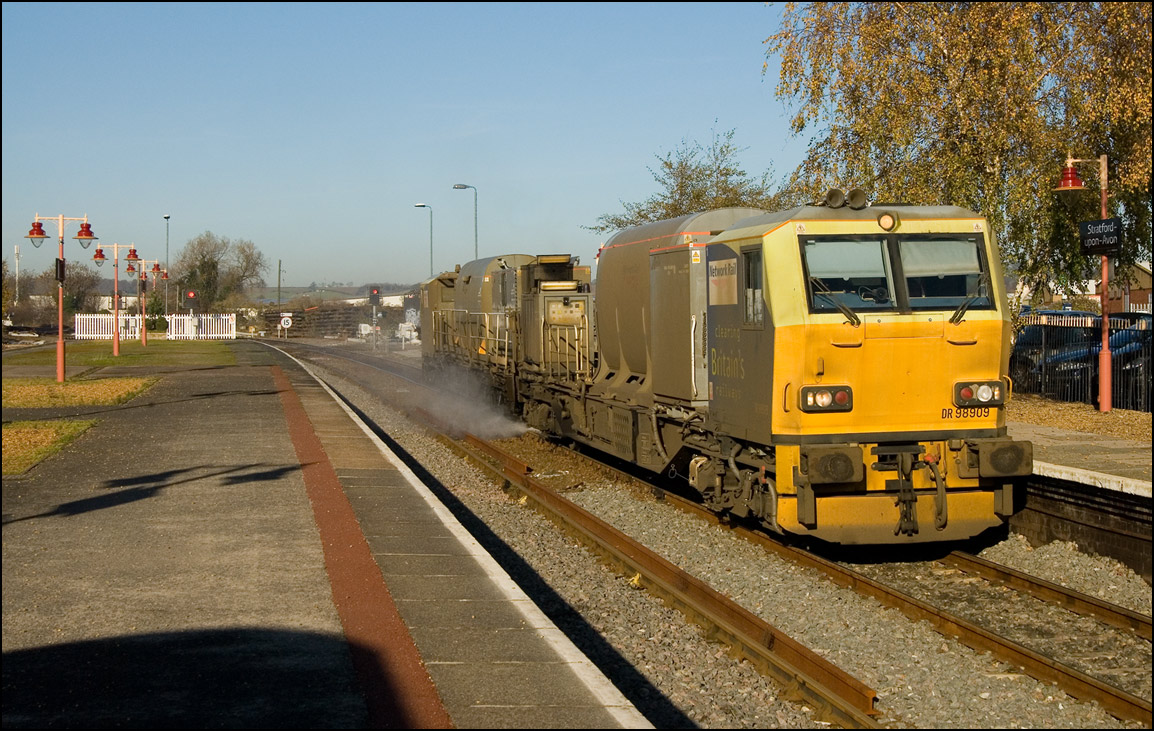 |
Given that Tuesday 16 November 2010 started with freezing temperatures and thick fog I didn't expect to see a lot of sun but the fog lifted well before lunchtime leaving a beautifully clear blue sky. That being so, I wandered down to Stratford-upon-Avon station just as the 13.27 DMU to Stourbridge Junction was leaving, in the hope of getting a couple of shots of the day's RHTT arriving. It ran much earlier than the previous day and sprayed its way into the platform just five minutes later at 13.32; a contrast to the day before when it didn't pass Edstone Aqueduct until 13.40. I was pleased to still see a bit of Autumnal colour in the Silver Birch tree adjacent to platform 1 as was half expecting the leaves to have blown off before now. |
_SonA_161110.jpg) |
It is hard to resist a few shots of any train standing in perfect light so I just had to take another view of DR98909 as it stood under Stratford-upon-Avon's footbridge on 16 November 2010. By now, the new LED signal at the other end of the platform had cleared and it was only a few seconds before the driver of the RHTT sounded its horn to warn a p-way gang that he was about to head their way and then back to the Birmingham area via Henley-in-Arden and Shirley. |
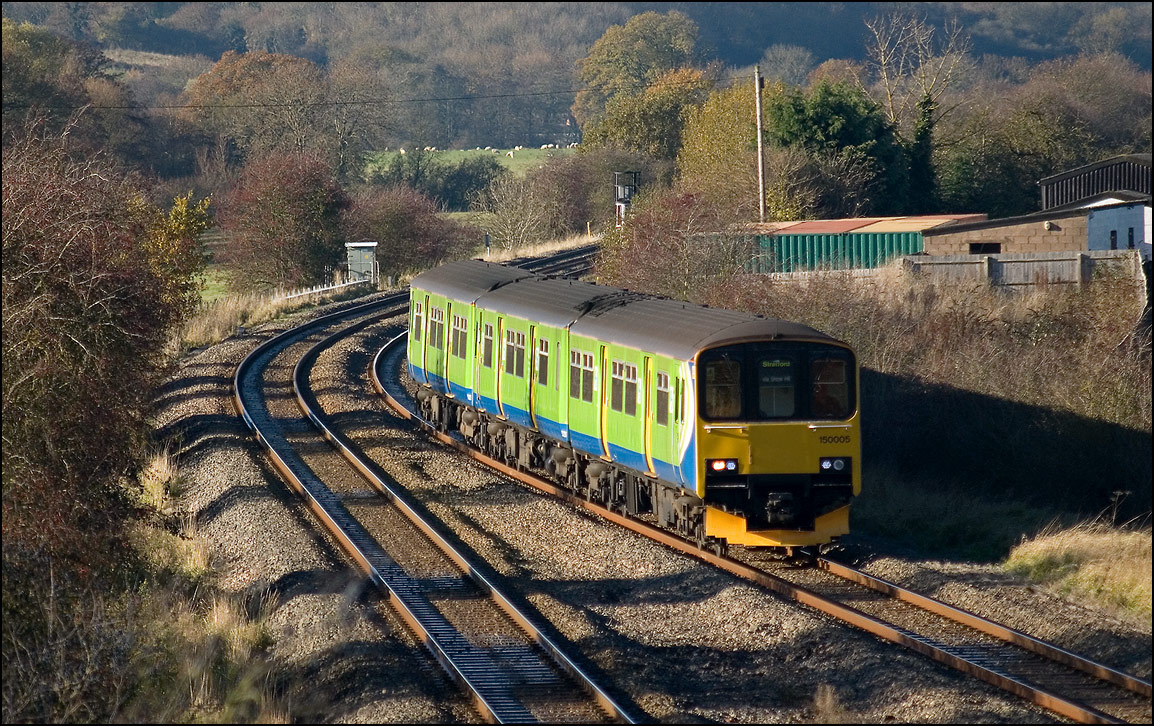 |
Monday 15 November 2010 was another of those beautiful days with clear winter sunshine. Whilst I quite wanted to take a couple of pictures I couldn't be bothered to travel far so just went a few miles from home to the aqueduct at Edstone, on the North Warwickshire Line with the aim of getting a shot of RHTT. Running in front of the MPV set was 150005 on a Stourbridge Junction to Stratford-upon-Avon train which is here seen having just passed a new signal put in place during the recent extensive engineering work on the line. |
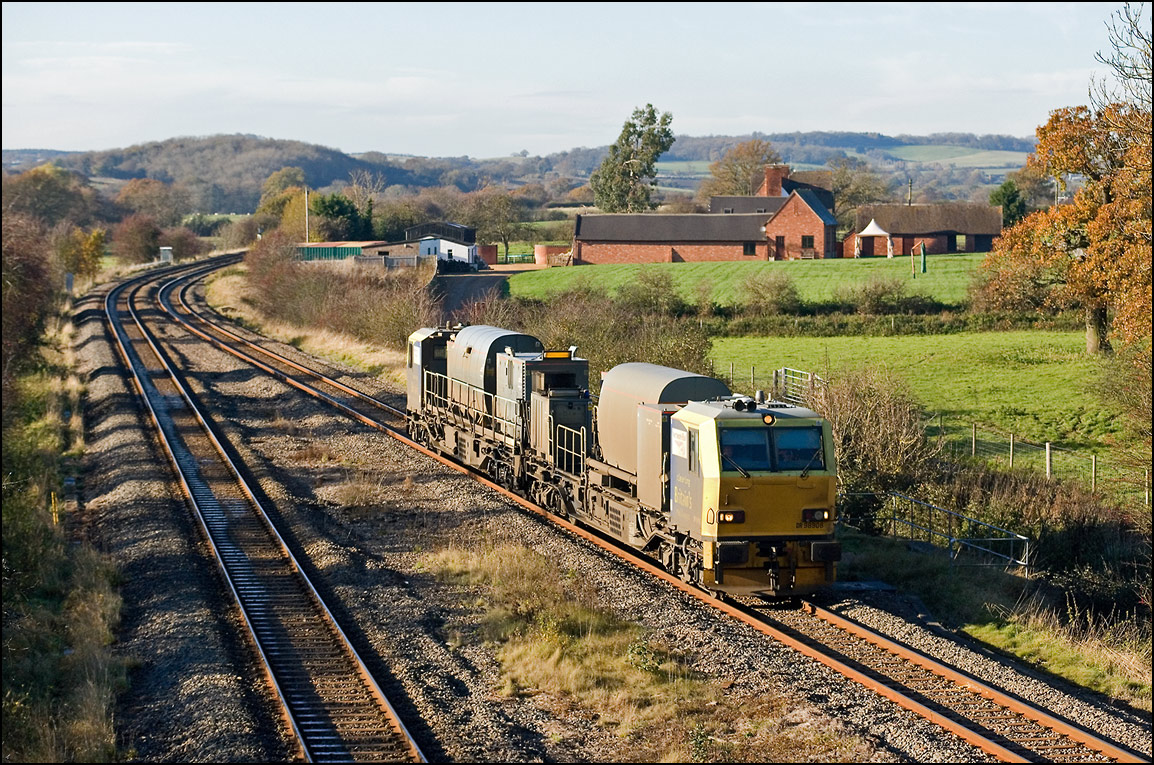 |
This picture of the North Warwickshire Line RHTT is taken from exactly the same spot on the towing path at Edstone Aqueduct as that of 150005 shown above but with a much wider angle lens. The two MPVs with 98908 leading are on the run down to Bearley Junction and then Stratford-upon-Avon on 15 November 2010. There are still some Autumnal colours around here although some very strong winds over the preceding weekend removed vast numbers of leaves from trees around here and thus marked an end to one of the most colourful seasons that I can remember. |
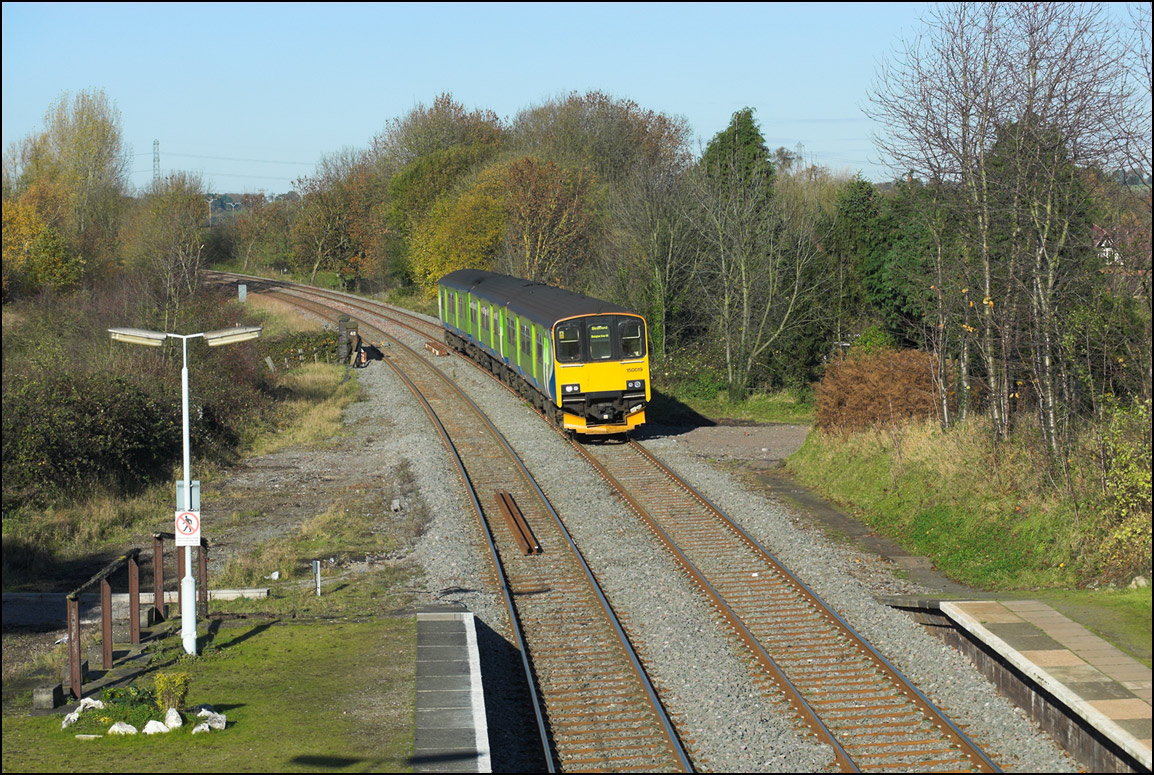 |
Following the radical changes of recent days to the scene around Henley-in-Arden I thought that I may as well wait for a day with some decent light before going back once to obtain a picture of the area just north of the station where the signalbox and associated semaphores used to be. Wednesday 10 October 2010 was such a day so I planned to go and have a shot of the 13.05 arrival from Stourbridge Junction. Here then is 150019 about to pass the patch of bare earth occupied by a the signalbox for over 100 years and no doubt even this patch will soon be indistinguishable from the rest of the surrounding vegetation. |
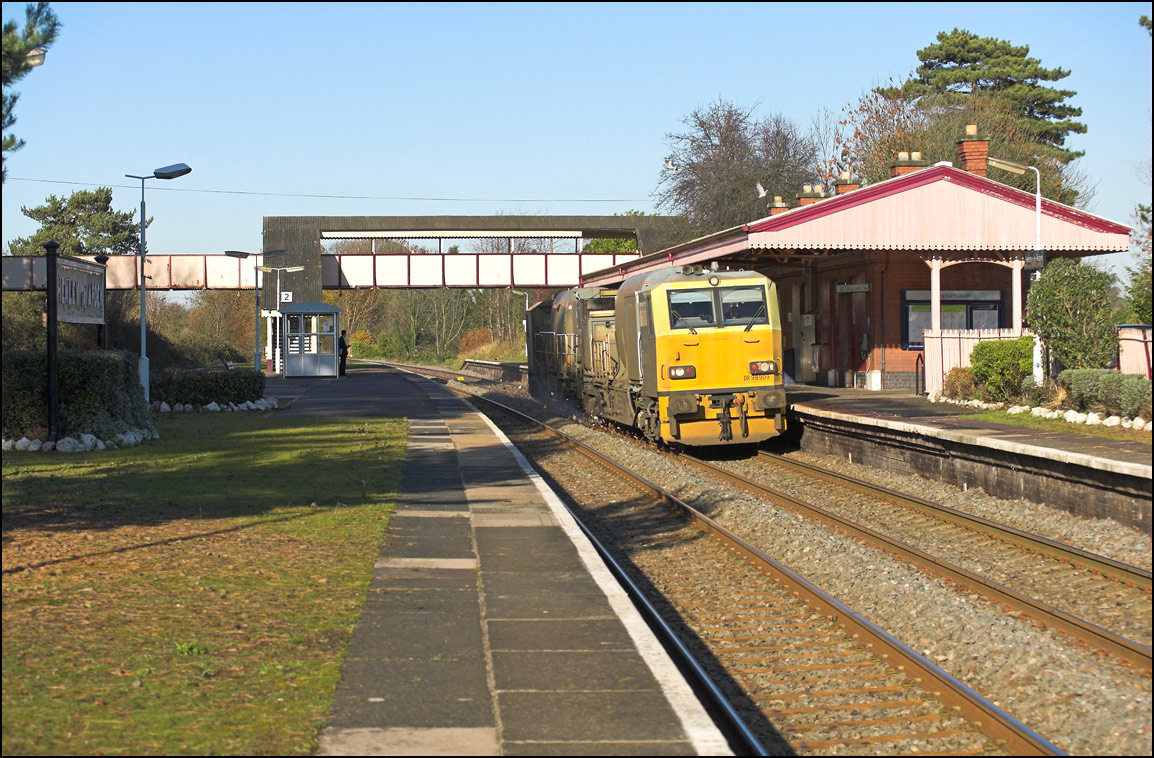 |
A Rail Head Treatment Train is booked to follow the DMU in the picture above down the North Warwickshire Line. Sure enough, about 25 minutes later I heard the hissing and rattling as DR98909 led the MPV formation towards Henley-in-Arden. Shadows from the trees on the left of the station had begun to encroach on the tracks through the platform but the main part of the scene was in the beautiful sun that had followed a cloudy start on 11 November 2010. |
 |
During the afternoon of 25 October 2010 I had a quick trip around the Wilmcote, Edstone, Wootton Wawen and Henley-in-Arden area to see if I could find any of the engineering trains on the North Warwickshire Line. All that was visible from public vantage points was the back of a ballast train just to the south of Edstone Aqueduct so after not photographing that I went to Henley and found this road-rail vehicle loading some redundant material from the lineside adjacent to the signalbox. The inside of the 'box was being stripped of anything either reusable or valuable before demolition. A large lorry with a skip and hydraulic crane was in the car park at the south end of the station and here is a picture after the road-rail vehicle has unloaded its scrap, including the upper quadrant down outer home signal which was situated a few hundred yards to the north of the signalbox. Note that the new LED signal operated by from Landor Street is illuminated. |
 |
The weekend commencing 24 October 2010 saw the closure of the North Warwickshire Line for the thick end of one week while the semaphore signalling was removed and some track remodelling took place. I have long had a fondness for the line and its infrastructure despite, or perhaps because of, the fact that no locomotive hauled trains are scheduled to run along it. The sole remaining lower quadrant signal between Bearley Junction and Tyseley was to be found just to the north of Henley-in-Arden station and here is a picture of 150011 passing it on Friday 21 October as it slows for the Henley stop with an afternoon train from Stourbridge Junction to Stratford-upon-Avon. The shot I actually wanted would have been taken just before the unit passed the upper quadrant signal visible over the middle coach but the undergrowth was just too obtrusive; much worse than that visible over the front of the class 150. Conventional stepladders wouldn't have been much help as the ground on this public footpath was too soft and uneven for them to be safely used. |
 |
This is the view looking towards Henley-in-Arden using the lower quadrant advance starter as a photographic prop on 22 October 2010. The train is the Rail Head Treatment MPV set used to blast leaf debris from the line and apply a layer of sandite material to give enhanced grip. It is fortunate that the ash tree just inside the fence had lost most of its leaves during the preceding few days of the shot would have had even more vegetation obscuring DR98959 than was already the case. It's a shame that the signal's finial had been removed as semaphores with them just don't look right but sadly, there were very few left along this stretch of line. The RHTT had been standing in the station for around 15 minutes waiting for a path back along the section of line to Shirley, the next block section, as 150005 forming the 14.27 Stratford-upon-Avon to Stourbridge Junction was occupying the line. The MPV had previously run to Stratford-upon-Avon with DR98909 leading. |
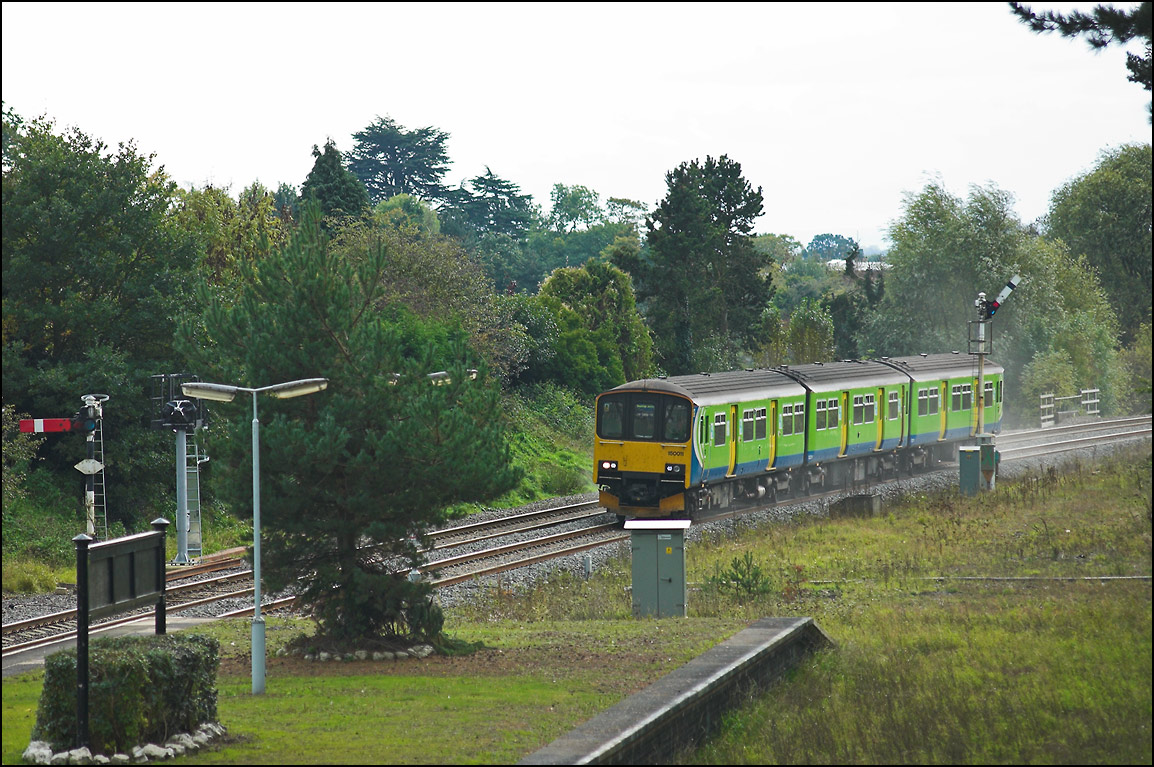 |
This picture shows 150011 approaching the stop at Henley-in-Arden station on 22 October 2010 with the 15.27 from Stratford-upon-Avon. It is passing the two semaphore signals at this end of the station and is kicking up quite a cloud of sandite material; being the first train to run over the up line since the RHTT shown above had passed. The replacement LED signal on its heavily engineered gantry is also in view; functional no doubt, but not quite as photogenic. The light picked up a little as 150011 pulled away from the station and ran past the two signals at the north end of the platforms. |
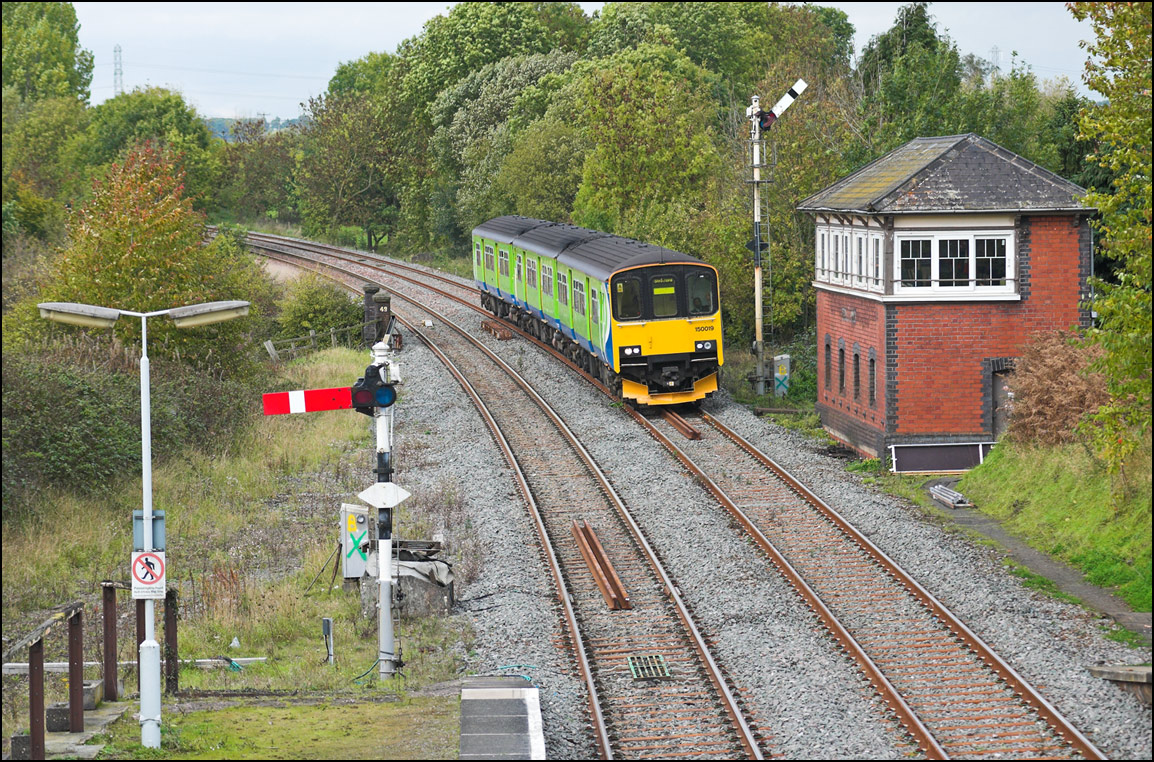 |
If anyone actually looks at my DMU pictures then they won't be surprised to see yet another version of this shot at Henley-in-Arden. My excuse this time is that this is last photograph with active semaphores and signalbox that I took as the 'box was due to be closed and signals taken down within a few hours of this being taken on 22 October 2010. The advantage of the new signalling régime will much be the potential for more frequent services between Stratford-ipon-Avon and Birmingham although it is unclear at the time of writing if anything of this sort is even in the planning stages of being planned... Here is the same unit, 150049 passing the much less frequently starting signal at the south end of the station. |
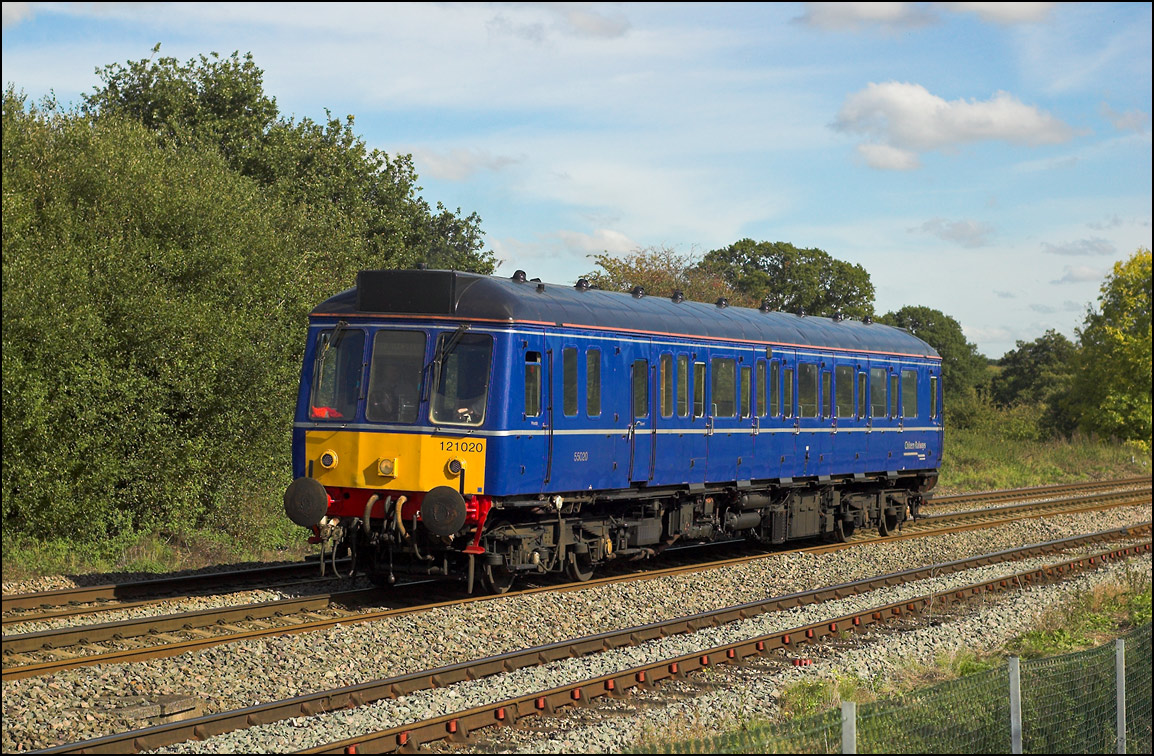 |
I have always had a soft spot for the single unit "bubble" cars that used to work branch lines; indeed my first ever train ride was in one of these when they worked the Stratford-upon-Avon to Leamington Spa shuttles. One of the remaining class 121 units in still in regular service for Chiltern Railways and 121020 was booked to run from Aylesbury to Kidderminster (SVR) on Thursday 7 October 2010 where it is due to perform at a gala over the coming weekend. I think that the blue colour scheme carried by this unit is most attractive so went to a bubble-sized spot on Hatton Bank where I knew that the sun would be in just the right direction at a little over 14.00. Just after I arrived, 66154 ran into the Down Goods Loop with 6M48, the 10.02 Southampton to Bescot loaded train of Ford cars. I took this to mean that 55020 was close behind and indeed, it appeared no more than two minutes later. |
 |
This is a picture that at first glance looks quite ordinary but is actually quite unusual. It shows Chiltern Railway's 168108 on Saturday 2 October 2010 shortly after leaving Hatton station and heading for Birmingham, but having run via the Stratford branch platform and using the spur normally used only by freight trains which have been looped and not turned out onto the down main line by the crossover just south of the station. I can only assume that 168108 was a stopper from Oxford, the Chiltern Line being under an engineering possession, booked to call at Hatton, but through late runnng was put into the branch platform to allow an Arriva CrossCountry service to pass without meeting too much delay. |
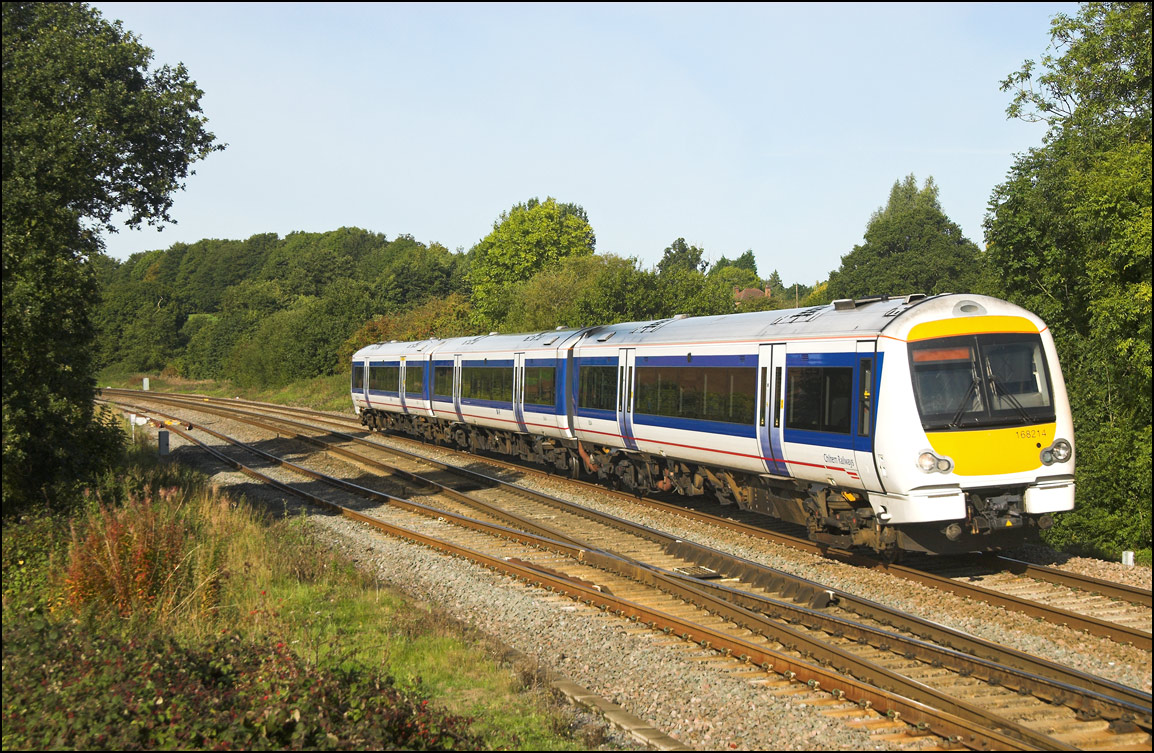 |
After a dull and foggy start, the morning of 30 September 2010 became clear and sunny and after reading that there was a 5Z37 10.22 Tyseley to Southall ECS I went across to the footbridge just south of Hatton cutting for a photograph of it. First along was 168214 on a Brimingham Snow Hill to London Marylebone service which, in perfect light, was well worth a shot. Unfortunately, the ECS was, according to a message posted from the Birmingham area, just a single coach hauled by WCRC's 37685 and I really cannot pretend to have a lot of interest in such short formations, less interesting even than a nuclear flask train and this, taken in my garden shed at the weekend. I left before it arrived, just catching a glimpse from the field near to the Hatton Locks car park. A shame, as a full length set of coaches would have looked good on such a nice day. |
_Henley_01.jpg) |
Continuing my photographic efforts along the North Warwickshire Line, the afternoon of 1 September 2010 saw me at Henley-in Arden. The shot that I had had in mind wasn't available because of a lot of tall grass and will need some substantial steps to achieve. I had left myself enough time to get back to the station footbridge in case something was wrong further along the line and I arrived back with a few minutes to spare before 150011 passed the signalbox and upper quadrant semaphores on its way to Stratford-upon-Avon from Stourbridge Junction. The signals and 'box, of course, are due for demolition within a few weeks and although I have plenty of shots taken from this exact spot, I felt that another in perfect late summer light wouldn't go amiss. Many people will disagree, but I feel that a scene like this on a country railway has far more to commend it than yet another picture of a class 60 on an oil train or a class 66 on an intermodal on an anonymous piece of main line, especially when the scene is about to change for the worse. |
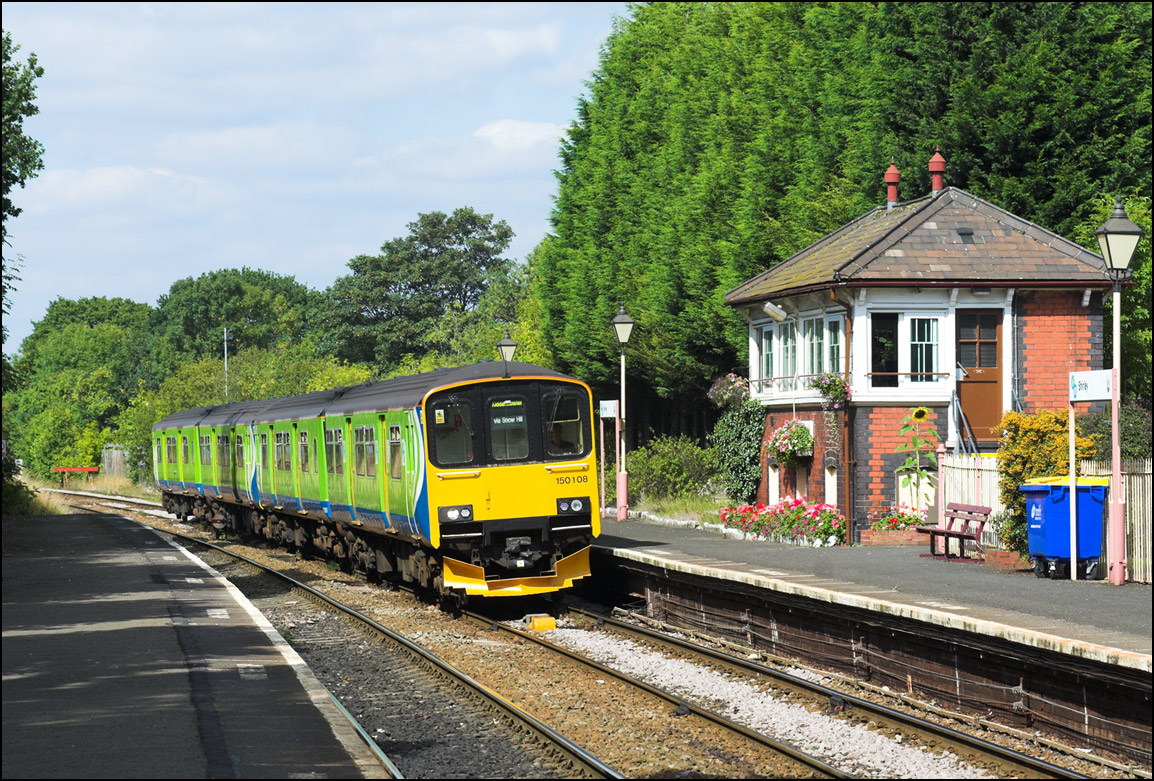 |
The North Warwickshire Line, from Tyseley to Stratford-upon-Avon, is in the throes of radical change. The remaining areas of semaphore signalling at Shirley, Henley-in-Arden and Bearley Junction are soon to be removed and the associated signal boxes demolished. The final dates for the 'boxes have now been set and I decided that it was time I went to Shirley to record a few scenes before all is changed. Bearing in mind the disappointing summer we have endured and that there's no point in going for an early afternoon shot much before the middle of August as the sun is too high, it was the last day of that month before I had about 90 minutes of decent light at the right time. Here is 150108 slowing to stop at Shirley station where the train will terminate before crossing over to the up line and returning to Kidderminster. The signalbox has been beautifully decorated by the resident signaller with a variety of plants, including this sunflower, for its final summer. |
_Shirley_310810.jpg) |
I have always thought that there is a lot more to railways than simply photographing locomotive-hauled trains on the main line as there is rarely much infrastructure of any interest on such lines and those who ignore the byways with some historical artefacts miss out. This is the 1907-built GWR signalbox at Shirley on 31 August 2010, just a matter of weeks before its demolition is scheduled. I understand that there was, until recently, some hope that if may have been preserved and used as office accomodation by London Midland but the plans have fallen through and a fairly rare surviving of a platform located 'box will be lost. Just to the Birmingham side of this scene is a short siding, these days used only very occasionally in the event of a unit failure but in busier days was used in the peak hours to stable a unit. Even further back in time there was a goods yard and shed in what is now the builders' merchant immediately behind the 'box. Here is an earlier shot of 150014 taken from the steps of the signalbox on a very wet day. |
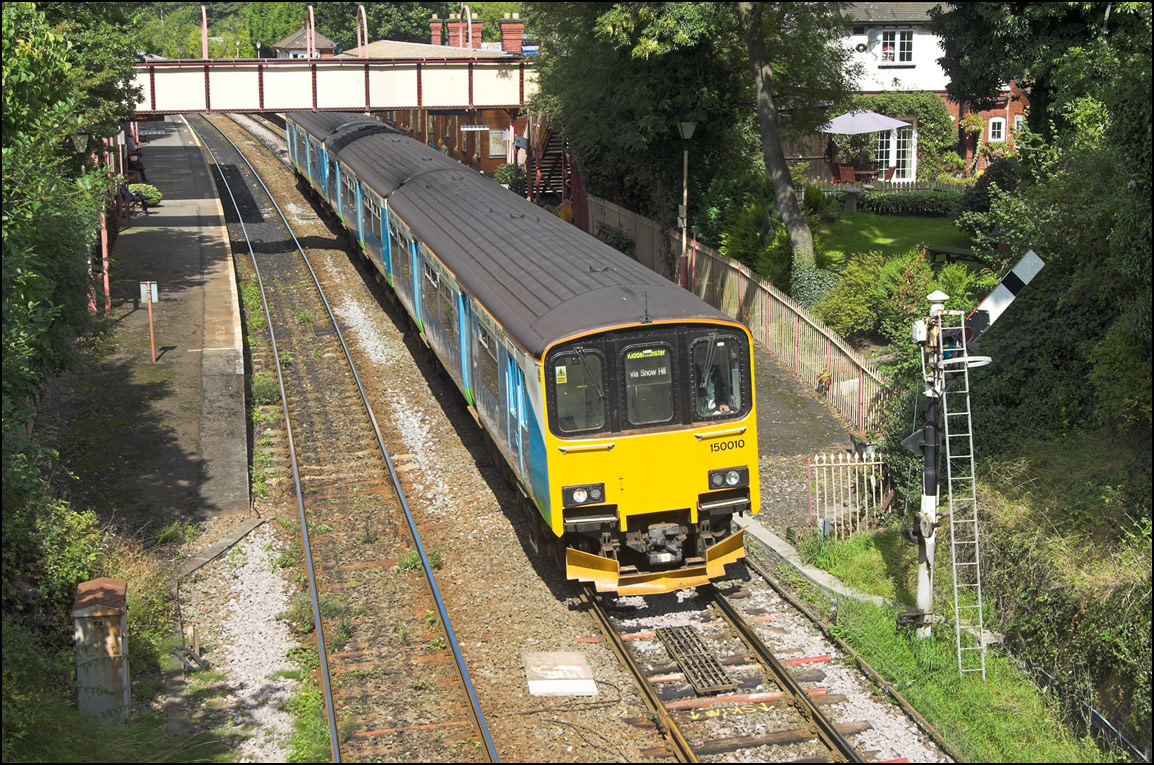 |
There is a twenty minute frequency passenger service to Shirley, where the trains currently terminate before leaving the station under the control of the upper quadrant starting signal and using the crossover to regain the up line before returning to Birmingham. The light was a little too straight for the picture of 150010 and in completely the wrong place for the linked picture of it about to crossover but I do, at least, have a record of the signals. Once the resignalling has been completed the trains currently terminating at Shirley on to the next station, Whitlocks End, where a new crossover will be installed. Quite why this extra movement was deemed necessary is unclear; I would have thought that a simpler option could have been developed which didn't need a seemingly wasteful move. |
 |
The crossover mentioned in the caption to the picture shown above is being used here by 150011 as it regains the up line at Shirley before it froms the 14.22 to Worcester Foregate Street on 31 August 2010. A lot of the ironwork in the picture looks as if it is ready for a good rub-down and new coat of paint. I wonder if this will happen when the forthcoming major possession is underway? Both the starting signal and ground dummy on the left of the train will be removed and the former's replacement is just visible by the DMU's roof. The ground signal will not be replaced as the crossover will be resited to Whitlocks End, the next station to the south. Just before leaving Shirley I took this picture of 150108 leaving for Kidderminster, largely so that I had a record of the outer starting signal with a train passing by. The longest lens that I had with with me was a 150mm example which wasn't, unfortunately, quite long enough for the job. |
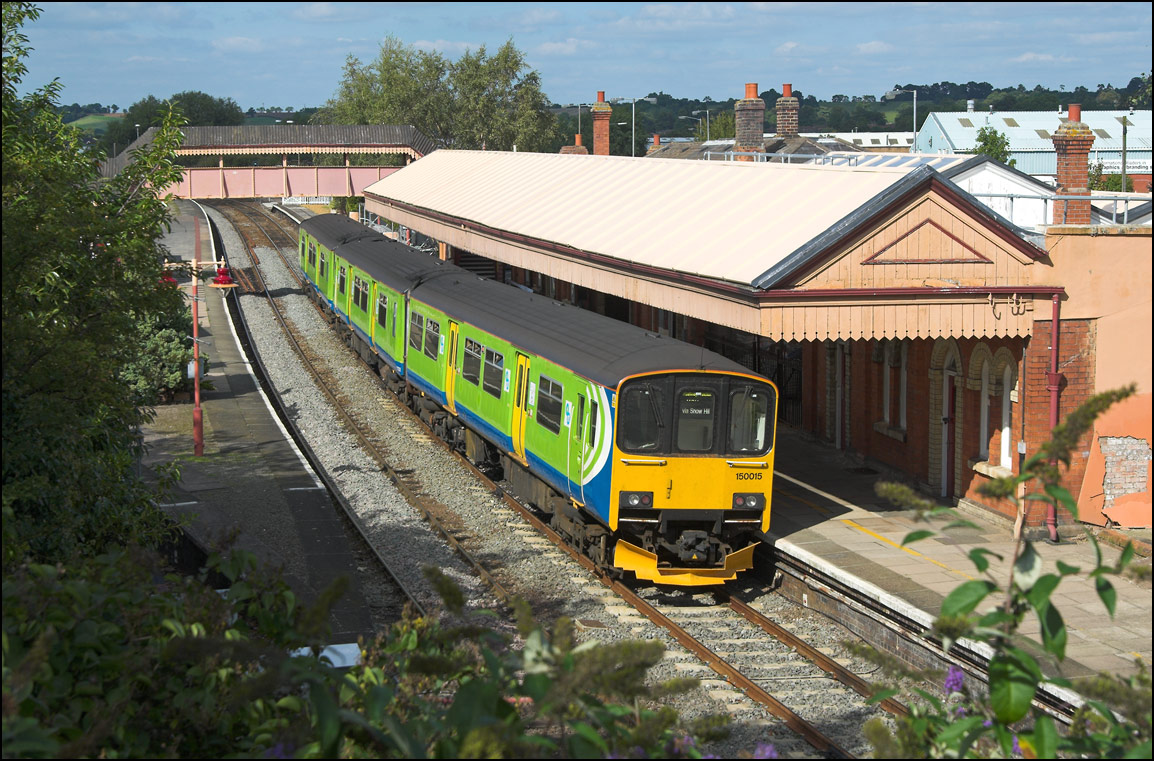 |
I had gone by train to Shirley for the pictures in the sequence above because there is rarely anywhere to park a car in the nearby area and travelled back to Stratford -upon-Avon on 150015. This is here seen amidst the faded Buddleia (Scrophulariaceae, a member of the figwort family) spikes from the Alcester road overbridge about to depart as the 15.27 to Stourbridge Junction. A chunk of plaster render has recently fallen off the station wall adjacent to the car rental company's office. How long will that stay unrepaired? |
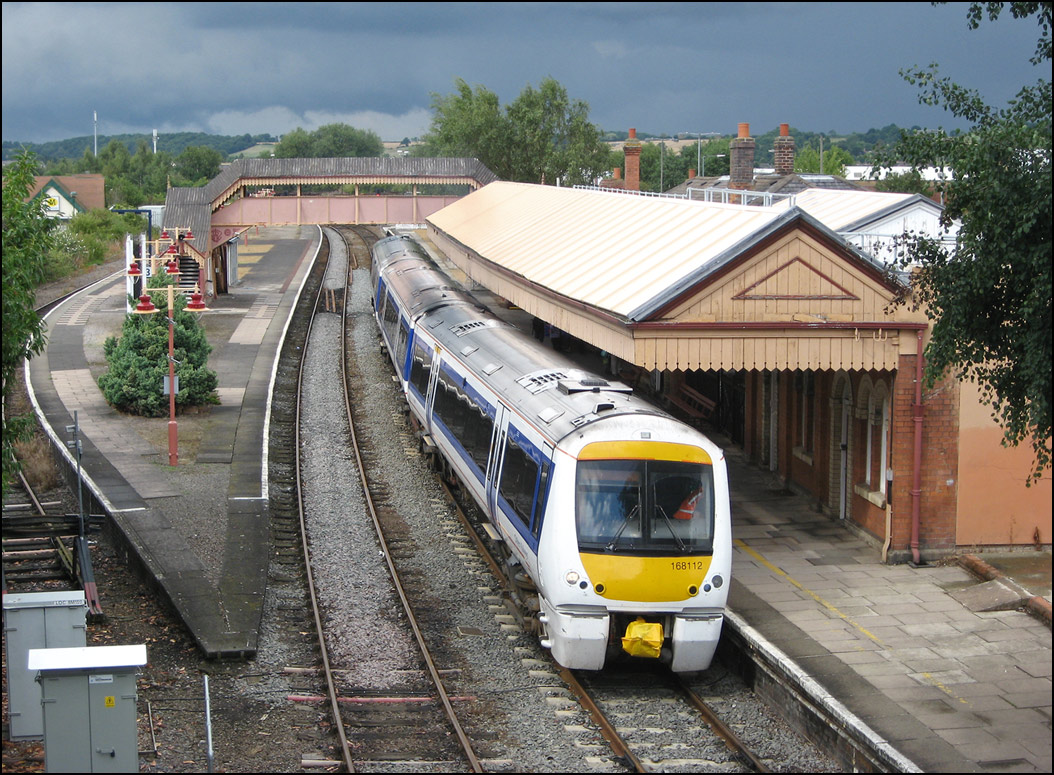 |
Chiltern Railways' class 168 make almost daily appearances at Stratford-upon-Avon, after a period when class 165 were exclusively found on the Birmingham Snow Hill services. On Saturday 14 August I happened to be walking past the station as 168112 was about to shunt across to platform 3 after arriving as the 13.53 from the London terminus. I had my Canon compact camera in my pocket and was attracted to the picture by the dark sky which was rapidly approaching with the odd flash of lightning warning of an imminent thunderstorm. In the event this didn't really materialise to any extent and I made it home without the soaking that I expected. |
_SonA_280510.jpg) |
One of the regular but infrequent test trains to visit the terminus at Stratford-upon-Avon ran on Friday 28 May 2010. This time it was formed of the Network Rail class 150 DMU 950001, was allocated the headcode 2Q08 and was due in at 08.53. It ran just about an hour late and is here seen leaving platform 1 en-route to Hatton where it was to reverse, return to Stratford and then head off back towards Birmingham. There are few photographic opportunities at Stratford station on a sunny morning; some cloud being welcome as it offers a bit more flexibility. The arrival managed to avoid the sun so I was able to take a shot from the footbridge. My thanks to David Weake for the information and updates on this working. |
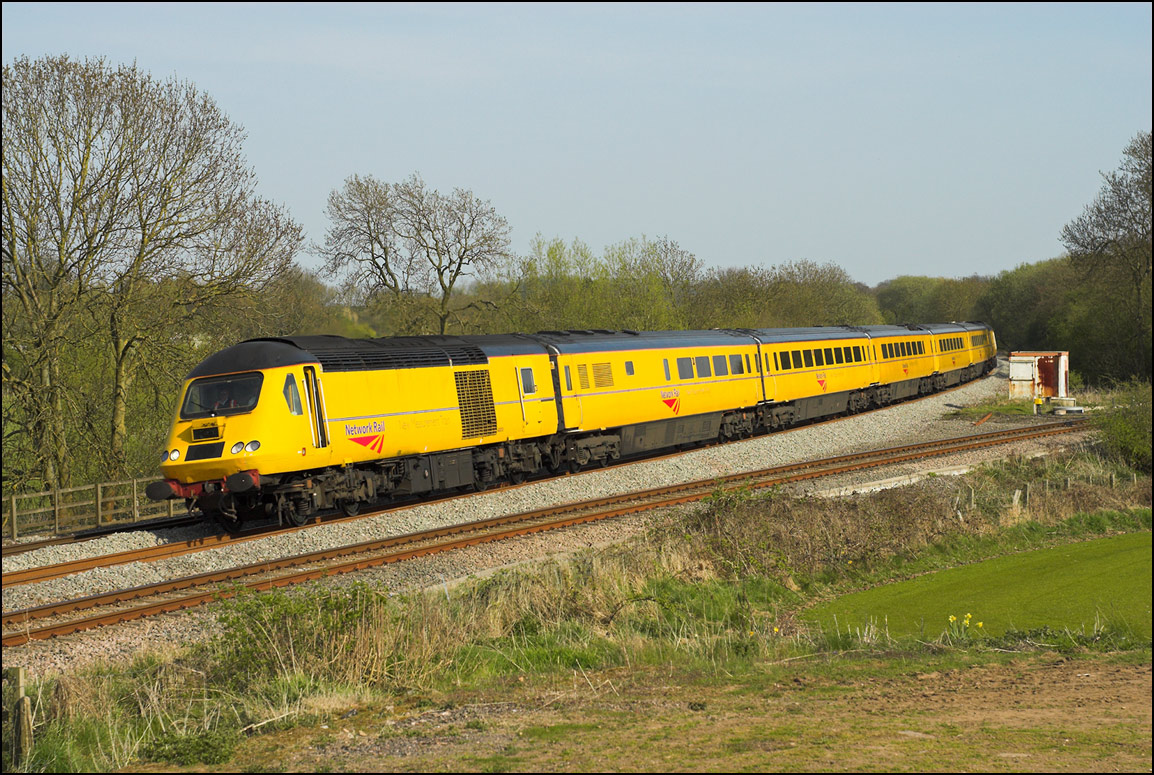 |
This week has been "Week 1" of the NMT HST's regular schedule so it was due to run as 1Z21 from Paddington to Derby on 23 April 2010. For a change the light was spot on for this train and this shot is, I think, my first on the NMT on this line in anything approaching perfect conditions. The power cars were 43013 and 43062 and the bright ensemble is seen rounding the curve at Hatton North Junction on the final leg of the journey to its home at RTC Derby. |
 |
Just before going home from Budbrooke on 21 April 2010 I hung on for a few minutes until a northbound Chiltern Railways' train came along so that I could try out this shot that I've had in mind for a little while. The unidentified class 165 has just left Warwick Parkway station and is passing a field adjacent to St. Michael's church who no doubt used the cross during their Easter celebrations a few weeks ago. |
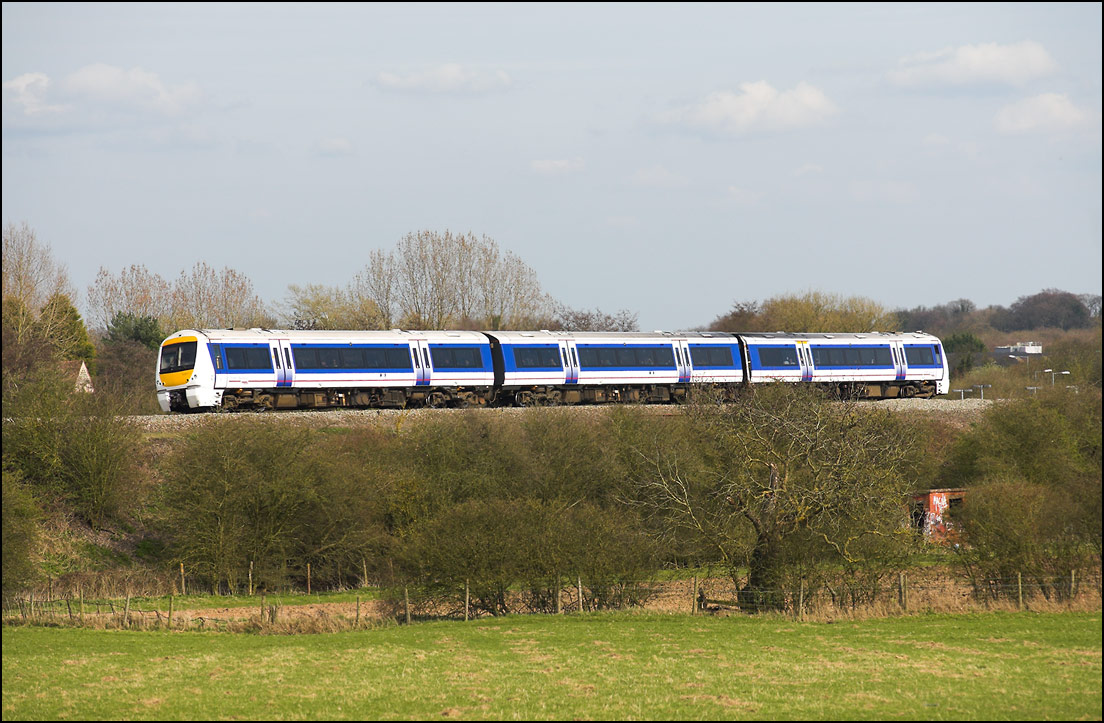 |
There is a frequent passenger along the GWR line between Leamington Spa and Birmingham, most of which is formed of Chiltern Railways' class 168 units. Here is 168111 shortly after leaving Warwick Parkway station en-route to Birmingham Snow Hill on 9 April 2010. Although I quite enjoy a session photographing multiple units once in a while, it is a shame that no locomotive hauled passenger trains use this route on a regular basis; the WSMR services, with the exception of the 11.20 departure from Marylebone to Wrexham for which the sun is unfavourable, now all run via Coventry. Arriva CrossCountry do have a presence on the line with an hourly service to Birmingham New Street, and an unidentifiable class 220 is here seen running north up Hatton Bank shortly before 168111. |
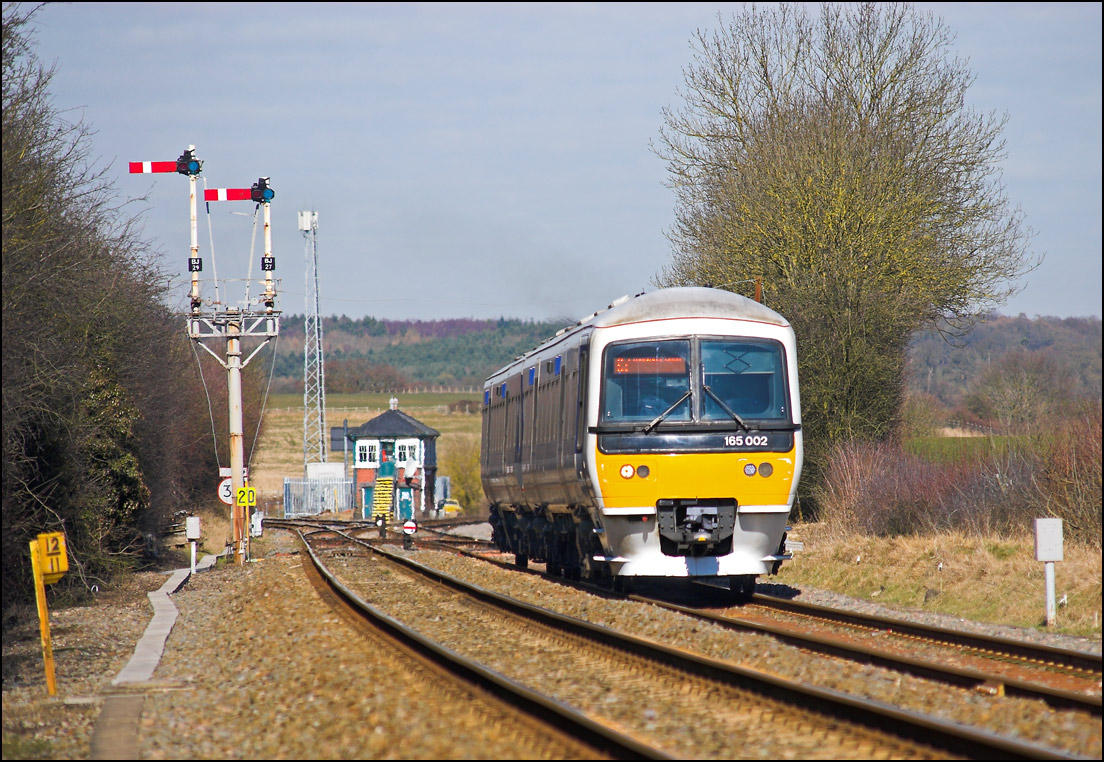 |
The remaining pockets of semaphore signalling in Warwickshire are scheduled for replacement in the Autumn of 2010 when control of the North Warwickshire Line is transferred to Landor Street Junction Panel. The nearest signals to my home are those at Bearley Junction and as Monday 8 March 2010 was clear and sunny I made up my mind to go and take a few shots from a couple of the foot crossings between there and Wilmcote. For reasons involving a sheep, a muddy, icy and slippery canal bank and the RSPCA I ended up at a crossing further north than I had intended for my first shots with the result that the sun wasn't quite as far round as I should have liked. Still, the signals were the real target with 165002 heading to Stratford-upon-Avon from London Marylebone being almost incidental and really just providing an additional prop. The signals here did, of course, operate in the lower quadrant, being firmly in GWR territory, but were converted a good twenty years ago to the then standard for semaphores. The splitting home signal was changed after the outer starter which had already gone over to upper quadrant operation by the time that I started taking an interest. |
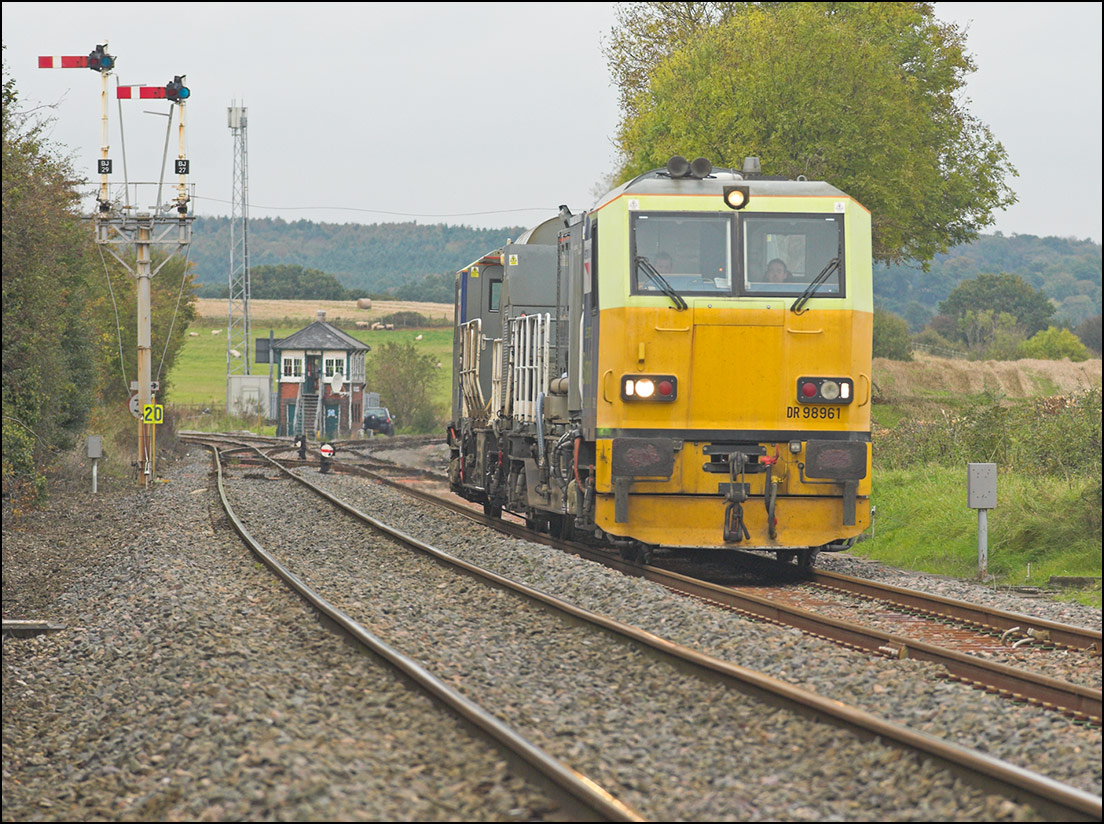 |
The Railhead Treatment Trains (RHTTs) commenced operations during the week of 13 October 2008. In my part of the world, these are all MPV operated which I quite like as one doesn't get to see these vehicles very often. Here is DR98961 moving away from Bearley Junction on 15 October 2008 as it heads from the North Warwickshire Line towards Stratford-upon-Avon. The train was slightly delayed because of a "Cathedrals Express" with 30777 Sir Lamiel having run early and been allowed to precede it to the terminus. The weather was quite poor but this did allow the headlight of the MPV to give a nice reflection on the nearside rail. |
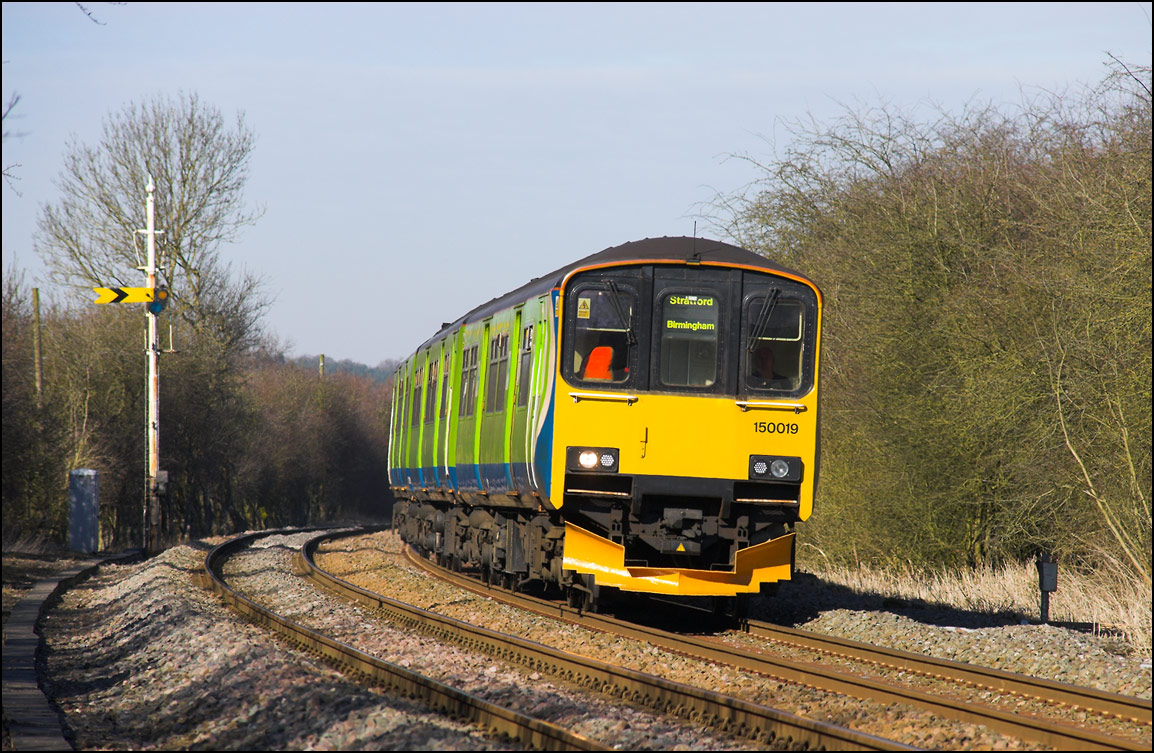 |
Great Western distant signals operating in the lower quadrant are very thin on the ground. I can think only a two or three around Worcestershire, some in Cornwall and this one operated by Bearley Junction signalbox on the up line between Stratford-upon-Avon and Birmingham. I wasn't sure if it was being pulled off at the moment because of a speed restriction at the junction so was pleased to see that it was in use today. The Sprinter, 150019, is slowing for the stop at Wilmcote station on 8 March 2010 as it passes the signal on its way to Stratford. As I was keen to get a photograph of a train passing it in the "off" position, I waited until 150019 returned from Stratford as the 14.27 to Stourbridge junction. |
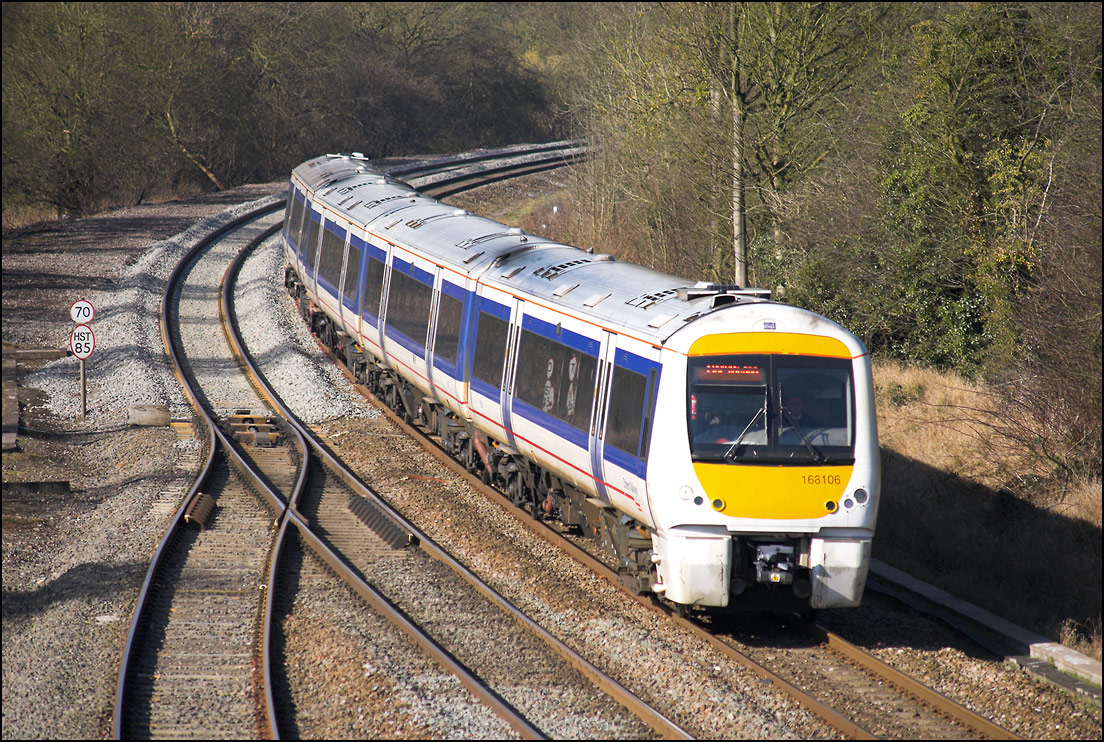 |
The majority of the passenger trains on the GWR Birmingham to Leamington Spa line are in the hands of Chiltern Railways' class 168 Clubman units. Most photographers ignore these because there's no locomotive involved but I usually take a shot or two of them if the conditions are favourable especially when there's some contrast between the train and the background as with this picture taken on 2 March 2010 with a longish lens as 168106 rounds the curve near Hatton station on the way to London Marylebone. Note also the relaid track of the down line commencing after the pointwork leading from the Stratford branch platform, also used on occasions by freights leaving Hatton's Down Goods Loop. |
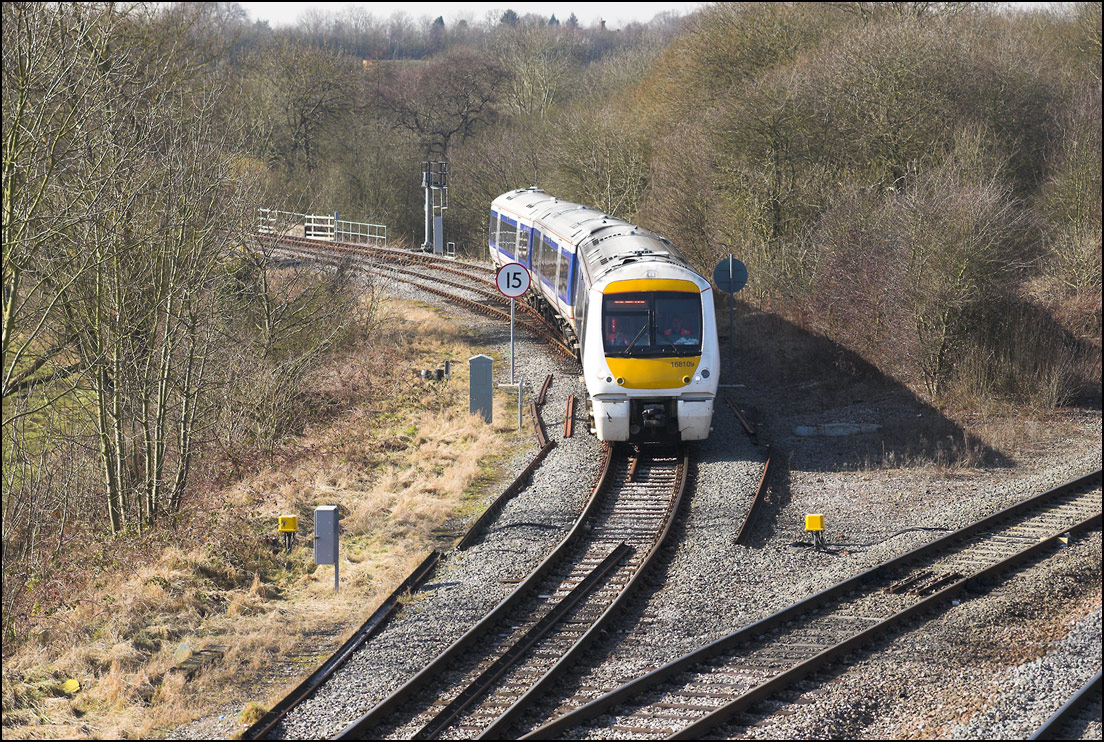 |
Class 168 units now visit Stratford-upon-Avon on a daily basis after having been quite rare for some years. Here is 168109 about to leave the Stratford branch at Hatton Station Junction with the 11.38 to Marylebone on 2 March 2010. This train was halted at the signal just behind the third coach for several minutes while 66517 working 4M55, the 08.55 Southampton to Lawley Street freightliner pulled out of the down goods loop. The exit from the branch platform in the up direction would, if the signal were overshot, have put this train directly in conflict with the freight, hence the former being held on the short double track section at the end of the branch to avoid even the remotest possibility of a collision. |
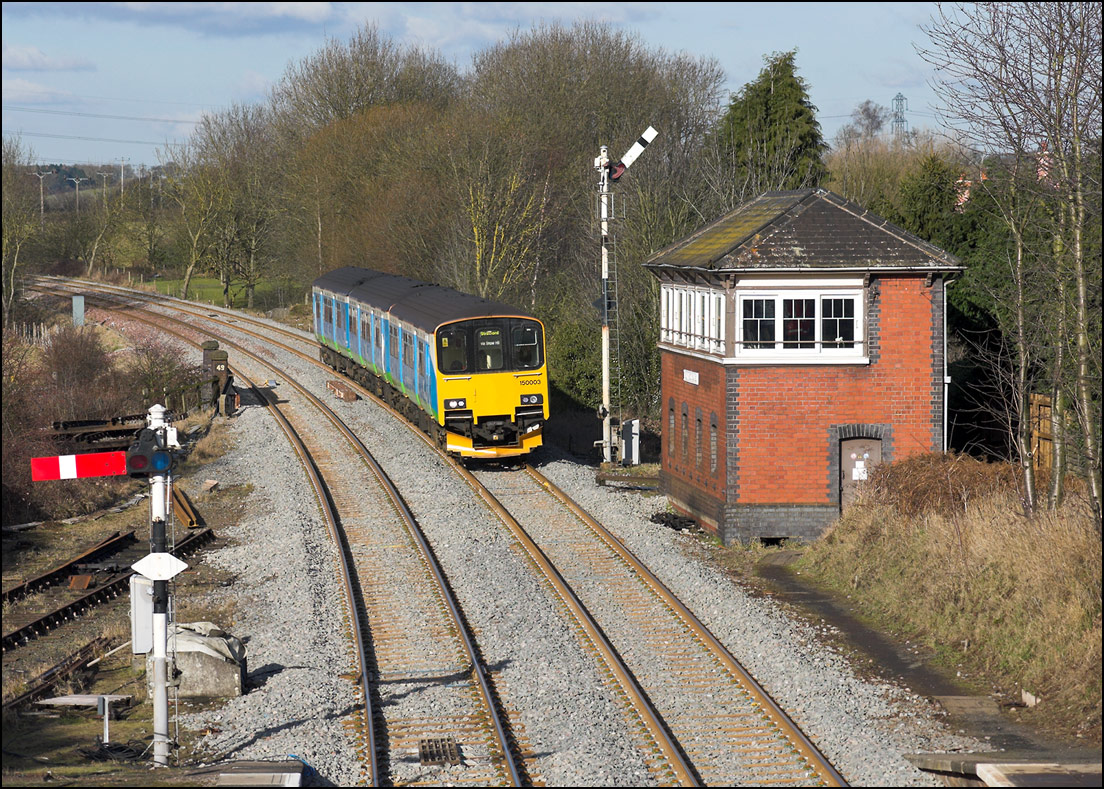 |
I recently seem to have developed a bit of an obsession with obtaining pictures of DMUs at Henley-in-Arden. One of the pictures I have been after is a train passing the inner home signal in good light, a commodity which of late has been in short supply. The best train for the angle of the sun is that arriving at Henley at 14.05 and the sky looked as if was clear enough to make the short trip from home on 11 February 2010 and sure enough, 150003 appeared right on time with the sun in a big clear patch. Part of my keenness to get photographs here is that fact that the signals and associated signalbox will be gone by the Autumn and I much prefer the winter sun with its lower angle than that later in the year. The bay platform line and adjacent siding have already been disconnected with new track and ballast having been laid through the statiion. All of the work so far has been taking place overnight to avoid disruption to the hourly passenger service, but I believe that at least one weekend of daylight activity is planned later in the year. |
_STJ_Henley_110210.jpg) |
When a train is in clear sunny conditions, moving very slowly and a quite different perspective is available by widening the field of view, it is inevitable that a second shot is inevitable. I can't see the point in putting online two or more shots that are identical save for the train having moved a couple of inches, but when the wider angle gives another view altogether, perhaps by including a station platform, I think it is worthwhile. What I still call an ATC ramp is a new addition to the down line at Henley-in-Arden but there is currently, on 11 February 2010, no sign of any new signal posts. No doubt these, when they arrive, will be the ugly and massively over-engineered variety that are now in vogue. |
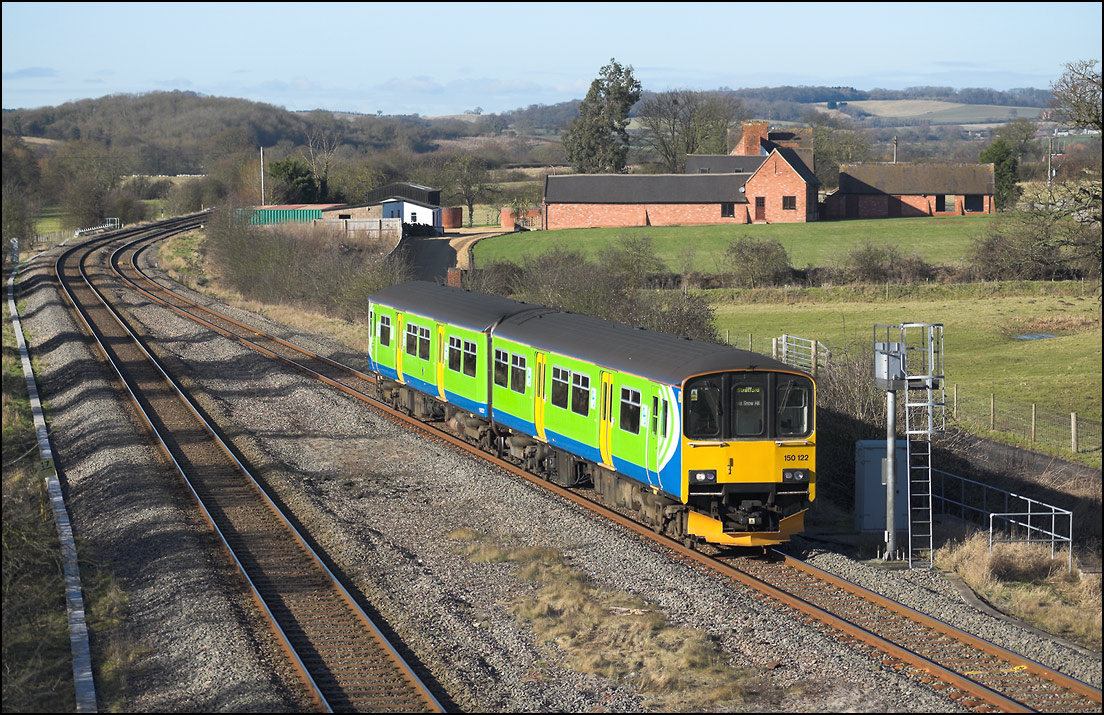 |
During the recent snowy weather I was lucky enough to obtain a reasonably attractive picture of 150007 from the towing path at Edstone aqueduct betwen Henley-in-Arden and Stratford-upon-Avon. When the sun appeared on Saturday 30 January 2010 I decided that it would be a good idea to repeat the shot but with the "normal" landscape, so here is a very clean 150122, albeit with 2 coaches rather than 3, in the same spot. After taking this photograph I made the short drive north to Henley in order to finally get a sunny shot of the 13.05 arrival there; one which cloud has so far meant I have missed. On arrival, the sun was beautiful so I took this view of the switched out signal box and starter and inner home signals and newly laid track, not to mention the recently arrived white trackside container no doubt to accomodate something or other for the ongoing engineering work. By the time the passenger train was due some small patches of cloud had appeared: need I say more? |
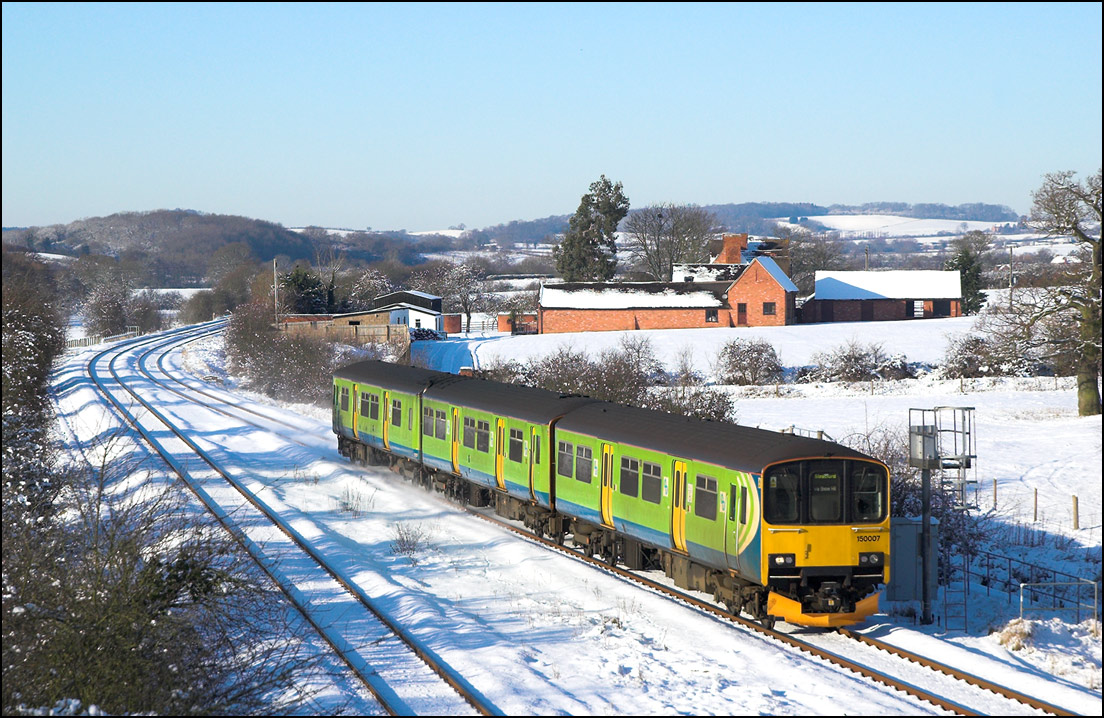 |
After a very cold spell with heavy snow and leaden skies, the morning of 7 January 2010 turned out to be beautifully clear and sunny but with below-zero temperatures so that the snow wouldn't disappear too quickly. I was keen to get a shot or two in these perfect conditions but didn't want to run the risk of a bent car or worse just for a photograph of a train. With this in mind I went just a few miles from home to the aqueduct at Edstone, between Henley-in-Arden and Stratford-upon-Avon, arriving in time for the train from Stourbridge Junction due to pass there at about 12.10. Unsurprisingly, 150007 was a few minutes late when it came into view, running through the very attractive Warwickshire countryside. The surroundings fields were an absolute picture in the snow and here is the view towards the diminutive River Alne, which runs along the extreme left of the picture, passing the small hut just visible by the hedge. |
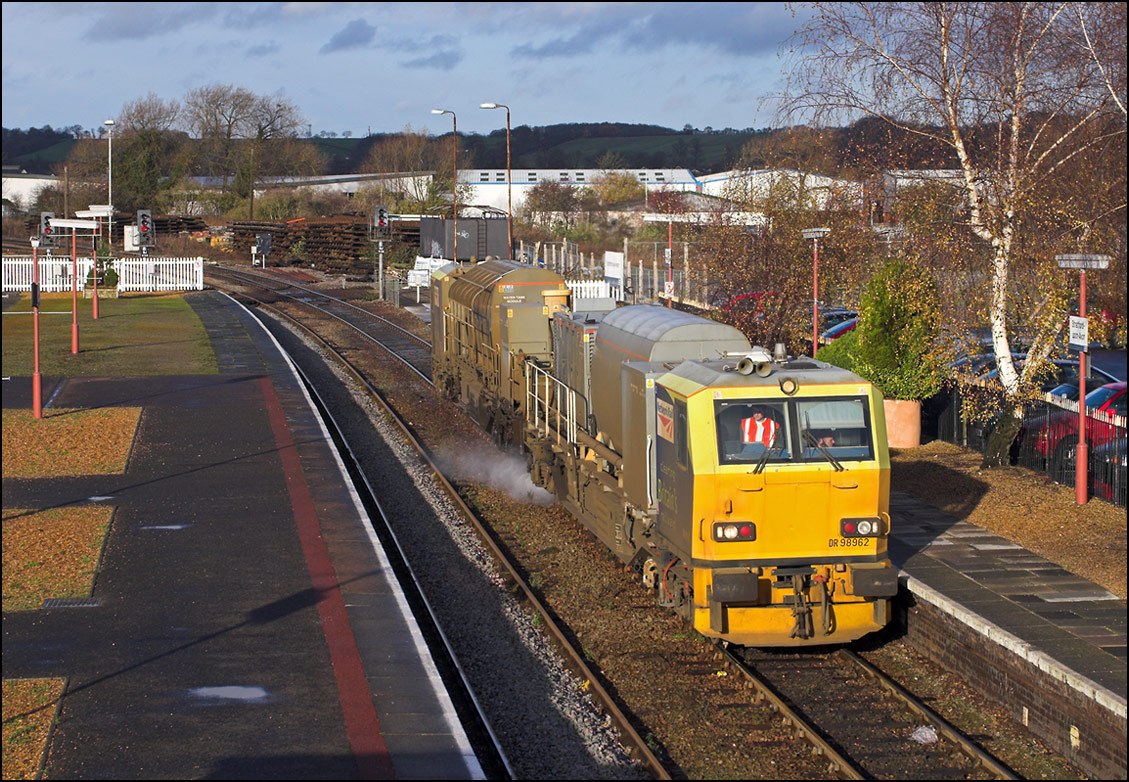 |
My intention on Wednesday 25 November 2009 was to photograph 3S87, the RHTT from Kings Norton to Kings Norton via Stratford-upon-Avon, somewhere along the North Warwickshire Line. In the event, the weather was quite poor at the time that I should have had to have left home so the plan was put on hold. At about 13.15, tooo late to drive out anywhere for the train, the sky looked as if it would clear so I just made the short walk down to Stratford station. A couple of minutes after I arrived, the 13.27 to Stourbridge Junction formed of 150003 pulled out of platform 1 under a sky that was just too dramatic to ignore. After the Chiltern Railways class 165 just visible on the left had gone at 13.40, the sun went behind a thick bank of cloud and I thought that yet another dull shot was on the cards. Fortunately though, 3S87 was running a bit late and the winter sun came back out. As the train was running late it didn't run right along the platform but stopped before the footbridge, where the crew changed ends before going back north. The signal was cleared to green by Bearley Junctiion's signaller almost before 3S87 had come to a halt so that it could leave immediately and run along the North Warwickshire Line with its long signalling sections without causing delay to the following train. |
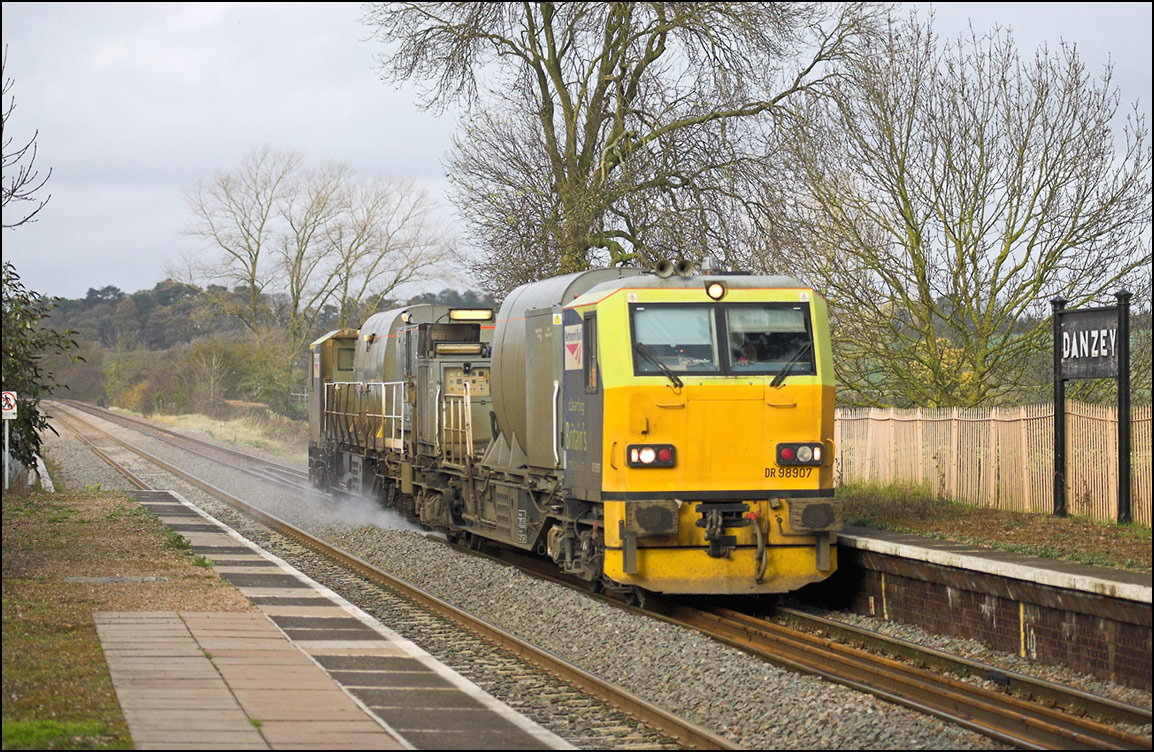 |
The weather forecast for the afternoon of 12 November 2009 indicate that strong winds and heavy rain would replace the clear skies of the morning. Hoping to catch to catch a cloudy but bright interlude I headed off to Wootton Wawen station, on the North Warwickshire Line, with the intention of taking a photograph of 3S87, the RHTT scheduled along there. When I arrived at the bridge over the station, the sun was out and, being in a cutting, the line was shadowed with a brightly lit background. This wasn't at all what I wanted, so had a quick drive to Danzey, on the other side of Henley-in-Arden where the sun, if out, would be in the right place. Naturally, as soon as I arrived, a thick bank of cloud appeared but as the train appeared in the distance a small hole in the cloud allowed the sun to poke through. New London Midland station signs have recently been erected here, replacing the previous Regional Railways versions. I really enjoy these short sessions on my local lines and much prefer it to spending a few hours alongside a main line somewhere photographing routine traffic, especially in poor light. Maybe, after many years, I have become more selective! |
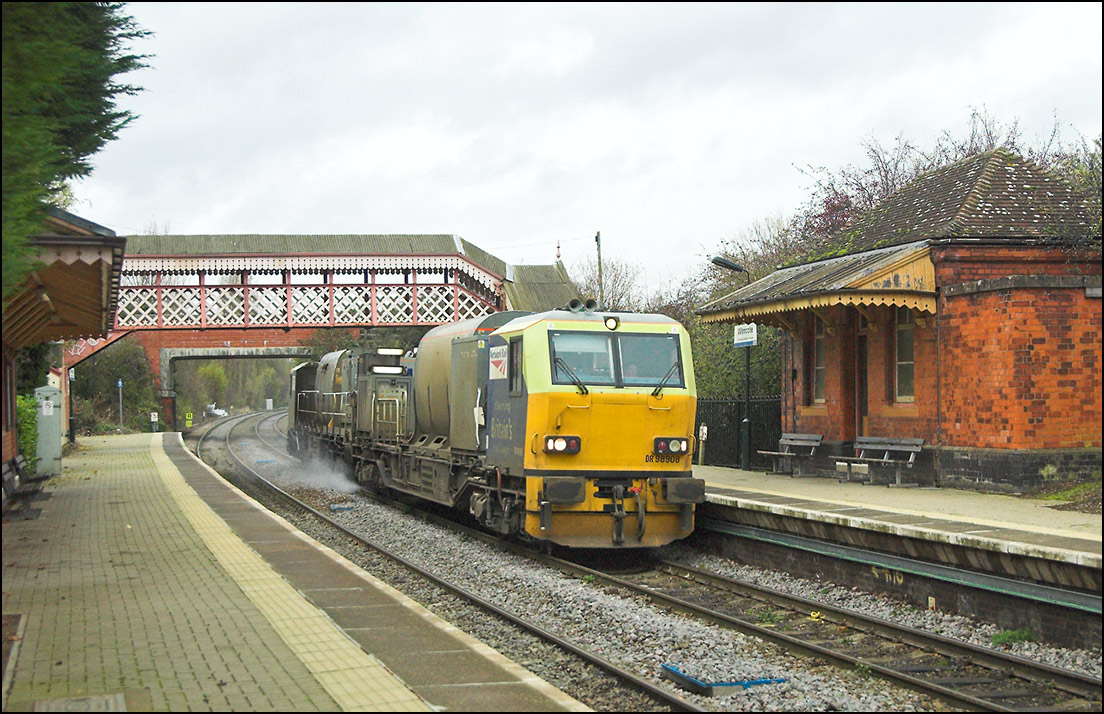 |
Friday 6 November was another dull and drizzly day in Stratford-upon-Avon so I took the opportunity to obtain another couple of shots of 3S87, the RHTT that runs down and up the North Warwickshire Line with a reversal at Stratford. I do like to take pictures of these short trains in station settings so that there is some definable character to the shot, especially when the light is on the dire side of dreadful. Here is DR98908 leading the formation through Wilmcote, a pretty well preserved example of a Great Western country station, unusually with buildings still extant on both sides of the lines. That on the down side, adjacent to the train, has been closed for as long as I can remember but I can recall the booking office on the up side being in use. I believe that a cardboard model of the down side building used to be available and examples are probably in use on model railways somewhere in the country. |
 |
There wasn't too long to wait before 3S87 reappeared, climbing the last few yards of the 1 in 75 of Wilmcote Bank before passing the eponymous station, but even in that short time the light deteriorated quite dramatically.. I took this shot early enough to show the privately owned and well maintained buildings on the up side of the station, along with part of the substantial house once occupied by the Stationmaster here. The GWR knew how to look after their staff in the days when the holder of such a position was a prominent member of the local community. I know that it's down to personal choice but I do feel that those who photograph only locomotives in the countryside miss out on some great historic locations and infrastructure. In how many places does one see a bicycle shed built in such as style as this, with accurately shaped woodwork? OK, the colour, a pinkish brown, is not authentic GWR but it does match that of the other stations along the line. New London Midland Railway signs are gradually appearing in the area and I imagine that it won't be too long before Wilmcote gets the treatment. |
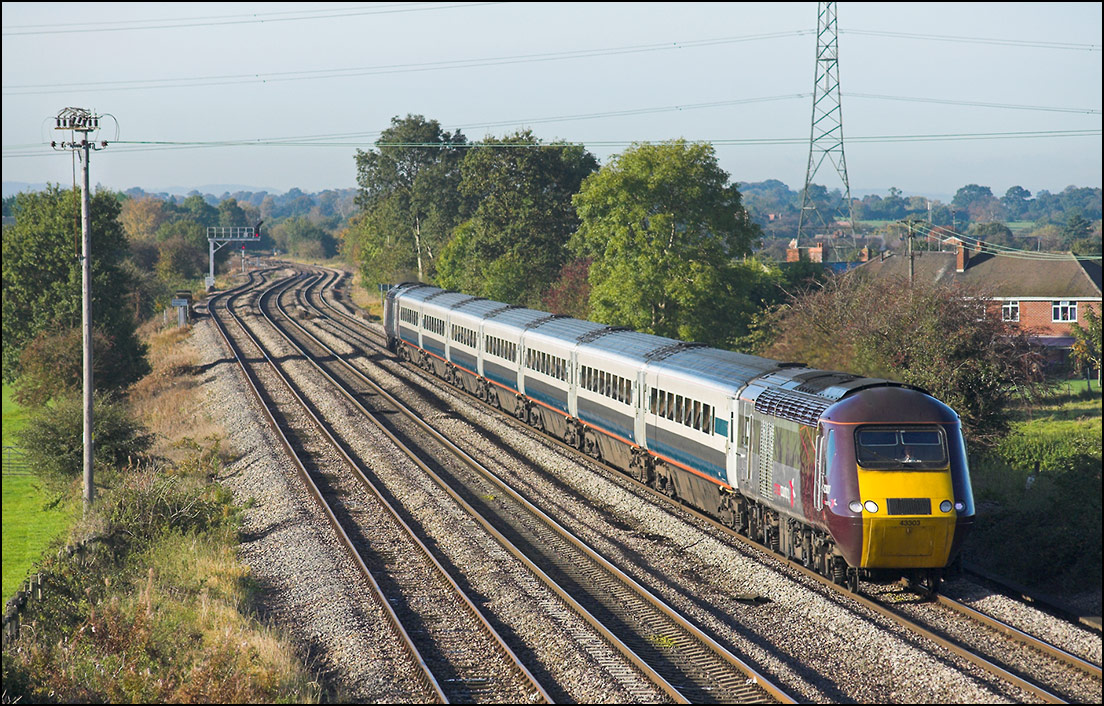 |
Arriva CrossCountry trains have recently been using an HST for at least one of its services, 9S53, the 06.40 Plymouth to Aberdeen, although I believe that the headcode is soon to revert to the more traditional class 1S53. I wanted a photograph of the set with the newly painted power cars but still with the MML coaches as these transitional pictures are more interesting in years to come than those showing the overall corporate liveries. The train was due to pass Bromsgrove at 10.05 so, on Friday 17 October 2008, I went just south of that point and had to wait only a short tome before the welcome sight of 43303 at the head of the train came into view. I committed the cardinal sin of cutting of the top of the electricity pylon in this picture so went the whole hog and cropped the image slightly to increase the impact of the train and make it look as if the error were intentional! |
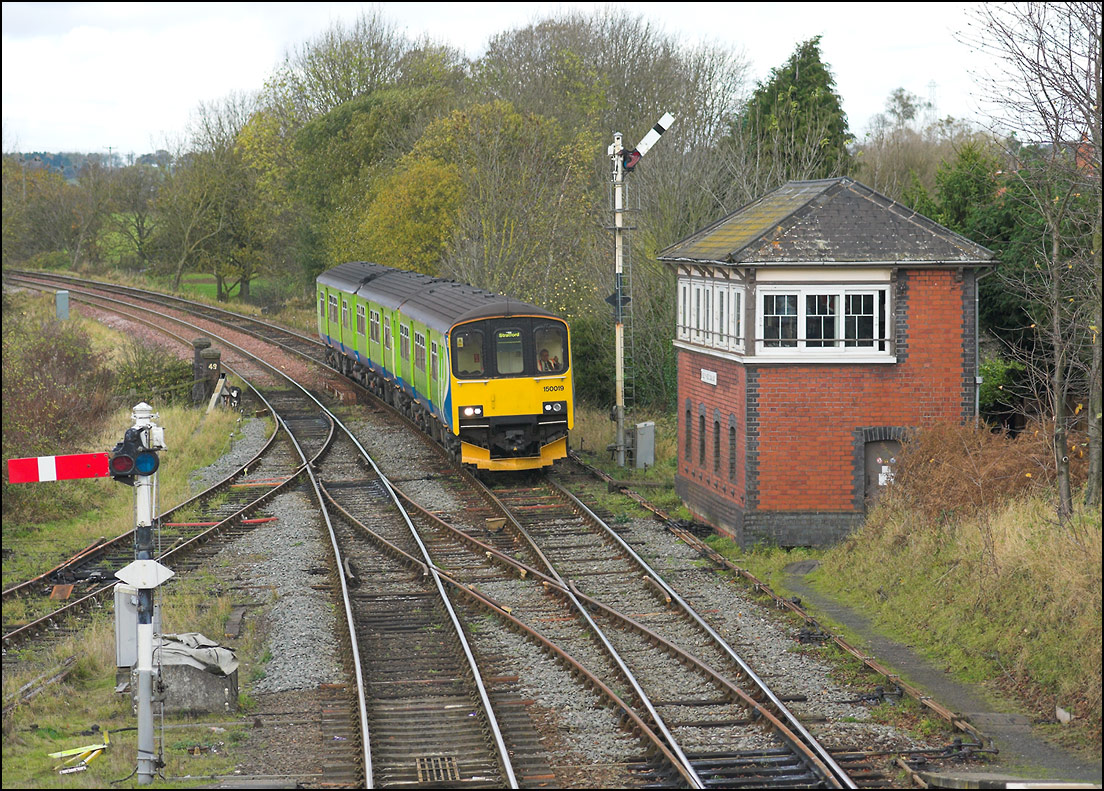 |
On Thursday 5 November 2009 I decided not to bother with a shot of 47805 hauling the Burton-upon-Trent to Dollands Moor empty steel train but went instead to Henley-in Arden station for a few more pictures of a DMU and the RHTT going to and from Stratford-upon-Avon. The old railway infrastructure at Henley is unlikely to survive for much longer given that resignalling is imminent so I thought that it would be a good opportunity to top-up my images from here. First along was 150019 slowing for the station stop while working a Stourbridge Junction to Stratford-upon-Avon train. Despite there being plenty of blue sky around, I wasn't lucky with the sun on this occasion so the Autumnal colours aren't shown to their best advantage but I was happy enough to secure some more photographs of this attractive country byway. |
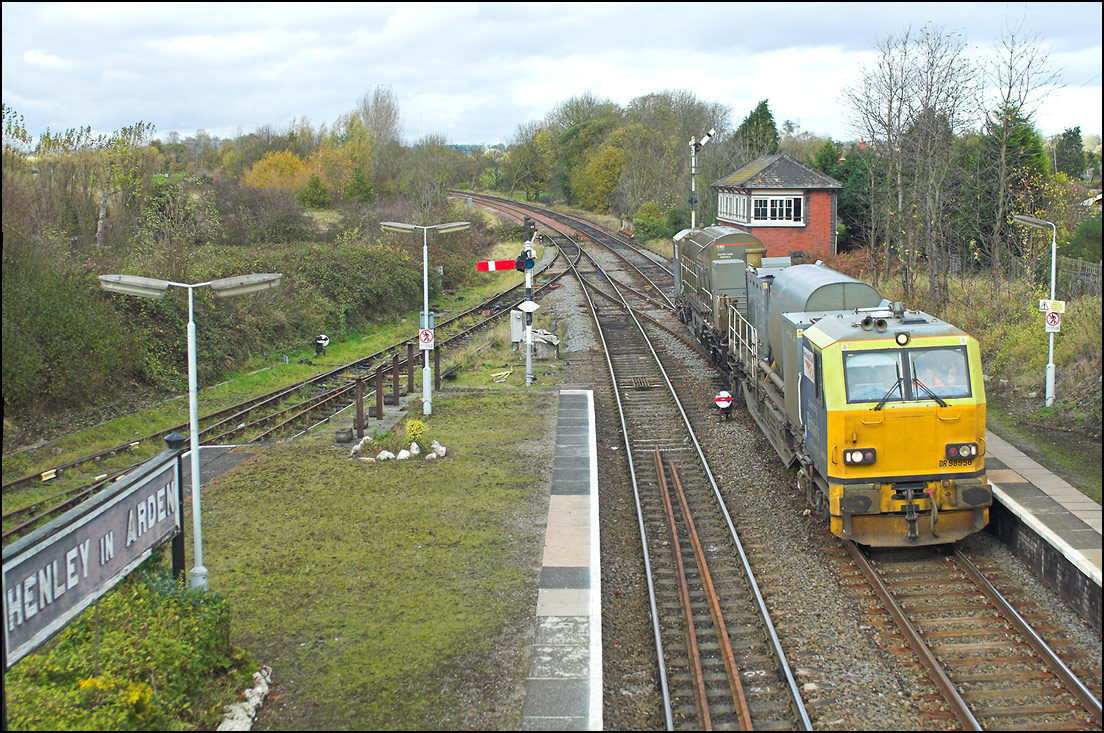 |
The DMU in the picture above soon cleared the signalling section which currently ends at Bearley Junction and this allowed the signaller to pull off the signals giving 3S87, the Kings Norton to Kings Norton via Stratford-upon-Avon RHTT, a clear road. A couple of minutes after the inner home signal was raised, the sun came out and I took this picture of the bay platform and siding signals. I did once ask a signaller here if it might be possible to take pictures with these signals in the "off" position, but he declined, saying that he thought it quite possible that the points, if moved across to allow the signals to be pulled off, might well not go back again! Anyway, 3S87 with DR98958 leading, came right on time and shortly after the sun went in again, this time into a sky full of black cloud. |
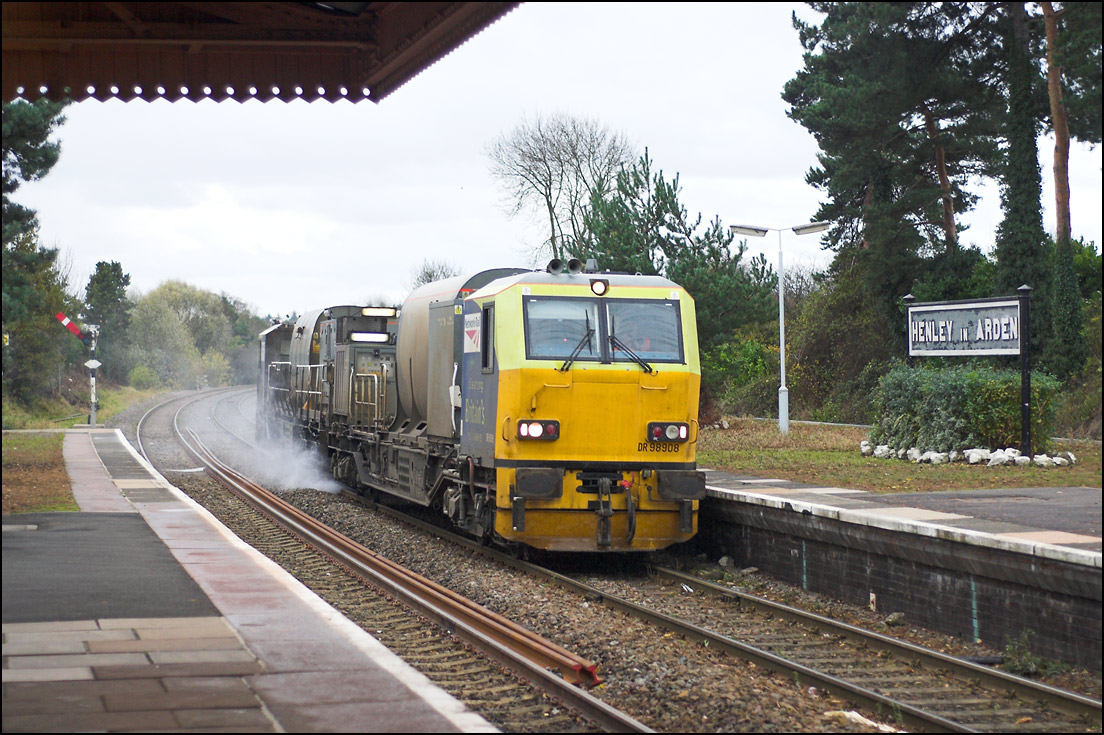 |
I hadn't really intended to stay at Henley in Arden for the return of 3S87 but changed my mind so as to get this picture as it ran through the platform with its water jets going at full belt. A cloudy sky was helpful on this occasion so that a shot looking towards the south-west was possible. Unlike the last time I saw this working, it had been held to right time either at Stratford station or Bearley Junction which meant that it should have crossed a Stratford-bound class 150 in the platform. Fortunately, the DMU was a minute or so late and my shot, with DR98908 now leading, wasn't obscured. |
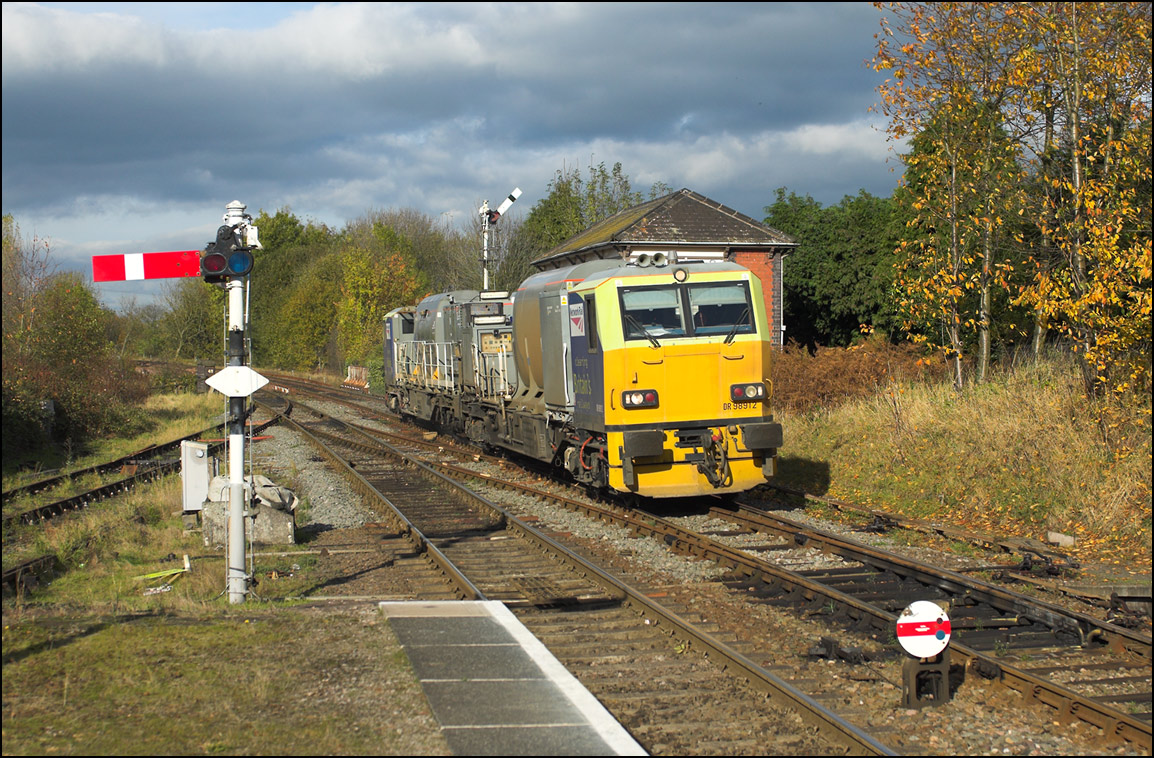 |
I always like to take a few pictures of the RHTTs on my local lines and once the clocks have changed at the end of October there are few better places for a shot than Henley-in Arden. Here is DR98912 leading 3S87, the Kings Norton to Kings Norton via Stratford-upon-Avon train, past the signalbox and associated semaphore signals. To be quite honest, as one who was brought in GWR territory, I should prefer signals operating in the lower quadrant but the pegs here still are an attractive feature of the North Warwickshire Line. It won't be long, probably less than 12 months, before the box here is taken out of service and the signals replaced with modern equipment operated from Landor Street panel so this year may well be the last chance for this shot. For a better view of the signalbox, use this hyperlink. One benefit of the resignalling will be that a half-hourly passenger service will be possible throughout the day with the chance to run trains with fewer stops, thus resulting in much reduced journey times. There will also be more paths available so the few special trains that run from the north to Stratford may be routed this way. |
_SBJ_Hen_281009.jpg) |
The regular passenger services along the North Warwickshire Line run between Stourbridge Junction and Stratford-upon-Avon. These are currently formed of class 150 DMUs although new class 172 units should make an appearance in the relatively near future. Here, 150007 forming the 14.27 from Stratford, calls at Henley-in-Arden and is using platform 2 from which the overall canopy was removed many years ago, the passenger accomodation now being a steel and glass shelter. The canopy remains on platform 1, but somewhat bizarrely, there are no seats of any description. New signage was being fitted during my visit and it is to be hoped that a use may be found for the boarded up but still sound building. In common with several other stations along the line, Henley has been painted in some rather odd colours, bearing no relationship to any railway company colour schemes either past or present. Before many minutes had passed, 3S87 returned north and is here seen between the up and down signals on the Stratford side of the station. The RHTT has to wait here for a few minutes until the preceding passenger train had cleared the section by reaching Shirley station. |
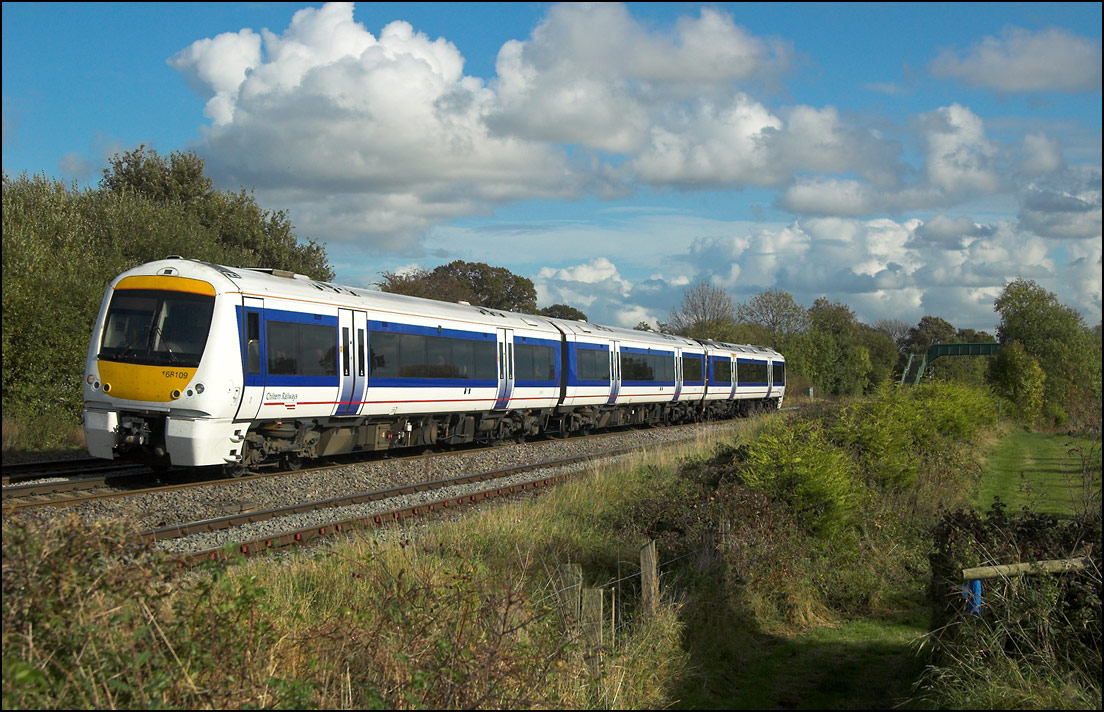 |
With the prospect of a few freights along the line through Hatton and with Friday 23 October being the last weekday before the clocks go back for Autumn I spent a couple of hours at the south end of the cutting. The first train at which I pointed my camera was the 12.20 Marylebone to Birmingham Snow Hill formed of class 168 168109. I can rarely resist taking pictures of these units when the sun is in the right place and especially when there is such an attractive cloudscape. I do not know whether it is down to the topography of the area but the skies around Hatton and Warwick often have a highly photogenic appearance during the early afternoon. One of the regular Autumnal features of the landscape at Hatton is a field of pumpkins ready for the customers at Hatton Country World preparing for Halloween celebrations. |
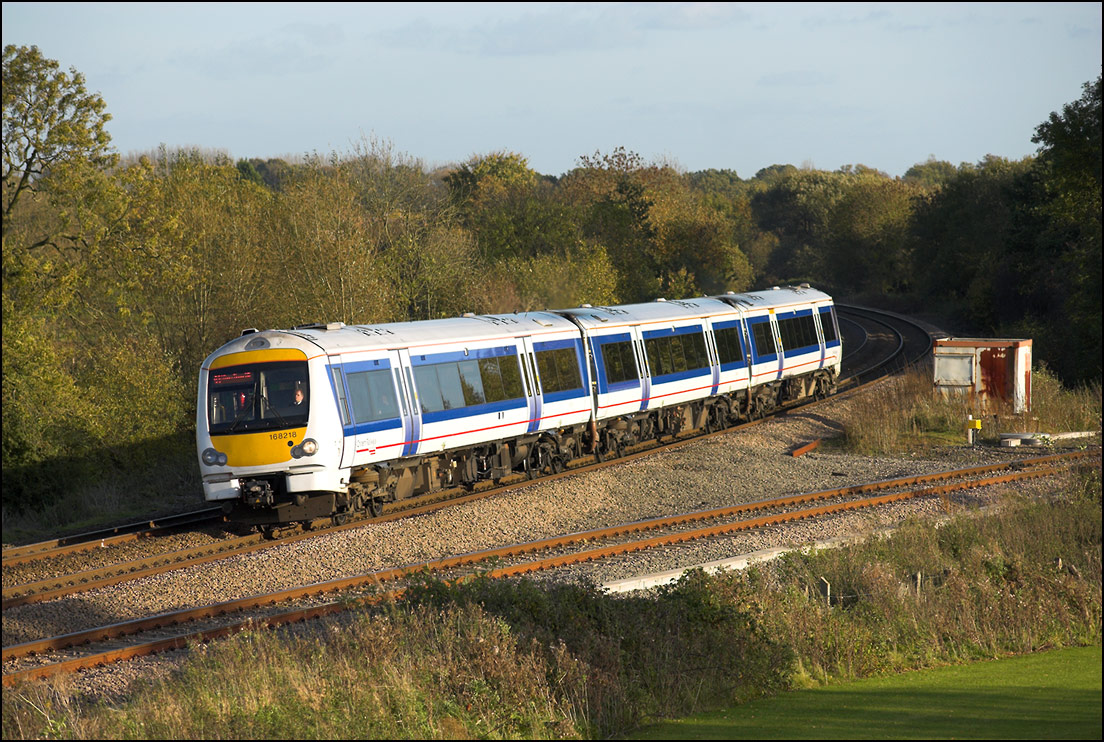 |
Whilst waiting for some freight activity at Hatton North Junction during the afternoon of 24 October 2008, I whiled away the time by photographing the regular passenger trains. I never think it's a good idea to upload every single image taken during a session at a single location but I do quite like this shot of a three coach Chiltern Railways class 168 unit, 168218, forming a London Marylebone to Birmingham Snow Hill service. The shadows were becoming a bit intrusive by 4pm so I switched to a stronger lens which helps to accentuate the curve, and almost tunnel-like effect of the tree-lined railway. |
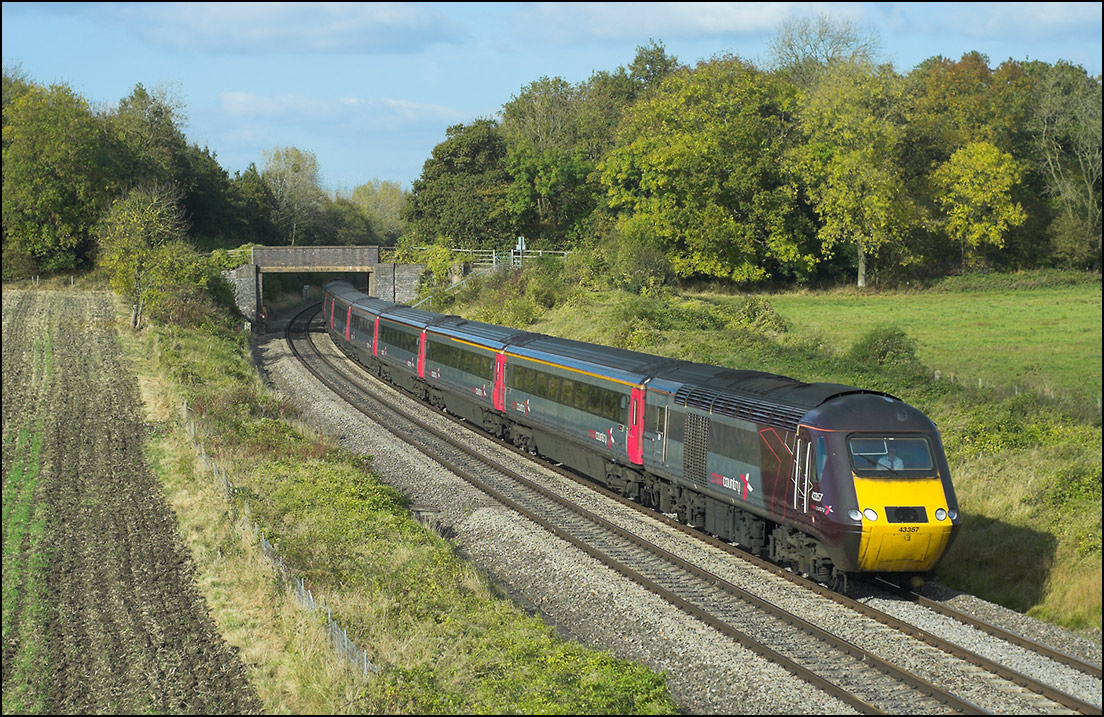 |
Cross Country Trains run several HSTs from Scotland and the North East to the West Country route. Thes relatively elderly sets still perform as well as they always did and provide infinitely more comfortable accomodation for passengers than the noisy, cramped and vibrating Voyagers. Here is 43357 leading the 06.32 Dundee to Plymouth service past Croome Perry Wood at 14.06 on a sunny Friday 16 October 2009. I was a bit disappointed that the Autumnal colours in the background have yet fully developed so I may return in a couple of weeks given the right conditions. |
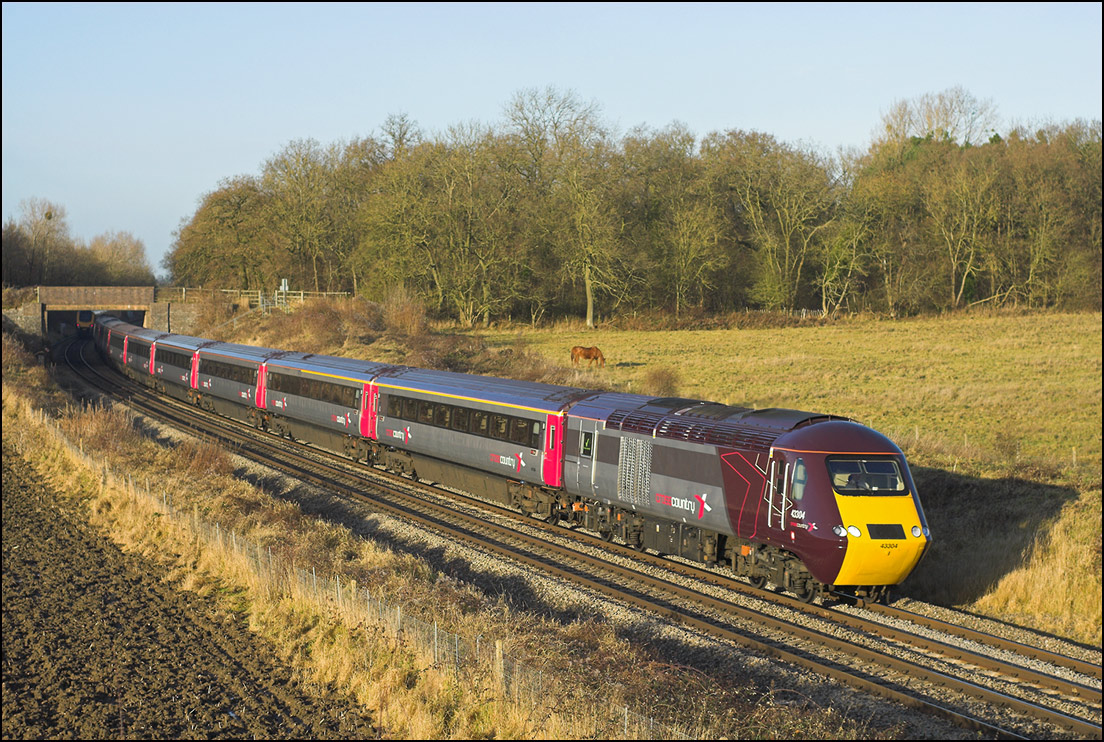 |
While standing on the grass verge at Croome Perry on 17 December 2008 I received a message from a friend saying that a full Arriva Cross Country HST set was on its way with 1V39, the 06.32 Dundee to Plymouth service. I think that HST liveries have improved as time has passed and the latest is the finest so far applied to these trains. Here is 43303 leading the set out of the wood as a Voyager from the same TOC recedes towards Abbotswood Junction. This isn't the best location for HST photographs as the rear power car is out of view but at this time of the year one's options are limited. A little while earlier, 47237 had gone north with Advenza's empty scrap train from Cardiff to Shipley. There is no worthwhile northbound shot here at the best of times and at this time of day in mid-December a going away shot, although largely unsatisfactory in my eyes, is the only choice. The wagons on this train always bring back happy memories of chasing class 33s around Kent on the trains conveying Channel Tunnel lining segments. |
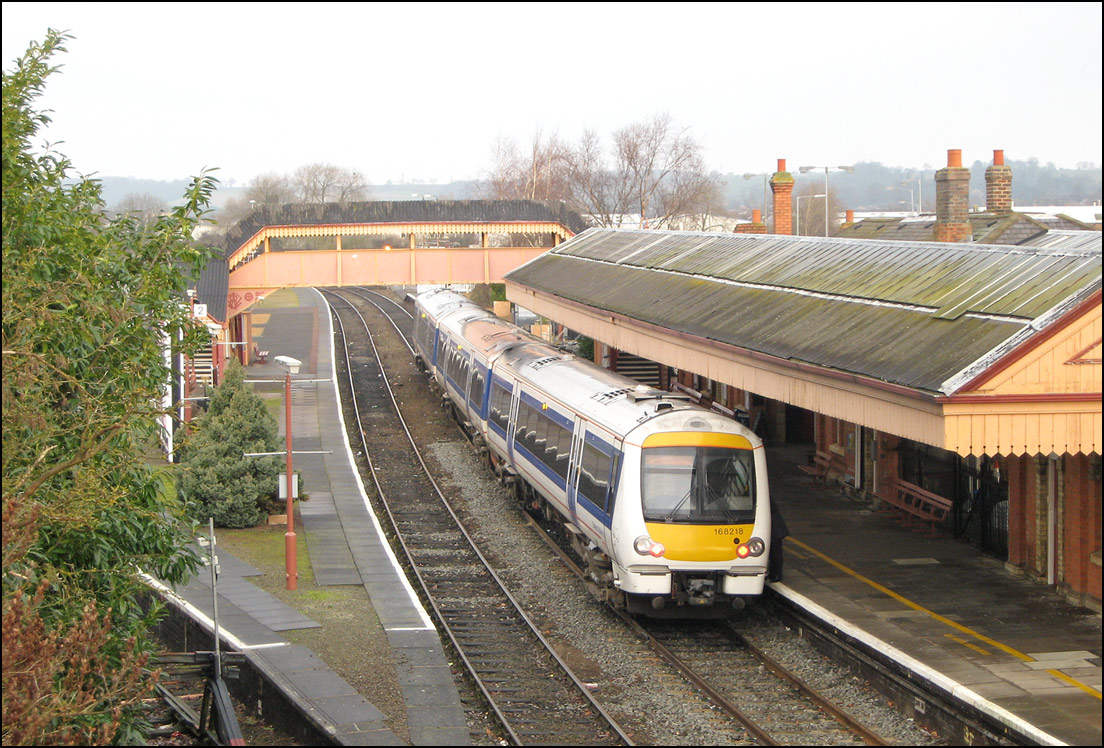 |
Most Stratford-upon-Avon to Marylebone services are formed of Chiltern Railways' class 165 stock, with occasional substitutions by class 168. Whilst I have seen several 168s it has always been on occasions when I have had no camera available. When going walking into Stratford-upon-Avon I have taken to carrying a compact digital camera to record the day-to-day street scenes around the town and from time to time donate a CD of images to the local archives. It has always been said that in 20 or 30 years time it is the ordinary scenes that will be of far more interest than special events; one does forget how much the average High Street changes in a relatively short period. Anyhow, I had my Canon Powershot A550 in my pocket (the model with a proper, zooming, optical viewfinder, none of this ridiculous holding a camera at arms length to compose a picture for me!) when I passed Stratford station just as the 09.38 to Marylebone was about to leave on Friday 16 January 2008 so finally obtained the shot I have been waiting for some time to take. |
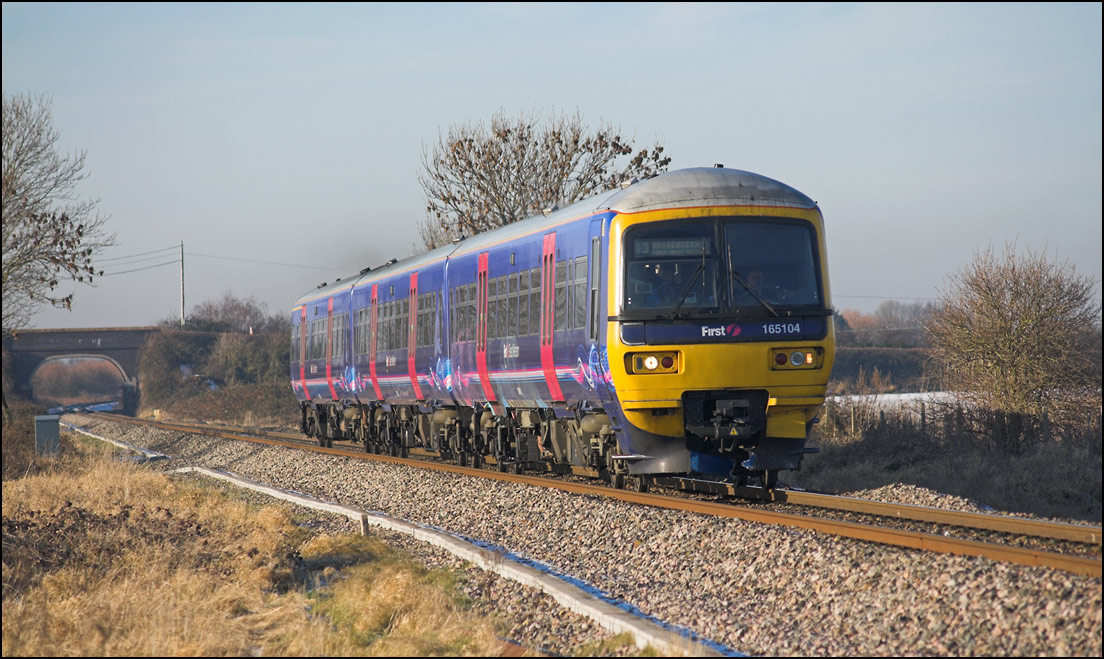 |
Tuesday 6 January 2009 started off with freezing temperatures and clear blue skies. After a trip to the gym and swimming pool I decided to head over to the Cotswold Line to, hopefully, take advantage of the sun and any snow still lying around. There certainly was plenty of snow around Fladbury but unfortunately it was largely in shadowed areas, that in the sun having pretty much melted. There was still a small amount on the surrounding hills but it didn't look as if would last long. The first train to come past the boarded foot crossing between Fladbury and Lower Moor was 165104 forming the 12.06 Worcester to Paddington Service. These units have made a bit of a resurgence on the line since the timetable change in December, after not having been seen along here for a while. |
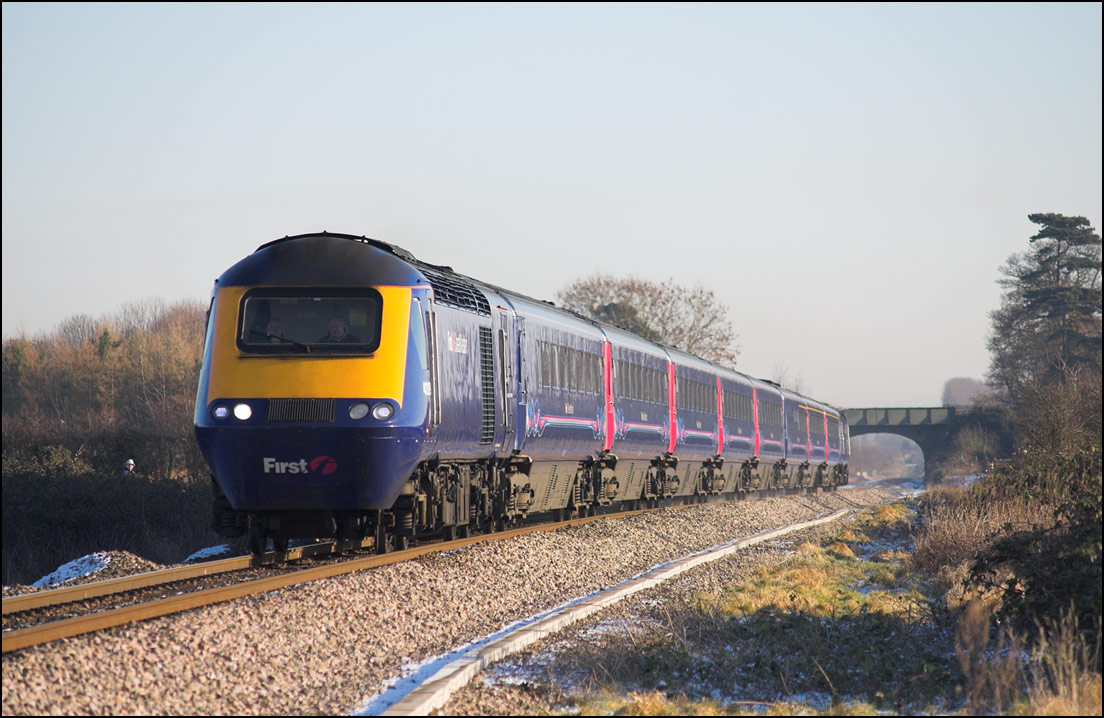 |
Everything appeared to be running to schedule on the Cotswold Line on 6 January 2009 because the 10.22 Paddington to Hereford train came north just 13 minutes after the class 165 unit shown above passed me. I'm not especially fond of ground level shots, much preferring a little height in order to better show the local environment rather than just a train in an unidentifiable piece of countryside, but on a line such as this with a fair number of lineside trees it is difficult to find a location clear of shadows in the middle of winter. Low-level shots also require a lot of care in the post-processing stage in order to avoid a white halo around the train roof against the sky; the result of over-sharpening. This sin also manifests itself by making the radiator grills of locomotives and power cars look too bright and almost silver in colour. All this, linked with heavy colour saturation, makes so many photographs seen on picture galleries look totally unnatural and nothing like the actual scene by the lineside. |
 |
Adding a welcome splash of colour to the sunny scene at Croome Perry on 16 October 2009 is 153380 leading an unidentified class 158 on the 14.51 Great Malvern to Weymouth. I quite like the current First Great Western colour scheme as it generally provides a good contrast to whatever background one has in the photograph. I generally prefer to take southbound shots in this area at Defford, a couple of miles south of Croome, but the lineside trees cast quite heavy shadows by 14.30 at this time of the year. |
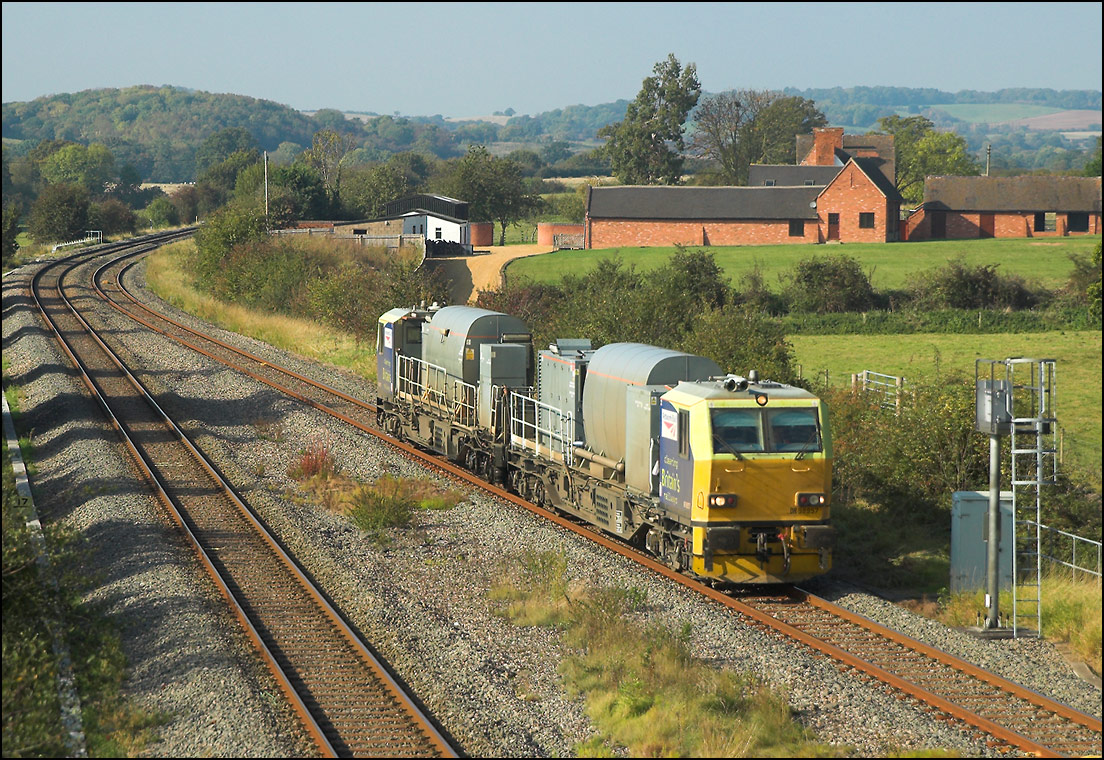 |
The afternoon of Wednesday 14 October 2009 became clear and sunny after a murky start and with nothing much of interest about I went for another photograph of the RHTT train running along the North Warwickshire Line. I initially looked at Henley-in-Arden but the sun was a little too straight at 13.15 so decided to move south a few miles to Edstone Aqueduct, where the line swings around onto an east/west axis. I heard the horn on DR98957 blow for a crossing just as a narrow boat started its journey across the longest cast-iron aqueduct in England and thought that I might have my shot obscured; an unusual situation to say the least. In the event, all was well and 3S87 came about 5 seconds after the boat had cleared my position. |
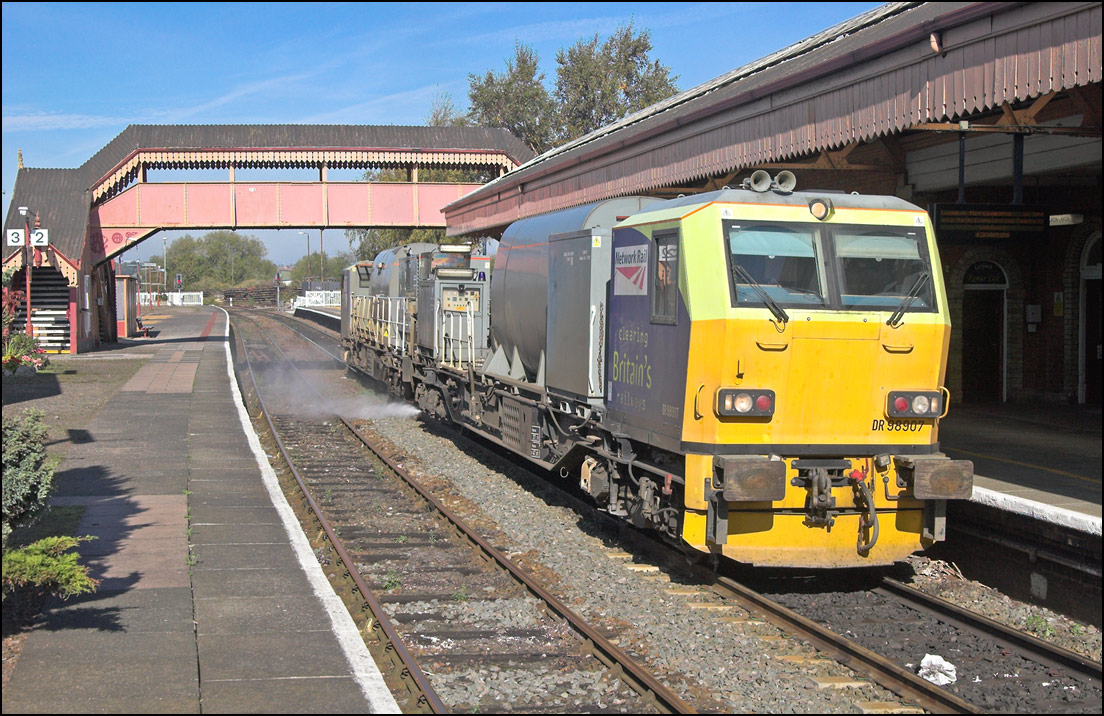 |
As Autumn porgesses the Raihead Treatment Trains start their daily journeys around the country both to clear leaves from the line and to apply Sandite, a paste intended to aid adhesion in slippery conditions. The West Midlands RHTTs are based at Kings Norton from where one diagram runs down to Stratford-upon-Avon, where arrival is scheduled for 13.48. I wasn't surprised to see a slightly early arrival on 13 October 2009 when DR98907 + DR988957 came into the station before reversal and a northbound run along the North Warwickshire Line via Henley-in-Arden. The other line to Stratford, that from Hatton to Bearley Junction, is not covered as there are no real gradients that might cause problems for the trains running over it. Here is a slightly closer view as the MPV stands in platform one while the crew changes ends, and a heavily backlit shot as the train, 3S87, departs a few minutes after the 13.41 Chiltern Trains service to Marylebone has started its journey. |
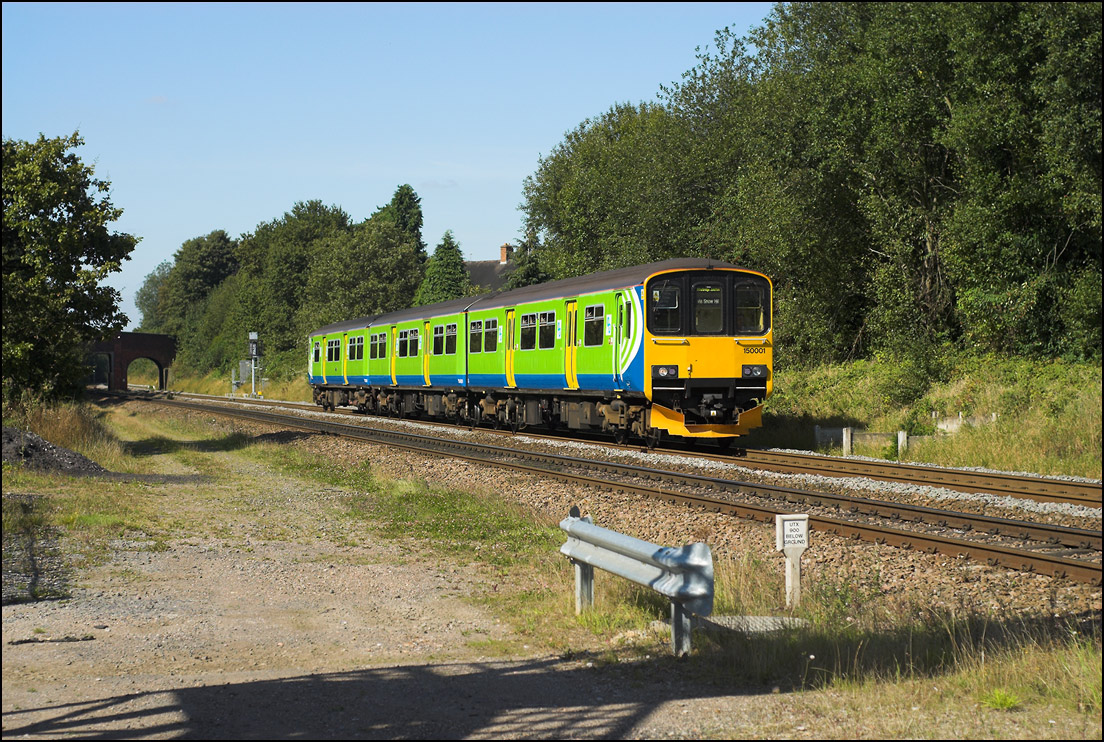 |
For those with a fondness for photographing class 150 DMUs, the line between Birmingham Snow Hill and Dorridge is a happy hunting ground as there is regular service at 20 minute intervals throughout much of the day. The train generally run into the bi-directional platform 3 at Dorridge and return north within a few minutes of arrival. Here is 150001 crawling towards the crossover from the up main line at Bentley Heath, situated just to the south of the crossing, to the line leading to the platform. Dorridge is also served by Chiltern Trains' class 165 and 168 units to and from London Marylebone and here is an example of the latter, 168106 slowing for the station stop. |
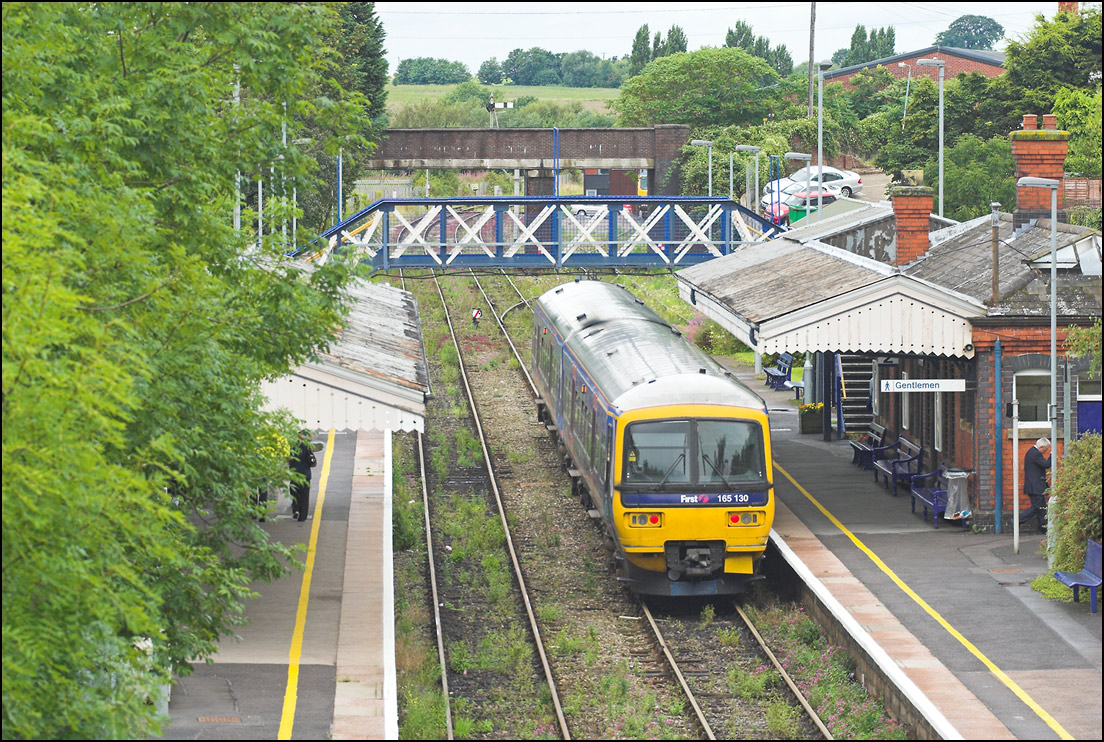 |
After photographing a ballast train at Aldington I made the short journey to Evesham station to find that the up platform was well populated with passengers waiting for the shuttle train to Worcester, this section of line being open for business. Within a few minutes, 165130 came into the platform for the passengers on it to alight ready for the onward journey to Oxford in one of the fleet of coaches waiting in the car park. This picture is slightly unusual in that it shows a down train in Evesham's up platform, with the ground signal in the "off" position to allow it to run wrong-road for a short distance until the single track to Norton Junction is joined. |
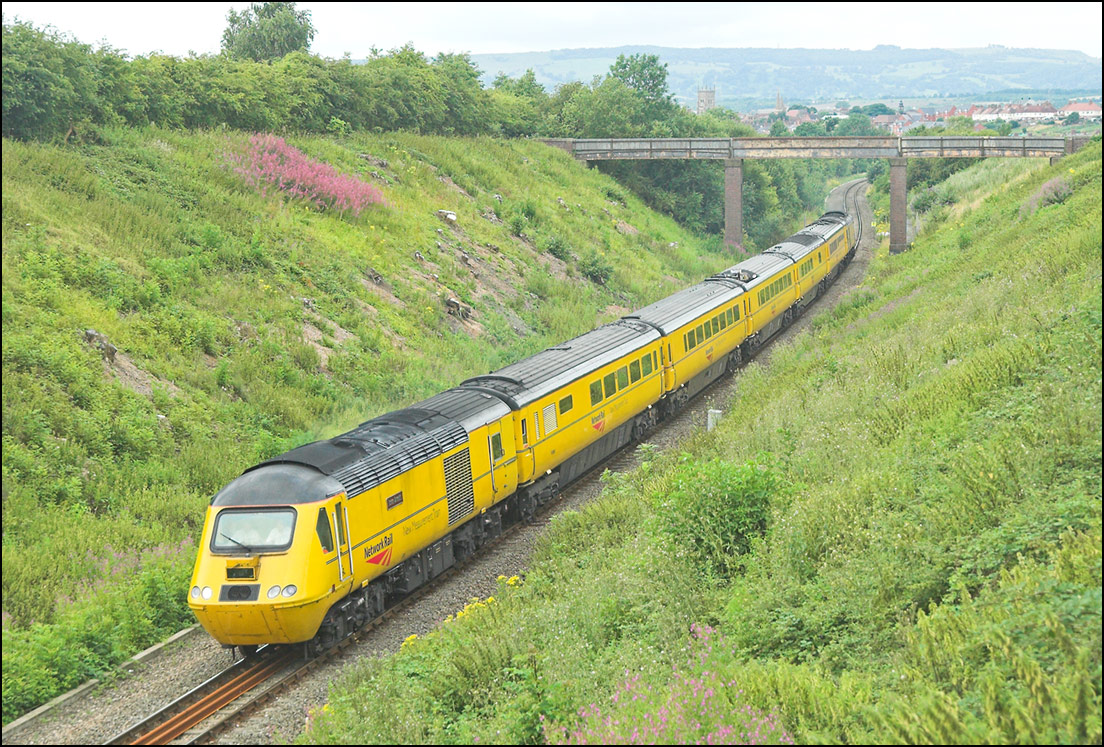 |
At the time of writing in mid July 2009, the Cotswold Line is about to become the subject of dramatic changes as much of it is about to receive double track after many years of being largely single. One of the sections of line to see this work carried out is that between Evesham and Moreton-in-Marsh so with only a few days to go before a two week long closure I went to this location just west of Evesham to take a few pictures of the scene pre-alteration. The first working that I saw was the New Measurement Train working as 1Z16 Derby to Derby via Worcester and Oxford with power cars 43062 + 43014. The weather was cloudy so I took the opportunity to take my photograph from the north side of the line which, to my eyes, was the more attractive view with the houses and churches of Evesham clearly visible in the background. |
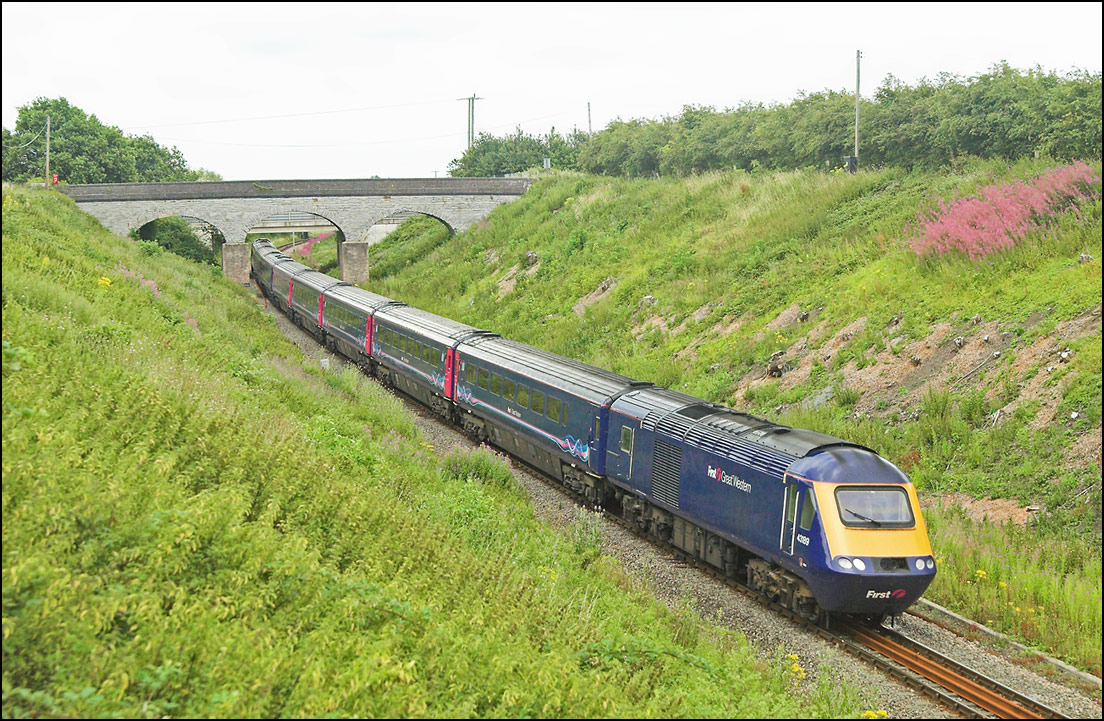 |
Before leaving this location near Evesham I took a photograph of a First Great Western service train, the slightly late running 11.22 Paddington to Great Malvern om the approaches to Evesham station. Once again on a dull day the better view was from the north side of the line showing the attractive stone occupation bridge leading to a riverside hotel and the less pleasing and much more modern bridge taking the Evesham bypass over the line. Much clearance work on the south side of the cutting took place in the early Spring and the remains of several trees can clearly seen in this view. Just off the stone bridge in a field is this ex-railway van used as a store of some description. The white paint marks, a circle containign a cross, showing the van to be withdrawn from service are still visible. |
 |
Most passenger trains between Paddington, Worcester and Great Malvern are currently formed of HST stock but Turbos of classes 165 and 166 do make appearances from time to time. I was told that a local MP complained to First Great Western about the older and inferior DMUs being used in preference to the the newer HSTs! Maybe someone should give him a lesson on railway chronology...Anyway, here is 166201 on the approaches to Worcester on 4 June 2009 with the 13.21 Paddington to Great Malvern which, at this point was running in the region of 20 minutes late. |
 |
A more conventional scene with an HST leaving Worcester is here seen as the 15.11 Hereford to Paddington passes Norton Barracks on 4 June 2009 with power car 43023 leading. The line through here is becoming quite overgrown and due to the presence of a large tree on the left hand side of the line a hefty shadow is cast across both tracks, this becoming more and more obtrusive as the sun moves round towards the west. This is one reason for switching to a longer lens as the afternoon progresses; the other being to foreshorten the view and bring closer the tower of Worcester Cathedral. |
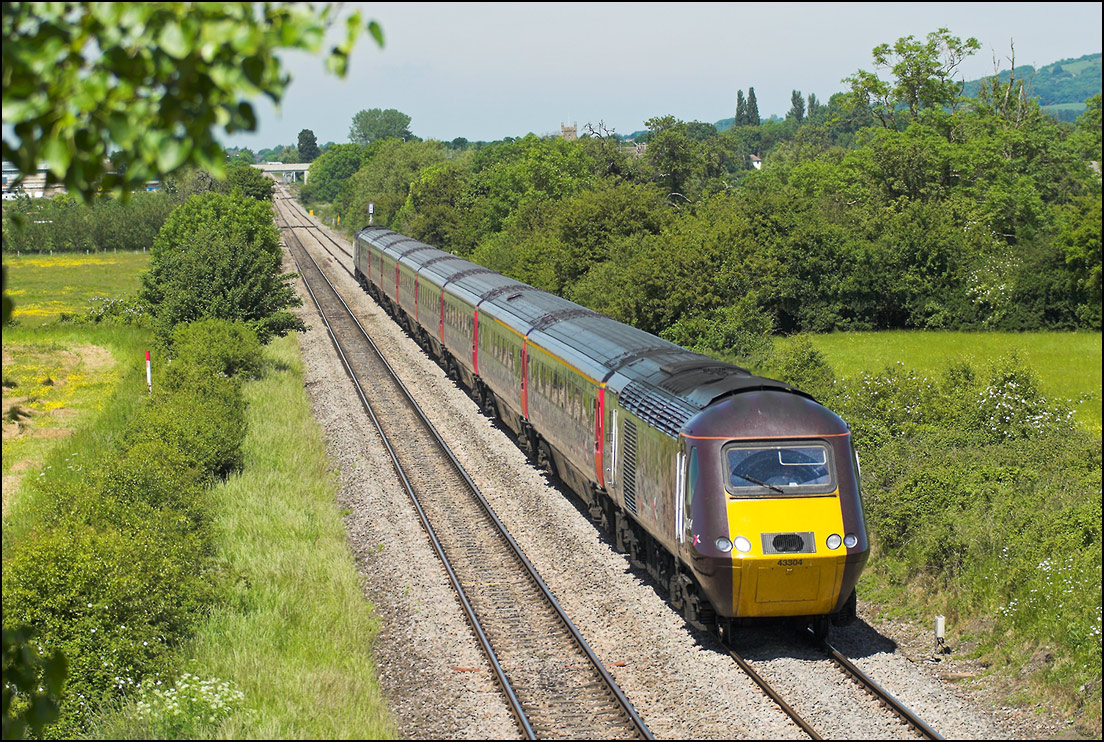 |
Tuesday 2 June was another hot and sunny day so in the absence of any one-off in which I was interested I decided to have a trip to the Birmingham to Gloucester line to take a few photographs of some steel workings. There has recently been quite an upturn in the number of trains conveying steel to and from the Midlands and I expected to see at least 4 trains. First along though was an Arriva HST service, 1V39, the 06.32 Dundee to Plymouth with power car 43303 leading. The sun at Claydon, near Ashchurch was perhaps still a little straight at just after 2pm but at least the light would move in the right direction as the afternoon progressed. |
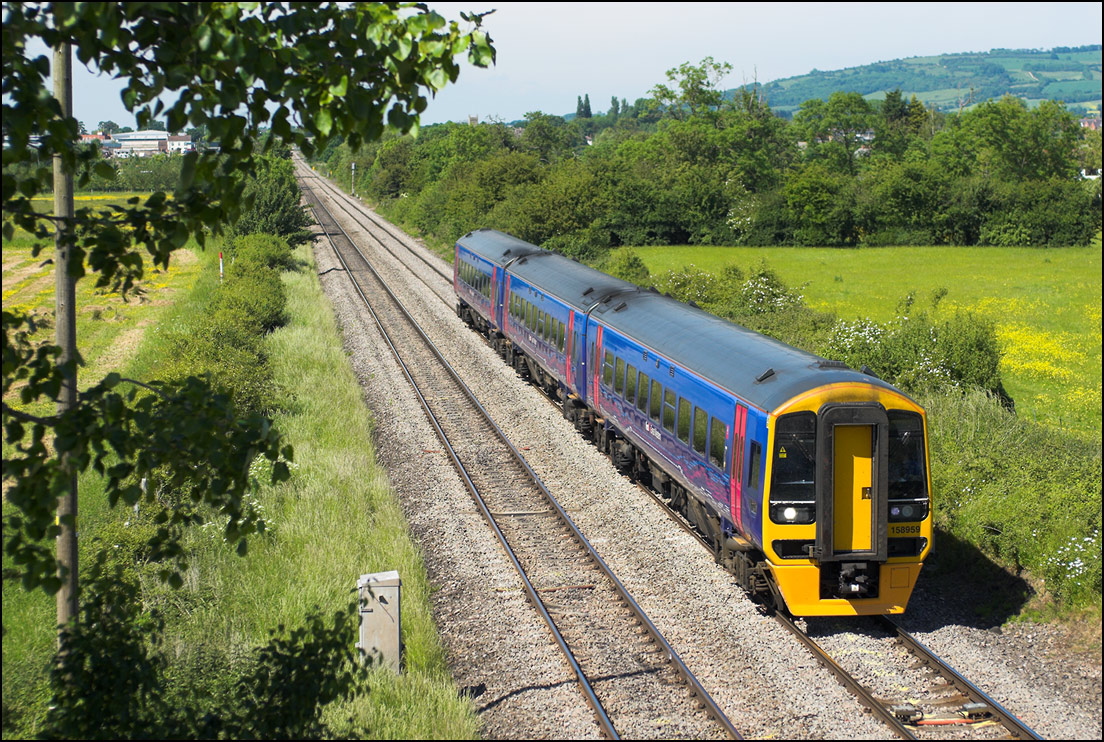 |
Most of the passenger traffic on the Birmingham to Gloucester line is run by either Arriva or London Midland but First Great Western makes its presence felt with trains to and from Worcester and Malvern. Here is 158959 with the 14.51 Great Malvern to Weymouth just after the station stop at Ashchurch on Tuesday 2 June 2009. This train is usually a sign that an empty steel train is on the way as 6V07 from Round Oak to Margam, if it's running, is generally allowed out of Worcester as soon as it has cleared the section towards Norton Junction. |
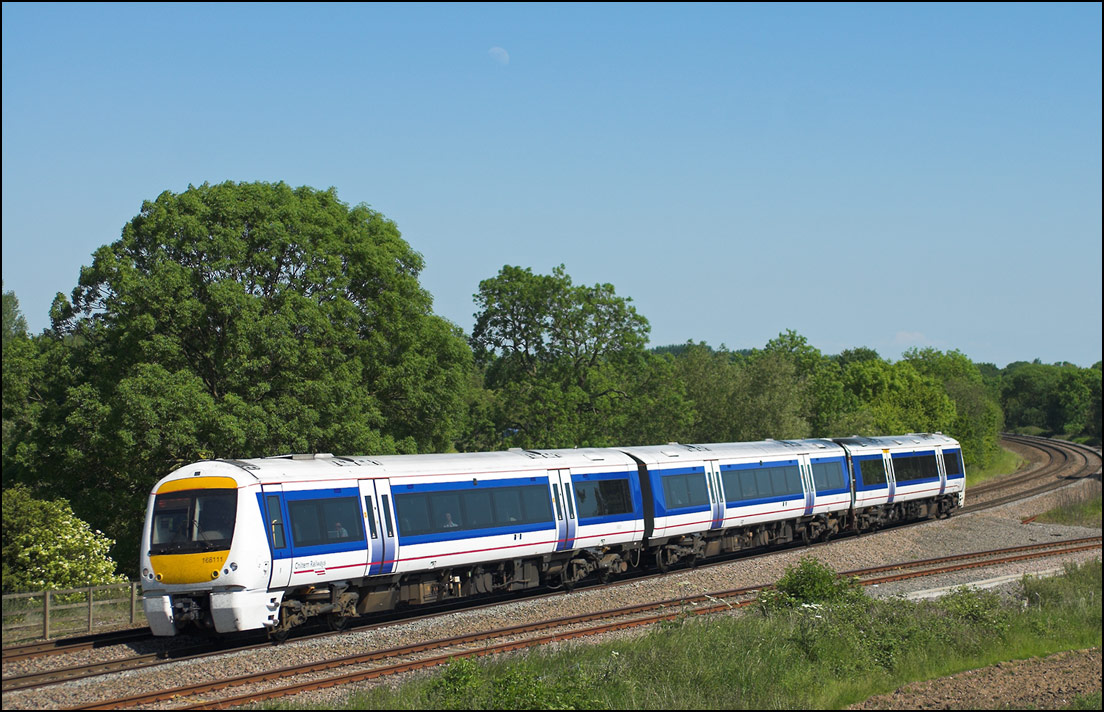 |
The photogenic units of Chiltern Trains run at roughly half-hourly intervals and on a nice day such as 1 June 2009 it is inevitable that they form regular photographic subjects. This then is 168111 accelerating away from the station stop at Hatton, situated just around the corner. The composition of the picture may initially look a bit odd as there is more sky in the shot than would be considered normal but I was keen to include the moon, visible above the smaller of the two background trees. A case of full sun and half moon... |
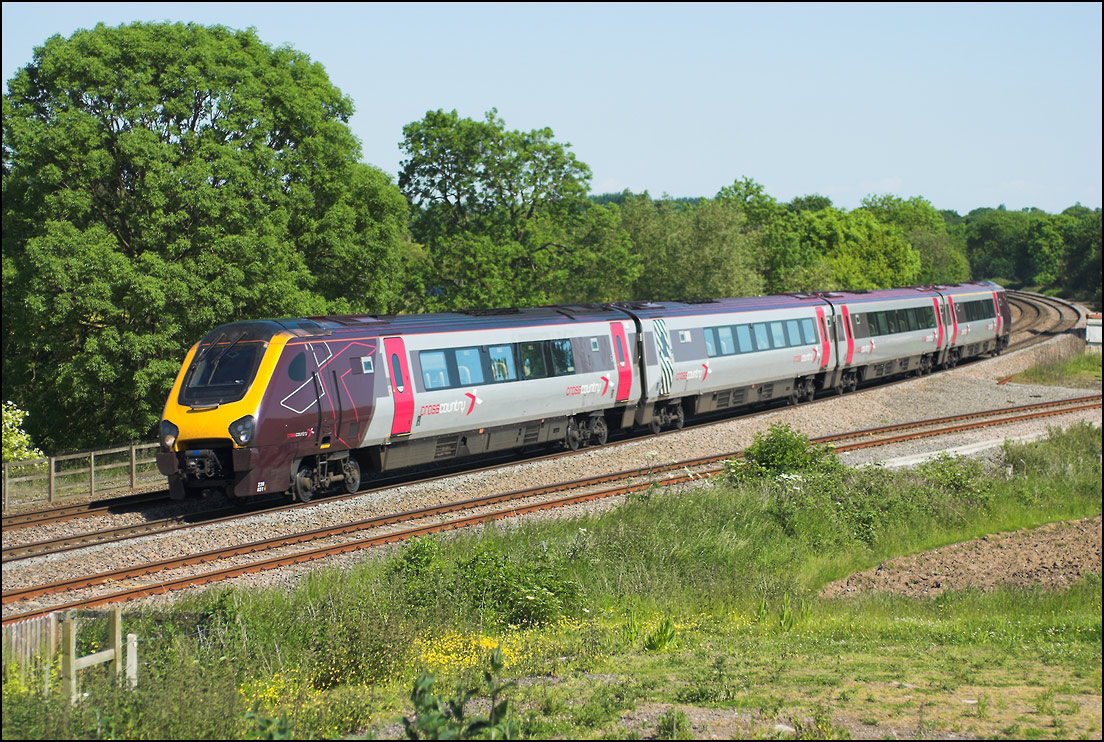 |
I don't have a great fondness for class 220/221 Voyagers, but on the bases that they are better to photograph than to travel on and also that I think that everything moving on the railway should be photographed at some point I take the occasional shot of them if the light is good enough. Here is 220031 passing Hatton North Junction on 1 June 2009 with a train to Manchester Piccadilly. It is a great pity in my eyes at least that a few mainline passenger services weren't routed along this line in earlier days as it is far more photogenic than the alternative route to Birmingham via Coventry. |
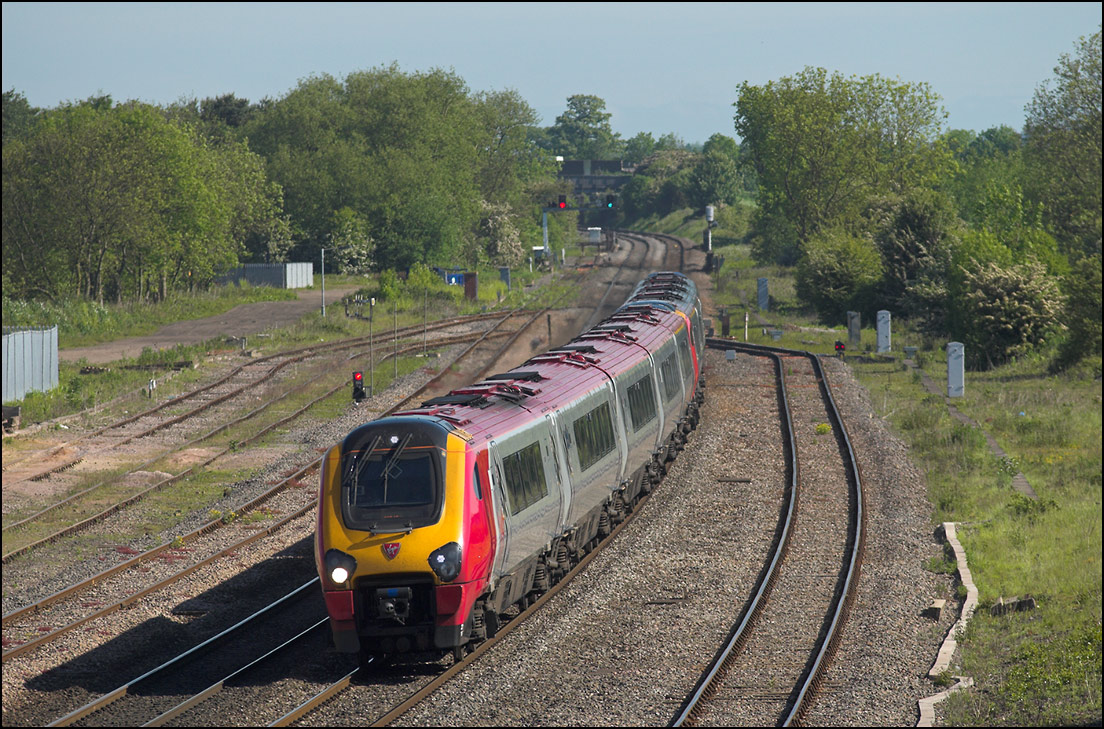 |
Saturday 23 May 2009 saw quite a variety of traffic on the Leamington Spa to Banbury line and remarkably, the weather forecast was more than favourable in that long sunny periods were predicted. Some of the trains were scheduled to run via Oxford and others via the Chiltern Line through Bicester North so it seemed a good idea to be somewhere north of Aynho Junction so as to be able to see the maximum amount of traffic. I decided upon the bridge adjacent to Banbury stone terminal as all the trains in which I was interested were southbound. The first up train along was a Virgin "Blockbuster", 1Z06, the 05.45 Liverpool Lime Street to Euston formed of two class 221 Voyagers, 221104 and 221105 respectively. Just to show that the northbound shot from this bridge isn't up to much, here's a picture of 221140 accelerating away from the station stop at Banbury. Thanks to Chris Beaumont for the Voyagers' ID |
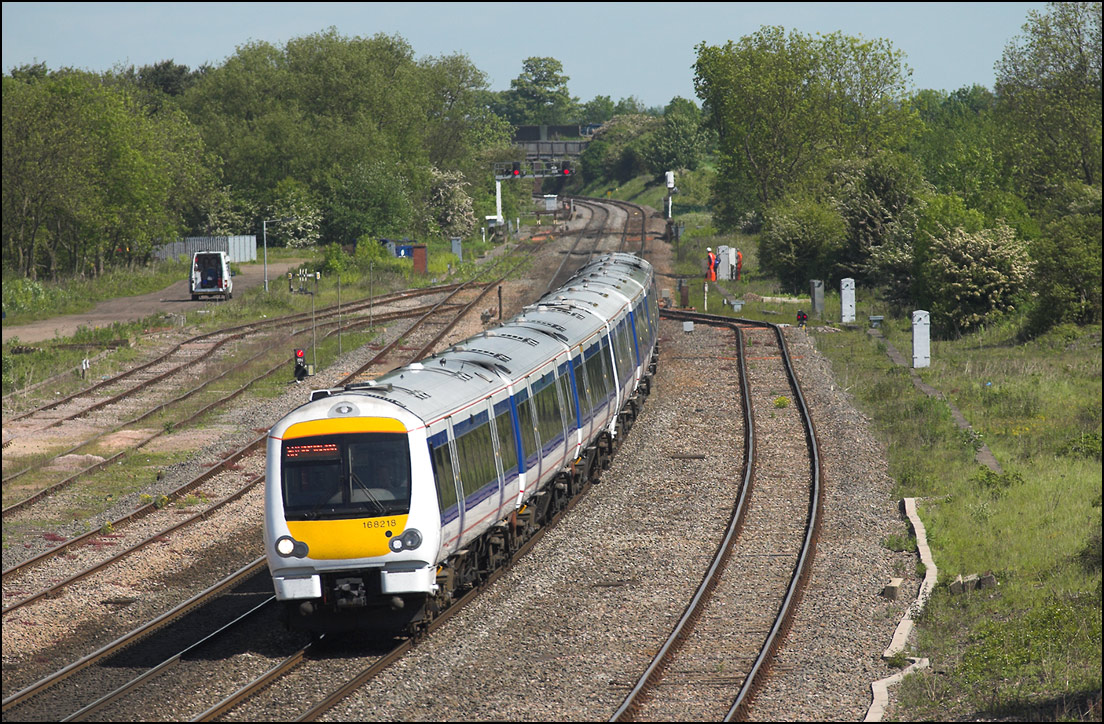 |
Whenever I go somewhere to take railway photographs I do like to obtain a representative sample of all the traffic on the line including whatever units are on the passenger services. The fact is that today the majority of trains on our network are units and it seems worthwhile to photograph them as classes and liveries change from time to time and it is good to have a record. I think that the Chiltern Turbos are quite photogenic in good light and here is the 09.03 Kidderminster to London Marylebone slowing for the station stop at Banbury, formed of 168218 and an unidentified sister unit. |
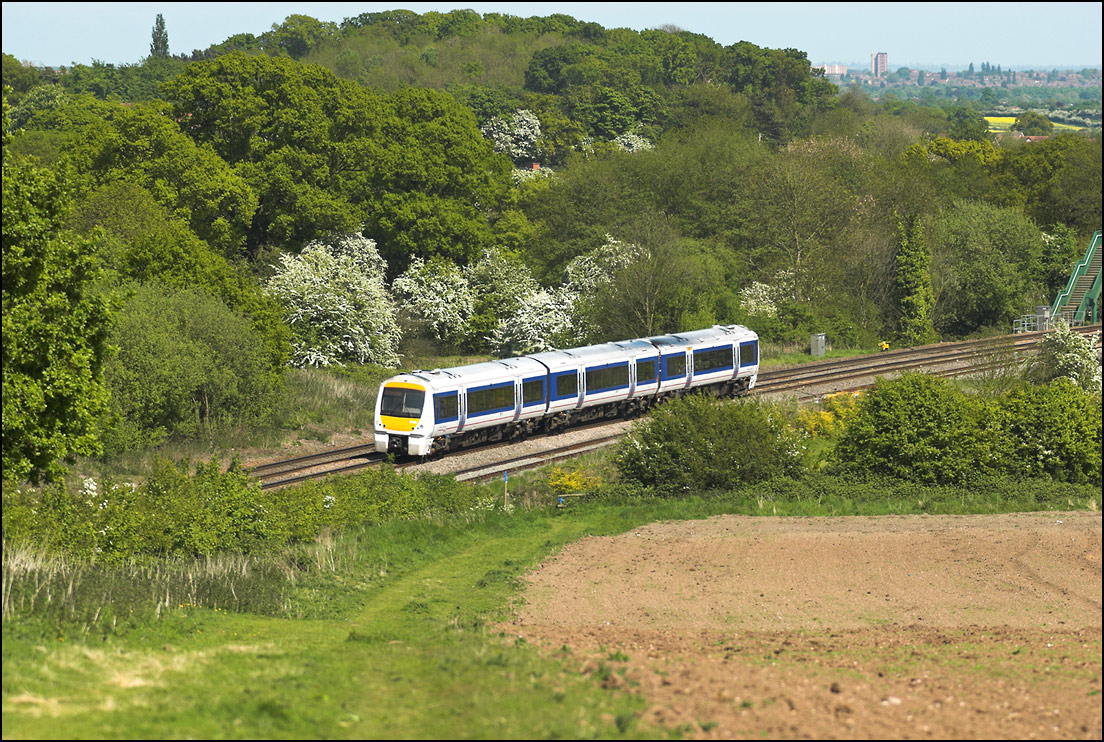 |
The area around Hatton cutting is a mass of blossom in early May 2009, exemplified here by the Hawthorn in flower all around Chiltern Trains' 168108 as it climbs the bank with a train from Marylebone to Birmingham Snow Hill on 9 May. The regular passenger services along this line help to fill the long gaps between freight services, especially in the afternoon, when one is lucky to get two or three freights in a three hour session. I quite like photographing units but the short formations can give problems in areas with panoramic views and I find that a longer lens helps to fill the frame and draw in the background, in this case the north-east side of Warwick looking towards Cubbington. |
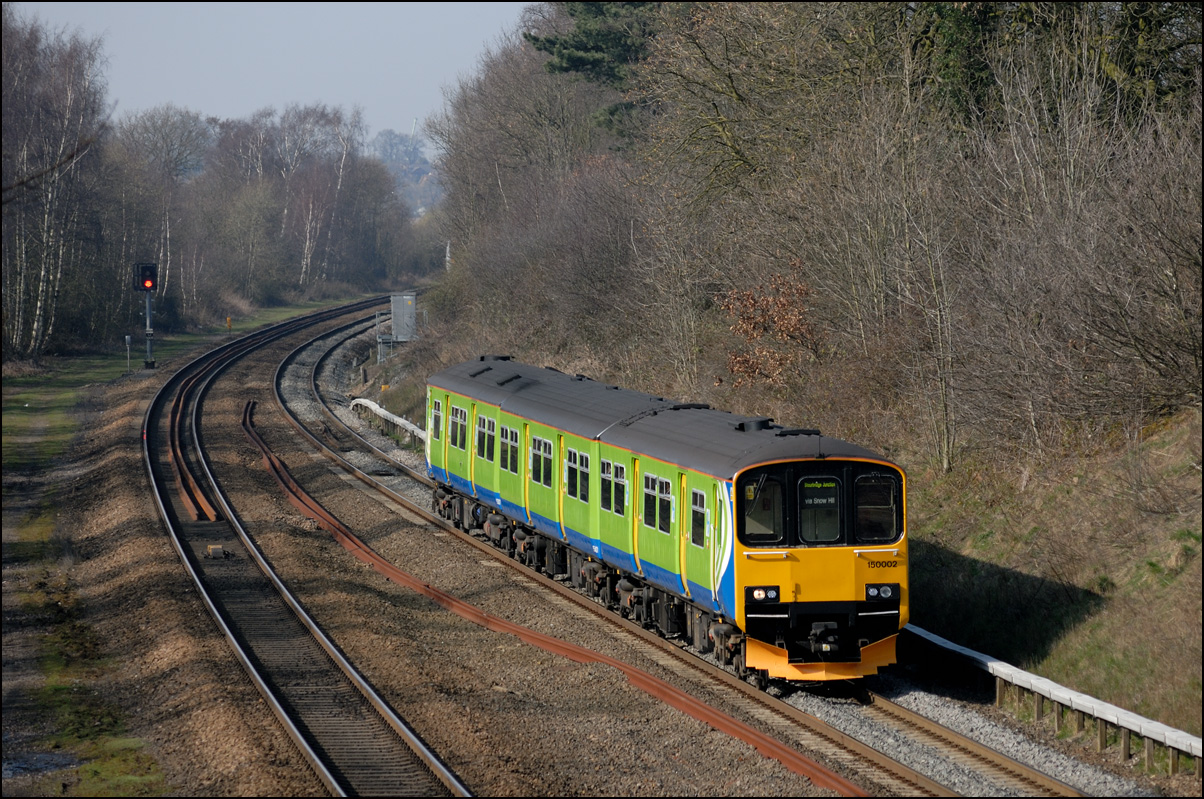 |
Dorridge station, on the GWR line from Birmingham to Leamington Spa, enjoys a 20 minute service throughout the day. The trains are invariably formed of London Midland class 150 DMUs which shuttle up and down from Stourbridge Junction via Birmimgham Snow Hill and Moor Street stations. Here is 150002 approaching journey's end on 19 March 2009 as it slows for an adverse signal which indicates that the train will be routed over the crossover just to the south of Bentley Heath crossing and into platform 3, clear of both up and down main lines. A Chiltern Trains class 168 can just be seen disappearing around the curve in the background as it travels the final few miles of its journey to Birmingham Snow Hill. |
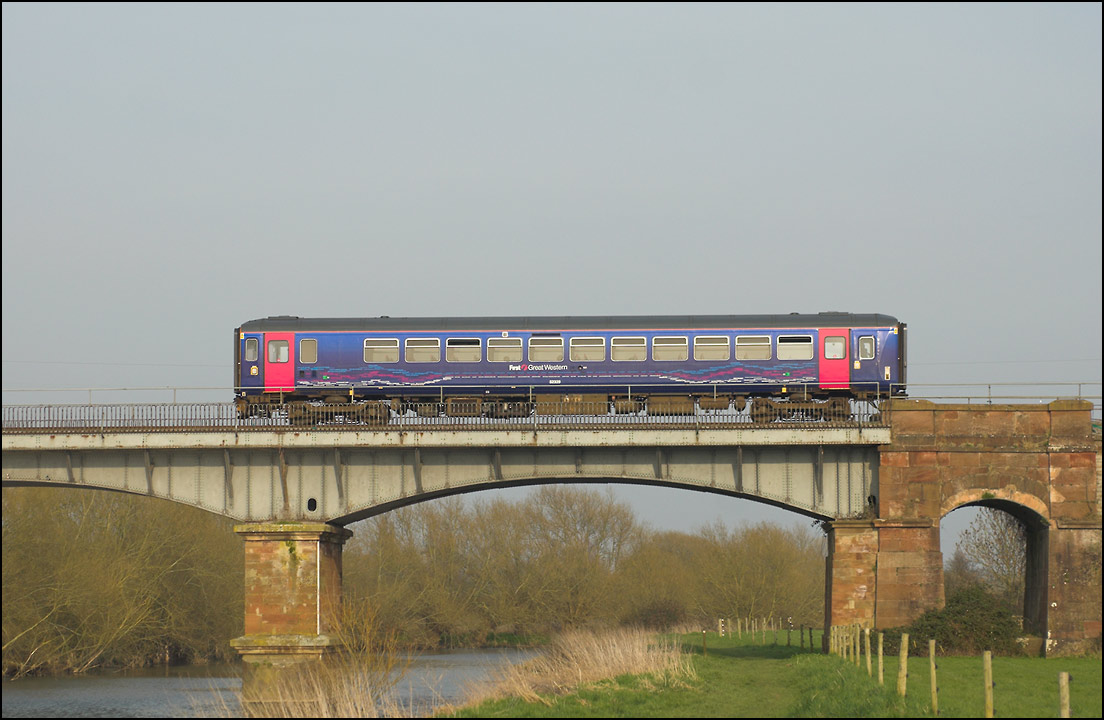 |
First Great Western's class 153 single units are not uncommon on the Cheltenham to Worcester line but they are mostly seen coupled to another, longer, unit. Here though is 52329 runnng solo while crossing the Warwickshire Avon at Eckington with what I think is the 12.26 from Southampton Central to Worcester Foregate Street. I wonder how often a passenger travels the whole route on this train? It forms a local service via Westbury and Bristol so is probably well used for intermediate stations, but hardly a time-efficient train for a longer journey. |
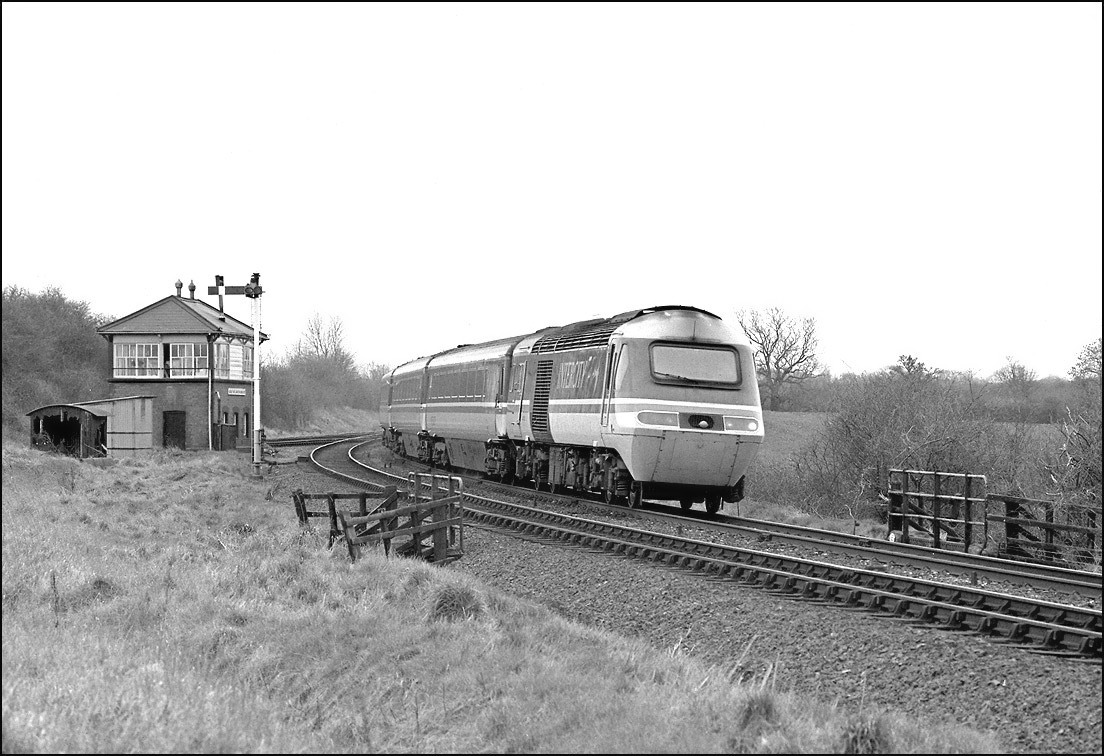 |
The first visit to Stratford-upon-Avon by an HST set took place on 11 March 1989 when a BR 125 Special organised by Hertforshire Railtours travelled to the terminus. The train originated from St Pancras and ran to Stratford via the Chiltern Line and Leamington Spa and after reversal went to Norwich via the North Warwickshire Line; the only HST to have used that line, and Tyseley, then on to Great Yarmouth eventually returning to London Liverpool Street. As it was Red Nose Day, each power car (43092 + 43055) had a large plastic nose affixed to the horn grille. The weather has dreadful and the light so poor that I didn't attempt a colour transparency but the nose can be seen on this picture as the train heads towards Birmingham, having just joined the North Warwickshire Line at Bearley Junction. Thi scene has changed quite a bit in the intervening years. There is a hedge along the fence against which I was leaning so that the view from the field is largely obscured, there are many masts and boxes around the signal box and the whole area is a bit of a mess. The 'box here and all associated semaphores are due for removal over the next 18 months or so, when control of the line passes to the new panel at Landor Street. |
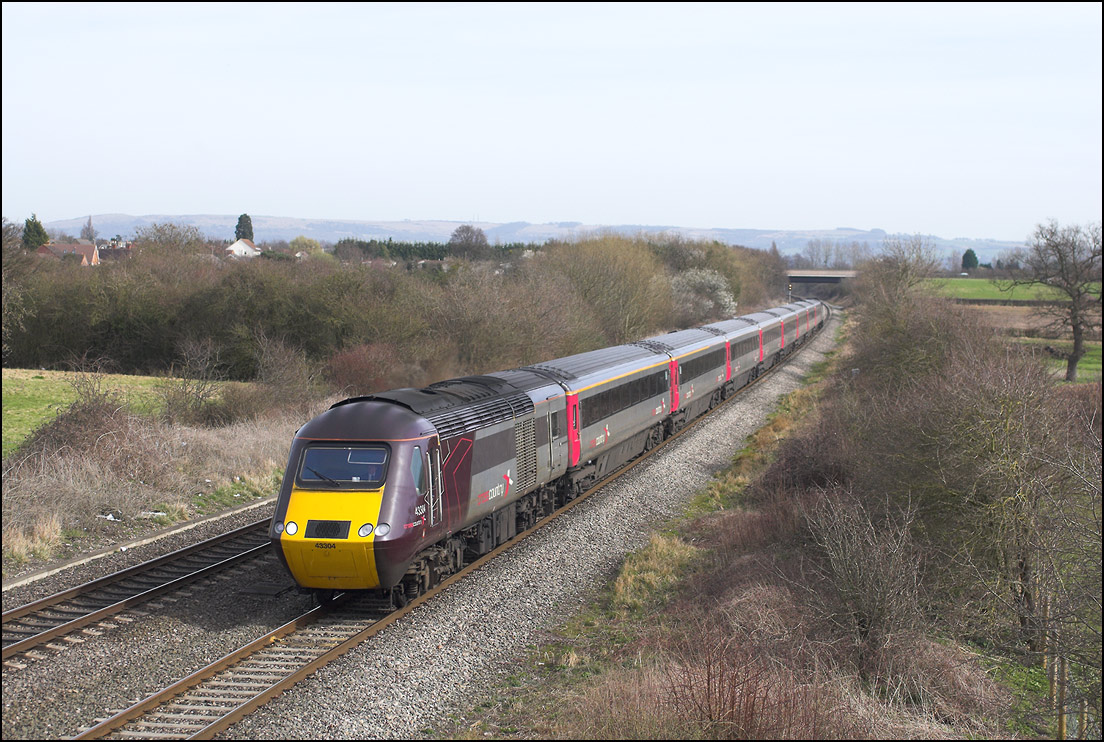 |
I had a quick trip to Badgeworth on 16 March 2009 to photograph a few bits and pieces in the bright morning sun. Unfortunately, the light became rather milky as I approached Cheltenham but I hoped that it might clear a little as the sun's heat burned off some of the high cloud and it wasn't too bad as 1V31, the 1V31 06:08 Edinburgh to Plymouth Arriva HST led by power car 43304 came around the bend from Cheltenham station. This is one of the few locations on the line from Birmingham to Gloucester which is usable after mid-morning, as it swings round to a roughly east - west direction so that the sun is well onto the side of the train for quite an extended period. |
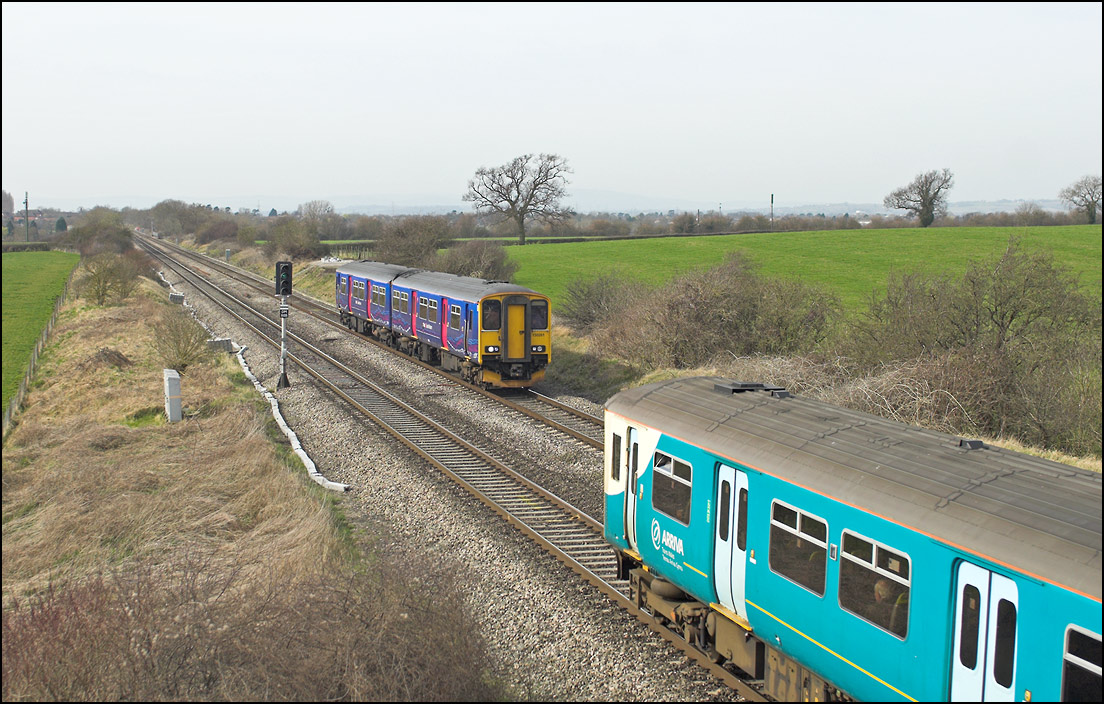 |
There is quite a variety of diesel multiple units along the line from Gloucester to Cheltenham and two different examples of the colour schemes are here seen at Badgeworth on 16 March 2009. First Great Western's 150261 is heading east towards Cheltenham as a sister unit, but from the Arriva stable heads west at the same time. The light had dipped quite badly for this shot but I kept my camera ready just in case a decent crossing shot presented itself. |
 |
Some major tree felling has recently taken place around Evesham station, none more drastic than that in the cutting immediately on the south side. It is many years since a shot like this was possible, probably close to 20 years in fact, when I remember going across on occasional Sunday afternoons when InterCity diversions of class 47s and coaching stock took place. This train is the 11.22 Paddington to Great Malvern formed of Adelante 180104 pictured a few yards before the Evesham stop. The cutting sides are currently a little messy but the piles of woodchips will soon disperse making for a very decent shot and one well worth taking before the 2 semaphore signals are removed and the single track doubled. I wonder if the redundant ivy-covered telegraph post will be removed to open the view a little more? |
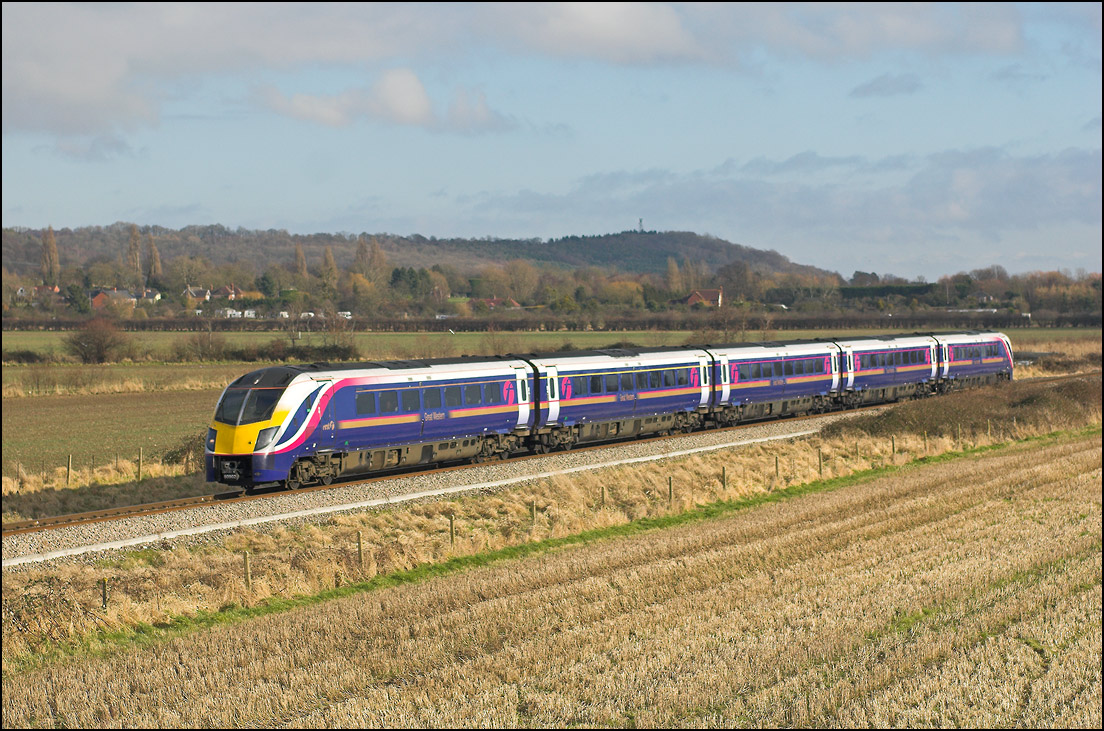 |
In theory, this scene should have been history well before 2009, but First Great Western are still using four class 180 Adelante DMUs to fill in gaps in their fleet. The majority of services along here are in the hands of HSTs with some Worcester trains being formed of class 166 units so it made a change on 3 February 2009 whenI photographed 180102 on the Cotswold Line at Lower Moor while it was forming the 11.22 Paddington to Great Malvern service. |
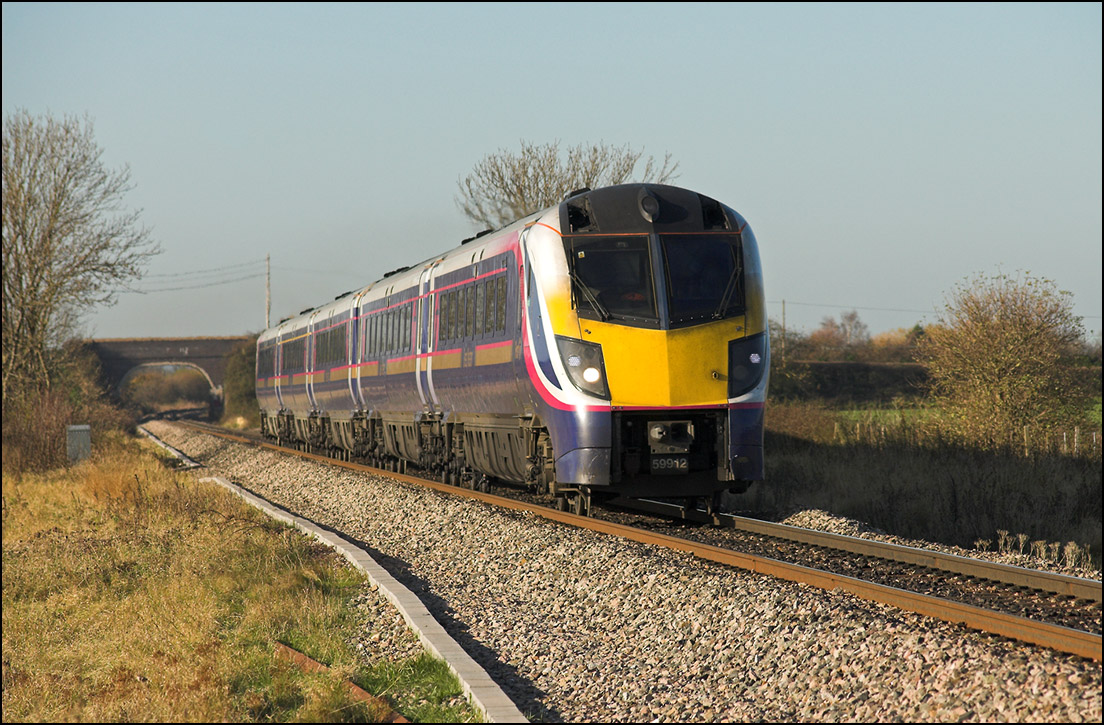 |
A stock move to Long Marston was planned for Friday 23 November 2007. In the event this did not happen but I decided that as the light was so good it would be a shame to miss out on the chance to photograph the day-to-day traffic along the Cotswold Line. I was on the boarded public crossing at Lower Moor near Fladbury when this class 180 Adelante, 180112, came along, forming the 11.25 Worcester to Paddington service. From the start of the new timetable on 9 December 2007 these stylish units will start to go off-lease to be replaced by HSTs. I, for one, will miss their distinctive appeareance although regular passengers and operating staff may feel differently as their reliability has not been quite as good as it should have been. The Autumn colours that were so vivid along here a few weeks ago have almost entirely disappeared now that we have had some frosts and strong winds. |
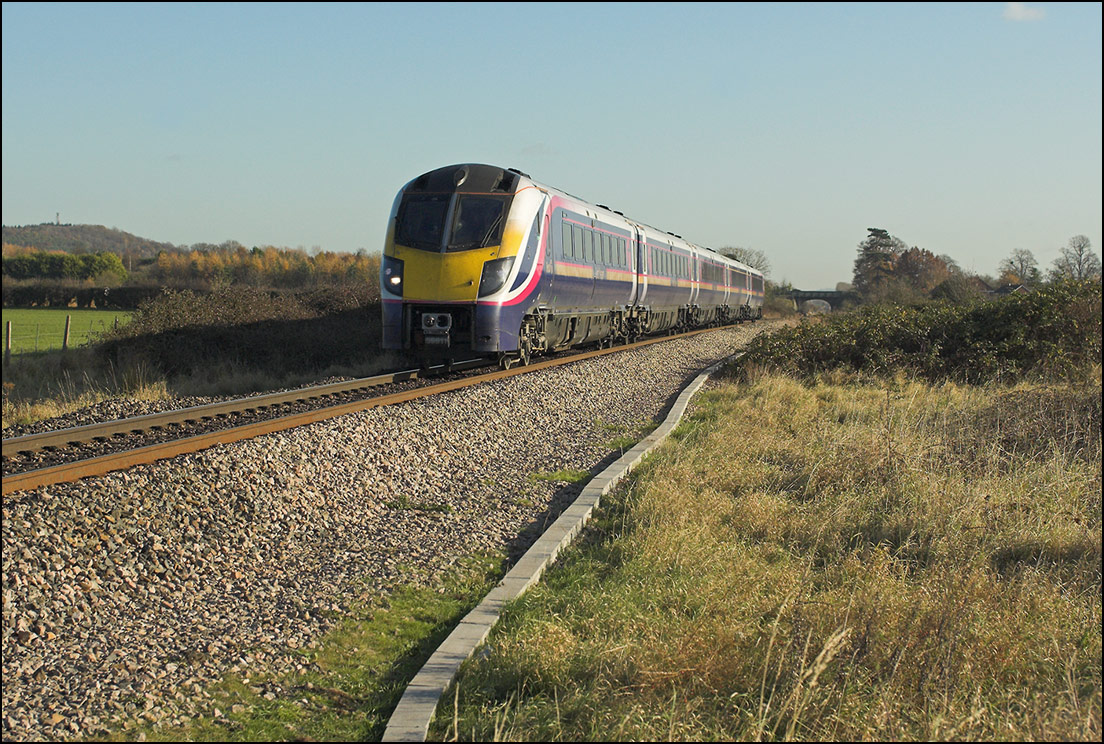 |
The next train to take the single line from Evesham to Norton Junction on 23 November 2007 was 180111, the 09.52 London Paddington to Hereford train. The bridge in the background marks the location of the long-gone Defford station, and in itself a good photographic location for most of the year. The shadows at this time of the year are a little intrusive, although shots are still possible albeit with a long telephoto lens. |
 |
Not all Cotswold Line trains are class 180 Adelante, some representatives of class 165 and 166 also appear. The 10.52 Paddington to Worcester Foregate Street was next along in the hands of 166205 in the striking, and to my eyes attractive, "neon" livery of First Great Western. Some remnants of Autumnal colour are still visible in the wood beyond the train but the best has now gone. |
_Lower_Moor_23110.jpg) |
166205 did not spend long at Worcester and returned to London Paddington as the 13.21 from Foregate Street. This one caught me slightly unawares and the composition of the picture isn't exactly as I would have wished. I had planned to take the shot from the top step of the stile leading from the crossing into the adjacent field but didn't quite have time to climb high enough but I did manage to get a clear and fairly wide view of the train's colour scheme. |
_Lower_Moor_2311.jpg) |
Class 180 180111 returned from Hereford as the 13.25 to Paddington and by the time it passed me at 14.36 the sun was getting quite low and the colour had an attractive golden tint. The bridge in the background is a popular location for down trains in the afternoon and if something out of the ordinary leaves Long Marston after lunchtime, there may be a dozen or more photographers spread out along the hedgerow. |
 |
As soon as 180111 had cleared the single line to Evesham, the daily RHTT working was able to head west towards Worcester. The working is 3S81, the 07:38 Kings Norton to Ledbury with MPV DR98973, which runs to Oxford in the morning and returns after lunch. There was no spraying taking place at this point as the location is not on much of a gradient nor is there a problem with leaf fall. |
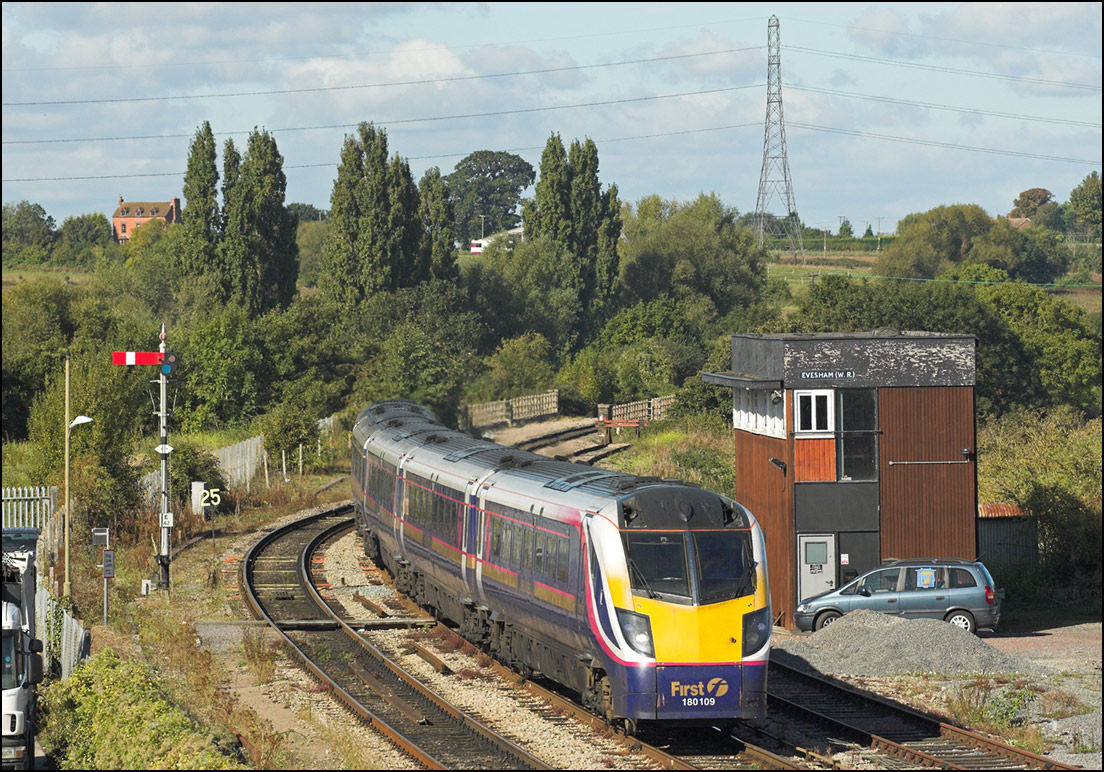 |
I can rarely resist the opportunity to photograph a FGW class 180 Adelante if the weather conditions are good. The sun could not have been better placed at Evesham on 4 October 2007 as 180109 approached the station stop so there wasn't really much of a decision to make. It seems slightly incongruous that one of the most modern diesel units is signalled along the Cotswold Line by GWR-style lower quadrant semaphores, but that, for me, is a large part of the attraction of this location. I wonder if the signalling will be replaced if, and it seems likely, the line from Oxford to Norton Junction near Worcester is re-doubled? There wouldn't seem to be a lot of work necessary here to stick with the existing arrangements, but whether a modern Network Rail would want to keep 19th century methods of working is a different matter. |
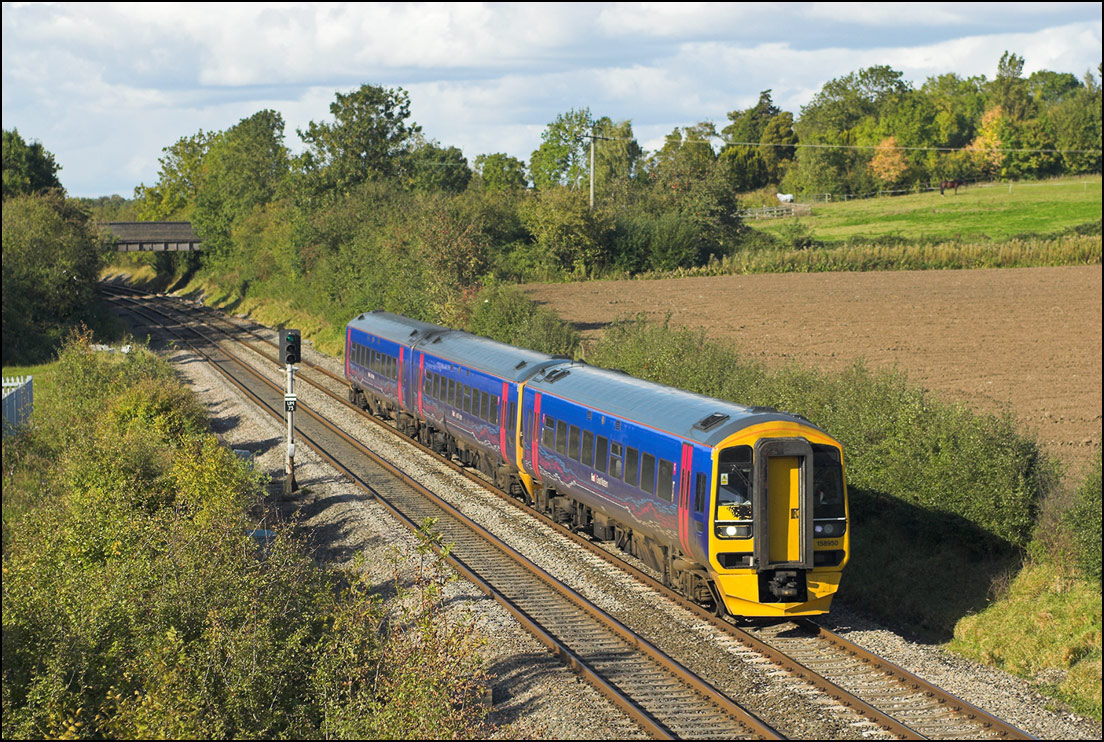 |
I was expecting this train, the 14.51 Great Malvern to Weymouth FGW service formed of 158950, to appear before 6V07 with 60063 as in the appropriate section. Sometimes though, the trains from Round Oak can get away slightly early and if there is sufficient headway they will precede the unit. I'm never one to turn down a well-lit shot of a colourful DMU and think that the latest FGW livery is attractive, especially as the trains are generally kept in good external condition. |
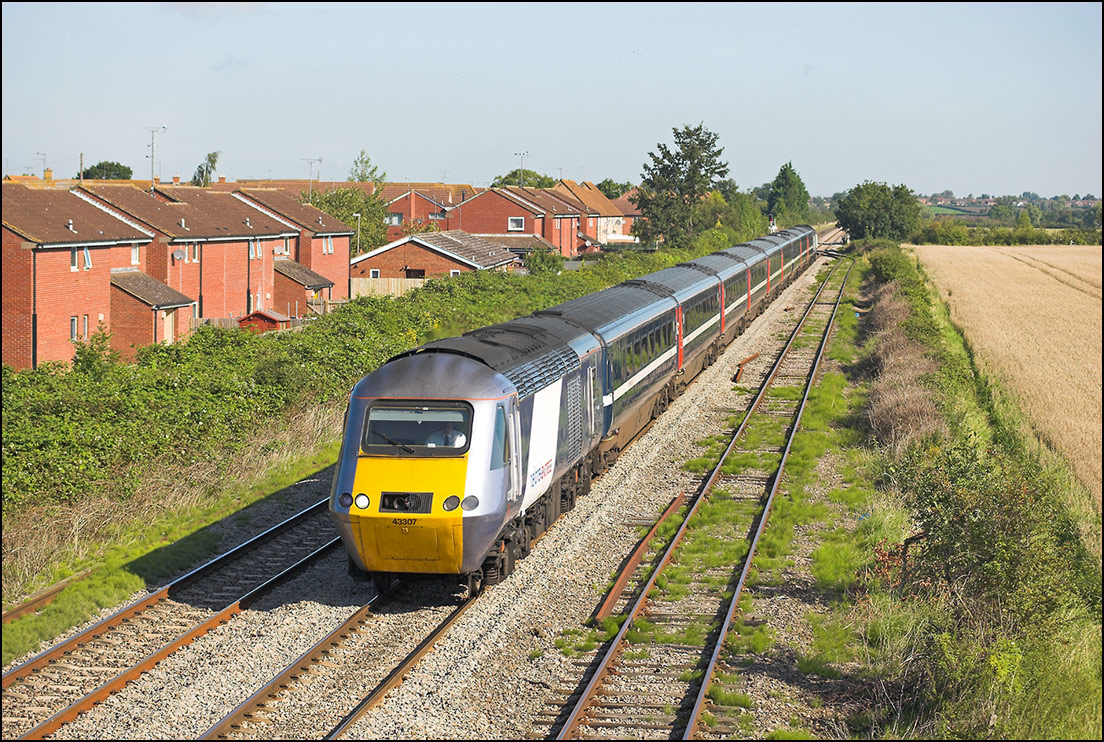 |
This summer has again seen the hiring in of HSTs to run on various trains to the South West. The first to go south from Birmingham on 23 August 2008 was this, led by National Express liveried 43307, forming 1V29 from Manchester to Newquay. The train was running in the region of 10 minutes when it passed Northway, near Ashchurch. It's surprising how much enthusiast attention these HST runs generate considering how they were largely ignored for the first 30 years of their lives.. |
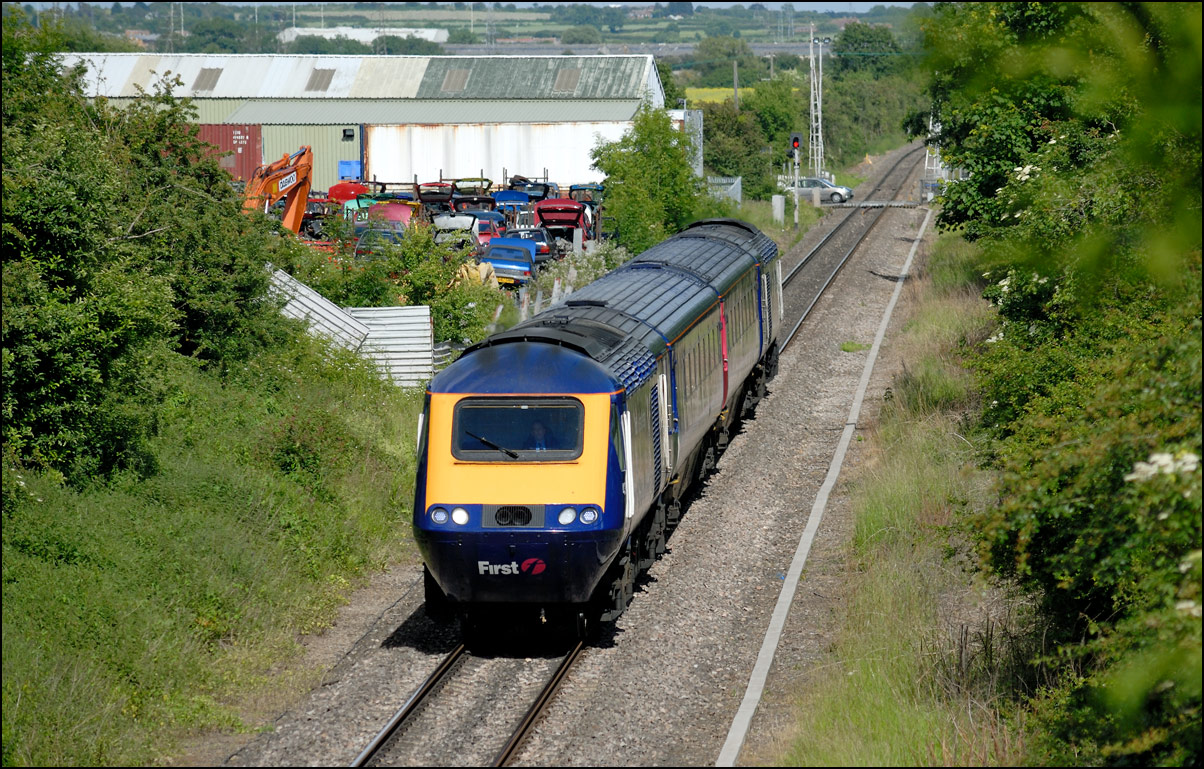 |
A most unusual HST formation was used on the Cotswold LIne during the afternoon of Sunday 15 June 2008. The driver rostered for the Hanborough (the first station north of Oxford on the line) to Worcester Shrub Hill shuttles did not sign 165s or 166s so a set was made of two power cars and 2 coaches, the short formation being sent from St. Phillips Marsh just for these workings. The only one convenient for me was 1Z73, the 15.40 Hanborough to Worcester and here are 43182, 42277, 44059 and 43042 passing the site of Littleton & Badsey station between Honeybourne and Evesham only a few seconds before the sun went behind a large black cloud. I chose this location because it is one I don't much use and has a recognisable background, but was surprised that the sun was so far around at this time, about 16.20. |
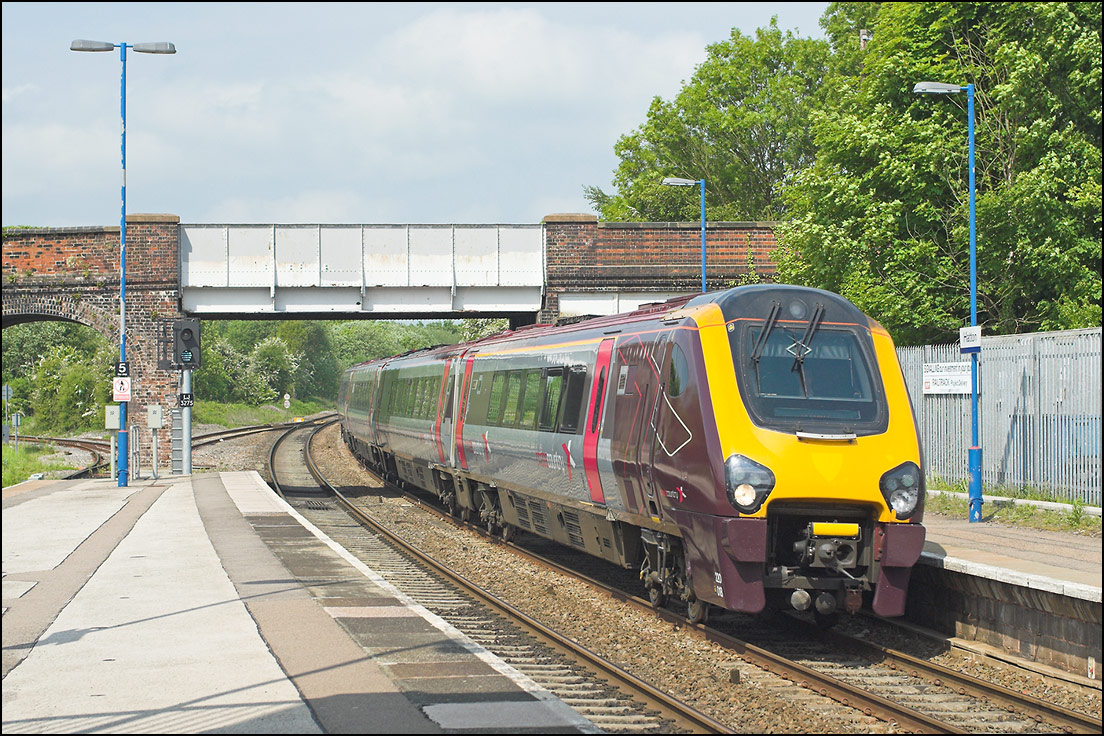 |
One of the trains I was hoping to see at Hatton on 24 May 2008 was the single unit "bubble" 960014 which was scheduled to make a run from Tyseley to Euston as a crew training run in connection with diversions from the WCML to the Chiltern Line. This didn't turn up so I assumed it was cancelled so my next shot was of Arriva Trains Voyager 220018 heading south through Hatton station. I include this photograph here only to show the apparently penny-pinching with which the recent repaint from Virgin Trains' red livery has been carried out - note the lighter yellow patch of the front end where the Virgin shield emblem used to sit. One would have thought that a complete job would have been done for by the new operator of the train; note also the red coming through just above cantrail level on the near side of the leading vehicle. |
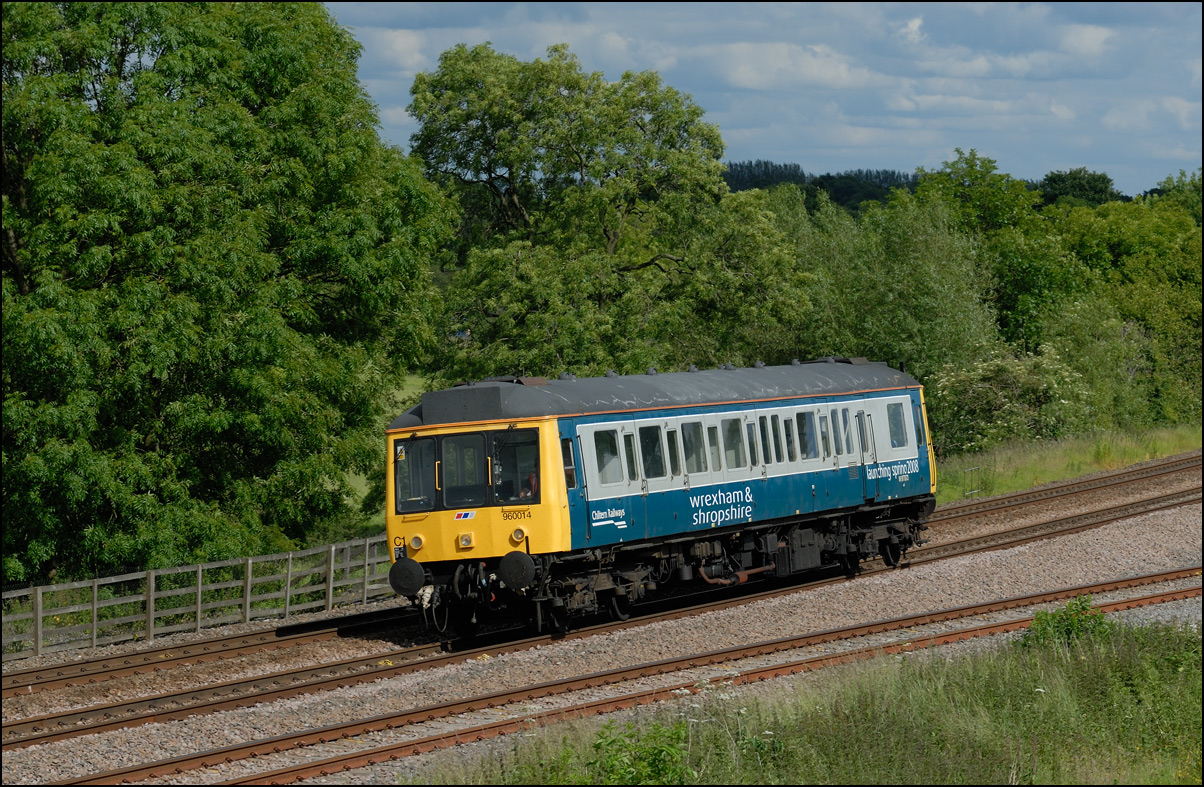 |
The Chiltern Trains Bubble, 960014, has been in use again recently, this time in connection with Arriva Cross Country crews learning the Chiltern Line and parts of the network between Acton and Euston in readiness for weekend diversions of Voyagers over the route. There are a couple of runs during the day but this, on 23 June 2008, was the last and the Arriva crew has obviously been dropped off somewhere and 960014 is heading back to Tyseley for the night. These single units have long been a favourite of mine and this train was definitely the highlight of the afternoon for me. |
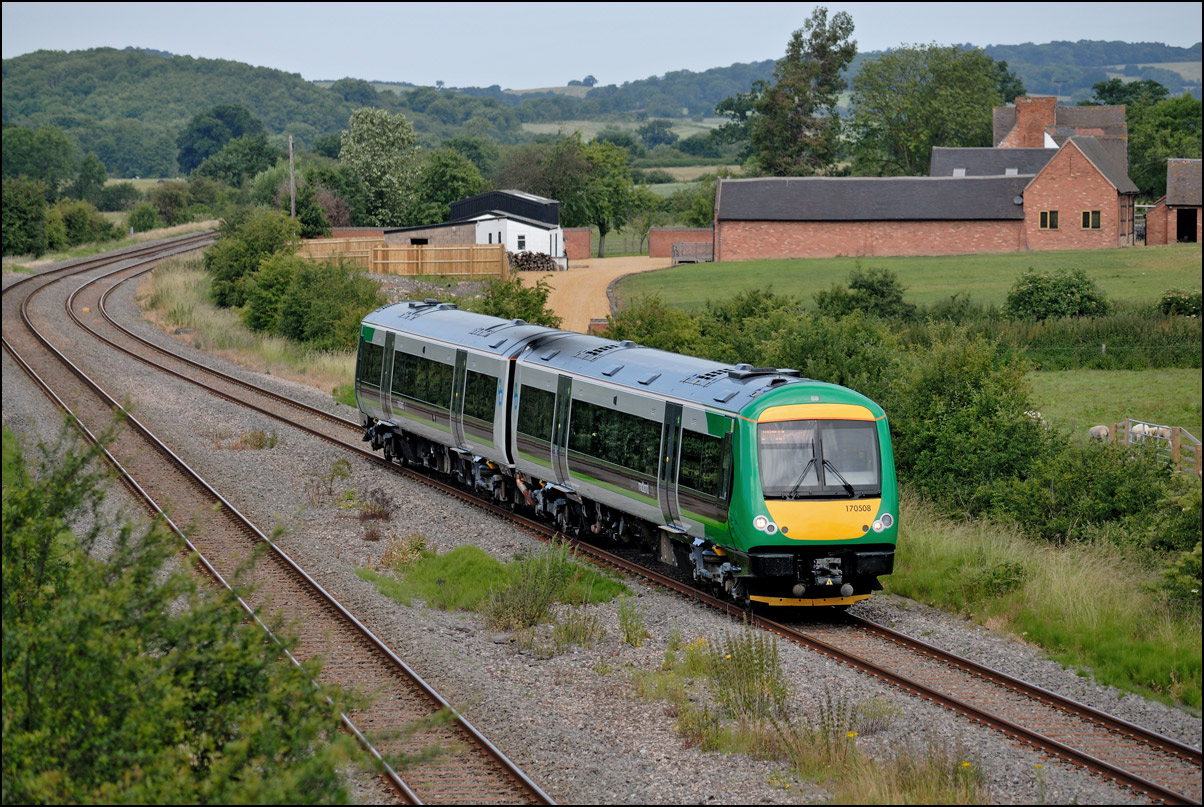 |
A special train ran from Birmingham (Snow Hill) to Stratford-upon-Avon on Tuesday 1 July 2008 carrying various London Midland Trains dignitaries. There was no mention of the type of train involved but my guess was that a reliveried class 170 would be rostered for it. I went to Edstone Aqueduct on the North Warwickshire Line to see the working and wasn't especially surprised when... a reliveried class 170 appeared! Despite the sky being largely clear a large patch of cloud managed to be in the wrong place as 170508 passed under the longest cast iron aqueduct in England. Although there have been occasional vists by class 170 to the line I believe that this is the first of an example in this colour scheme. A few minutes earlier, 31454 had gone in the same direction forming an 0Z31 Derby to Derby via Stratford-upon-Avon, presumably as a driver route knowledge refresher for SERCO trains. |
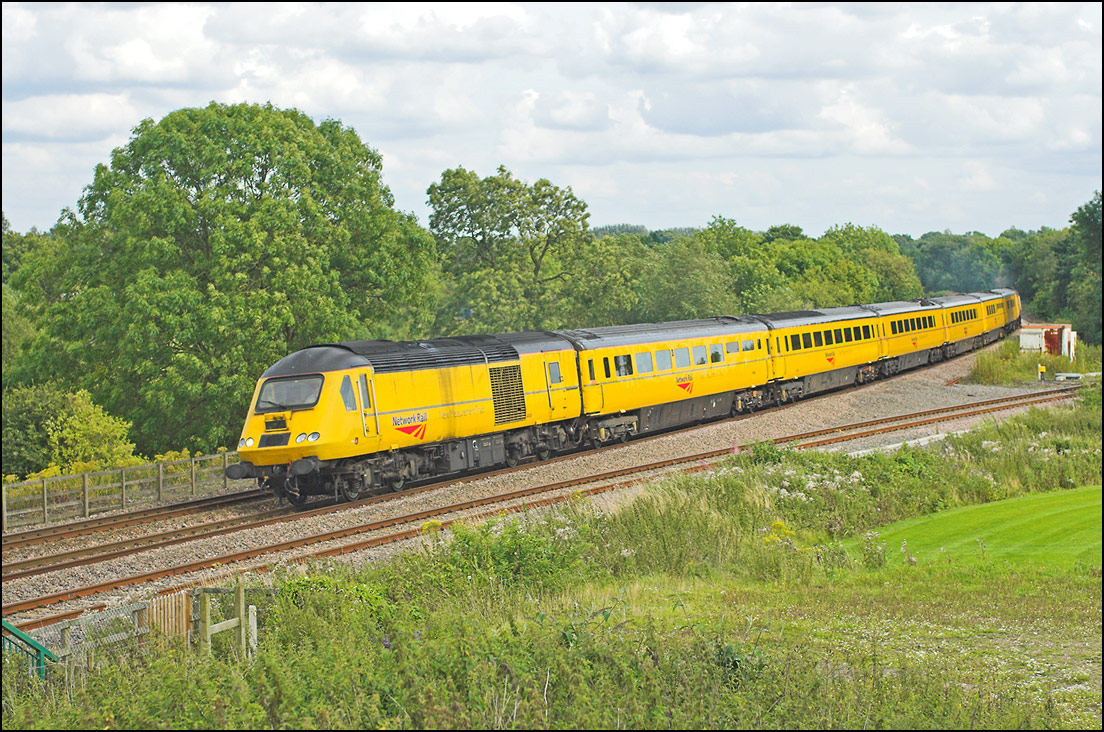 |
The Network Rail HST makes regular trips along the Great Western Main Line to Paddington and the West Country returning to Derby on a Friday afternoon. Such a trip took place on 15 August when it ran north via Hatton and Solihull. Here is the train, 1Z21, contrasting nicely with the green background, passing Hatton North Junction just about spot on time at 16.35 with buffer fitted 43013 leading. The sun was just coming out but was still right on the edge of some dense cloud. |
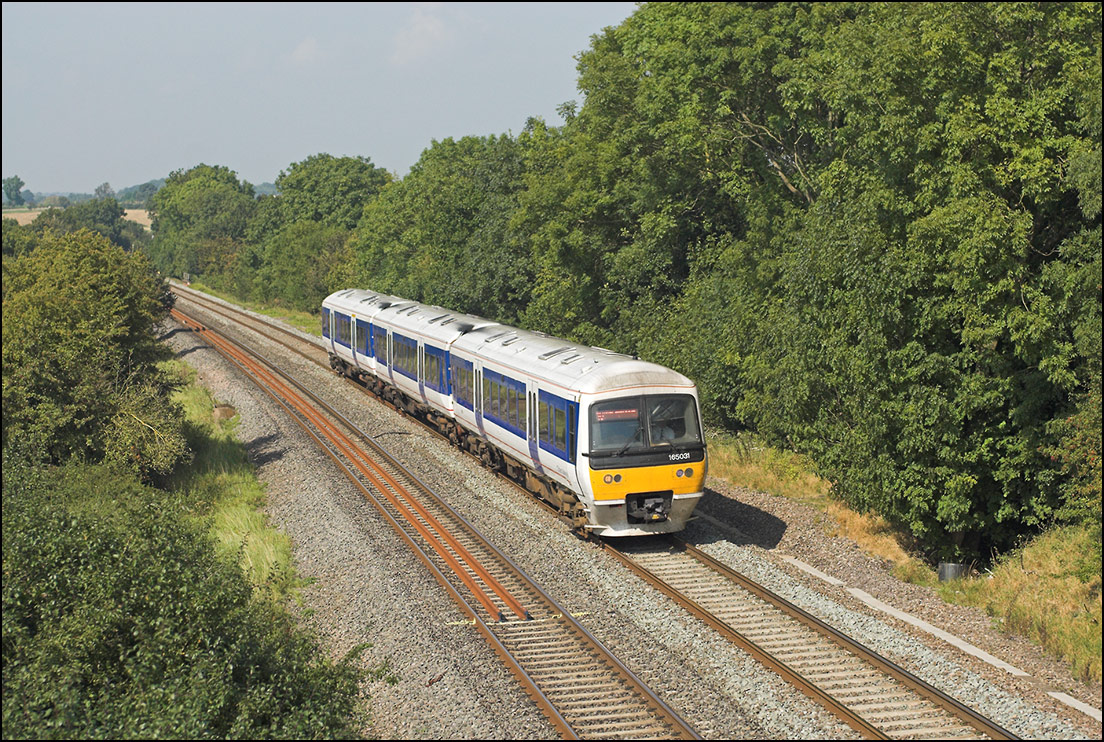 |
Class 168 DMUs are the mainstay of Chiltern Railways' services on the Marylebone to Birmingham line, but 165s and 166s do turn up from time to time. Here is 165031 forming an up train about to pass under a relatively new footbridge near Shrewley in Warwickshire. This bridge was erected to replace a foot crossing when higher speed trains from the Chiltern and Virgin stables began to use the line. This spot is pleasant enough but is really a little bland for my my taste and lacks any real clue to its identity or location. |
|
|
Most Stratford-upon-Avon to Marylebone services are formed of Chiltern Railways' class 165 stock, with occasional substitutions by class 168. Whilst I have seen several 168s it has always been on occasions when I have had no camera available. When going walking into Stratford-upon-Avon I have taken to carrying a compact digital camera to record the day-to-day street scenes around the town and from time to time donate a CD of images to the local archives. It has always been said that in 20 or 30 years time it is the ordinary scenes that will be of far more interest than special events; one does forget how much the average High Street changes in a relatively short period. Anyhow, I had my Canon Powershot A550 in my pocket (the model with a proper, zooming, optical viewfinder, none of this ridiculous holding a camera at arms length to compose a picture for me!) when I passed Stratford station just as the 09.38 to Marylebone was about to leave on Friday 16 January 2008 so finally obtained the shot I have been waiting for some time to take. |
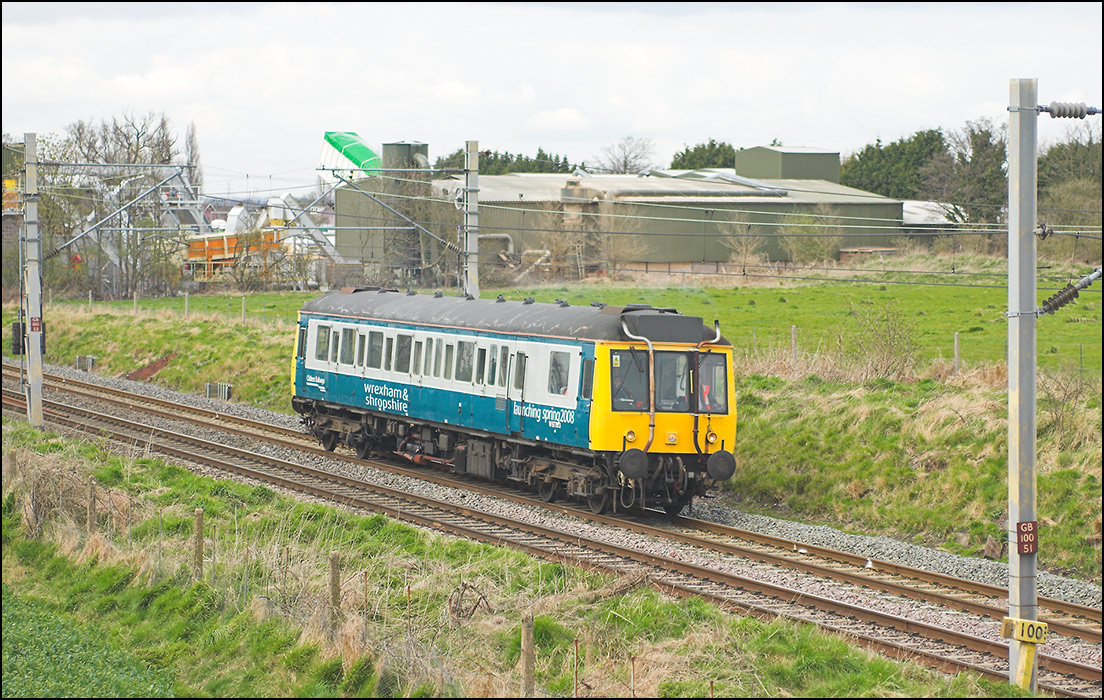 |
There has been a lot of fuss made about the training runs for the upcoming WSMR trains between Banbury and Marylebone with class 67 locomotives, but very little has been said about the blue & grey single unit also runnning in the Birmingham area. I much prefer bubble cars to 67s so made the effort to go out on 7 April to get a shot of it which is here seen approaching the outskirts of Balsall Common, between Coventry and Birmingham International stations. |
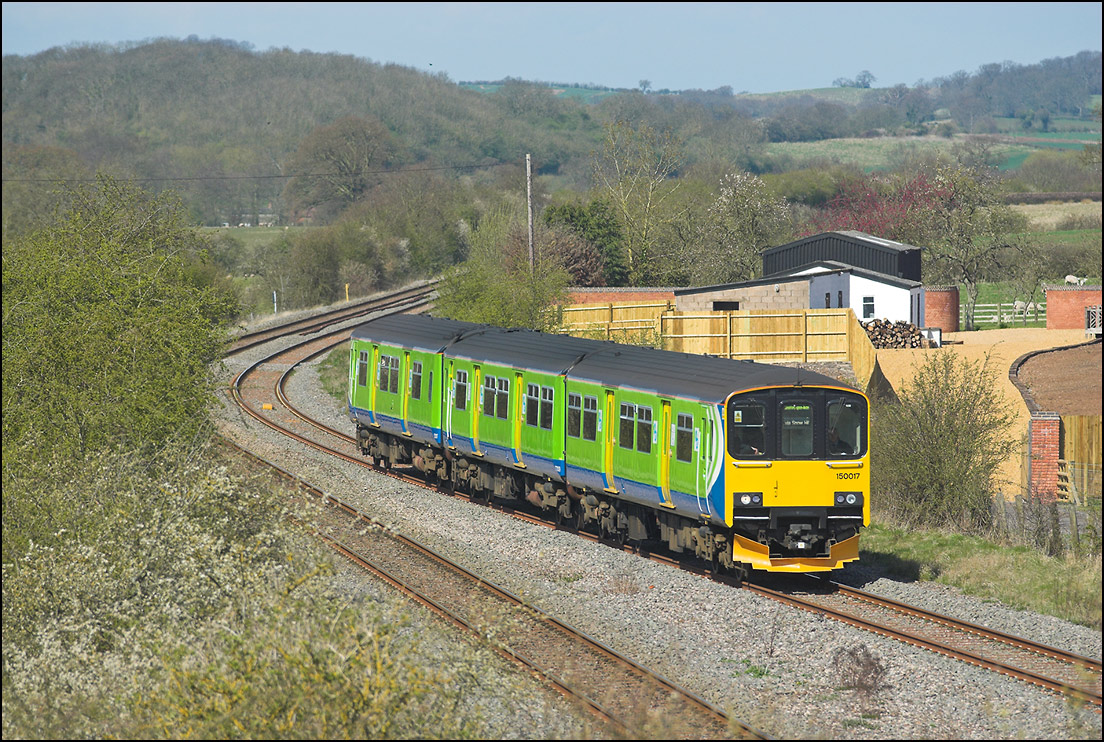 |
There was supposed to be a trial run of GWR Castle Class 5029 Nunney Castle from Tyseley to Stratford-upon-Avon on Tuesday 14 April 2008. For reasons I can't quite fathom, I decided to go and have a shot of the tender-first run, complete with single support coach, on the North Warwickshire line. The only place where the sun would be just right is on the section of line where it passes under the Edstone Aquaduct and curves around on an east-west axis. In the event the steam run was cancelled but I did capture this shot of 150017 forming a late running Stourbridge Junction to Stratford service. The formerly scruffy farmyard in the background has recently seen a lot of refurbishment and conversion into an expensive-looking residence, although only the outbuildings are visible in this long lens view. |
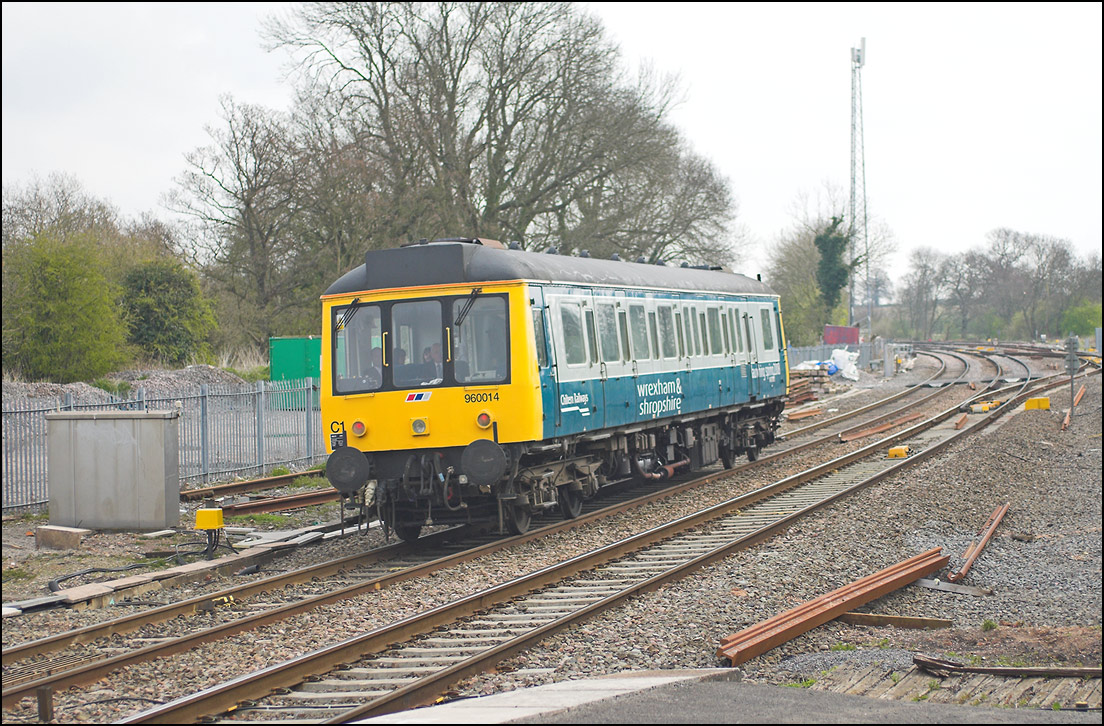 |
Some crew training runs in connection with the forthcoming WSMR trains between Wrexham and London Marylebone using the single car DMMU 960014 took place on Friday 18 April 2008. The first run was to Birmingham New Street and the second up the main line to Leamington Spa. I am far more interested in seeing this old survivor of the early DMU fleet than the test runs with class 67s as these will be around for some time and I can get my phototgraphs when the fuss has died down. This train was runnng about 15 minutes late at Hatton due to some earlier signalling problems and managed to run through the platforms at exactly the same time as a northbound Chiltern Trains class 165. I quickly grabbed this receding shot as the 960014 passed a load of untidy clutter on the ballast - the seemingly inevitable aftermath of majot engineering work. Just why the mess can't be cleared when the work ends escapes me; it seems to invite vandalism. |
 |
The bubble car 960014 was booked to run straight through Hatton station on its return to Birmingham but through previous late running lost the path and was looped in Hattons Down Goods Loop. It ran into the Stratford-upon-Avon Branch platform, rekindling memories of the many years that units of this type shuttled back and forth between Leamington and Stratford. The reason for the looping was to allow a down Arriva Trains Voyager to pass on the main line. |
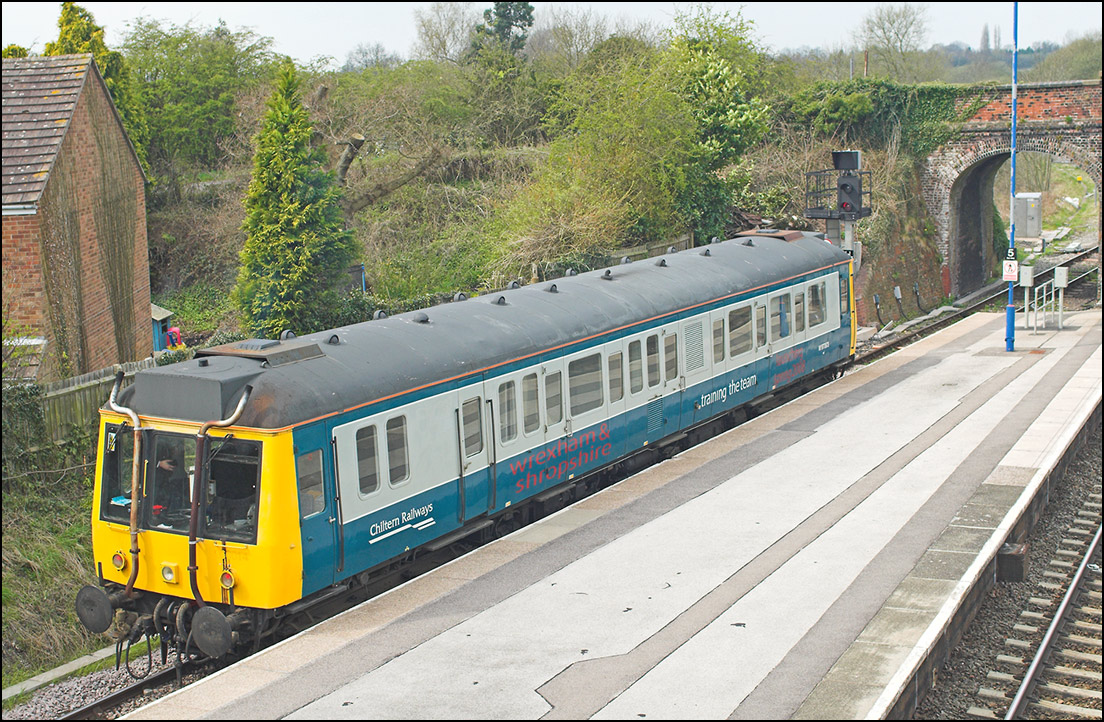 |
If it were not for the branding on the sides of 960014 this picture could almost have been taken in the 1980s, at least if one ignores the modern signalling. In earlier days a train such as this would have turned left at the junction and gone to Stratford-upon-Avon but this working is a training run for WSMR crews and will take the spur onto the down main line at Hatton once the Voyager shown above has cleared the section. |
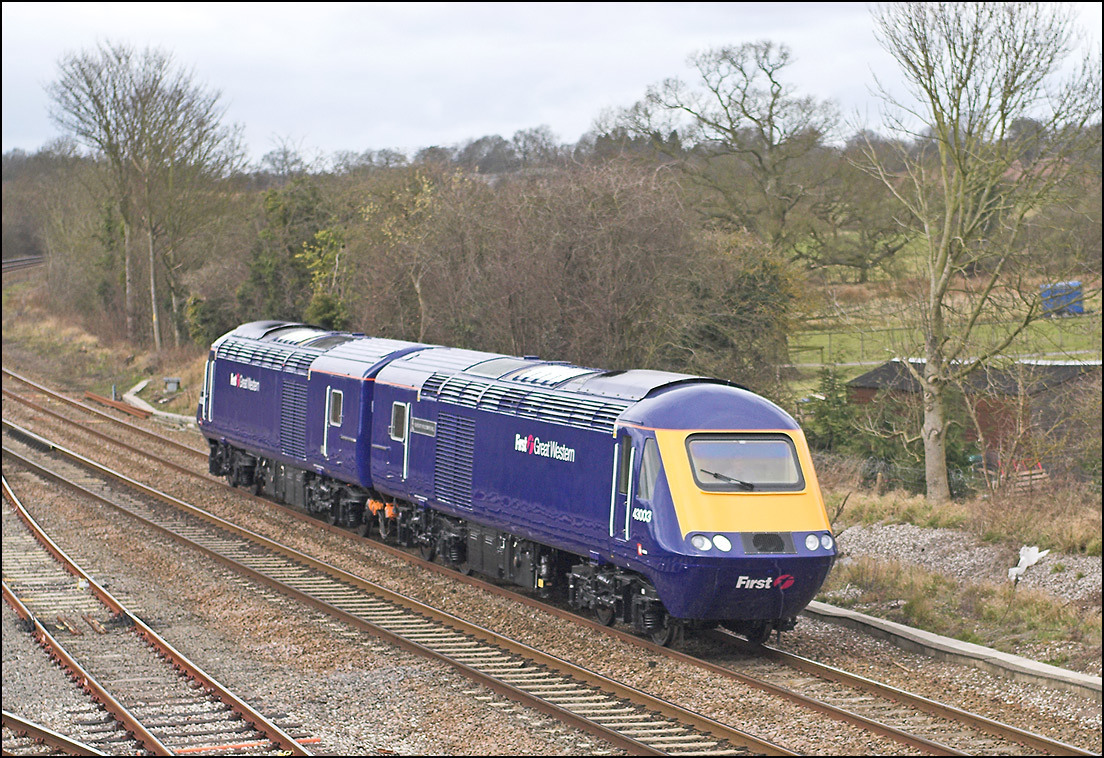 |
Here are 43003 + 43002 working from Brush's site at Loughborough to Old Oak Common on 6 March 2008; the final power cars in the current MTU conversion programme. It is unusual for these recently refurbished power cars to work under their own power, they are normally dragged by a class 47 with a couple of barrier coaches in the consist. The routing of 0F70 was also unusual, despite it being to me at least, the obvious route and preferable to either the WCML or the even more bizarre run through Cheltenham, Gloucester, Swindon and Didcot to Reading and OOC. Whatever the reason, the power cars made for a very rare sight on this line and worth the trip, even when the deadful light was taken in account. |
 |
The New Measurement Train made one of its regular runs over the Cotswold Line on 4 October 2007, this time formed of HST stock with power cars 43013 showing off its new headlights and 43062 on the back instead of a locomotive-hauled substitute. No doubt this was the reason for a total lack of messages about its running on the "gen" groups. Here is 1Z20, the 09.20 Derby to Derby via Worcester, Oxford and Worcester, passing the signalbox at Evesham some 29 minutes early at 12.13. Because a down passenger service was running late, 1Z20 did not have to wait in the platform at Evesham for the booked departure time, 12.44, but went straight off after the token had been exchanged. |
 |
The single unit DMMU Pandora was booked to visit the South-West on 25 June 2007 and to return to Derby the following day. The latter move was running as 5Z21, the 09.00 from Bristol Barton Hill depot, being routed via Didcot, Reading, Didcot because of a possession at Didcot West Curve to Oxford, Hatton and Birmingham. 960011, formerly 55025, is reported as being an early candidate for withdrawal so even though the light was quite poor I decided to have an attempt at a shot. I think that such a short train always looks better in an identifiable location with some background rather than open countryside and as Hatton station is only about a 12 minute drive from my home, I went there. Here is Pandora some 39 minutes early passing the down platform. The former class 121 has had extensive modifications since her last passenger duties, one of the most noticeable being the slewing of one of the 2 exhaust pipes into a single pipe, also used as a mount for one of the video cameras. Note the insulation on the pipe around the camera's mount. |
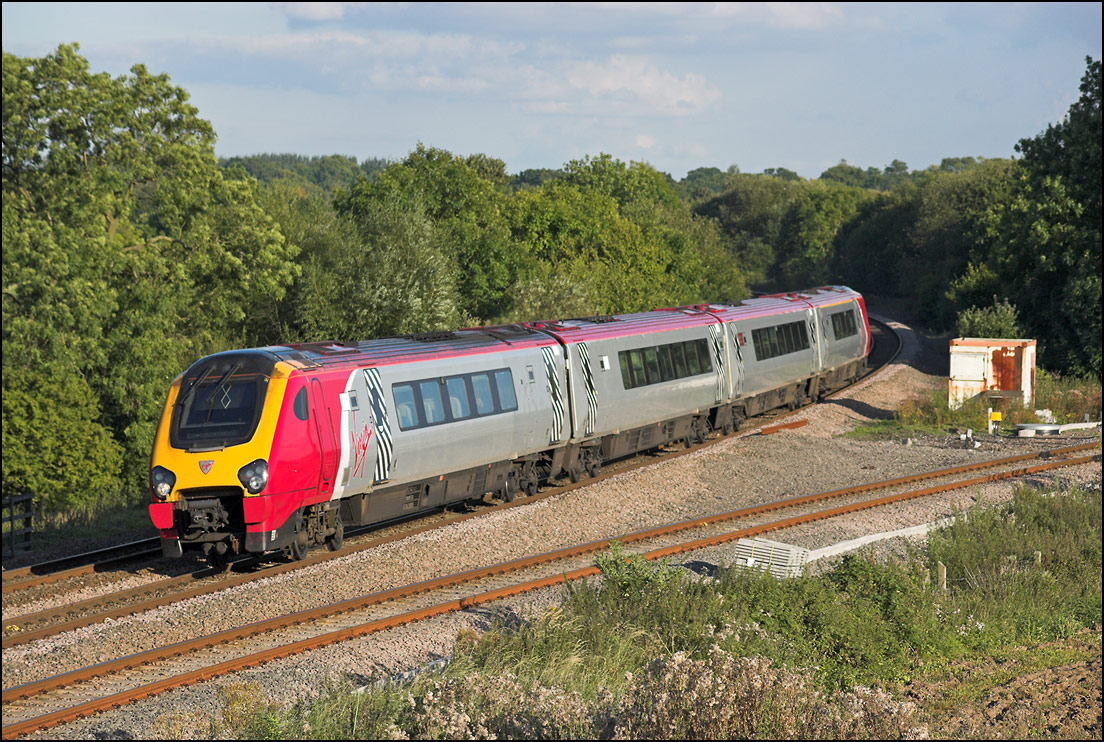 |
I can't admit to a great fondness for Virgin Voyagers. It's nothing to do with the fact that they displaced locomotive-hauled trains but more that they strike me as being poorly designed and painted in a rather garish colour scheme. Having said that, when you're standing in the sun at a location for hours on end waiting for a freight that doesn't actually appear, anything is going to get photographed. So in between pictures of rabbits, buzzards and scenery, the odd Voyager is going to get the D200 pointed at it, as did 220029 at Hatton North Junction on 5 September 2007. With Virgin about to lose the franchise for these trains, I suppose that one should have a record of what is around hence this picture appearing here. In years to come I wonder if there will be surge of nostalgia and a preservation group for the class? Just look how class 47s were ignored and despised by most enthusiasts and how some strange people will now go for miles to photograph one travelling light engine and get all wound up if the sun goes in on their shot. |
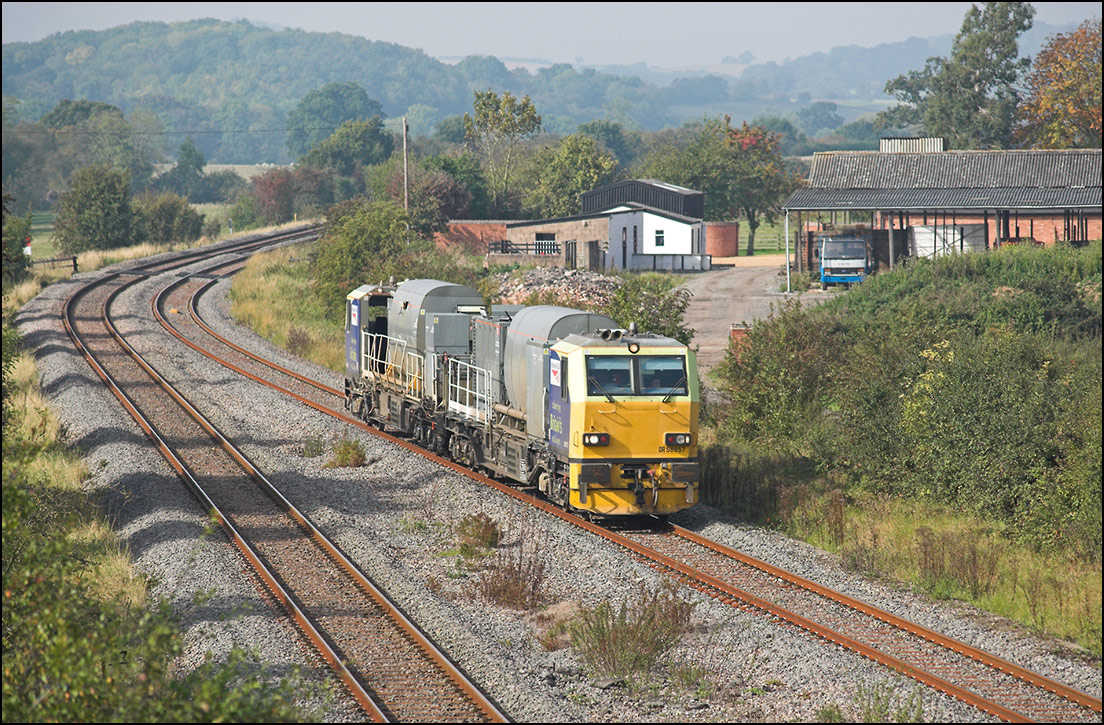 |
The beginning of October usually marks the start of the railhead treatment season when various trains run either to apply Sandite to the rails or to blast away leaf debris rolled into a slippery paste by other trains' wheels. Most lines have some form of treatment but only those using top-and-tailed locomotives ever seem to get any publicity. It may be unfashionable to say so, but I much prefer to have the chance to photograph a train formed of Multi-Purpose Vehicles (MPV) as they are more elusive than locomotives which, after all, can be photographed somewhere practically every day. Here is MPV DR 98957 running as 3S87, the 09.05 from Kings Norton, about to pass under the cast iron aquaduct at Edstone on the North Warwickshire Line, where some Autumnal colours are begining to show, some 30 minutes early at 13.00. As this stretch has a gentle downhill gradient no jetting is being done, but I heard the spraying start as the train approached the braking point for units going towards Bearley Junction and onwards to Stratford-upon-Avon. Click on this hyperlink for a closer view of the unit. |
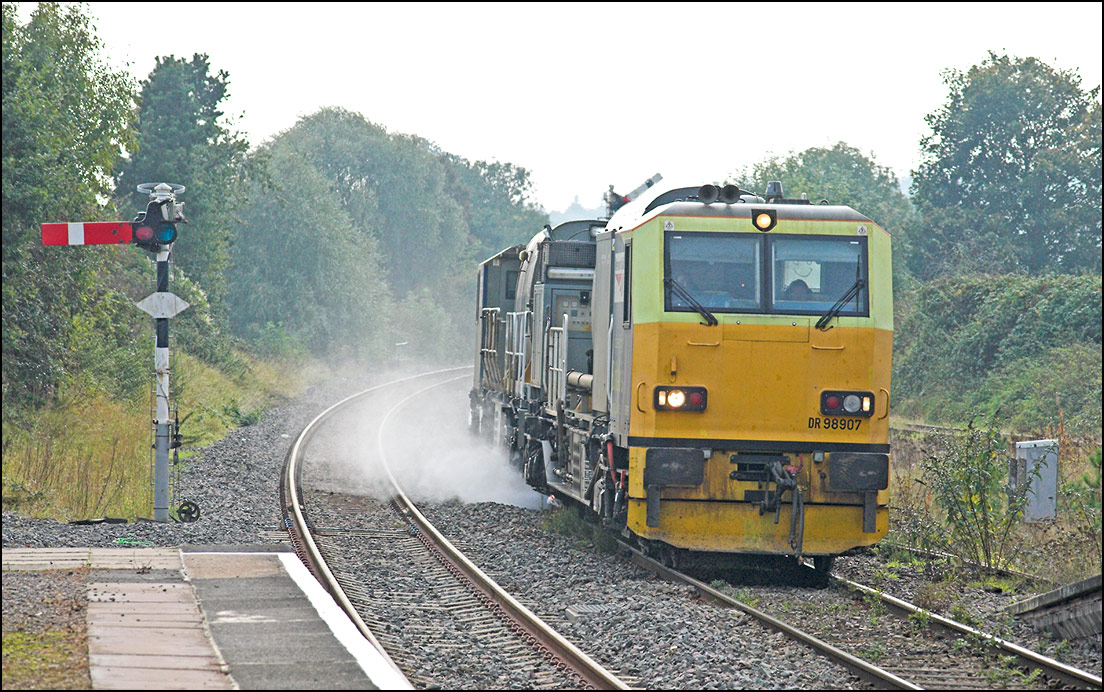 |
After photographing 3S87 at Edstone I went to Henley-in Arden for another crack at it, despite knowing that the sun would be straight into the lens. I needn't have worried as mist and cloud built up quite quickly after I arrived. The early running continued as the MPV sprayed through the station startling at least one passenger waiting for the 12.20 from Stratford-upon-Avon - he heard the train approach, got up from the seat and leapt back as this appeared! Henley station has some attractive features, click on this hyperlink for a look as the train continued north. |
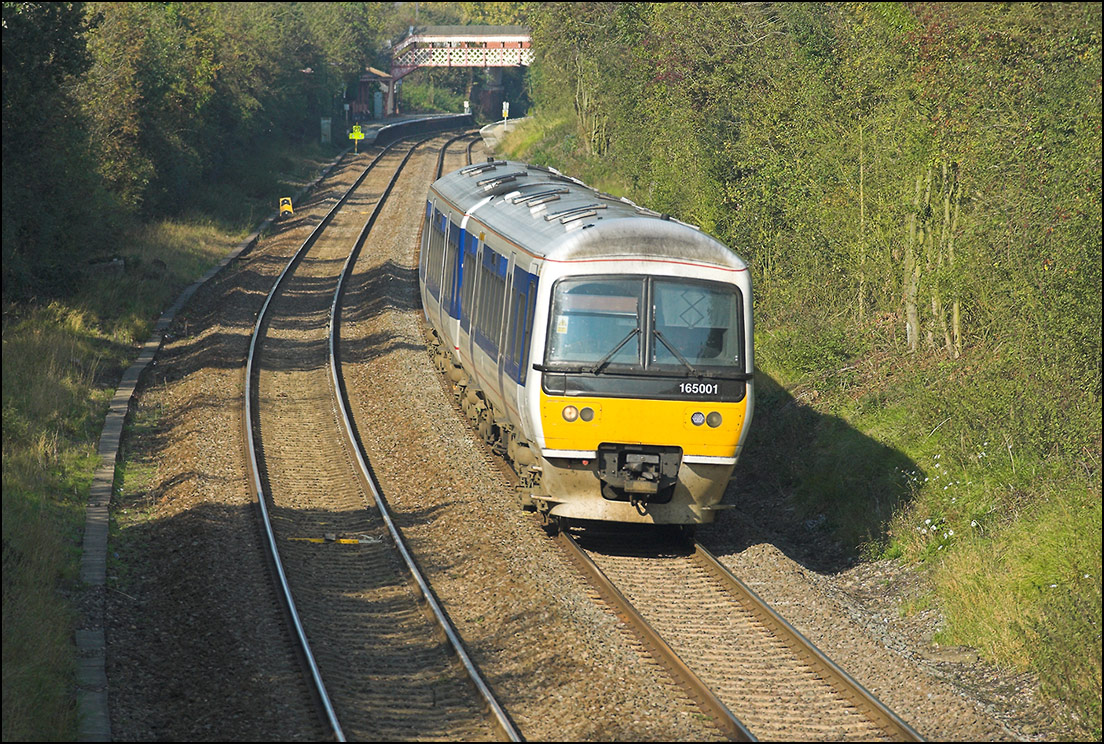 |
Tuesday 23 October 2007 was a bright and sunny and although I wanted to get out and take some pictures, I couldn't be bothered to travel far. That being the case and with my wife having taken a day off work, we walked along the towing path of the Stratford-upon-Avon to Wilmcote where there is a convenient occupation bridge. The first train to come along was 165001 forming the 10.54 London Marylebone to Stratford. Chiltern Trains' service don't appear to call at Wilmcote station these days, maybe because they run quite close in front of the Central Trains units from Birmingham which means that a quick shunt is required at the terminus for the first arrival and the time gained by not stopping at the station is useful here. |
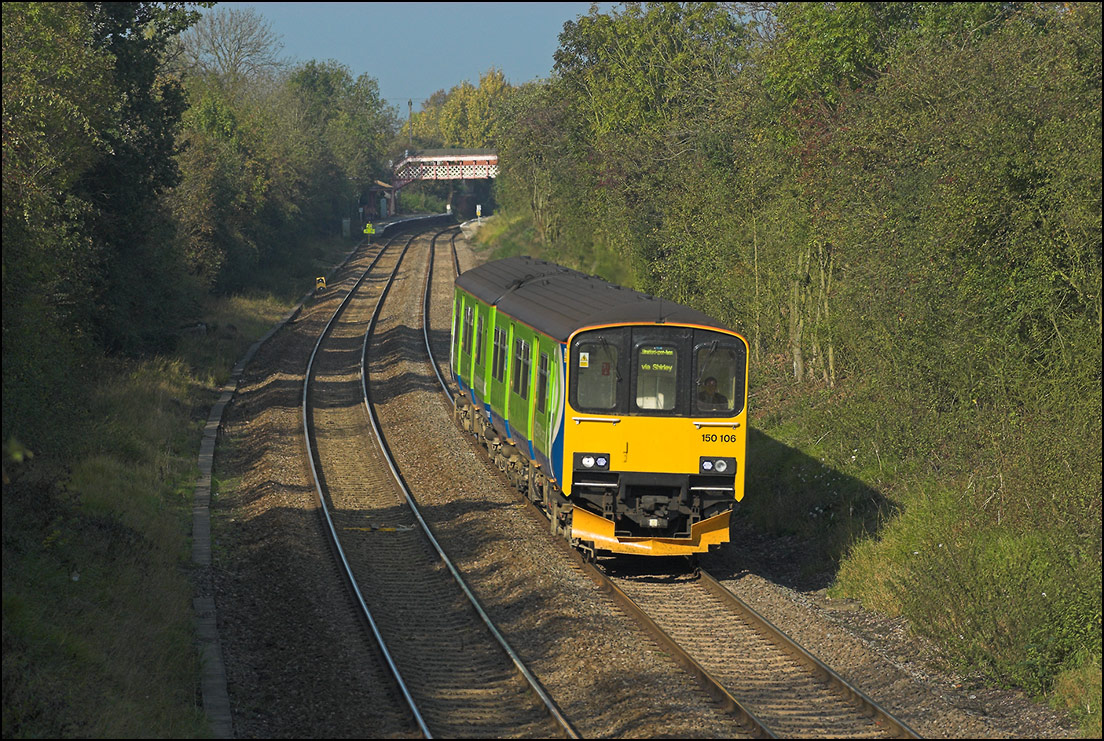 |
Next along was 150106, the 11.54 from Stourbridge Junction to Stratford-upon-Avon. I think it is important to record these everyday workings as in 20 or 30 years it will be these that are of more interest than the higher profile trains, which get photographed to death by every man and his dog. Just before the train left Wilmcote station, visible in the background, this Kestrel flew by keeping a beady eye on proceedings. |
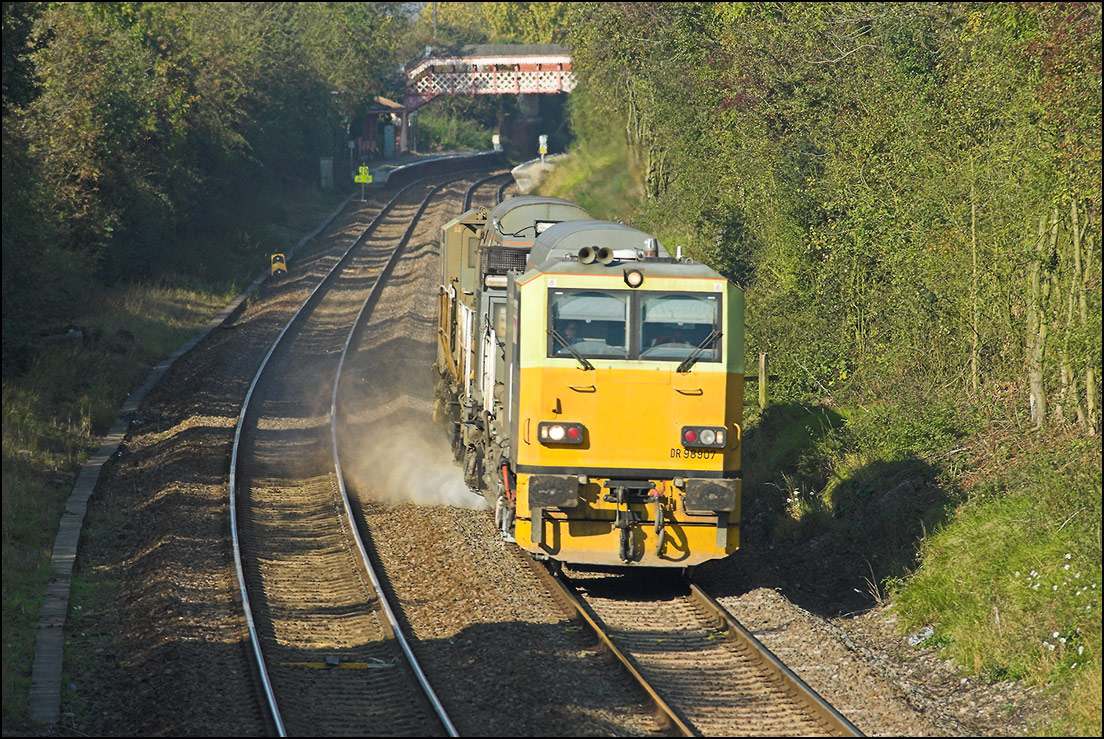 |
The 09.05 Rail Head Treatment Train from Kings Norton to Stratford-upon-Avon via the North Warwickshire Line, 3S87, was the final train I photographed at Wilmcote on 23 October 2007. As with all diesel units, the majority of photographers ignore these highly complex machines in favour of yet another shot of top-and-tailed locomotives doing the same function. I get far more satisfaction in picturing an MPV on my local patch than having to travel miles in Autumn, with its uncertain weather, just to stand in a gallery of other enthusiasts getting virtually identical shots. This is the last week that this shot, on a sunny day at least, will be possible. The shadows were rapidly encroaching and I had to use a powerful lens to get the train in a clear patch. Once the clocks have gone back, that will be it for this bridge until late spring next year. |
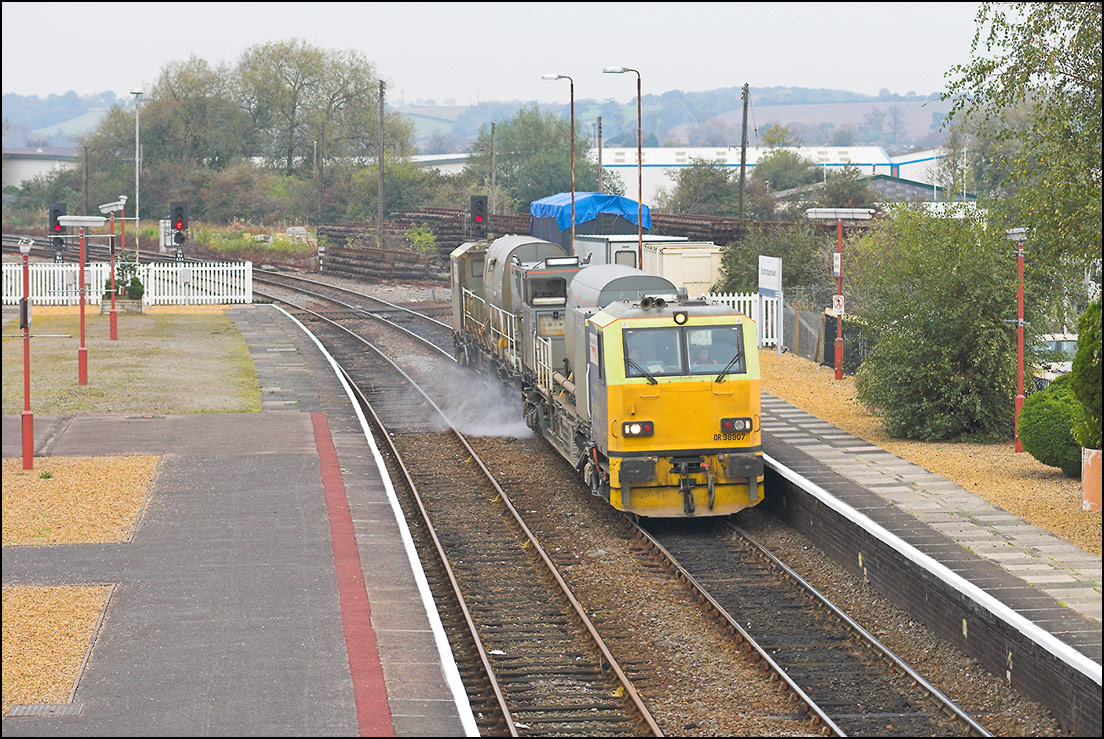 |
I decided to have another go at photographing the RHTT working to Stratford-upon-Avon on 22 October 2007, this time at the station itself. With this sort of working, I prefer to have some background rather than countryside so that the location can be identified. The 09.05 from Kings Norton, 3S87, is here seen arriving at Stratford spot on time at 13.40 with its spraying jets still in operation. |
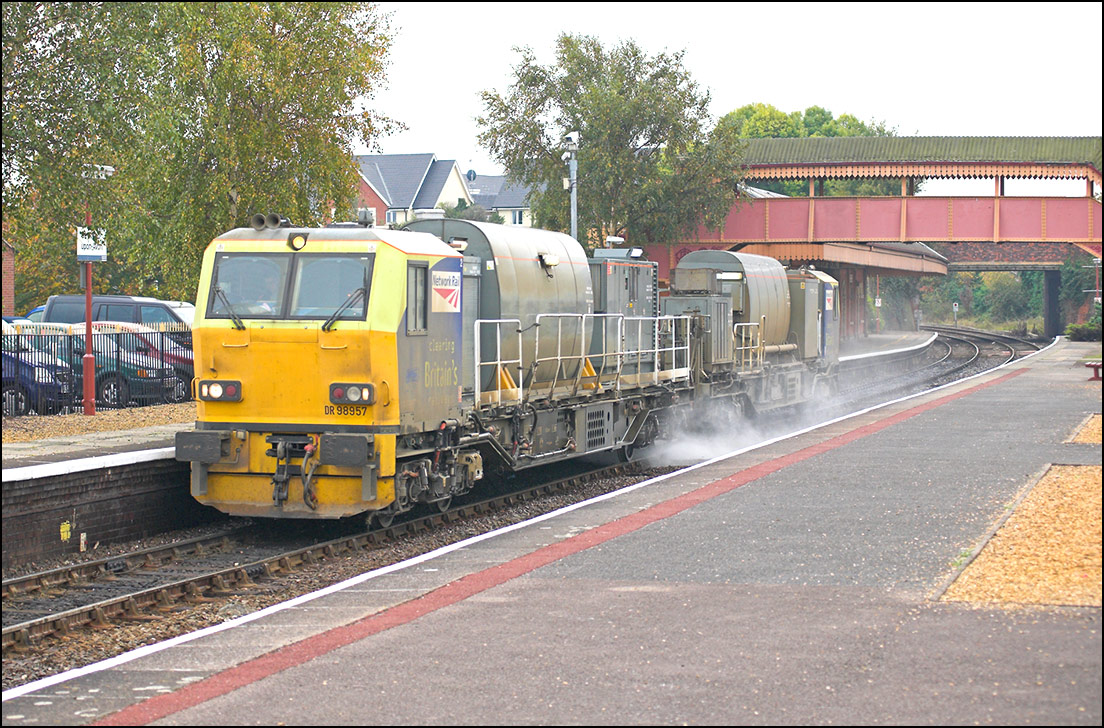 |
3S87 is allowed 5 minutes in platform 1 at Stratford-upon-Avon before returning along the North Warwickshire line to the Birmingham area. The crew took advantage of the PNB facilities before rejoining their unit and leaving, again turning on the jets which, of course make for a more interesting photograph. The background to this photograph has recently been transformed with the building of a new complex of retirement homes; see last year's shot from a similar spot on the platform for a comparison. |
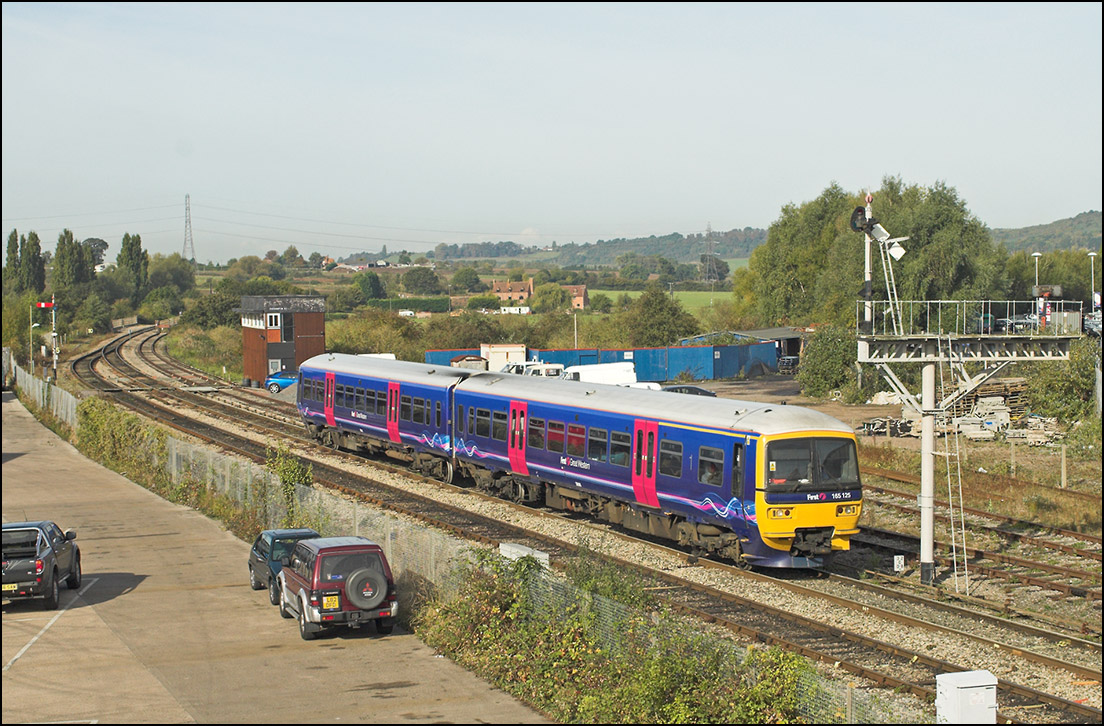 |
Most passenger services over the Cotswold Line between Worcester and Oxford are formed of class 180 Adelante stock, but now and again substitutes appear. On 18 October 2007 165125 in the attractive FGW "Neon" livery was out and about and is here seen about to make the stop at Evesham station with the 11.25 Worcester Shrub Hill to Paddington train. Evesham is the site of one of the passing loops on the line and as soon as the the class 165 had stopped, the signal for the down line was pulled off in readiness for a down Adelante to proceed towards Worcester. |
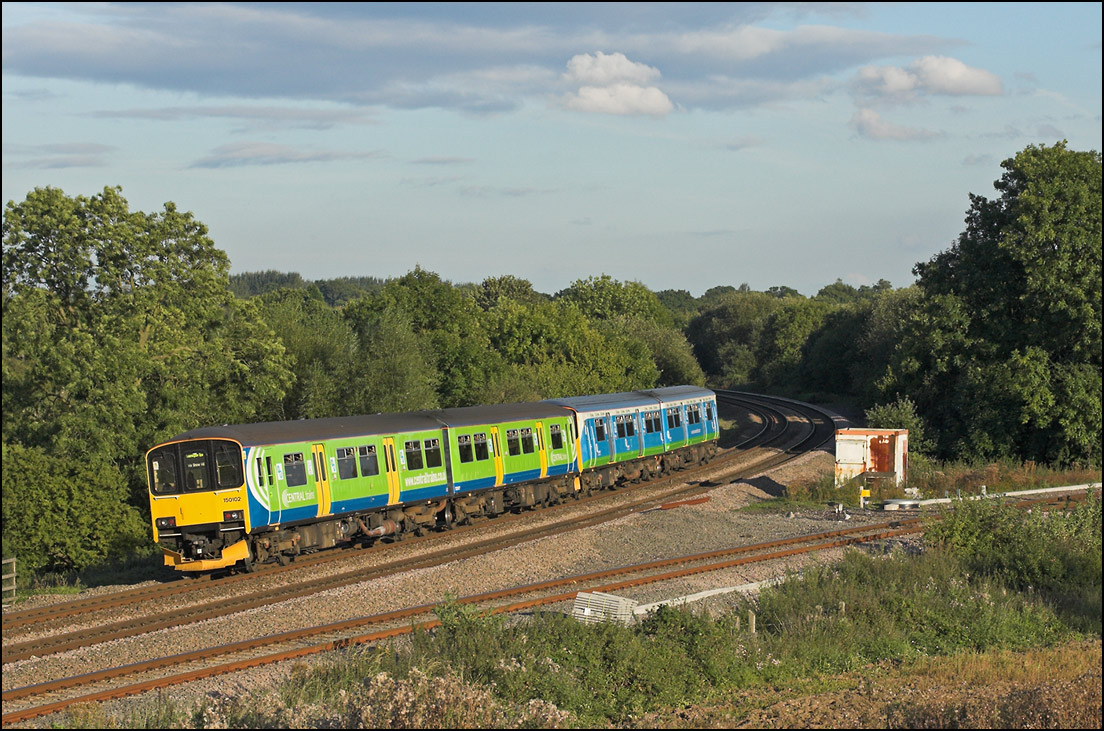 |
Central Trains have painted some of their class 150 DMUs into a new colour scheme. Never one to miss a colourful DMU I took this shot of 150102 trailing its bluer cousin on a Stourbridge Junction to Leamington Spa stopping service. OK, I would have much preferred it to be coming the other way and with the newly-painted unit leading, but there you go... These trains now run only in peak hours and with relatively few Chiltern Trains' services calling at all stations, some parts of the line to Birmingham have the worst service they have ever had. This picture from Hatton North Junction is timed at 18.17 on 5 September 2007. |
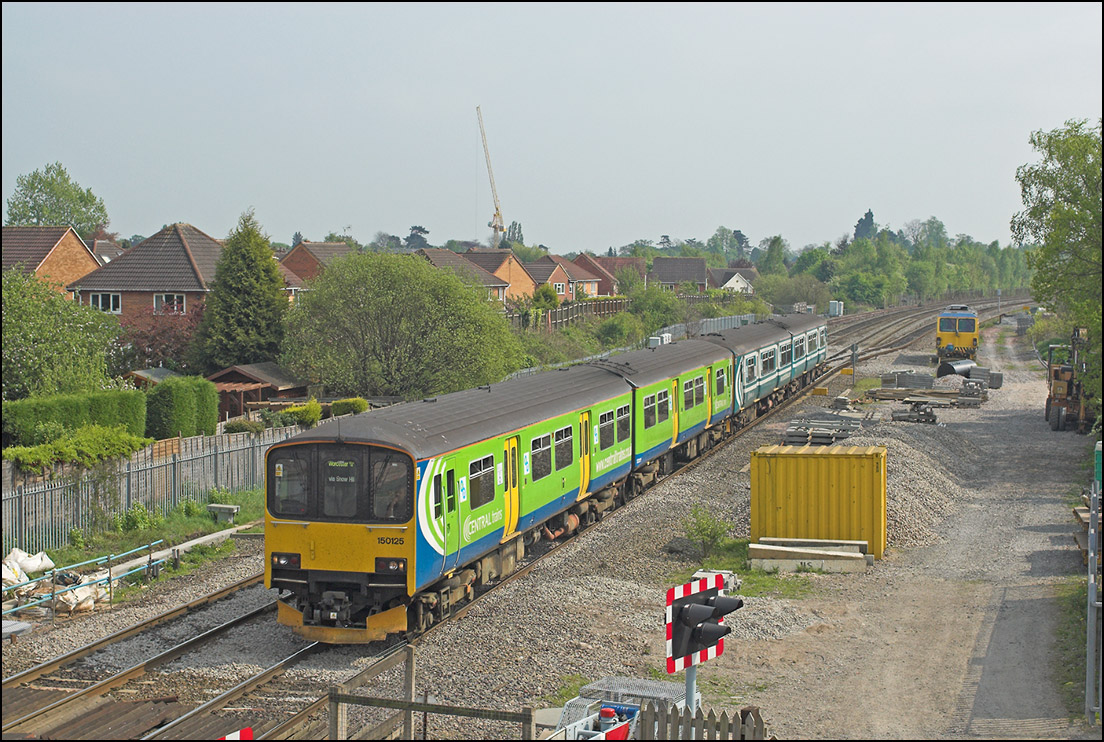 |
There is much evidence of recent cabling work in this view taken from the footbridge at Bentley Heath, near Dorridge, on Friday 27 April 2007. The train, formed of 150125 and a sister unit in the now obsolete Anglia colours, is a Dorridge to Worcester local via Birmingham Snow Hill; it has come from the loop adjacent to the track machine stabled in the down siding which serves the outer face of the island platform at the station. The housing estate on the left is the site of the extensive goods yard which served the area of which there remains absolutely no trace. |
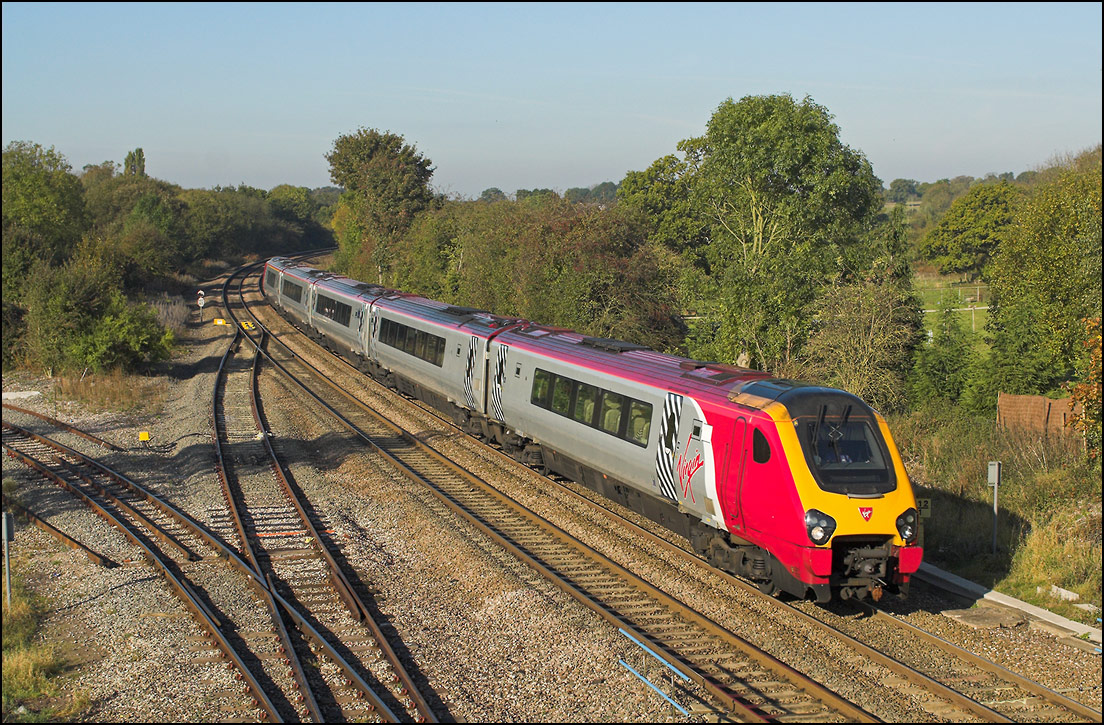 |
Here is one of the most frequently seen but least photographed trains on the UK network, a Virgin Voyager. This one was working the 06.44 Newcastle to Bournemouth train, a long way for any through passengers given the noise, vibration and poor seat positions in relation to the windows. Given that these units convey passengers on some long journeys, I would have thought it possible that they could have been better designed and provided a more comfortable and quieter environment. From a photographic point of view, I don't suppose they're too bad in a decent location and good light, the garish red livery providing a contrast to most urban and rural scenes. |
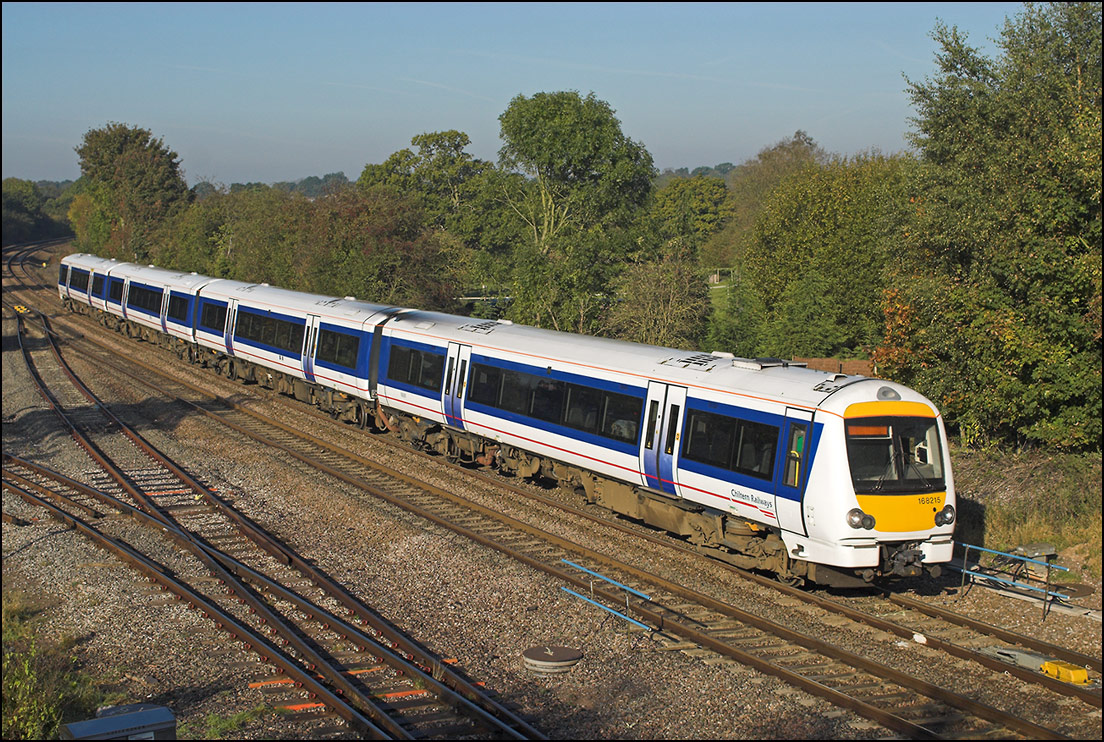 |
The weather forecast for Wednesday 24 October 2008 was for wall-to-wall cloud so it was a pleasant surprise when the sky cleared at around 09.30. I went to Hatton with the intention of taking some pictures of day-to-day trains, including Chiltern Railways' units, Virgin Voyagers and a couple of Freightliner and EWS intermodals. The first to appear was 168215 working the 09.52 Birmingham Snow Hill to Marylebone service which is pictured approaching Hatton station at the South Junction where the branch from Stratford-upon-Avon joins the main line. A lot of re-signalling work is being carried out here at weekends with all existing gantries being replaced and, in some cases resited, along with some additional new signals in a few locations. |
 |
This was my first sight of a former Virgin Voyager in the colours of Arriva, the franchise holder for Cross Country railways. 220017 is seen heading north towards Hatton North Junction on 6 February 2008 with a train for, I think, Manchester Piccadilly. This was very much a grab shot as I was watching some rabbits in the adjacent field and only heard the train approach at the last moment. If I had known it was coming I should have gone for a much wider view to see more of the new livery. |
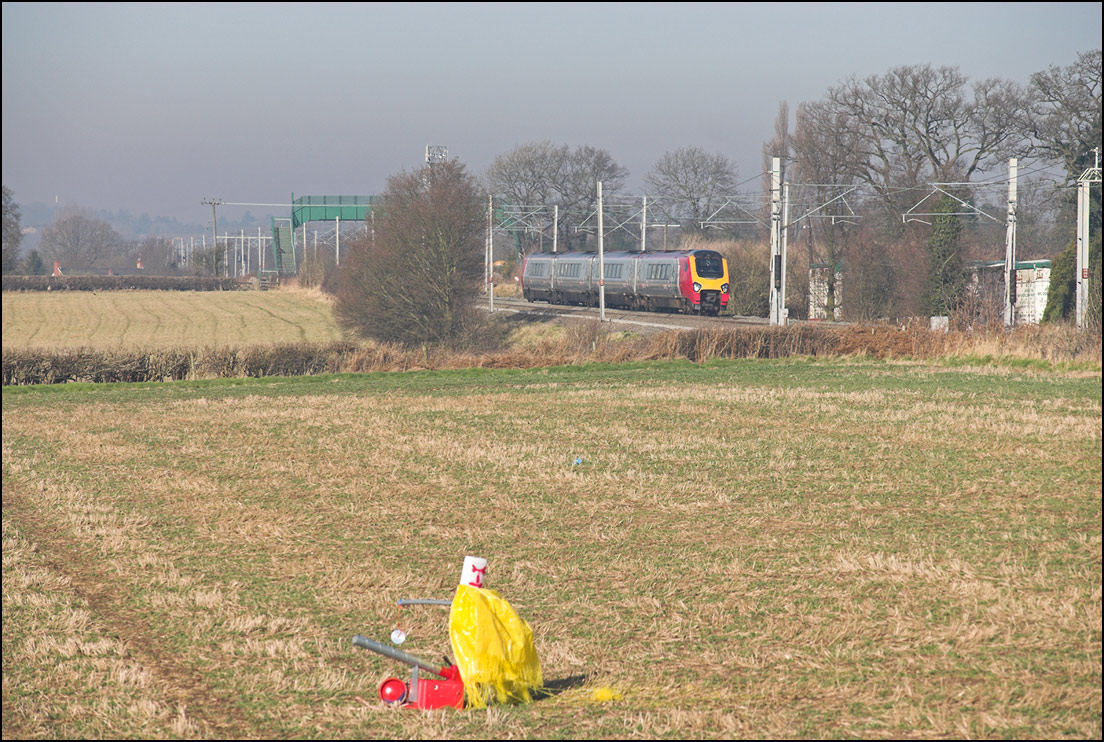 |
Whilst walking from the lane where I had parked my car at Wootton Green on 12 February 2008, I heard what I thought was the farmer shooting rooks or pigeons but when I arrived on the occupation bridge I saw that an automatic gas-gun bird scarer was the source of the noise. It was made a bit more interesting by the addition of the head and yellow cape although, with the random timing of the detonations, it still made me jump every time it went off. The train is a partly rebranded Arriva Cross Country Voyager heading for Bournemouth via Leamington Spa and Oxford. |
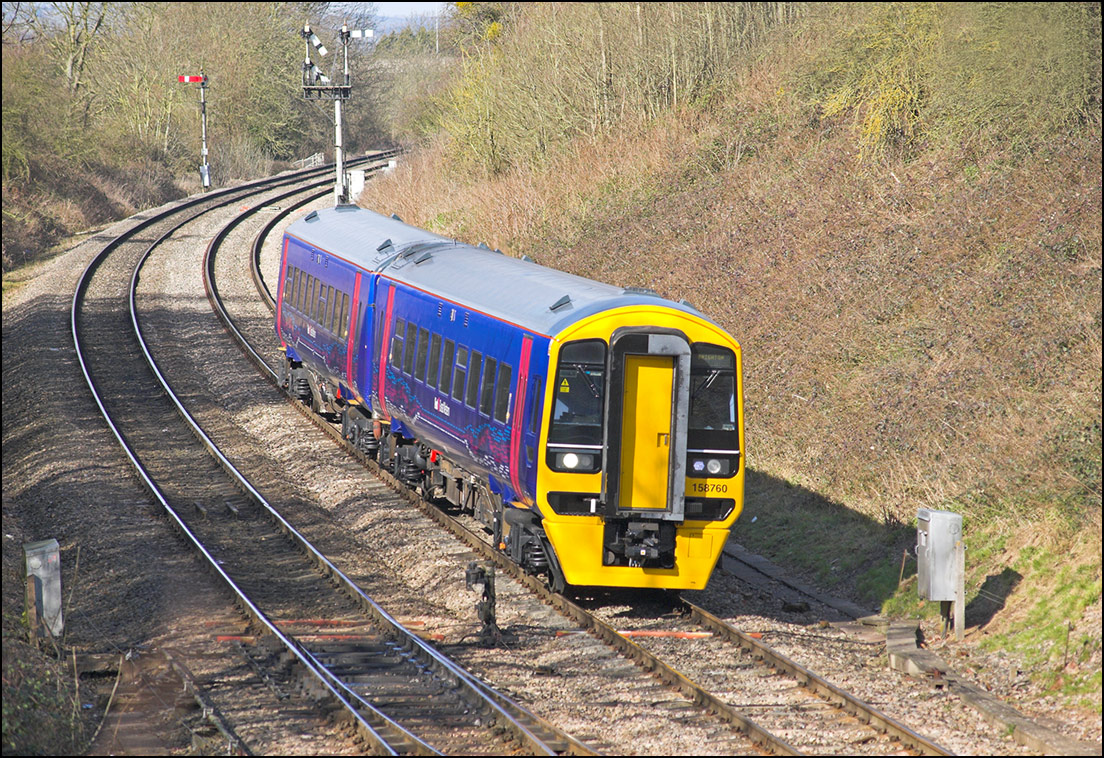 |
I soon found out from the signalman at Norton Junction that 6V05 from Round Oak to Margam was not running but I decided to hang on as I had seen this class 158 heading north and knew that it would return from Worcester and head to Brighton. This is the first of this class I have seen wearing First Great Western livery. Verdict? Not bad, but would look better with a third vehicle in the train. The distant signal on the bracket has been lowered, telling the driver that the road is clear across Abbotswood Junction and onto the down main line. |
 |
Just after the class 158 shown above had cleared, the round was put across for a train to leave the Cotswold Line. Within a few minutes this HST came around the curve forming a Paddington to Worcester service, led by power car 43029. This is the first HST I have photographed here since they took over the majority of workings from the clas 180 Adelante which, sadly, have now virtually disappeared from the network. |
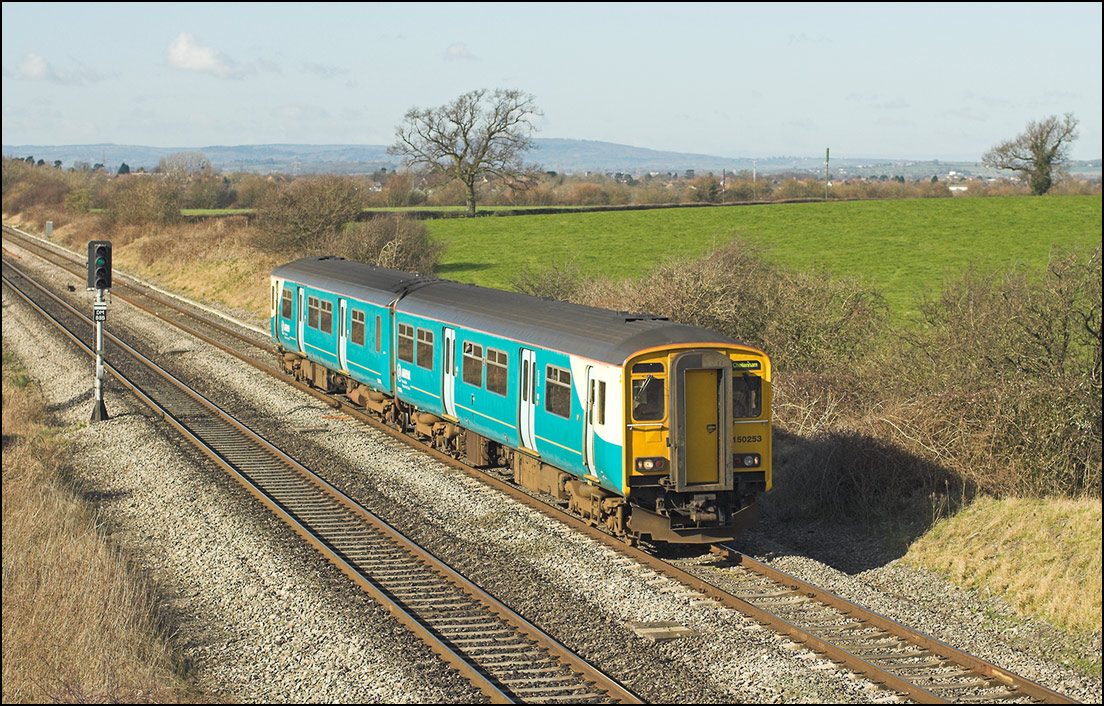 |
Yet another variety of class 150 livery was the next to appear at Badgeworth, this time Arriva Trains West on 150253 on a local service to Cheltenham. This stretch of line sees a great variety of diesel units and is a good area for those enthusiasts not totally obsessed with locomotives. I've always liked DMUs and am quite happy to spend an hour or two photographing these colourful little trains. |
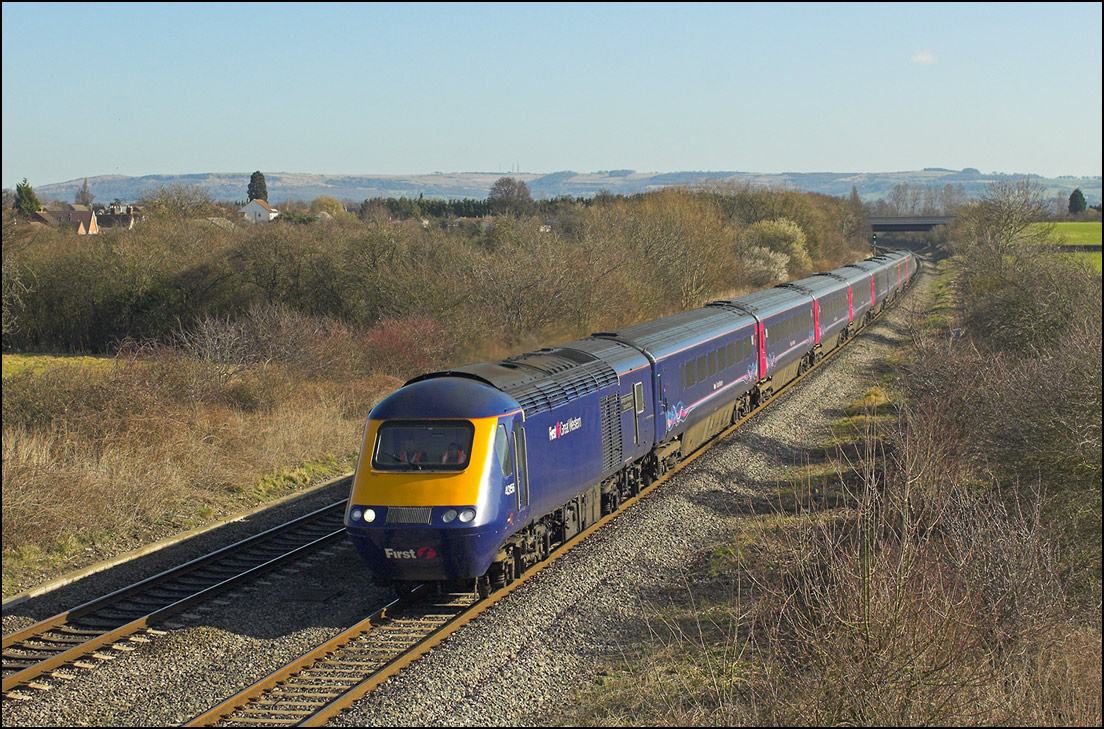 |
Cheltenham's importance has long been recognised by the railway and still benefits from direct trains to and from Paddington. I had previously photographed the down working, led by 43155, but in an attempt to give some variety to the day's action, here is the up train with 43156 at the pointed end accelerating away from Cheltenham and pasing the village of Up Hatherley, just visible behind the trees in the background. |
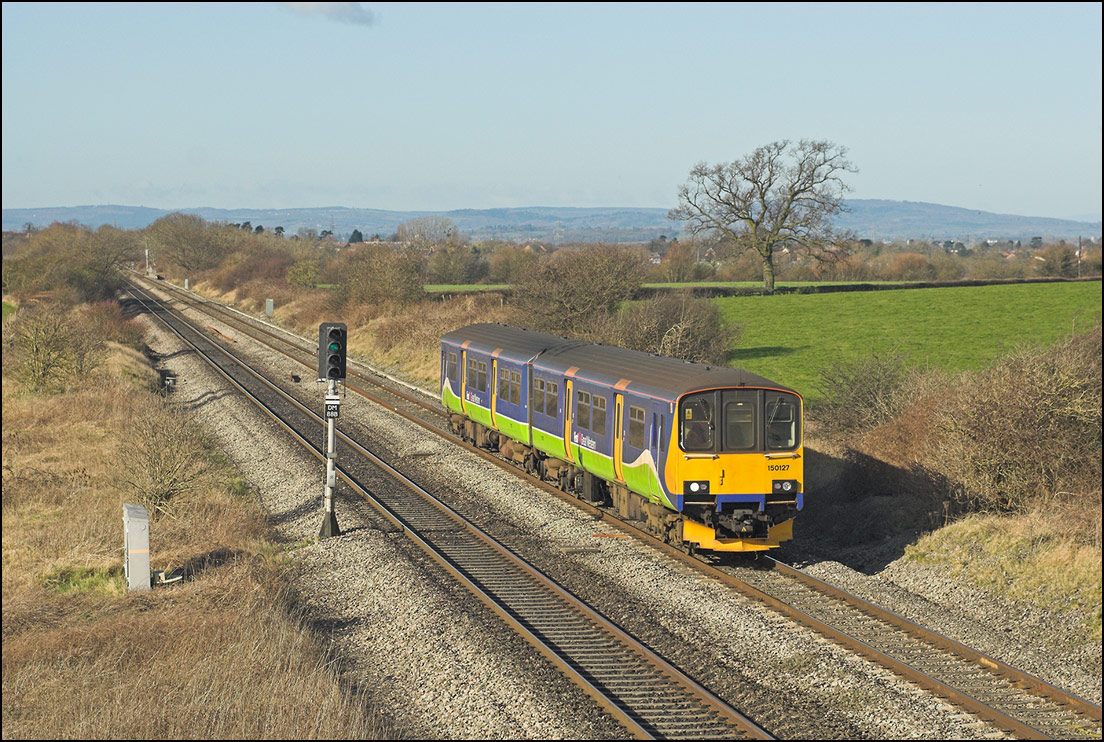 |
Here is a brightly-coloured 150127 in Silverlink livery with small FGW brandings. This is obviously the company's solution to overcrowding but I cannot but wonder if the passengers are too grateful for the less than comfortable seats these units provide. I'm sure they are fine for a trip from Gloucester to Cheltenham, but not much further...From an enthusiast's point of view, these transitional liveries give a welcome splash of colour. |
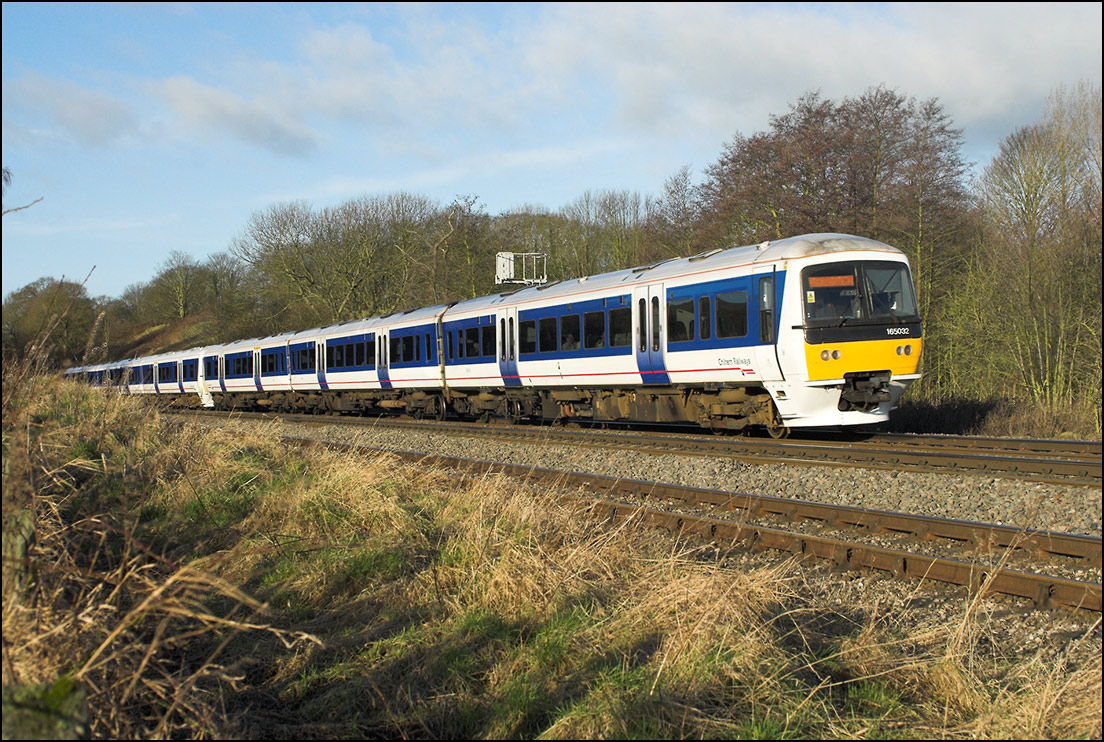 |
I can rarely resist pointing my camera at anything when I am by the lineside in lovely winter light and I think that the Chiltern Railways' trains look good against a dark background. Here is 165032 leading a class 168 out of Hatton cutting on Saturday 26 January 2008. The signal poking out of the first coach's roof is shortly due for removal as a replacement has been erected by the footbridge a few hundred yards to the south. A lot of new signals have appeared in the area as part of a major resignalling project in the area, together with more lineside cabinets desinged to make the railway photographer's life less easy! |
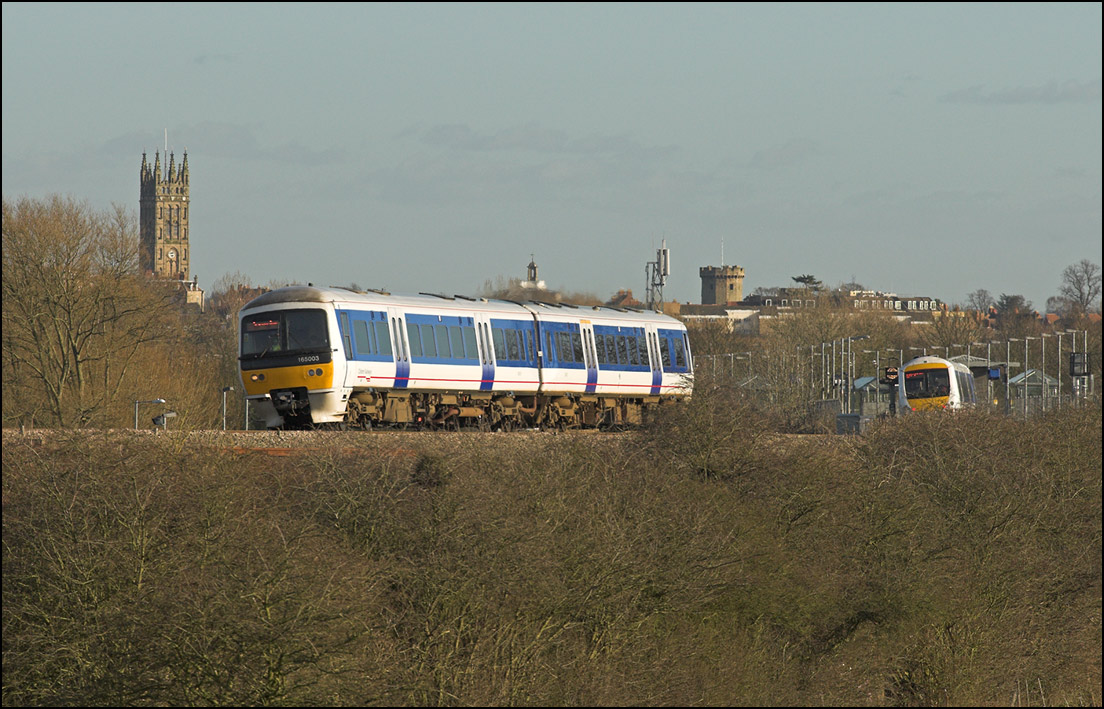 |
I am not one of those photographers who ignore diesel units unless they are being hauled by a locomotive as I feel everything on the railway is ephemeral as as such should be recorded. This picture shows 165003 passing non-stop through Warwick Parkway with a London Marylebone to Stratford-upon-Avon service whilst a 168 waits in the station with a train from Birmingham Snow Hill. The Stratford trains form a local service and as such stop at the station in Warwick town rather than Parkway which has a much more frequent stopping pattern. |
 |
Passenger trains calling at Ashchurch station are generally formed of class 158 stock, but on 31 July 2007 a northbound service produced my first sight of FGW's 150249 in the new "Neon" livery. Here is the unit about to make the station stop with at least 2 customers to increase the payload. |
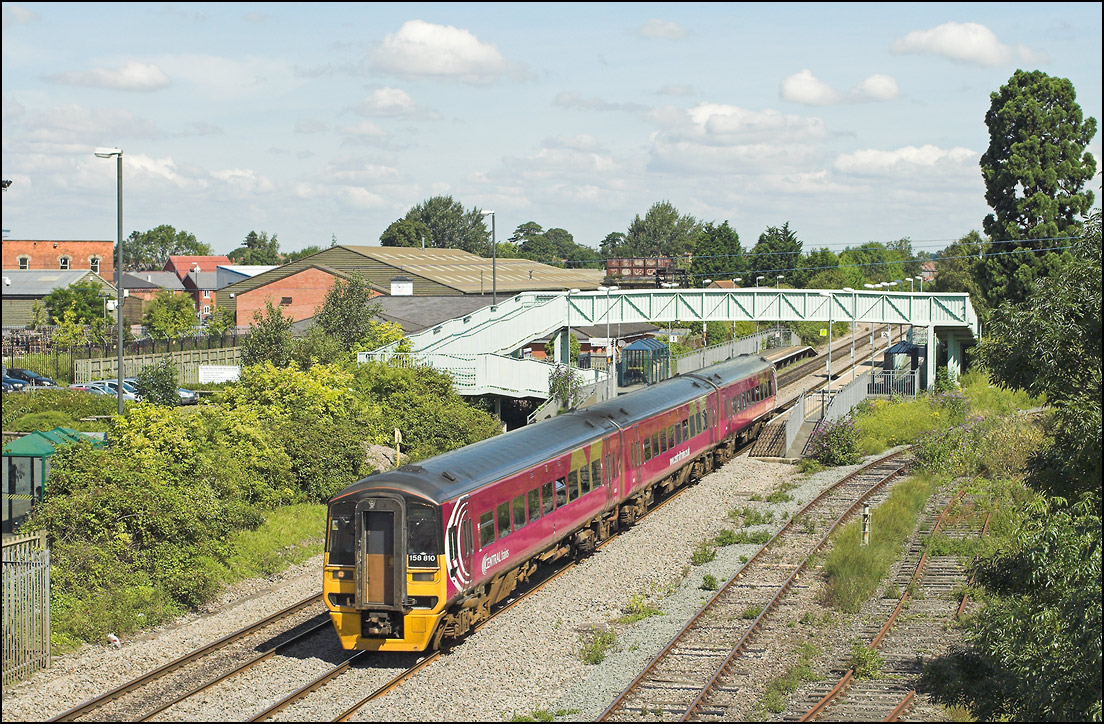 |
Central Trains have now made a start in at least partly branding the class 158s acquired from Trans-Pennine in their house style. This picture shows 158810 leaving Ashchurch station for the south with the Central logo applied over the red and gold of the former operator. It's a small thing, but I do like to get pictures of these intermediate and probably transient colour schemes, and with multiple unit liveries changing so frequently these days a large slice of luck is needed. I can't understand those who totally refuse to photograph units but will chase half-way across the country for yet another picture of an EWS or DRS 37. Units are the most colourful part of the current railway scene and in most instances, to my eyes at least, enhance the appeal of the industry. |
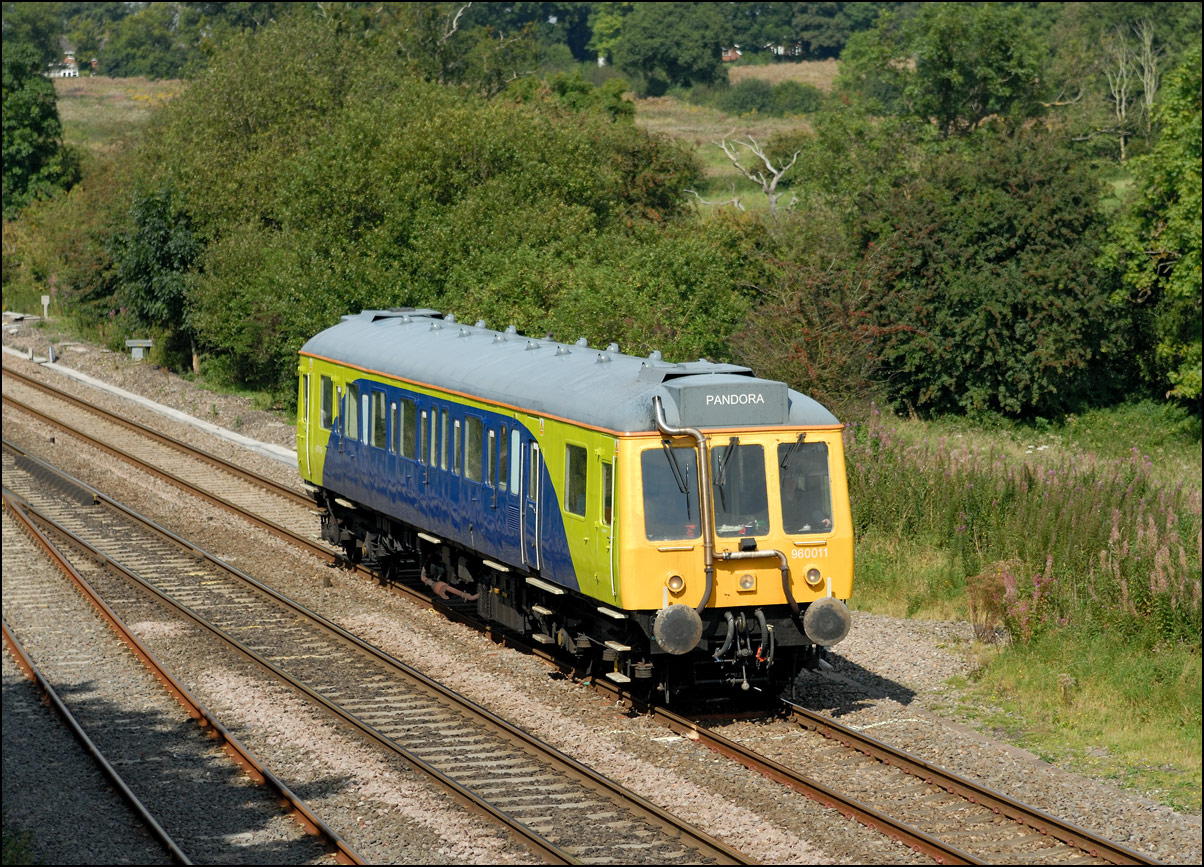 |
I have always liked the single unit DMMUs and here, at Hatton North Junction, is 960011 "Pandora" coming from the north with 2Z21 Derby to Eastleigh spot on time at 12.21 on 4 September 2007. A gang of 3 permanent-way workers is conveniently hidden behind the unit; I don't normally mind track workers in my shots but with such a small train their presence in full orange high-visibility gear would have been a little distracting. Single unit DMMUs were a long-standing feature of the lines between Birmingham, Leamington Spa and Stratford and it was good to see one again, albeit in a very different livery to the blue & grey they carried for much of their working lives. |
|
|
Central Trains have painted some of their class 150 DMUs into a new colour scheme. Never one to miss a colourful DMU I took this shot of 150102 trailing its bluer cousin on a Stourbridge Junction to Leamington Spa stopping service. OK, I would have much preferred it to be coming the other way and with the newly-painted unit leading, but there you go... These trains now run only in peak hours and with relatively few Chiltern Trains' services calling at all stations, some parts of the line to Birmingham have the worst service they have ever had. This picture from Hatton North Junction is timed at 18.17 on 5 September 2007. |
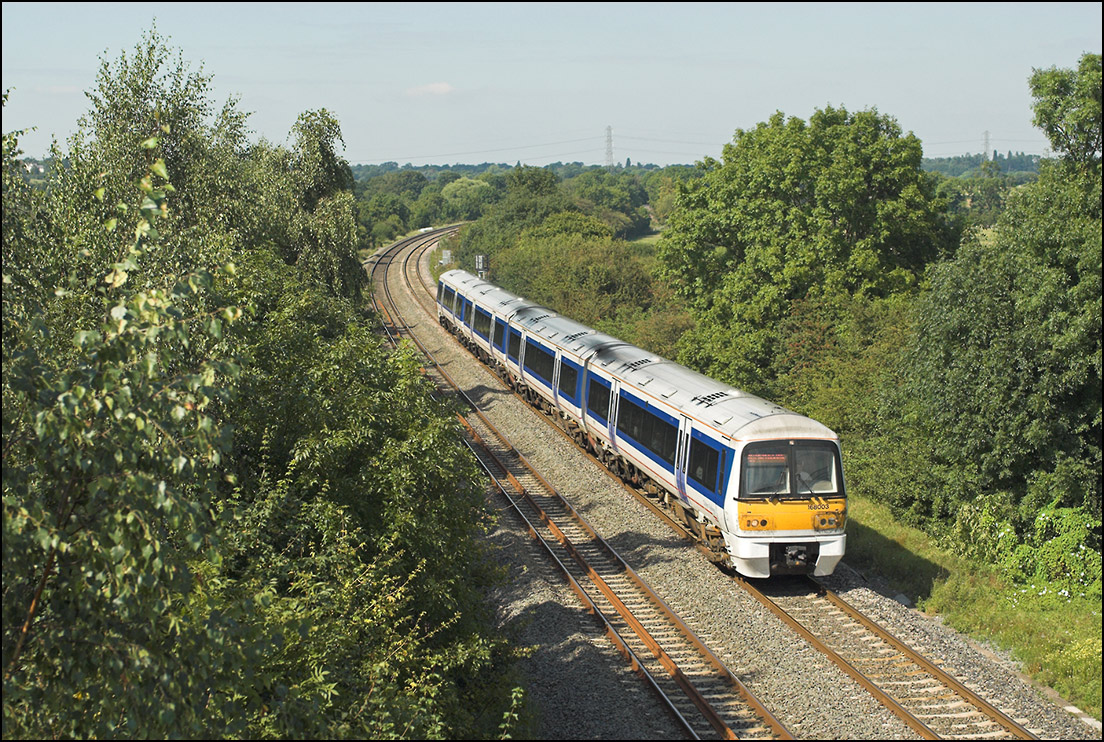 |
This picture as taken in a location at one time very popular with railway photographers, especially in the 1990s when it was possible to see 4 or 5 freights with a couple of hours late on a Saturday afternoon. I had been meaning to go and have a look at the scene for a while and on 4 September 2007 made the short trip from Hatton to this bridge over the M40 between Rowington and Lowsonford in Warwickshire. The first train to come along was 168003 on a Birmingham Snow Hill to Marylebone working. The shot has changed a lot since I used to come here in 1994, witnessed by this picture of 47363 on the Saturday Leeds to Southampton freightliner taken from much the same spot on 23 April 1994. Today's shot was taken at about 14.30 and by 15.30 the shadows had gone completely over the line. The 1994 picture was taken at 16.10... |
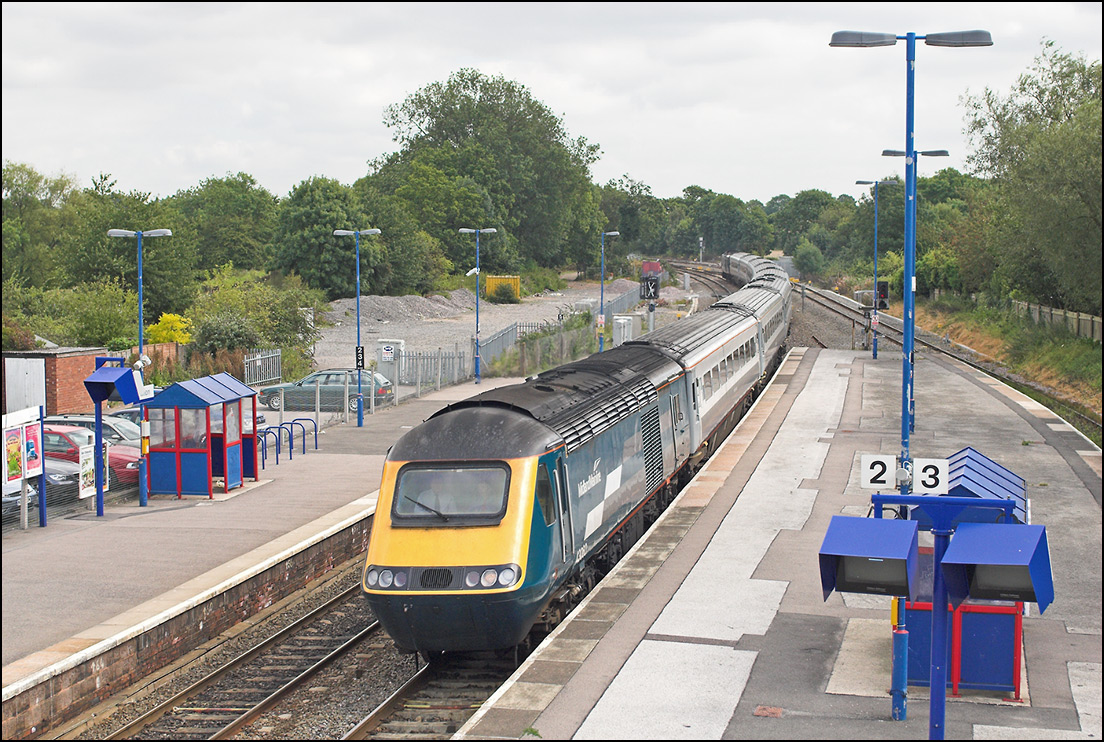 |
The August Bank Holiday Monday in 2007 again produced an HST working along the GWR Leamington Spa to Birmingham main line. In contrast to last year, the train today ran in the down direction, the working being 1Z53, the 11.45 Reading to Leeds, headed by power car 43060. Unlike last year, when I caught the up train in a lucky patch of sun, this year's run missed good light by a few seconds as it passed Hatton station. I wanted to get my shot somewhere easily identifiable so as to emphasise the unusual nature of the working. The train had worked the 1V49 09.41 Newcastle to Newquay on Saturday 25 August, the usual northbound diagram being fulfilled by a Virgin Voyager in order to release the higher capacity HST for passengers from the Reading Festival. Note the new signal on the end of the up platform; the inclusion of what appear to be "calling-on" lights on the pedestal seem to indicate that a fully-signalled move from the up main to the Stratford Branch platform, via the ladder crossover, may be in the offing. Even if this isn't the case, the new signal will cut down the length of the section; currently Hatton North Junction to a location at the south end of Hatton cutting. |
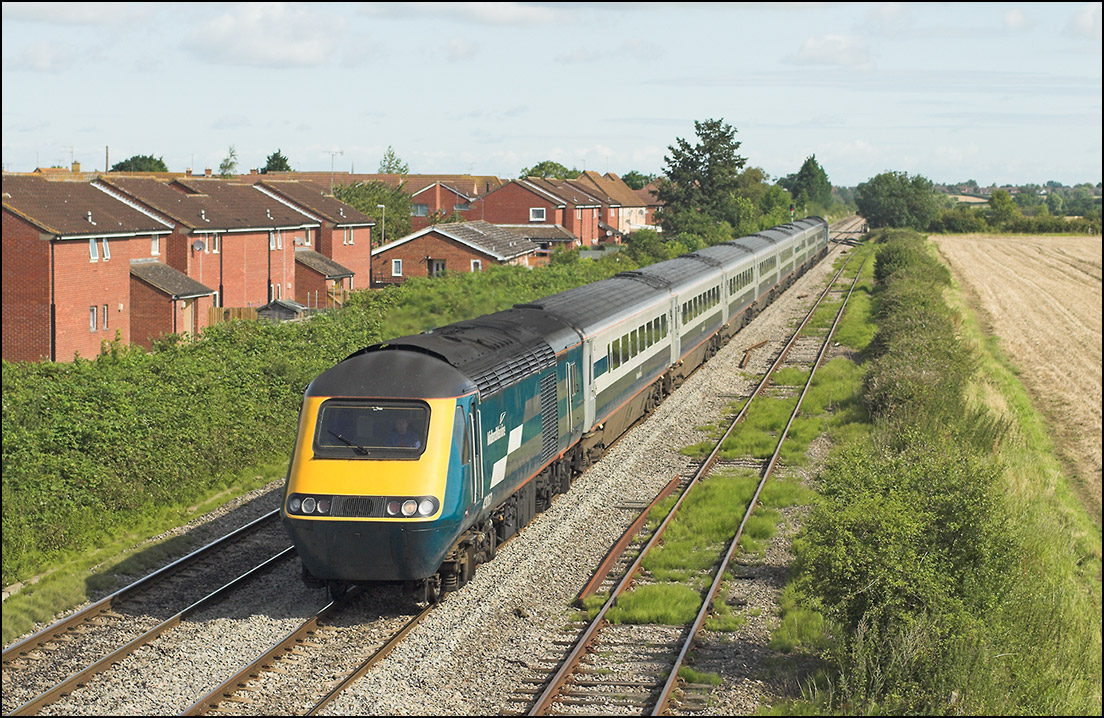 |
Summer Saturdays in 2007 have once again seen the use of HST stock on various trains to and from the West Country. Here is a Midland Main Line set, led by power car 43060, approaching Ashchurch in Gloucestershire on 28 July 2007 with 1V29, the 07.25 Manchester Piccadilly to Newquay train. It is always good to see something different on the railway and these HSTs make a pleasant change from the omnipresent Virgin Voyagers. This is the best train for favourable light in my part of the world, the others being around lunchtime and towards evening, when I doubt that I could be bothered to go out. |
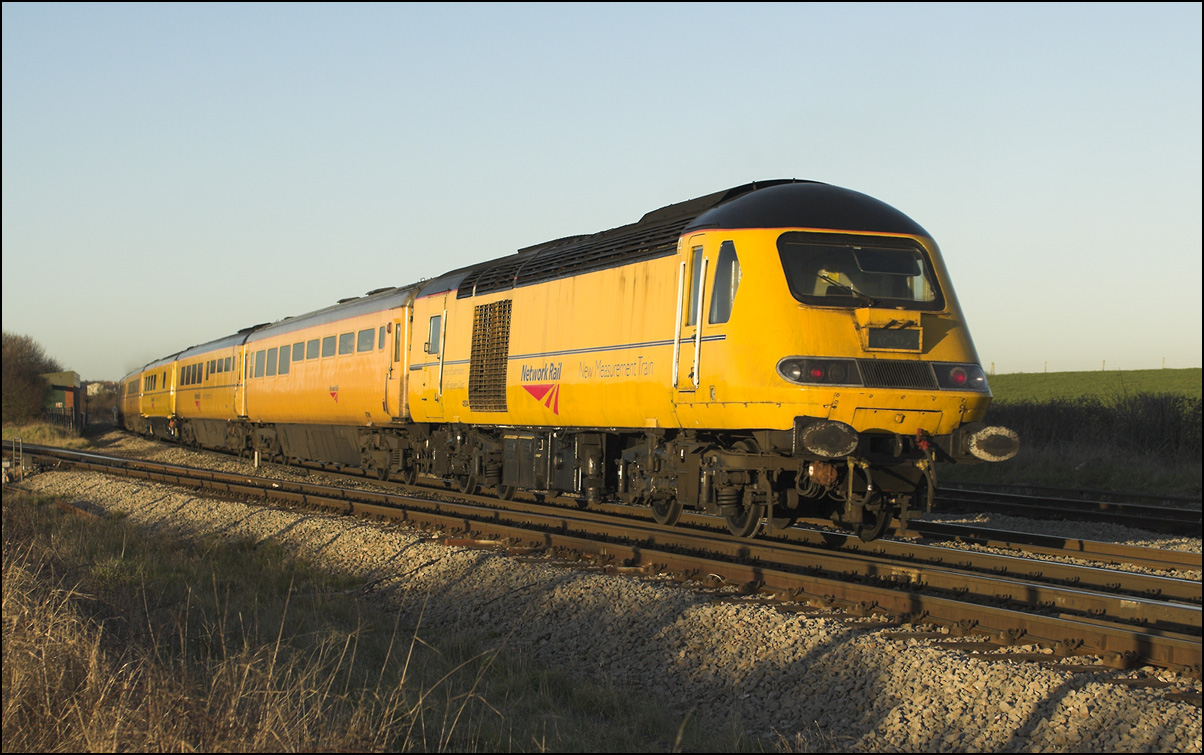 |
The New Measurement Train went on a trip to the South West on 14 February 2007. It was noted returning past Taunton at around 15.00 and I didn't expect to see it before leaving Abbotswood Junction, but , in fact, it reached there at 16.28 whilst I was still in a location suitable only for a southbound shot. As I have always been foiled in my attempts to get a decent photograph of the HST, usually by the train running with class 37 power, I decided to take a going-away view as power car 43014 tailed the formation away from the camera. Maybe next time... |
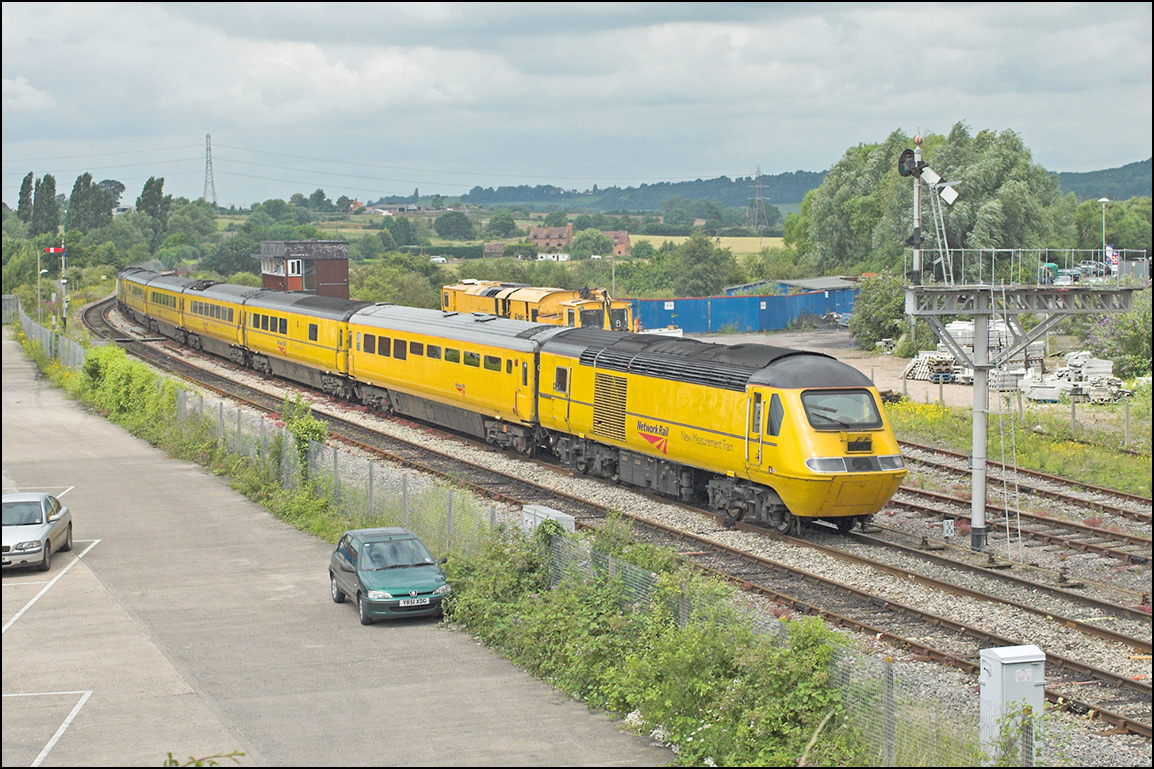 |
The New Measurement Train lived up to its name in one respect on 5 July 2007 when it visited some track for the first time. It was booked to run along the Cotswold Line as 1Z20 from Derby to Worcester and Oxford, before returning by the same route later the same day. Here it is, nearly catching a lucky patch of sun, passing Evesham signalbox and the rather lop-sided looking signal gantry. 1Z20 had to sit in the station for around 15 minutes to allow the passage of a northbound passenger train and 37410 running as a light diesel from Long Marston. I was surprised to find myself alone on the bridge for this working, given that it was a new working for the line. |
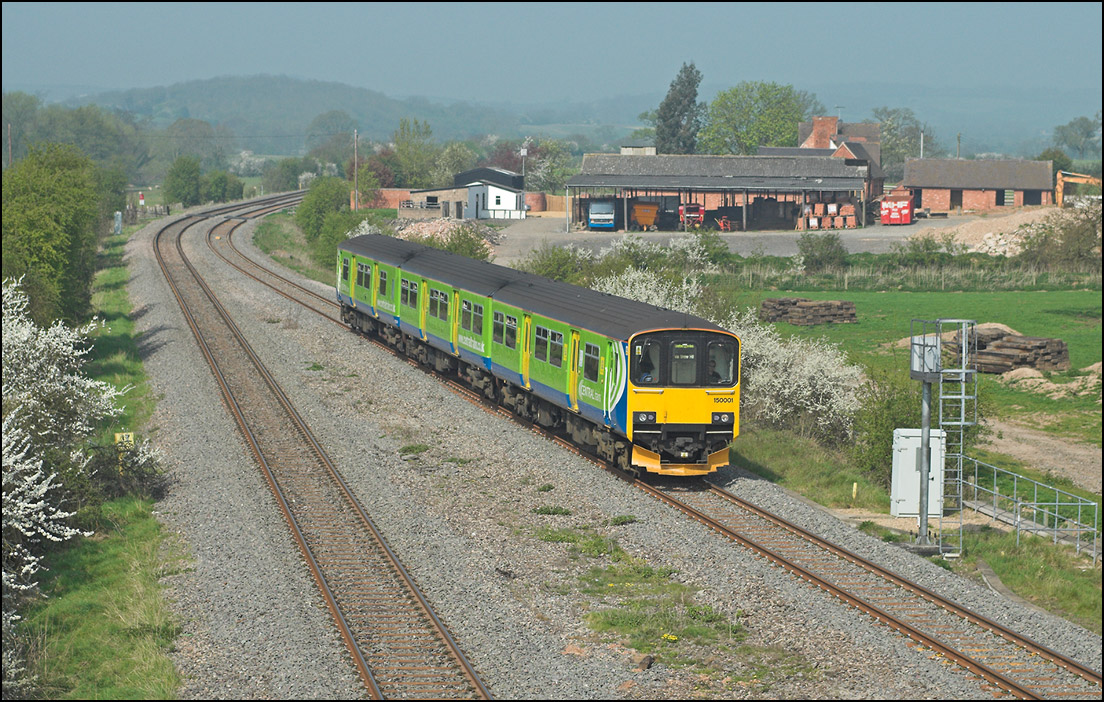 |
Class 150 DMUs form the mainstay of services along the North Warwickshire line to Stratford-upon-Avon. Here is the lowest numbered of the class, 150001, about to pass under the longest cast iron aquaduct in England, to be found at Edstone near Bearley Junction. Although it's not visible in this shot, this where the branch to Alcester and Redditch diverged from the main line, and water for the branch engine was taken from the canal, a ladder, stop-cock and leather being provided for this purpose near to where I was standing for this photograph. |
 |
Easter weekend 2007 saw engineering work closing parts of the WCML. To cater for the expected extra demand between London and Birmingham, Chiltern Trains strengthened their services by, in some cases, using 2 class 168 units on Snow Hill trains. Here, on Good Friday, is the 14.20 from Marylebone just after leaving Warwick Parkway station and attacking the 1/110 average gradient of Hatton Bank. Some of Warwick's famous architecture can be seen in the background, including the tower of St. Mary's Church and the Round Tower of the castle. Warwick is not immune from delinquency, as evidenced by the abandoned shopping trolley in the extreme bottom right-hand corner of the picture. |
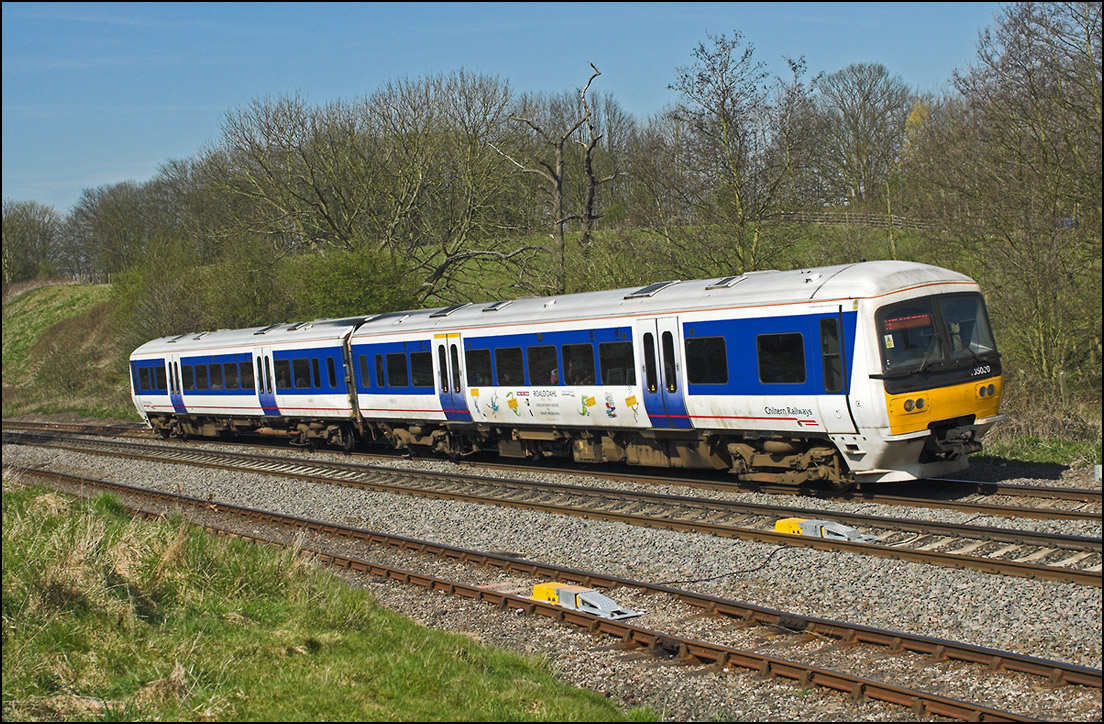 |
A couple of miles to the north of the picture above is Hatton Cutting. Just leaving this on Good Friday morning is 165020 with the 11.40 Stratford-upon-Avon to Marylebone train. The leading coach has been adorned with vinyls commemorating the author, Roald Dahl, who lived near Great Missenden for many years. Click on this hyperlink for a closer look at the appropriate part of the train. |
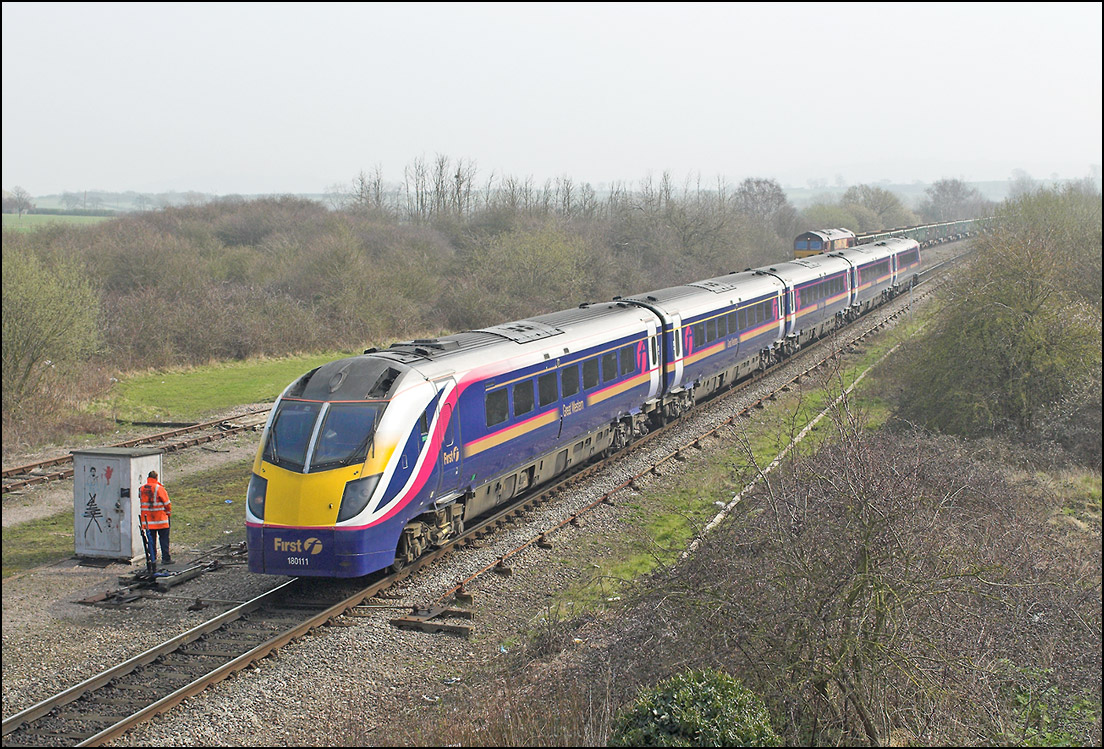 |
On Friday 30 March 2007 I photographed 66179 leaving Long Marston and then decided to have another shot at Honeybourne Junction. The train from Long Marston arrived at Honeybourne at 12.15 but it was clear that there would be a delay as the 10.52 Adelante from Paddington was due to call at the station at 12.32, meaning that the single line from Moreton-in-Marsh to Evesham was occupied. Here is 180111 approaching the station with 66179 and the JNAs visible on the branch. The crew member at the ground frame will have to wait for the Adelante to get away from Evesham about 12 minutes after leaving here, before he will be able to extract a token from the machine in the hut which will unlock the ground frame and allow him to operate the point levers. |
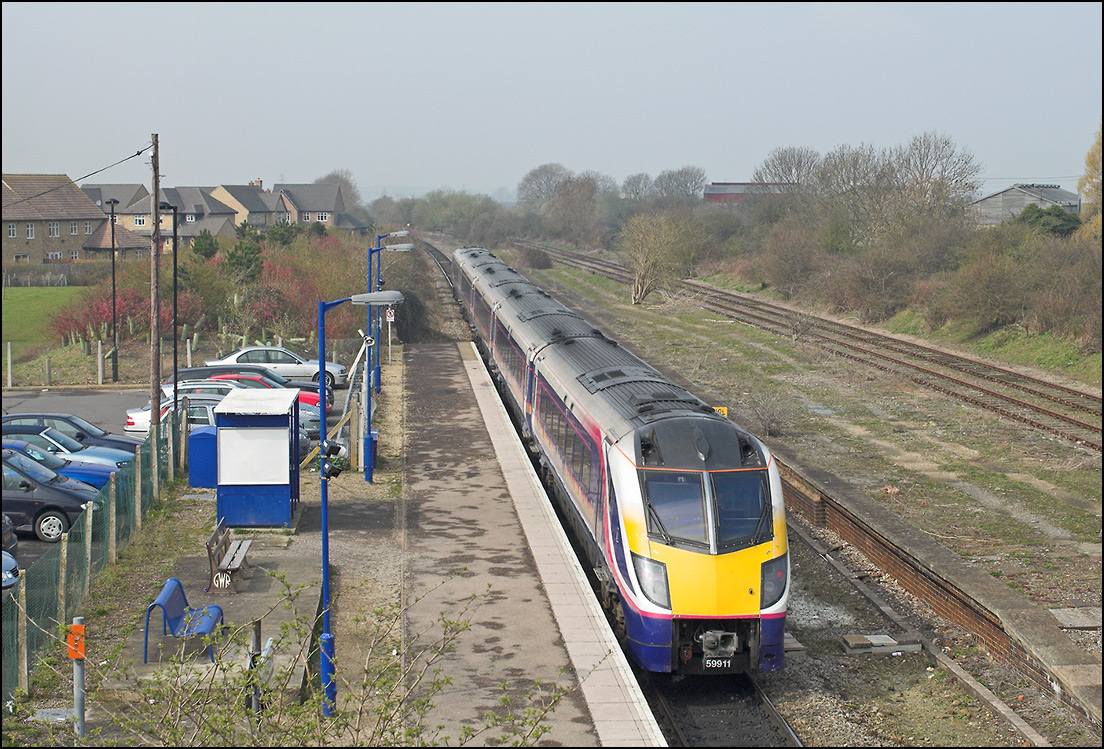 |
Here is another view of 180111, this time leaving Honeybourne station for Worcester. The scale of the site here can be well seen here, with the currently unused island platform prominent to the right of the train. It is possible that the line will be doubled in the forseeable future, in which case the island will be again used by up trains. The rusted lines on the extreme right were once those used by trains to and from Stratford-upon-Avon, and also by locomotives needing to use the coaling stage or those depositing wagons in the associated sidings. |
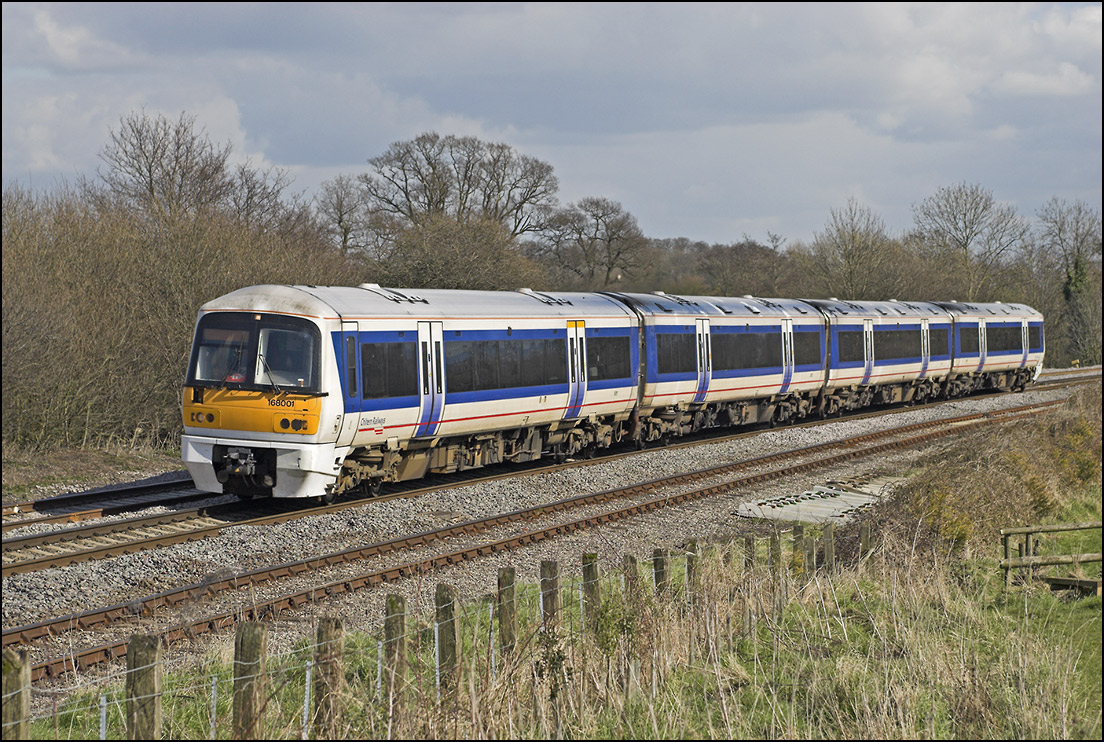 |
Class 168 is the mainstay of Chiltern Railways' express services between London Marylebone and Birmingham Snow Hill. Here, the first of the class, 168001, is seen on the climb of Hatton Bank with the 13.50 from London. On a line such as this, one learns to appreciate the passenger trains, such is the paucity of freight movements and in any event, I think it's important to record all aspects of todays railway. In 20 or 30 years time, it's the photographs of day-to-day scenes that will be looked at with more interest than one-off or special workings. |
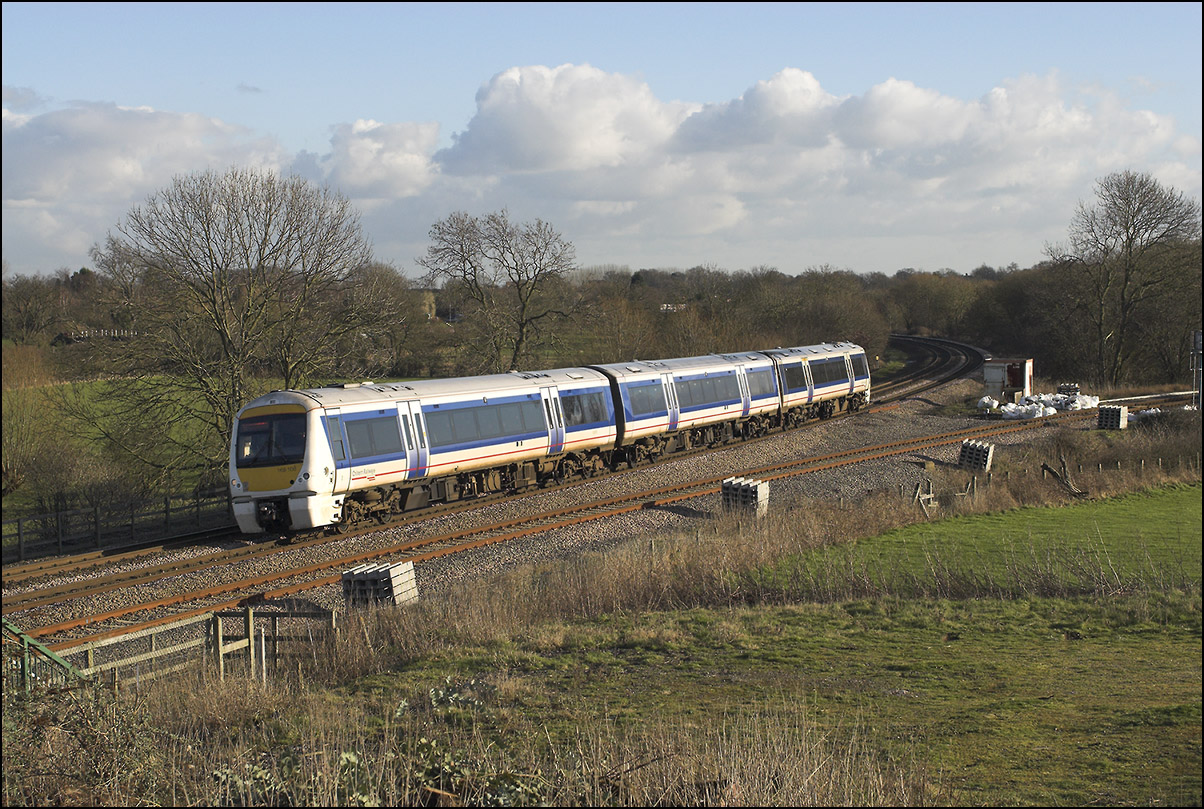 |
During the afternoon of 25 January 2007 a little cloud began to build up. When it's in the right place, i.e. not obscuring the sun, cloud in a blue sky can add a lot to the scene, hence my inclusion of this picture of 168104 on a Marylebone to Birmingham Snow Hill train passing Hatton North Junction. I quite the look of these units and am happy to take photographs of them when conditions are right. After all, if one photographs only locomotives, a lot goes unrecorded and there are long gaps between shots on a line like this. New trunking has been laid along the curve from Hatton North to Hatton West Junctions - the connection to the Stratford-upon-Avon branch and it looks as if there's more work to coming judging by the piles of material lying around. |
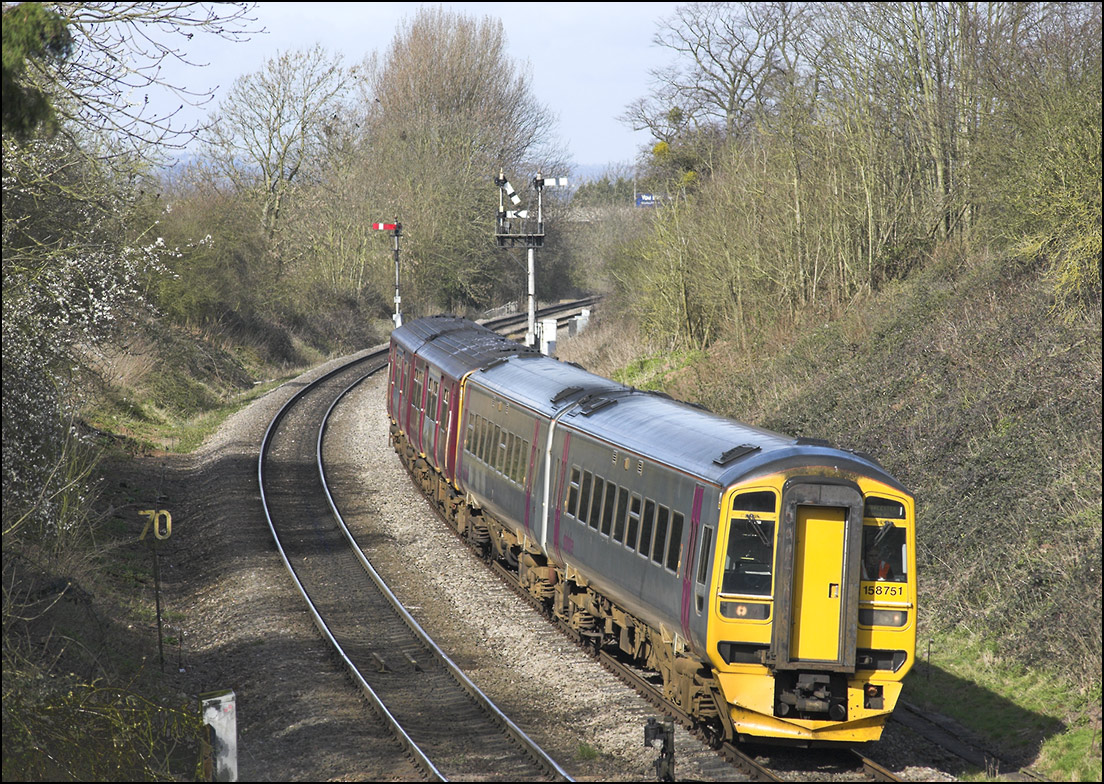 |
Not all regular passenger services heading south from Worcester are FGW Adelanti. This train is heading for the main Cheltenham line at Norton Junction and is formed of Alphaline 158751 with 150240 tagged on the back. This is one of those locations that I would almost never visit were it not for the lower quadrant semaphore signals. Without them, there would be little of any interest at all in the picture; just a woody tunnel between the M5 and Norton Junction roadbridge. |
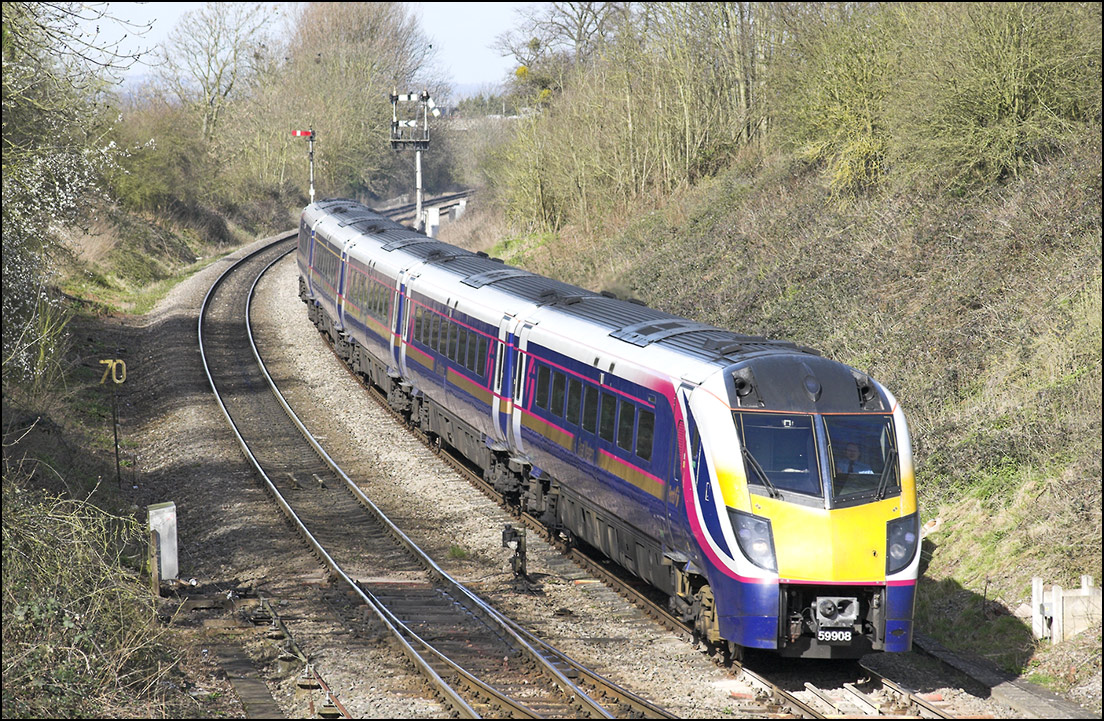 |
Here is one of the most modern 21st century diesel multiple units under the control of 19th century-style signalling. The train is the 10.23 Worcester Foregate Street to London Paddington, formed of 180108 and pictured at Norton Junction, Worcester on 16 March 2007. The route over which this train is signalled is regarded as the main line and the distant signal for the junction can be cleared to a green aspect only for trains heading up the Cotswold Line to Oxford and London. The other route controlled by the bracket signal leads to Abbotswood Junction and the main Birmingham to Gloucester line. The lower quadrant distant signal, in itself quite a rarity these days, is lowered only if the train can proceed over the single track lead across Abbotswood Junction and onto the main line. |
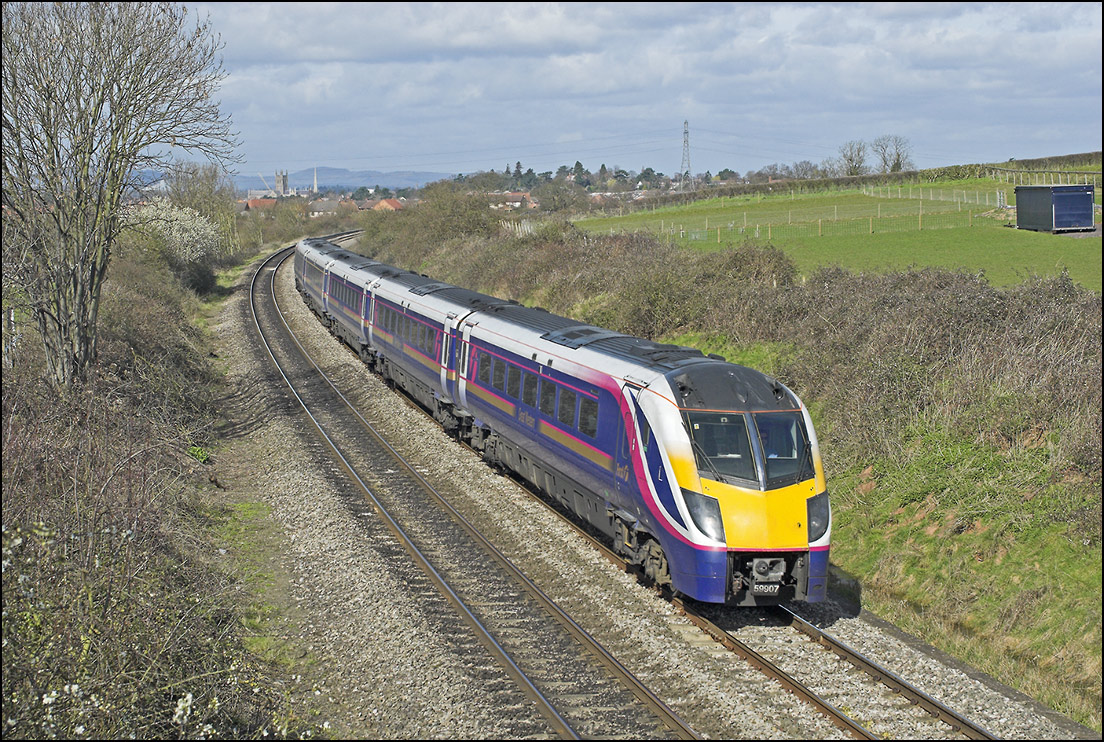 |
Just a couple of miles up the line towards Worcester is an occupation bridge carrying a bridlepath over the railway near Norton Barracks. This bridge gives a good view in both directions but my preference is for the shot looking towards Worcester. This picture of Adelante 180107 on a Paddington-bound service was taken in the late morning of 16 March 2007 |
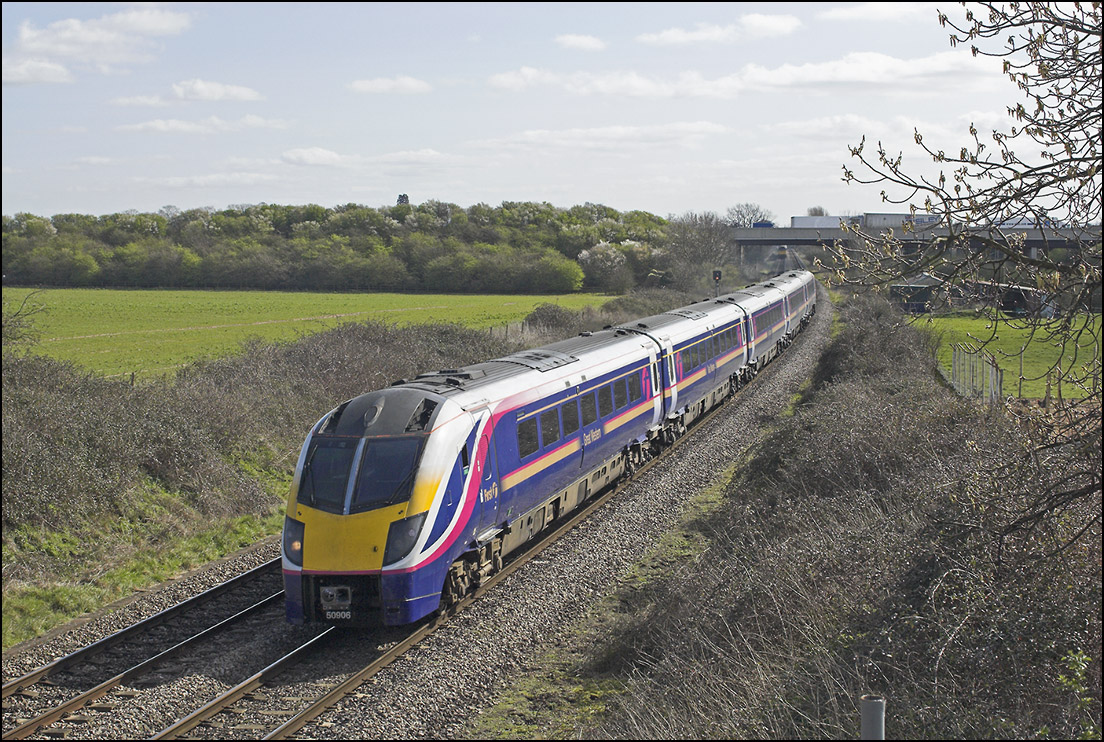 |
For the sake of completeness, here is the view of a down train at Norton Barracks. 180106 is on the final leg of its journey to Worcester as it passes underneath the M5. In the distance on the up line is 47826 bringing up the rear of a Worcester to Cheltenham special run in connection with the Cheltenham Festival; 57601 was on the front. |
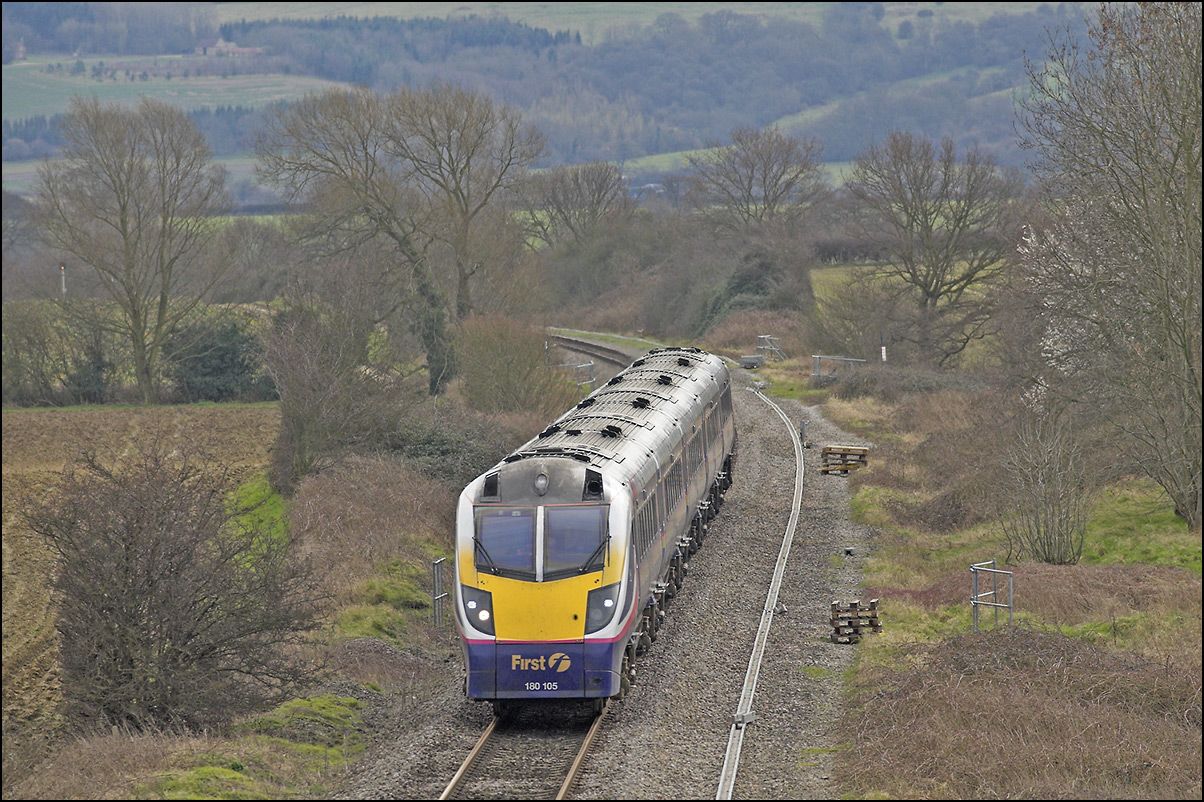 |
First Great Western Adelante units form most of the passenger trains on the Cotswold Line to and from Paddington, Worcester and Hereford. Here is 180105 on the long and gentle climb from Oxford to Chipping Campden with the 10.52 Paddington to Worcester service. The backdrop is the wooded northern slopes of the Cotswold Hills, one of the more attractive pieces of scenery on the line. Note the Moreton in Marsh up distant signal in the left background; this station is just a few minutes to the south of this location. |
 |
I don't miss too many opportunities to photograph the stylish Class 180 Adelante units when the light is favourable. Here is a Worcester to Paddington working passing the village of Lower Moor between Pershore and Evesham on Thursday 8 March 2007. It looks as if some major cabling job is about to take place if the piles of concrete trunking are anything to go by. The wreck of a car alongside the white wall is intriguing; has it suffered a high-speed shunt, or just been cut in half? |
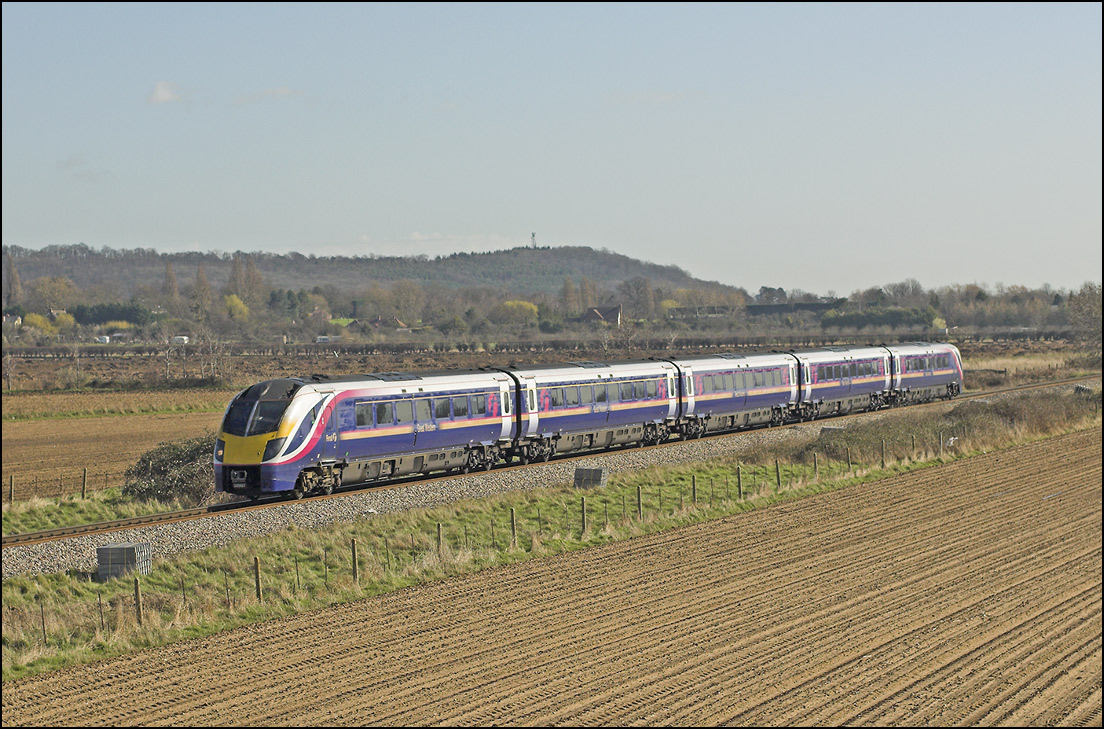 |
This is the view of a down Paddington to Worcester train at Lower Moor on 8 March 2007 to compare with the picture of an up working above. This scene may be about to change for the worse. The field visible above is the subject of an attempt to obtain planning consent for a huge glasshouse in which a hydroponic "food factory" will be established. The mounds of earth are the results of architectural digs to establish if anything of historical interest was on site. There is obviously a lot of local opposition to the proposed development which, if built, will range from 8 to 11 metres in height and will cover the whole field. Even from a more prosaic standpoint I can imagine the reflections that would be generated on a sunny day would not be conducive to good photography... |
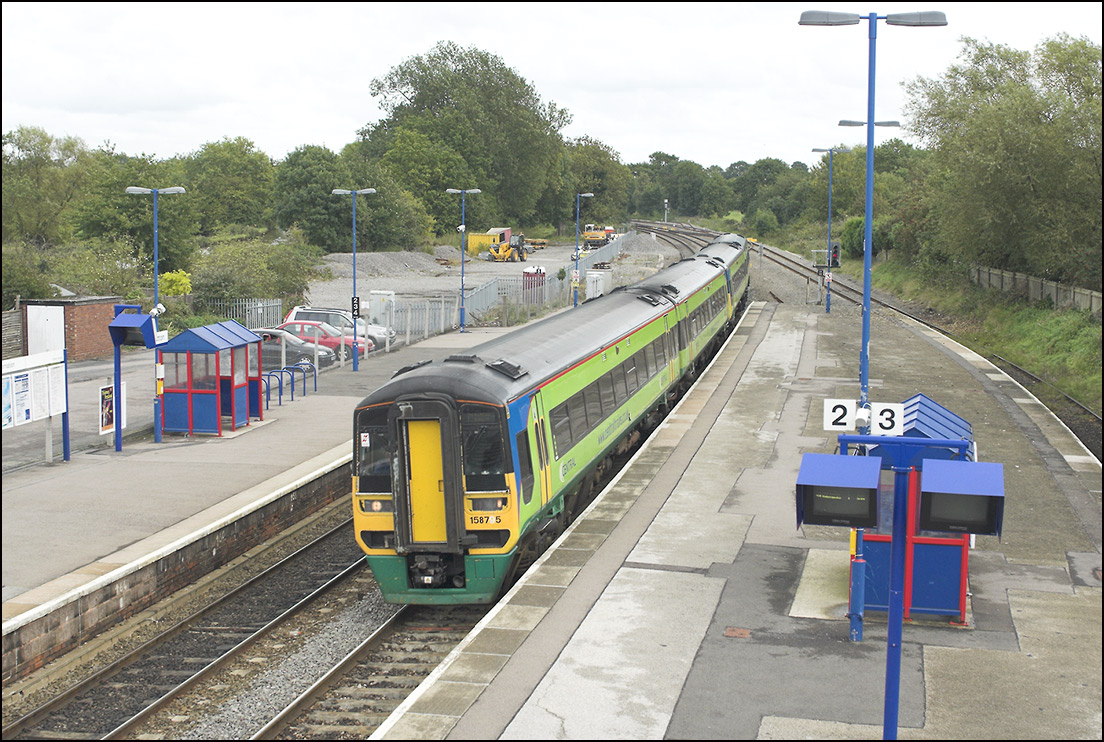 |
Here is a slightly unusual scene at Hatton - a 5Z82 Bristol to Neville Hill move of 2 class 158 units. These have never been commonplace on this line, the only others being a Liverpool to Portsmouth Harbour and return some years ago. The units are 158795 and 158798 - note the numbers on the leading unit - they are in several different font sizes with a white number 9. |
 |
We don't seem to have a lot of snow these days so even though I'm not keen on snowy shots without the sun, I thought it worthwhile to include this picture of 165038 in Hatton cutting on Saturday 10 February 2007 whilst working the 12.20 Marylebone to Birmingham Snow Hill. I was surprised how much snow remained in the cutting, as only a few miles away in Stratford-upon-Avon, it had almost completely thawed. The roads on the way over were quite badly flooded in parts, especially in the lanes around Claverdon and Pinley. |
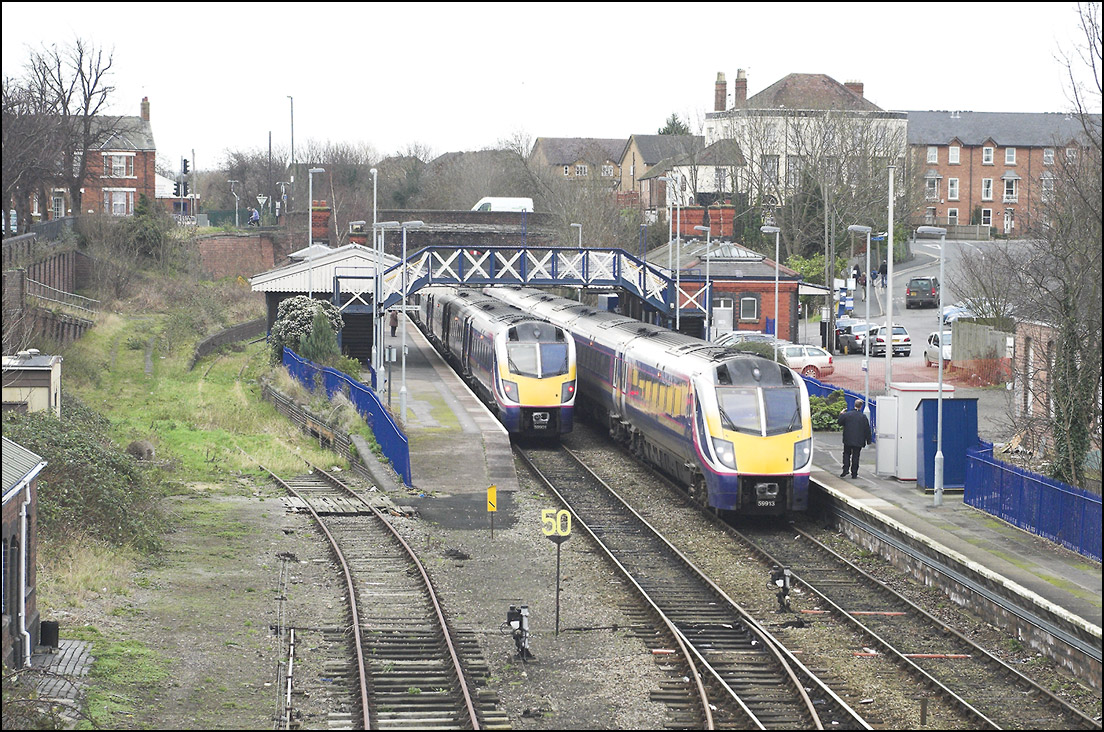 |
 As I mention elsewhere, I do like the FGW Adelante DMUs and shall be sorry to see them leave the Cotswold Line. Here are two units at Evesham on 15 January 2007, the driver of the northbound train having just obtained the token for the single line to Norton Junction from the broom cupboard
on the platform. This train was running late and the southbound service should already have been at Moreton in Marsh, meaning that this shot would not have been possible; such is the inflexibility of single lines. The good news is that some parts of, if not all the line from Wolvercote Junction, Oxford to Norton Junction is looking set to be redoubled over the next couple
of years. A consultation exercise is taking place with detailed examinations of the project to commence in February 2007.
As I mention elsewhere, I do like the FGW Adelante DMUs and shall be sorry to see them leave the Cotswold Line. Here are two units at Evesham on 15 January 2007, the driver of the northbound train having just obtained the token for the single line to Norton Junction from the broom cupboard
on the platform. This train was running late and the southbound service should already have been at Moreton in Marsh, meaning that this shot would not have been possible; such is the inflexibility of single lines. The good news is that some parts of, if not all the line from Wolvercote Junction, Oxford to Norton Junction is looking set to be redoubled over the next couple
of years. A consultation exercise is taking place with detailed examinations of the project to commence in February 2007.
|
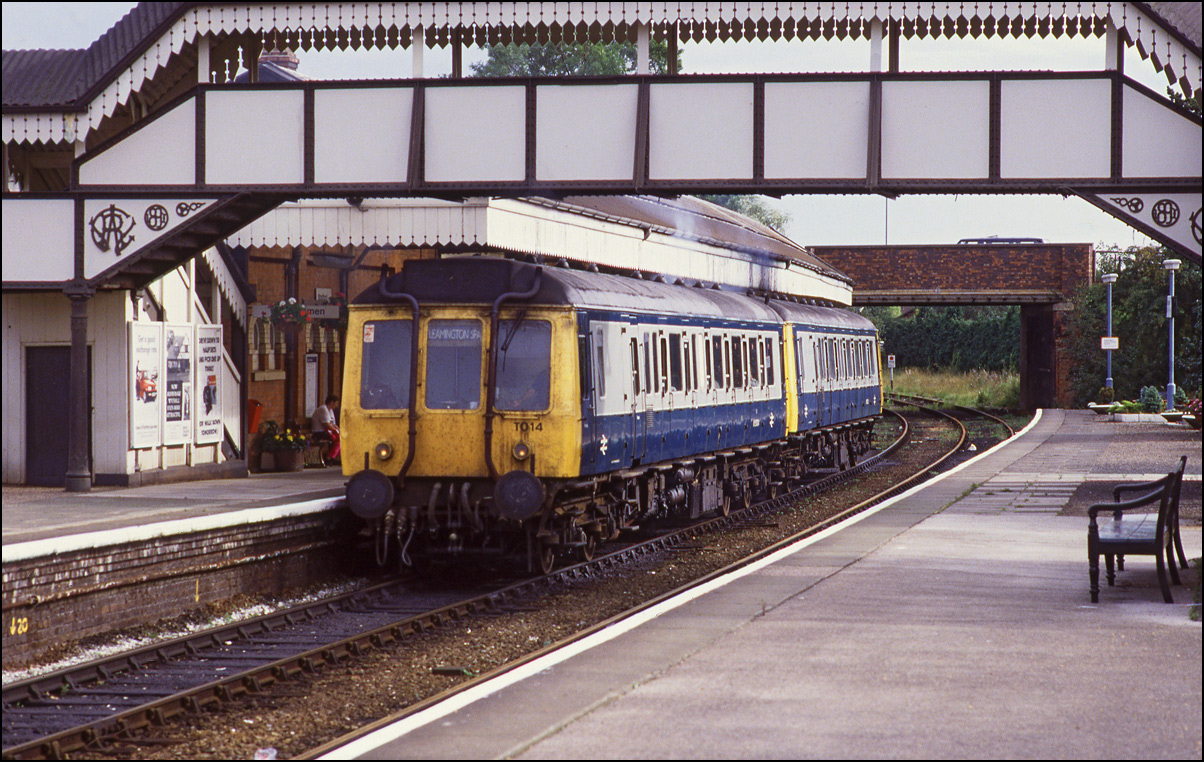 |
I have always had a soft spot for the single car DMMUs, or bubble cars as they were inevitably called and as far as I can recall one of my first train rides was in one of these units. They were daily visitors to Stratford-upon-Avon for many years
although by 1992 the much-loved units such as 55012 had been been replaced with higher-numbered versions imported from the former Western Region. Here, 55034 + 55032 are standing in Stratford station with the midday train to Leamington Spa on
10 August 1992. Stratford no longer has a dedicated Leamington service; a 2 hourly Chiltern Turbo now fulfils the role of the local stopping train, although stopping by request only at Bearley and Claverdon.
|
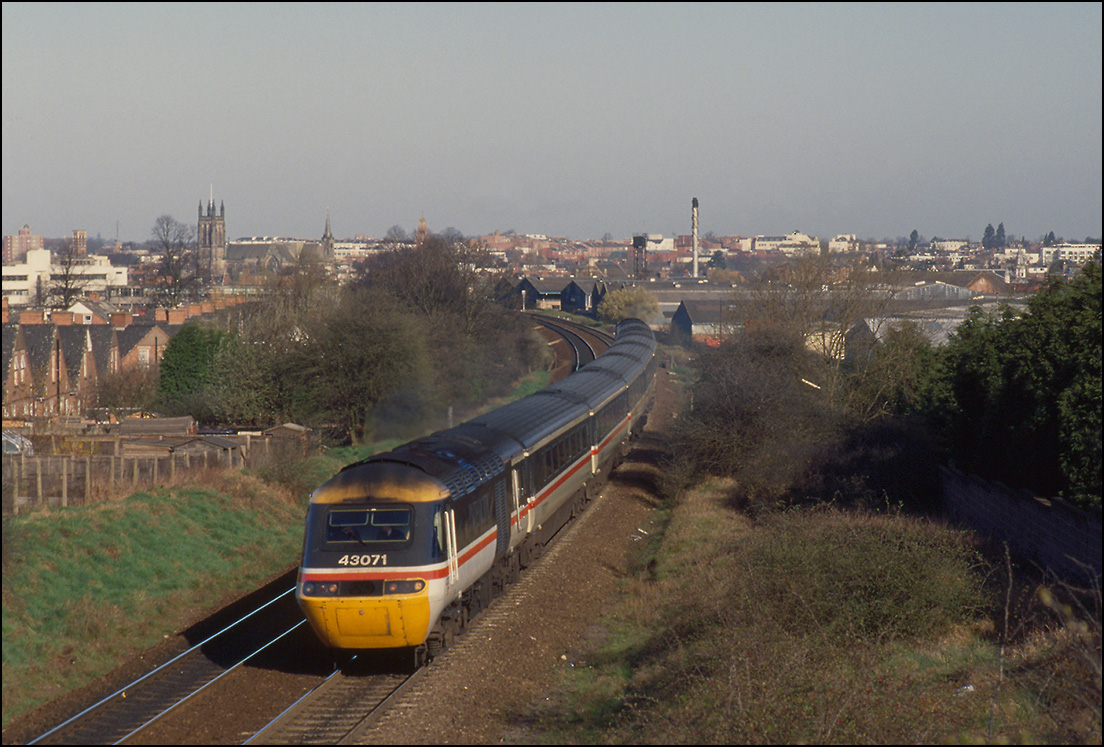 |
Some of the locomotive-hauled InterCity trains to Poole had been replaced with HSTs running only to Bournemouth in 1993. Here are power cars 43071 + 43079 climbing the bank out of Leamington Spa on the morning of
19 March 1993. This sort of incline had little effect on the performance of these trains; after all, they come with a built-in banker... I like HSTs and have always appreciated the purposeful exhaust note when they are running hard - once the edgy turbocharger shriek had passed.
|
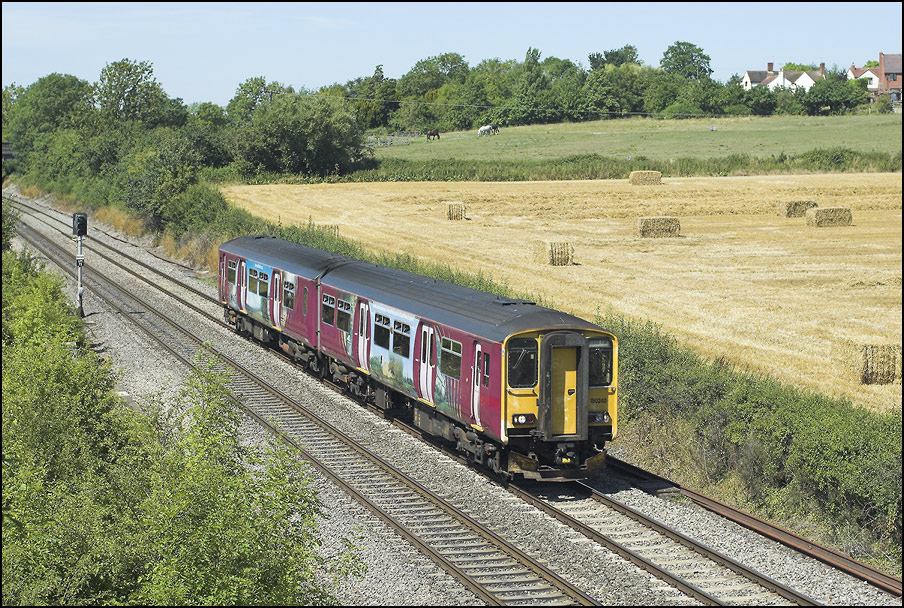 |
Friday 28 July produced yet another bright, sunny and warm afternoon, so once the sun had dropped from its highest position I drove over to Defford in Worcestershire with the aim of getting a few freight workings passing the site of the erstwhile station. I was pleased when 150240 appeared on a Bristol service, as a well-lit shot of this unit advertising various sites throughout the South-West has evaded me ever since it first came out in this colour scheme. |
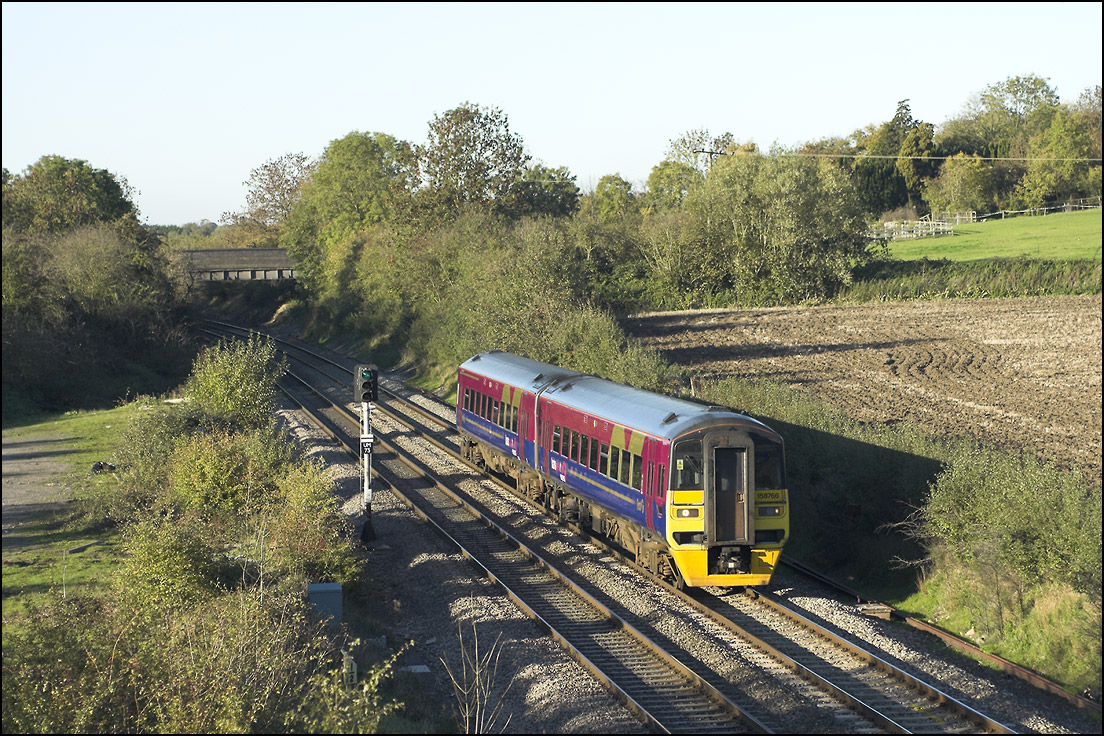 |
One of the more colourful passenger trains I photographed at Defford during the afternoon of 2 November was 158766 in Trans-Pennine livery, working a Cardiff-bound service. This has fairly been transferred to Central Trains, and it is to be hoped that this colour scheme will be retained for a while, at least. |
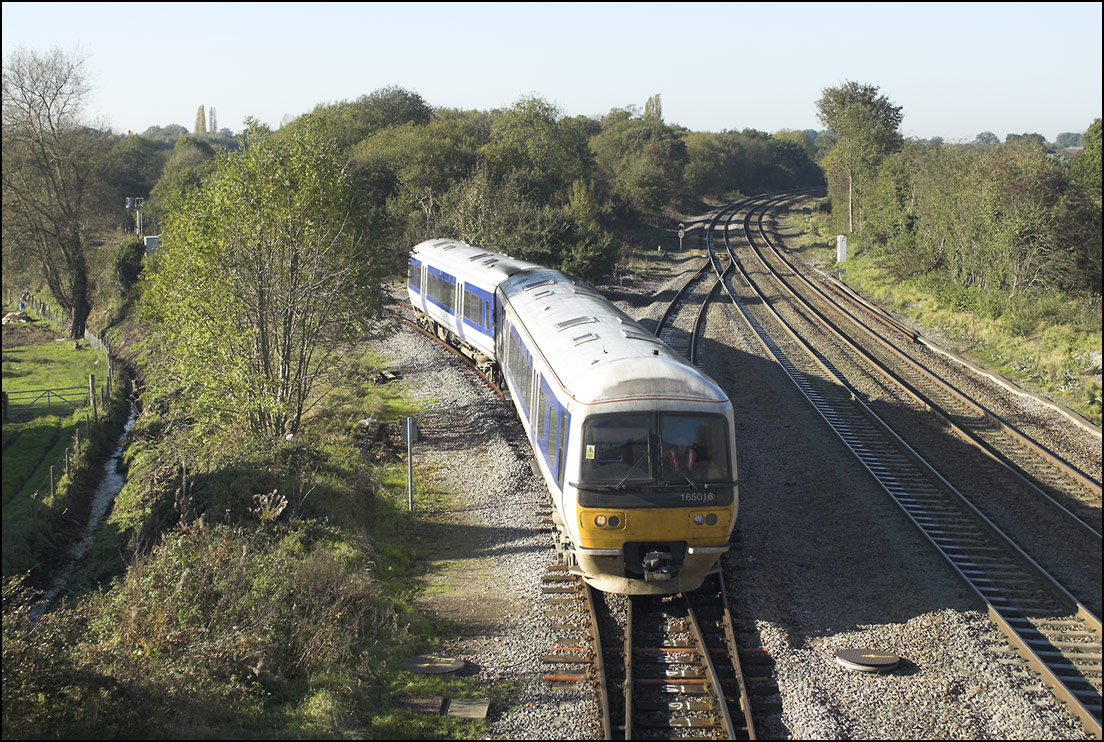 |
Stratford-upon-Avon has a regular service to London Marylebone - roughly every 2 hours on weekdays and Saturdays. Here is 165016 with the 11.38 to London on Saturday 4 November 2006 approaching Hatton station at the West Junction. This is a strange junction in that the line from Bearley Junction is single track, which gives way to a very short stretch of double track between the South and West Hatton Junctions. No trains are booked to cross here so the retention of this short section is a bit of a mystery. |
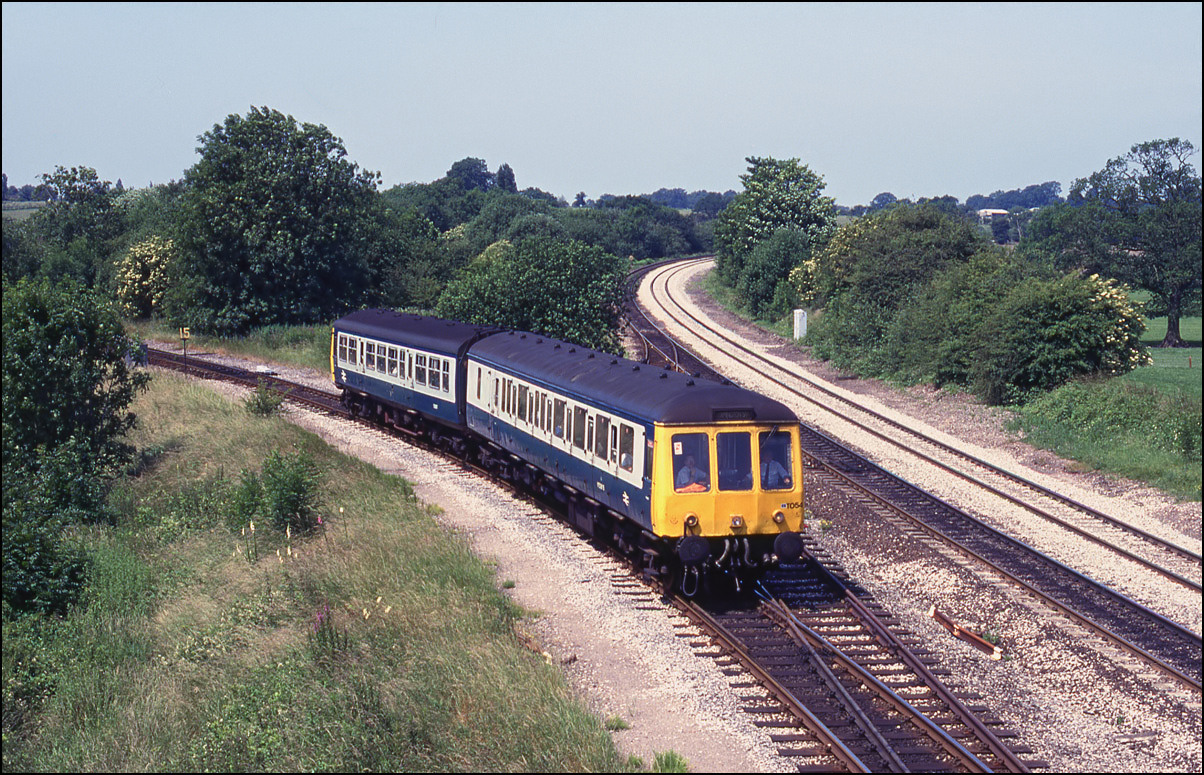 |
Here is the equivalent shot to the one above from 1992. It shows a hybrid unit of classes 116 and 101 leaving the Stratford-upon-Avon branch on 20 June of that year. The vegetation has grown considerably since that date meaning that it is no longer possible to
obtain quite such a wide-angled view. The up main line had recently been relaid and this accounts for the gleaming ballast so evident in the picture.
|
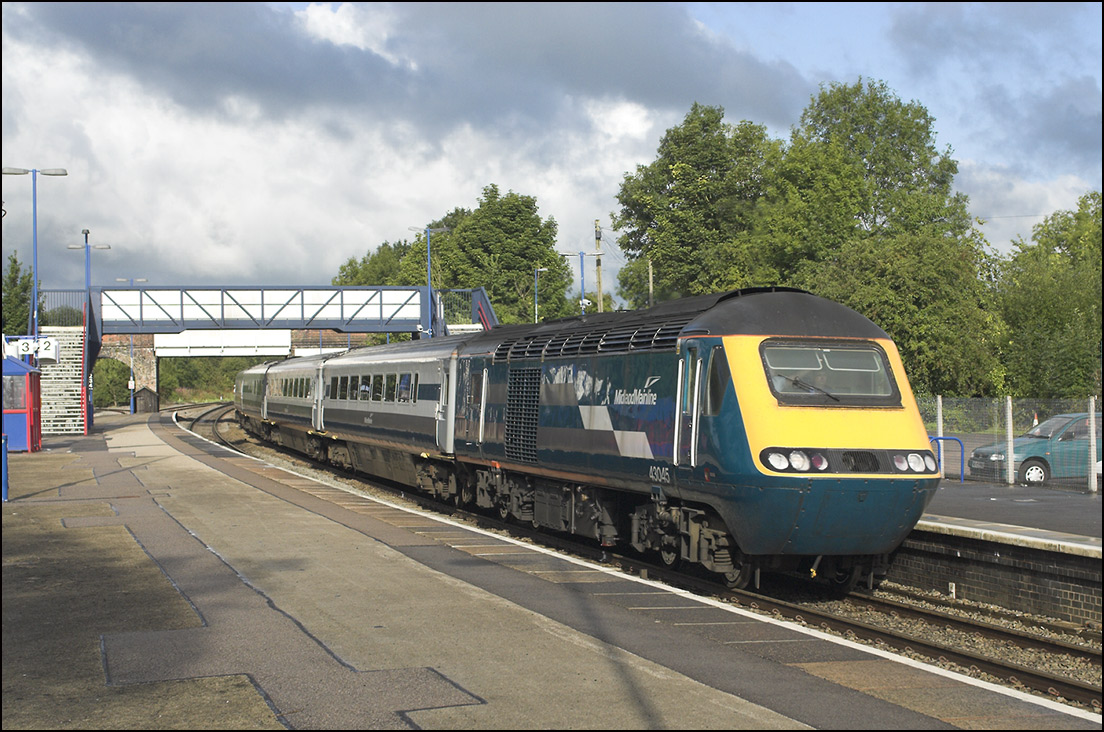 |
Bank Holiday Monday, 28 August 2006 saw Virgin hire a Midland Mainline HST set to use on their 1V36 07.45 service to Reading to allow more passengers heading to the Reading Festival to be accomodated. HSTs of any sort have never been especially common on the line through Hatton and I believe that this is the first MML set to travel over these former GWR metals and therefore wanted to photograph it somewhere identifiable so decided on the platform at Hatton station. The black clouds were a bonus as was the fortuitous burst of sunshine in an otherwise stormy sky. The train passed here spot on time at 08.55. |
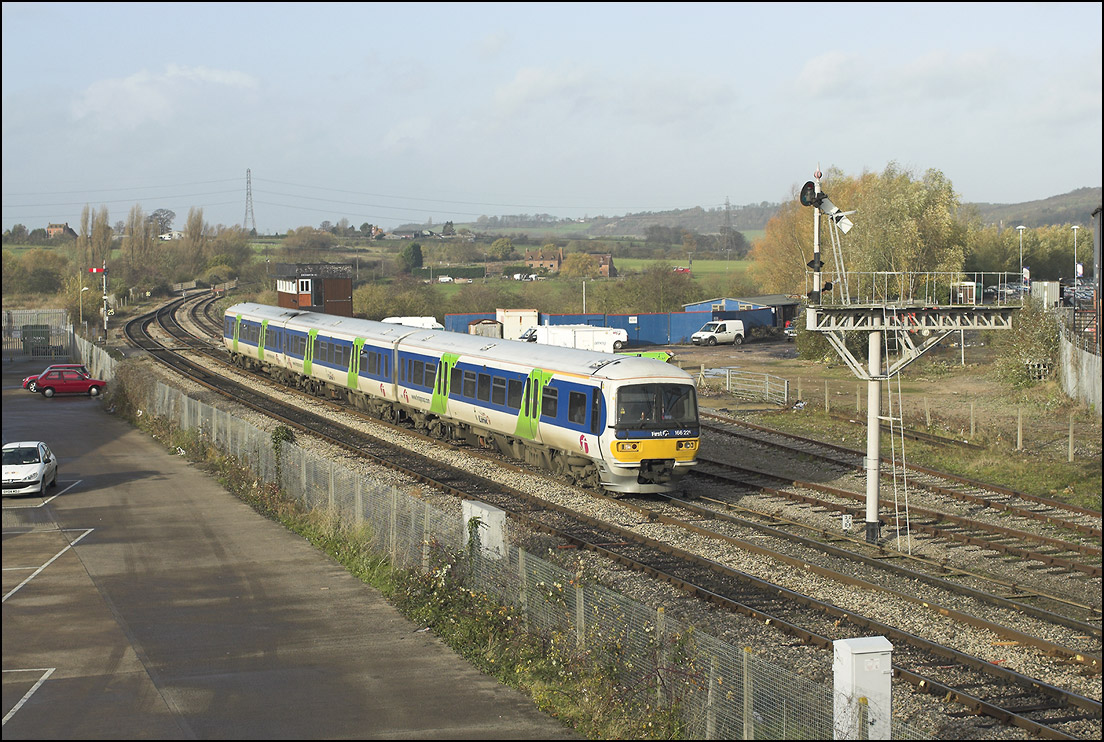 |
Passenger services on the Hereford, Worcester and Paddington line are shared by FGW HSTs, Adelanti and 165/166 Turbo units. On of the latter, 166221 is here seen about to make the Evesham stop with an up Worcester train on Monday 27 November 2006. Is the colour of the skip in the yard coincidental with the door colour, or is it a FGW example?! |
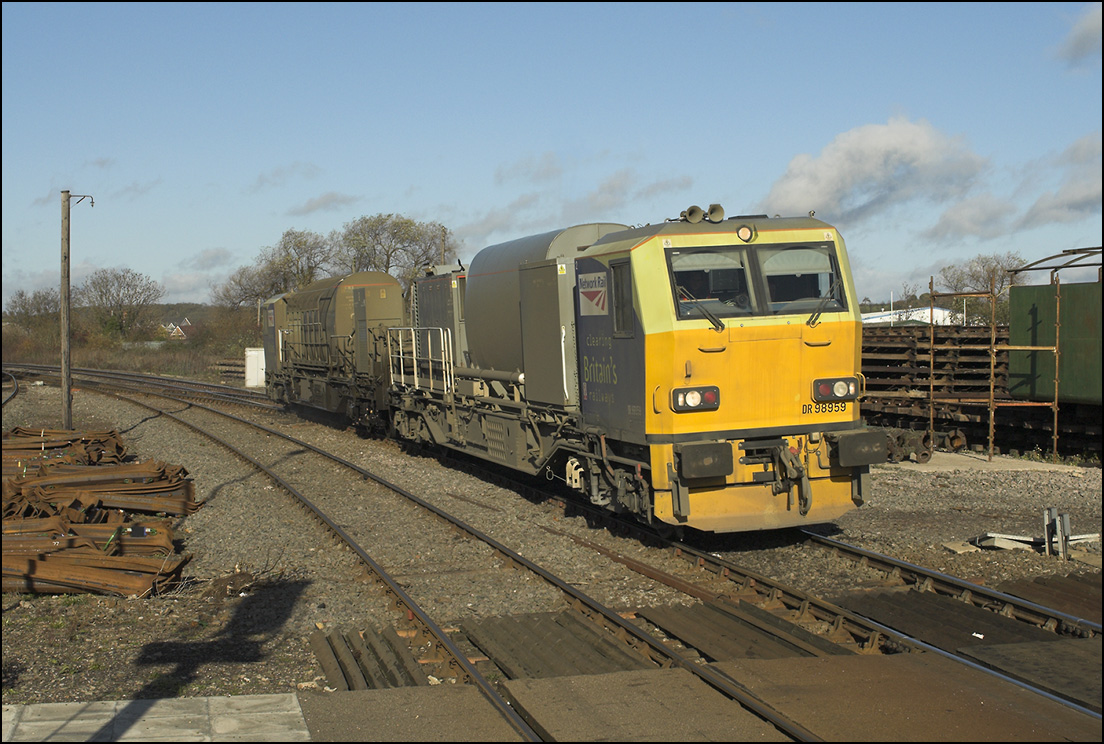 |
In common with most lines in the country, the North Warwickshire line to Stratford-upon-Avon has seen regular RHTT trains for the past few weeks. I thought it was high time I went to my local station to take a few photographs. The arrival is timed at 12.31, just after the 12.27 passenger service to Stourbridge Junction has departed and on a sunny day this is just late enough for a well-lit picture. Here is MPV 98959 running as 3J87, the 09.03 from Bescot passing evidence of recent engineering work just beyond the platforms at Stratford-upon-Avon station on 21 November 2006. |
_sona_211106.jpg) |
The 09.03 MPV RHTT from Bescot is booked to stand at Stratford-upon-Avon for several minutes, perhaps to allow the crew a PNB at the station. Here is MPV 98959 standing in platform 1 awaiting reversal. I find these highly complex and technologically advanced vehicles quite interesting, more so than a couple of locomotives topping and tailing a few water tanks. After all, it is not difficult to find locomotives to photograph, but these vehicles tend to appear only in the weed-killing and Autumnal leaf-fall seasons. Stratford-upon-Avon station is liberally decked with advertisements for the current Royal Shakespeare Theatre season, during which all of the Bard's plays are being performed. |
_sona_211106.jpg) |
After the booked stop and reversal at Stratford-upon-Avon, 3J87 returns to the Birmingham area. It looks as if this unit has not seen much in the way of cleaning since the start of the season - the constant spraying clearly takes its toll... The time of this photograph is 12.36 when the sun is pretty much into the lens for a northbound shot, so much so that I had to take the picture one-handed so as to shield the lens from direct illumination. |
_sona_211106.jpg) |
Turning around from the picture shown above, this is the scene as MPV 98959 leaves Stratford-upon-Avon en-route to the West Midlands. The pile of sleepers just visible beyond the train roughly marks the site of the proposed steam centre it is hoped to build here. This would apparently be a major attraction for the general public and would include a turntable to avoid the need for either a trip to Hatton and Dorridge for reversal via a triangular junction, or tender-first running. There would also be a servicing facility operating as an outpost to the museum and workshops at Tyseley. The planning application for this site was recently withdrawn to allow for the plans to be re-drawn. The original submission made insufficient allowance for parking and for adequate access and egress to and from the site. Anyone who has tried to leave Station Road in order to head away from Stratford-upon-Avon at a busy time will know the problem faced here... |
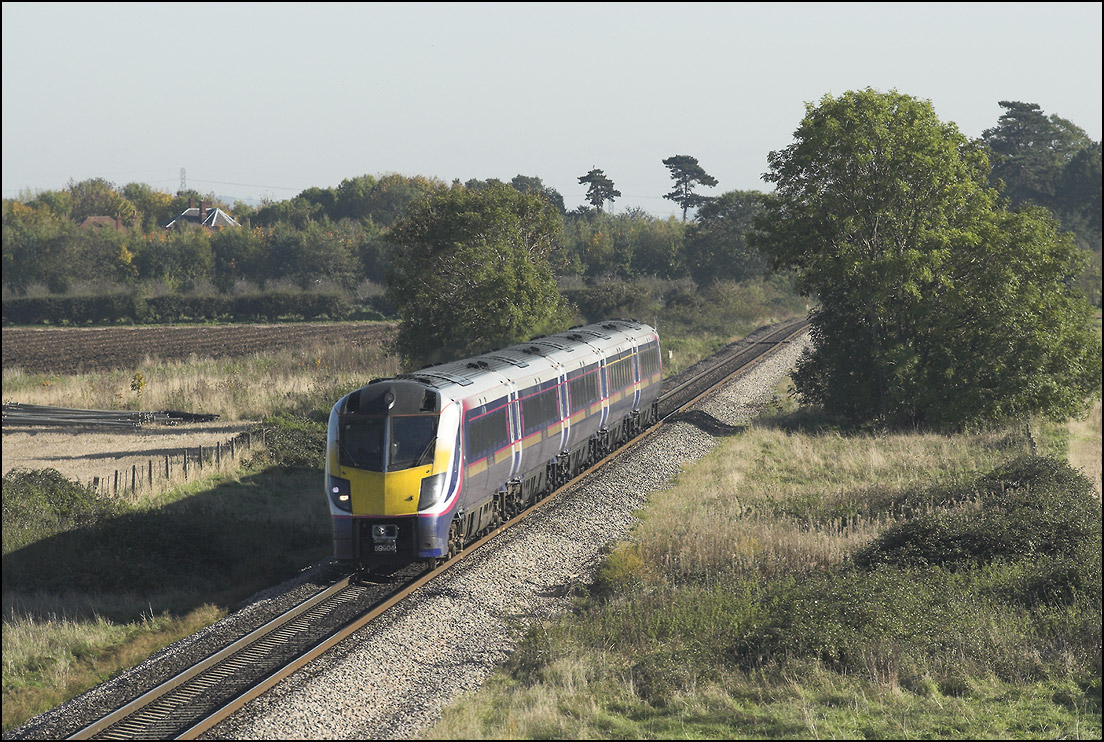 |
It is said that Adelanti are not to be used on the Paddington - Worcester - Great Malvern - Hereford circuit for much longer. With that in mind, I have made an effort to get a few shots of them in the Evesham area. Here is a set on a "down" run heading for Worcester passing the attractive scenery around Lower Moor. |
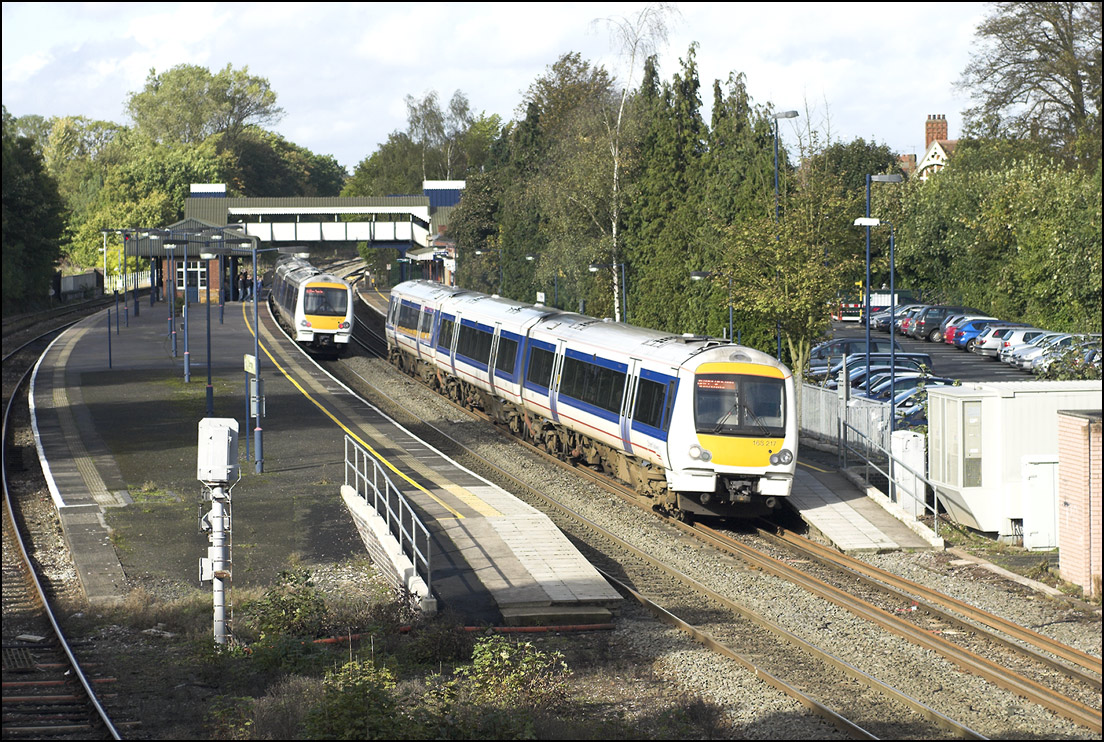 |
Multiple unit trains are often ignored by the enthusiasts of today who seem obsessed with locomotives however mundane the working. When looking back over the work of such great photographers as Michael Mensing, it is the local workings that I find to be of the greatest interest. The endless shots of express passenger workings are fine, but for real nostalgia I much prefer the photographs of local trains, whether of the then ubiquitous GWR Prairie tanks or 3 car suburban DMUs. With this in mind, I make an effort to record non-loco trains whenever possible. I spent a few hours at Dorridge on Saturday 21 October and photographed quite a few unit moves, including this shot of numerically coincident 168217 and 168218 Chiltern Trains' units on Marylebone and Birmingham Snow Hill trains. |
 |
In the caption to the photograph above, I described the shunt move carried out by Central Trains' units at Dorrdge. Here, refurbished 150014 has crossed from the up main line to the down relief, from where it will return north. The ladder crossover is clearly visible behind the train. The innermost line is occasionally used to loop northbound freights if a passenger train is catching it. In happier times, the 4 track section ran from Lapworth to the south as far as Moor Street and there have been proposals to reinstate at least part of the formation, but this would be difficult bearing in mind that at most stations, car parks have been built on the old formation. |
 |
I spent a while at Fladbury, between Pershore and Evesham on 24 October 2006 and took a couple of unit shots while waiting for 47714 with some IZA wagons destined for store at Long Marston. This was the better and shows 165101 on a Paddington - Hereford working. The compressed perspective from using a long lens gives a good view of the pleasant countryside in this part of the Vale of Evesham not to mention the point when the line was slewed across when it was singled in the 1970s. |
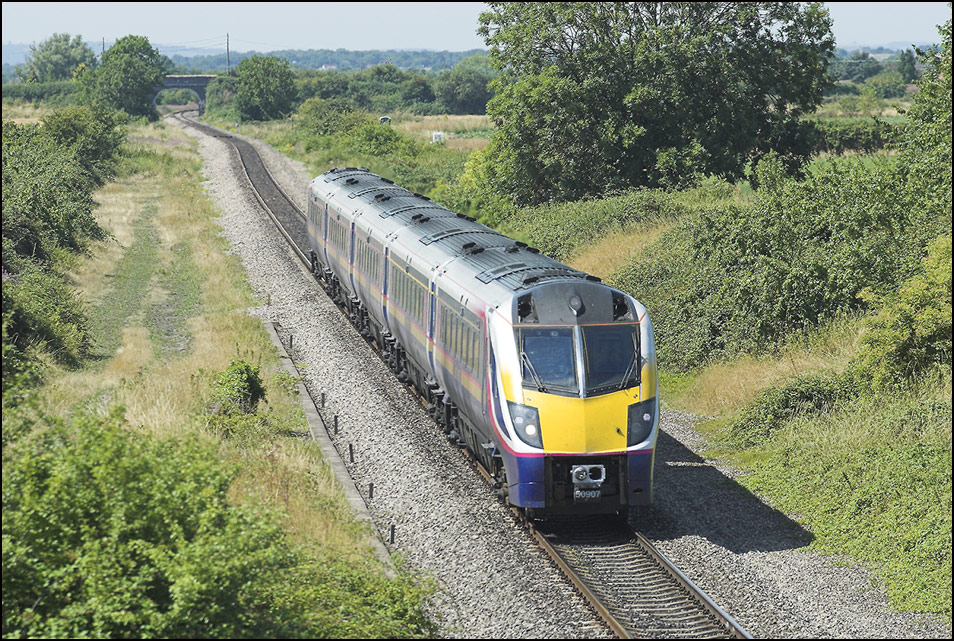 |
This picture, taken on 7 August 2006, shows a First Great Western Adelante unit at Fladbury on the Cotswold line. I find these modern units quite attractive; maybe it's the FGW colour scheme or perhaps the striking styling of the front end. These trains won't be on the Worcester to Paddington services for much longer by all accounts, so it is well getting one or two shots while they are around. |
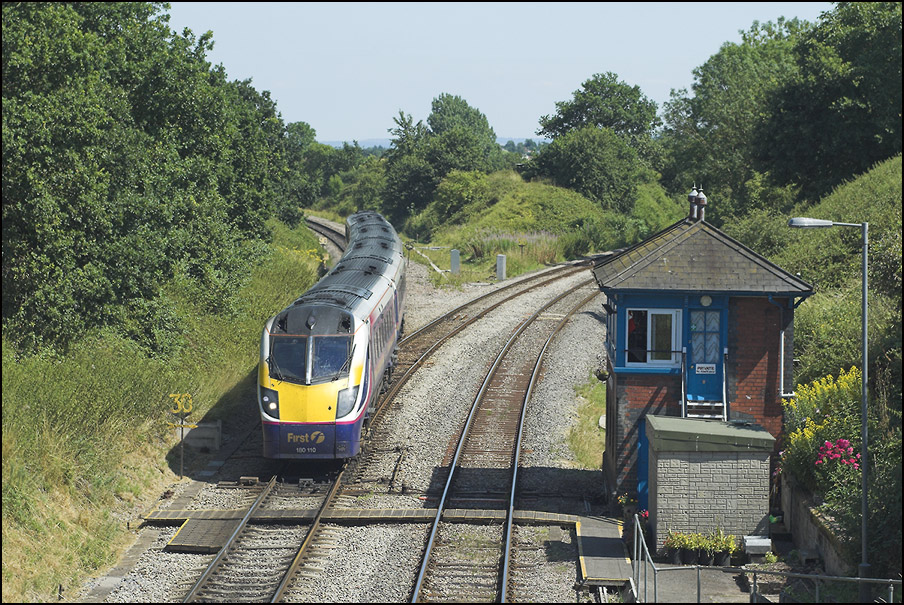 |
Here is the view looking south from the roadbridge at Norton Junction as 180110 on a Paddington to Worcester service leaves the single track Cotswold line and heads towards its destination. |
 |
As Hatton is on the main line betwen London Marylebone and Birmingham Snow Hill, there are plenty of opportunities to photograph Chiltern Trains' various units. I quite like class 168 so have included this photograph of 168133 accelerating away from the stop at Hatton station. Not all services stop here, in fact the local service is absolutely apalling outside the peak hours. Considering that the station is only a short walk from the enormously popular Hatton Country World, I find it surprising that Central Trains don't make more of this connection. |
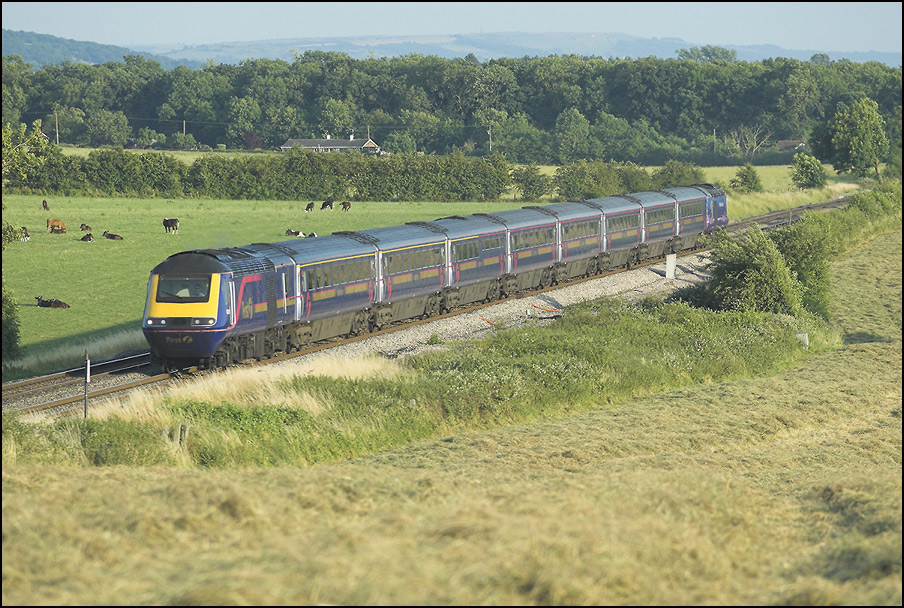 |
I was keen to get a shot of the 6X52 Portbury to Washwood cartic at Abbotswood Junction, especially since it has been retimed to run a little later. I tried on Wednesday 12 July when the lighting conditions were perfect. It is due at this location at around 19.30, but by 20.30 it had still not appeared. This Paddington to Worcester HST was the only train of any real interest to come north in the 3 hours I stood here - and the "Neon" power car just had to be on the back, didn't it? |
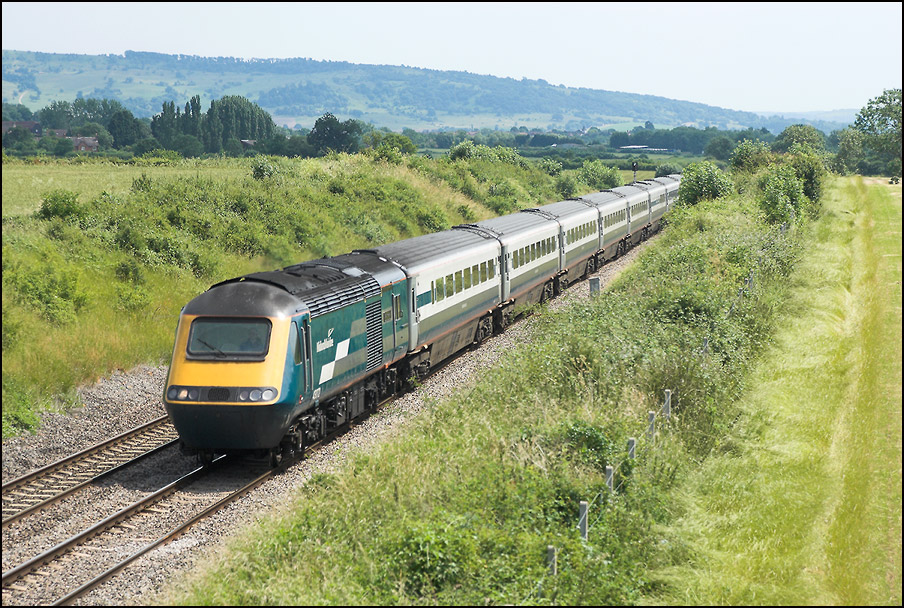 |
The only train of any real interest I saw at Croome Perry during the afternoon of 1 July 2006 was this MML HST set returning from the South West as 1E41 09.40 Newquay to Newcastle. I like HSTs; they sound good and make a pleasant change in the summer months from the relentless barrage of Voyagers. I'm a bit surprised that so few enthusiasts make any effort to photograph them. On this occasion, the power cars were 43061 + 43072. |
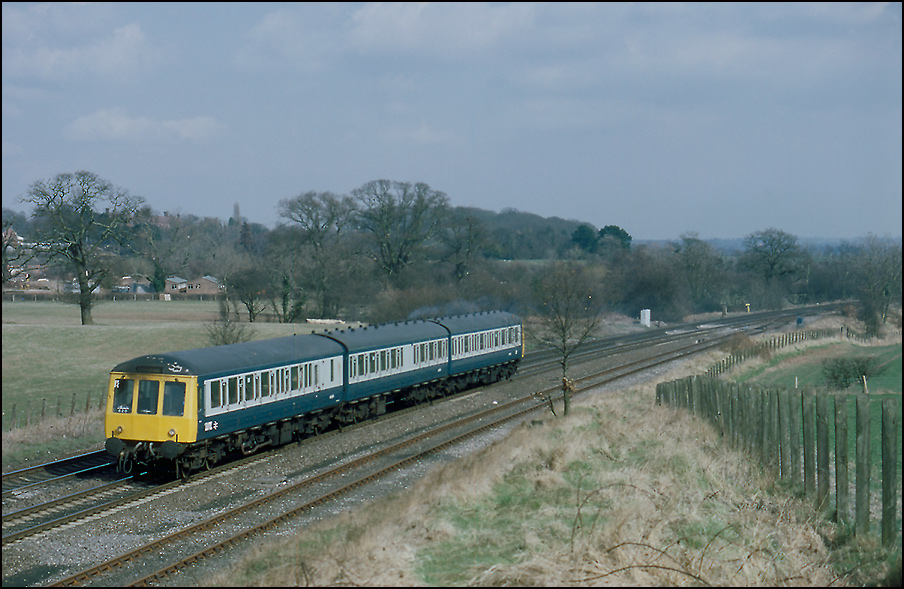 |
Heading north from Leamington Spa and Warwick, Hatton Bank is soon encountered. With a gradient averaging 1/110 it has alway presented quite a challenge to down trains and even relatively lightweight class 116 units on Leamington to Birmingham trains were slowed to around 30mph. Here is such a train climbing the bank on 11 April 1986. |
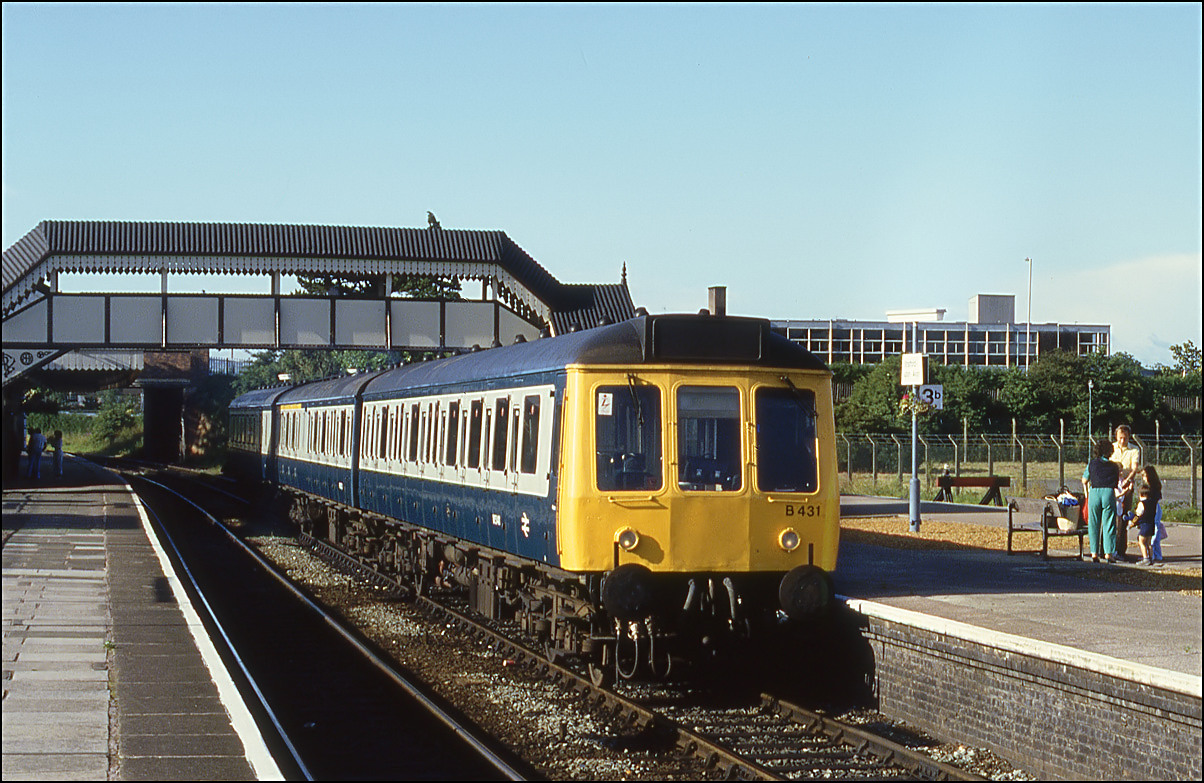 |
On occasions, Tyseley depot had other area's units in their possession and they were often sent out when their own sets were booked for maintenance. Such was the case on 19 July 1985 when Bristol's B431 was in use on the 08.12 Stratford-upon-Avon to Leamington Spa shuttle. It was always amusing to see the passengers avoiding the first class compartment, absent from the usual units, thinking that a supplement would be charged! |
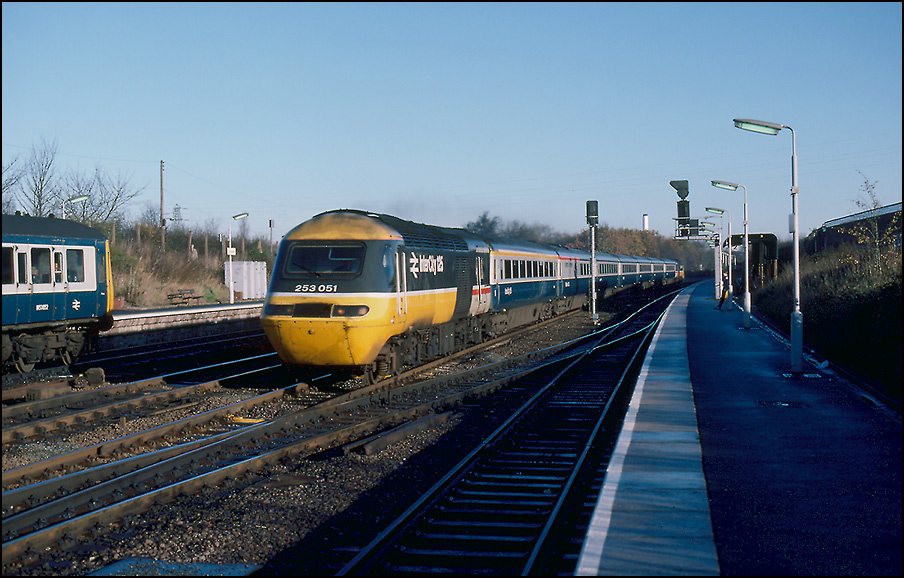 |
Another shot at Longbridge, this time taken on 19 November 1986, shows a down HST hammering through the station. These trains had attained quite high speeds by here if given a clear road and the sound was a deep throbbing, the somewhat edgy turbocharger shriek having gone by then. This was a transitional period with the blue & grey being gradually replaced with the new InterCity colours complete with set numbers on the front of each power car. |
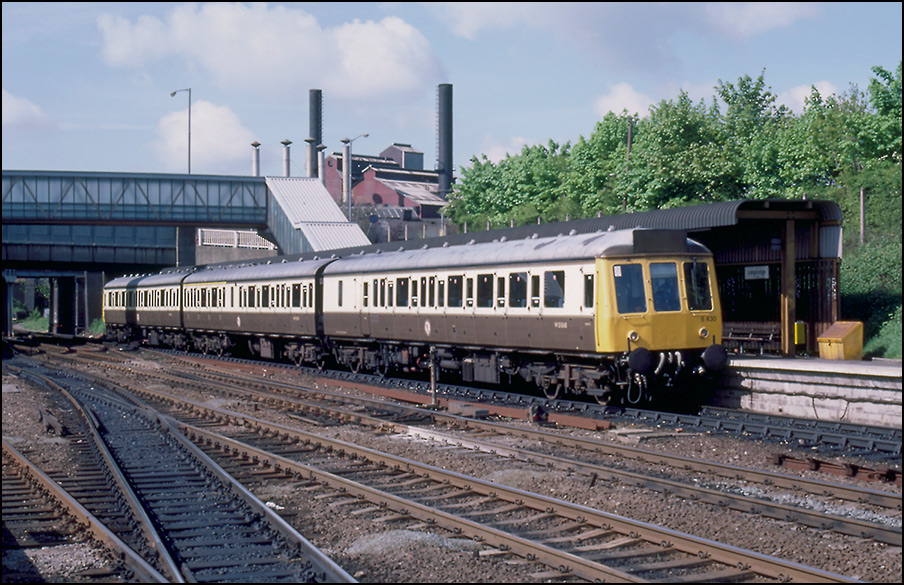 |
As part of the 1985 celebrations for the 150th anniversary of the Great Western Railway, Bristol's B430 set was repainted into chocolate and cream livery. It was often to be seen around Birmingham and on 16 May 1987 it was in use on the Cross City line where I photographed it at Longbridge station. |
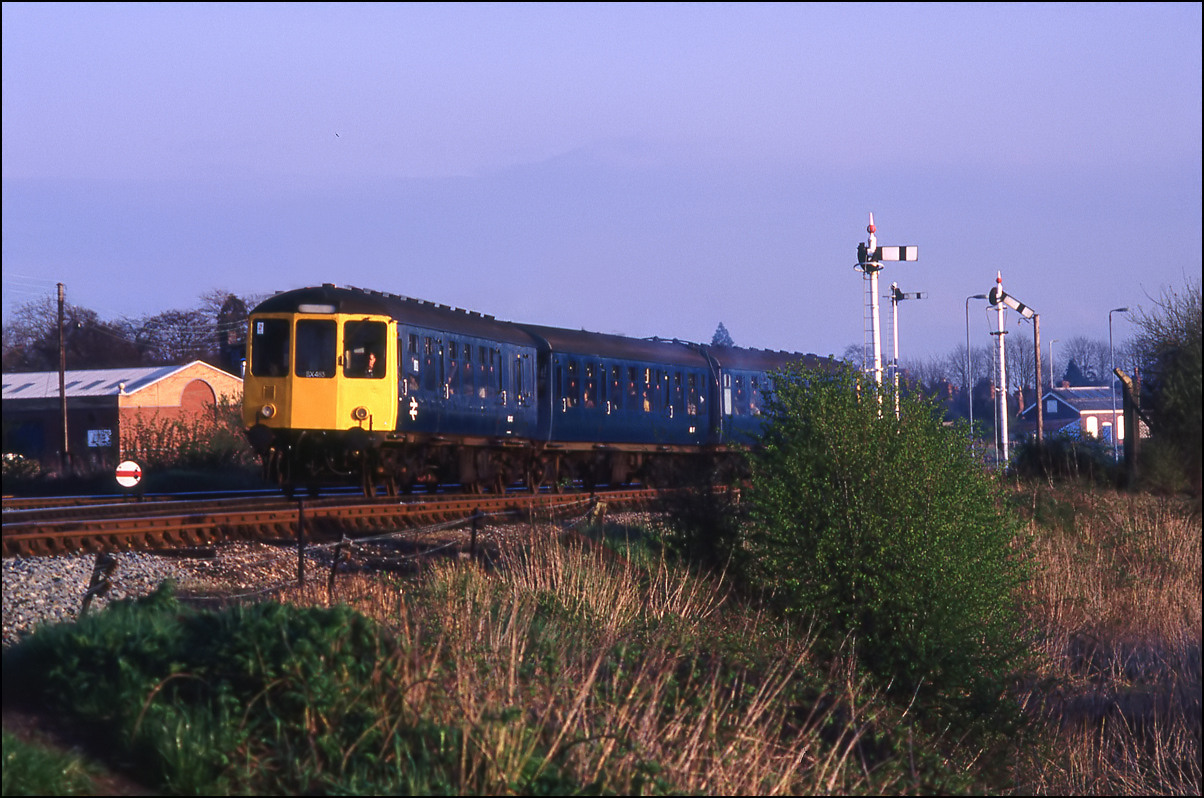 |
Another special from the north-west visted Stratford on 20 April 1985 and once again was formed of a blue class 104 unit. The train is seen here leaving platform 2 of the station at around 18.30, being pictured from the canal towing path. |
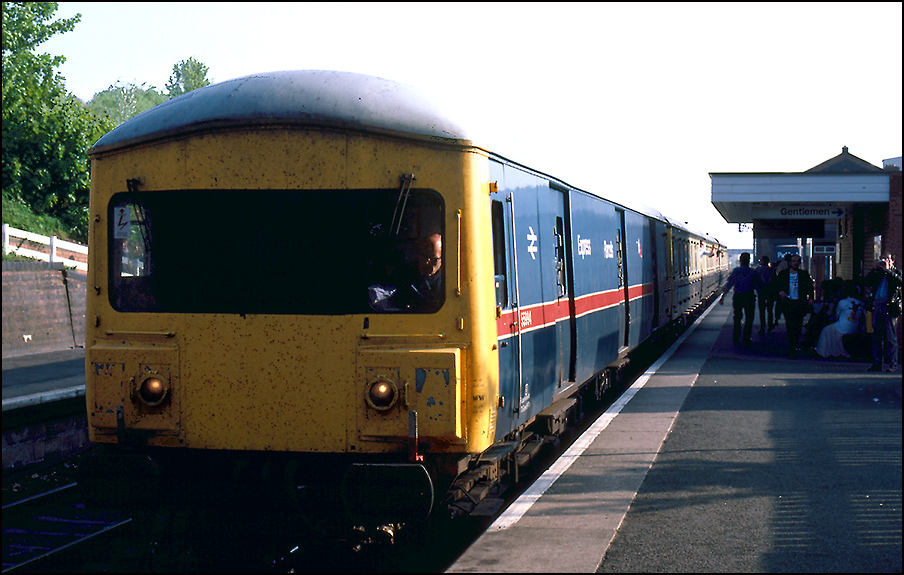 |
This picture is dated 9 May 1987 and sbows 55994 topping a 3 car class 117 at Kidderminster while working a service to Birmingham New Street. The contrast from the 2 units shown above is striking, particularly the modification to the cab ends and the brighter blue and red livery. It looks as if the warm and sunny weekend had brought out a large number of insects judging by the fatalities apparent on the yellow end... |
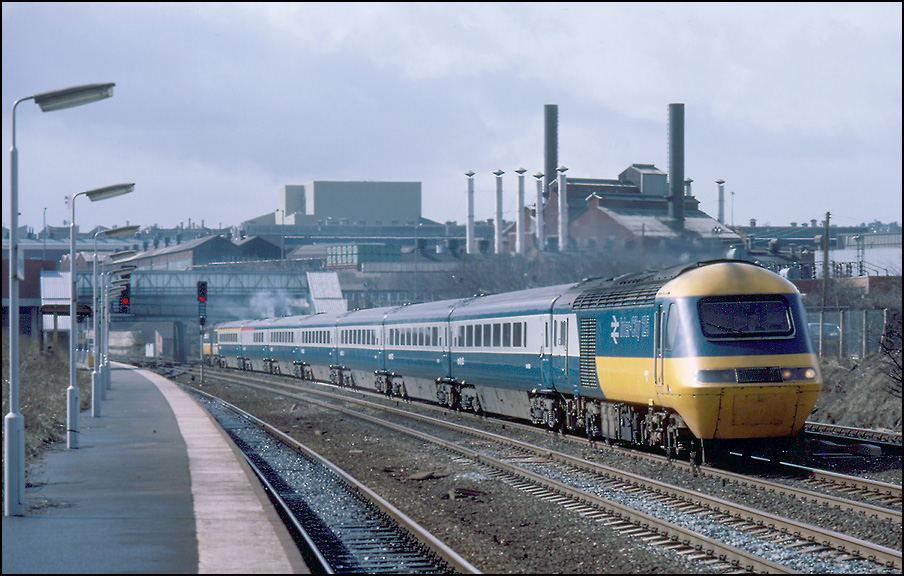 |
As I stated in the preamble to this section, I am treating HSTs as diesel units for the purpose of this website even though this is not strictly accurate. I have always liked them, especially the purposeful looks and the deep exhaust note when working hard. Here is a set passing Longbridge and just catching a weak patch of sun on a showery morning whilst working an unidentified up service on 28 March 1986. It is nearly all in the original blue and yellow livery but with an InterCity rear power car. The smoke from behind the penultimate carriage is from a 3 car class 116 DMU on a Four Oaks local train. |
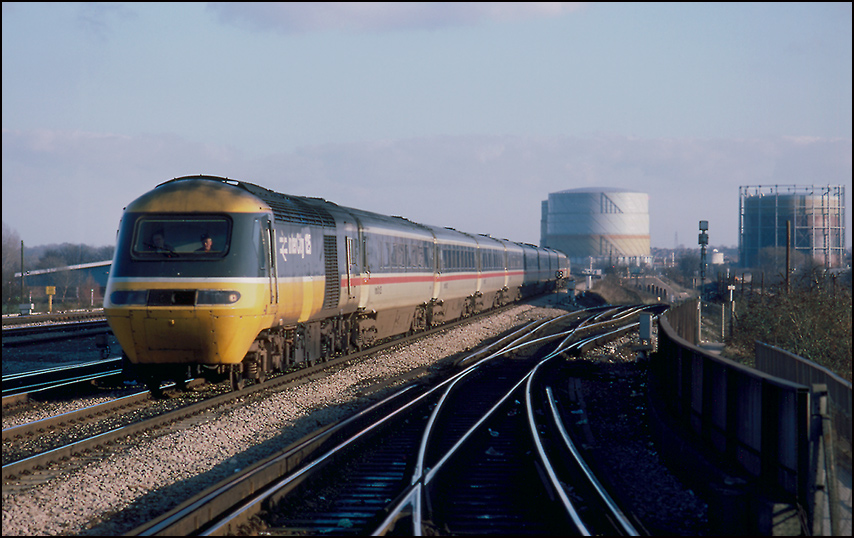 |
In contrast to the HST set shown above this Paddington to Plymouth train is in the full InterCity livery. It seen approaching the Reading stop on 3 January 1987. |
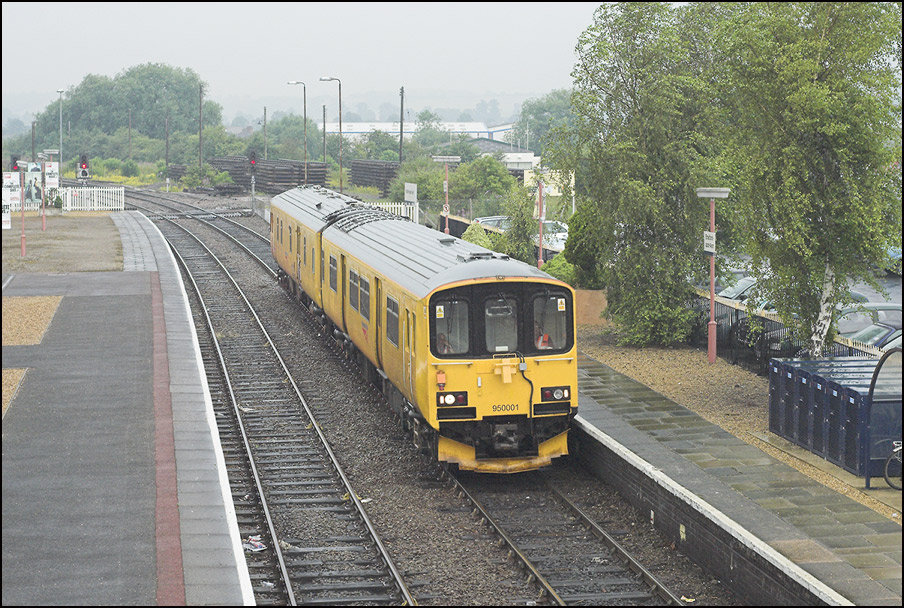 |
The Network Rail class 150 DMU 950001 did some travels around Warwickshire on 6 July 2006. The weather was extremely unpleasant and the unit, running as 2Z08 from Tyseley, is seen here arriving at Stratford-upon-Avon in the middle of a torrential downpour accompanied by lightning and thunder. The storm had caused various problems in the locality, including sigalling problems leading to the cancellation of the inward working of the train forming the 10.27 from Stratford-upon-Avon to Stourbridge Junction and power being off at my home close by. |
_sona_060706.jpg) |
Here is a view of the other end of 950001 just before it left Stratford-upon-Avon for Birmingham. The rain was quite literally bouncing off the train's roof at this point. Behind the unit are about 20 cheesed-off passengers who have nearly an hour's wait for the next passenger train into Birmingham. Many people would not bother with photographing such a working as no locomotive was involved, but I find this unit of infinitely more interest than a light class 37 move, which it seems causes enormous interest. |
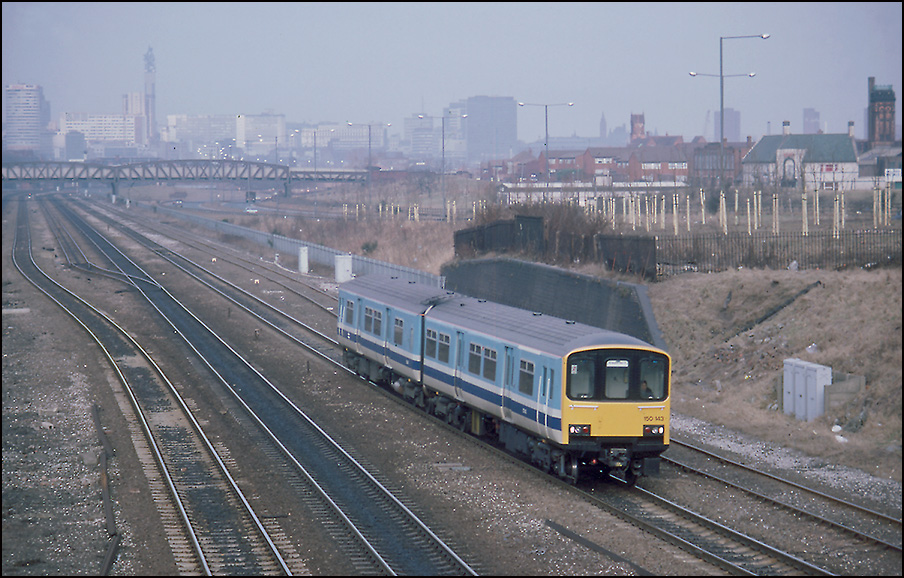 |
A portent for the future is here seen at Small Heath, Birmingham on 1 March 1986. Sprinter 150143 is heading for Tyseley depot where it will be stabled. The destination blind says "Birmingham New Street" which indicates that its diagram has been completed. I have never been especially fond of these units - they are to my eyes particularly bland and uninspiring, but nevertheless worth recording. The version of the class 150 with corridor connections look slightly better as the plain front end is broken up to some extent. |
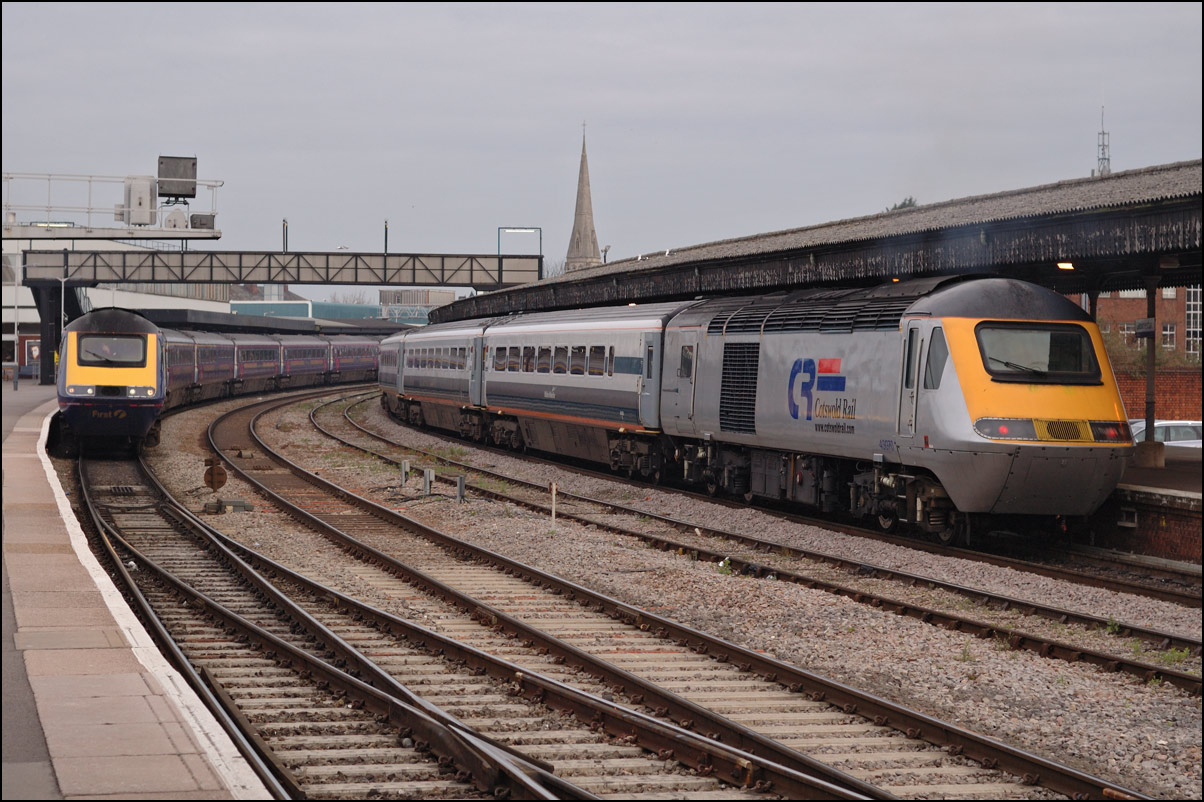 |
Heartland Rail and Cotswold Rail ran their first train as a TOC on Saturday 15 April. My wife and I were fortunate enough to be among their guests for the trip, which was from Gloucester to Penzance. The train led by 43070 is seen here after arrival as ECS in Gloucester station, alongside a FGW set being used on a Gloucester to Swindon local service. For those interested, the exposure for this shot was 1/125 @ f3.5, using an ISO setting of 500 - yes it was a bit dull! From a technical perspective, the lack of "noise" at this sensitivity is quite impressive, and no, I haven't used Neat Image to clean it up. Our train suffered a slight problem at Totnes, the cause of which was found to be no more than a snap connector joining, or rather not joining, 2 wires in a control box. As soon as this was rectified we made a storming ascent of Rattery bank and had a clear run to Penzance. |
_pz_15406.jpg) |
As a passenger, photo opportunities were obviously limited so I contented myself with this view of the Hornby-liveried power car standing in Penzance station shortly before departure. We had a superb run back, with an early arrival at Bristol Temple Meads after a high speed run from Newton Abbott. We also departed Bristol early and arrived in Gloucester some 9 minutes ahead of schedule. My thanks are due to Adrian Parcell and Mark Honey of Cotswold Rail for a great day out. |
 |
Two ex-GNER HST power cars were deposited in the sidings at Evesham on Friday 12 May 2006 while en-route to Long Marston. They are here seen being passed by a northbound 180110 on Saturday 13 May 2006. A bird appears to have come to a messy end on the earlier run up to Paddington... |
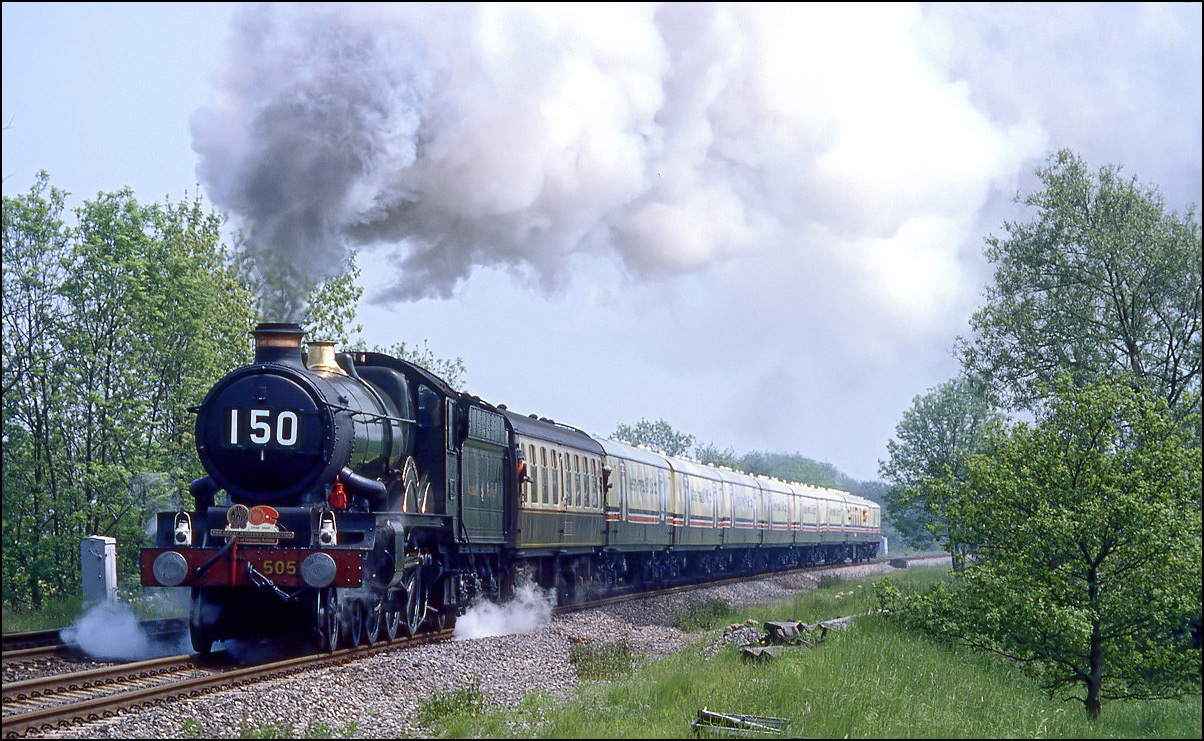

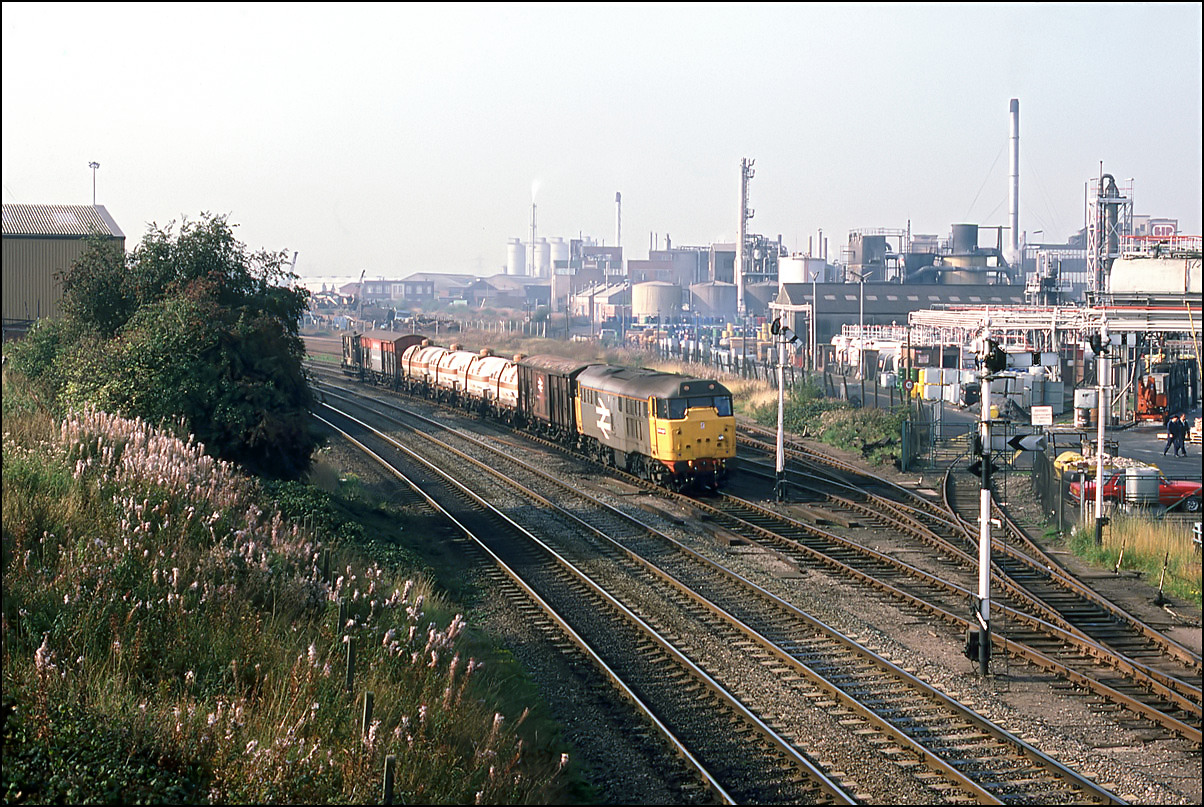
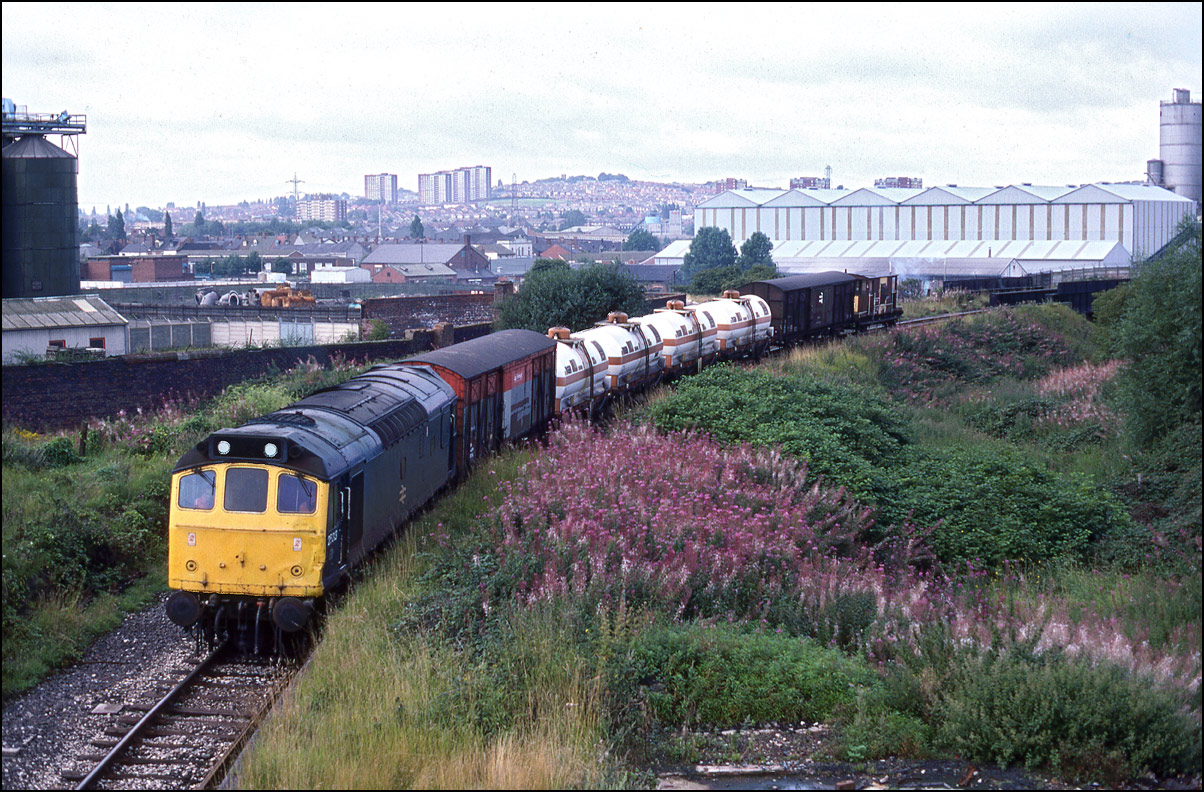
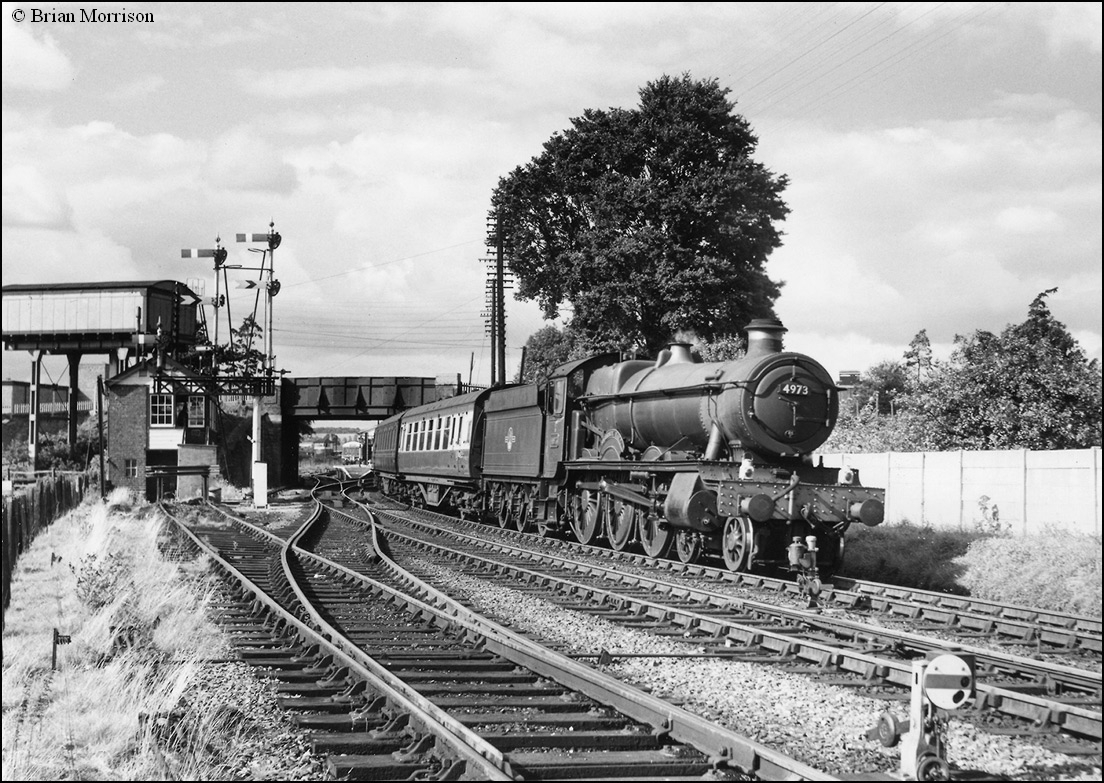


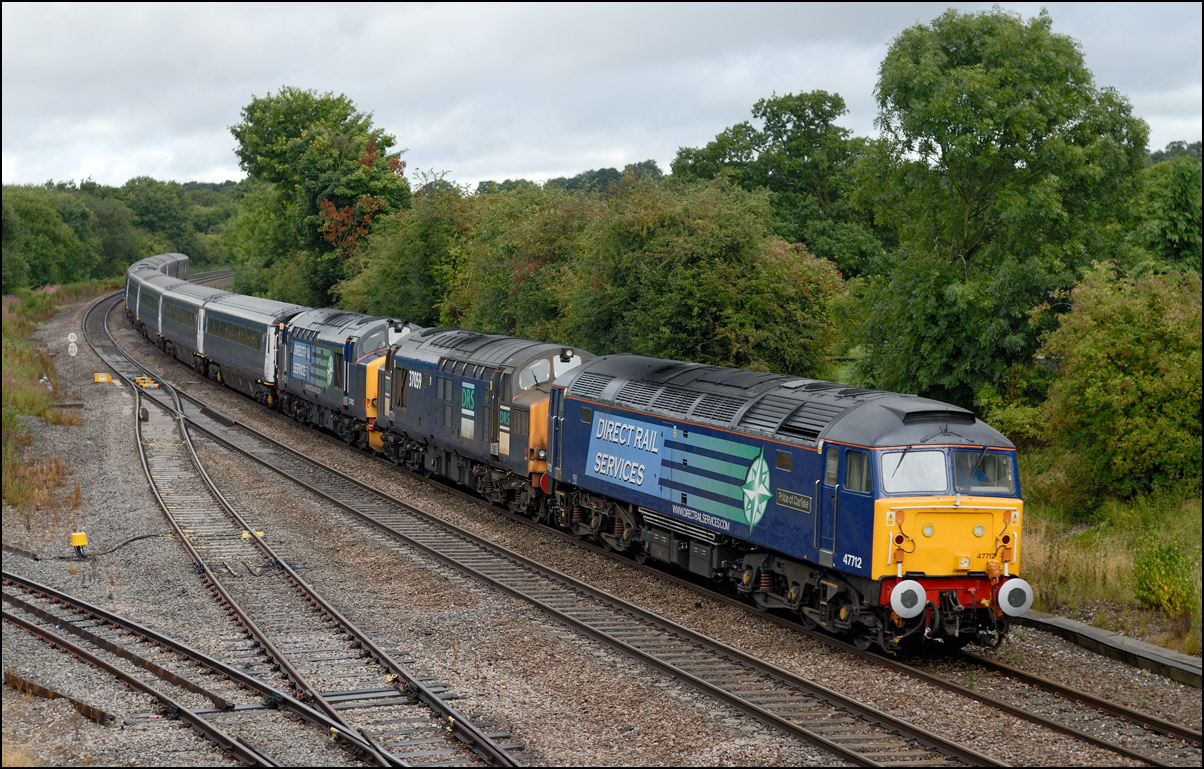
_eagle_xing_16687.jpg)
_pontycwmmer_10596.jpg)
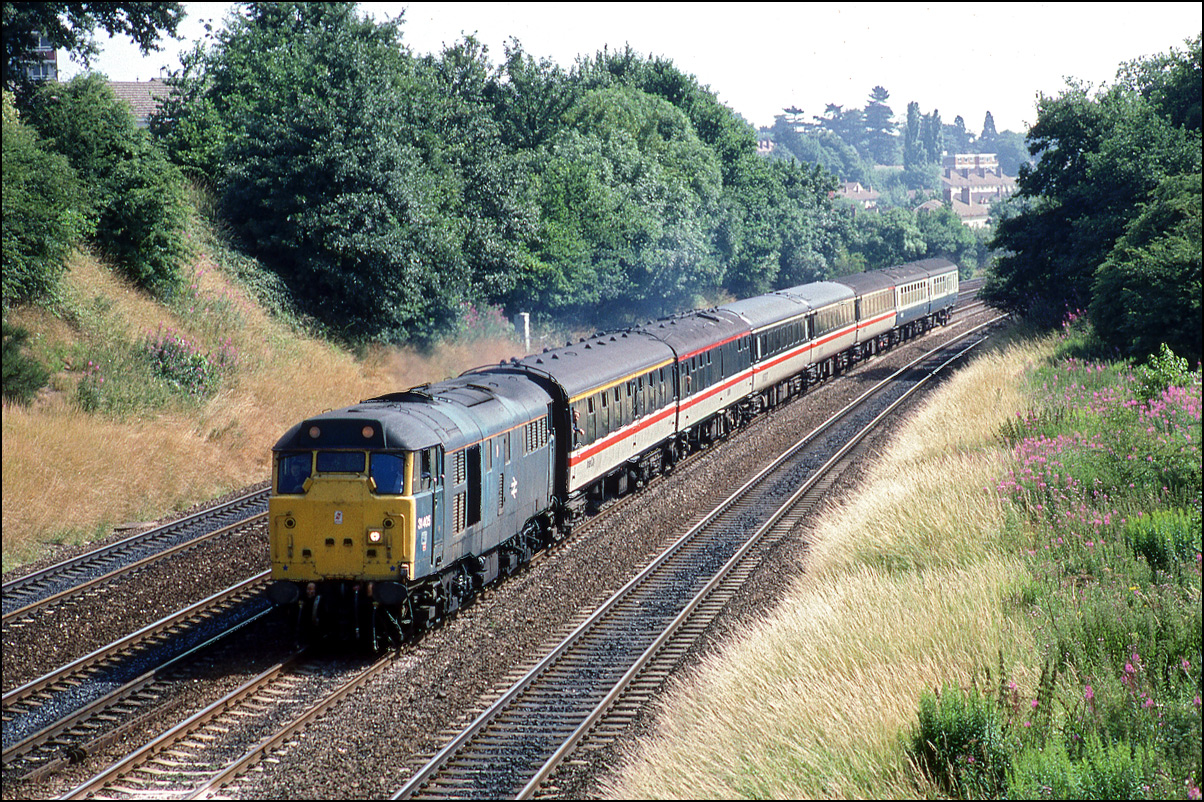
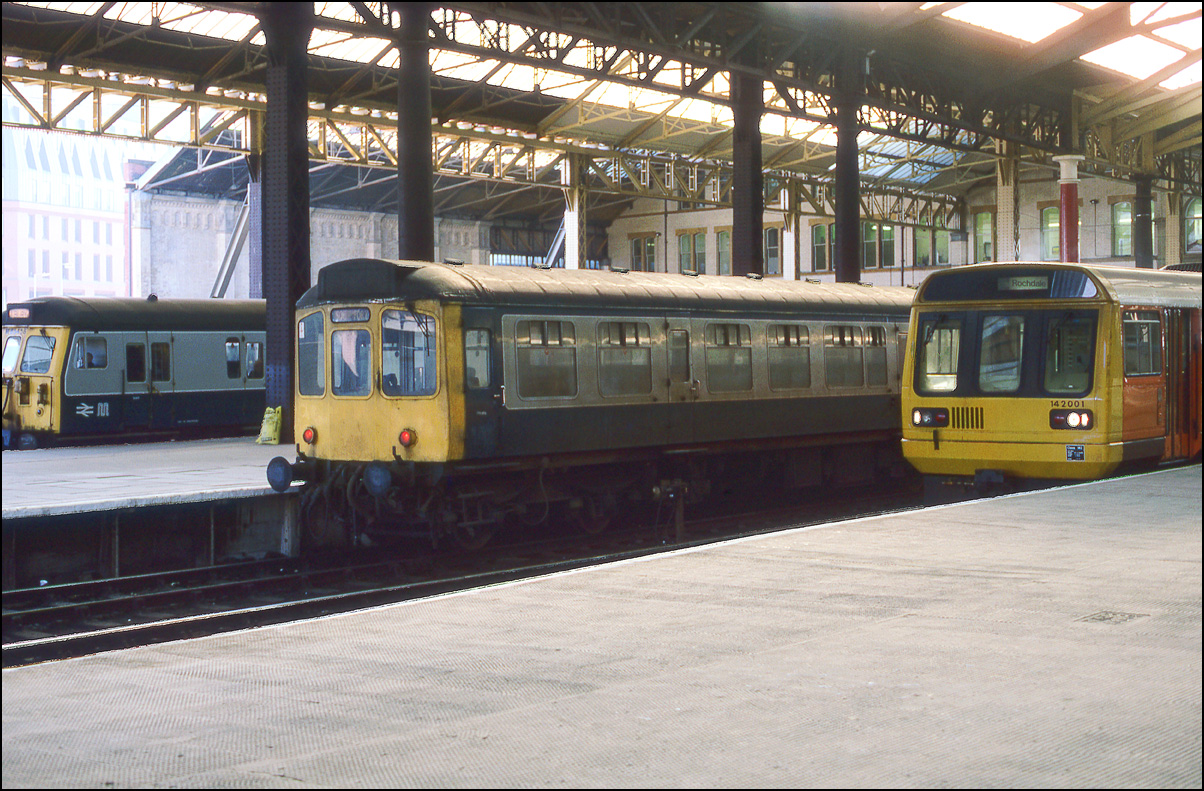
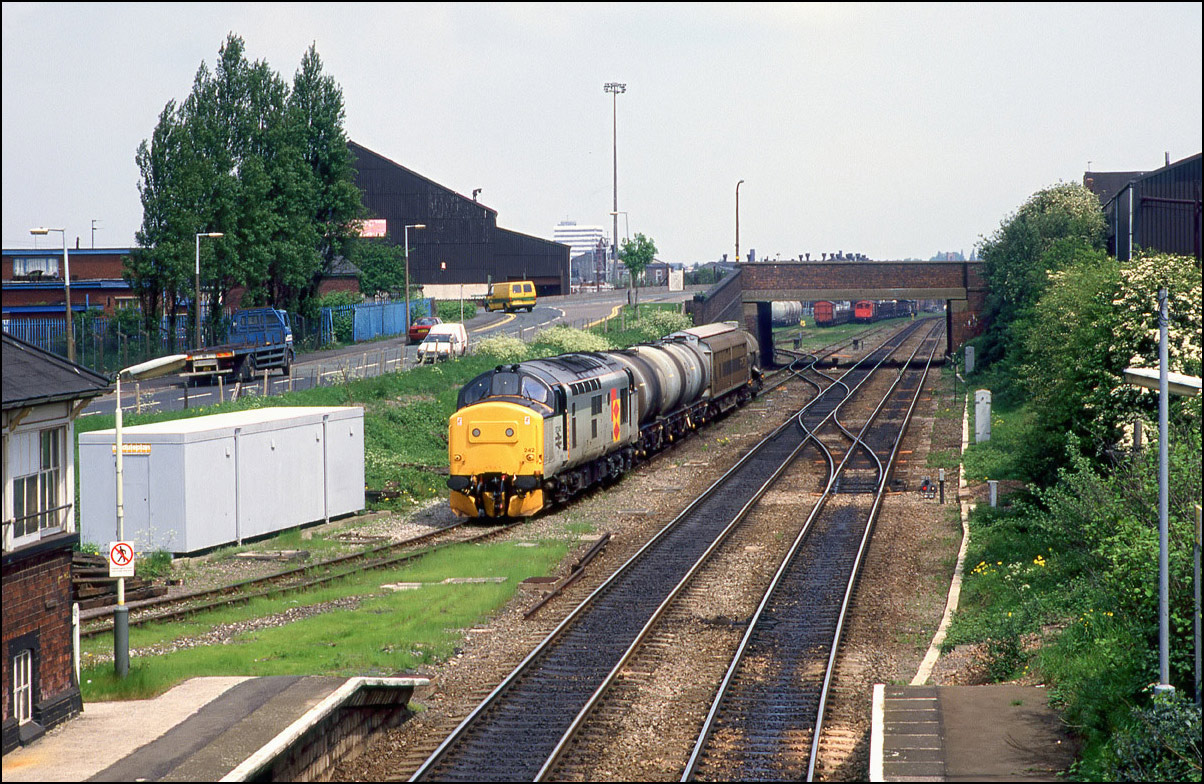
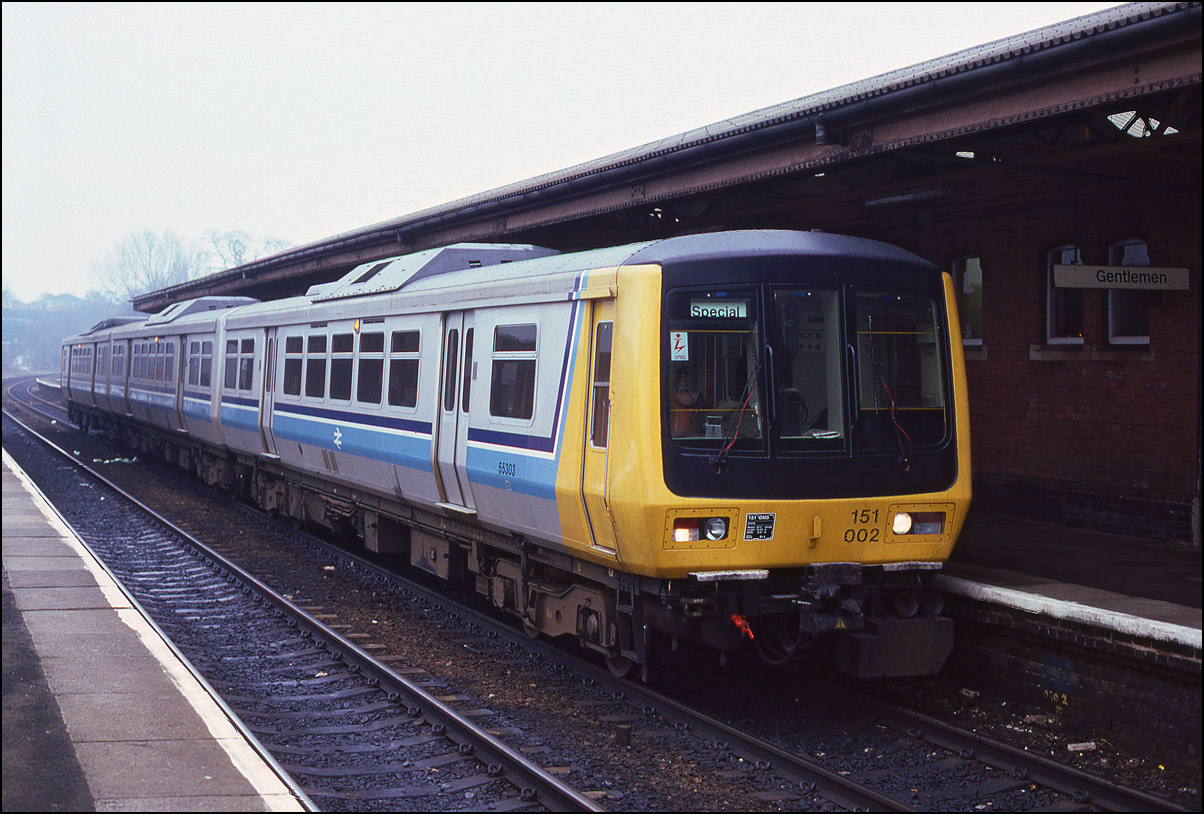
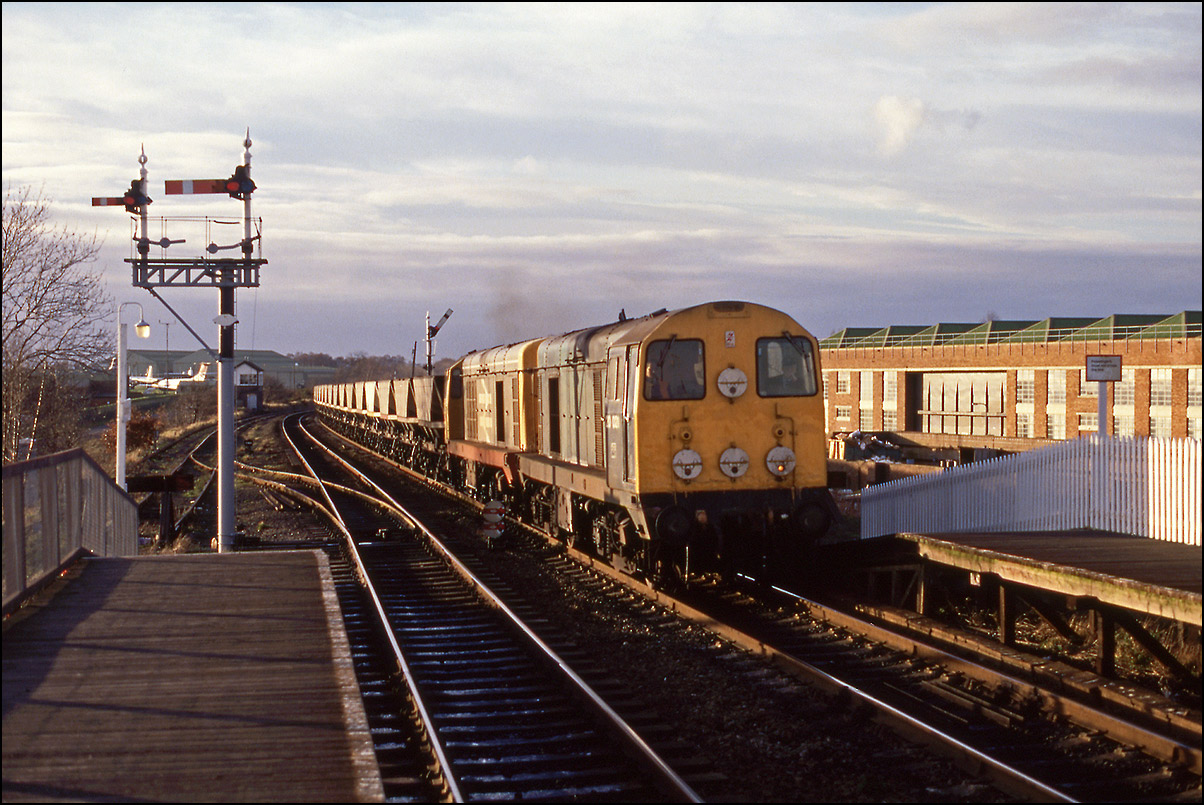
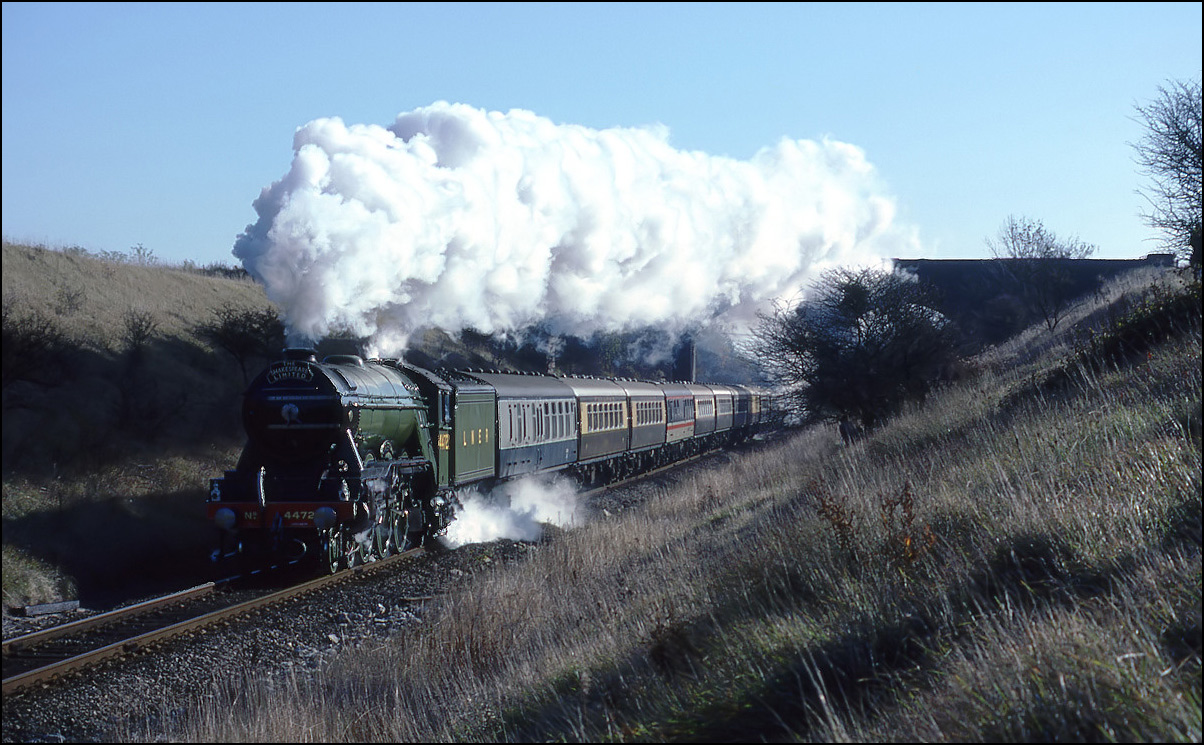
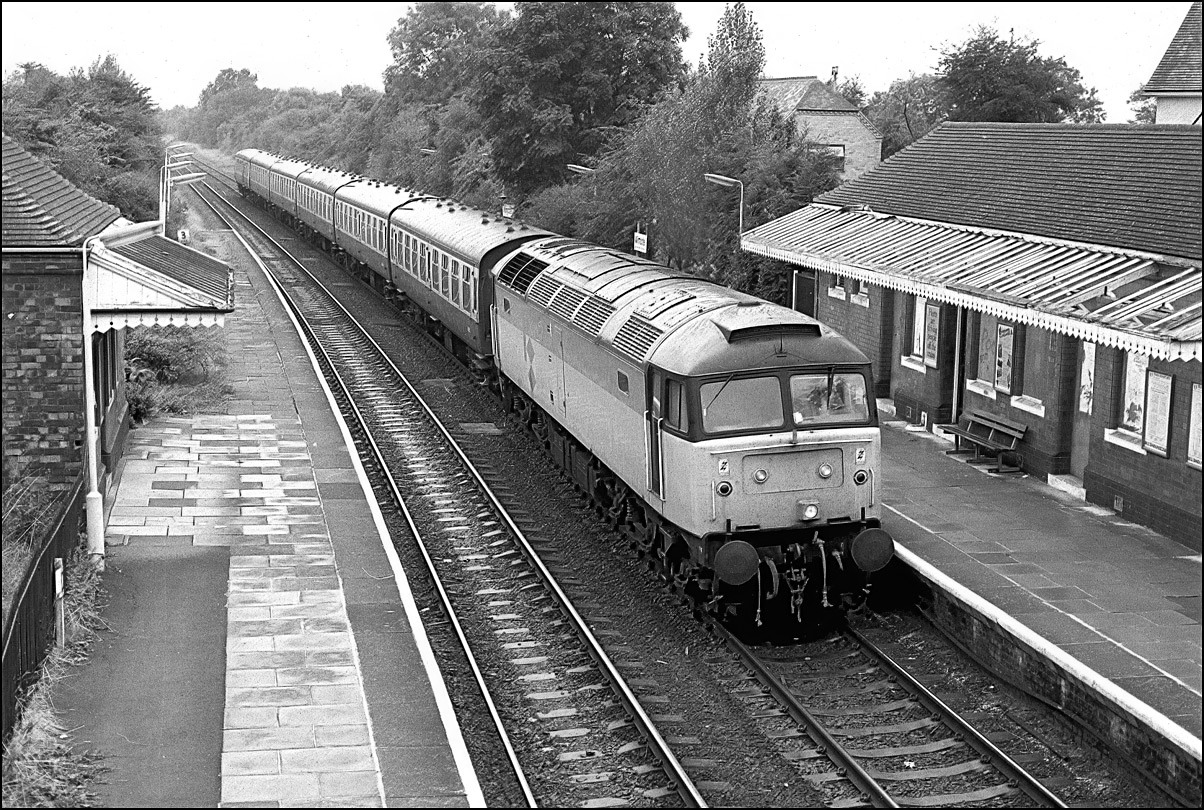



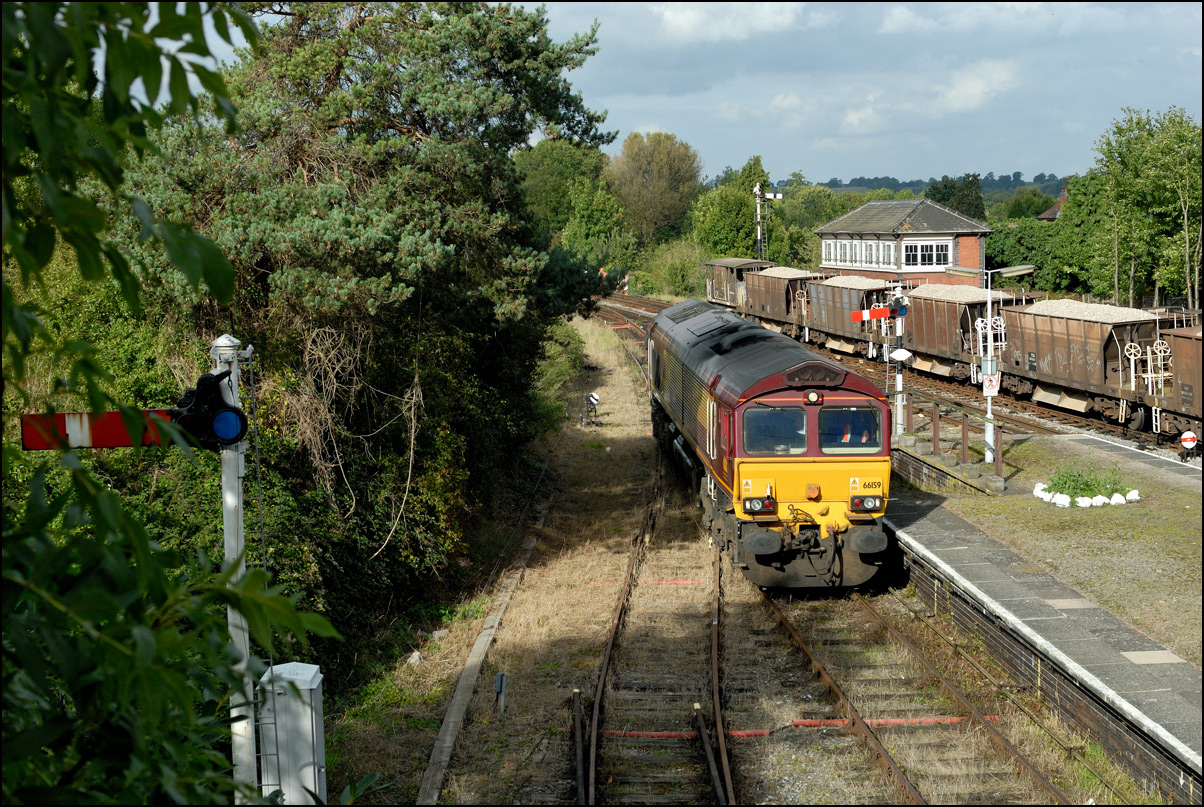
_henley_0810.jpg)
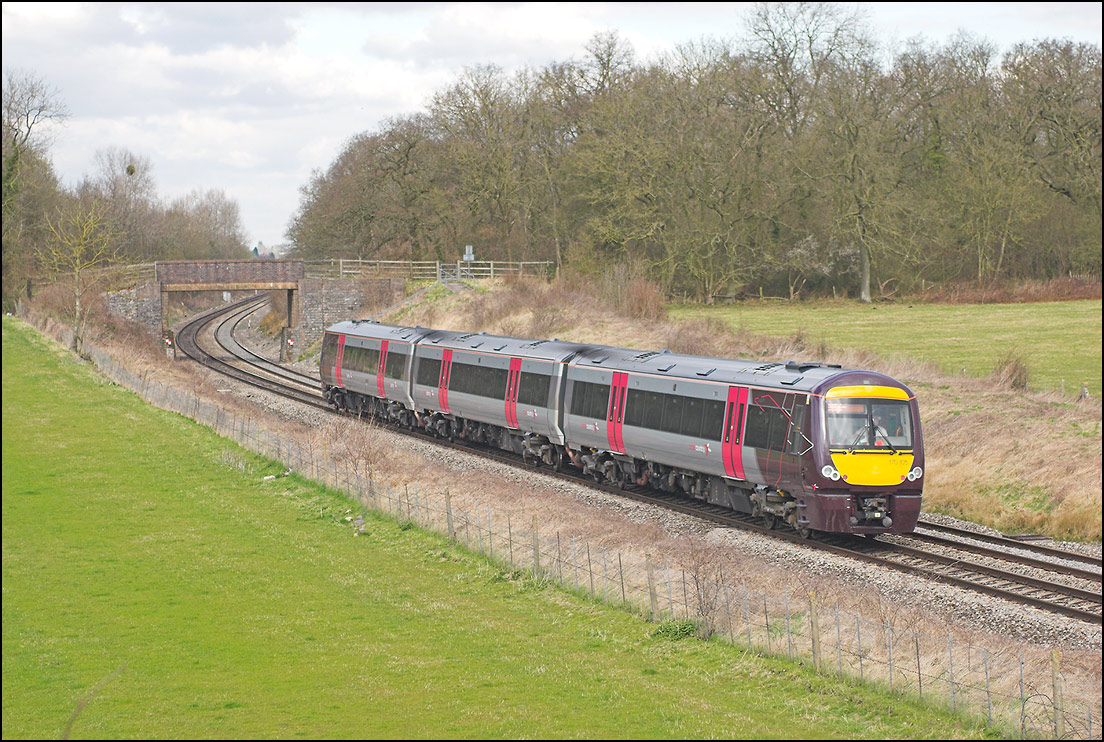
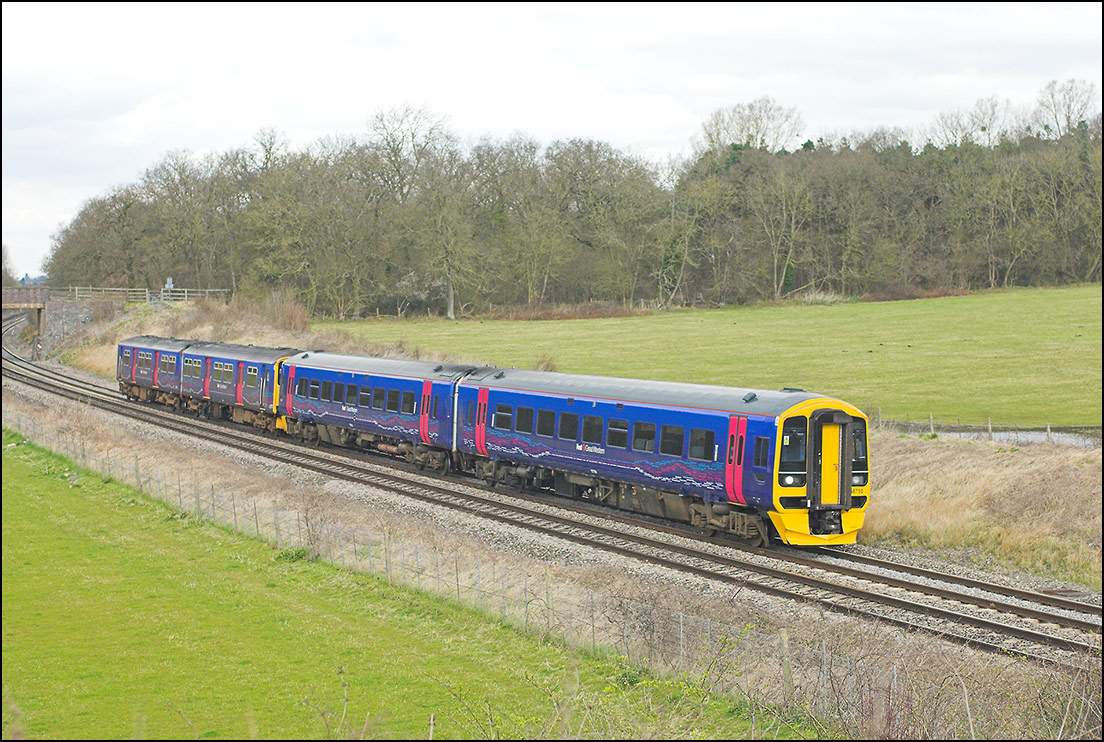
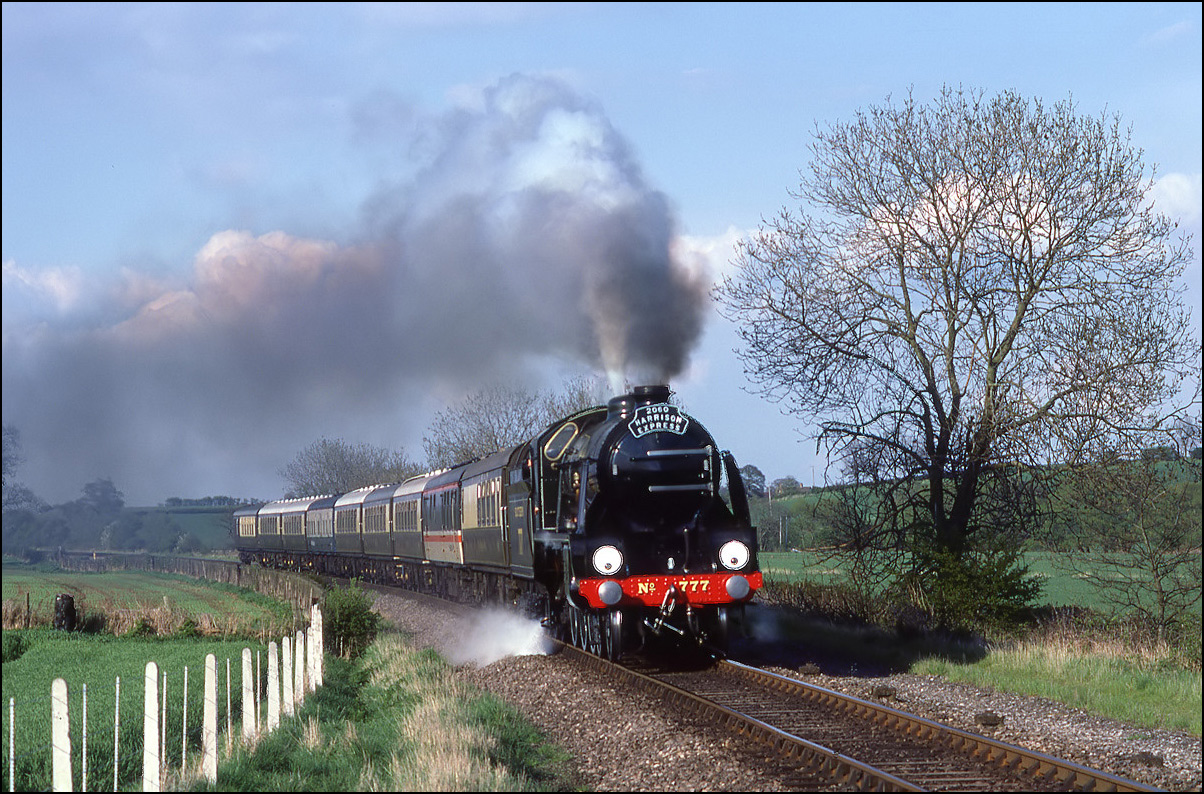
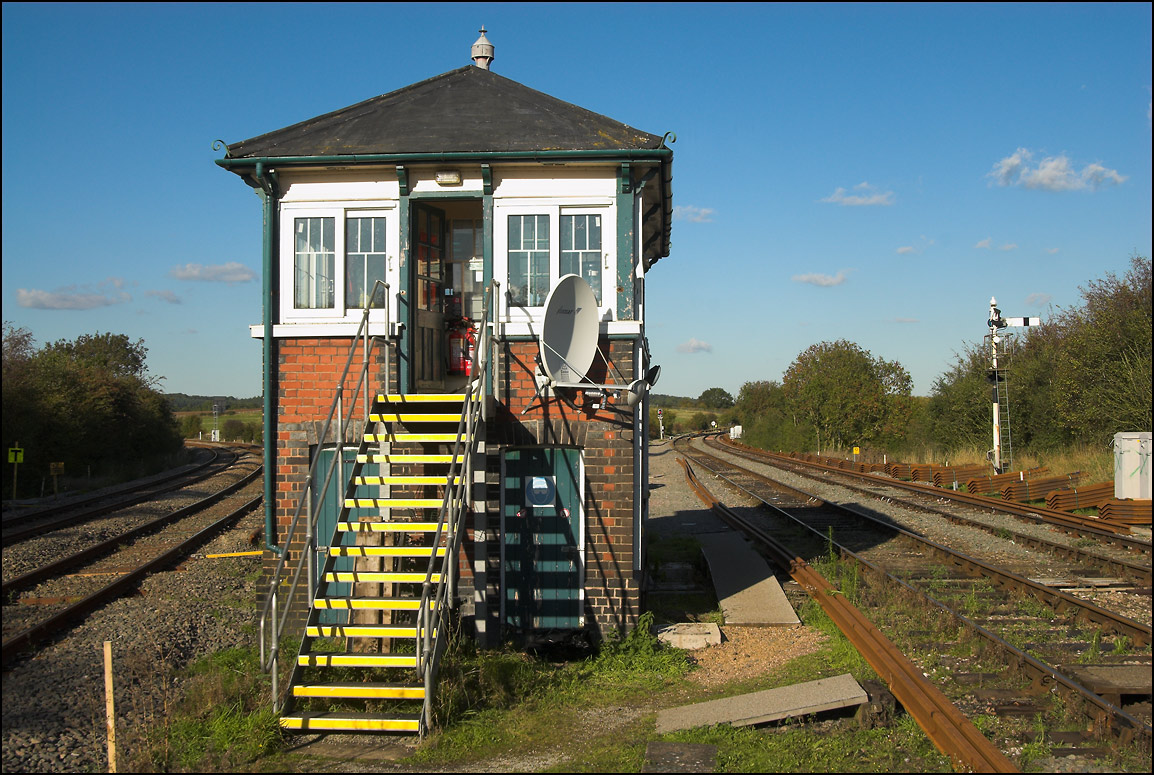

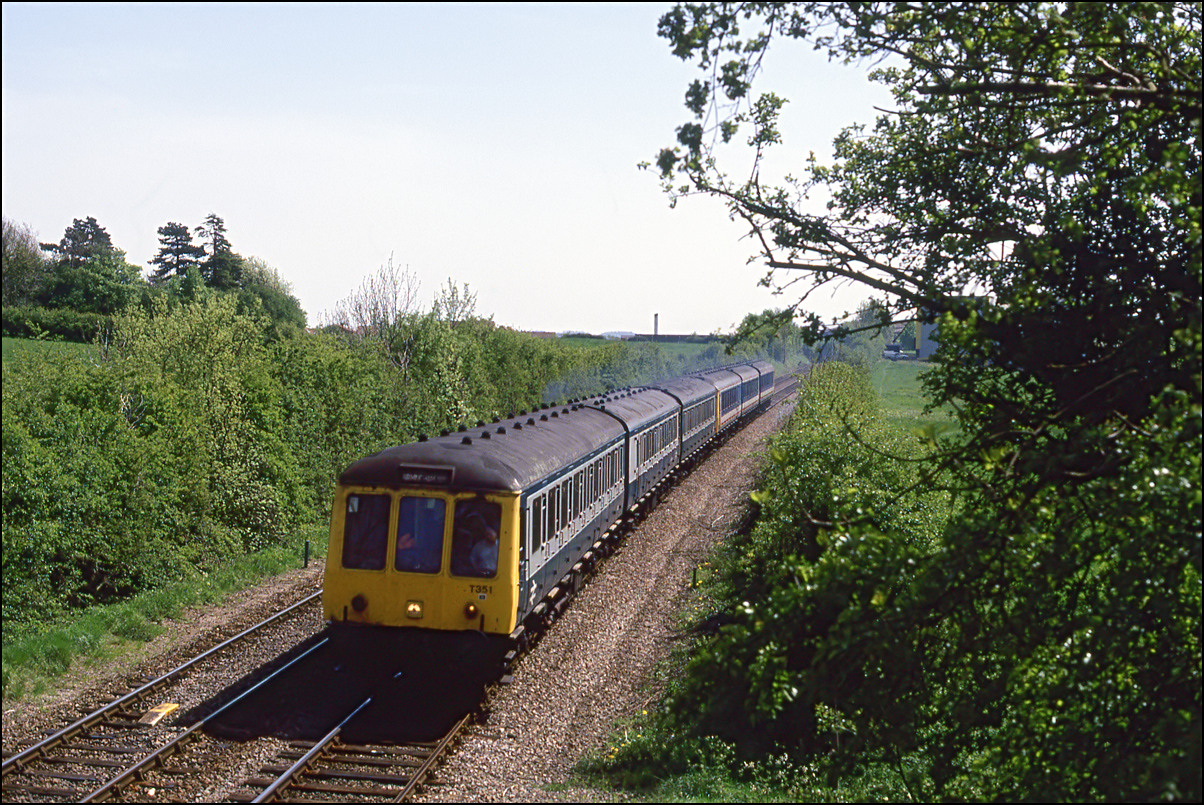
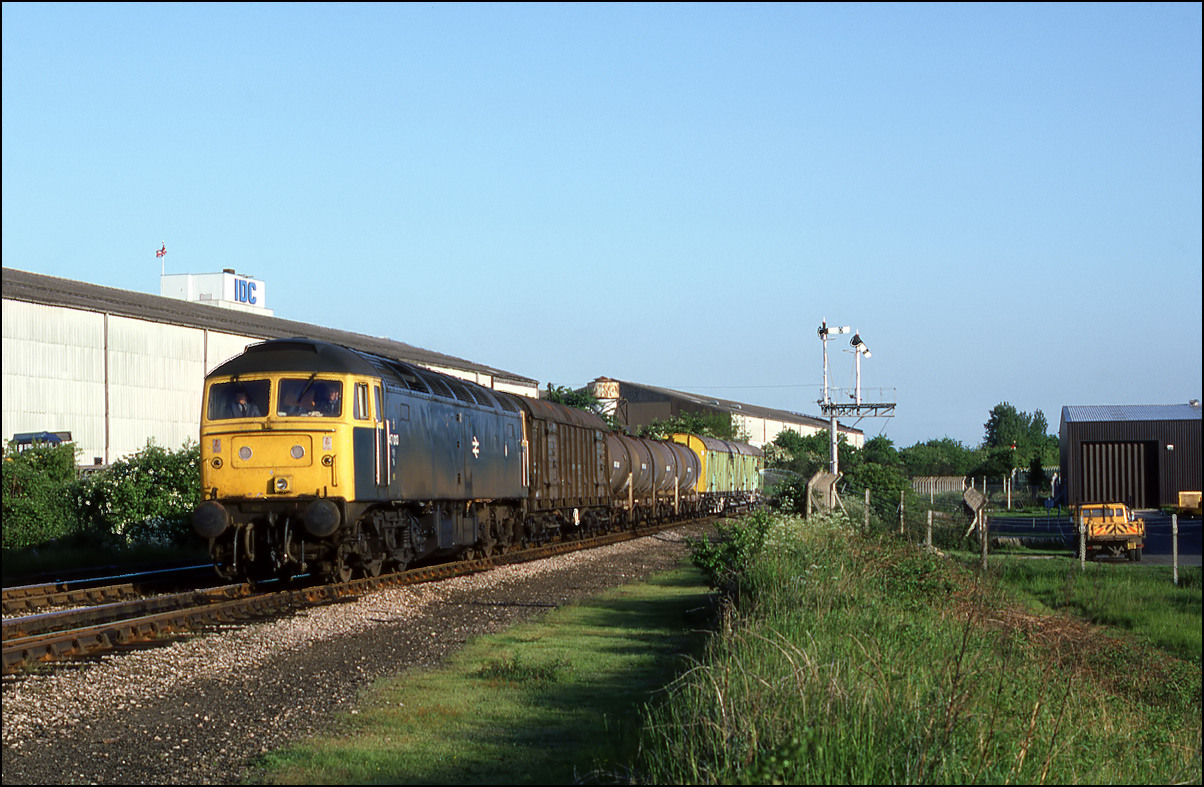
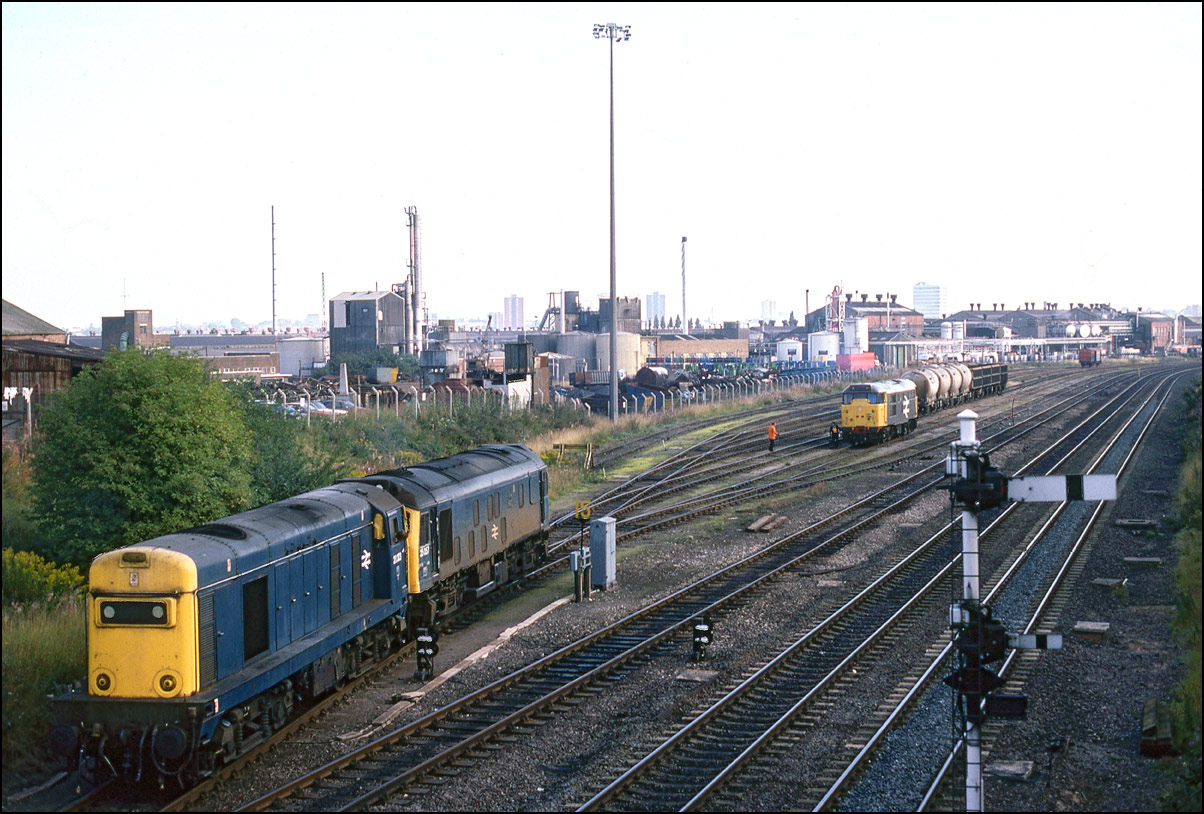

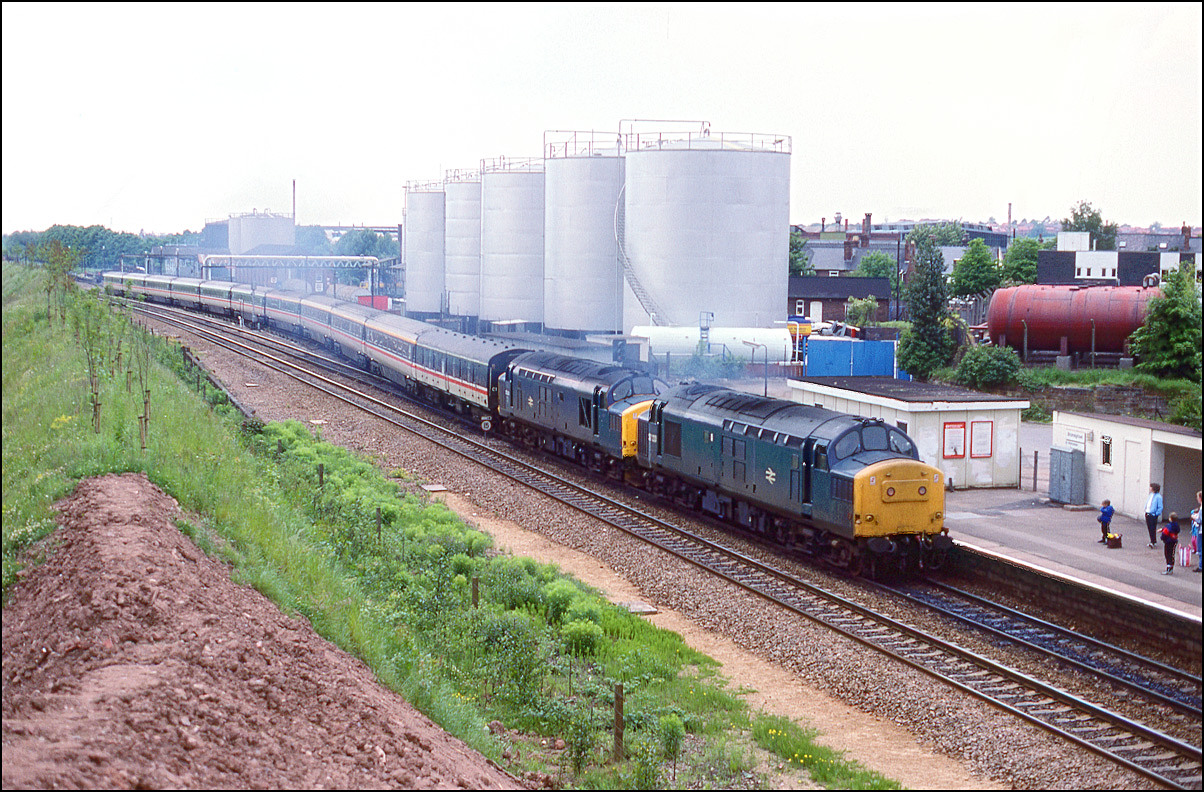
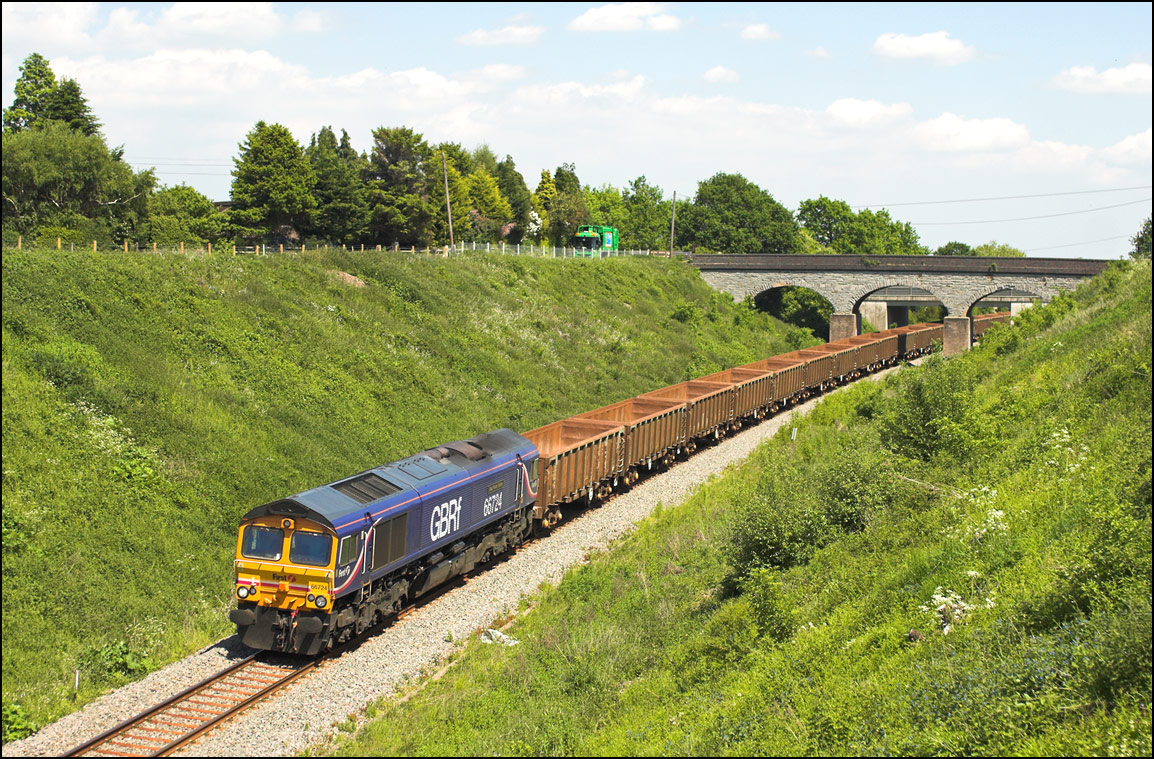
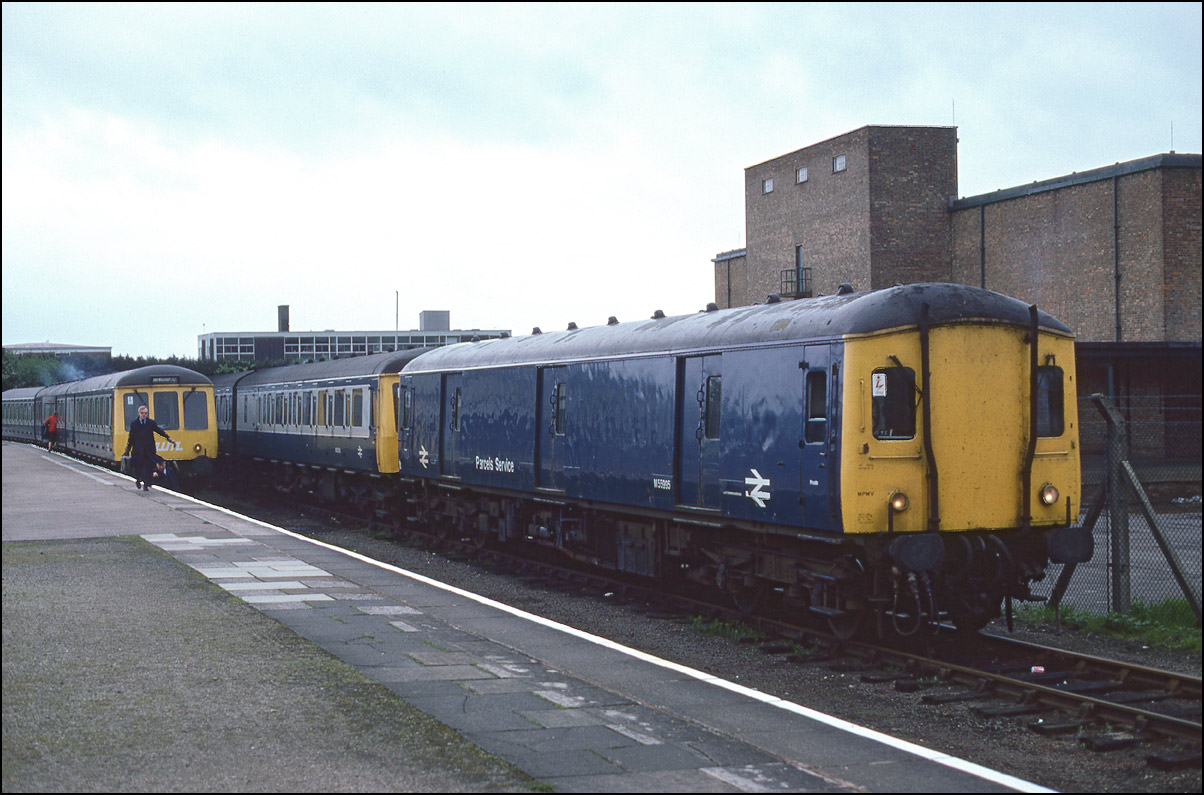


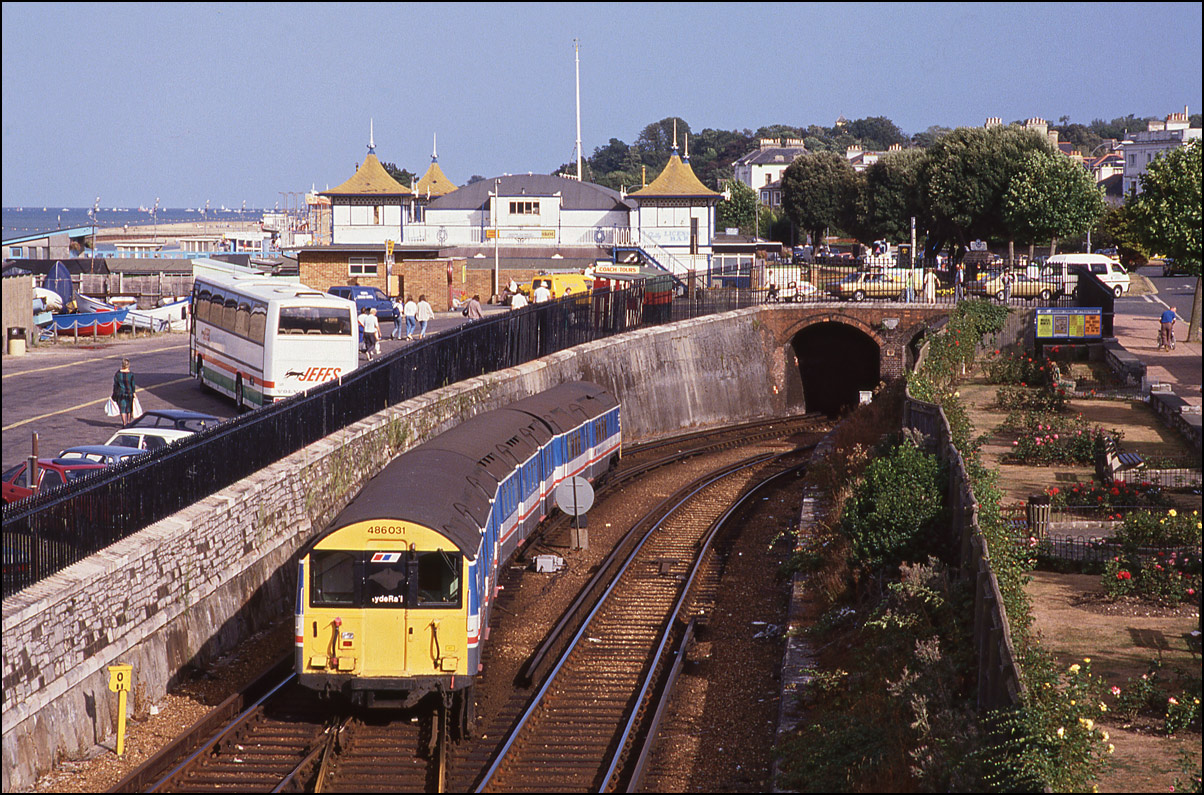
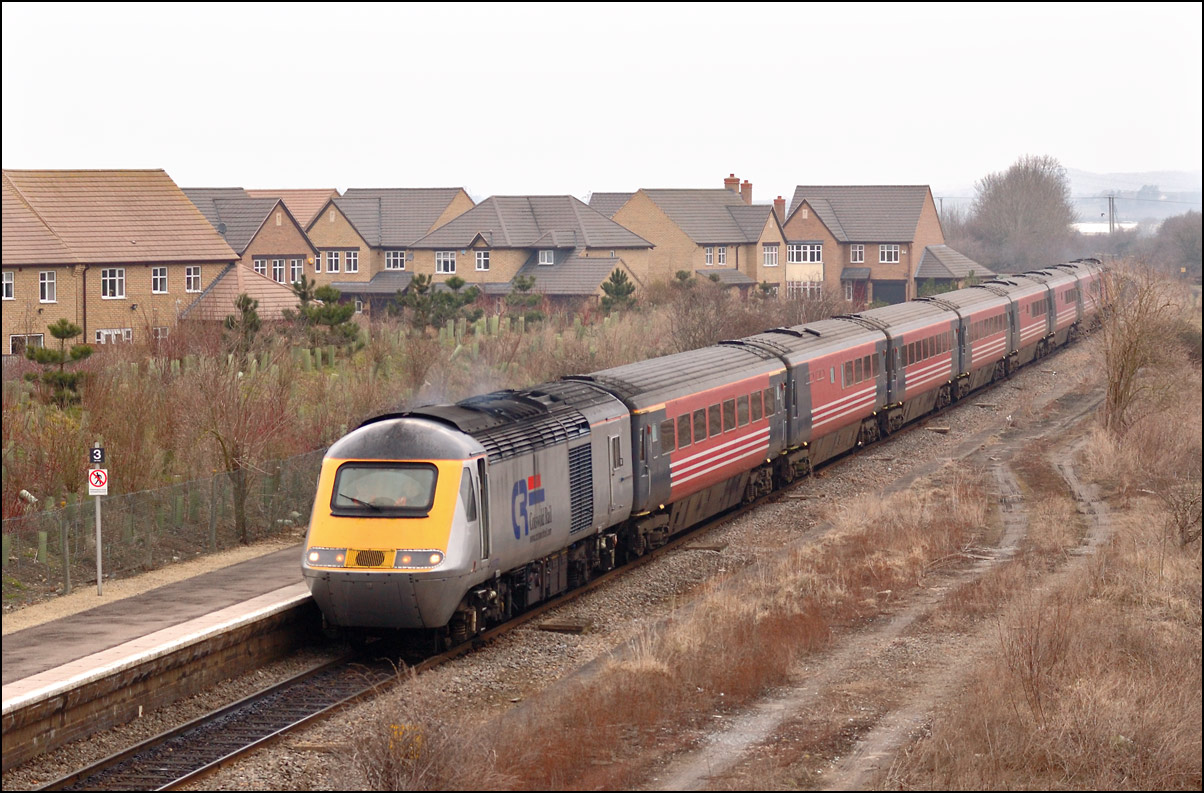
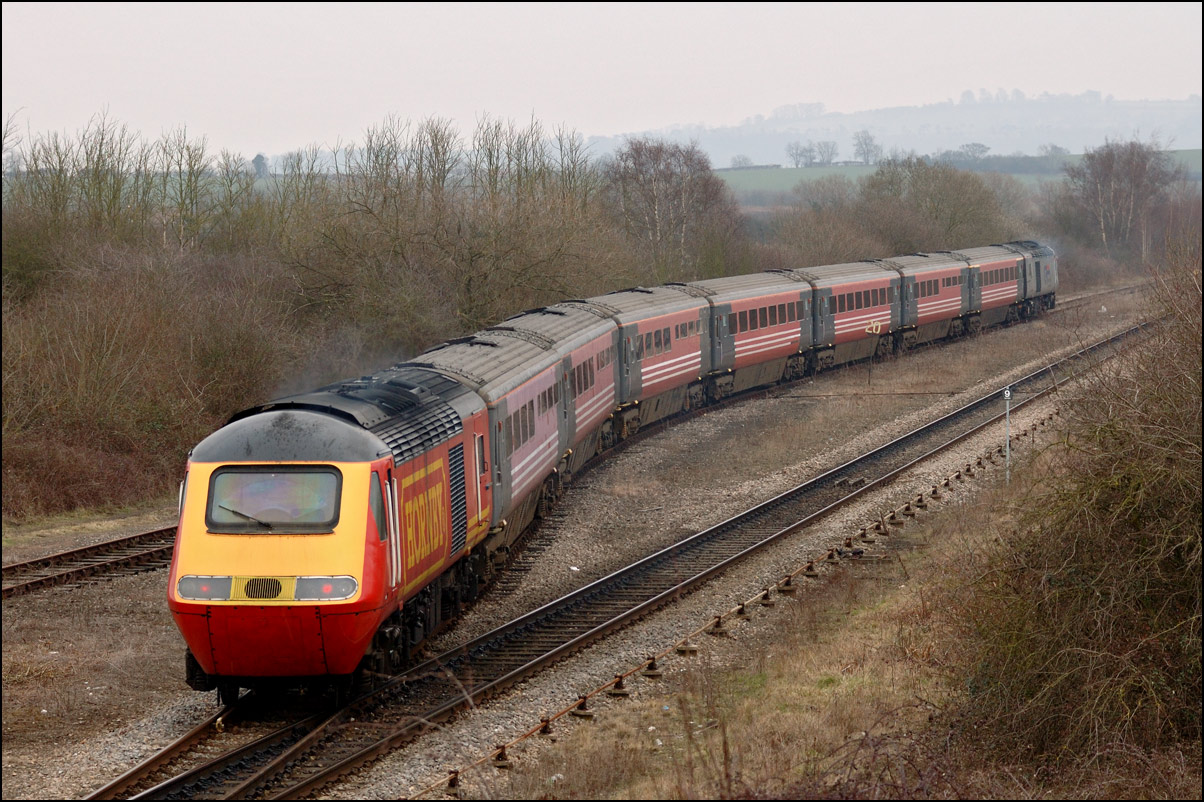

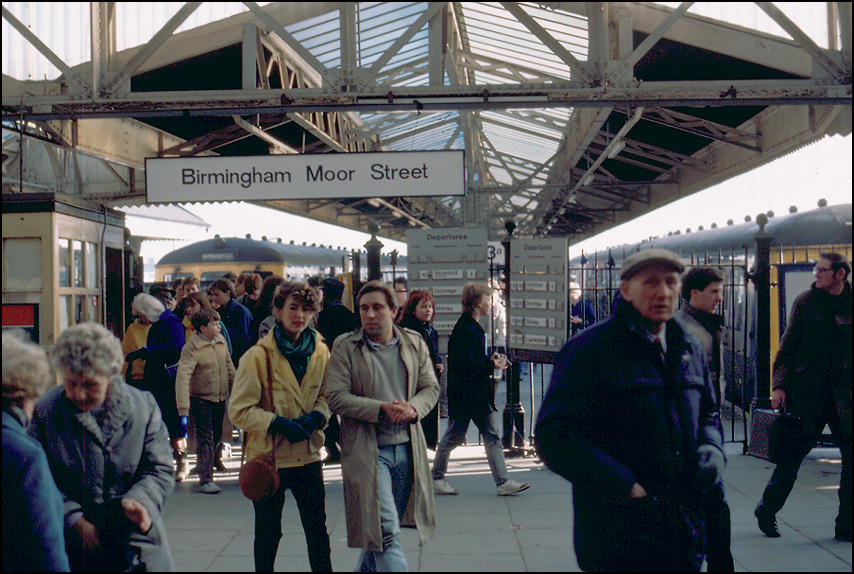
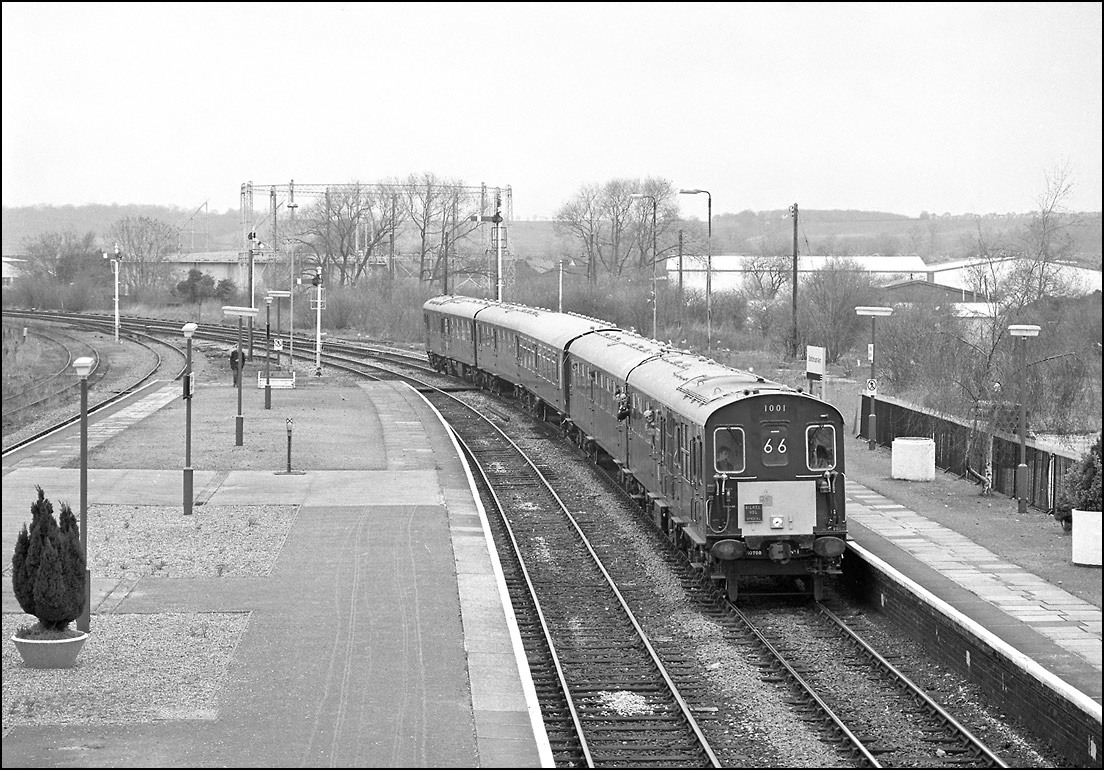
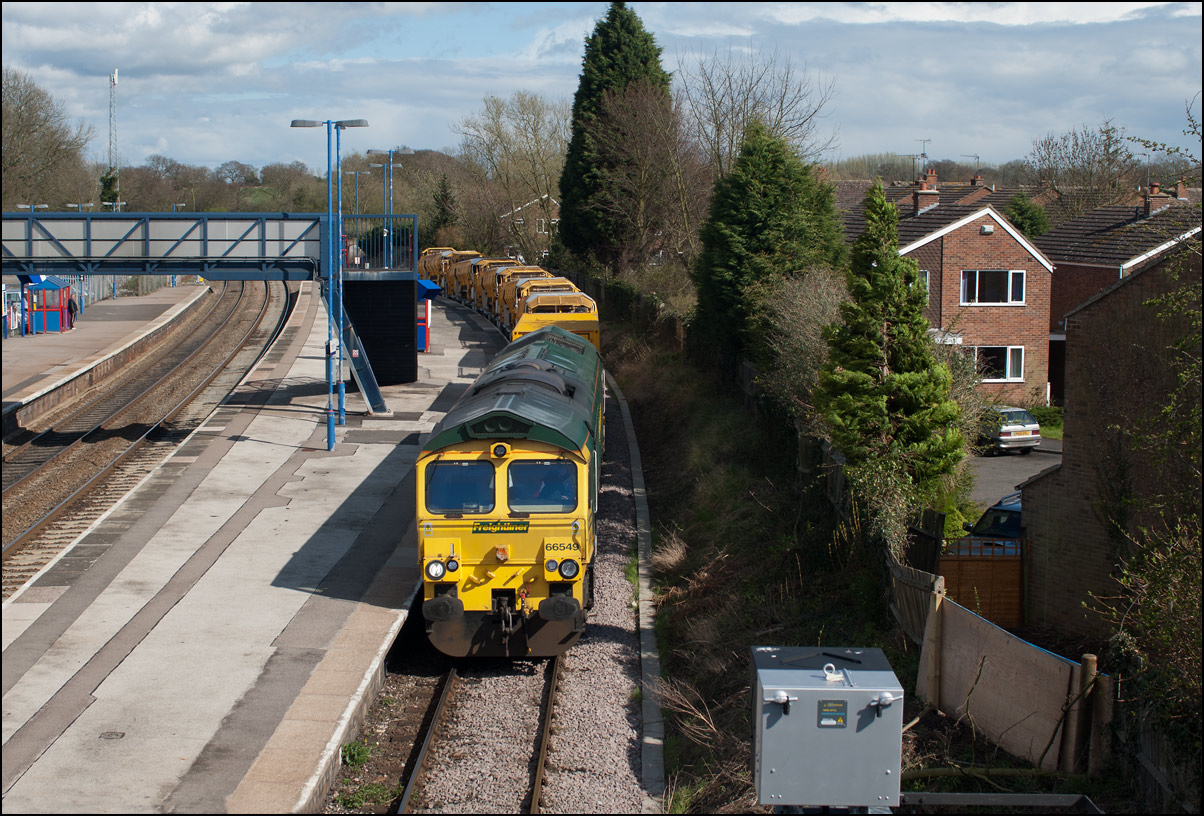
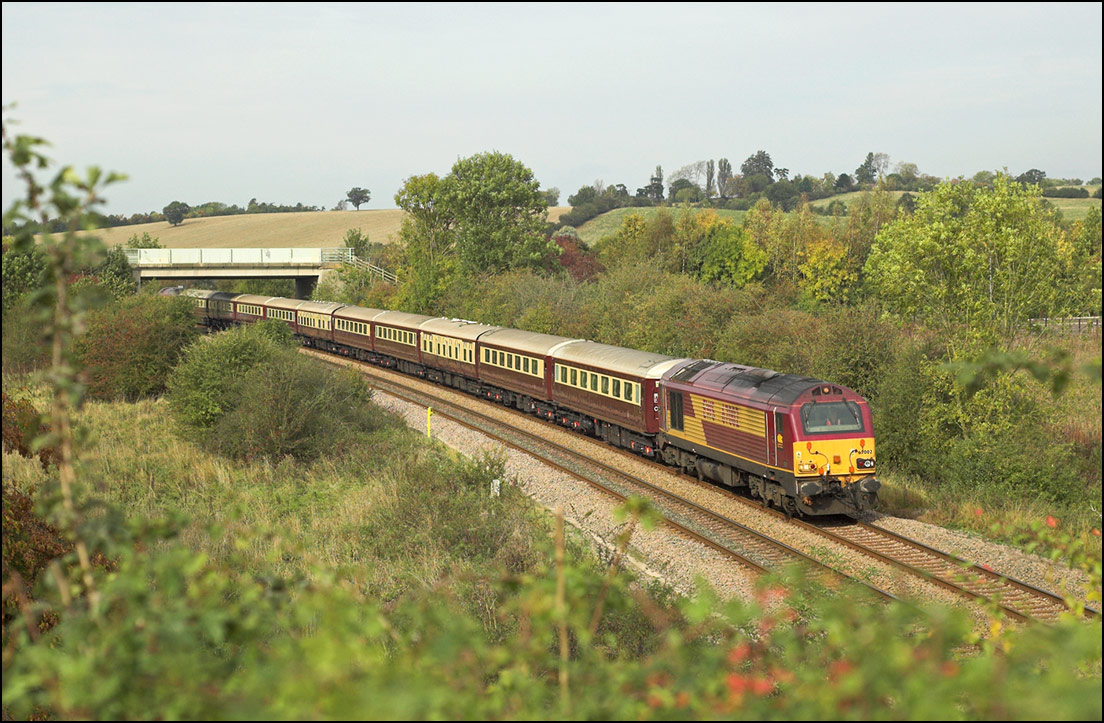
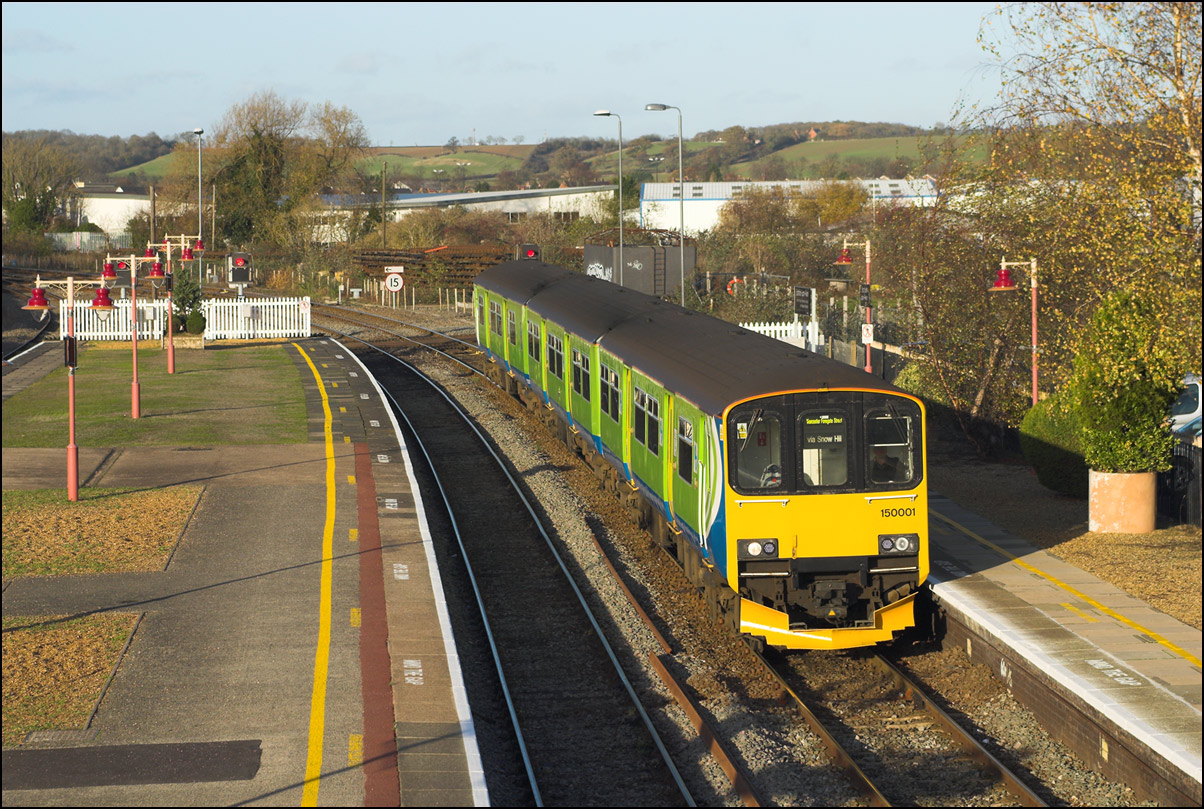
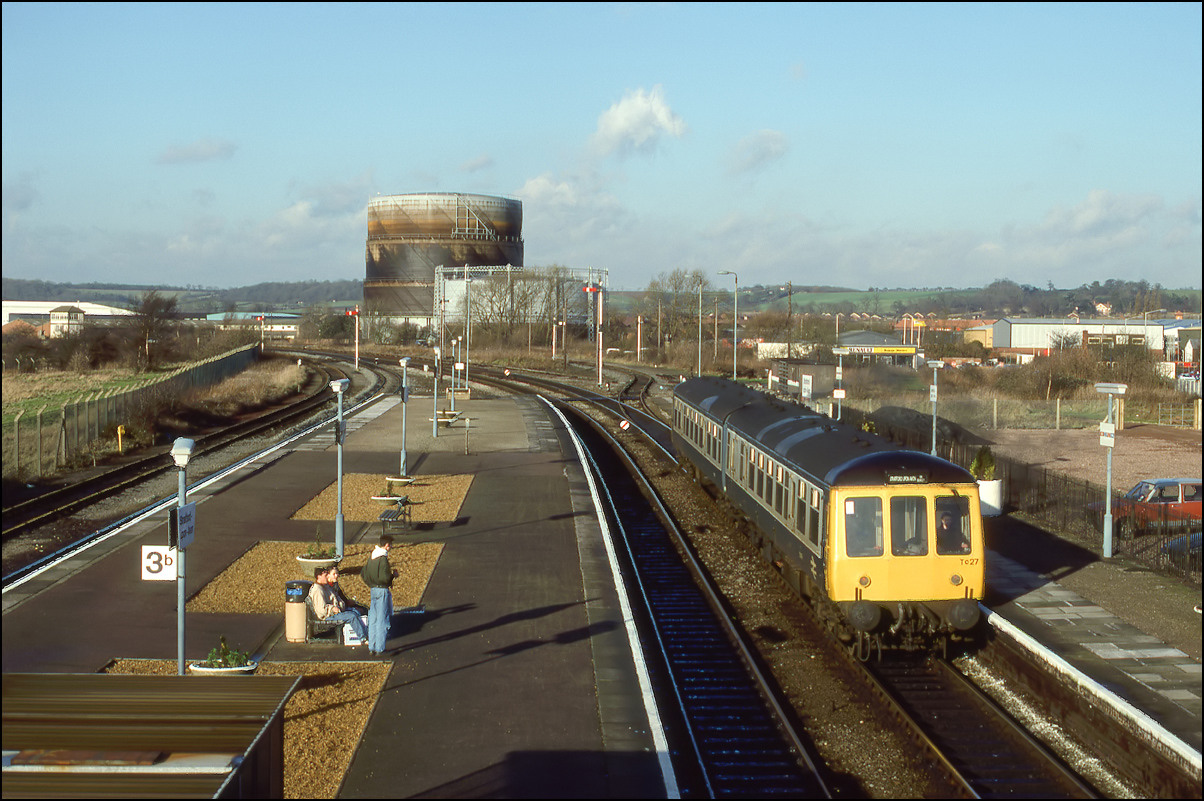
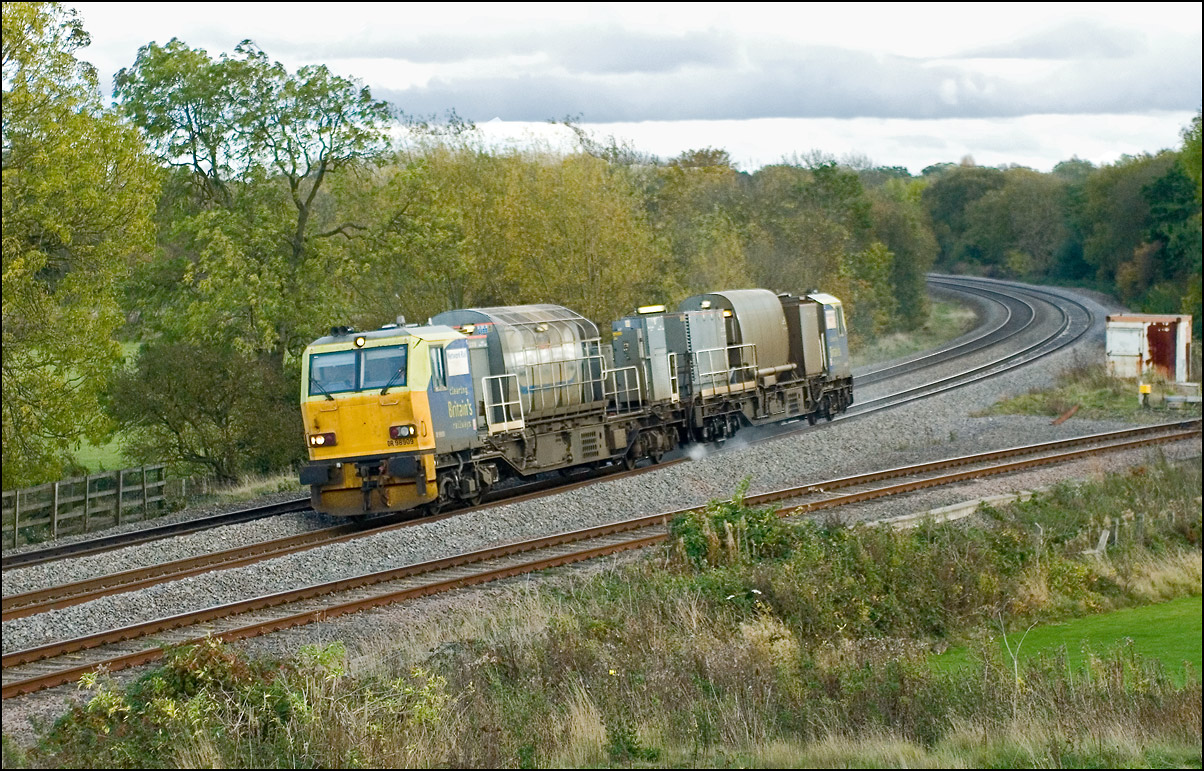
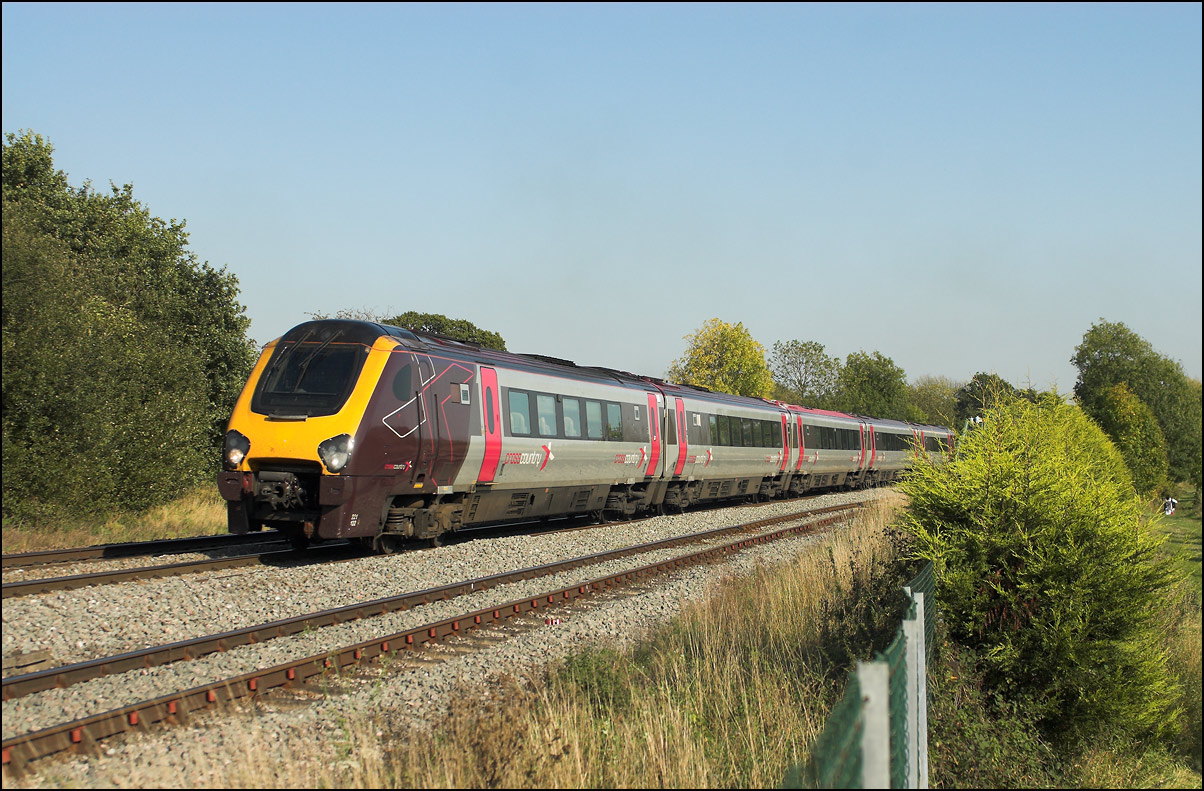
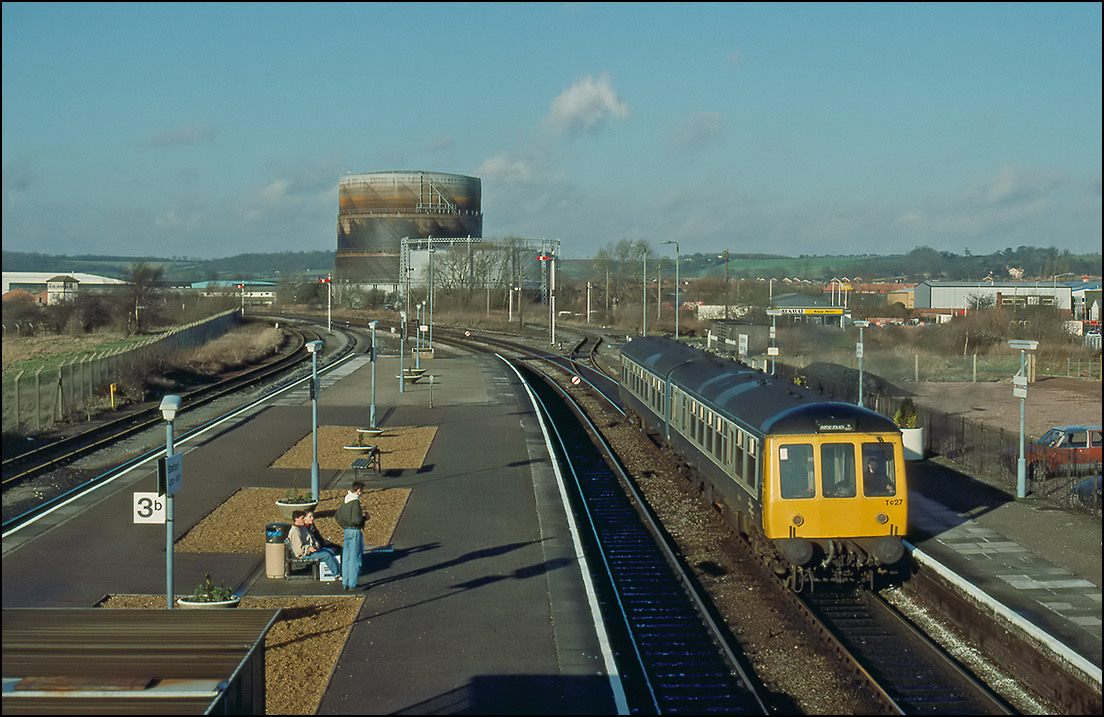
_SonA_300811.jpg)
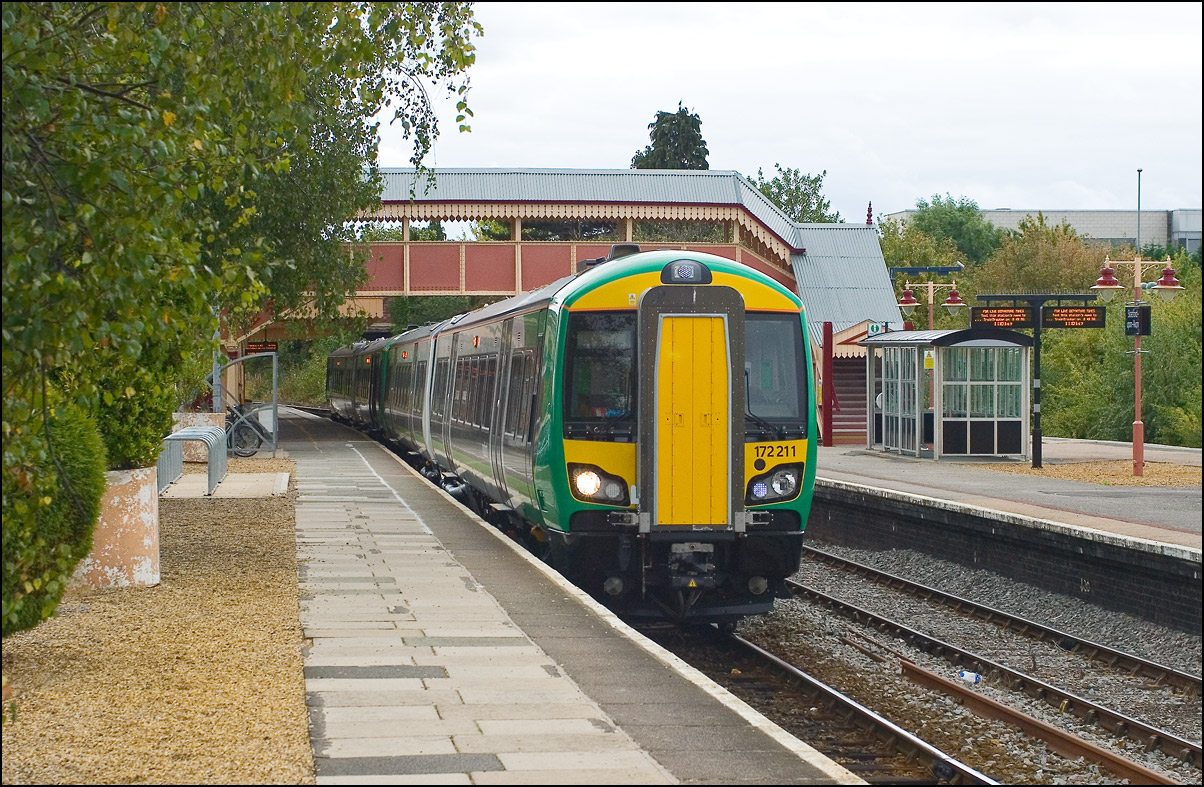
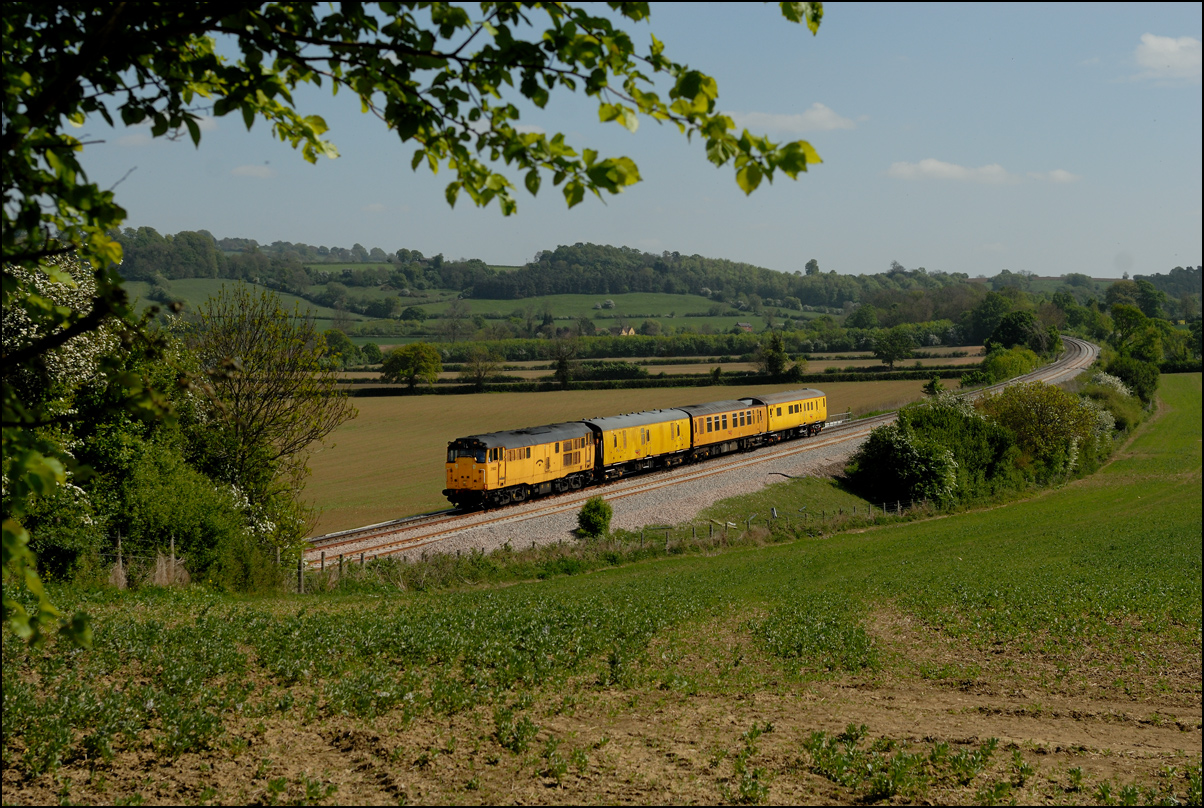
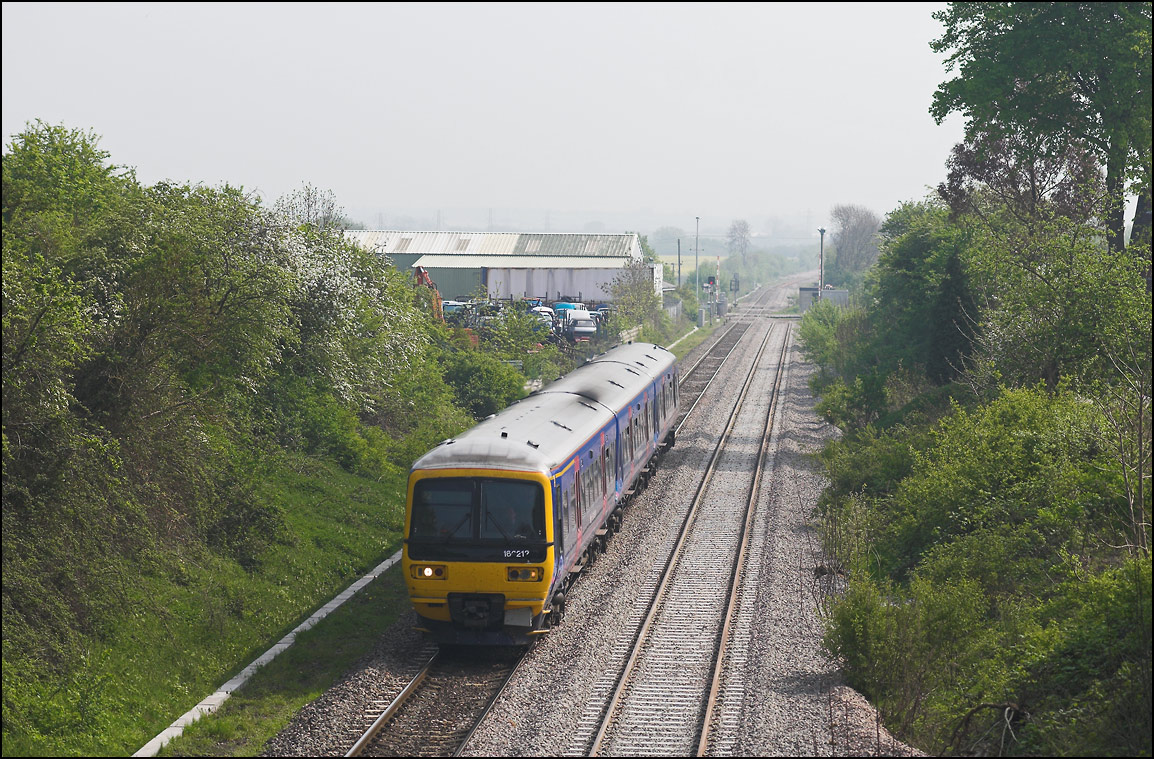
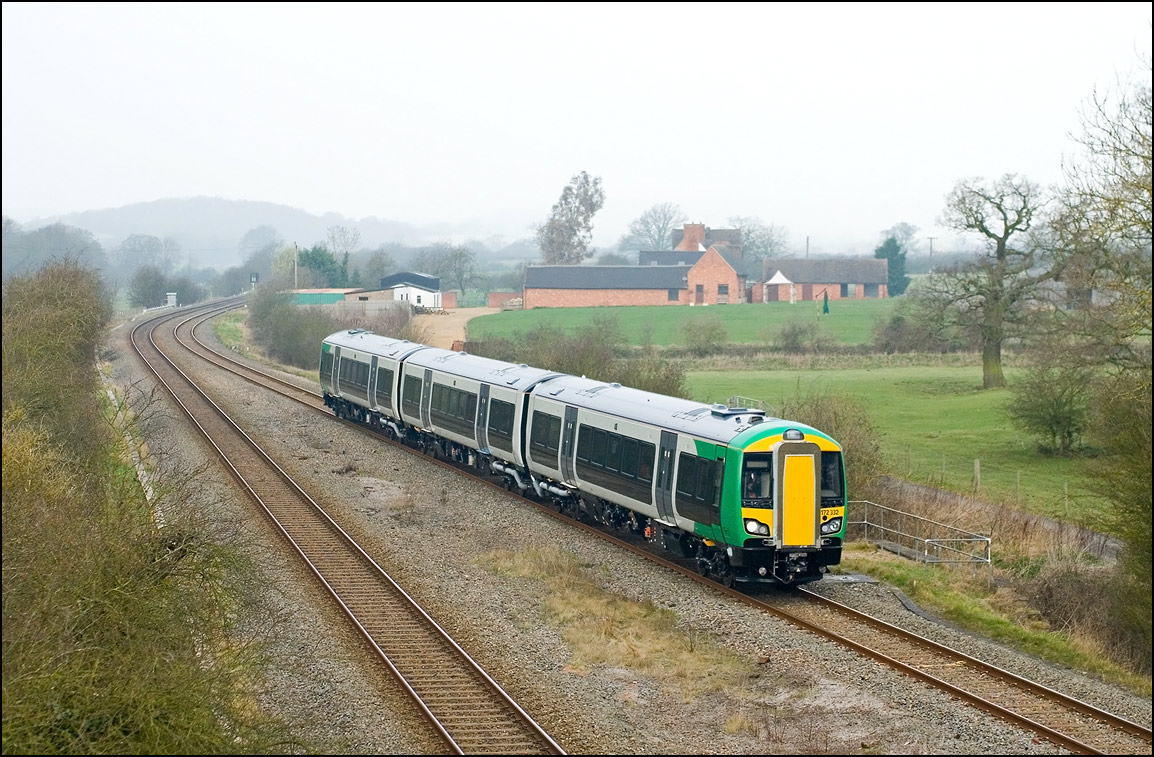
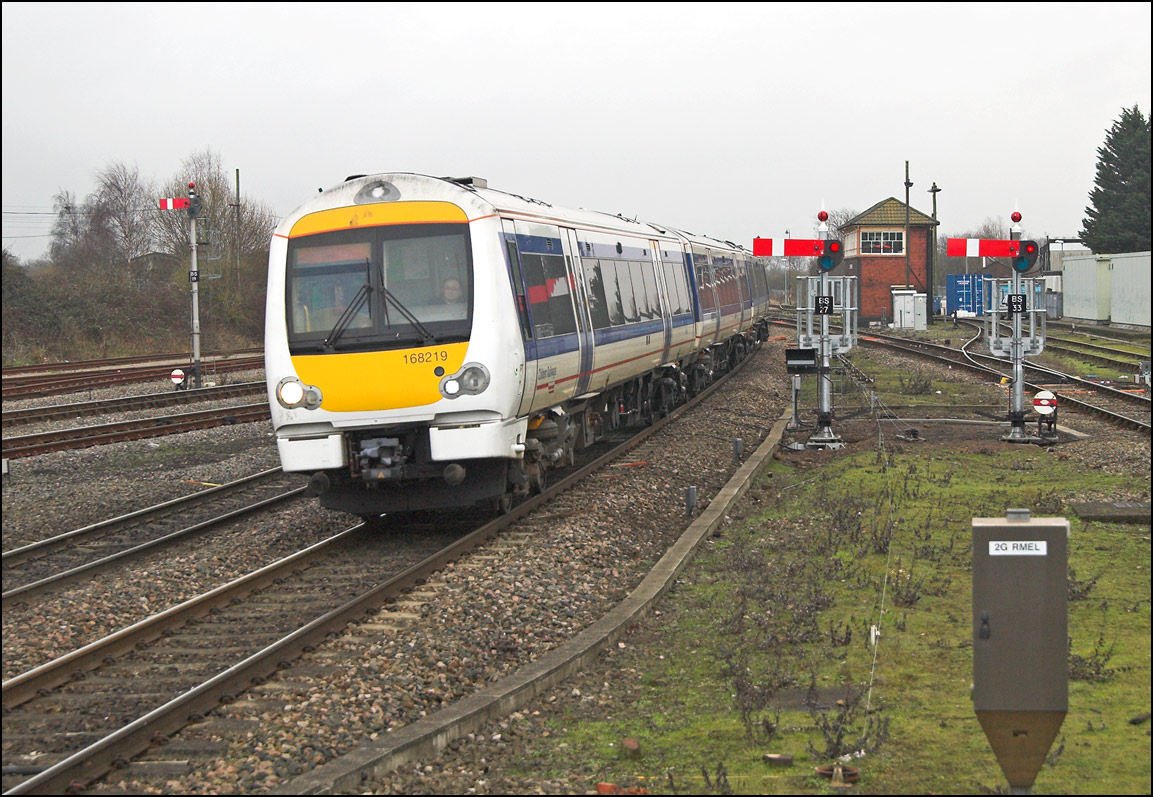

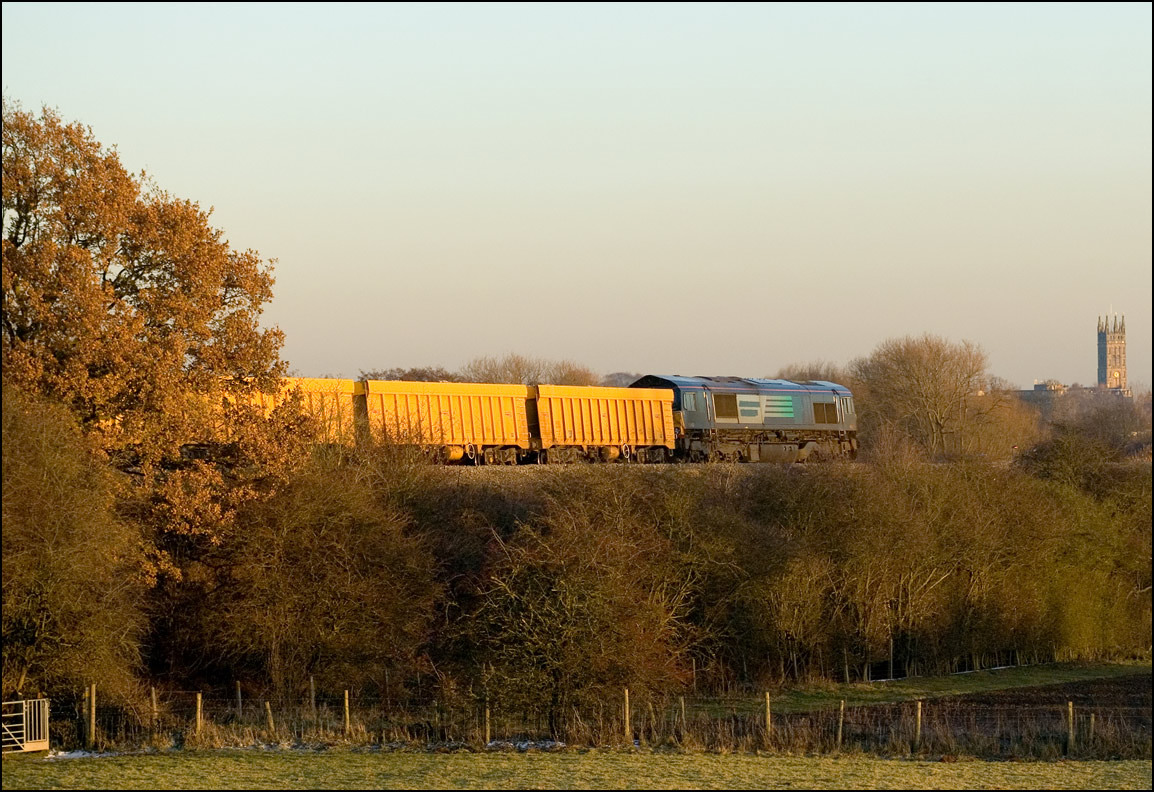
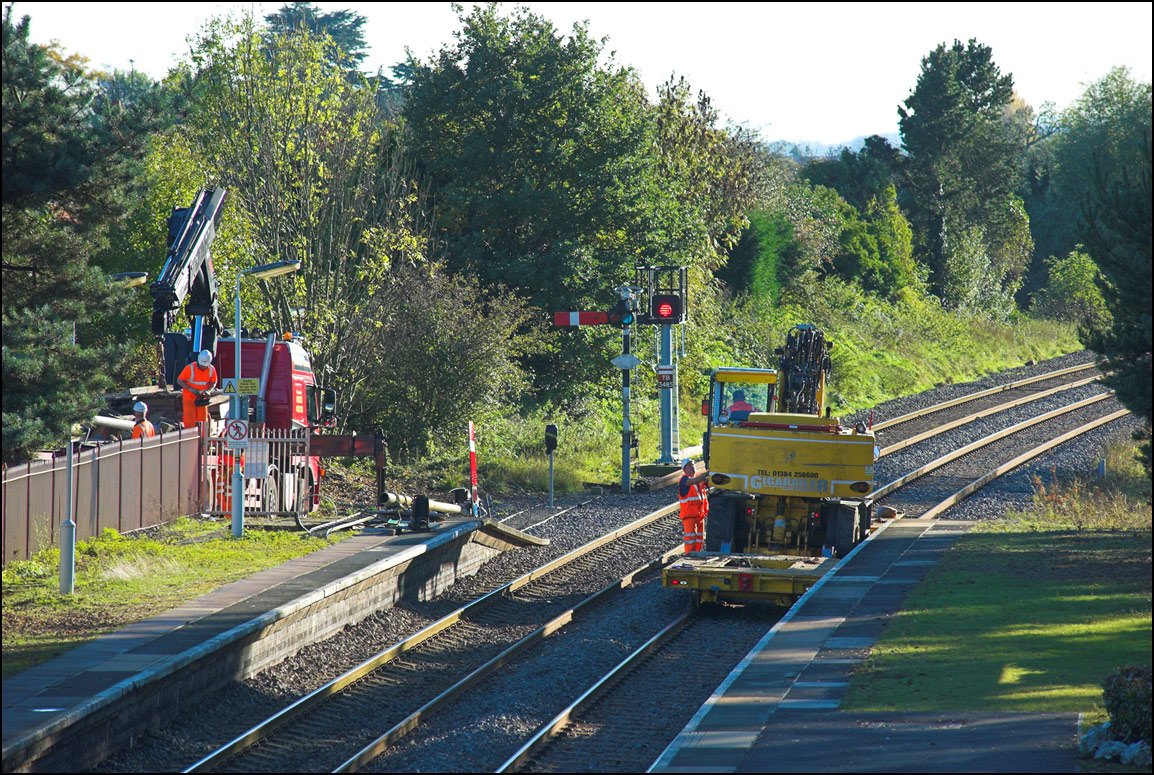


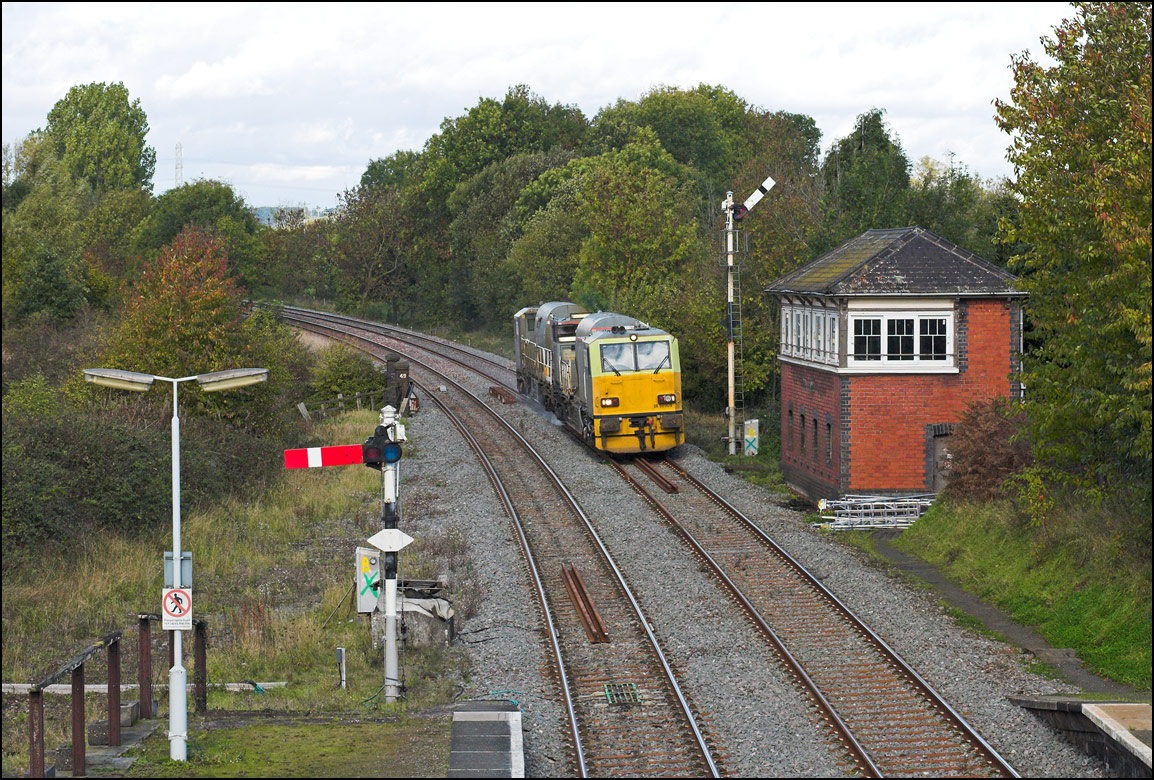
_Henley_221010.jpg)
_Henley_22101.jpg)

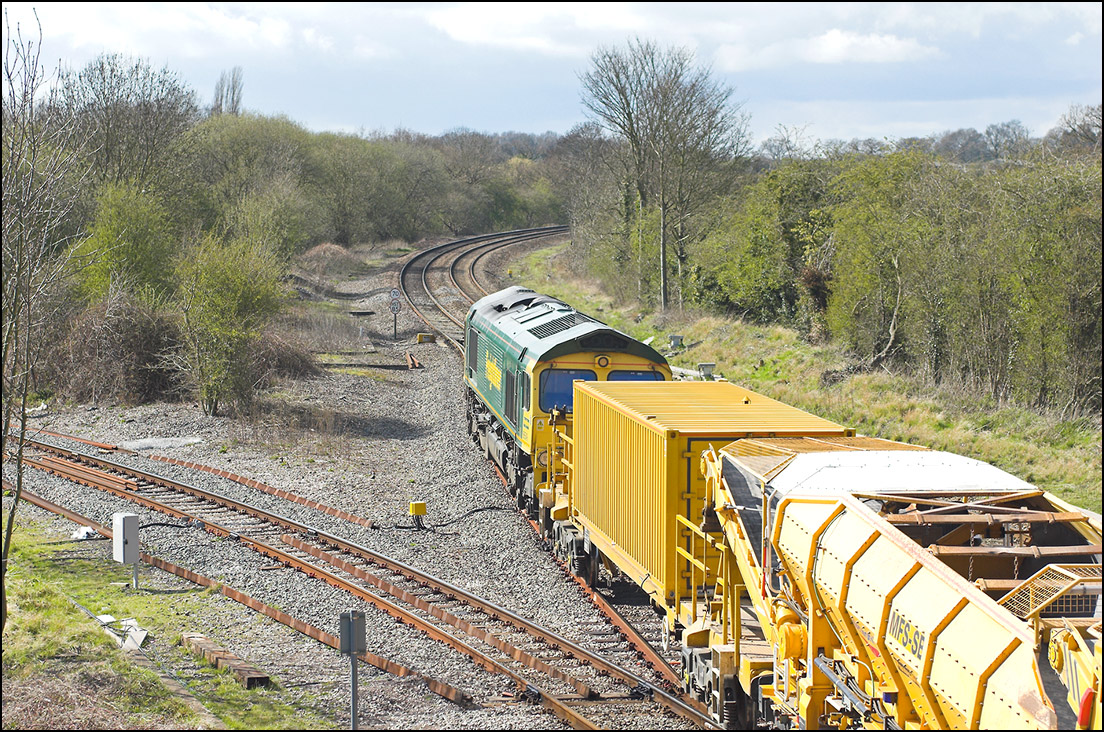

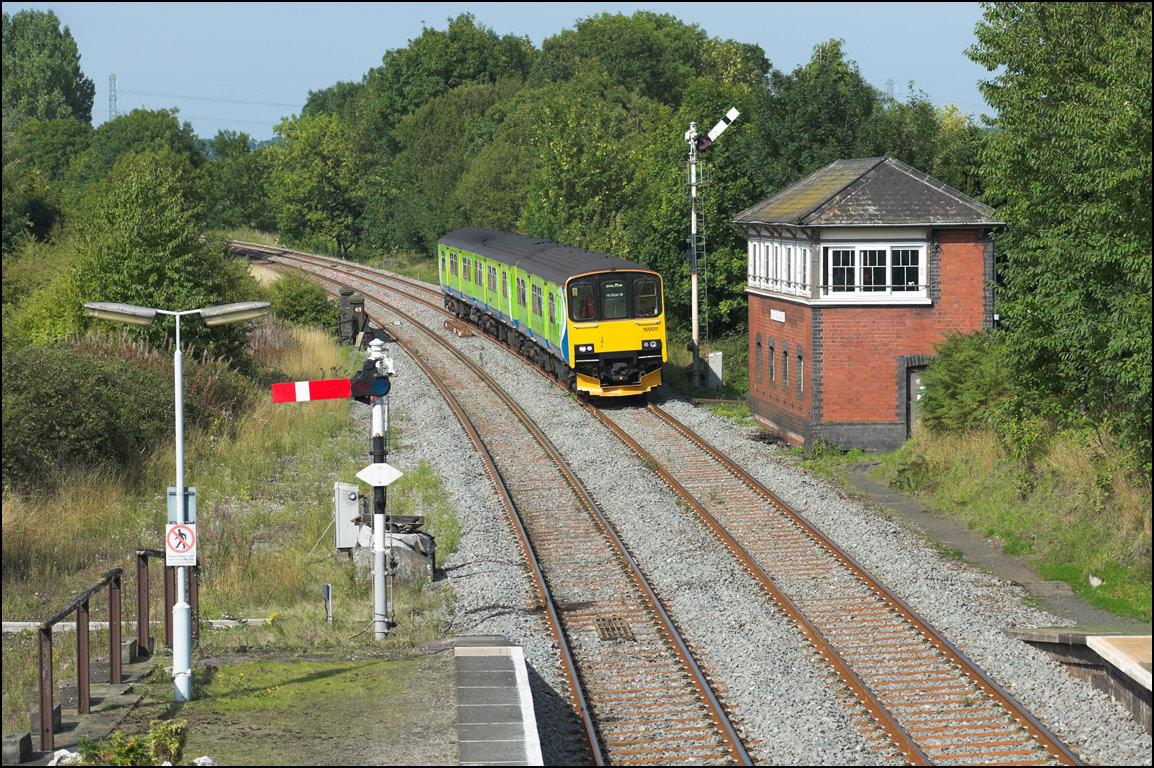
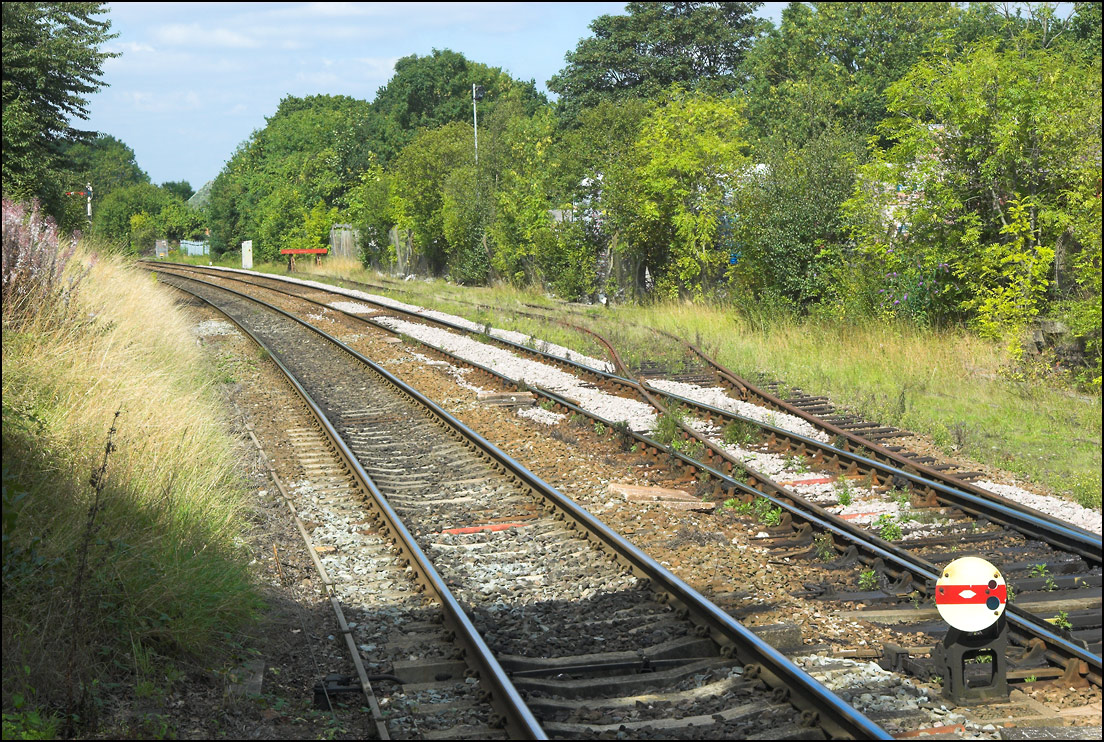
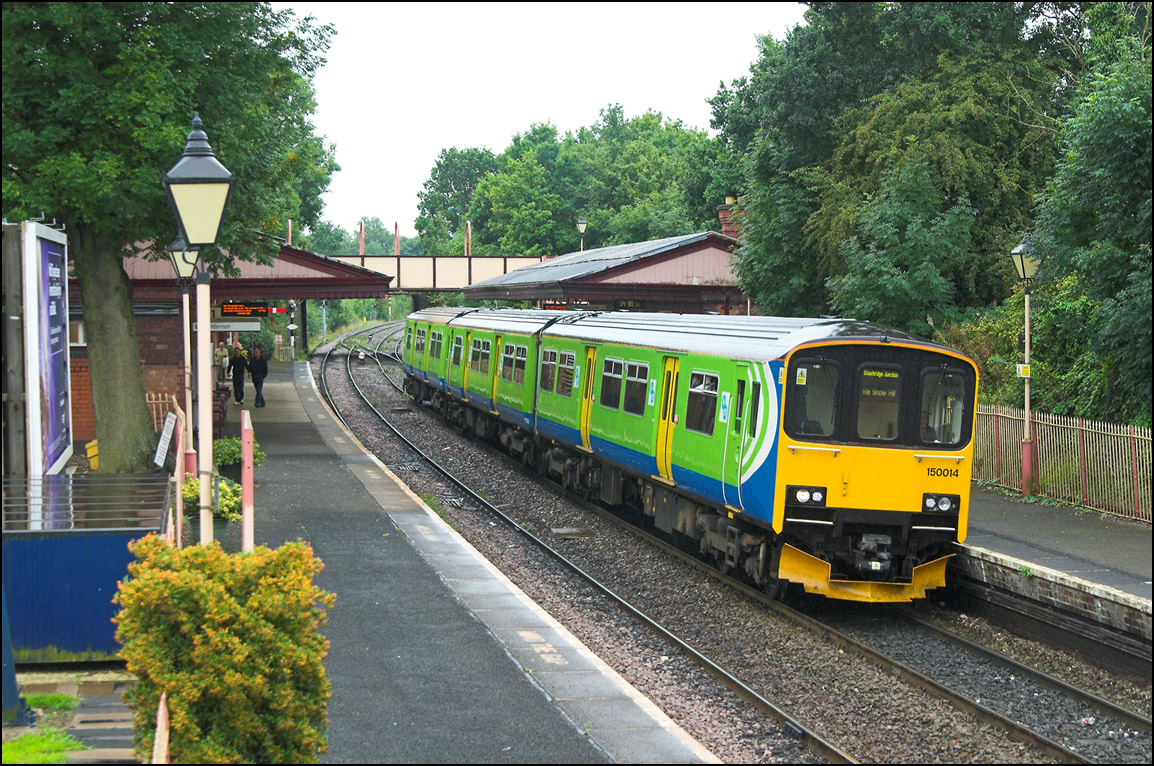
_Shirley_.jpg)
_Shirley_310810.jpg)
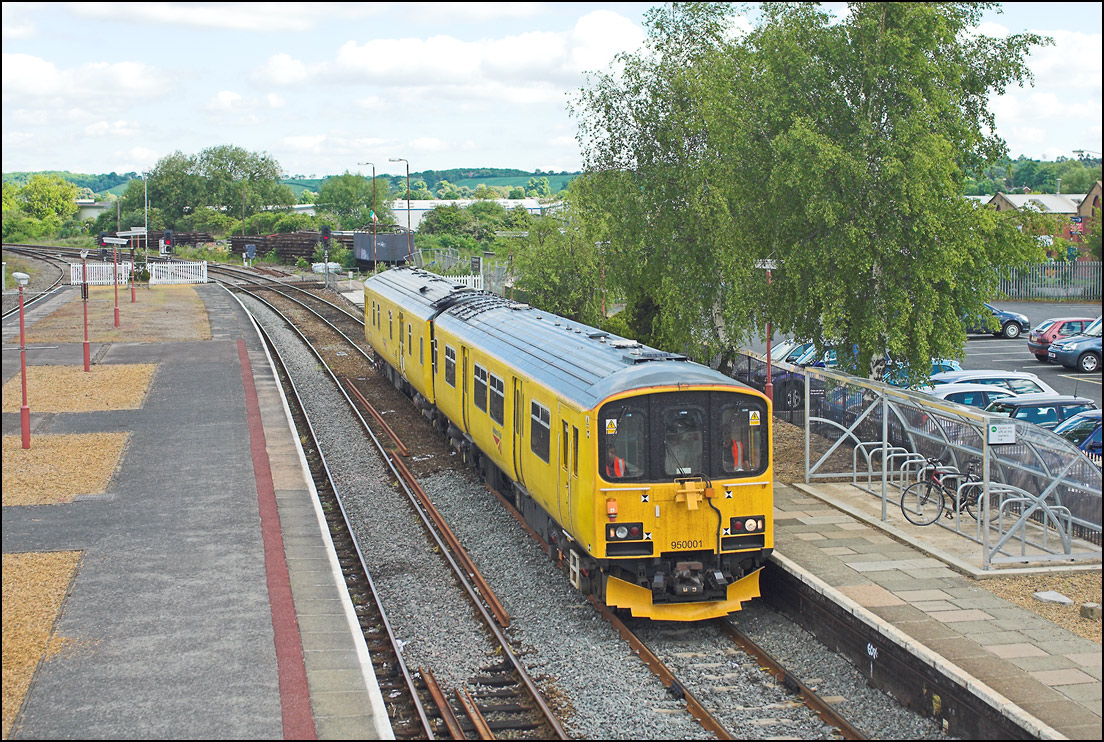
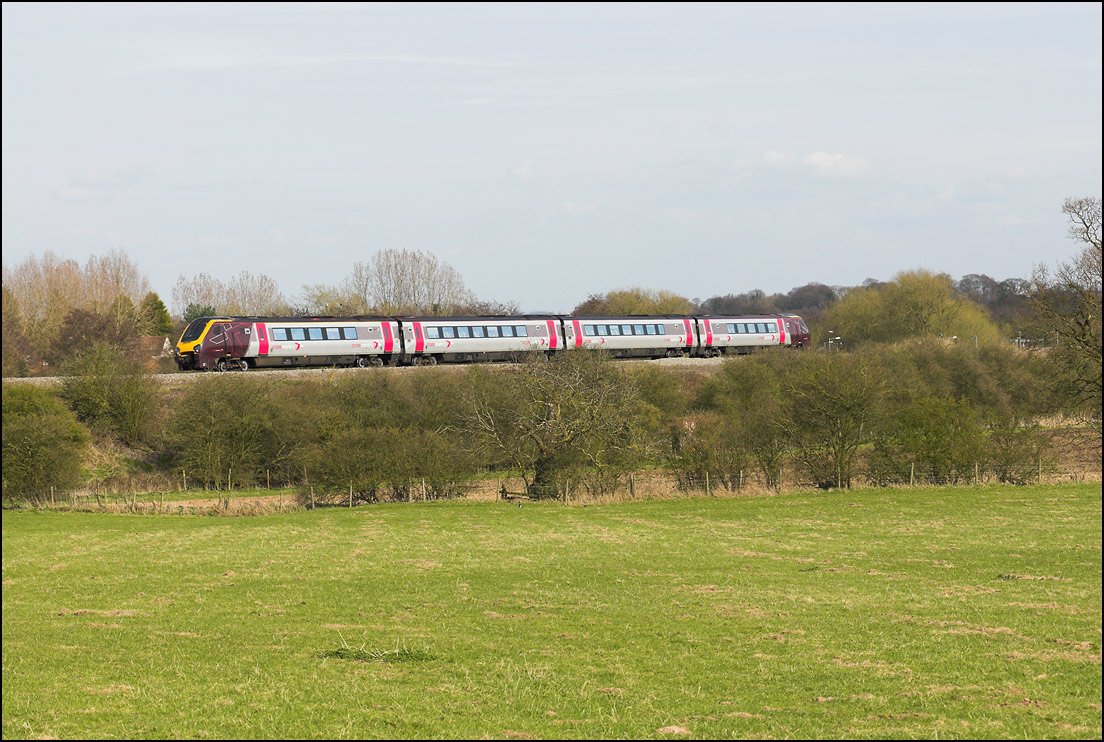
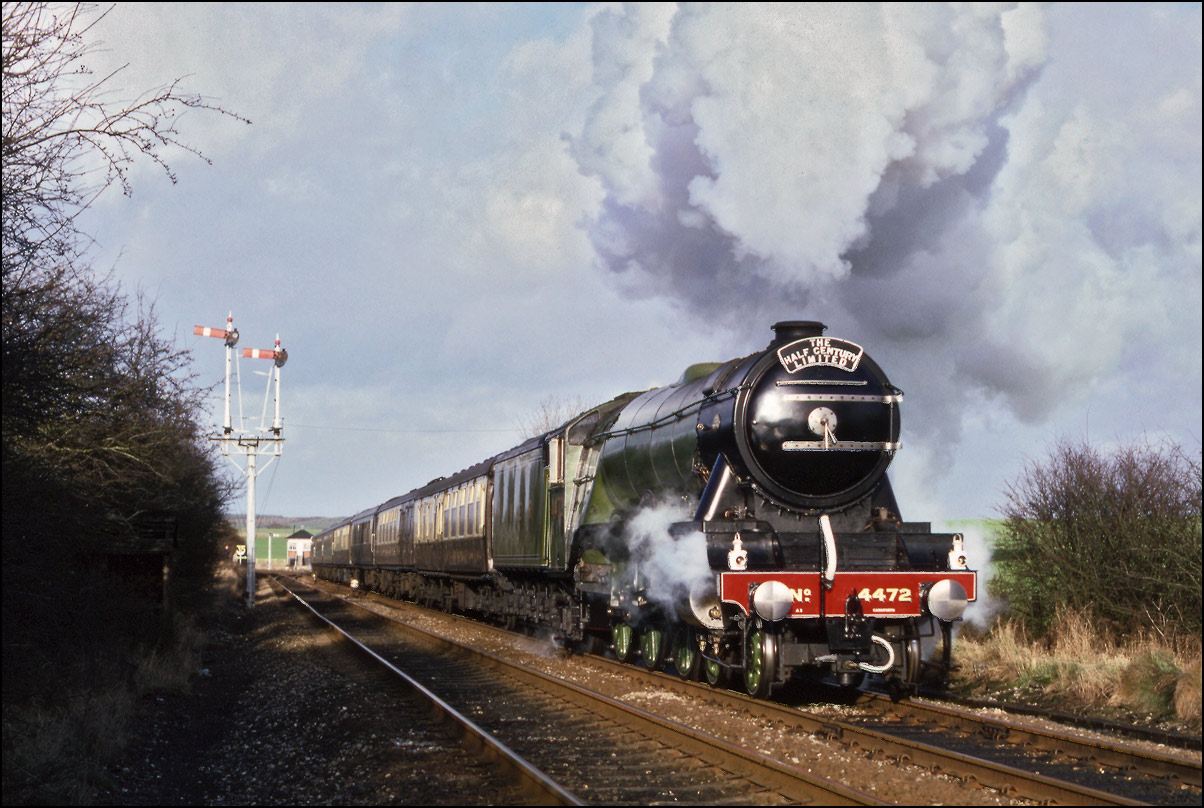
_Bearley_080310.jpg)
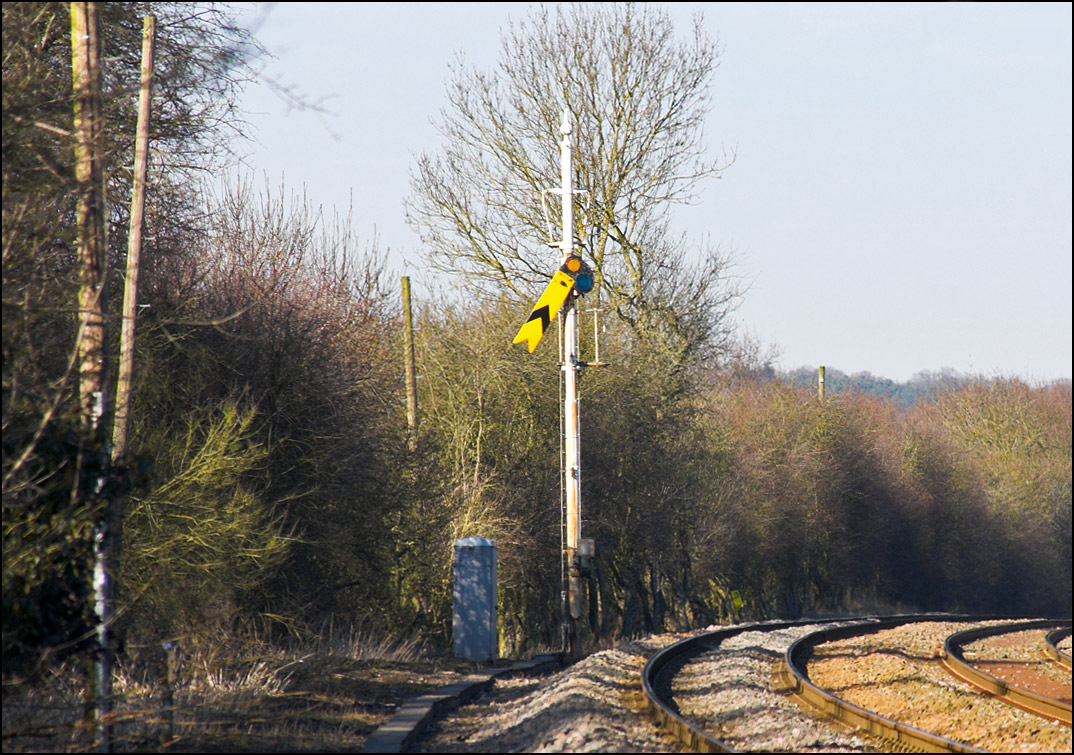
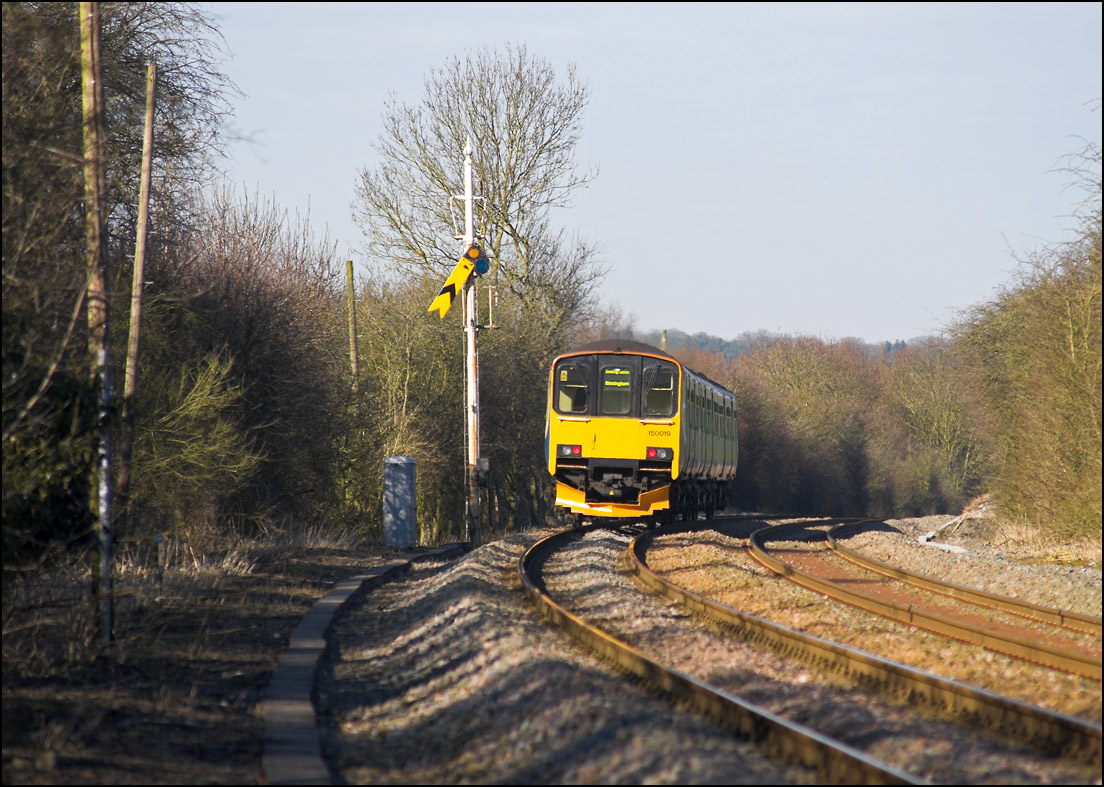
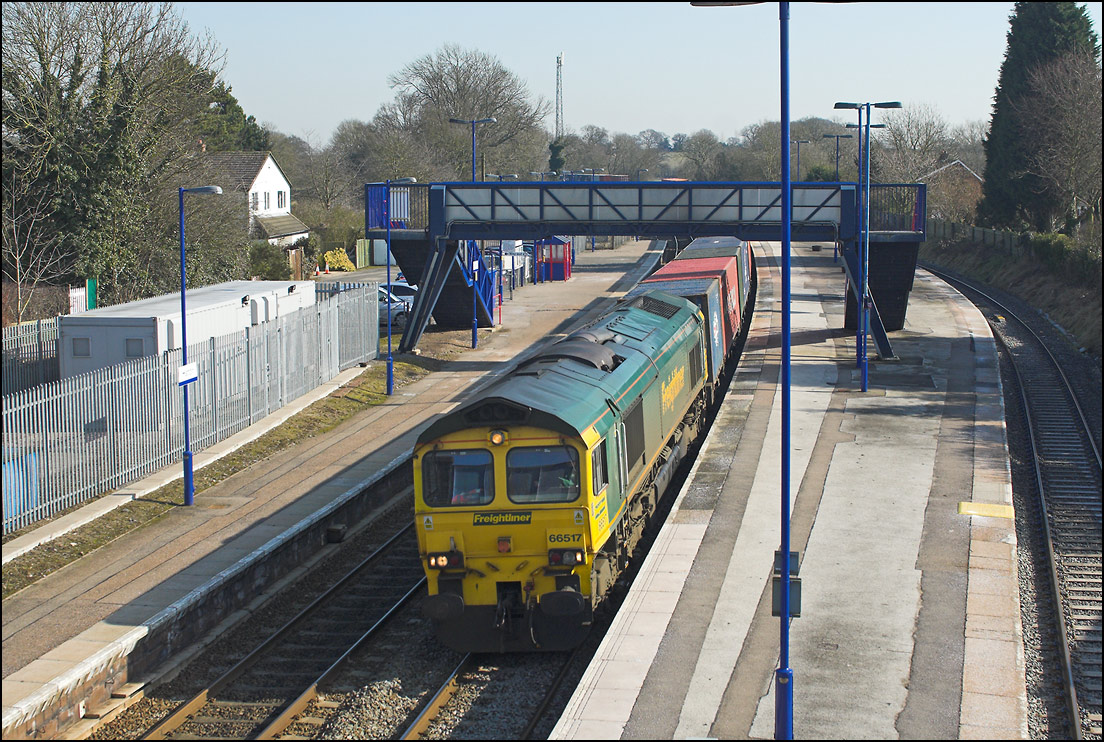
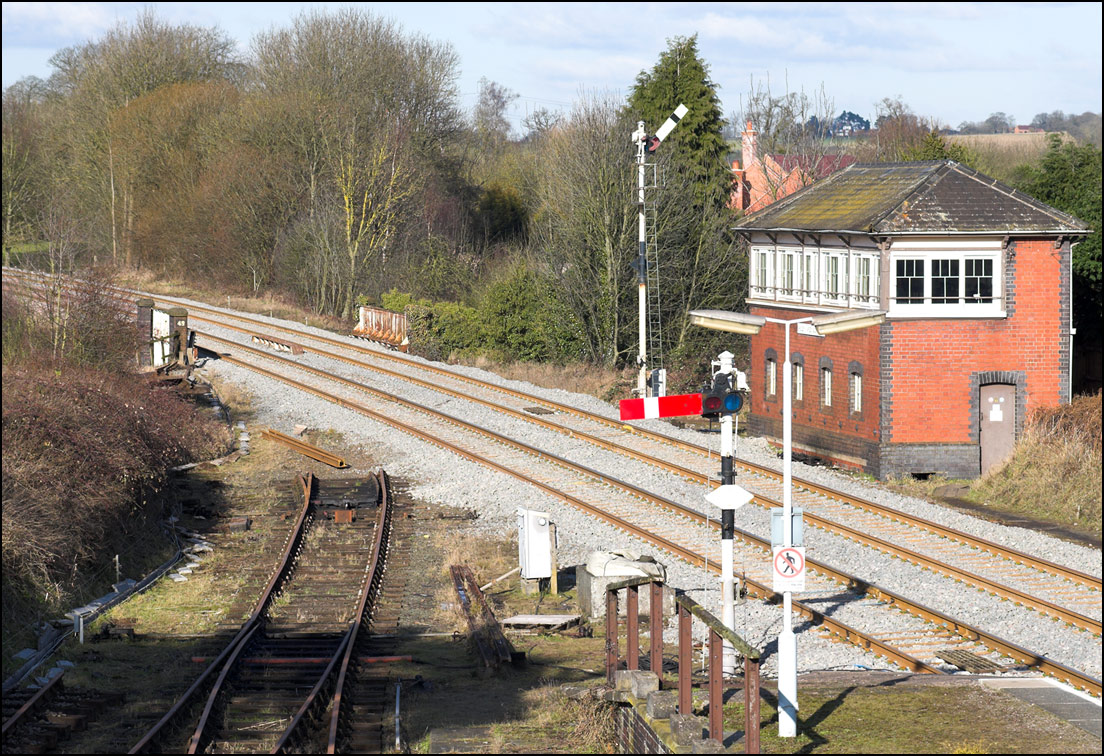
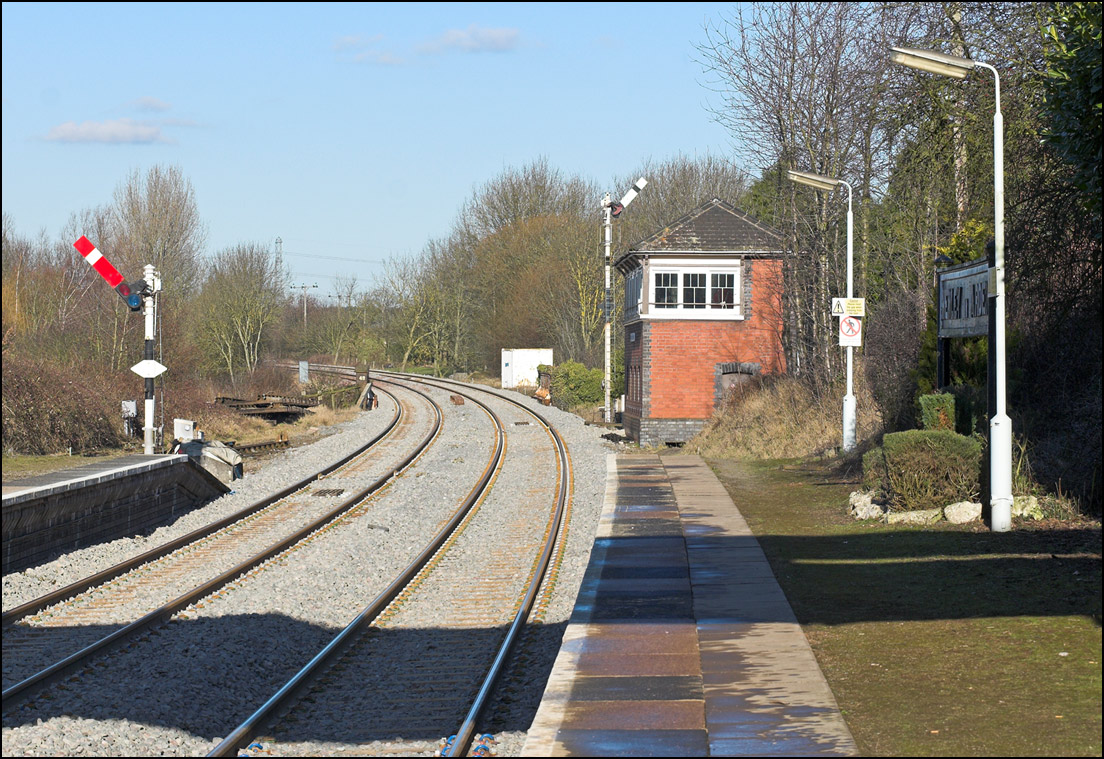

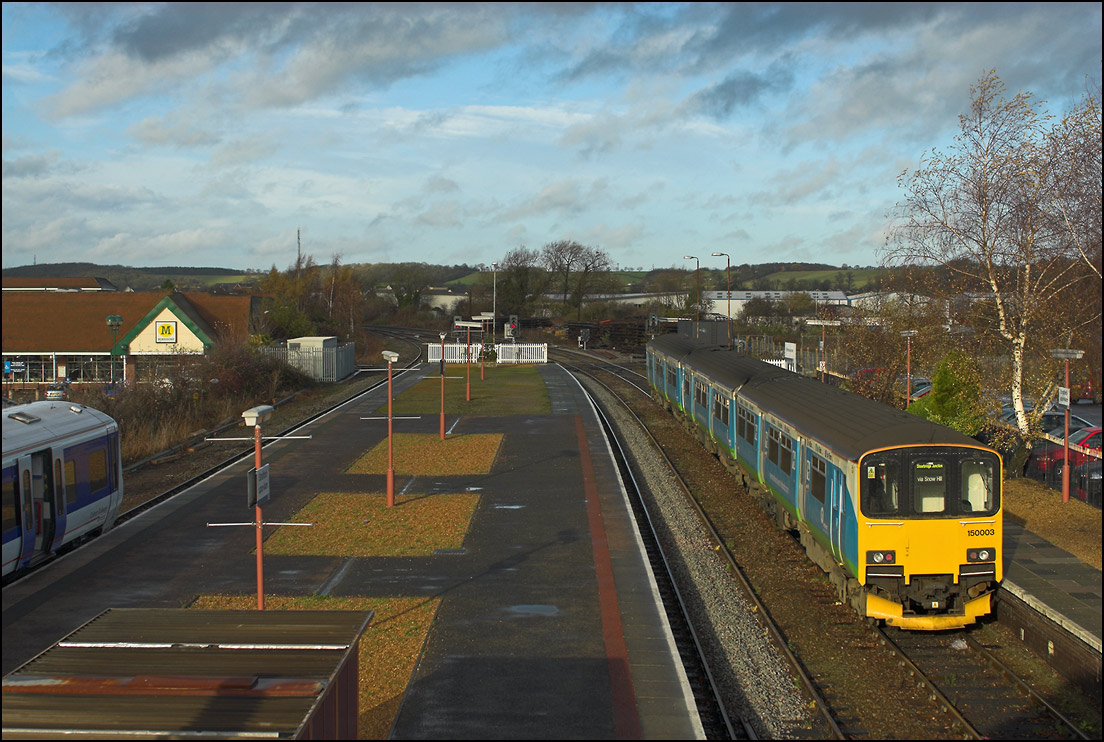
_3S87_SonA_251110.jpg)

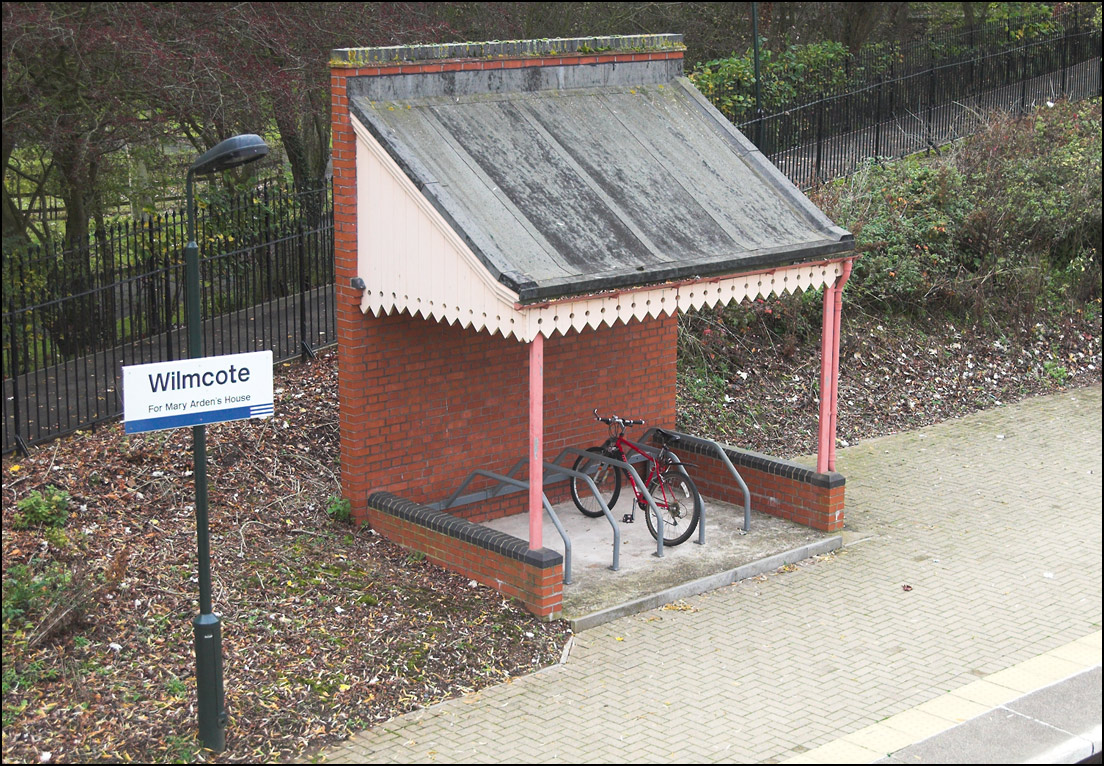
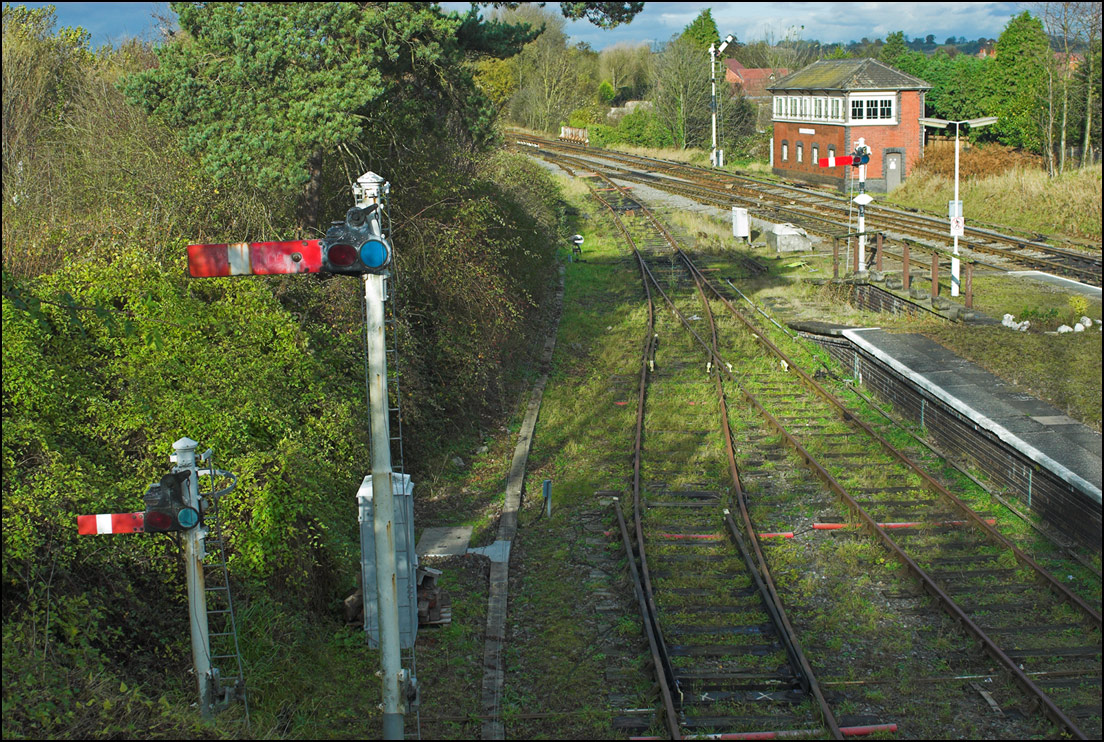
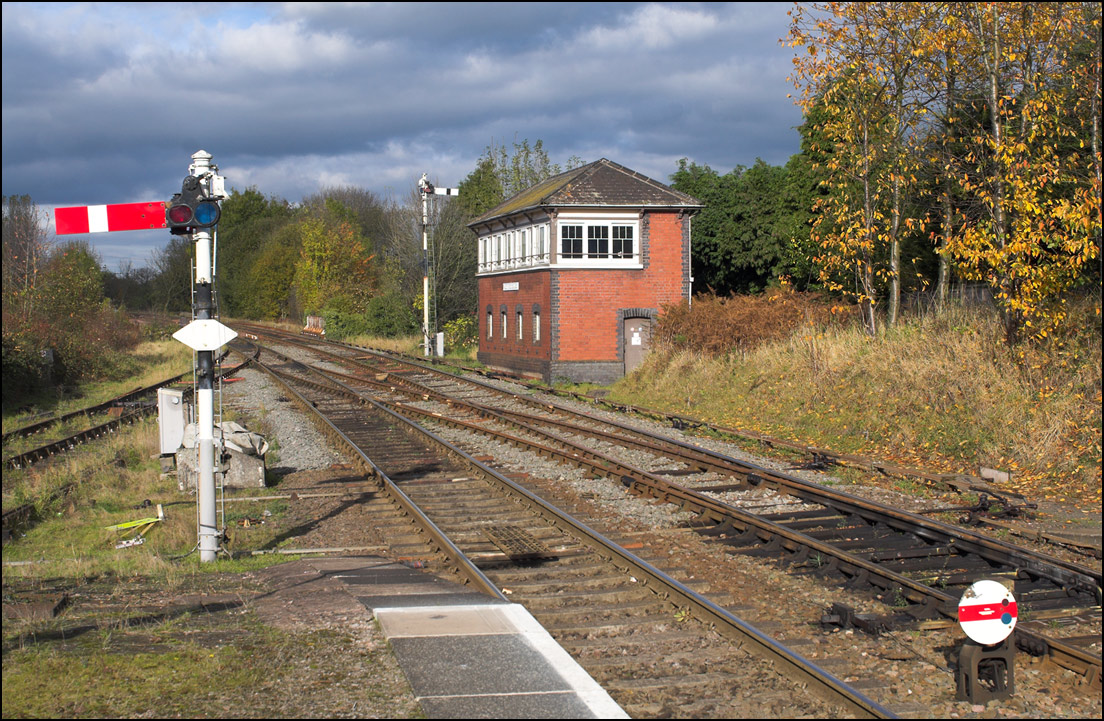
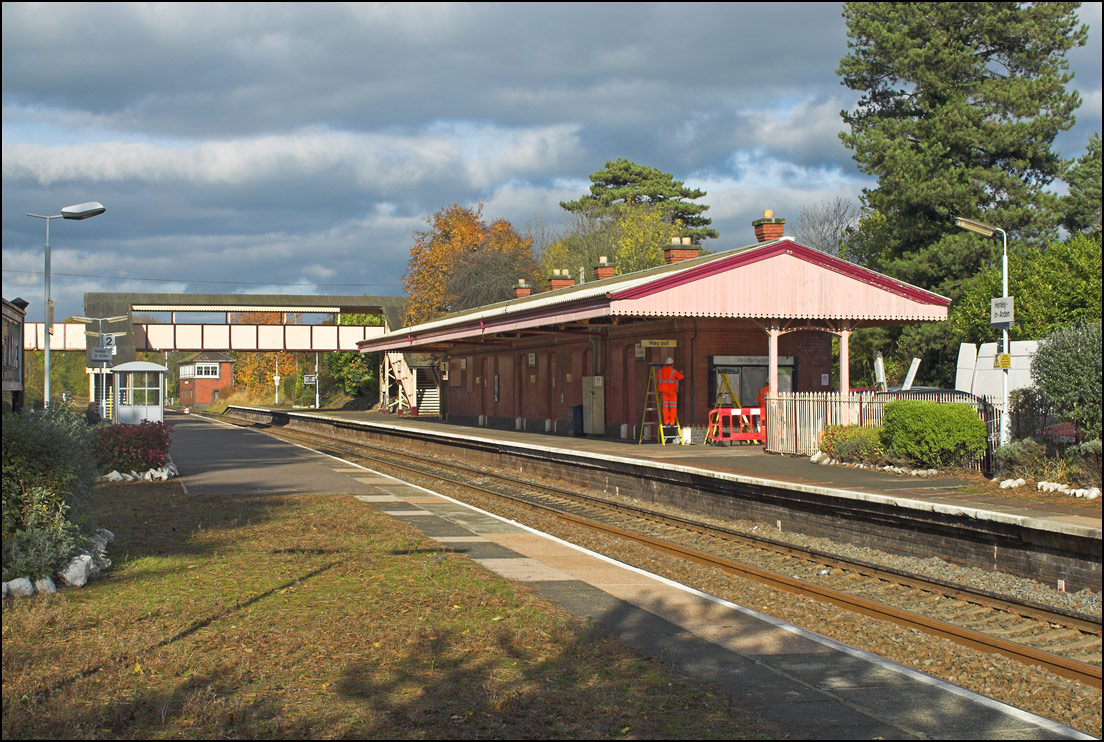


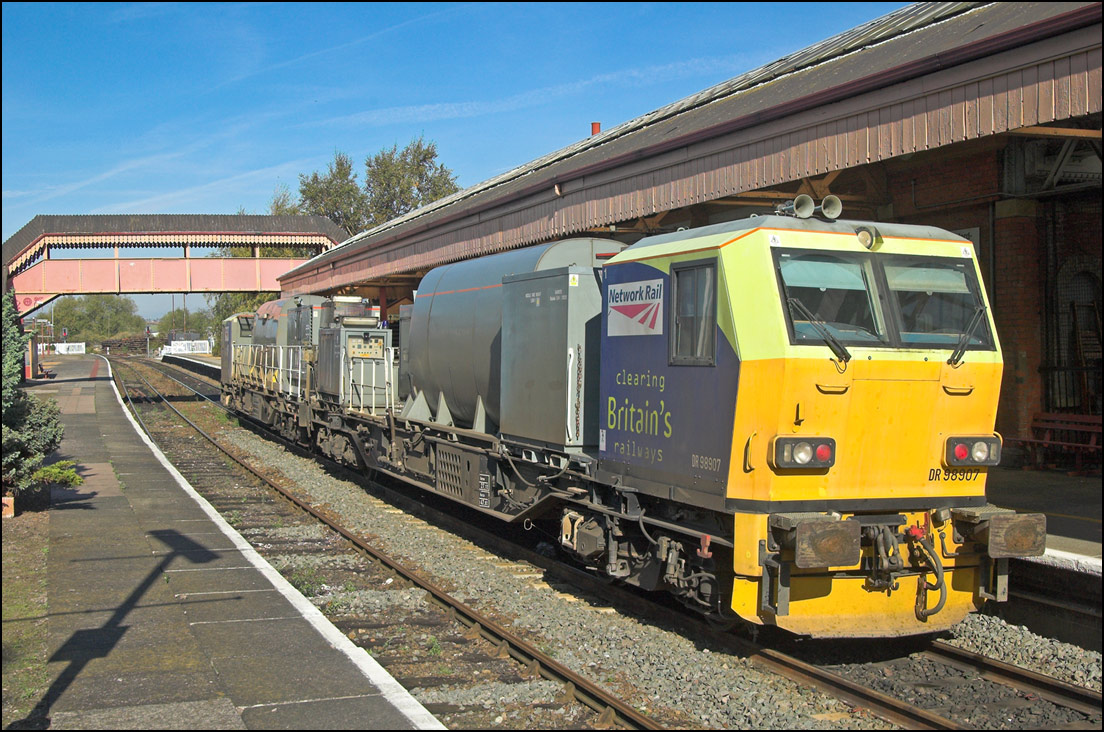
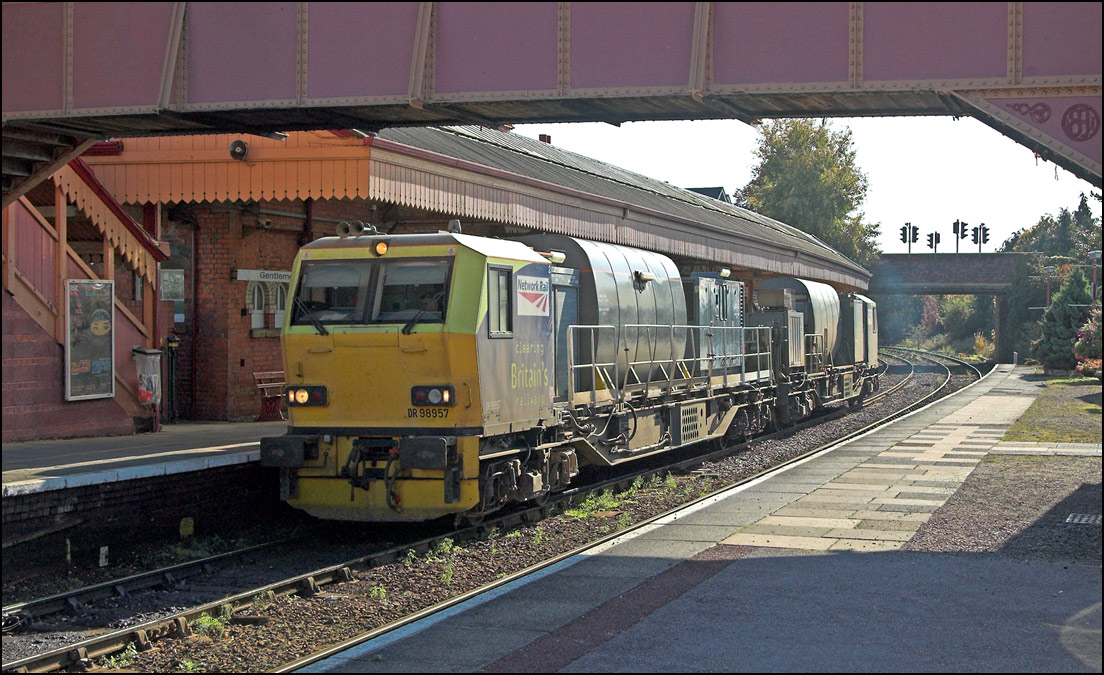
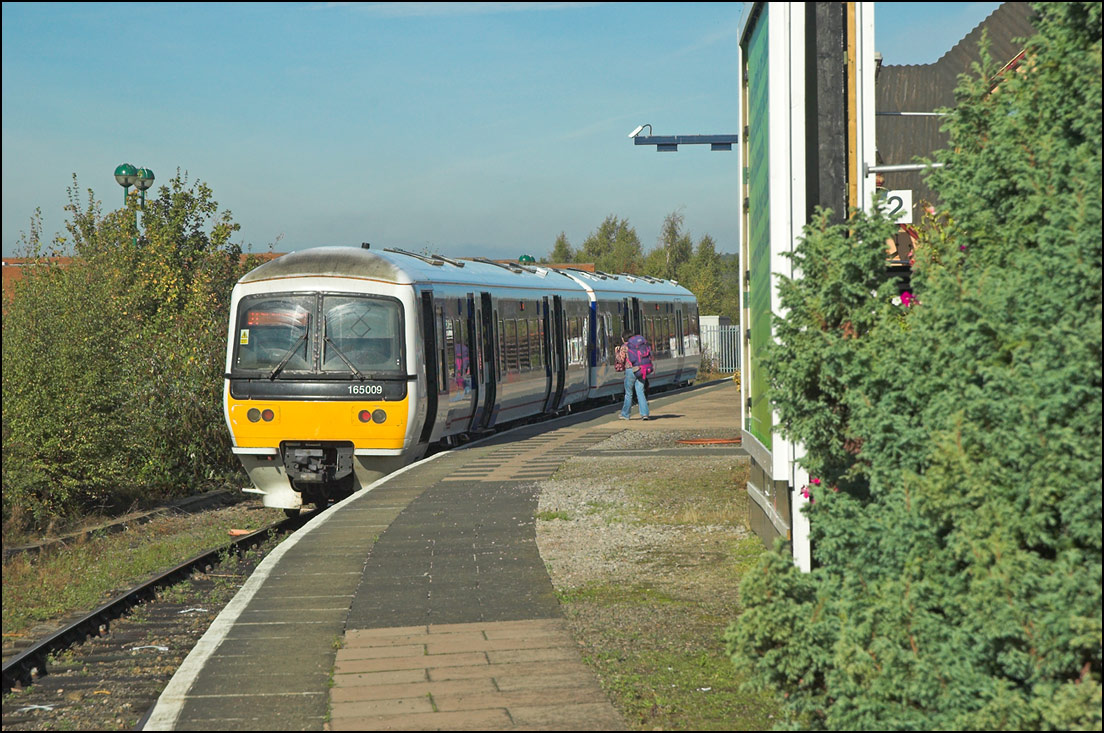
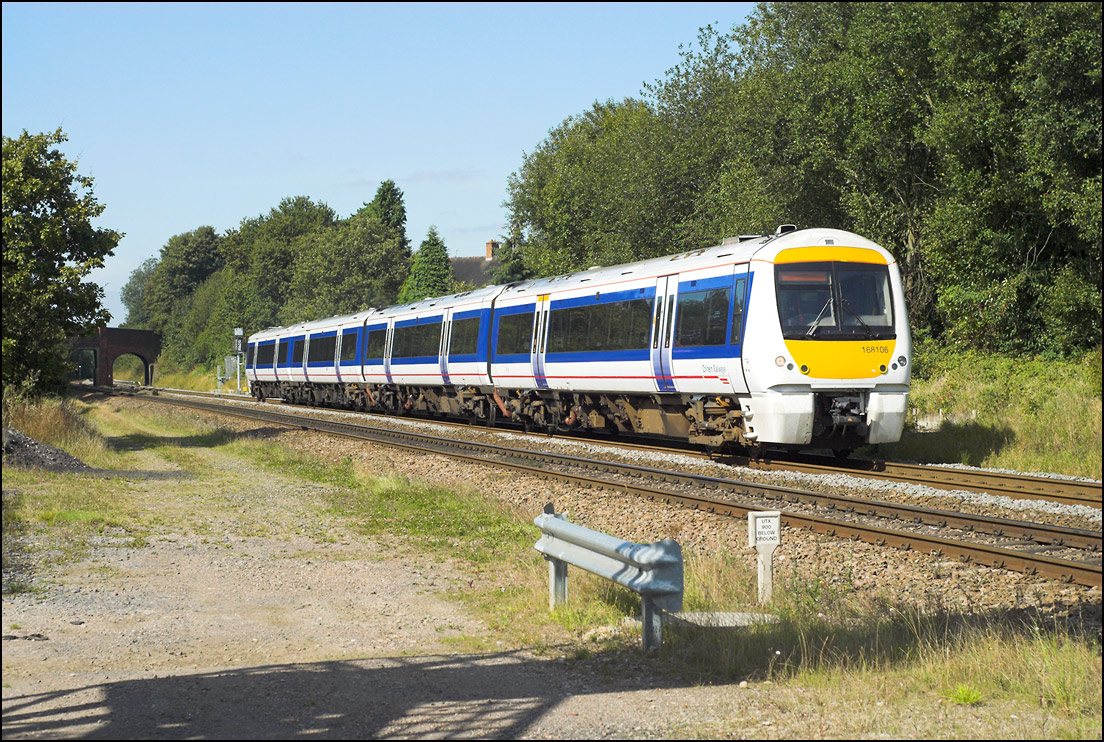
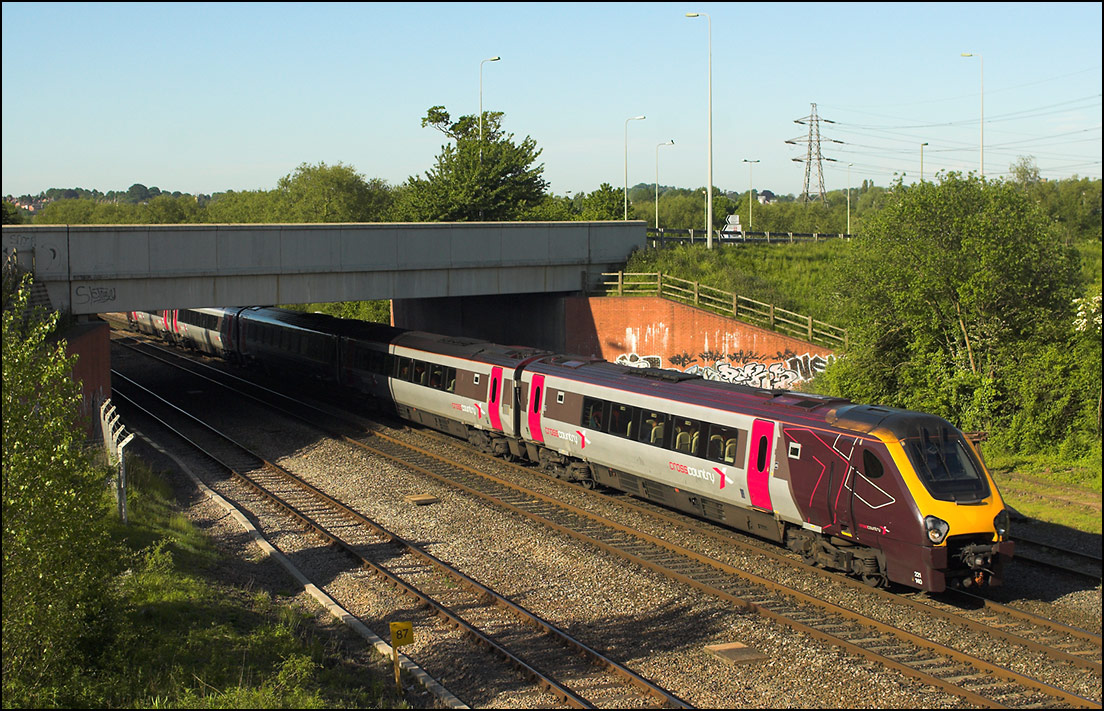
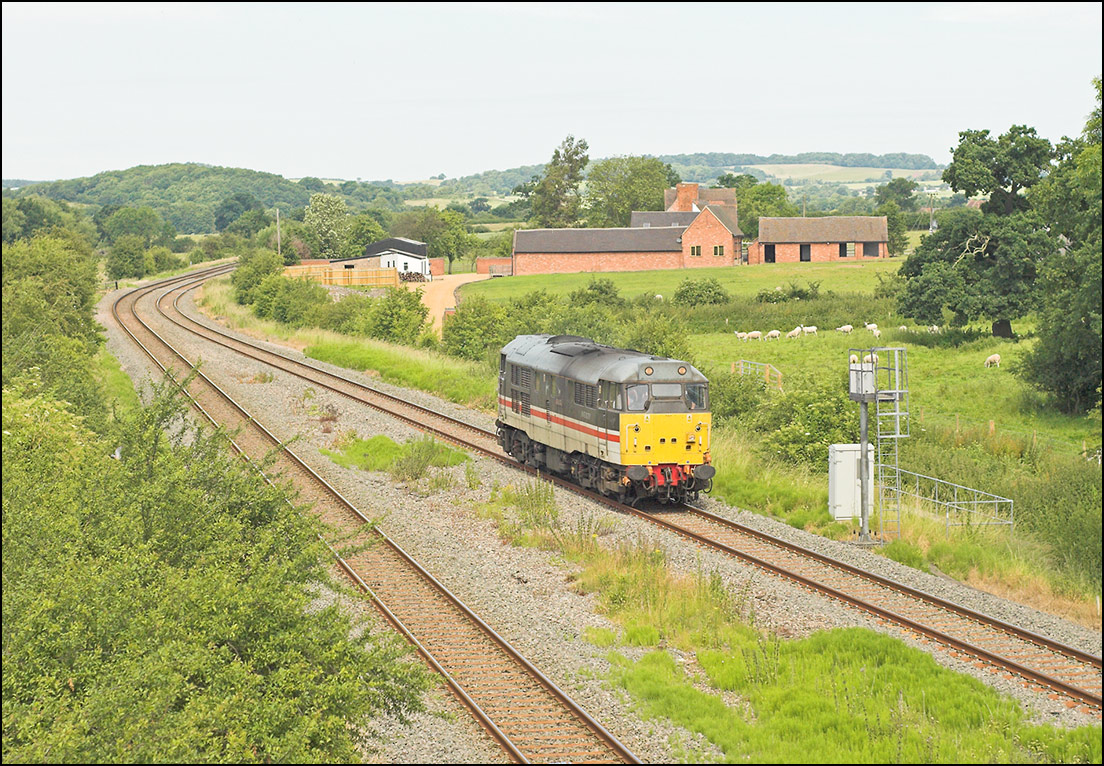

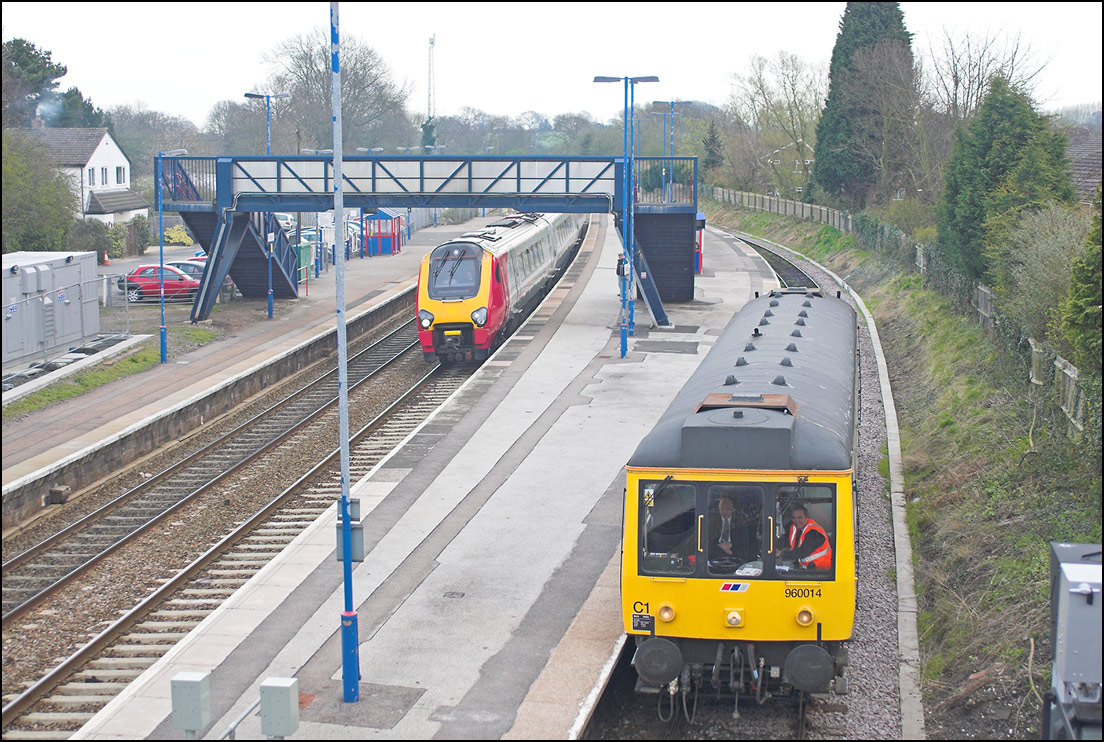
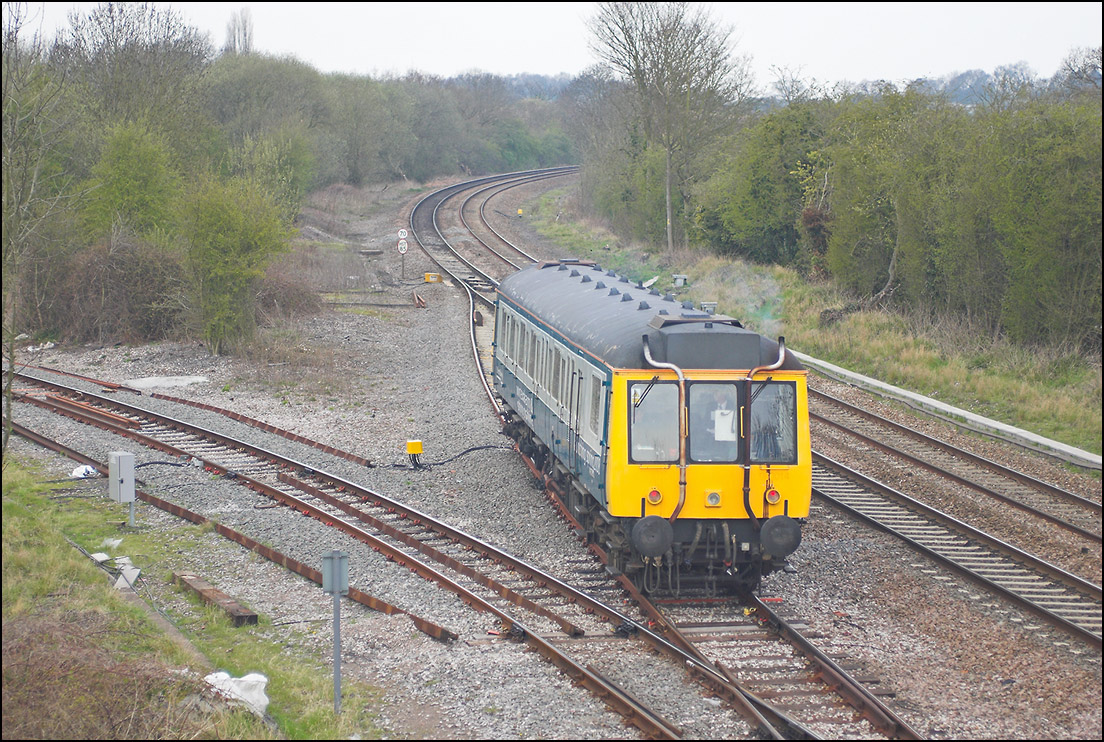
_111007.jpg)
_111007.jpg)