_16858.jpg)
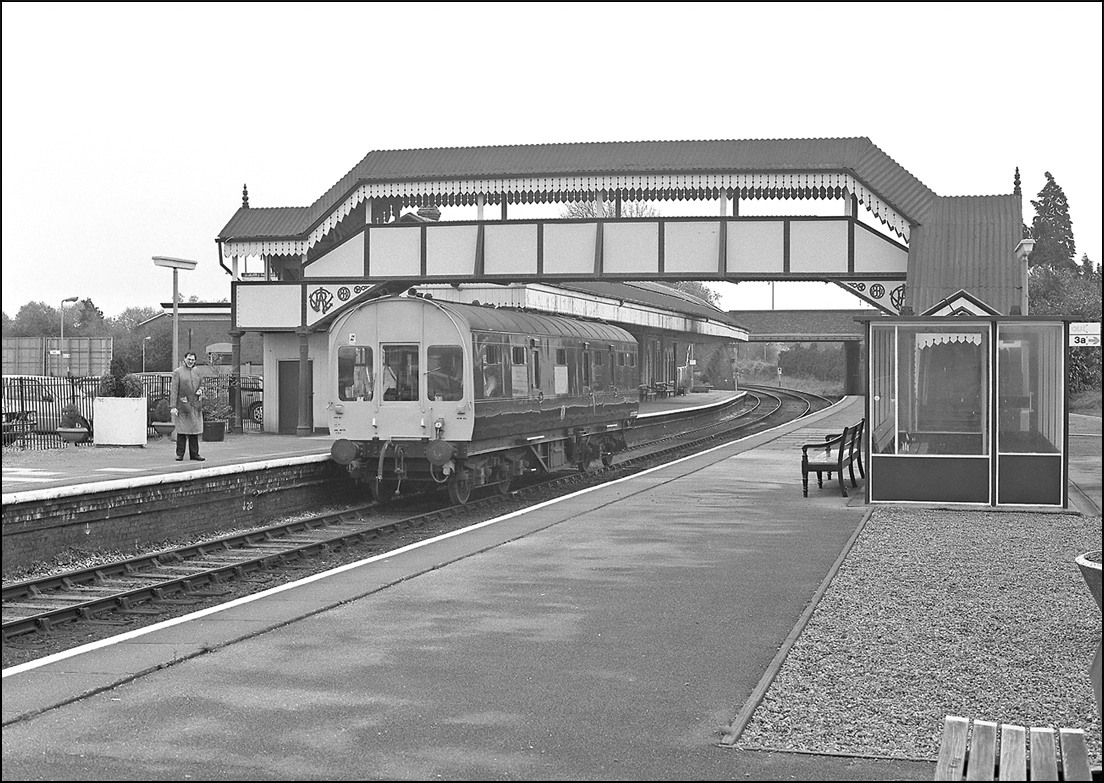
It is hard to believe in 2007 that the now truncated line from Birmingham to Stratford-upon-Avon once continued to Honeybourne, Cheltenham and on to South Wales and the West Country. On summer Saturdays in the summer, the line was extremely busy and I can recall seeing as many as 6 northbound expresses in the 30 minutes between 18.30 and 19.00. Most of these would have been double-headed from Stratford because of the climb to Wilmcote, although more lightly loaded services may just have been banked as far as Wilmcote, where a crossover existed to return the assisting locomotive to Stratford. The rundown in services began at the end of the summer timetable in 1963 after which date the majority of West Country trains, including the line's most famous train, The Cornishman, were diverted to run along the Midland line via the Lickey incline. There were, however, many through freights on the line and frequent diversions, especially at weekends, still ran via Stratford. When the line closed in 1976 there were several freights each day, this route providing a good way to avoid the bottlenecks around Birmingham, keep slower class 6 and 7 trains clear of increasingly fast passenger services, and, for northbound trains, avoid the Lickey Incline
|
|
I find pictures of real steam infinitely more interesting than those of preserved locomotives and trains and here are some previously unpublished and quite superb pictures from James White of Stratford-upon-Avon. This is one of my favourites and shows GWR 7808 Cookham Manor entering Stratford station with a westbound freight in the early 1960s. The loocmotive was in a nicely clean condition and there are traces of white paint on the buffers so it may be that it had been on special duties, possibly the Royal Train, in the recent past. The backdrop to the picture is of as much interest as the train itself with the town gasworks and gas-holders prominent and not to mention the steam shed (84E). |
|
|
As Stratford-upon-Avon GWR had an engine shed, 84E, there was also a coaling stage. In this picture by James White, Collett 0-6-0 2211 is alongside it waiting for its tender to be filled both with coal and water. Coal wagons were propelled up the incline on the other side of the structure from which the fuel was transferred by hand to small tubs which were then pushed onto a cantilevered ramp and tipped into the locomotive's tneder or bunker. The awning on the far side was there to provide the labourers with some protection from the elements while unloading the main line coal wagons. The excellent Warwickshire Railways website has much more information and plenty of photographs showing the coal stage here. There were usually one or two of the Collett 0-6-0 locomotives somewhere around Stratford. They were latterly used for local trip freight freights and for assisting nothbound main line trains on the 1/75 climb to Wilmcote. In most cases they banked the train as far as Wilmcote station but on occasions they were coupled inside a Castle or Hall and worked through to Birmingham Snow Hill as shown in a picture by Michael Mensing showing 2211 with 5089 approaching the summit of the bank. |
|
|
Another of James's pictures at Stratford-upon-Avon's coaling stage shows Churchward designed 2-6-2-Prairie tank 4133 with a trace of steam from the whistle about to move away after its bunker has been refilled. The 22,500 gallon water tank on top of the building and another on the other side of the station near Stratford West signalbox, were filled from the GWR-owned Stratford canal with the inlet placed near Wilmcote and above the short flight of locks made necessary by the town's position in the Avon Valley and the consequent gradient going north. The shed's water crane, one of four in the station area, was a few yards in front of 4133. |
|
|
This is the interior of 84E, Stratford-upon-Avon GWR engine shed. The 2 pannier tanks had been withdrawn and were on their way to Bird's yard at Long Marston to be scrapped and the Midland 4F just visible would have come here for servicing after the Old Town shed had closed. The spot upon James was standing was about to be occupied by Collett 0-6-0 2211 which had just been coaled and watered. |
|
|
Stratford-upon-Avon's other railway was the Stratford-upon-Avon and Midland Junction. Old Town station as it was known was to the south of the GWR and crossed it on its way towards Broom Junction. In its later years the line was only lightly used and made a useful photographic location for anything passing underneath on the GWR route. On this occasion James White used this spot to photograph 4998 Eyton Hall heading south with a returning theatre special on the way to Oxford via the curve at Honeybourne. The sad-looking remains of some SMJ buildings are in the background but in 2022 there is absolutely no sign here that either railway ever existed. |
|
|
The SMJ bridge over the GWR main line south of Stratford-upon-Avon I mwentioned above can be glimpsed in this picture of 4074 Caldicot Castle by James White. The train, doing a good impression of a race special, is passing the GWR Racecourse Station at the far end of which is the SMJ overbridge. The line coming in from the right is the 1960 spur from the SMJ to the GWR the opening of which allowed the closure of the Midland line between Stratford and Fenny Compton. This entire area is now a car park for a foot and cycle path, The Greenway, which occupies the GWR trackbed as far as Long Marston. Just after the track had been lifted and before all the railway infrastructure had been demolished in 1986 I took this picture looking north from what would have been the up platform of the Racecourse station. On 13 April 2022 I took this image using my phone in approximately the same location as James's image of 4074 although with no reference points it is hard to be precise. |
|
|
Stratford-upon-Avon Old Town station had closed by the time that James White took this photograph of 6989 Wightwick Hall passing the platforms with a mixed freight from the Cheltenham line, via the 1960 spur from the GWR line, on its way towards Fenny Compton and Banbury. For an up-to-date comparison I took this view of what is now the Seven Meadows relief road on 13 April 2022 showing the short length of platform edging that was left when the rest of site was cleared. There was some controversy in 1964 when part of the disused station's platform was resurfaced at considerable expense when HM Queen Elizabeth The Queen Mother visted the town to officially open the restored Stratford-upon-Avon canal and the station was used to stable the Royal Train ECS. Her Majesty had alighted at the GWR station and the train was taken to Old Town until the following day. This photograph from Warwickshire Railways shows LMS Black 5 44919 entering the station having run south from the GWR line and having used the junction seen behind the first few wagons in this photograph taken by my father some time in the 1950s |
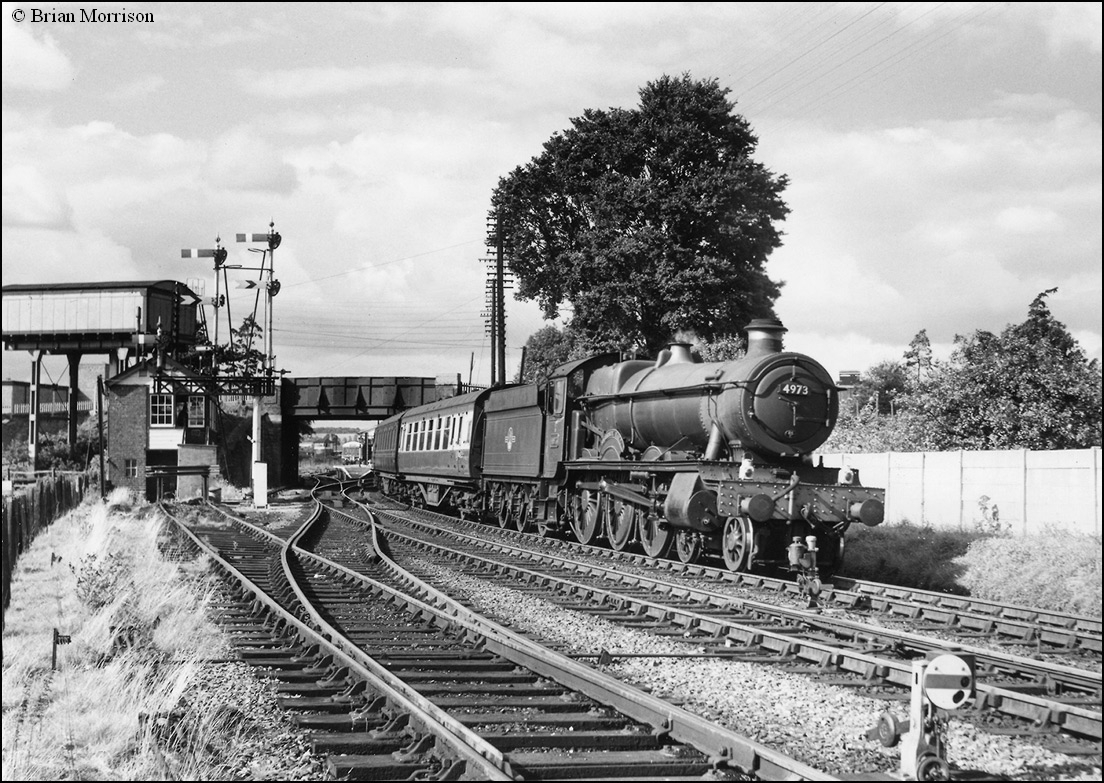 |
This photograph, taken on 16 August 1958, shows GWR 4-6-0 4973 Sweeney Hall leaving Stratford-upon-Avon with a Birmingham Snow Hill to Cardiff and Swansea train. The picture is full of long-gone railway infrastructure absolutely oozing with character, including the water tower which was fed by gravity from the Stratford canal at Wilmcote via a pipeline running under the towing path. Wilmcote was at the summmit of a stiff 1/75 climb and was sufficiently elevated to provide a sufficient head of water to keep the tank full in order to supply columns at each end of the station and in the adjacent shed and goods loop. Both the West and East signalboxes are visible, the former being the closer to the camera. This was locally known as The Palace, being kept in immaculate condition by its regular signalmen, and was often the venue for visits by important railway dignitaries. A 3 car DMU on a local service, can be seen in platform 3. The headshunt by the West Box was used to stable one or more banking engines, up to 6 or 7 of which would have been sent down from Tyseley on summer Saturdays. In the week, 2 Collet 0-6-0s or a Prairie tank shedded here would fulfilled the role. Brian Morrison |
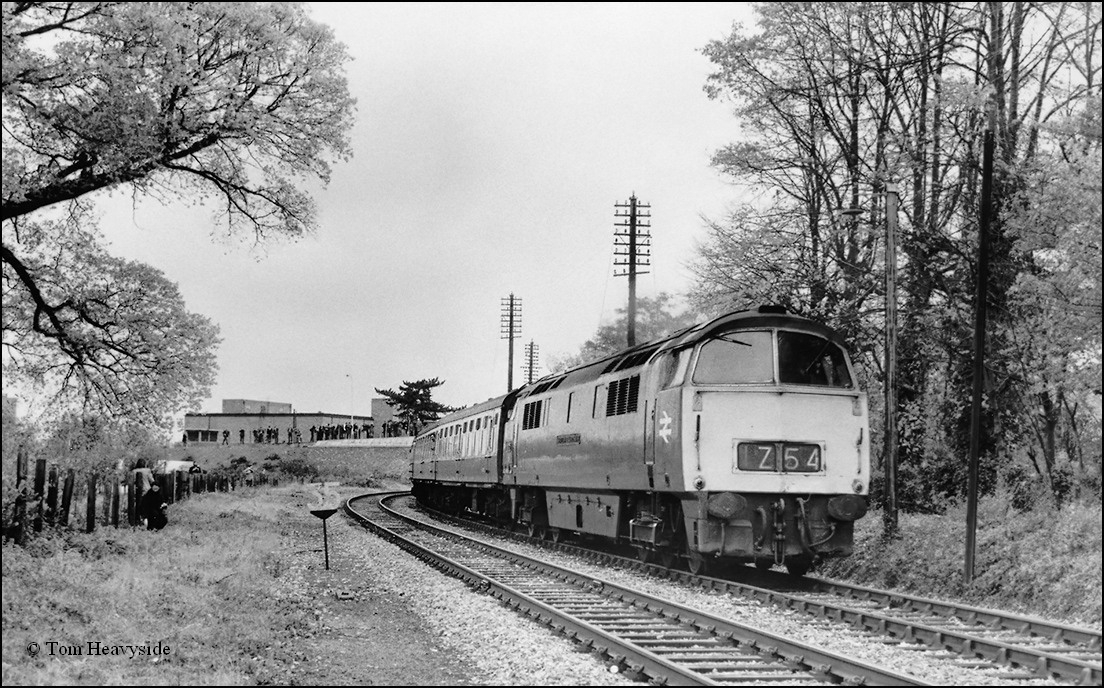 |
The scene just south of Stratford station had dramatically changed by 26 October 1974, as this picture shows only too well. The West Box has gone along with the water tower, siding, headshunt and associated signalling. By this time, there was no connection from the up main line to platform 3 because the local passenger service, the only user of the connection, had long since finished. The entrance to the station was controlled by Evesham Road Crossing Box, some 1/2 mile down the line, but through the relatively infrequent traffic in 1974, this would not have caused any capacity problems. I suspect that the running of this train may well have occasioned the special opening of this signal box on a Saturday, when it would normally have been closed at this time, as no trains were scheduled over the weekend. Diesel hydraulic 1025 Western Guardsman has just taken over an enthusiasts' special from steam locomotive 35028 Clan Line and was pictured leaving the station for the south. I imagine, at this late stage in the life of the Westerns that more photographers were out for this leg of the journey than for the steam section. Tom Heavyside |
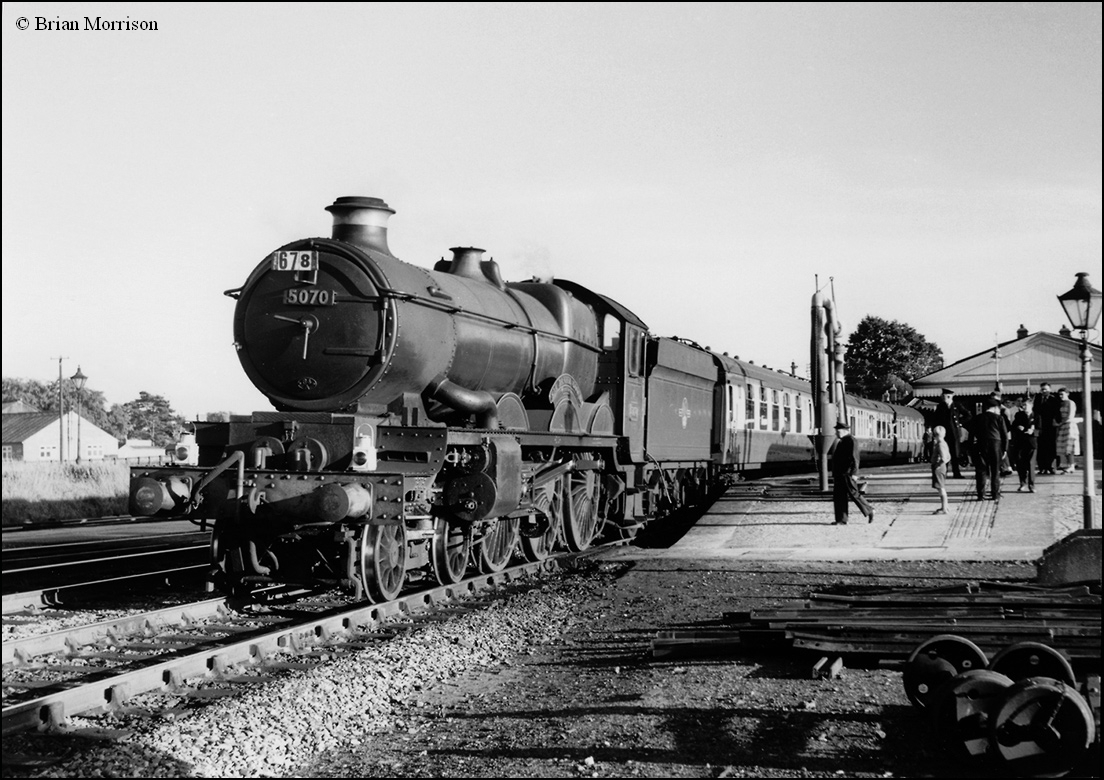 |
This picture, also taken on 16 August 1958, shows Stafford Road's Castle 5070 Sir Daniel Gooch preparing to leave Stratford-upon-Avon with the 11.15 Newquay to Wolverhampton train. The usual practice would have been for the locomotive to come onto the train at Bristol after being serviced following the southbound run from Wolverhampton earlier in the day. There is a strong possibility that a pilot locomotive would not have been required to assist this powerful locomotive up the 1/75 to Wilmcote; it is more likely that an engine would have come from the siding alongside the West box and give the train a shove through the reverse curves immediately outside the station and then up the bank. My parents did not live far from the station and I can well remember hearing these trains start from the station, accelerate along the short downhill stretch through Bishopton and then become slower and louder as the gradient began to bite on the climb north. Brian Morrison |
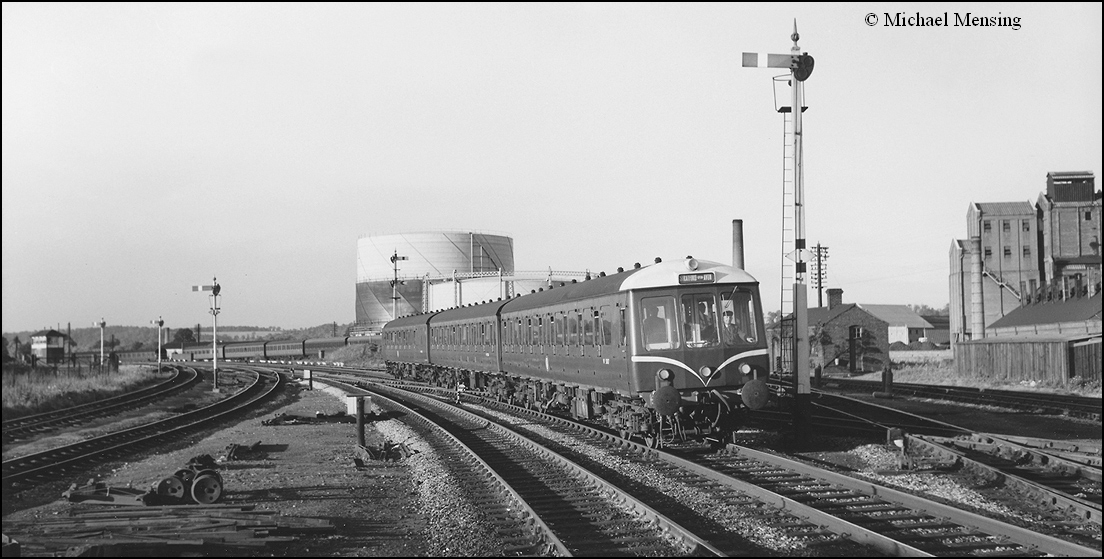 |
I am so glad that it wasn't only the main line expresses that were photographed in the 1950s. DMMUs, so often ignored and indeed despised by the more blinkered enthusiasts of time were vital to the railway and have only recently been given the attention that they deserve. Here is a 3-car Western Region suburban unit forming the 15.05 Birmingham Snow Hill to Stratford-upon-Avon service arriving at its destination on Sunday 10 October 1958. At least two passengers can be seen on their feet ready to alight once the train had stopped in the platform. As always, the infrastructure holds as much interest as the train, with the gasworks and gasholders prominent in the right and middle background, the engine shed visible below the gasworks and the East Box, which controlled all the signals, visible at the extreme left hand edge of the picture. Michael Mensing |
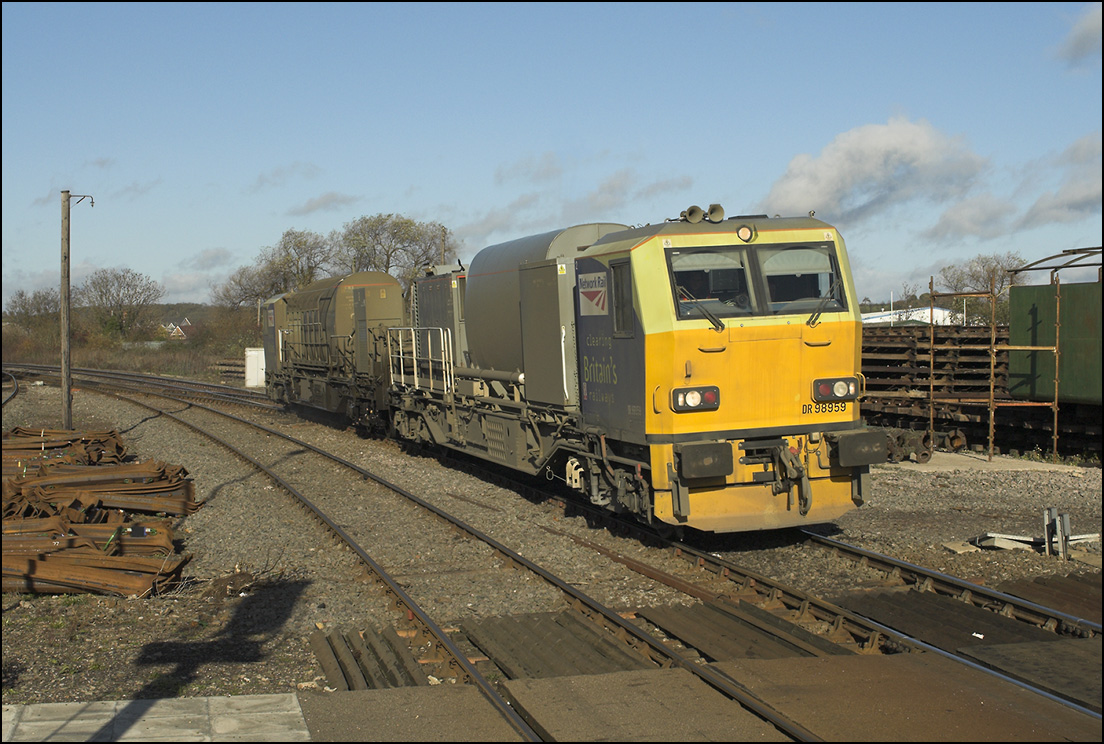 |
In almost total contrast to Michael Mensing's photograph of the DMU arriving at Stratford shown above, here is the scene from as near to the same spot as it was possible in the winter of 2006. The working is one of the regular Railhead Treatment Trains which ran in November with the intention of blasting leaf debris from the rails to improve adhesion. The arrival was timed at 12.31, just after the 12.27 passenger service to Stourbridge Junction has departed and on a sunny day this was just late enough for a well-lit picture. Here is Multi Purpose Vehicle (MPV) 98959 running as 3J87, the 09.03 from Bescot passing evidence of recent engineering work just beyond the platforms at Stratford-upon-Avon station on 21 November 2006. |
_sona_211106.jpg) |
The 09.03 MPV RHTT from Bescot is booked to stand at Stratford-upon-Avon for several minutes, perhaps to allow the crew a PNB at the station. Here is MPV 98959 standing in platform 1 awaiting reversal. I find these highly complex and technologically advanced vehicles quite interesting, more so than a couple of locomotives topping and tailing a few water tanks. After all, it is not difficult to find locomotives to photograph, but these vehicles tend to appear only in the weed-killing and Autumnal leaf-fall seasons. Stratford-upon-Avon station is liberally decked with advertisements for the current Royal Shakespeare Theatre season, during which all of the Bard's plays are being performed. |
_sona_211106.jpg) |
After the booked stop and reversal at Stratford-upon-Avon, 3J87 returns to the Birmingham area. It looks as if this unit has not seen much in the way of cleaning since the start of the season - the constant spraying clearly takes its toll... The time of this photograph is 12.36 when the sun is pretty much into the lens for a northbound shot, so much so that I had to take the picture one-handed so as to shield the lens from direct illumination. |
_sona_211106.jpg) |
Turning around from the picture shown above, this is the scene as MPV 98959 leaves Stratford-upon-Avon en-route to the West Midlands. The pile of sleepers just visible beyond the train roughly marks the site of the proposed steam centre it is hoped to build here. This would apparently be a major attraction for the general public and would include a turntable to avoid the need for either a trip to Hatton and Dorridge for reversal via a triangular junction, or tender-first running. There would also be a servicing facility operating as an outpost to the museum and workshops at Tyseley. The planning application for this site was recently withdrawn to allow for the plans to be re-drawn. The original submission made insufficient allowance for parking and for adequate access and egress to and from the site. Anyone who has tried to leave Station Road in order to head away from Stratford-upon-Avon at a busy time will know the problem faced here... |
|
|
I had walked to the station at Stratford on Avon on 25 February 2020 in heavy rain but by the time 37403 with Caroline approached the sky was clearing. A passenger train was in platform 1 and I hoped that 2Z01 would be routed in P2 as at least the sunwould be on the correct side. Unfortunately it went into P3 which is useless for photography and as this happens all too frequently it does seem that someone somewhere doesn't like railway photographers. Just because you're paranoid it doesn't mean that someone ISN'T out to get you!! Still, this working was rare enough to have a go even though there are few worse things than a shot against the light like this. I don't often take detail shots of locomotives but here are the nameplate, number and Scottie dog on 37403's bodyside. This train reminded me of the visit of a similar one with 31405 in 1992. |
|
|
After not achieving the shot I wanted of 37403 with an inspection saloon on 25 February 2020 it was a surprise to find on the following morning that there would be another chance. There was initially some doubt about whether or not the train, 2Z02, would run but a change of route was made to avoid Shrewsbury which was suffering from high water levels at the Severn Bridge and so it was on. It was shown as using platform 1 at Stratford-upon-Avon which was the best bet for photography but I had my doubts as the unit running just in front was shown to be going there too. In the end I went for the safe option on a largely sunny day and ended up at Wilmcote for an image including the attractive footbridge. There was no doubting when 37403 had left Bearley Junction as the wind coming from that direction carried the sound very nicely. This isn't a shot to get approval from the light police because of the shadows around the train but it's good enough for me. |
|
|
The inspection saloon that visited Stratford on Avon on 25 February 2020 didn't hang for long before going back out but while the driver changed ends some of the crew posed for photographs alongside 37403. I had hoped for some exhaust smoke as 2Z01 pulled away so was pleased when a plume or two did appear. The booked route was for 2Z01 to go to Tamworth via Dorridge and then back to Shrewsbury but very high water at the Severn Bridge there caused a rerouting and it ran directly to Crewe. |
|
|
I was out for a walk on the morning on Sunday 28 July 2019 and was crossing the road bridge at Stratford-upon-Avon station about 10 minutes before 8F 48151 was due to arrive with 1Z50 from Burton-on-Trent, a train operated by WCRC (probably much to the annoyance of Vintage Trains based at Tyseley!). I checked RTT and saw that 1Z50 was 9 minutes early passing Wilmcote and as I usually carry my Canon G10 when out and about stayed put. Within about 15 seconds I heard the train arriving but had to switch to the other side of the bridge as it was running on platform 2 rather than P1, as booked. This might give it an easier exit on the return to Burton in the expected wet weather given that it won't have to use the crossover from P1 to the up main line. I vaguely recall seeing the occasional 8F here in my spotting days when steam was real; I think they turned up now and again on a Washwood Heath to Honeybourne coal train although by that time 9Fs were more commonplace and on one memorable occasion gave me my one and only footplate ride; to Honeybourne with a tender-first light engine return. My mother's reaction when a very grubby and smut-covered 9 year old went home is best forgotten! |
|
The sole remaining Hastings Line gauge DEMU, 1001, made its 3rd visit to Stratford-upon-Avon on Saturday 4 July 2015. I had photographed the previous visits so had no intention of missing this trip as it arrived at the terminus. The arrival time was just after 11.30 and 1Z40 was booked to run into platform 3, the one furthest over from the station buildings and car park. The best option for an arrival shot is from the extreme end of platform 1 after the train has crossed over from the down main line. On this occasion there was a short wait outside the station to allow 172335 to start its journey to Stourbridge Junction from platform 2 where it had been standing alongside 168001 waiting to leave for London Marylebone at 11.37. Unlike the previous occasion that 1001 came to Stratford, 8 March 1997 there was a little bit of brightness although a complete lack of semaphore signals. This shot is now impossible because of the new lift and bridge which is approaching the end of the construction process. It does seem likely that it will be possible to use the new bridge for a shot of something arriving into platform 1 although I can't be sure at this stage. |
|
|
I don't often take multiple shots of trains as I'm not keen on the "photo-journalism" approach because, as the saying goes, less is usually more, but on this occasion I did hang around for the passengers to disperse a little and then take a few static images. Here is 1001 standing in platform 3 at Stratford soaking up the warm and rather high sun before its departure to Tyseley for refueling and presumably some attention to the on-board services. To me, this unique train is of far more interest than a mundane locomotive-hauled working although, judging by the lack of postings on various email groups, my view isn't widely held! |
|
|
There was just enough time for a walk along the island platform to take a final shot of 1001 complete with its "Warwickshire Wanderer" headboard. The sun was into a big clear patch of sky by now and I joined the orderly queue on the platform end for my turn to take this image in the rather restricted available space. The ECS movements to and from Tyseley was shown as running along the Noth Warwickshire Line but as is often the case this didn't happen and both runs were via Solihull. |
|
|
The returning ECS from Tyseley to Stratford, 5Z41, was a few minutes late leaving and was routed via Solihull and Hatton North Junction instead of the booked route though Henley in Arden. This didn't bother me too much as I had planned to go either to Wilmcote or Stratford Parkway to make sure that my photograph of 1001 was in a recognisable location rather than in open countryside; I don't really see the point in taking an unusual or one-off shot in a spot that could be anywhere in the country. Anyway, I went for the latter option as although there is an attractive footbridge at Wilmcote it is, to say the least, very well photographed and perhaps slightly clichéd. Just after I arrived at the Bishopton Lane roadbridge 172102 with an unidentified sister unit arrived for its booked stop at the station. This meant that 1001 was on the way from Bearley Junction and it soon came into view as it coasted down Wilmcote Bank, just a couple of minutes late. |
|
|
The Statesman dining train made for a rare locomotive departure from Stratford-upon-Avon on Wednesday 8 June 2022 with a 1Z40 circular trip to Carlisle. The stock running as 5Z41 arrived with 47614 (47853) leading into platform 1 and the sun had just dipped into some cloud allowing a picture from platform 2 rather than the hopeless platform side shot I had envisaged. The large contingent of on-board staff had arrived earlier and were waiting to start a very long shift. |
|
|
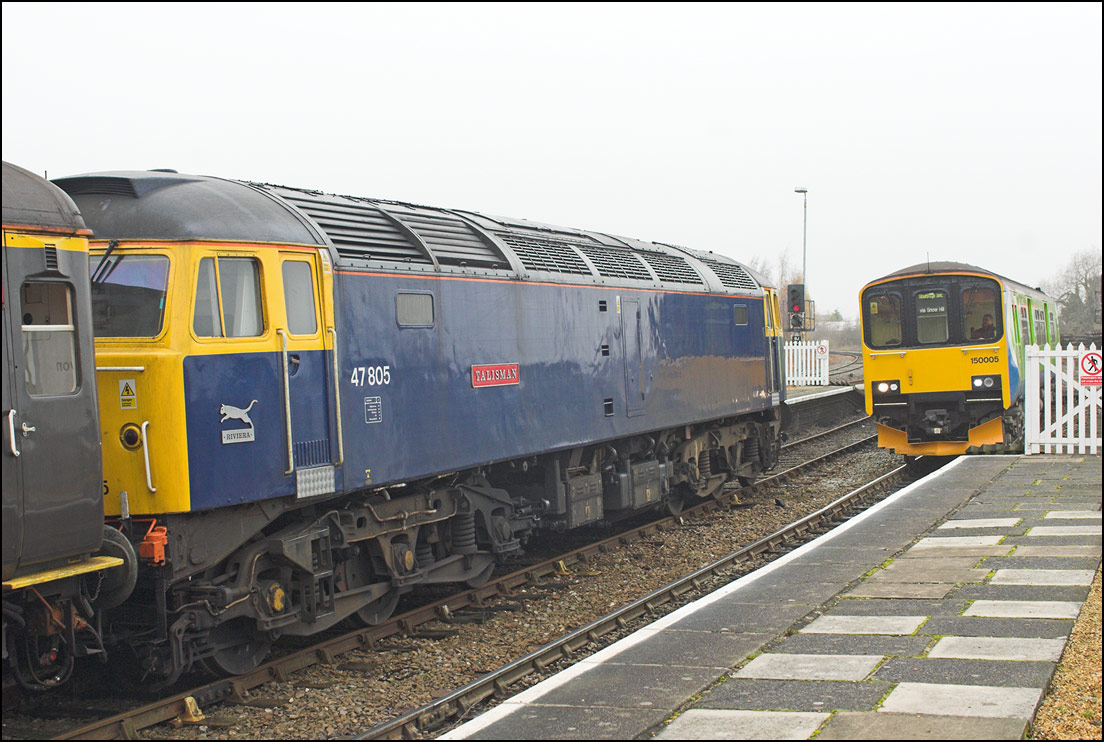
The second shot of 1Z40 with 47805 leading was a bit of a problem as far as location was concerned. The train picked up passengers at Henley-in-Arden but a Stratford-bound unit was due to arrive at the same time so the chances of a blocked shot were very real. A lot of previously open shots have seen a lot of vegetation growth in recent years so I opted for Wilmcote station even though I knew that plenty of shadows from trees in the adjacent field would be an issue. The shadow cast by the footbridge is acceptable but that from the tall elder bush is a bit of a pain. Still, 47805 sounded really good with 11 coaches and a dead class 47 on the back as it topped the 1/75 climb from Stratford. I should maybe have shot some video on my phone instead of this still image. |
|
|
The return of The Statesman to Stratford-upon-Avon from Carlisle on 8 June 2022 was scheduled for 21.34, some 10 minutes after sunset. I thought that a reasonable shot of 1Z41 with 47805 leading would be on the cards especially as the bright LED lamps would give a real boost. In the event the train was 14 minutes late and the lights hadn't come on which was odd considering that they usually are lit even if the weather gets a bit dull at any time of day! It couldn't have been great for the many passengers who had to alight in near darkness. It was quite a lot darker than this image suggests as digital cameras obviously can produce results in very poor light. |
|
|
What appeared to be a weedkilling train was due to visit Stratford-upon-Avon during the night of 4 April so I made up my to go for a look as it seemed that it might not be an MPV as had been the case in recent years. I arrived at the well-lit station and took this view of 172342 about to leave with the 23.30 to Birmingham Snow Hill, 2W88. While taking the picture I saw that the unit was named and and here is the plate itself. |
|
|
During the last week 2023 of March 2023 I happened to notice on RTT that what appeared to be a weedkilling train was due to visit Stratford-upon-Avon during the night of 4 April. In recent years MPVs have been used but the service code suggested that this year's train would be operated by GBRf. The first working was from Bescot to Kings Norton on Sunday 1 April with 66717 with the new stock and 66766 providing the power and so the Tuesday trip to Stratford seemed to be likely although a similar job in 2022 was cancelled after departure time. No such problem on 3 April when 3Q98 ran early as far as Birmingham but then followed the last passenger from Kidderminster, 2S90, and therefore kept to right time. The arrival time was 23.31 just after the class 172 had left the station and here is 66716 making the first arrival at the terminus for the GBRf locomotive. |
|
|
The 21.54 from Kings Norton to Stratford-upon-Avon, 3Q98, stood in just the right spot for photography on 4 April 2023. The locomotive, 66766, was very clean and shiny which caused a lot of reflections from the LED lamps on the platform and the intensely bright headlight caused a bit of burnout in the image. The train itself is, as far as I know, the new set of stock that was introduced last years and which I photographed at Hatton on 20 March 2022. I took a shot of the control vehicle in which two crew members took a break while the reversal took place. |
|
|
There was some engineering work on the North Warwickshire over the night of 3 & 4 April 2024 involving a topped and tailed 6G61 ballast train from Bescot with 66798 + 66777 providing the power. As usual it ran to Stratford-upon-Avon for a reversal and as this was just the second visit of GBRf locomotives to the terminus I decided to have a quick trip to the station. The weather was foul with a strong wind and heavy rain that shows up only too well in this image of 66798 arriving in platform 1. |
|
|
It took a few minutes on 3 April 2024 for the driver of 6G61 to change ends during which time the rain became heavier and it was a struggle to keep water off my lens while taking a few shots with varying exposures. As 6G61 left the station I took a short hand-held video sequence with 66777 leading the autoballasters and 66798 trailing. It was just 12 months since the first time that GBRf locomotives came to Stratford when when 66766 + 66717 appeared on a test run with new weedkiller stock. |
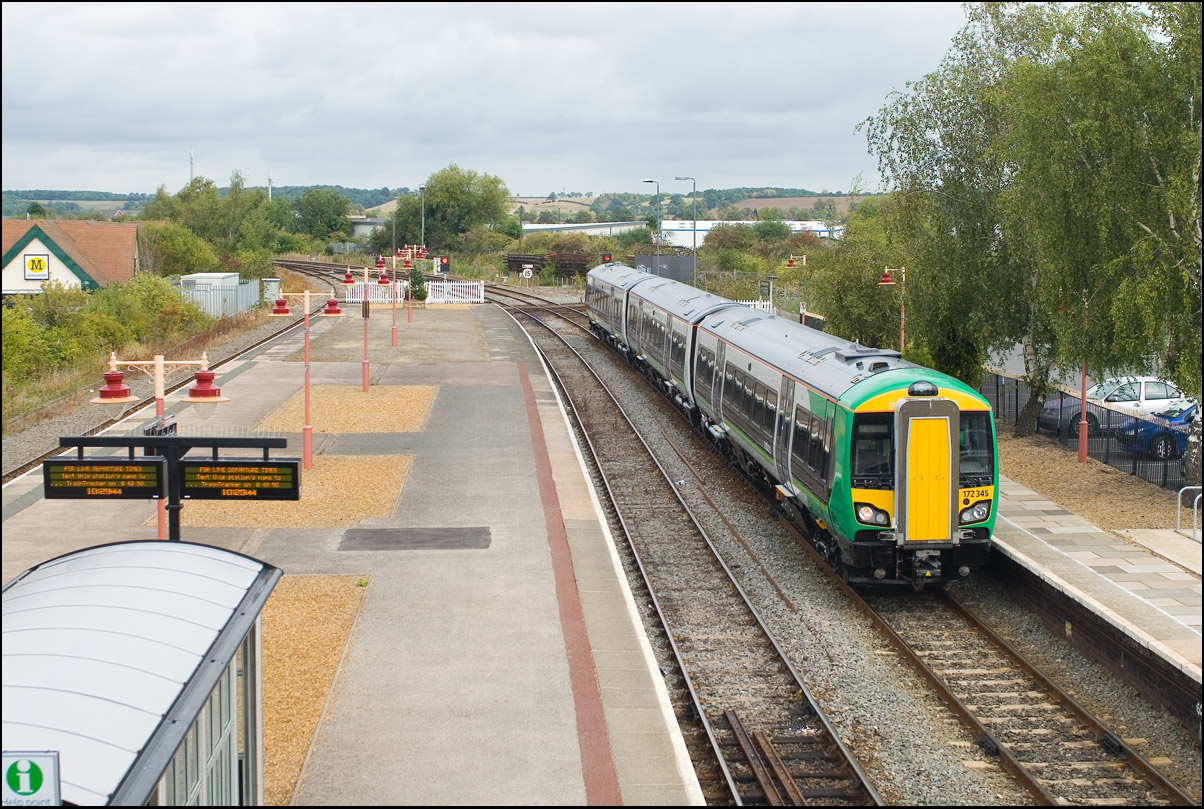 |
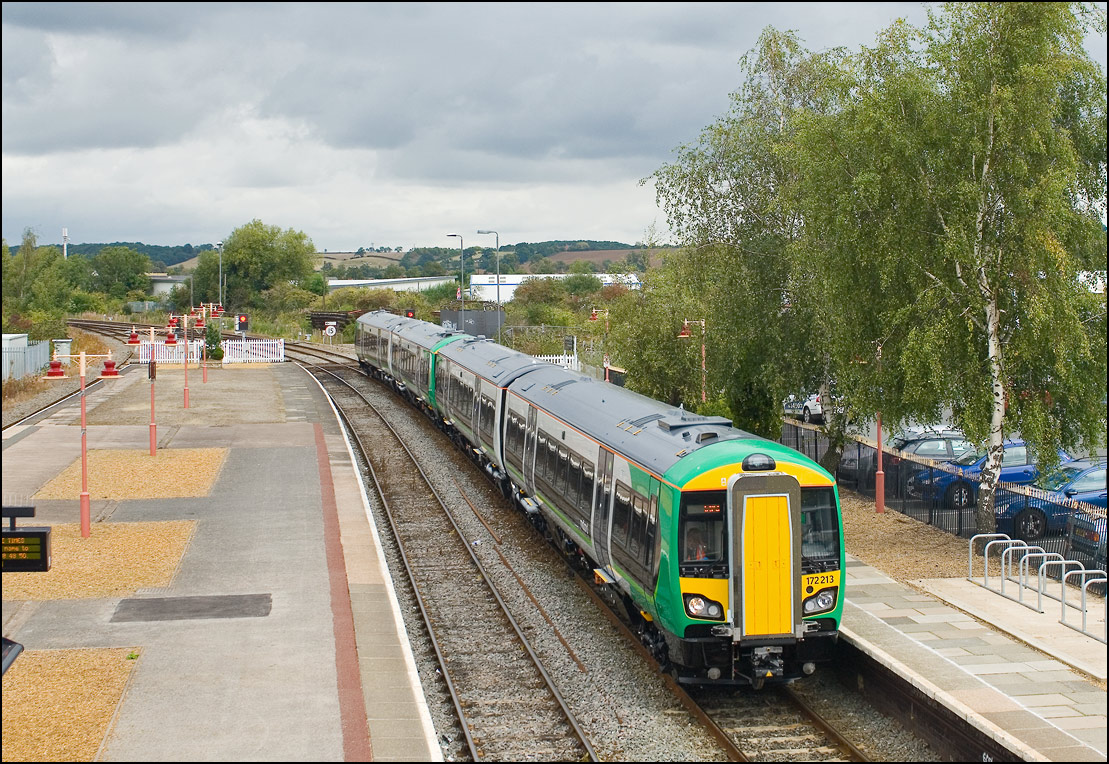
The first run of a class 172 DMU to Stratford-upon-Avon with passengers on board took place on Tuesday 30 August 2011 when London Midland gave its staff, friends and families the chance for a run from Birmingham Snow Hill before the new trains enter service from 5 September. Here is 172345 arriving at the terminus's platform 1 spot on time at 10.30 with the first run of the day which didn't seem to have generated a lot of enthusiasm amongst those eligible to travel; I doubt that there were more than a dozen or so passengers on board although there was a second run at lunchtime with a much longer layover at Stratford which may have been more interesting to potential passengers . The view from this footbridge has changed a little in the last twenty-odd years; here is a picture of a class 114 unit taken in 1990. |
_SonA_300811.jpg) |
The first passenger carrying class 172 to visit Stratford-upon-Avon had a break of around twenty minutes before returning to Birmingham Snow Hill. This gave the passengers the chance to visit the coffee shop and other facilities on the platform and for the crew to record the event. The driver of 172345 poses for a photograph beside his cab before returning north on 30 August 2011. There have been almost daily mileage accumulation runs of these units to Stratford for some time now and it is is good to be able to take a few photographs while they still are clean and shiny. My final picture of 172345 was taken as it left the station, passing the new London Midland station sign and running-in board. |
 |
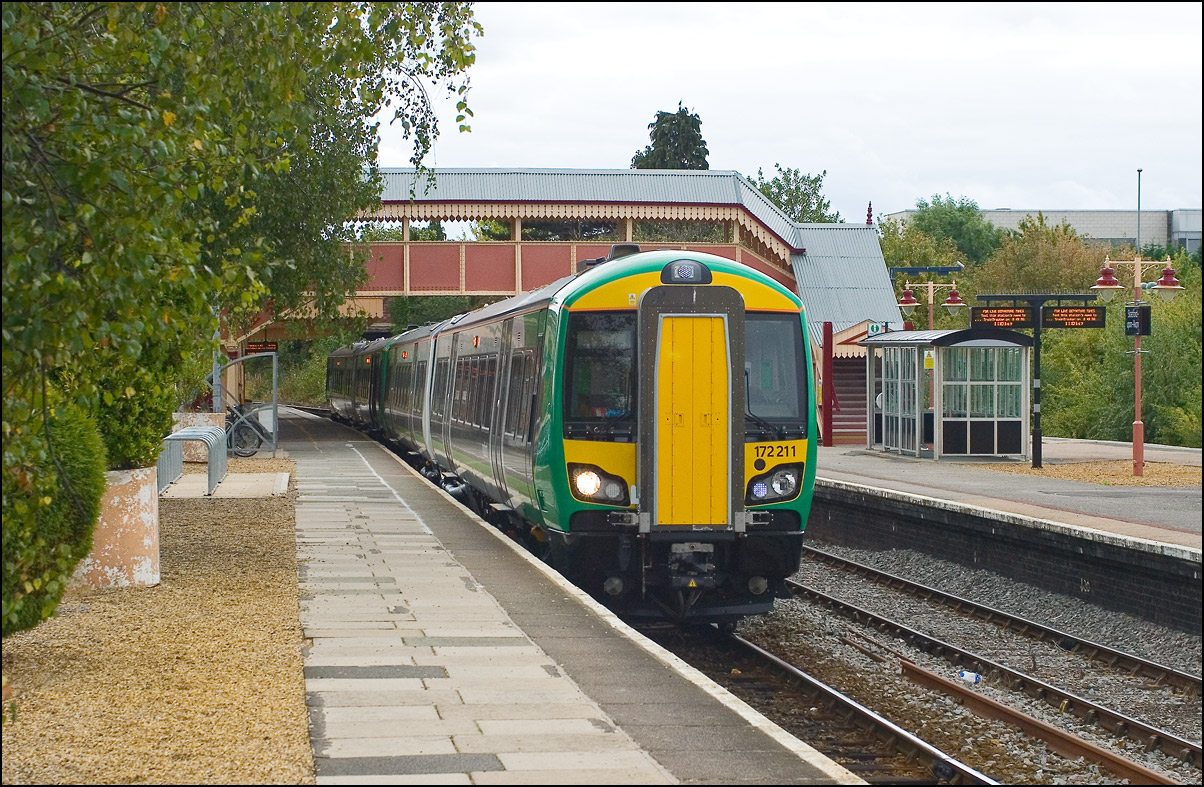
As I mentioned above, there have been many mileage accumulation runs of class 172 DMUs to Stratford-upon-Avon. Just after the first passenger carrying train had left the station two twin coach sets, 172211 + 172213, ran in on a such a duty. All the other units of the type that I have seen have been three coach sets and having differing capacities will enhance the flexibility of the type in commuter and outer suburban use as they can be couple into various formations. This train stayed in platform 1 for about fifteen minutes and is seen again just prior to departure along the North Warwickshire Line to Tyseley. |
|
|
Two of the paths for 196101's runs to Stratford-upon-Avon were used on Wednesday 12 August 2020. The first train, 5Z21, was the one in which I was interested so I walked down to Stratford station for the 09.30 arrival and before the weather became unpleasantly hot. The new unit arrived on time and just about the only spot where the sun is any good for an arrival into platform 1 at this time is by the fence at the end of the platform. It is very noticeable that the brakes produce a loud squealing noise when applied and it is to hoped that a solution will be found for this before the class enters day-to-service, especially for the sake of rail staff working as train despatchers. |
|
|
There isn't much of a shot as a morning train leaves Stratford-upon-Avon from platform 1 but at least the sun at 09.40 is just about broadside on to the subject and high enough to stop most of the shadows being cast by the station and car park infrastructure being too intrusive. |
|
|
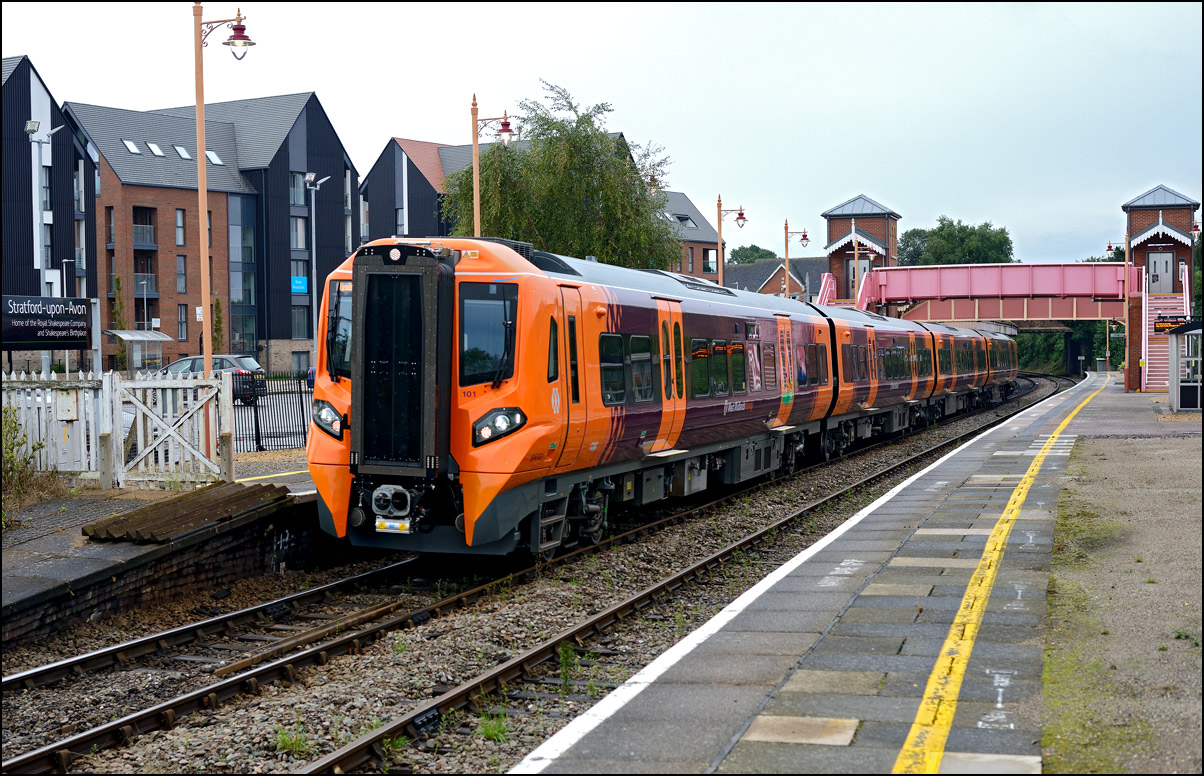
The new CAF DMU 196101 has been running between Tyseley and Stratford-upon-Avon on a regular basis. On 2 September 2020 its diagram continued later than previously and 5Z25 operated, due to arrive at the terminus at around 16.30. It's a pity that it hadn't run on the previous afternoon as it was clear and sunny then, as it had been for my previous outings but on the 2nd if was just the opposite. I still walked down to the station for a few images and this is the first taken as it slowed for the stop and reversal in platform 1. While it stood I took this view to show some detail of the front end. For some reason all the lamp posts on the station have recently been replaced with taller versions of those already there. I'm don't know why this was done but some governmental dogma has no doubt been enforced. At least the lamps are an attractive design unlike the utilitarian lights in some areas, notably stations on the North Cotswold Line. |
|
|
The newish foot and lift bridge at Stratford isn't the station's most attractive feature but at least the design gives a nod to the GWR aspect by having nicely produced valances on the porches sheltering the lift doors. The original footbridge is still in use but I do wish that a decent colour scheme had been specified rather than the muddy pink currently in favour. Still running as 5Z25 196101 had just received a green light to leave Stratford on 2 September 2020. |
 |
There was just time for me to walk to far end of the platform on 2 September 2020 before 196101 pulled away on its journey to Tyseley. As it left the station I noticed the numbering system on one of thje coaches. Quite a lot for those enthusiasts who collect numbers to record... |
|
|
During the early afternoon of 9 September 2020 the sky cleared and bright sun with a blue sky appeared. As 196101 had continued its booked diagram at least as far as 5Z25, the 15.40 departure from Tyseley TMD, I walked down to Stratford-upon-Avon station for another crack at the unit and to take the image I prefer of something arriving into platform 1 during the afternoon. As I crossed the Alcester Road bridge 172103 was just leaving the station with 2L64, the 16.18 shuttle to Hatton. There was just time to take a single shot as it began to move with a platform full of students from several nearby establishments waiting for the West Midlands Train 16.26 to Stourbridge Junction via Henley-in-Arden. |
|
|
The 16.26 from Stratford-upon-Avon to Stourbridge Junction via Henley-in-Arden is popular with youngsters heading home from school now that the proper education has restarted after the COVID-19 lockdown forced their closure. Their train was formed of 172336 on 9 September 2020 and it is seen here entering platform 1 at Stratford under a perfectly clear blue sky. |
|
|
My main reason for being at Stratford-upon-Avon on 9 September 2020 was to take an image of 196101 as it stopped it platform 1 with 5Z25 from Tyseley LMD. This is my favourite afternoon shot here as the GWR footbridge is prominent, albeit with the more modern foot and lift bridge appearing to be part of its structure, and because the planters sponsored by the Friends Of Stratford Station (FOSS) can be included in the picture. This was the first time that 196101 has come to Stratford on this part of the diagram when the sun was shining and I was keen to take this one. |
|
|
The new West Midlands Trains CAF class 196101 did some more test/training runs to Stratford-upon-Avon on 9 September 2020. The first part of the diagram, 5Z21, left Tyseley LMD some 20 minutes late which meant that there was a strong possibility that the 08.59 from Birmingham Snow Hill via Dorridge and Hatton North Junction, 2D11, would arrive first and occupy platform 1 leaving 5Z21 to use the photographically favourable platform 2. This is exactly what happened and 196101 is shown here drawing to a halt just as the light began to pick up a bit after a patch of lighter cloud passed over the sun. |
|
|
The earlier arrival at Stratford-upon-Avon, 2D11 from Snow Hill, was formed of 172004 + 172003 on a regular diagram for class 172/0 units. This gave the chance for a picture of contrasting front ends as 196101 prepared for its reversal and return to Tyseley TMD, standing alongside the 172s. The sun just managed to make an appearance at the right moment showing that late running and a consequent platform alteration can occasionally be a good thing. |
|
|
After taking the shot shown above I wandered along the platform at Stratford on 9 September 2020 to line up a final shot as 196101 moved away. Before I had gone far it started off and so this is very much a grab shot and not quite what I had in mind. |
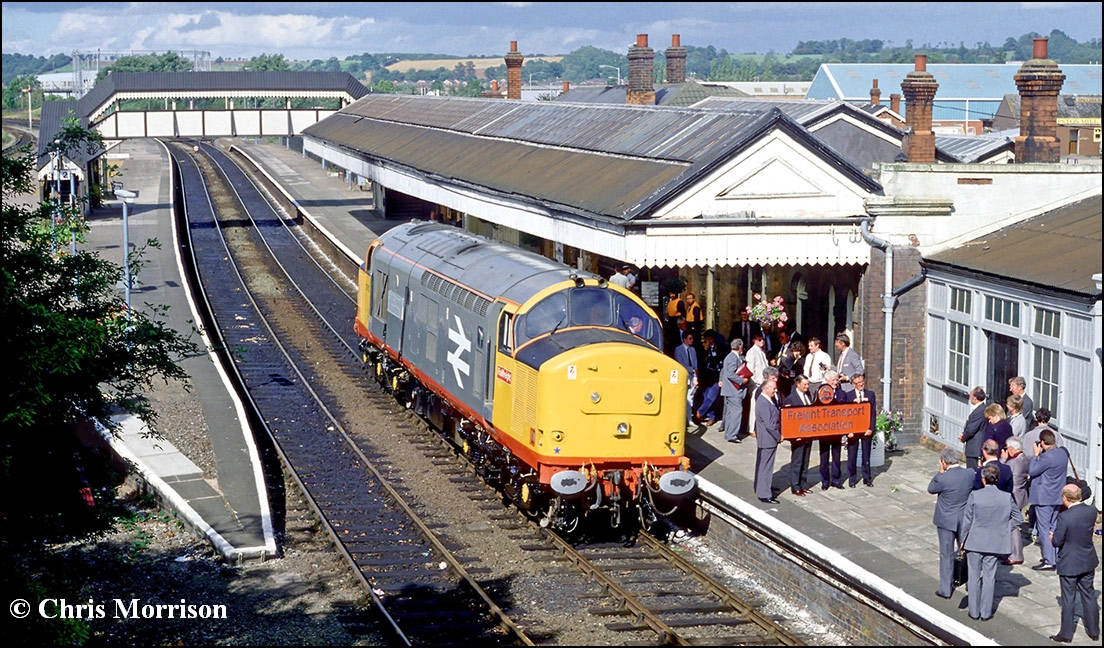 |
Stratford-upon-Avon station has seen the occasional locomotive naming take place over the years. One that I missed entirely was on 14 September 1987 when 37672 was named Freight Transport Association while standing in platform 1. One wonders that if a similar event took place today would the assembled photographers be quite so well dressed? Chris Morrison |
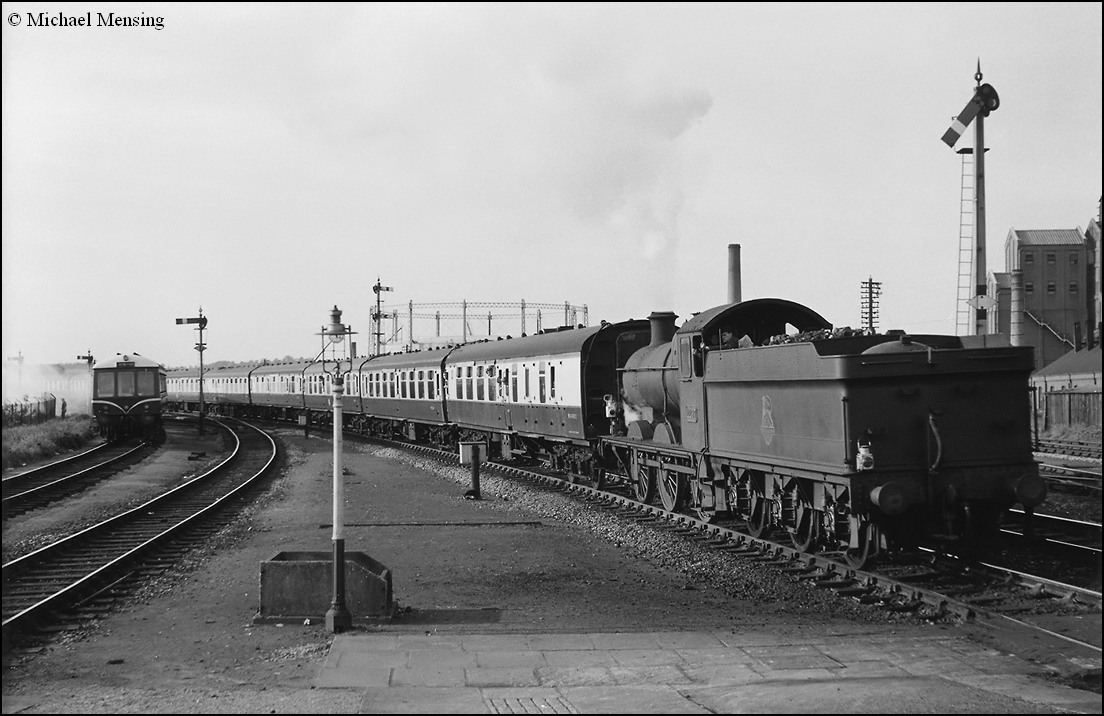 |
I mentioned in the caption to the picture of 5070 that a Castle might not need the help of a pilot locomotive all the way to Birmingham. Here is the proof. Stratford's Collett 0-6-0 2257 is here seen at the rear of the main portion of the northbound Cornishman on 23 May 1959. I did like this engine and its sister 2210, both of which were shedded at Stratford. They had a lovely exhaust note when being worked hard and could accomplish a good turn of speed when required. The train locomotive on this occasion was coincidentally 5070 Sir Daniel Gooch, the same Castle as in the picture above. The DMU on the left of the picture, in the "Cold Store" siding is no doubt waiting for the express to clear the section so that it can pull forward before reversing into one of the departure platforms, probably No. 3, to form a northbound connecting service. The building on the extreme right of the photograph is Stratford's municipal gasworks, feeding the well-known and sadly now demolished gas holders.Michael Mensing |
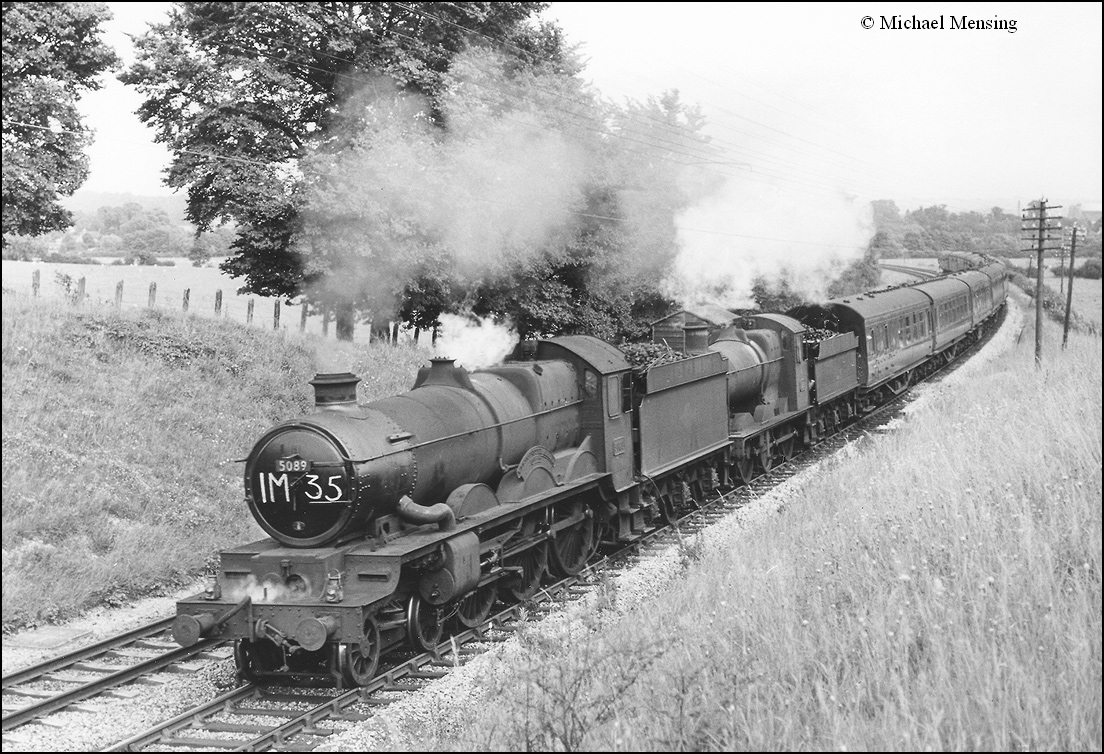 |
Here is a photograph of Stratford's other "Baby Castle", 2251 coupled inside Castle Class 4-6-0 5089 Westminster Abbey. The train is is the 11.15 Ilfracombe to Wolverhampton Low Level climbing Wilmcote bank on 27 June 1964. The help of the Collett 0-6-0 will be appreciated on this 1/75 gradient and also on the 1/150 of Danzey Bank, but then the crew of the train engine will be in for a bit of a shaking as the longer-legged Castle gets into its stride on the run into Birmingham. Most mainline expresses to the South West on this route had ceased at the end of the summer timetable in 1963 but the line through Stratford-upon-Avon was still used for some summer Saturday trains over the following years. Michael Mensing |
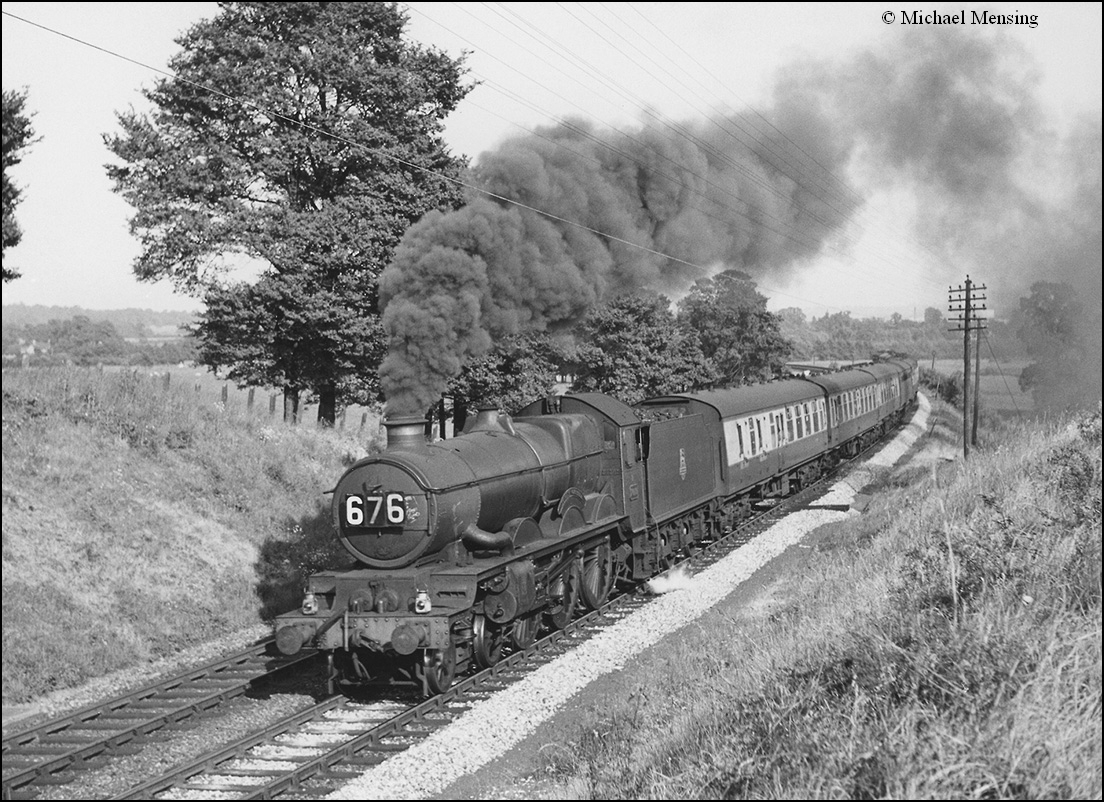 |
By way of contrast to the photograph above, this beautiful picture shows 7019 Fowey Castle, with a flat-sided tender, making a lot of visible effort on the climb to Wilmcote with a relief to the northbound Cornishman on 15 June 1957. The locomotive appears to be completely steam tight and the driver, on this dry evening, clearly had confidence in his engine and fireman to tackle the bank unaided. Wilmcote Bank is relatively short and there is a downhill stretch at Bishopton before the gradient starts to bite and keen drivers really made the most of this - I can remember listening to trains leaving the station in the early 1960s and being fascinated to hear them rapidly pick up speed once away from the reverse curves before becoming much louder and slower as they climbed away. Michael Mensing |
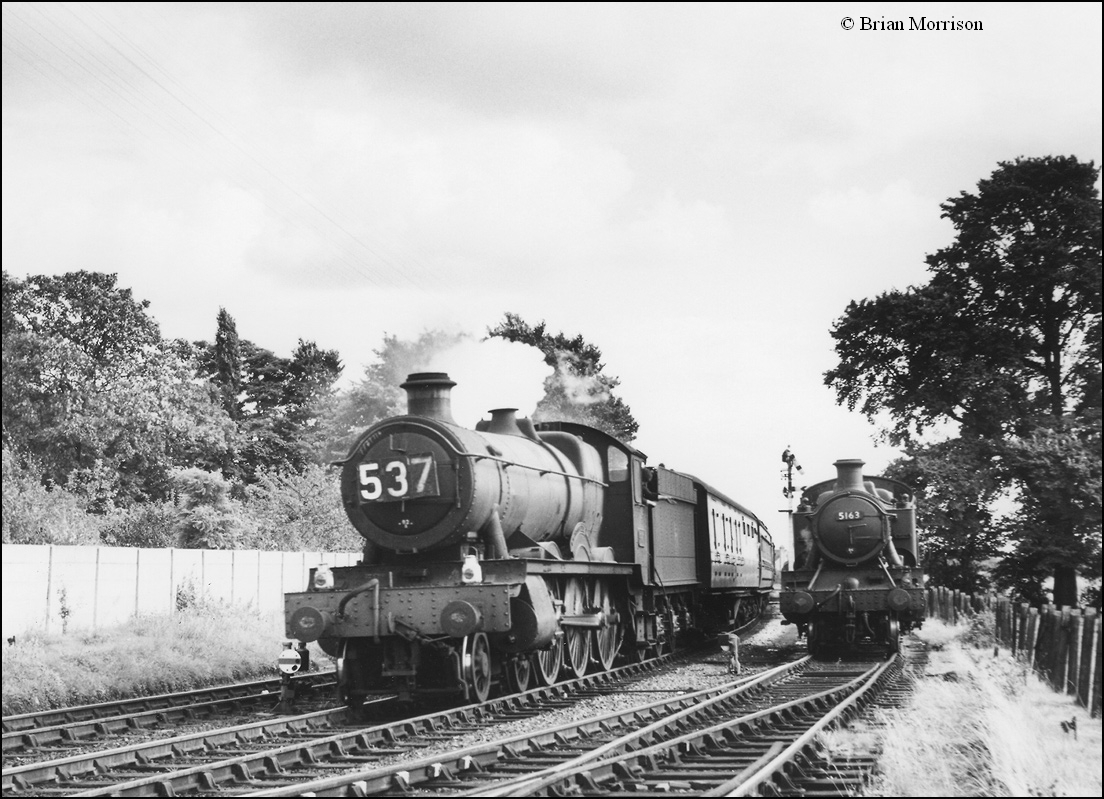 |
Turning around from the photograph of Sweeney Hall at the top of the section, this shot saw 4980 Wrottesley Hall approaching the station with the 10.35 Paignton to Wolverhampton train on 16 August 1958. Stratford's prairie tank 5163 has reversed out of the headshunt adjacent to the East signalbox and once the Halls's train has cleared the pointwork it will buffer up to the rear coach and bank it to Wilmcote. Thos area just south of the station was locally known as "The Cutting" and several footpaths straddled the line, all of which were regularly blocked when a long freight was held outside the station or made to reverse into the refuge siding. It was not unknown for impatient walkers to literally risk life and limb by attempting to cross the line by clambering between wagons. Brian Morrison |
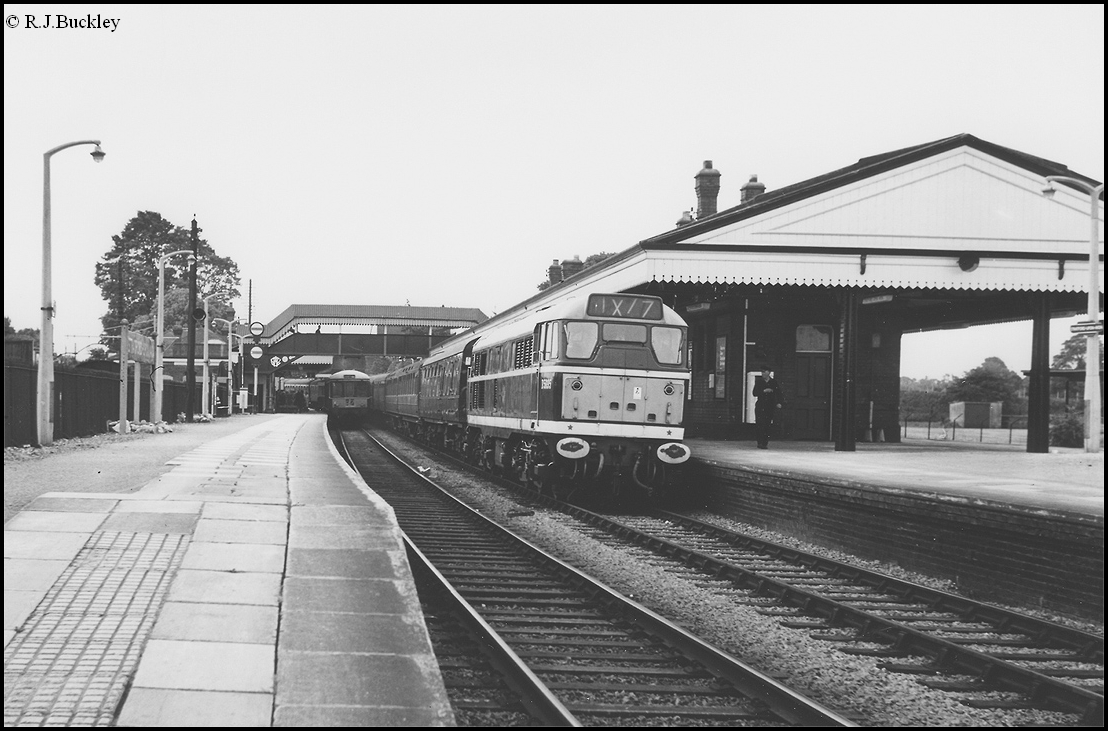 |
This exceptionally rare photograph of a diesel-hauled train arriving at Stratford-upon-Avon in 1964 shows D5695, latterly 31265, in the station on 11 June of that year with a special train from Bury St. Edmunds. The overall canopy roof on platforms 2 and 3 is still intact; it was later removed prior to a visit to the town by HM the Queen as it was by then in a pooor state. The DMU in platform 1 is a service from Birmingham terminating here - if it had been going further south the repeater signal on the platfrom would have been in the "off" position. I should like to repeat my plea for any similar material; it has been virtually impossible to find photographs of diesel locomotives around Stratford and I should be most grateful to hear from anyone who knows of such pictures - particularly if they show timetabled freight services. R.J.Buckley |
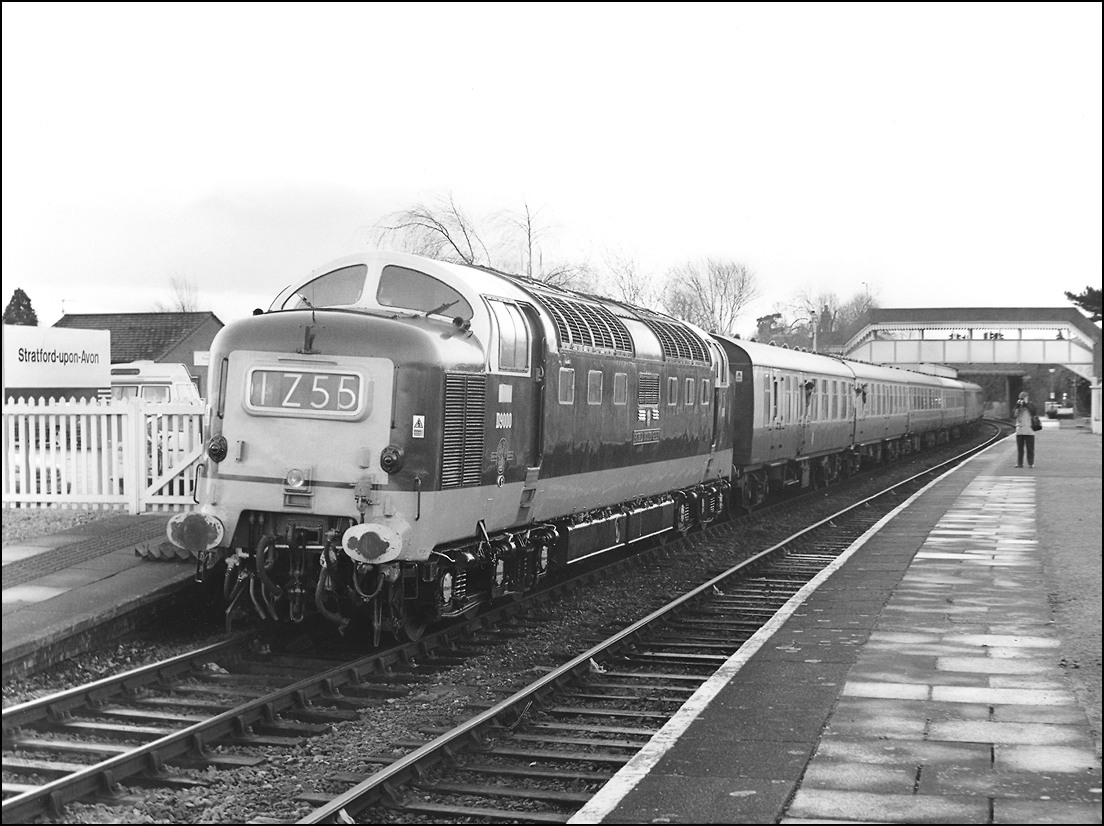 |
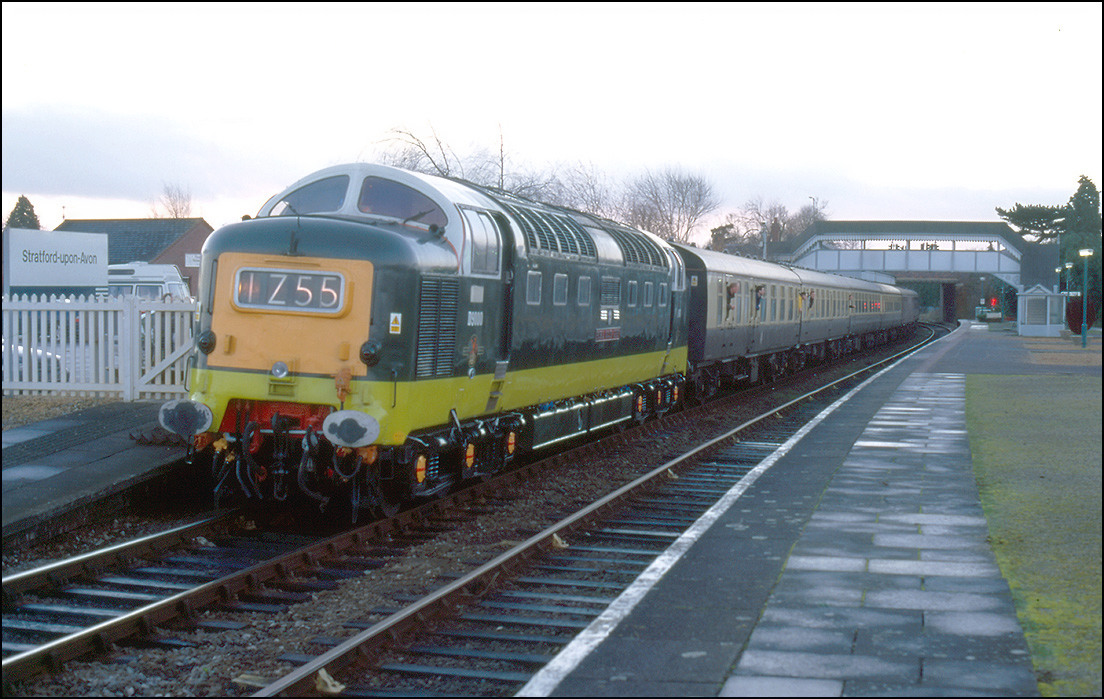
A much more recent rare visitor to Stratford-upon-Avon is seen here. D9000, Royal Scots Grey came to the town on the early morning of 9 December 2000 with a railtour from Shirley, on the North Warwickshire Line, to the Lindum Fayre at Lincoln. When I was a young enthusiast in the 1960s, I would no more have dreamed of a seeing a Deltic here than Sir Nigel Gresley or Mallard. In fact, there are now very few classes of locomotive, steam or diesel, not to have visited the town. The train, reporting number 1Z55, is here seen at 08.15, just before departure to Lincoln via Hatton West to North Junctions and thence Birmingham, Water Orton, Hinckley, Leicester and Nottingham. I did also take a colour transparency of D9000 but the lighting was a little difficult with the sun rising and illuminating the other side of the train. After returning from Lincoln, the train departed from Stratford shortly before 10pm and I did stand outside my house, about a 5 minute walk from the station, to hear it roar away up Wilmcote Bank and back to Birmingham. |
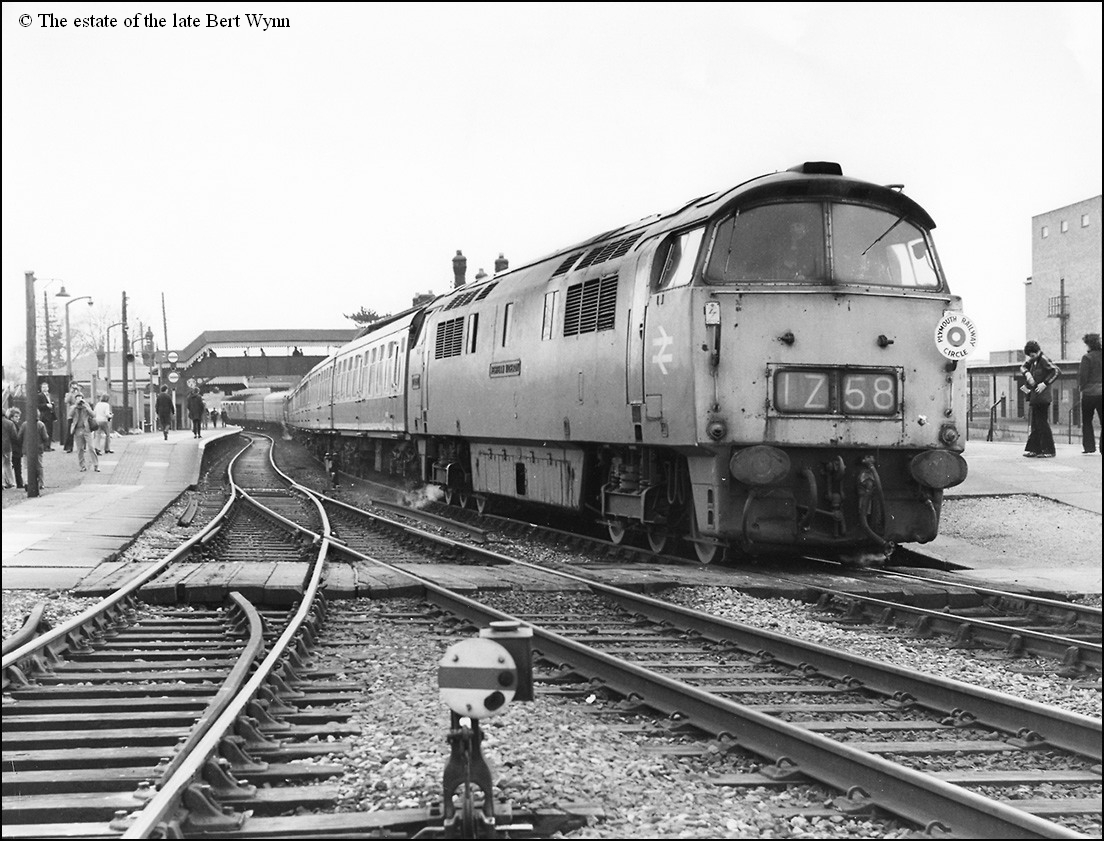 |
Another Western to visit Stratford was 1052 Western Viceroy. This one came at the head of a Plymouth Railway Circle Railtour on 29 March 1975 and was photographed during a photostop in platform 2 having come north from Cheltenham. The two aspect repeater signal on platform 1 is worth a second look. The station was on a slight curve with a high roadbridge immdediately on the end of the platform. This made sighting difficult fro drivers so this repeater was added. This device always fascinated me on my frequent visits to the station in the early 1960s - a signal moving without wires creaking? Whatever next! Westerns were never seen at Stratford on timetabled services, but I am told by one of the signalman from the Evesham Road Crossing Box that occasional visits were made by the class in the 1970s on trains from Birmingham used for brake tests around Toddington. Sadly, I didn't see any of these and as far as I am aware, no photographs exist of them. In fact, I have been quite unable to find any photographs at all of diesel-hauled freight in the immediate vicinity of Stratford-upon-Avon in the 1970s and should be most grateful to hear from anyone that either has or knows of any.The late Bert Wynn |
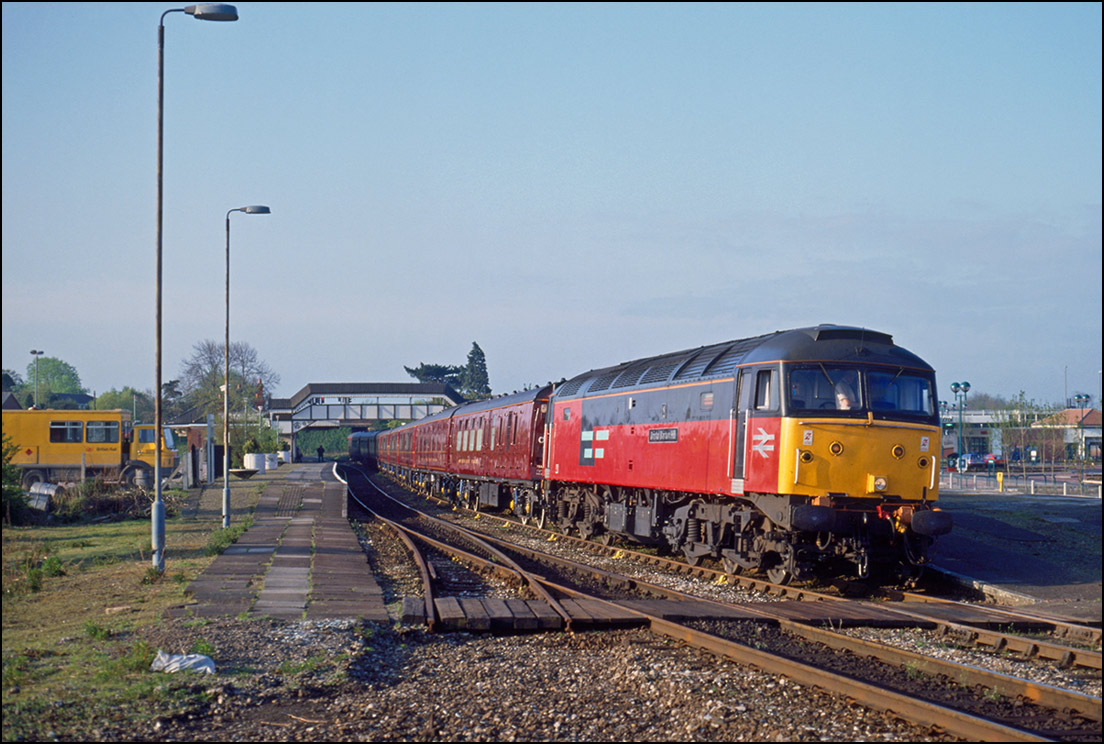 |
This photograph was taken from a similar position to that of Western Viceroy shown above, but some 19 years later. It shows 47738, named Bristol Barton Hill, with the Royal Scotsman stock standing in platform 2 prepraring to leave with an early morning departure for Perth. I lived within sight of the line when this shot was taken on 29 April 1994 and had seen the train rolling in during the previous evening. A few enquiries at the station established the departure time which, being 07.30, needed a sunny morning to make the most of the picture. This was the first visit of the stock to Stratford-upon-Avon and it becamse quite a regular over the next 2 years, before the terminus was taken off the list of destinations. 645 |
|
|
Another set of class 172/0 test runs between Tyseley and Stratford-upon-Avon took place on 14 March 2019. After some heavy showers the sky at Stratford began to clear so I walked to the station in the hope of getting a sunny shot. When I arrived 165018 was in platform 2 waiting to for the 10.37 to Leamington Spa, 2L33. I can rarely resist a good cloudscape on a sunny day so took this view framed in the footbridge as the unit left the station. |
|
|
The next movement at Stratford-upon-Avon on Thursday 14 March 2019 was the arrival of 172341 from Stourbridge Junction via Dorridge and Hatton North Junction. There isn't much of a photograph for a platform 1 arrival on a sunny morning but a head-on shot makes the best of a bad job. These trains via Hatton North have a layover of nearly 20 minutes here so there was nothing to delay the class 172/0's arrival into the station. |
|
|
Just after 172341 as shown above had arrived at Stratford-upon-Avon on 14 March 2019 the sun went behind a large black cloud. My mapping app showed that 5T72 was somewhere between Wilmcote and Stratford Parkway stations and as a large clear patch of sky was getting close I was hopeful that I would have a sunny shot. Just for once everything went right and 172002 arrived into platform 2 in good light and with a dark sky. The sky was so good that I took another view as 172002 left, now running as 5T73. The second return run was cancelled so that the end of things for the day. |
|
|
After a short break the 5T7X training runs using a class 172/0 recommenced on Monday 8 April 2019. I wasn't able to photograph the first run and the second was curtailed at Whitlocks End following 172006 suffering a coolant leak which ran onto a hot exhaust initially causing fears that an engine was on fire. On Tuesday 9 April I was out walking and timed things so that I arrived at Stratford-upon-Avon station just before 5T72 was due. I lined up a shot for a platform 2 arrival but 172002 was instead sent into P3 which isn't the best for photography. I waited until the headlights had been turned on before taking a single image just before departure. Another of these units, 172003, has received the vinyls of its new operator and I had hoped that it might had appeared today, but no... One of the benefits of the station's ongoing refurbishment is the presence of a new café in the car park serving some of the best coffee that money buy, roasted just outside Stratford by Monsoon Estates the owners of which, Anne and Chris, are pictured extreme left and right in my picture of the café. Thanks to Steve Widdowson for the information on 172003/006. |
|
|
The GWR station at Stratford-upon-Avon is in the early stages of a complete refurbishment. Contractors have erected some temporary buildings between the station building and the road bridge, some of which can be seen in this view. The chaotic mess on the foreground and right of the image is where the builders of the horrifically designed and executed new high-density housing scheme looming gloomily over the whole area have taken over most of the foot and cycle access to the station, covering the whole concourse with mud and debris. I hate to think in what state the new paving will be be left bearing in mind the standard of building work on the new estate. |
|
|
Prior to the introduction of Chiltern Railways' services to Stratford-upon-Avon there were some route familiarisation runs for crews. On 11 November 2004 single car DMMU 960014 was in use and this image shows it shortly after arrival at Stratford. The opportunity was taken for a bit of advertising on the unit's sides although it is oopen to debate how much notice prospective passengers may have taken of it. |
|
|
During the layover of 960014 at Stratford-upon-Avon on 11 November 2004 I took the opportunity to drive to Wilmcote station for another shot as it went north to Hatton on its route learning run. Here it is passing under the GWR footbridge, albeit in an odd shade of muddy pink. |
|
|
It doesn't take long for a train to travel from Wilmcote to Hatton, reverse, and then return. Despite the gloomy weather I must have thought int worthwhile on 11 November 2004 to hang on for 960014 to return for its second visit of the day to Stratford-upon-Avon. |
|
|
On Friday and Saturday 5 and 6 July 2019 the Northern Belle train made separate visits to Stratford-upon-Avon from Carnforth and Wakefield respectively. Both runs went via Dorridge and Hatton North Junction and Friday's was under cloudless skies and with none of the local photo-stops being of any use at all just after noon I stayed at home; it's a shame it didn't use the North Warwickshire Line where at least a couple of locations would have been usuable. On Saturday 6th the skies were cloudy and just to have a record shot I made the short walk to the GWR station, taking my Canon G10 which although small and light shoots in RAW format and has a proper zooming optical viewfinder. Just before 1Z63, topped and tailed by 57316 + 37314, arrived some drizzle started to fall and I think that a raindrop on the lens caused the slight fuzziness evident towards the back of the train. |
|
|
Some out of the ordinary trains between Tyseley and Birmingham Moor Street are planned for shoppers over the Christmas period of 2018. These will apparently run with a steam locomotive topped and tailed with a diesel, probably 47773, with 50007 acting as a back-up in case of any problems. The class 50 made a crew familiarisation run from Kidderminster SVR to Tyseley on Friday 16 November 2018 running via the North Warwickshire Line and Stratford-upon-Avon. I had previously photographed just 4 class members in the station environs so had a walk down for a shot of a different example. The arrival time was 15.29 and although one wouldn't want the sun out for a platform 3 arrival at that time of day some light would be have welcome as 0Z65 ran slowly along the platform line. |
|
|
After having a chat with the driver about another class 50 move with which he was involved in 1986 there was time on 16 November 2018 for a couple more images as 50007 stood under the bright station lights. |
|
|
I do like to include people in photographs on stations as long as their presence is appropriate! Here is a view of the crew alongside 50007 on 16 November 2018 just before departure time. The starting signal was already on green and it wasn't long before everyone was on board and 0Z65 was on its way to Tyseley. |
|
|
Mayflower, the preserved B1 steam locomotive, was down to work a Steam Dreams charter to Stratford-upon-Avon on Sunday 15 December 2019. Sadly, the dream soured when the B1 failed in the Clapham Junction area and 47804 substituted after some no doubt frantic 'phone calls to Network Rail in order to set up a new path which involved a completely different route to Reading and presumably leaving passengers joining on the Ascot line to make their own way to Reading on service trains. The 45 minute lateness was recovered en-route and here is 1Z82 arriving at Stratford close to right time. It's a shame that no-one thought to cancel Warwickshire Fire and Rescue who with their water tender were in the car park to fill up Mayflower's tender tank. WCRC's 47804 has been to the terminus on several occasions and here it is on 27 February 2010 approaching Wilmcote station; a shot which I took from a public footpath to show the Bearley Junction up distant signal shortly before its removal in the resignalling scheme which abolished all the mechanical signal boxes in the area. |
|
|
During a quick trawl of RTT on the morning of 18 May 2022 I noticed that an 0Z21 was running to Stratford-upon-Avon to Stratford-upon-Avon via Kidderminster. It was operated by LSL and at a guess would involve a pair of class 20s from Butterley. I watched Railcams as 0Z21 reversed at Kidderminster and saw that the locomotives were blue 20205 and green 20007 and although running about 30 minutes late it seemed likely that most of the time would be made up between Birmingham Snow Hill and Stratford. Even though it was just a light engine move I went to the station and had to decide whether 0Z21 would run into platform 1 as booked or use P2 because of trains from both Birmingham and Leamington Spa being on their way. I hedged my bets and stood in the middle of the footbridge until the 20s appeared leaving time for both alternatives. The schedule was followed and here are the pair with 20225 leading slowing down for a reversal and return to Tyseley LMD. |
|
|
Almost as soon as 0Z21 had stopped at Stratford-upon-Avon on 18 May 2022 the signal for its exit from platform 1 was cleared. The crew changed ends and prepared to leave with the man from a security company, here to control youngsters from the local school and college, watching as the train now running as 0Z22 moved away. Here is a short video from my smartphone. I imagine that the purpose of the outing was as a route or traction refresher for the LSL crew members. |
|
|
One of the few classes of locomotive not to have visited the terminus station of Stratford-upon-Avon was, until 4 November 2018, a 68. Some extensive engineering work resulting in single line working between Hatton and Tyseley made many timetable changes necessary and Chiltern Railways, with some admirably lateral thinking, took the opportunity to run one of their locomotive-hauled sets to Stratford. The ground breaking locomotive was 68010 which arrived with 1D27, the 11.40 from Marylebone, and this image shows the train ariving spot on time and as booked into platform 2. The weather was dull and slightly damp but the first, and probably last class 68 here unless a railtour comes this way, wasn't something I wanted to miss. The scene is lifted by the intense Autumnal colours around the station. I took a series of images on maximum speed "motorwind" in the hope that at least one would show all 3 lights illuminated; I was lucky on this occasion... |
|
|
The first class 68 to visit Stratford-upon-Avon didn't tempt out many photographers, only 3 of us being present at the station but there were reportedly over 60 |
|
|
I don't usually go for the photo-journalism approach to railway photography as too many images of one train or location can be tedious but on this occasion I took several different views because this is quite possibly the only chance there will to record a class 68 at Stratford-upon-Avon. This one shows 68010 propelling 1H37 out of platform 2 and making quite a racket in the process; certainly enough to make the footbridge vibrate to some degree. The departure was 4 minutes late because there seemed to be some confusion about whether this train, or the late-running West Midlands class 172 in platform 1 should go first. Pragmatism won the day and 1H37 was sent off first probably on the basis that it would clear the section more quickly than the unit! |
|
|
A West Coast Rail charter from Southport to Stratford-upon-Avon ran on Wednesday 26 April 2018. This was really only of marginal interest and I wasn't sure if I would be able to make to the station for a shot after spending an hour or so in the swimming pool at my health club. As it was I arrived just as the 11.26 local to Stourbridge Junction was pulling out of platform 1 so had 3 or 4 minutes. I had my Canon G10 with me rather than cart the heavier Nikon DSLR around and took this image as 47804 with 1Z75 approached its journey's end. I chose this unfashionable platform-side view from the footbridge steps rather than the much worse alternative from the shady side of sthe station. Sister locomotive 47772 was on the other end although I didn't hang around for a picture, preferring to leave the site before the well-filled carriages emptied and made egress difficult. |
|
|
A casualty of the hot and dry weather of the 2018 summer was a steam special from Preston to Stratford-upon-Avon which had to be postponed until the threat of the countryside being set alight had passed. By 8 September everywhere was nice and damp so 46100 Royal Scot was allocated from Crewe. The train met about an hour's delay around Wigan because of a problem with the diesel locomotive used from Preston and this delay stuck for the rest of the journey. I don't have much of an interest in steam photography although I quite enjoy seeing and hearing the locomotives in action; what does put me off is the crowds that tend to gather in every single location. There is a spot near the station which I have meaning to check out for a while and I thought that 1Z48, the return to Preston, would be the ideal chance. It turned out to be not too great but I did bang off a few as 46100 prepared to leave. The smoke was a bit of a nuisance and the sun came out at the wrong moment but it gave me an idea of what might be possible if we ever get a decent train first thing on a summer morning. |
|
|
A private charter from Didcot to Stratford-upon-Avon ran on Monday 21 October 2024 with GWR Castle 5043 Earl of Mount Edgcumbe providing the power for the 6 coach load plus 47773 which had taken the ECS and steam locomotive from Tyseley earlier in the day. It arrived right on time at 15.11 with the punters still finishing their lunch before being taken to a hotel in a chartered coach parked across the road. In earlier times before the end of steam and the closure of this line further south this picture would have been possible on countless occasions but obviously without all the modern bits and with quite a lot of "proper" infrastructure in view! |
|
|
After the headcode had been altered to 5Z43 on 21 October 2024 the ECS from the private charter brought to Stratford-upon-Avon 5054 Earl of Mount Edgcumbe, the train waited for it's departure time with 47773 ready to lead back to Tyseley. In the meantime a local service with 172342 arrived in platform 2 to form the 15.43 to Kidderminster, 2D71. I took some video as 47773 pulled away but something odd was going on with my phone so the clip is a bit disjointed. |
|
|
The exit from Stratford-upon-Avon is awkward for the crews of steam locomotives because it is on a adverse gradient, has some quite severe curvature and worst of all if the train is in platform 1 it has to negotiate a crossover to the up main a short distance from the station. It is quite usual for a diesel to give the train a shove and on 8 September 2018 D1935 was used as was working quite hard as I took this shot. The picture of Royal Scot leaving wasn't a success because of steam and smoke obscuring the front of the locomotive. The white tanker in view just in front of D1935 was the one used to water the steam engine; good to know that the tender tank and boiler won't be clogged up with weeds! |
|
|
The annual Global Gathering music festival took place at Long Marston airfield over the weekend of 26-28 July 2013. Chiltern Railways ran several additional services from London Marylebone to Stratford-upon-Avon and the most interesting of these was 1Z18, the 09.18 from London formed of 67023 hauling the blue & grey slam door stock. The scheduled arrival time at Stratford was 10.55 and the train should have run into platform 2 but the preceding train formed of a Chiltern class 165 had gone into there some fifteen minutes earlier and wasn't due to leave as ECS until 11.00. There was little chance of 1Z18 going into platform 1 as this would be needed by the Stourbridge Junction trains so the only option was P3. This was initially a bit disappointing but I changed my mind when I thought about it; I didn't have a picture of a locomotive-hauled train going into this one. I did take a picture of 37418 standing there but this was way back in March 1994. All in all I was quite happy with this image of 67023 with it's full load of some 600 passengers arriving at Stratford; more so than the one taken of the return, 1Z62, when it passed Stratford Parkway with DVT 82305 leading in an unwelcome period of bright sunshine. The exhaust smoke of 67023 can just be made out under the Bishopton Road bridge. |
|
|
The 14th annual Global Gathering festival at Long Marston airfield took place place over the weekend of 25-27 July 2014 and Chiltern Trains provided several additional and strengthened services from Marylebone to Stratford-upon-Avon which included a 1Z18 09.18 departure from the London terminus. This utilised the locomotive and coaching stock from 1H21, the 07.44 Banbury to Marylebone which would otherwise be stabled at Wembley for most of the day. The locomotive on the blue & grey coaches was 67023, the same one used last year which went into platform 3, and my 2014 photograph was taken as the train arrived into platform 2 at Stratford about 2 minutes early. This wasn't the shot I had had in mind but a London Midland class 173/3 was in platform 1 waiting to depart for Stourbridge Junction a few minutes later so I had to stand a bit further along the platform than I should have liked. The return from Stratford was timed for 15.12 but with the DVT leading and the sun in completely the wrong place for photography I made do with this view, although I did take an image showing the revamped station forecourt area and another from the adjacent road bridge which wasn't completely satisfactory thanks to heavy shadows from the station vegetation. |
|
|
A new bridge combining passenger lifts and stairs has recently opened at Stratford-upon-Avon station; not replacing the listed GWR bridge although the latter is rather overshadowed by the new contruction. The new bridge is of the standard modern design but with some welcome embellishments such as brick facias and wooden valances to reflect the Great Western character of the station as seen here just before completion. This is marked contrast to similar examples at Shirley and Henley-in-Arden which are less sympathetically finished. I hadn't been onto the station for a while and was curious to find out if any photographs of trains arriving at the station were available from the new structure so with there being little of any interest around, apart from the sun, on 16 February 2016 I walked down to have a look as 2D12, the 09.40 from Leamington Spa, pulled in platform 2. A perfectly reasonable shot is on offer so all that is now needed is a slightly more interesting working to visit here. As the Global Gathering Festival seems unlikely to take place this year the chance of a Chiltern class 68 coming seems rather remote and diesel-hauled trains here are rarer than hens teeth so long wait is likely. I intended to return later in the day when the sun on the other side for an arrival into platform 1 but the sun had faded by the optimum time so another visit will be in order at a later date. |
|
|
RealTime Trains showed that a 2Z01, operated by London Midland, was to visit Stratford-upon-Avon on 21 May 2015 as part of a run between Birmingham New Street and Shrewsbury. It was obviously going to be a multiple unit of some sort although probably the not ubiquitous class 172 as it was timed for 75mph running and as a Sprinter. A friend saw it near Solihull saying that it was a 2 coach class 170; a type that I hadn't photographed at the terminus although I do have a single shot of 170508 on the North Warwickshire Line at Edstone Aqueduct. Always happy to take a picture of a "new" class at Stratford I walked down to the station, arriving about 5 minutes before 2Z01's booked time of 09.54 and with time to take a picture of the new and nearly completed footbridge complete with lift access for any disabled (or possibly lazy!) passengers. It good to note that some concession has been made to the GWR heritage of the station with brick facing and wooden valances rather than the more utilitarian examples of a similar same type found at Henley in Arden and Shirley. Anyway, 170504 rolled into platform 2 from Hatton North and West Junctions, narrowly missing a patch of sun, and came to a stop before the crew changed ends and took the train towards Shrewsbury via Henley and New Street. Another "Z" was due into Stratford later the same day, this time steam locomotive 5043 on what I guess was a test run of some sort. I bet that there were more folk around for that... |
|
|
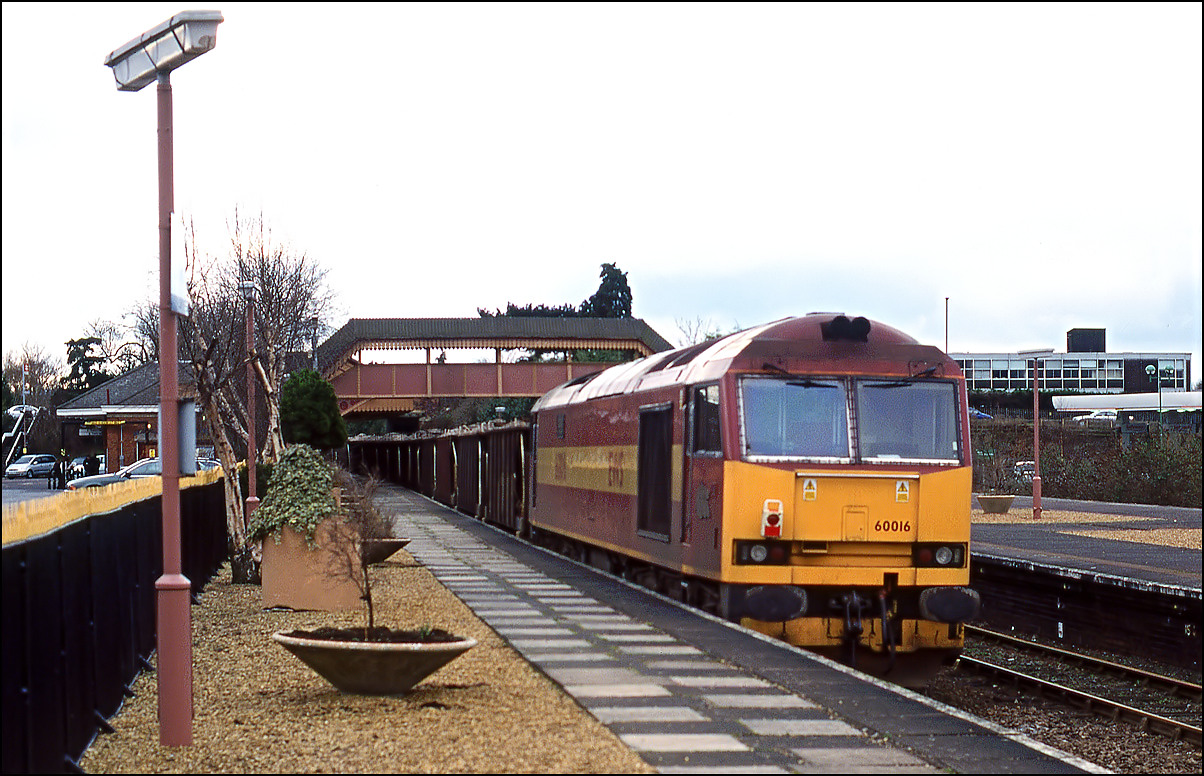
Few diesel-hauled charter trains visit Stratford-upon-Avon these days so when I saw from RealTime Trains that such a train from Leeds was coming down on 25 August 2014 I was reasonably keen to have a look. It was routed along the North Warwickshire line and if the light had been better a trip somewhere over that way, maybe to Edstone would have been in order. However, the weather on this Bank Holiday Monday was dreadful with glowering skies and intermittently heavy rain which managed to make its presence felt as 60059 entered platform 2 at the terminus. As far as I know only one class 60 has been here before; 60016 back in February 2004 on an engineering train which, as the station was closed I had to photograph rather unsatisfactorily from the car park. Today's picture of 60059 is a bit messy thanks to ongoing preparation work for the new bridge incorporating lifts which is to be sited directly in front of the GWR structure. A 3 car class 172 was just out of sight in platform 1 having arrived from Stourbridge Junction via Dorridge a few minutes earlier. It's lucky that wasn't a longer train. |
|
|
If I thought that the weather was bad when 60059 arrived at Stratford-upon-Avon on 25 August 2014 then it was a lot worse when it left at 16.15. The sky was much darker and the rain a lot heavier when I arrived at Wilmcote station for a photograph but I decided to get a bit wet and take my shot from the platform to include the attractive station footbridge, despite its rather dodgy colour scheme, in the picture. I heard 1Z61 climbing the 1/75 of Wilmcote Bank and the train soon appeared through the murk and rain on its way back to Leeds, this time running via Hatton North Junction and Solihull. If the weather had been clear and sunny I would have gone to the former where it would have been interesting to have had a comparison picture to this one of 60096 leaving the Stratford branch in March 2006. |
|
|
Saturday 9 April 2016 saw a locomotive-hauled train scheduled to visit Stratford-upon-Avon from Skegness. The original plan was for a steam locomotive to work the inward leg with a diesel, left on the back of the stock after the ECS move, powering the return. The slightly scary combination of West Coast Rail and Network Rail managed to change the plan several times during the preceding week, with the eventual, allegedly final, schedule showing the steam to be removed at Duddeston Junction (Saltley) and a WCRC class 47 bringing 1Z62 to Stratford. Even on the day things changed with the locomotive swap taking place at Landor Street where 47760, which had run from Rugby, came onto the front. OK, a maroon 47 doesn't make for the greatest image but we don't get many locomotives at Stratford so I walked down to the station for a shot from the new foot and lift bridge. I was watching 1Z62's progress and saw, oddly, that it had run through Hatton station on the up main line where it stood before reversing at Hatton South Junction, running though the Stratford branch platform and so back onto its booked route. The reason for the unusual manoeuvre was a track circuit failure somewhere around Hatton North Junction. This all meant that the far more attractive 47580 was now leading, albeit with a tail-light on the bracket, and it managed to arrive at platform 2 in the last of the sunshine before thick cloud made everything a lot duller. With a half-decent shot of 47580 in the bag my plan to go out for the return working could be abandoned. |
|
|
The third of this year's "Stratford Flyer" trains run by the WCRC reached the terminus on 22 May 2019. This time it was 1Z61, the 08.00 from Scarborough, with 57314 with 57316 providing the power which was sceduled to arrive into Stratford's platform 1 at 13.49. As expected it was a couple of minutes early having a good run along the North Warwickshire Line from Whitlocks End to Bearley despite having to pause for few minutes at both locations to allow local traffic to precede it. The weather was warm and bright and as the arrival time was a bit early for optimum lighting conditions had the sun been fully out some light cloud was welcome. The station is in the throes of some quite major improvement works which along with the dreadful and over bearing sight of the new high-density housing scheme on the former cattle market site dominating the scene, the visitors' first impressions of their destination were not favourable. At least the station improvements are positive and will greatly benefit passengers when complete. The other development is likely in time to make the area a no-go area after dark... |
|
|
Most of the locomotive-hauled test trains that visit Stratford-upon-Avon do so late in the evening meaning that some after dark photography can be practised. On Monday 29 July 2013 an unusual set of timings saw 3Q55, with DBS 9701 and 31285, arrive in daylight at 19.45 and indeed on a sunny evening. Here is the train arriving into platform 1 at the terminus spot on time and just about managing to dodge most of the shadows. This view will soon be a thing of the past as planning notices have been issued giving notice that a new, additional, bridge with lifts for disabled (and possibly lazy!) passengers is to be built roughly in the area of the two square gravel patches on the island platform. |
|
|
This test train, 3Q55, had originated from Derby and was headed for Didcot via Nuneaton, Coventry, Nuneaton, Washwood Heath, Stratford-upon-Avon, Leamington Spa, COD Kineton and Oxford. It left Stratford right on time, 19.56, with quite a healthy noise from the elderly 31285 after a break to allow the driver to change ends. I am always happy to record another working with a class 31 in charge as they surely won't be doing this sort of work for many more months. The light was lovely although the sun had just dropped enough for the shadow from the platform to encroach slightly on the train's wheels. |
|
|
I was walking along the towpath of the Stratford-upon-Avon canal on the morning of 18 August 2018 when I saw a reliveried class 172 about to enter Stratford station. I assumed that it was the 08.21 arrival from Stourbridge Junction and after returning home worked out that the same unit should return on the 14.21 arrival. Luckily, a friend texted me to say that it was actually on 2D40, the next service which ran via Dorridge and Hatton North Junction which meant that the train I had seen earlier was 5D70 from Tyseley depot running early. I had a walk to the station in the afternoon taking my Canon G10 and arrived a few minutes before 172335 in its new colour scheme arrived with 2D40. |
|
|
To my eyes the colours applied to 172335 by West Midlands Trains really suit the lines of the class, more so than the original green as seen here at Bentley Heath on the same unit in 2012. I don't know if this will become the standard livery for the class but intend to kep an eye on this example in the hope of getting a sunny shot next time. There were no Chiltern Railways services on 18 August 2018 as engineering work caused their replacement by a fleet of buses such this being loaded with passengers and their luggage against the new backdrop of Stratford-upon-Avon's hideous new high-density housing scheme. Thanks to Chris Morrison for letting me know the correct train that 172335 was working. |
|
West Midlands Railways has recently acquired some of Chiltern's class 172/1 units to bolster their services. On Saturday 19 June 2021 I had a message saying that 172104 was working the 08.57 from Birmingham Snow Hill to Stratford-upon-Avon, 2D11, and as this was the first time I had seen a 172/1 on a WMR service had a walk to the station for a shot or two. Here is the train arriving into platform 2 instead of the booked P1 as the pointwork allowing access to it has still, after several months, not yet been replaced. This unit was the first that Chiltern used and here is my picture of it at Hatton running as ECS under the headcode 5Z74 which worked from Derby to Marylebone (via St Albans) and back on Monday 16 May 2010. |
|
Class 172/1 172104 working with WMR arrived at Stratford's platform 2 on 19 June 2021 while Chiltern Ralways' own 168325 was waiting in platform 3 to form the 10.39 to Hatton which a bit oddly runs ECS to Leamington Spa to return to Stratford later. The chance for a picture of two Chiltern liveried units side-by-side here was unusual to say the least but their positions relative to each other needed a wider angle lens than the 50mm on my Nikon D800. This picture was therefore taken on my 'phone with the inevitable distortion caused by the very short focal length. To show the current operator of 172105 to passengers decals have been placed on the bodysides. |
|
|
Just as I was about to leave Stratford station the sun appeared and offered the chance of another shot of the 2 units but from the other end of the platform. The Train Manager is about to desptach 2W72 to Kidderminster with 168325 framed between the trees masking Morrisons supermarket from view. Thanks to Steve Widdowson for news of this working. |
|
|
My interest in all railway related matters has been waning recently, so much so that I couldn't be bothered to go out for topped-and-tailed class 47s with some ECS at Hatton on Saturday 1 September 2018. The most I could be bothered to do was to walk to Stratford-upon-Avon station for a single shot of 172335 as it arrived with 2D40 from Stourbridge Junction. The novelty of the new colour scheme will wear off quite soon as more units are repainted from the current green colour scheme... |
|
|
The monthly(ish) test train from Derby RTC to Derby RTC via Stratford-upon-Avon generally arrives at the terminus around 20.45 and is photographable in daylight in June and July. The evening of 11 June 2024 was fairly bright so I wandered down to the station for a shot, hopefully of ex-Cross Country power car leading into platform 1 with some sunshine on it. I was peeved when the passenger train, 2S09, was routed into platform 1 instead of P2 as booked which allowed 1Q48 to run a few minutes early into P2. This stuffed my chance of a decent shot but at least the sun faded as it entered the station which made it a bit easier to approximate the exposure. |
|
|
Power car 43251 was on the other end of 1Q48 at Stratford-upon-Avon on 11 June 2024 and stood for long enough after the driver had changed ends and switched on the headlights for a few images as it stood in the sunshine alongside 168324 on the next Chiltern departure. I wish those who install platform lights would make sure that the lampposts are vertical despite a sloping platform: I have taken the correct vertical from the flats in the background although judging by their build quality this faith may be mis-placed. This isn't 43251's first visit to Stratford; here it is arriving with the same working on 2 November 2021. There was time to take a short video clip as 1Q48 left the station. |
|
|
The monthly test train from Tyseley to Stratford-upon-Avon was due to run on Tuesday 3 November 2020 and with it using some previously unseen traction for the line I went to the station for a few shots. I arrived just in time to try out some varying exposures on 172340 as it prepared to leave the station with 2K77, the 20.27 to Kidderminster. |
|
|
Colas Rail has recently acquired 2 of the former EMR power cars for use on trains with, I believe, more to follow with a view to dispensing with most locomotive haulage from the Network Rail test trains which they operate. On Tuesday 3 November 2020 the monthly test train from Tyseley, 1Q48, utilised 43050 + 43060 still in the EMR livery but with vinyls showing their new operator until they can be repainted. As this was the first time that HST PCs have been to Stratford-upon-Avon on such a working I went to the station for some shots and was surprised to be the only photographer there. The new station lighting here very effective and I used my Nikon D800 hand held with settings of ISO 4000, 1/125 second with a 50mm lens set at f2.8 to achieve what I think is an acceptable result. |
|
|
The test train 1Q48 had arrived at Stratford-upon-Avon some 15 minutes early on the evening of 3 November 2020 and not long after the driver had walked from 43060 to 43060 and changed the lights to white the starter signal for platform 1 was cleared. I thought that on departure there might be a bit of smoke so took another shot as the train began to move even though it was quite similar to the previous image. |
|
|
The regular test train, 1Q48, ran to Stratford-upon-Avon on Tuesday 2 November 2021. The previous month's run had been cancelled because the stock was under maintainance and for the November train the usual locomotives, 67023 + 67027, were unavailable through being on RHTT duties and were substituted by Colas HST power cars still in LNER livery 43251 + 43272. This was the first visit of HST PCs in this colour scheme to the terminus so I went to the station for a shot or two. Here is 1Q48 arriving in platform 1 with 43251 leading in a pool of light from the station's LED lamps. For anyone interested the techincal details for the picture are Nikon D800, ISO 6400, 1/200 sec @ f2.8 on a Nikon 50mm prime lens. |
|
|
On 2 November 2021 test train 1Q48 from Tyseley LMD was about 8 minutes late arriving at Stratford-upon-Avon with Colas/LNER power cars 43251 + 43272. The latter was to lead from Stratford and here it is after the crew had swapped ends ready for reversal. They were keen to get going after the late arrival but were kind enough to give me the chance for a set of bracketed exposures and can be seen watching for my thumbs-up before they moved. In reality, this took only about 20 seconds and this image was taken on ISO 4000, 1/125 @ f2.8. |
|
|
The annual visit to the Stratford-upon-Avon line of a weedkilling train took place during the early morning of 5 April 2025. I had assumed that as before top and tailed standard-liveried GBRf class 66s would be used but but I happened to notice that 66718 + 66747 were allocated for the trip from Kings Norton. Always one for a first at my local station I made the decision to head down for the second part of 3Q98's diagram after it had been to Leamington Spa even though the due time was around 4am. My wife said that she didn't mind me going out then so I went out only to find for the first time ever on my night-time trips that the platform lights had been turned off. The lights around the booking office on platform 1 were fortunately on so this is the only shot that was possible taken as 66718 stopped prior to reversal and return to Birmingham. The other locomotive, 66747, also in a special colour scheme, was in almost complete darkness and a frontal shot just wasn't possible so this was the only poor option available. The lights on the train itself are almost painfully bright and I could do nothing about the burnt-out highlights. |
|
|
Stratford-upon-Avon's monthly visit from 1Q48, the test train from Derby RTC, took place on the evening of 25 January 2022. After a late start the train made up all the lost time and then some and looked to be about 10 minutes early arriving at the terminus. I knew that the power cars were 43251 + 43274 and hoped that the latter would be on the back as it came into the station but the picture as it slowed in platform 1 was better than expected and showed off the purple colour scheme of EMR, it's former operator. |
|
|
A young enthusiast and his father were on Stratford station for 1Q48's visit on 25 January 2022 and the boy kneeling to take his photograph adds some interest to the scene as the driver of 43251 prepares to leave for Leamington Spa and a later return here. This PC has been here on another occasion and it was a lot cleaner on 2 November 2021. |
|
|
A photography lesson from dad as 1Q48 left Stratford-upon-Avon on 25 January 2022. |
|
|
I've had it in mind to go to Stratford-upon-Avon station for a picture or two of 3J04, the Freightliner operated RHTT, now that it is dark by the time it arrives. On Thursday 4 November 2021 I noticed that in addition to 3J04 one of the class 196 test runs, 5Q27, was running about 70 early because most of the WMR passenger services were cancelled. This meant that it would be in the station at around the same time as the RHTT. I miscalculated how quickly it would run down from Bearley Junction and get ready to reverse, so much so that it was pulling out of platform 2 as I arrived. My camera was already set up for after-dark photography so a grab shot was taken as 196002 receded from the lens. |
|
|
As soon as 196002 running as 5Q27 to Tyseley LMD had cleared the section out of Stratford-upon-Avon station on 4 November 2021, 66519 leading 3J04, the RHTT from Aylesbury, was allowed to cross over from the down main line and run into platform 3. This isn't the most photogenic platform at the station but it does have the best lighting which helped to show off the dirty state of the locomotive. I like the way that the light in Morrisons' car park illuminates the autumnal colours of the tree alongside the lineside fence, one of the bonuses of taking pictures in the darker evenings. Here is another vew of 66519 taken as I walked to the other end of the train. |
|
|
I wasn't sure if the RHTT at Stratford-upon-Avon on 4 November 2021 was far enough along the platform to allow a shot of 66522, a recent replacement for 66510, but it was positioned perfectly. The engine was shut down so I waited for the driver to turn the V12 over before taking a shot in the hope of getting a plume of smoke as it started. It worked well and the remaining touch of light in the western sky adds a lot to the scene. Another view of the other end of of 66522 is here to show the flower containers plated by FOSS and which add greatly to the attractiveness of the station. This locomotive once carried a slightly different colour scheme as can be seen here while it was working a 6Z22 Eastleigh to Stud Farm on 7 July 2011. The repainted bodyside patch can just be made out in this image taken from the car park. |
|
|
Even the most mundane scene is transformed into something more interesting by after-dark photography. This picture shows 165003 just about to leave Stratford-upon-Avon on 4 November 2021 working 1U71, the 17.38 to Banbury. There were some very frustrated customers on the station waiting for trains running to Birmingham Snow Hill and beyond. All the peak hours West Midlands Railway services between 16.23 and 18.58 were cancelled. |
|
|
I noticed from a mapping app that a different locomotive in the form of 66507 to accompany 66519 was operating on 3J04, the Chiltern Line RHTT, on Tuesday 23 November 2021. I assumed that this one might be a bit cleaner than 66522 which had been working for about 3 weeks so walked to Stratford station for a couple of shots. Photographic opportunities at Stratford's platform 3 are limited to say the least and this view of a filthy 66519 arriving with the water jets still operating is the best available. |
|
|
It takes a few minutes for the train crew to change ends and prepare the train for reversal so there was plenty of time for some trial exposures before it left. On this occasion the rear locomotive coming to Stratford had been left running so there wasn't the chance for a shot similar to that I took of 66522 on 4 November but at least 66507's Freightliner green paint was still recognisable. The difference in colour between the two shots is noticeable and is the result of the later shot being taken on a cloudy evening with more ambient light diffusing from orange lamps in the area. |
|
|
When 3J04 started running in October I took this shot of it standing at Stratford-upon-Avon on a sunny evening. Comparison of the 2 pictures taken from the footbridge is striking... |
|
|
More after-dark photography on Wednesday 8 December 2021. The daily RHTT from Aylesbury to Banbury via Stratford-upon-Avon should be finishing its runs on 10 December and the chance for some better shots than my previous efforts came along with 3J04 being routed in platform 2 rather than the usual platform 3. The train still spraying and headed by 66510 is shown here arriving at the station about 15 minutes early having been given the road at Bearley Junction because of a late running passenger train on the North Warwickshire Line. |
|
|
Having arrived 15 minutes early at Stratford-upon-Avon on 9 December 2021 I had quite a wait before the crew moved to 66522 to change ends. In the meantime the locomotive's diesel engine had shut down so after the usual procedures it was restarted. There was a strong wind blowing which whipped the initial exhaust away. There didn't seem any point in waiting for 3J04 to leave Stratford on 8 December 2021 as there was still some 20 minutes to wait and with a Chiltern service to Leamington Spa going on the same route it wouldn't have been able to go early. I just took this image of the cab before heading off. |
|
|
It's sometimes hard to resist just one more shot and I can't imagine that 3J04 will be sent into platform 2 on either of the two remaining days on which it is due to run. So this view of 66510 tailing the RHTT tanks and spraying equipment was worth a frame with the station canopy and bridge being so well lit. This locomotive missed part of the jetting season through having wheel flats which meant a class 8 trip from Banbury to Tyseley very early one morning. Despite having been cleaned while in Birmingham its position at the spraying end of the formation meant that it soon regained the usual RHTT colour scheme. |
|
|
Following a weather alert on the evening of 21 January 2024 which mentioned that many trains were cancelled because of strong winds associated with storm Isha I had a quick look at the RTT page for Stratford-upon-Avon to see if there were any cancellations. There weren't but I did see that a 3Q14 was on its way from Derby RTC, a train that usually arrives here between midnight and 2am, but this time scheduled to reach the terminus at 21.50. This was a bit more reasonable so despite my wife saying that I must be off my head (so?!) went down to the station. A friend up the line had confirmed that 37219 was on the back of the Structure Gauging Train which is ideal for static shots before it reverses on the station.. The weather was absolutely foul with strong winds and driving rain; the basic bus shelter on platform 2 being almost useless to keep anything dry. As soon as the driver had reached the locomotive cab and switched on the lights I grabbed a few shots before moving along the platform to take this one in a better spot of light from one of the platform lamps as 3Q14 moved off. |
|
|
Whenever a test train is scheduled to visit Stratford-upon-Avon I keep an eye open in case Colas locomotives are allocated as this is one colour scheme I had yet to photograph at the station. On 4 October 2016 1Q48 from Derby to Tyseley was due to make 2 visits to the terminus and 37219 and 37175 in top-and-tail mode were reported as providing the power. The first visit was around 16.30 and although it was booked to run into platform 3, the worst possible for photography, I hoped that with no trains using platform 1 at that time and with a clear sky promising sunshine it might be routed into that platform. It wasn't and ran as booked and this shot was about the best possible in the circumstances. I didn't have a long lens with me but some judicious cropping did the job although having to compromise between shadows on the front of 37219 and its nose appearing to clip the fence was unfortunate. Even so it was better than the light on the wrong side view for which it was barely worth pressing the shutter release. Just to complete the story I took a third image as 1Q48 left Stratford for the next part of its journey around parts of the East Midlands. |
|
|
As I mentioned above 1Q48 made 2 visits to Stratford-upon-Avon on 4 October the second being due to arrive just about 22.30. Following the poor results earlier in the day I dug out my tripod and went back to the station to have a crack at a time exposure under the platform lights. This time 1Q48 was due to arrive into platform 2 and it did so meaning that there was a good chance of obtaining a decent image after the driver had changed ends and switched on the cab and headlights. The station lights here are quite bright and the exposure used on ISO 200 was 1.3 seconds at f5.6 in contrast to the lighting in the days when I used 100asa medium format slide film when about 15 seconds was needed. After a decent interval allowing several bracketed exposures the train pulled out of the station for the final part of the day's itinerary to Tyseley LMD. |
|
|
My enthusiasm for going out for photographs is inversely proportional to the outside temperature so I haven't bothered during the heatwave during June and July 2018. Although the evening of 10 July was quite warm it wasn't too bad so I had a walk to Stratford-upon-Avon station for a shot or two of 67023 + 67027 with 1Q48, the Derby to Tyseley test train. I took only my lightweight Canon G10 compact camera secure in the knowledge that with its RAW image capability it is more than capable of taking a decent picture without the weight of a DSLR and heavy lens. The train was about 15 early joining the North Warwickshire Line which put it in front of 2S64, the local passenger service from Stourbridge. There was therefore a possibility that it would be routed into either platform 2 or 3 the latter of which had just been vacated by a Chiltern service to Leamington Spa but I was hopeful that it would run as booked into P1. It did and made for an attractive scene as it drew to a halt alongside the beautiful floral display sponsored by FOSS, the Friends of Stratford Station. |
|
|
The test train operated by 67027 + 67023 was followed into Stratford station by 172344 which had to terminate in platform 2 rather than its booked platform 1. The latter is just visible in the this view as the incoming and outgoing passengers swap over. I thought that 1Q48 might be allowed to leave before the passenger train but the signal for platform 2 flicked to green as I took this telephoto view from the extreme end of platform 2 so it was time to leave but with a short pause to take this wide-angle view of 67027 as it stood awaiting departure time. The picture also shows a tiny part of the hideous and gloomy high-density housing scheme under construction on the site of Stratford's cattle market. |
|
|
The first chance to photograph the monthly test train in daylight at Stratford-upon-Avon occurred on Tuesday 18 May 2022. The HST PCs 43274 and 43272 provided the power for 1Q48 and the train was due to arrive into platform 1 at 20.46. It ran very early and I went to the station where I suspected that it might use P2 because of a following passenger service from Kidderminster so placed myself on the footbridge where it was easy to switch sides if necessary. My hunch was correct and here is 1Q48 with former EMR 43274 drawing to a halt some 53 minutes early. |
|
|
It took the driver of 1Q48 only a few minutes to get into the cab of 43272 and switch the lights from red to white ready for the journey towards Leamington Spa. There was no chance of it moving for some as both Chiltern and WMR services were on their way to Stratford so pausing to take a quick a shot of the coach containing the track recording equipment as the crew took their break and another of a banner marking The Queen's Platinum Jubilee placed here by the SLPG, I left for home. I later saw that the train was held to to its booked departure time, 20.51. |
|
|
The Structure Gauging Train visited Stratford-upon-Avon during the evening of Friday 28 October 2016 running as 1Q06 from Tyseley and was routed via the GWR main line to Hatton North Junction where it was to turn right and join the Stratford branch. The locomotive was Colas Rail's 37219 which, unfortunately from a photographic point of view, was on the south end of the formation. Local passenger services were disrupted due to track damage at Hartlebury and several train were cancelled. Just in front of 1Q06 was 2D63 from Stourbridge Junction to Stratford which was 48 minutes late and arrived at the terminus just before I did. It ran into platform 2 and was soon turned round, its 6 coaches leaving as 2Z86 to Worcester Shrub Hill. Platform 1 contained a 3 coach class 172 which screwed up the chances of a decent shot from there as 1Q06 stopped in platform so the only choice was this just after it had stopped. The driver turned off the headlight before his train came to a halt which made a poor image even worse. I moved over to platform 1 for a shot of the DBSO where the lighting is much better and with some attractive interplay of light and shadow in the platform-side trees. |
|
|
Stratford-upon-Avon has seen more test trains in recent weeks than for the past 2 years and another one appeared in the schedules for Tuesday 29 November 2016. Once again it was 1Q48 from Derby RTC to Tyseley via parts of the East and West Midlands and was due to make 2 visits to the terminus, the first being at 16.30. I went down for this early run for 2 reasons the main one being that the sky would not be completely black and thus give an attractive quality to the light and second, the next visit was at 22.40 and a cold night was forecast! Colas Rail's 37219 and 37421 topped and tailed the 3 coaches which as planned ran into platform 1 and as soon as the leading locomotive's front lights were switched on a series of exposures was made. The station lights here give a really strong and contrasty light; the amount of post-processing of the RAW (NEF) image was minimal; just a touch of sharpening at 0.2 pixel radius and a very small amount of highlight reduction on the footsteps facing the camera which the bright lights had almost burned out. |
|
|
Rail travel across much of the UK was disrupted by heavy snow during the first few days of March 2017. On the Friday afternoon, all Saturday and Sunday morning no trains ran to Stratford and it seemed that one snowdrift in particular near Wilmcote was particularly deep, at least according to a mapping site which showed it on the down line. I had a message from a friend on Sunday 4 March saying that 50049 was running as a snowplough across the line to Stratford although this was soon changed to 37611 because of ROG crewing issues. No times were available but on searching the mapping site I found 0Z99 between Lichfield and Blake Street on the Birmingham Cross City Line. The locomotive went into platform 12 at New Street betfore making its way to Bordesley Junction. Tysleley and Solihull before turning right at Hatton North Junction and then heading for Stratford. I went to the station to find that the newer of the 2 footbridges was closed so had to go for a ground-level shot and 37611 ran into platform 1. Sod's Law intervened and the sun came out at just the wrong moment; I would never deliberately take a shot from the shady side if there were any possible alternative as there is nothing remotely attractive about such an image and almost always results in over-processing in an attempt to counter the rubbish lighting angle. |
|
|
The sun became veiled as 37611 stood in the platform at Stratford on 4 March 2018 so I took this view with my Canon G10 as the crew were debriefed by mobile 'phone and given their instructions for the next leg of the journey. Ironically, most of the snow had gone from here by the time that 0Z99 arrived but there was evidence on the plough shown in the photograph above that at least one deep accumulation had been encountered. |
|
|
By 12.30pm 0Z99 was ready to leave and is pictured here moving away under the GWR footbridge. I later saw that it again ran via Hatton and went straight back to Derby and then presumably Leicester. I had never before seen a snowplough operation at Stratford hence my interest in this working. I wouldn't usually have bothered to leave the house for a light engine move! |
|
|
There was a rare locomotive movement from Lawley Street to Stratford-upon-Avon on Tuesday 22 Jun 2021 involving only the 3rd Freightliner to visit the terminus. Running in front of it was WMR's new 196011 on 5Q21 from Tyseley LMD and as usual this arrived into platform 3. This isn't the best angle for photography but it is what it is so I took one as it slowed for the stop before the crew changed ends and went back to Birmingham. |
|
|
Next to arrive at Stratford-upon-Avon station on 22 June 2021 was 172343 working 2D11, the 08.27 from Stourbridge Junction via Dorridge and Hatton North Junction. Platform 1 here is still out-of-use after several months until some part or other for the pointwork has been manufactured and delivered so most Birmingham services use P2 as is this one. |
|
|
The test and/or crew training runs using new CAF class 196s still visit Stratford-upon-Avon from time to time and on 6 September the mid-morning run operated as 5T22, instead of the usual 5QXX. On my way somewhere else I dropped into the station for a couple of shots despite the weather being very dull and drizzly. Here is 196108 arriving into platform 1 and although I don't keep records of which units or locomotives I have seen the number sounded familiar. On checking my images this unit was one of those taken for storage to Long Marston and which was dragged there by on 10 February 2022 by 50008. The steps by each bodyside door appear quite odd in my opinion and look as if they are an unplanned late addition to the design because those bodysides are too high for British platforms. |
|
|
While the driver was changing ends on 196108 at Stratford-upon-Avon on 7 September 2022 the light improved a little so I took another shot of 5T22 as it stood under the twin bridges between platforms 1 & 2. |
|
|
Later on 6 September 2022 something of more general interest than 196108 visited Stratford-upon-Avon in the form of 37421 and 37219 working the test train 1Q48 from Derby RTC in place of the now usual HST-powered train. Despite this there were only 2 of us there for its first visit of the evening pictured here as it slowed for the stop in platform 1. |
|
|
There is always time for a few bracketed exposure shots of 1Q48 once the driver has changed ends and switched on the white nose lights (and hopefully those in the cab) before it pulls out on its way to Leamington Spa. Having done probably far too many shots of these workings since the installation of LED lamps on the platforms I now know what exposure is required so don't spend too much time on the images. This locomotive was one of, if not the first of its class, to receive the Colas colours and here is my earliest shot of it in the livery at Long Marston on 20 June 2014. The front end has been noticeably modified since then. |
|
Light engine moves don't hold a lot of interest for me but when something unusual comes to my local station I do make an effort for a record shot. Freightliner's 66565 running as 0B44 from Lawley Street, just the third of its class to reach here, was down for several visits on 22 June 2021. As the timings were a lot more convenient than the first time that 66/5s came here when 66508 tnt 66507 arrived at 03.50 on 13 April 2021 I had a walk down. It was really lucky that the sun came out of a largely cloudy sky as 0B44 came across from the down main line into platform 3. |
|
It's not often that the chance come along to photograph a class 196/0 2 coach DMU alongside a class 66/5 at Stratford-upon-Avon but that is exactly what happened on 13 July 2021. On my way into town I dropped into the station with my Canon G10 in my pocket for a record shot of 66501 working 0B44 road learning special from Lawley Street. The new 196006 on a mileage accumulation trip arrived first and while it was standing in platform 1 66501 was allowed into the station and came into P2. Within a few moments the signal giving 196006 the road was cleared and the opportunity for this shot presented itself. |
|
|
Wednesday 14 June 2021 started off bright and sunny so I had another walk to Stratford-upon-Avon station for a well-lit shot of the Freightliner road learning trip from Lawley Street. First to arrive though was 196006 with 5Q21 from Tyseley LMD and even though it ran into platform 1 I thought it worth a shot. The 2 coach variants of the class seem a lot better than the 4 coach sets and seem to be running reliably whereas the longer trains are, I believe, grounded and one has been towed from Tyseley to Donnington for storage. |
|
|
I had hoped that 66501 would be allowed to run into Stratford-upon-Avon before the passenger train 2D11, the 08.27 running from Stourbridge Junction via Dorridge and Hatton North Junction. Despite this being being no closer than Lapworth on the Leamington line and 66501 being at Bearley Junction the passenger train was given precedence. I was expecting the usual class 172/3 to appear but was slightly surprised when 2 coach 172003 ran into the station, especially given that sister unit 172006 running as 2K25 to Stourbridge Junction had left only some 20 minutes earlier. These units aren't a daily sight at Stratford at the moment. Incidentally, 172003 was first of the class to see revenue-earning work in the West Midlands when it ran to Hereford on 7 May 2019. |
|
|
I have been waiting for a sunny morning to get a decently lit image at Stratford-upon-Avon of the Freigthliner roadlearning trip, 0B44, from Lawley Street. Tuesday 14 July 2021 was such a day and here is 66501 slowing to a stop in platform 2. It was slightly irritating that the driver had changed the lights from white to red before the locomotive stopped... |
|
|
Having failed to take a fully sunny shot of 66415 at Stratford-upon-Avon earlier in the week I went down again on Thursday 29 July 2021 for another go. First along was 196007 on what I take to be one if its first runs from Tyseley and the only view available on platform 1 on a sunny morning is this as it leaves the station running as 5Q21. |
|
|
There was no need for 66565 running as 0B44 to go far along the platform at Stratford-upon-Avon on 21 June 2021 with what I take to be a road learning special for future engineering work on the line. This meant that a quick shot from the footbridge as the crew changed ends was about all that was possible but once again I was lucky that the sun stayed out. There was just time to walk along the island platform for another view as 0B44 moved away after a stop of no more than 2 minutes. Thanks to Neil Higson for the headcode information. |
|
Road learning runs between Lawley Street, Tyseley and Stratford-upon-Avon continued on 30 June 2021. Platform 1 at Stratford was finally reopened on Thursday 24th so there was a reasonable chance that a shot of 0B44 arriving into platform 2 was on the cards. I saw from RailCams that it was running early and was allowed to leave Bearley Junction before the WMR unit from Stourbridge Junction via Dorridge was anywhere near so walked down and arrived just as the 09.26 to Birmingham via Henley-in-Arden was leaving. A minute or two later 66529 came into the platform with a cab full of drivers learning the road prior to the Chiltern Line RHTT season commencing in the Autumn when a daily working will visit here. |
|
|
After an early morning walk on the hot morning of 20 July 2021 I returned home to see that the Lawley Street to Stratford-upon-Avon road learning trips for Freightliner drivers were running and so went out again and walked to Stratford-upon-Avon station. Unusually 0B44 was running ahead of 5Q21, the Tyseley-based class 196 test run, and was waiting just around the corner for the 09.27 Stratford to Stourbridge Junction to leave platform 1. I was pleasantly surprised to the see pink 66587 appear but less so that it had been routed into Platform 3. A quick adjustment to the zoom setting on my Canon G10 compact camera had to be made which enabled this image to be shot albeit including the messy pile of trackside junk that has been left here. |
|
|
There was no point in crossing over the bridge for another picture of 66587 on Tuesday 20 July 2021 so I took this image as it stood with Morrisons supermarket looming in the background. One of the crew paused to take a picture of the locomotive behind the platform sign; maybe proof of presence on some required track! |
|
|
I saw from a mapping app that 5Q21 from Tyseley LMD to Stratford upon Avon was approaching the station on 20 July 2021 and took this image as 196006 ran into platform 2 with 66587 alongside in P3. This unit has now made many trips to Stratford and appears to have run reliably unlike the 4 coach versions which have been down here on previous occasions. |
|
|
Another sunny day on 21 July 2021 and another Freightliner class 66 on road-learning trips to Stratford-upon-Avon. This time it was the second run of the morning for me as I had been out walking along the local canal earlier on and had been fortunate enough to film the first otter I had seen in the area. The locomotive for today's 0B44 was 66596 and here it is arriving into platform 2. I think I now may have enough images of class 66s running light here; I'll now wait for the RHTTs during the Autumn leaf-fall season. |
|
|
It made a change for 0B44 to enter the station rather than wait close to the signal at the end of the platform. As I walked home I took this view from the Alcester Road bridge with a 50mm lens on my Nikon D800 and then cropped it in the raw convertor to zoom in a bit. There were some disgruntled passengers on the station waiting for the 12.03 to Birmingham via Dorridge which was cancelled due to train crew shortages, They would have had to wait for the 12.26 via Henley-in-Arden but at least there is a vey decent café just outside the station so were able to obtain some refreshments in the meantime. |
|
|
I was crossing the road bridge at the south end of Stratford-upon-Avon station on 27 July 2021 and noticed that the usual 5Q21 proving run from Tyseley for a class 196 DMU was for the first time in weeks a 4 coach set. The signal for it to leave was green but there was just time to grab a shot of 196102 befoe it moved away making a change from 2 coach 196002 which has been on these runs for a few weeks. |
|
|
There was an unexpected trip for me to Stratford-upon-Avon station on 27 July 2021. A friend messaged me to say that 47773 was on its way from Tyseley Steam Trust with a route refreshing train for crew prior to the start of the Shakespeare Express season. One of these was down to run during the morning, presumably planned for steam traction running tender first as it had 35mph timings, but it didn't materialise so I was surprised when the afternnon train, 5Z31, did run. This isn't quite the shot I had in mind but there was a 5 coach class 172 DMU in platform 2 so this slightly truncated was all that was possible. As some compensation the sun did just about get out of the thick cloud enough to lift the scene a bit. |
|
|
Although having made up my mind not to take any more photographs of Freightliners 66s on road learning duties at Stratford-upon-Avon I saw that on Tuesday 27 July 2021 there was a 33.333% of Genesee & Wyoming liveried 66415 being rostered for 0B44 at Lawley Street. It was worth taking my Canon G10 for a walk and just for once my hunch paid off when the locomotive came into platform 2 a couple of minutes late having followed a WMR passenger train from Bearley Junction. This colour scheme really stands out even on occasions when the sun was only halfway out some cloud. |
|
|
Running as 0B44, 66415 from Tyseley LMD to Stratford-upon-Avon ran part way along platform 2 giving me the chance of a second record shot of the first visit of a locomotive in this colour scheme to the terminus. No more shots of this now (unless a class 70 happens to be sitting spare on Lawley Street!) |
|
|
The first locomotive-hauled RHTTs to visit Stratford-upon-Avon for many years are due to start in September 2021 and in connection with these another few road-learning runs began on Tuesday 28 September following on from those which ran in July. The working, which ran as 0B40 from the Reservoir Neck Sidings at Banbury, involved 66507 which arrived spot on time and as booked into platform 3. I had lined up a shot using the lineside equipment as props so needing a wide-angle lens to fit everything into the frame. The sky in the background was clear but I was very fortunate that the sun was in a small gap in the clouds behind the camera at just the right time. |
|
|
After several road-learning runs for Freightliner crews the first locomotive-hauled RHTT train to visit Stratford-upon-Avon ran on Friday 1 October 2021. We used to see locomotives on the annual weedkillers but as far as I know only MPVs have done RHTT duties down here. The inaugural run was topped and tailed by 66510 + 66519 and I had been hoping for a cloudy but bright evening as 3J04, the 09.17 from Aylesbury Sidings 1-7, would use platform 3 at the terminus, completely useless at 17.30 on a sunny evening. Sod's Law intervened and the afternoon was clear and sunny and the least worst option for a shot was Stratford Parkway. The shadows were quite intrusive but not bad enough to wreck the shot completely. |
|
|
Platform 3 at Stratford-upon-Avon isn't the best for photography but freight locomotives here are rare enough to warrant reeling off a few shots when they do appear. On 28 September 2021 66507 was booked to stand here for around 20 minutes, giving the 2 man crew time to visit the café just by the station entrance and buy refreshments. This wasn't the first visit here for 66507; it was one of the pair that were notable in being the first Freightliner locomotives to arrive at the terminus at 04.00 on 13 April 2021. It had been cleaned since then as it was so dirty on the first visit that it made the whole picture look slightly unsharp. |
|
|
The second run of 3J04, the Aylesbury to Banbury RHTT took place on Monday 4 October 2021. Ar just after 5pm the sky was cloudy but reasonably bright so I walked down to the station to take a shot mof 66510 arriving into platform 3. On arrival onto platform 1 the sun came out into a clear sky just as my mapping app showed that the train was clearing Bearley Junction and out it stayed. The shot wasn't quite as bad as I had feared and at least some of the RHTT tanks are visible as 3J04 slowed down for its stop and reversal. The gull on the lamp post didn't seem at all bothered by the train and didn't fly off for several minutes. |
|
|
The RHTT with 66510 + 66519 sits at Stratford-upon-Avon for around 20 minutes to allow a couple of passenger trains to come and go. This is the view of 66519 as the driver walks along the platform to prepare for departure on 4 October 2021. I wasn't going to bother with a shot from the bridge but quite like the way the sun lit up the background with the autumnal colours coming to the fore even the train itself was in shadow. |
|
|
Unless something dramatic happens such as complete disruption to passenger trains meaning that the RHTT is put into either platform 1 or 2 at Stratford-upon-Avon I probably won't take any more pictures of it before the nights are fully dark and images under the bright station lights are possible. With that in mind a shot or two of both ends of the train seemed in order and here is 66519 with the crew waiting for departure time on 4 October 2021. Before this year no locomotive-hauled RHTTs had been to the terminus so I took a final shot of 66510 with the sunlight filtering through the silver birch trees. |
|
|
Another day and another crack at the RHTT from Aylesbury to Banbury via Stratford-upon-Avon. There aren't many worthwhile locations between Hatton and Stratford; the only bit I'm really interested in taking pictures of this because of the general lack of locomotive-hauled workings on the line. On Wednesday 6 October 2021 I chose Wilmcote station where a new older style running-in board has been installed and a lot of lineside trees have been removed. The latter wasn't of much significance for this shot because the sun, had it been out, would have been too low in the sky to reach the tracks but there was a bit more ambient light on the scene. The train was again using 66510 tnt 66519 and with the spray heads adjacent to 66510 it is already getting a little grubby. |
|
|
This view of 3J04 about to go down Wilmcote Bank towards Stratford-upon-Avon on 7 October 2021 is to show the difference in cleanliness between 66519 and the leading locomotive, 66510, as they work the Aylesbury to Banbury RHTT. |
|
|
Vintage Trains' Clun Castle was unavailable for the Shakespeare Expresses for the second week of the season on 8 August 2021 with class 20s 20142 + 20227 deputising once more. The weather was dull and drizzly so I went to Stratford-upon-Avon GWR for a record shot as 1T50 arrived and the locomotives performed their run-round. Here is the train of many colours arriving in platform 2 with a decemt load of punters aboard; not as many as if a steam locomotive were on the front but still a worthwhile loading. The woodpigeon on the lamp standard doesn't seem bothered by the whistling pair a few yards away. Here is a view from a similar spot in May 1991 with 20903 + 20902 heading a weedkilling train. |
|
|
It took only a few minutes to detach 20227 + 20189 from the stock at Stratford on 8 August 2021 before running them through platform 2 ready to couple on to the train for the return to Birmingham Snow Hill, 1T51. Until this year it's been quite a while since class 20s have been here. This image was taken in the early morning of 7 July 2012 when 20309 + 20308 brought in the ECS for a railtour to Carlisle. That trip didn't end well for the class 20s as one of them failed and the return to Stratford was in the hands of 57002, pictured here on the following morning. |
|
|
I shouldn't think that a class 168 arriving at Stratford-upon-Avon has previously been the subject of so much attention as it was on 8 August 2021. This 2 coach unit was forming 2D20, the 10.40 from Leamington Spa and fitted nicely enough between 2 of the photographers who were, of course, there for the class 20s working the Shakespeare Express. |
|
|
As soon as 168324 was in platform 3 at Stratford upon Avon on 8 August 2021 the class 20s working the Shakespeare Express, 20227 + 20289, returned to platform 1 where they were coupled to stock form 1T51 to Birmingham Snow Hill. Once the group of photographers has thinned out a bit there was room for a relatively uncluttered image to be taken once the headlight had been switched on. In April 2013 both 20227 and 20193 carried different styles of colour scheme with a London Underground theme which I photogaphed at Bentley Heath near Dorridge. |
|
|
The situation regarding Clun Castle seems to have changed during the past week and it has now been said that Sunday 22 August 2021 may be the last run on The Shakespeare Express for 20189 + 20227. My options were a bit limited as it's my wife's birthday but I did walk to Stratford Parkway for the first train of the day, 1T50, and took this view as it approached Stratford's down distant signal at quite a speed and running 7 minutes early after the pick-up/set down stop at Henley in Arden. The bypass bridge isn't the most attractive structure on the line but I do prefer some identity to these record shots rather than some anonymous countryside. |
|
|
During the early afternoon of 22 August 2022 the sun came out and there was just time for a quick trip to Stratford station for a shot of 20189 + 20227 in platform 1. The light wasn't great for the conventional shot and with a lot of people being around because of a Steam Dreams charter with the B1 Mayflower I didn't make too much effort. I'm not a huge fan of 20227's colour scheme much preferring the proper BR blue of 20189. |
|
|
I had a message during the early afternoon of 21 June 2020 saying that a pair of Chiltern class 68s were running light engine from Wembley to Wembley via Stratford-upon-Avon, Hatton North Junction, Dorridge and Leamington Spa in order to turn the locomotives. Quite why they needed to be turned and why they had to visit Stratford when Hatton West Junction would have sufficed is unclear but as I have photographed only one class 68 here the short walk was well worthwhile. As I arrived at the station I saw this row of seats suitably labelled for personal distancing during the Covid-19 pandemic. Stratford is well-kown for its brace of riverside parks and I did wonder why these people chose to have a picnic in the none-too-pretty surroundings of the station car park! |
|
|
The pair of class 68s visiting Stratford was due into platform 1, ideal for a photograph at 17.20 on a sunny afternoon. The passenger train 2S16 formed of 172338 that had come in a few minutes earlier was booked into platform 2 and the electronic signs confirmed this. There were several passengers waiting on platform 2 and there was a lot of confusion and panic when the unit ran into P1. It seems to me that a signaller who doesn't like photographers was on duty and wanted to mess up any pictures of 0Z68; this sort of thing has happened several times in the recent past when a locomotive movement has come into Stratford. On this occasion it nearly resulted in some passengers missing their train. Anyway, 68015 + 68013 were routed into P2 and this is the mediocre result. |
|
|
Chiltern's 68013 + 68015 sat at Stratford-upon-Avon for only a few minutes on 21 June 2020 before reversing and going off towards Hatton and Dorridge for another reversal. I took a lot of pictures as it stood in the platform in the hope of getting one with all 3 lights showing. The system used means that the lights flash very rapidly and it is a matter of luck to get one right. The station is overshadowed by a horribly designed and badly built development of retirement flats (all unnoccupied) which amusingly advertises them for for sale with this banner. Yeah right. On about 2 days each year if your vision is 20/20 and you balance on the roof! |
|
|
Another brief outing for my Canon G10 on Monday 16 July 2018 when LSL's D1935 (47805) ran as 0Z48 from Crewe HS to Stratford-upon-Avon. I'm not all that bothered about light engine shots but the chance of a two-tone green class 47 at Stratford without making any effort was worthwhile. The timings were such that a 2 minute diversion while on my way home from the gym and swimming pool, with my lightweight camera in my bag, would find me at the station at just the right time. The road-learning move, in preparation for steam specials later in the year (if it rains before then!) was booked into platform 3 and arrived exactly on time. The sun, had it cooperated would have been in just the right place as D1935 ran into the station against the backdrop of Morrisons supermarket. This wasn't 47805's first visit to the terminus as it was here on 29 November 2006 in the company of 47815 when they operated a Compass Tours charter from Liverpool South Parkway. It was here again in 1991 when in Intercity colours and when there were still semaphore signals on the platform ends. |
|
|
As soon as 47805 had stopped in platform 3 at Stratford-upon-Avon on 16 July 2018 the diesel engine was stopped and the four man crew alighted and took a few photographs of their locomotive before walking under the nearby road bridge to inspect the headshunt and locomotive release points. The locomotive has also carried Virgin and DRS colour schemes and has been to Long Marston on several occasions. |
|
|
Test trains to Stratford-upon-Avon now run on a regular basis meaning that the terminus sees far more locomotive-hauled services than since before the closure of the line to the south. On 21 February 1Q48 was allocated 37421 in top-and-tail mode with 37254. The schedule meant that the first of 2 visits to Stratford was just before sunset but in the event there were problems around Rowley Regis meaning that safety inspections were being carried out leading to delays for London Midland passenger services. Because of this 1Q48 with 37421 leading joined the North Warwickshire Line at Tyseley 17 minutes early and with nothing else on the line progress was rapid and it arrived in front of my camera 42 minutes early. Thanks to a Chiltern Railways unit being in platform 3 rather than P2 as booked the test train went into P2; much better for photography and with a little unexpected sun lifting the scene. |
|
|
The driver of 1Q48 soon removed the portable tail light from 37254 and turned on the headlights. It seemed likely that the train would adhere to the booked departure time so there was plenty of time for a few pictures taken from different angles. Even had the sun not been out, albeit being a bit weak given the time of day, there would have not been a shot available from platform 1 because the train hadn't run far enough down the station so a platform-side view was the only choice but you have to make do with what's available on the day. |
|
|
Colas Rail's class 67s, 67027 + 67023, paid their second visit in recent weeks to Stratford-upon-Avon on Tuesday 18 April 2017 with a test train from Derby RTC to Tyseley. On this occasion their arrival was timed to be just before 18.00 with 1Q32 being routed into platform 1; the best for photography at this time of day should the sun be out. The previous train 2S64 from Kidderminster came before a bank of thin cloud found the sun but the light had faded a bit when 67027 led 1Q32 into the station. Still, this was my first image of a Colas 67 in the terminus as when the pair first ran here a few weeks ago a combination of dreadful weather and the train going into platform 3 didn't inspire me enough to make the effort after photographing it at Edstone Aqueduct. The first ever visit of a class 67 to Stratford took place on 15 August 2009 when once again 67027 led its train into the station; photographed from the GWR footbridge a few yards further down the platform than the new bridge from I took the later shot. |
|
|
There wasn't much of a layover at Stratford for 1Q32 and the driver had soon switched ends and turned on the white lights ready for 67023 to lead away from the station towards Leamington and Fenny Compton loop where another reversal took place before the rest of the diagram was fulfilled. The sun did come out a little more strongly for a few seconds while 67023 was waiting to leave so I took the opportunity for a reasonably lit image as it stood under the bridge. |
|
|
I have been waiting for a chance to take a sunny image of 1Q48, the monthly Derby to Tyseley test train, at Stratford-upon-Avon station for a while so when 22 May 2018 had mostly clear skies I walked down for a shot or two. The sun was in the middle of a blue patch of sky as 67027 led its train and 67023 into platform 1 a few minutes late following a unit failure somewhere or other beyond Snow Hill. Platform 1 was free for about 10 minutes which allowed the shot I wanted to be taken as the train approached the footbridge. |
|
The sun stayed out just long enough Tuesday 22 May 2018 to take a photograph of 67023 with 1Q48 standing in platform 1 at Stratford-upon-Avon station. The distracting background of scaffolding shows a tiny part of a huge sink estate of the future undergoing construction on the site of the cattle market. The consensus of local opinion of which I am aware suggests that within a few years this part of the town will be very much a no-go area after dark within a very few years. Well done, Stratford DC... |
|
|
The monthly test train to Stratford-upon-Avon from Derby ran on 13 June 2017. This time the power was provided by 2 Europhoenix class 37s, 37611 and 37608, instead of Colas Rail's 67s which were on the previous couple of trips. The weather was poor and it was only because the locomotives were in a new colour scheme for Stratford that I went down to the station to take a coujple of images. Here is 1Q32 ariving into platform 1. In my view, this is a livery that needs sun to show it off to its best advantage but was a commodity sadly lacking on this occasion. |
|
|
Some engineering work took place in the Wootton Wawen area on the North Warwickshire Line during the night of 12th and 13th April 2021. The train was showing as coming down to Stratford-upon-Avon to reverse before returning to Bescot and the service code indicated that Feightliner was operating it. I don't think that any Freightliner locomotive had previously been to the terminus and this was a bit of an incentive for me to go down for a shot or two during the arrival and reversal process which was scheduled to take place at around 05.00. I woke up at about 03.30 and checked the online maps and saw that the train was standing at Wootton Wawen under a green signal so got up and waited for it move over Bearley Junction before making the short drive to the station. As soon as I set foot on platform 1 at about 03.50 some headlights appeared with 66508 running as 6Y66 leading 5 autoballasters and 66507 into platform 2. |
|
|
I never thought that I would be standing at the end of Stratford-upon-Avon's platform 1 at 04.00 in the morning but the first visit of a Freightliner locomotive to the town saw me doing just that on 13 April 2021. The train was a set of 5 autoballasters sandwiched between 66508 and 66507 the latter of which is seen here as the driver prepared to return to Bescot with 6Y66 some 54 minutes early. The locomotive was a bit grubby which hasn't helped the overall look of the image but there was nothing to be done about it. Platform 1 has been closed for some weeks and a coating of rust can be clearly seen on the nearmost tracks. The closure doesn't affect day-to-day operations at the terminus and Network Rail has obviously put the repairs to the pointwork on their "whenever" jobs list. Thanks to Adrian Kenny for the headcode information. |
|
|
Later in the day on 13 April 2021 2 GWR power cars, 43086 + 43196, were taken from Burton on Trent to Long Marston where 2 more were to be addedand taken to Laira depot. The stored power cars have lower engine hours and are to be used in the company's Castle Class HST sets. The inward move move led by GBRf 66748 ran close to time and I chose to go to Evesham where 0V20 is seen about to pass through the station. The locomotive was one of those at one time painted in overall grey livery which I photographed at Hatton North Junction on 28 September 2015 while working 6M40 from Westbury to Stud Farm. |
|
|
On Tuesday 5 September 2017 the test train from Derby RTC to Tyseley via the East Midlands and Stratford-upon-Avon ran again after a gap of 2 months, the August working having been cancelled not long after departure because of a fault with the on-train recording equipment. The evening of 5 September was bright and sunny when I left home for the short walk to the station where I had planned on taking a well-lit shot of 67023 arriving with 1Q48. The intention was to feature the displays of flowers on platform 2 provided by FOSS, the Friends of Stratford station, and this week would be the last possible chance before the darker evenings arrived. The class 170 which came into platform 1 as I crossed the footbridge was beautifully lit but by the time that this had left and cleared the crossover heavy cloud had covered the sun making the light so poor that the automatic platform lights had switched themselves on. Given the poor conditions there didn't seem to be much point in hanging around but I did pause to take this view of the main flower display. |
|
|
My first shot for a few weeks following an Autumn break on Exmoor is the usual test train from Derby RTC to Tyseley via Stratford-upon-Avon, 1Q48, which ran on Tuesday 31 October 2017 once again with 67023 + 67027 in charge. Because of the recent clock change this was the first of the early evening runs scheduled to arrive after dark so I went down to the station for a shot. The train arrived a minute or so early and the driver had soon switched ends and lit up the front of 67023 giving the 3 of us there plenty of time for some bracketed exposures uder the bright platform lights. |
|
|
I took another shot of 1Q32 at Stratford-upon-Avon on 13 June 2017 as 37608 stood at the north end of the train. This locomotive was quite grubby but at least I now have a record shot and can always hope for another visit in good light. |
|
|
After the warm and sunny weather of the previous few days Thursday 28 February was much cooler and wet. The class 172/0 training specials between Tyseley LMD and Stratford-upon-Avon were again running but in view of the conditions I made no more effort than a quick walk to Stratford station in the pouring rain just in time to witness 5T72 arrive into platform 2. |
|
|
I scarcely had time to walk along the platform after 172006's arrival at Stratford-upon-Avon on 28 February 2019 before the crew had changed ends and responded to the green signal at the end of the platform. The other class 172, 172333, had arrived from Stourbridge Junction (via Dorridge and Hatton North Junction) a few minutes before 172006 but has a layover here of nearly 20 minutes before returning; this gives the crew a decent chance for a break. |
|
|
Another of the WCRC charters to Stratford-upon-Avon ran on 4 October 2018, this time originating as 1Z50 from Scarborough. The arrival time at Stratford was 13.51 and as the day which had started with cloudy skies had become clear and sunny I walked down to the station for an image or two. Running a few minutes in front of the charter was 172334 with 2D44 from Stourbridge Junction to Stratford via Dorridge and Hatton North Junction and diverted into platform 2 to allow 1Z50 to use P1. The sun was still a bit straight at this time but as virtually all recent charters here have run in cloud it was good to see 57313 (on at least its 5th visit here) and the uniform stock in strong sunlight. Out of sight at the back of the formation was 47746. The booked dparture time for the return, 1Z51, was 16.40 but as I type this at 16.55 it was still in the platform, albeit under a green signal... |
|
|
After returning home from photographing 57313 arriving at Stratford-upon-Avon on 4 October 2018 I looked out for 1Z51's departure on a mapping system. The booked time, 16.40, came and went with no sign of movement until the green signal for platform 1 eventually was returned to red because of the imminent arrival of a class 172 from Stourbridge Junction. It was some 80 minutes later when the train finally left for Scarborough no doubt to the huge amusement of the passengers. On my way to my health club the following morning I happened to glance over the road bridge by the station and could see some WCRC maroon through the bushes and assumed, wrongly, that it was 47746 dumped there following some failure or other. I went for a walk to the station in the early afternoon and found that it was 57313 that had failed and been shunted a little way to the south of the platforms. This meant that platform had had to be closed to all traffic and all passengers for the busy Birmingham line trains had therefore to cross over to P2. At the time of writing I don't know what is wrong with 57313 but guess that a brake fault might have been found and that either a fitter will be sent by road or with a rescue locomotive in the near future. |
|
|
The continuing saga of WCRC's 57313 at Stratford-upon-Avon finished on Saturday 6 October 2018 when 33207 was sent from Southall to collect and take it to Carnforth. The schedule for 0Z51 appeared during the previous evening and whilst I sort of hoped that a 33 would be diagrammed for the novelty value of a class 33 at Stratford it didn't seem all that likely. An early morning posting confirmed the allocation and despite the pouring rain and cold wind I walked to the station for a shot or two. There was early running between Oxford and Hatton and I thought that with some smart working it could arrive before the 09.03 Stourbridge Junction via Dorridge service needed the single track between Bearley and Hatton West junctions. It wasn't to be so I had a chilly wait in the basic shelter on platform 2 until a horn announced 33207's presence just around the corner. The light was dire but considering the minimal effort needed to be here it was worth the walk. |
|
|
The failed 57313 was stabled just beyond the end of platform 1 and had necessitated the closure of the platform to all traffic. It wasn't long before 33207 had coupled up to the class 57 but there were 2 local trains to arrive and depart before it was due to leave. Once the 10.03 to Stourbridge Junction had gone 0Z51 was moved along platform 1 under a yellow signal where the driver kindly paused for a few seconds to allow me to take some shots with bracketed exposures before pulling away. This final image shows the pair of locomotives heading for the crossover onto the up main line. |
|
|
For the first time since the signalling at Stratford-upon-Avon and the North Warwickshire Line was transferred from mechanical signalboxes to the West Midlands Signalling Centre, on Tuesday 3 October 2017 an RHTT ran to the terminus during daylight hours. The train was 3S02 from Kings Norton and was timed to arrive at Stratford at 10.50 and with it looking likely that the sun would be fully out I went to the station for an image or two. Running a few minutes in front of 3S02 was 172340 forming 2D16 from Stourbridge Junction to Stratford via Dorridge and Hatton North to West Junctions which as usual was routed into platform 1. The RHTT was held on the North Warwickshire Line at Bearley Junction for 2D16 to pass and as soon as the section was clear was released to run into the terminus and as booked came into platform 2, the best for photography at this time of day. |
|
|
Once DR98908 had stopped in Stratford-upon-Avon's platform 2 the driver had to walk to the other end before a reversal could be made prior to a run to Hatton before returning here and then off again to the West Midlands via Henley-in-Arden. There was plenty of time for this posed portrait before I left for home, pausing for a moment to take a final view from alongside 172340 just before 3S02 pulled away. |
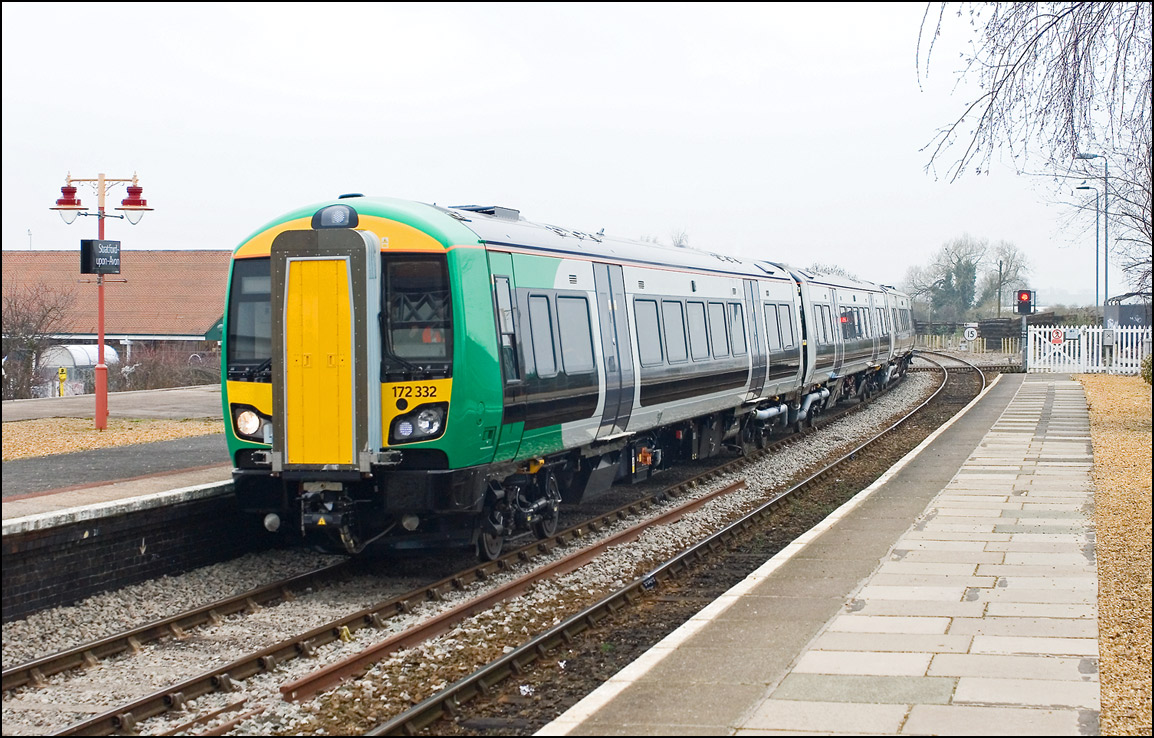 |
London Midland, who operate the suburban railway services throughout the West Midlands, are soon to replace their ageing and increasingly decrepit class 150 DMUs with new class 172/3 units. One of these, 172332 visited Stratford-upon-Avon for, I think, the first time on 15 March 2011 on a mileage accumulation and test run. The train is here seen arriving into platform 2 at Stratford as the usual arrival platform for trains from Birmingham, No.1, was under possession by a gang carrying out refurbishment work on the canopy. It is only within the past few months that train have been able to run directly into platforms 2 and 3, the required work having been carried out when the resignalling of the whole line took place late in 2010. It's a pity that the sun wasn't out at the time because it would have been in the perfect place for this move. |
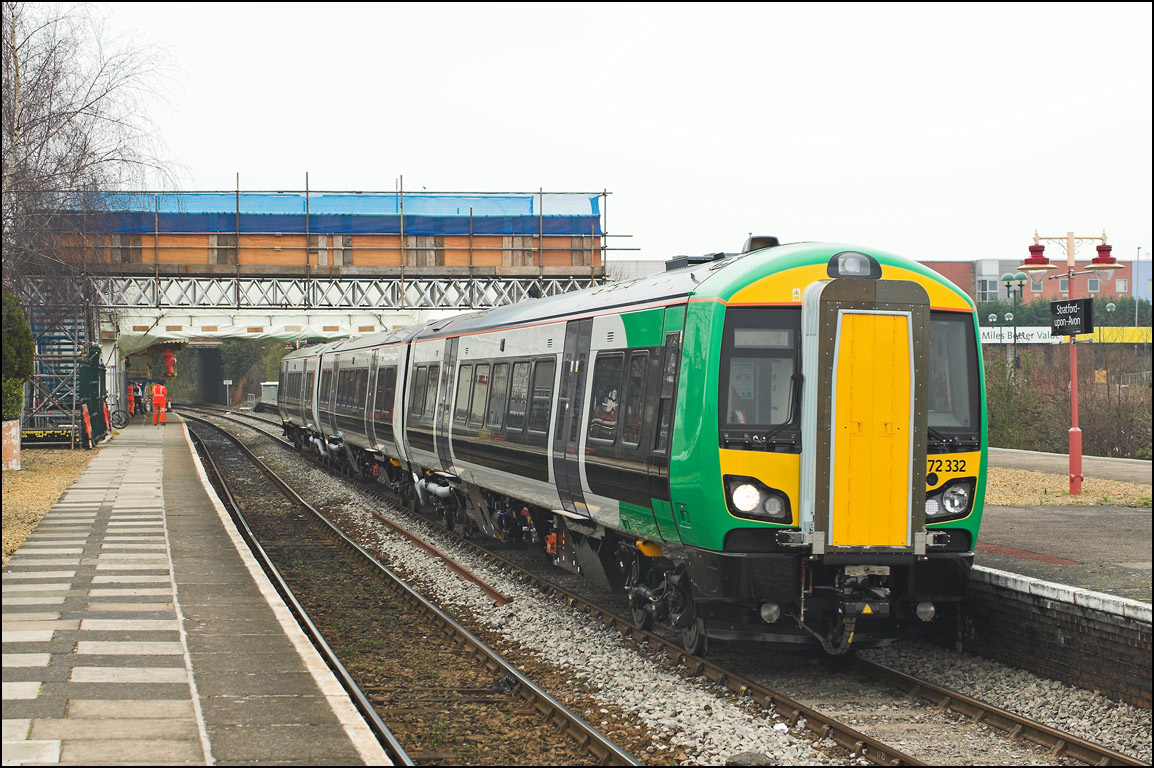 |
There was a turnround time of about ten minutes at Stratford-upon-Avon for 172332 before it retraced its tracks over the North Warwickshire Line to Tyseley, the main London Midland depot for the area. Here it is leaving the terminus with evidence of the work being carried out to the platform canopy and GWR footbridge, the latter having required the construction of a temporary footbridge so that passengers can access platforms 2 and 3. The corridor connection to be used when units are coupled will make revenue protection easier for the on-train staff and will generally increase the flexibility of the trains when compared to the existing class 150 DMUs. |
 |
Once 172332, as shown in the two pictures above, had returned to Tyseley on 15 March 2011 it was sent on another trip to Stratford-upon-Avon. The new unit is here seen passing Wilmcote station with its distinctive GWR footbridge and buildings before dropping down the 1/75 of Wilmcote Bank before having to wait outside the terminus for the 13.27 from Stratford to Stourbridge Junction to clear the crossover. The return of 172332 happened in an unfortunate patch of bright sunshine; unfortunate because at this time of day it is in exactly the wrong place for photography so I didn't bother with another picture. |
|
|
A couple of engineering trains were scheduled to visit the station at Stratford-upon-Avon during the week commencing 10 February 2013. The first of these was 6P50, the 19.52 from Bescot to Bearley Junction where an overnight possession was in force. The train, with 66161 in charge, arrived at the terminus a few minutes early at 21.41 as soon as the final London Midland service of the day had left. It ran into platform 2 and once the locomotive had run round its load of five autoballasters I had plenty of opportunities for some time exposures. The relatively new station lights at Stratford are quite bright so very long exposures are not necessary but there are a lot of extraneous light sources, most noticeably the lamp-post apparently growing on the roof of 66161! |
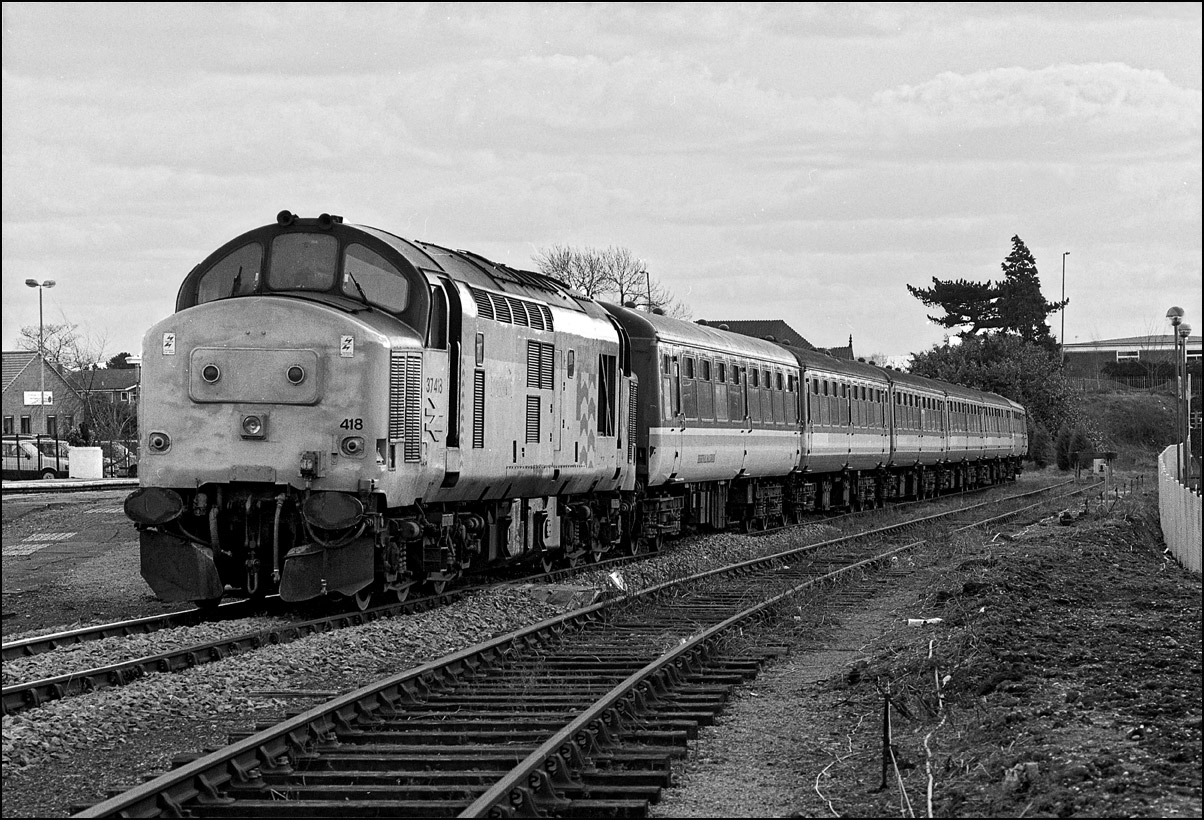 |
There have always been occasional excursions to Stratford for no other reason than to allow passengers to enjoy the historical aspects of the town or to simply enjoy a walk along the River Avon. This train, headed by 37418, came from Cardiff on 19 March 1994 and was organised by Regonal Railways. This day was notable in that a long-serving member of the station staff, Aubrey Wheeler, retired at the end of the afternoon shift and I was lucky enough to be invited into the staff room for a drink and to witness Aubrey's presentation by the Area Manager. I took advantage of the quiet spell outside to nip across the tracks and take this shot of the train standing on platform 3. Since then, the siding in the foreground has been lifted, this being done when the station area was resignalled. |
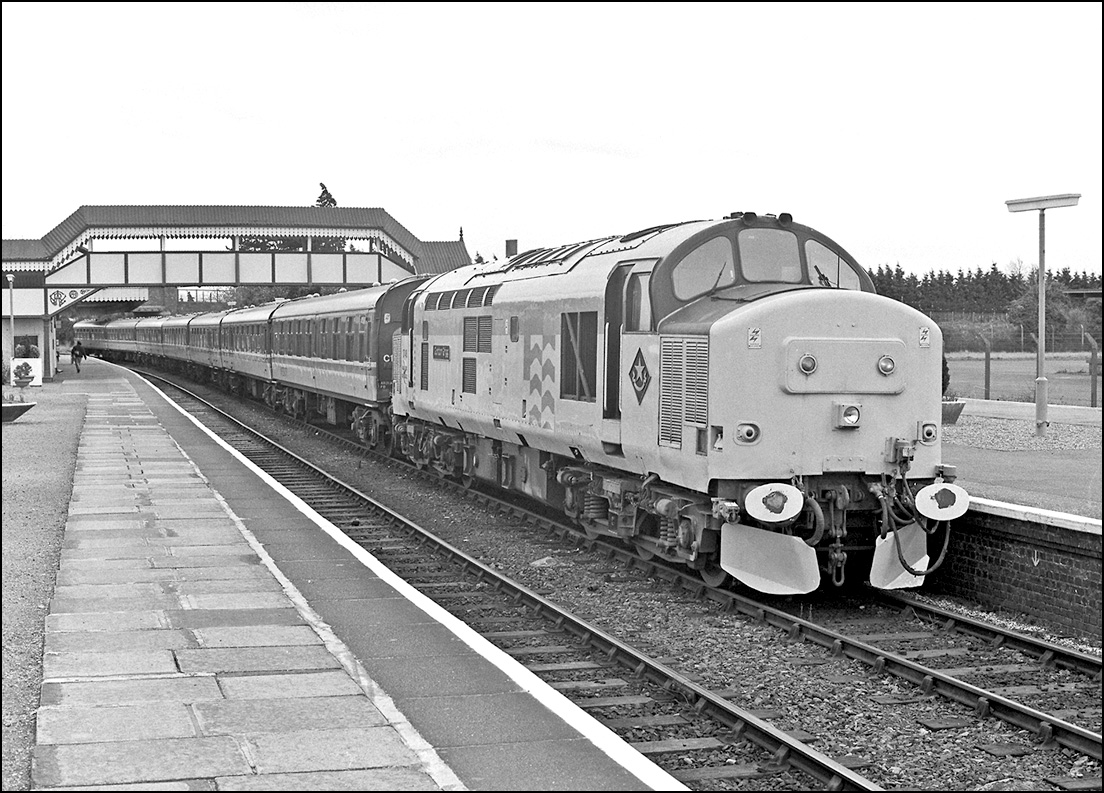 |
An earlier visit to Stratford by 37418 was under more unusual circumstances. The locomotive hauled a private charter to mark the retirement of a senior executive from his post within an international oil company. As an added point of interest, 37418 was renamed "Gordon Grigg" before the train departed from Kensington Olympia on 11 March 2002 form whence it ran to Stratford where the guests alighted and were ferried to a hotel on the outskirts of the town for lunch. The ensemble is here seen stabled in platform 2 headed by the specially cleaned ETH machine. |
_110392.jpg) |
Here is another view of 37418 at Stratford-upon-Avon showing the temporary nameplate, "Gordon Grigg", prior to the train's departure to London Paddington. A WR "bubble" car is about to enter the station forming a Leamington Spa to Stratford shuttle service. Sadly, the terminus currently has a very poor service to Leamington, just a basic 2 hourly train which manages to miss pretty much all of the Virgin Trains' connections both to the south and north. Perhaps with the change of franchise in 2007 this situation may change and Chiltern Trains will have some competition on the Leamington line with a consequent improvement in the service. |
|
|
The mainline registered 40145 hauled a railtour from Castleton in Lancashire to Stratford-upon-Avon on Saturday 1 October 2016. This was the first time that I had seen a member of the class here although while waiting for 1Z49's arrival was shown a picture of 40078 standing in the ertswhile goods loop on an Adex some years ago. I was mostly interested in taking an image of the train's arrival rather than anywhere else and as the day had been dull and wet thought that a shot from the new bridge as it ran into platform 2 would be the best bet. As I prepared to leave home for the short walk to the station the sun came out fully and stayed out when 172337 forming 2S42 from Stourbridge Junction arrived, also into platform 2 rather than its booked platform 1. This made me wonder if 40145 would go into P1 which, if the sun were out, would be absolutely spot on for the light. It didn't but the sun did find a small piece of cloud at just the right moment and so avoided one of those awful contre-jour pictures which tempt some into over-use of the shadows and highlights tool on Photoshop without altering the parameters governing the tonal width and radius of the settings resulting in very strange and over-processed-looking images. Given the circumstances I was reasonably happy with the result and noticed the faint rainbow in the right background only when uploading the image file. |
|
|
The monthly 1Q48 test train from Derby to Tyseley via Stratford-upon-Avon ran on 20 February 2018 but in a much more user-friendly set of timings than those to which we have bencome accustomed. The North Warwickshire Line was covered at the ideal time for a shot from the Edstone Aqueduct and I arrived in time to take an image of the preceding passenger train, 2S24, the 09.57 from Stourbridge Junction to Stratford-upon-Avon. This location is one of the few on the line where the sun is in a decent position and which has a good background rather than just some anonymous undergrowth. The sun was in cloud when I heard 172323 approaching but the brisk wind blew it away just in time. |
|
|
Those of us in the Warwickshire area who like to photograph test trains have been used to getting night shots of 1Q48 over the past months. It was pleasing to see that for the February 2018 run on the 20th of the month ran in a completely different schedule which saw it pass Henley-in-Arden at 11.13; the ideal for a shot from the cast-iron canal aqueduct at Edstone, just to the north of Bearley Junction. Quite a lot of cloud was blowing around in the breeze and just as with the preceding passenger train the whole scene was quite dark when the horns were blown for a foot crossing just around the corner. Luckily for the 4 of us waiting for a shot the sun found a good clear patch at just the right time and I took my first fully sunny shot of 67023 tnt 67027 on one of these trains. |
|
|
After 1Q48's first run of the day to Stratford-upon-Avon on 20 February 2018 and a layover of nearly 90 minutes in platform 3 it was scheduled to go south to Banbury via Bearley Junction and Hatton West and Station Junctions. I investigated a few roadside shots near West Junction but thought them too anonymous being little more than gaps in a lineside hedge. The roadbridge at Hatton station offered a much better view even though a multiple trunked tree hides the rear locomotive. With 67027 now leading the train is about to enter the Stratford branch platform where it was booked to stand for long enough to allow 2 passengers trains to pass including 168107 running from Marylebone to Birmingham Moor Street. |
|
|
Following the short stop at Banbury on 20 February 2018 1Q48 went to Stratford upon Avon again, this time entering platform 2. Although not brilliant for a shot on a sunny day it's infinitely better than P3. Unfortunately, the sun came out about 5 seconds too late and illuminated the rear locomotive and background very nicely but leaving 67023 in deep shade. I made do with this platform-edge shot as it stood alongside the freshly plated floral display provided by FOSS, the Friends of Stratford Station. I waited a few minutes for this image as a class 172 was in P1 alongside 1Q48 and this was a bit distracting. |
|
|
In perfect lighting conditions for the sludge-like colour scheme of WCRC diesel locomotives 57316 was photographed approaching its journey's end at Stratford-upon-Avon on 14 February 2018. I knew nothing about this train, 1Z97 from Chester-le-Street, until a couple of hours before its arrival time when a friend sent me a message to say that it was on the way. For those passengers who joined the train at Chester-le-Street they will have had, by the time they get home, 13 hours travelling for a 2 hour visit to Stratford; barelt time for a reasonable lunch. It sounds like purgatory to me... |
|
|
The return from Stratford-upon-Avon to Chester-le-Street was 1Z98 with a scheduled departure time of 16.40. On at least its third visit to the terminus 57313 provided the motive power and is pictured here shortly after arrival with stablemate 57316 on the other end. The building work in the background is a large complex of what will be a gloomy development of apartments on the site of the old cattle market. |
|
|
An unadvertised charter operated by WCRC ran from Scarborough to Stratford-upon-Avon on 16 August 2016 with 57313, 6 mixed livery coaches and 57316 making up the consist. Although I knew that the sun would be a bit too straight at Stratford station at the arrival time of just before 13.00 the uninspiring colour scheme of the locomotives led me to save some petrol and just make the walk there for an arrival photograph. The train was booked to arrive into platform 2 which it did about 5 minutes early. The return to Scarborough was to run to Birmingham along the North Warwickshire but on a sunny day around 16.30 even half-decent locations are few and far between so I shan't bother. |
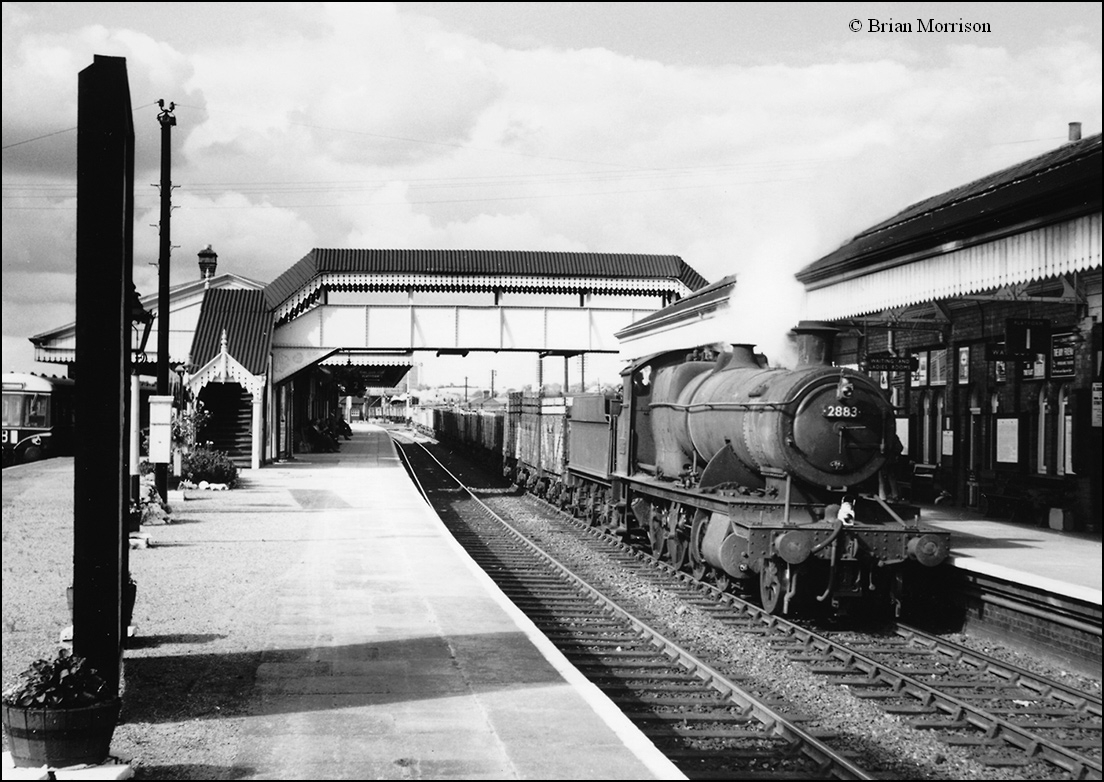 |
Despite the procession of passenger trains to and from the West Country and South Wales, there were still freight services for the hard-pressed signalmen to fit in on the route through Stratford. Here is GWR 2-8-0 2883 from Tondu restarting a freight for Severn Tunnel Junction and passing through Stratford station. Virtually all down freights would have been routed into the down goods loop for watering and to get them out of the way of passenger trains and the rear of this train can be seen snaking onto the main line as it leaves the loop. There was less flexibility for up trains and if a faster service was approaching from behind, a freight would have had to have been propelled into the refuge siding by the West Box after running into the station to clear the appropriate points. These immensely powerful freight locomotives sounded magnificent when working hard although at this point 2883 would have been running very slowly until the last wagons had cleared the loop. Even then, it would have run cautiously as the gates of the Evesham Road crossing a little further south may not have been opened and the distant signal would probably still have been at caution. Brian Morrison |
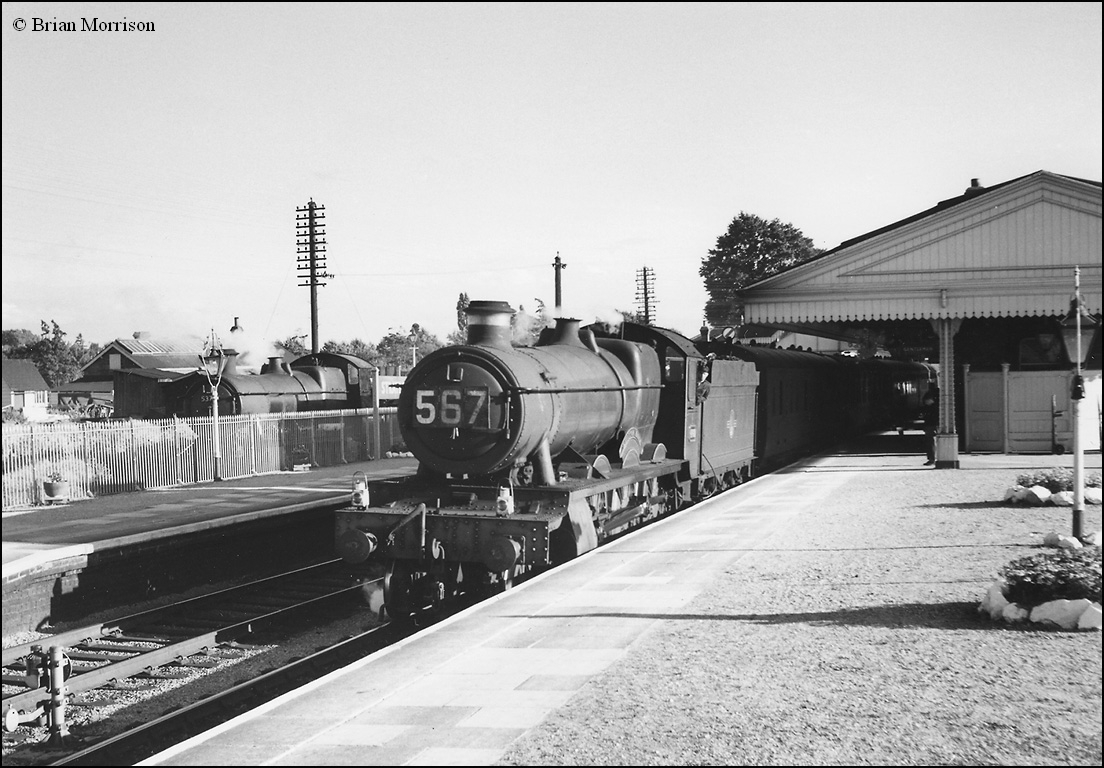 |
This photograph, also taken on 16 August 1958, shows 4968 Shotton Hall drawing to a halt at Stratford-upon-Avon with the 13.55 Paignton to Wolverhampton. The train would have drawn right to the end of the platform so that water could be taken, necessary because of the lack of water troughs both on the line from Cheltenham and the North Warwickshire line via Henley in Arden. If if had been routed via Hatton West and North Junctions this train would have passed over water troughs near Rowington, but I doubt it woould reached a sufficiently high speed after joining the GWR main line to have been able to have used them. A GWR 2-6-0 is visible in the cattle dock siding and this would have been ready either to pilot or bank the Wolverhampton-bound train, should it be over the weight limit for a single Hall on the climb to Wilmcote. if a pilot locomotive was taken, then its help would also have been appreciated on the 1/150 bank through Danzey on the North Warwickshire line. Judging by the aspect of the repeater signal poking over the top of the first coach, a southbound train is approaching. Brian Morrison |
 |
Going forward in time, here is a photograph of "Peak" class diesel 45020 leaving Stratford-upon-Avon with a train of empty coaching stock on 25 July 1984. If passengers had been on board, the train would have been required to shunt into platform 2 and would have left under the control of the tall upper quadrant starter visible to left of the lower quandrant inner home signal. This was because of the facing points at the end of platform 1 which have been clipped by the shunter just visible in the background. The details of the working are a little sketchy in my memory, but I think that the train was a Henley-in Arden to York advertised excursion and it had run to Stratford just so that the locomotive could run around the stock. I was standing on the World War II air-raid shelter which consisted of a large concrete pipe partially buried in the ground and covered with turf. This gave one a useful bit of extra height for a shot of something leaving the terminus in the morning and along with virtually everything else in the picture has now gone. The Ministry of Food cold store has been replaced by a Morrison's supermarket and the signalling, now of the 3 aspect electrical variety is controlled from Bearley Junction. |
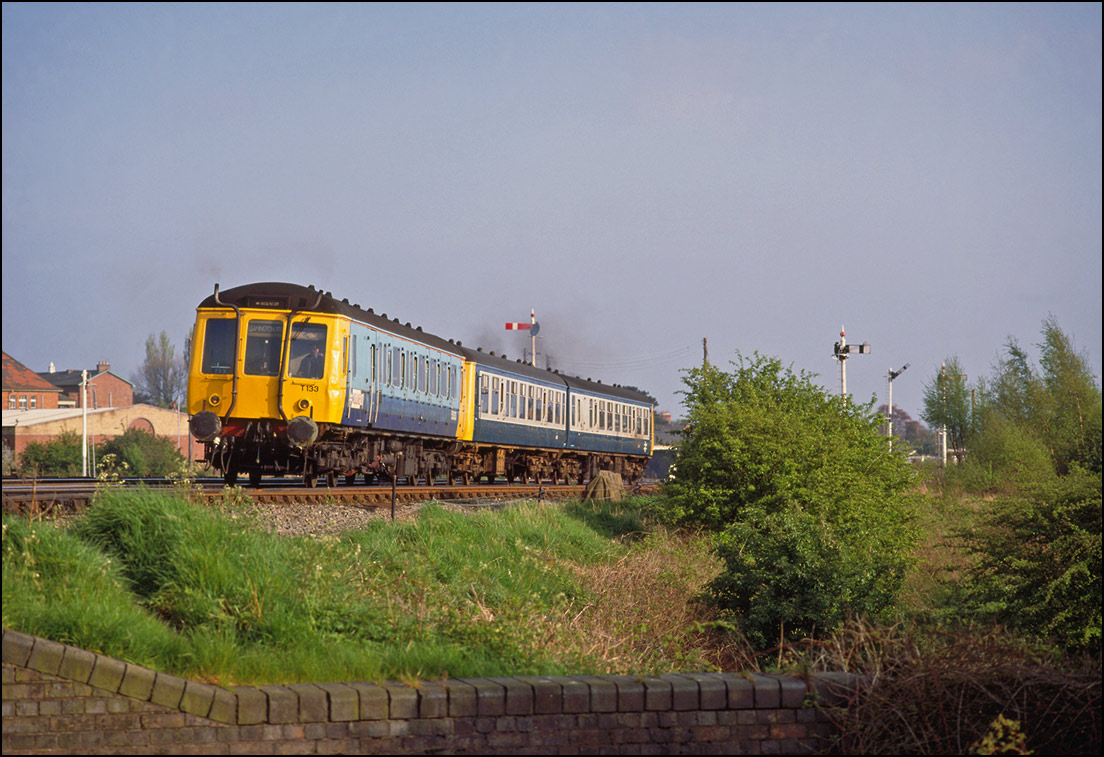 |
I always had a soft spot for the single unit "bubble cars" used for many years on the Stratford-upon-Avon to Leamington Spa trains. In the later years of its life, 50033 was repainted from the standard blue and grey into a livery based on the house colours of Midline, the marketing name for the Western MIdlands PTA. This picture shows the unit together with a class 114 two car set leaving Stratford with the 18.30 to Birmingham on 2 May 1994. The photograph was taken from the towing path of the local canal at a time when the vegetation had not encroached too much and the semaphore signalling was still in use. The train left from platform 1 which was controlled by the tall upper quadrant starter showing a clear aspect. Neither the single unit or the class 114 were to be seen here for much longer as their replacement, in the form of class 150 sprinters were coming into service. 645 |
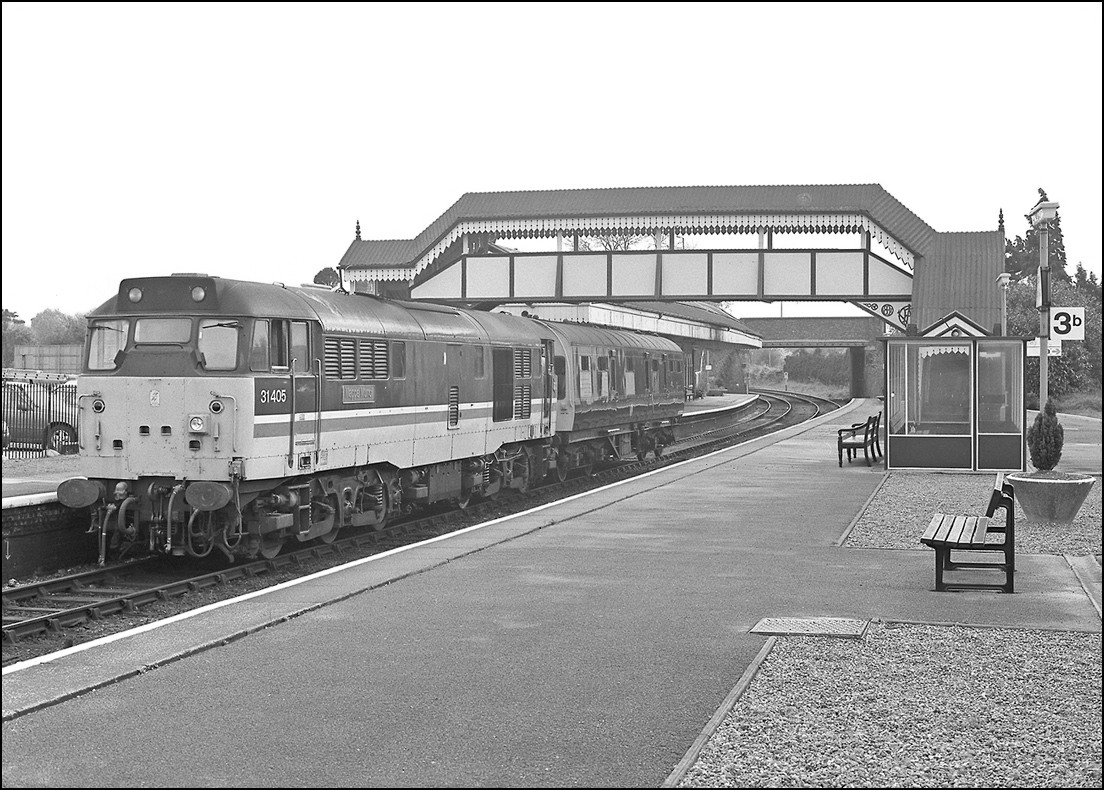 |
In common with the rest of the railway network, Stratford-upon-Avon has the occasional visit from an inspection saloon. The date of this trip was 30 April 1992 and the saloon was hauled by 31405, named Mappa Mundi. I was expecting the train to be propelled out of the station the driver using the controls in the saloon, but on this occasion 31405 ran aound the coach and headed it back towards Birmingham. Use this hyperlink for a closer view of saloon 45026 standing in platform 1 while 31405 runs-round. This picture was taken from approximately the spot on the platform as that of Shotton Hall, shown above. Time has change the scene quite markedly in the intervening years. |
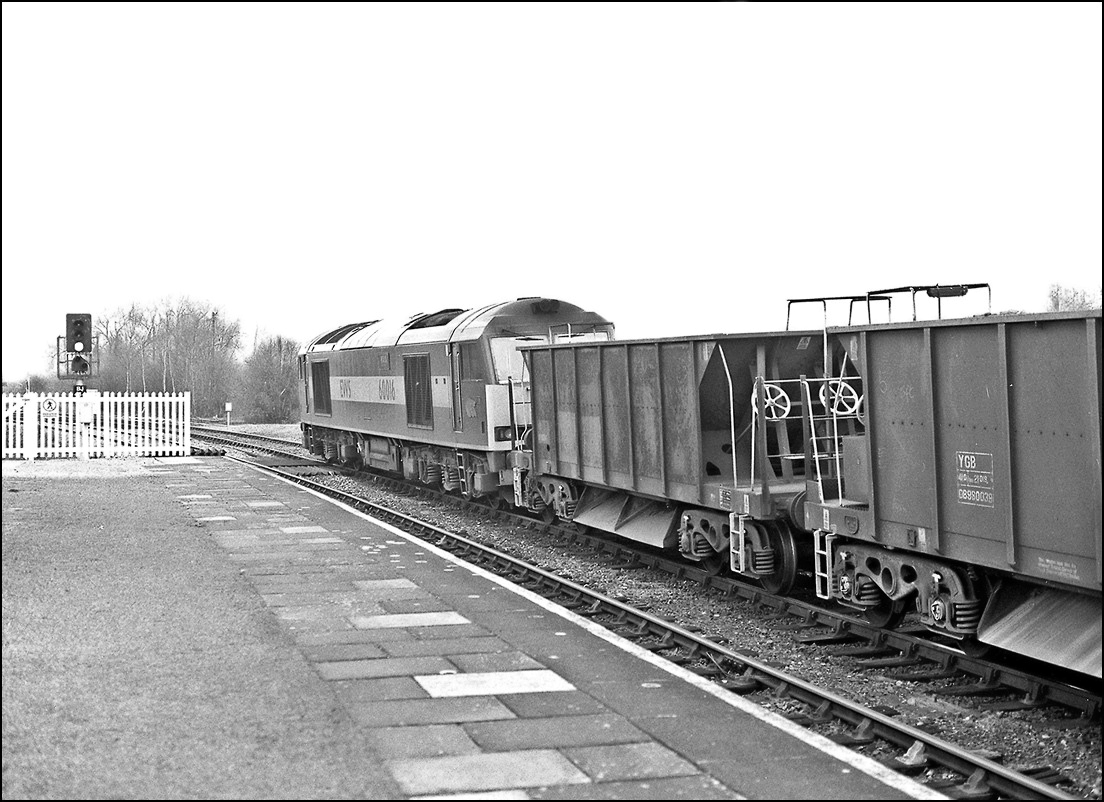 |
A more modern diesel locomotive seen at Stratford on Sunday 15 February 2004. 60014 was on the back of a ballast train from Bescot, hauled by 66089, which spent most of the day sitting in platform 1. Despite my best endeavours, I failed to gain permission to enter the closed station and photograph it, and had to wait until Monday morning to try for a photograph. Unfortunately, the train was pulling out as I arrived on platform 2 and this is the best I could manage. I think that this was the first class 60 to have entered Stratford station, although other members of the class have been as far as Bearley Junction on overnight engineering trains. Here is a shot of 66089 taken from the Alcester Road bridge during the occupation. This picture clearly shows the arrangement here which enables the release of locomotives from visiting trains. The backdrop to this picture has changed during the first part of 2007. The offices have been demolished to make way for sheltered accomodation for the elderly. |
|
|
Stratford-upon-Avon sees occasional test trains, sometimes locomotive hauled and sometimes formed of the Network Rail class 150 unit, 950001. On Thursday 9 January 2014 the latter worked a 2Q08 Tyseley to Derby via Stratford and as it was a sunny day I made my first photographic trip of 2014 by walking down down to the station to photograph 950001's arrival into platform 2. This image shows the unit drawing to a halt amidst various shadows prior to reversal and a trip to Hatton along the single track via Bearley Junction and Claverdon. The orange sheeting to the left of the train marks the site of a new bridge incorporating lifts for the use of disabled passengers. This will make a decent photograph of anything arriving in the terminus' platforms just about impossible. I should have thought that a better location for the new structure would have been adjacent to the Alcester Road bridge where disruption to operations when under construction would have been minimised and where users would have been under shelter for more of their trip to platforms 2 and 3. |
|
|
The test train 2Q08 had run to Stratford-upon-Avon down the North Warwickshire Line via Henley-in-Arden and its next trip was to Hatton, back to Stratford and then along the North Warwickshire to Birmingham before visiting Round Oak. I hadn't planned for a second shot but watched the train's progress on RTT and saw that it had arrived, as booked, into platform 3 at Hatton. It didn't report again and I have no idea what happened: did it fail or go off route under another schedule? Anyway, it left Stratford on time and made for a challengingly backlit picture alongside a pair of London Midland class 172/2 units waiting to run to Stourbridge Junction via Hatton North Junction and Solihull. |
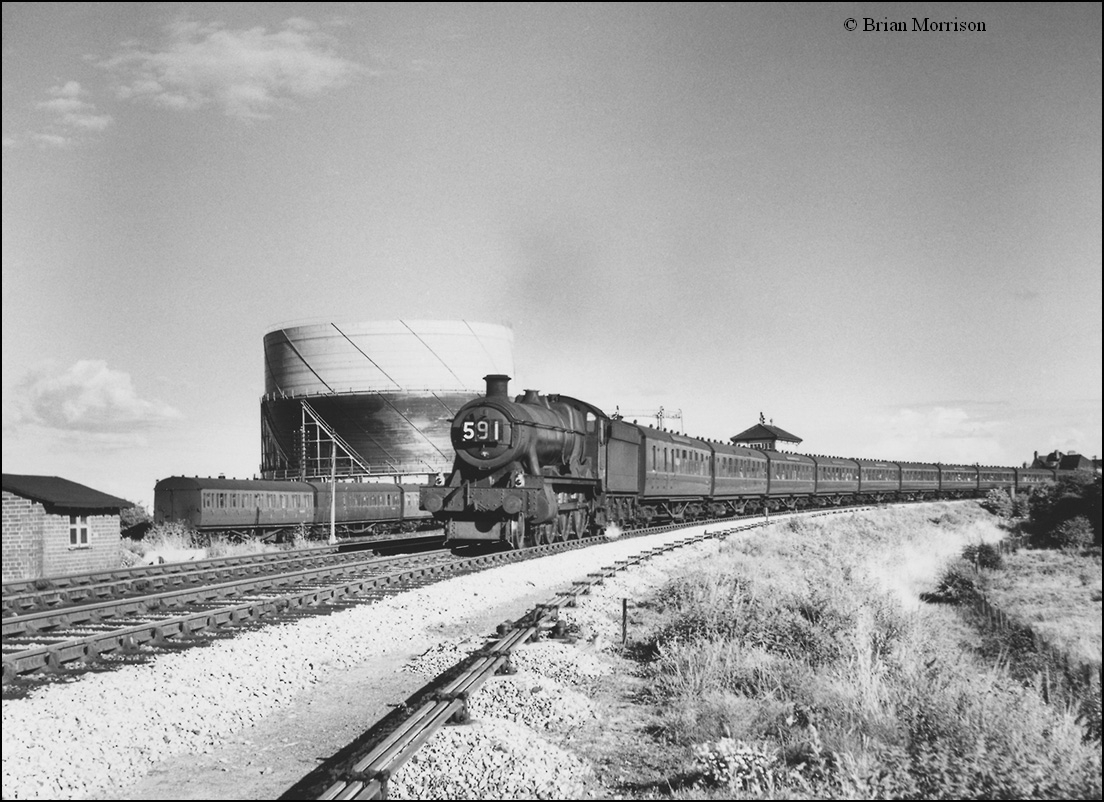 |
Here is one of Hawksworth's modified Halls, 6986 Rydal Hall, shortly after leaving Stratford and passing the East Box having just crossed the Stratford-upon-Avon canal. This train was neither piloted or banked, which was quite unusual on Saturday evenings; there was a northbound train every few minutes in the peak hour between 6pm and 7pm and the assisting locomotive gave a bit of extra speed on the bank to Wilmcote, plus a bit of added security. Given the almost complete lack of exhaust from the locomotive, the evening of 16 August 1958 must been a hot one! To the left of the locomotive is a rake of maroon stock stabled in the siding alongside the Down Goods Loop, this appearing to be a short non-corridor set used on one of the local services perhaps to Honeybourne or Worcester. The gasholders were fed from the municipal gasworks, which was just out of site to the left of the picture. Regular trains of coal fed the works, there being a dedicated long siding from the yard. I can well remember the awful smell generated by the gasworks when my father and I fished in the canal; it was an unfortunate coincidence that the best fishing spots were close to the source of smell...Brian Morrison |
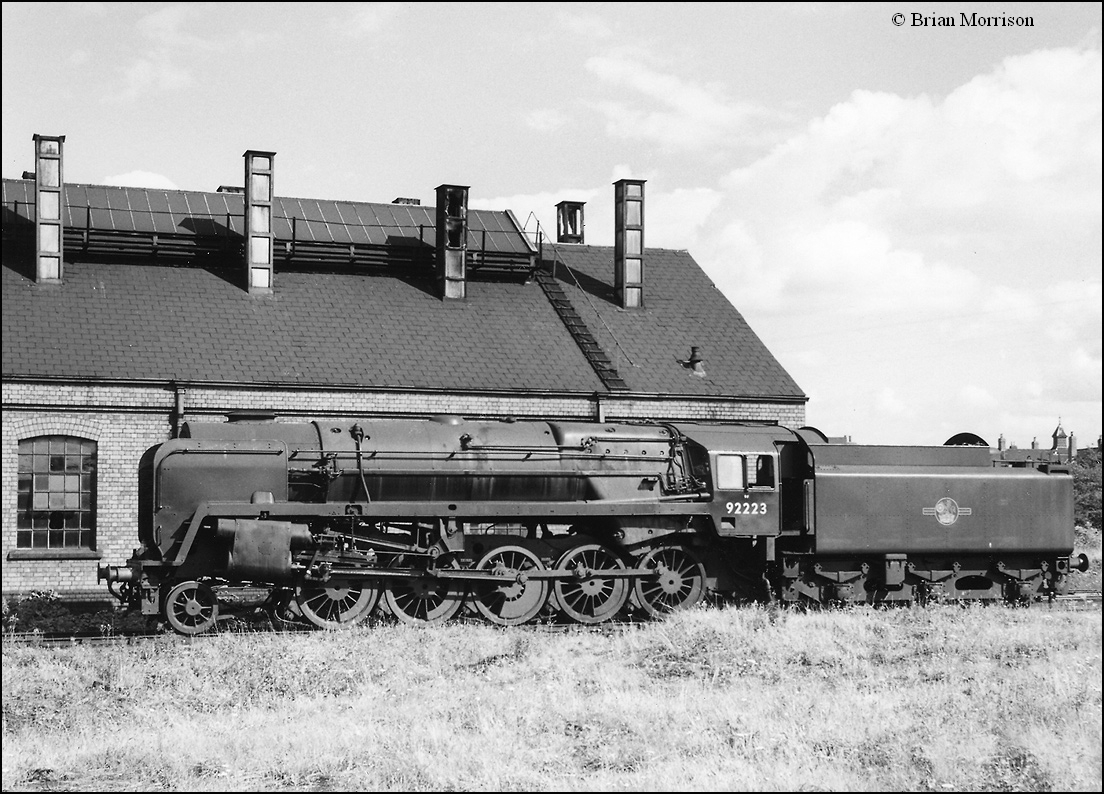 |
Stratford-upon-Avon's locomotive shed, 84E, was a sub-shed of Tyseley. It was situated on the down side of the main line from which it had no direct connection. Access to the shed involved several reversal moves and must have been the bane of the crews' lives. There was no turntable at Stratford because of the existence of triangular junctions both at Old Town and Bearley, although the latter was the more frequently used. This photograph shpws 9F 92223 dead outside the shed on 16 August 1958. The presence of such a large engine here was unusual and I imagine that its presence was due to a failure of some sort. Plans currently exist locally for a new steam servicing and visitor facility to be built on roughly the site of the original to relieve some of the pressure from Tyseley and to enable the servicing of visiting locomotives. There are certain problems around vehicular access and egress to and from the site and the proposal may require its plans to be re-drawn to allow completion of the scheme. Brian Morrison |
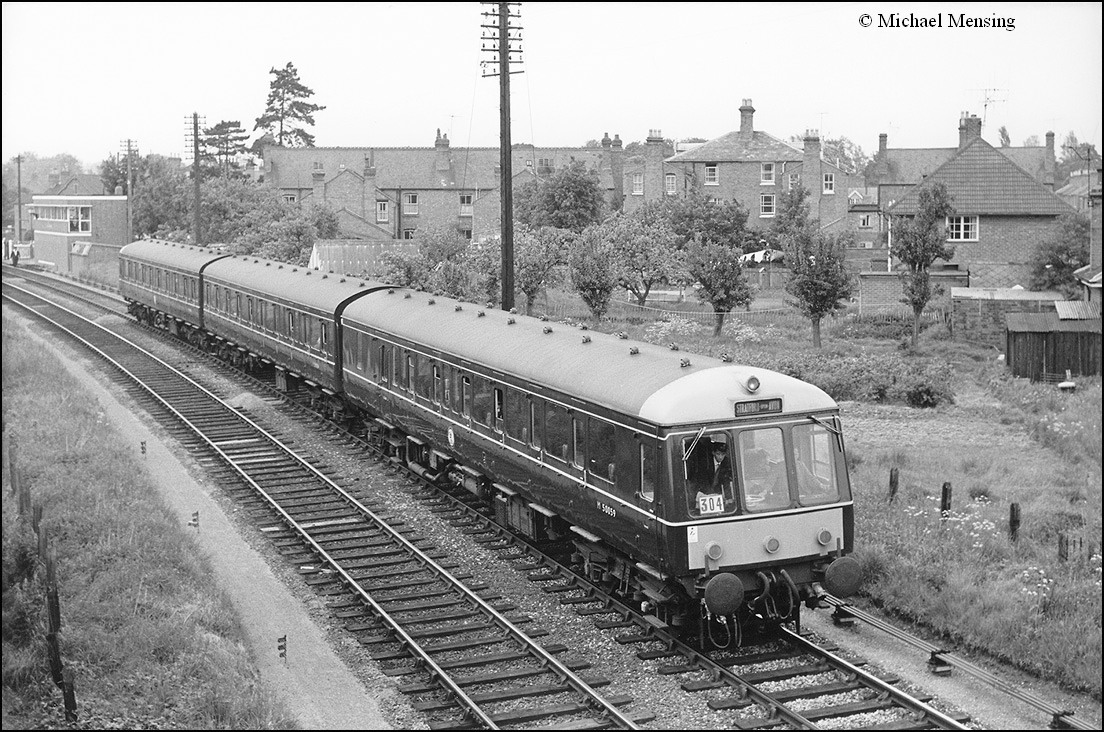 |
The line to the south of Stratford-upon-Avon was blessed with only one overbridge between the station and Long Marston, excluding where the Stratford-upon-Avon and Midland Junction Railway (SMJ) line crossed the GWR. The bridge was that carrying Sanctus Road, formerly Sancta Lane, near the site of the first station to reach the town from the south. This photograph of a three car Western Region suburban DMU forming the 6.03pm Stratford to Honeybourne was taken from this bridge on 23 May 1964. Most of the main line expresses had been diverted away from the line by this time but the local services continued as did both diverted passenger and freight trains. Clearly visible in the background is the 1960-built signalbox, protecting the Evesham Road level crossing. This new box also controlled the recently installed but soon-to-close curve from the SMJ used by freight services from the junction at Fenny Compton. I wonder if the guard is standing up to change the destination blind to the correct setting? Michael Mensing |
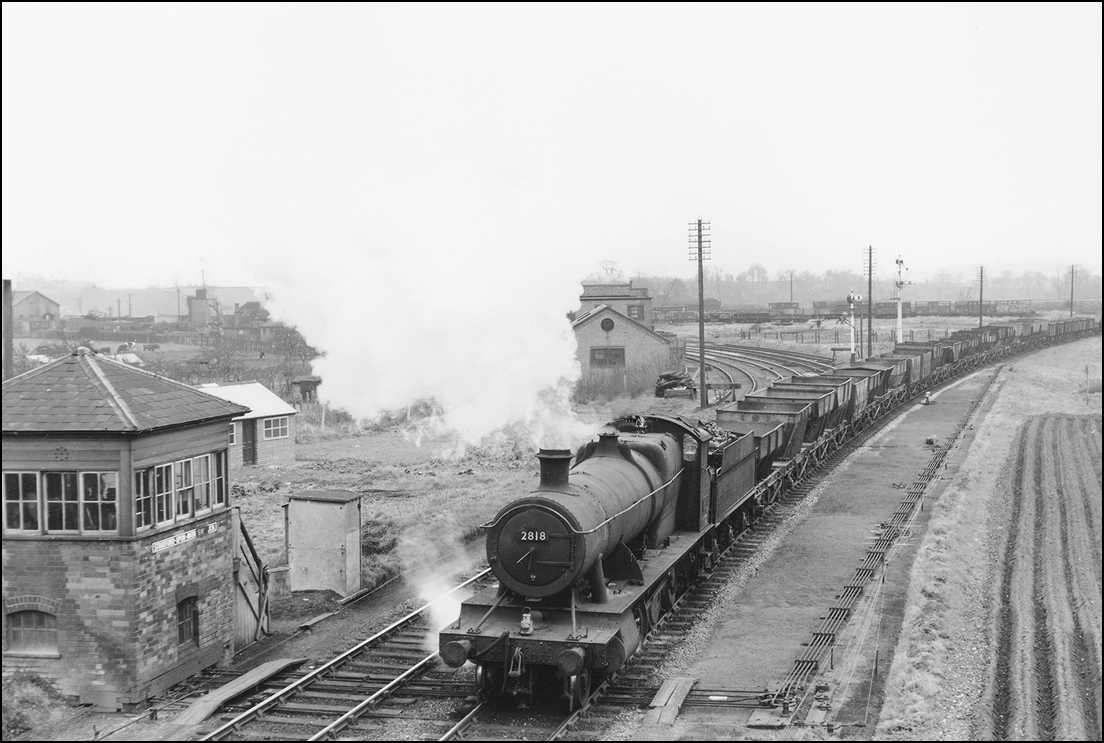 |
The origin of this photograph is slightly mysterious. I found the print amongst a pile of family pictures taken my late father who although an accomplished photographer had no real interest in railways. I must assume that he took the shot whilst out for a walk and when he happened to have his folding camera, which took 9 pictures to a 120 roll, in his canvas bag. I still have the camera and have used it once, althought the maximum shutter speed of 1/100 was a little limiting. The lens is of excellent quality and as it likely that the train featured would be moving very slowly towards the Evesham Road level crossing after a signal check there is no noticeable blur. The date is unknown, but it is probably from the late 1950s when the signal box appearing on the left of the locomotive was still in use to control the spur round to the SMJ. Although it was a misty day, quite a lot of detail of the SMJ's buildings can be seen in the background. When the box here shown was replaced in 1960, the curve round to the SMJ was singled and became rarely used. The SMJ to the west of Stratford was closed at about the same time and the new "Racecourse Curve" was brought into use, as described below. |
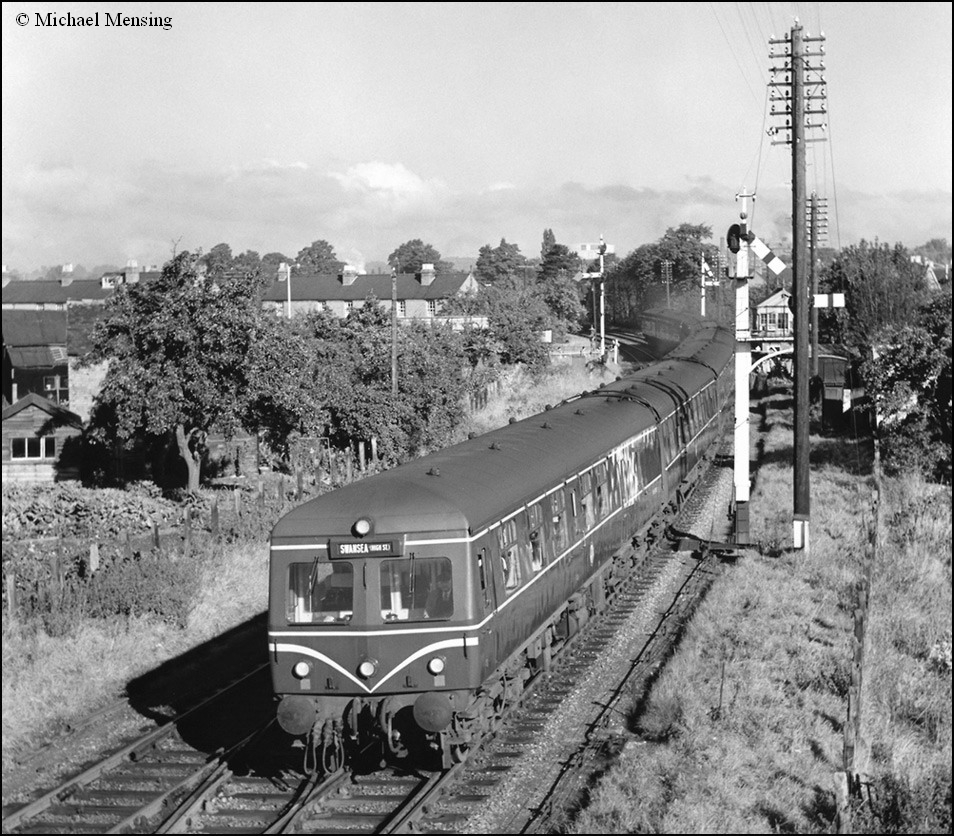 |
This earlier picture from Sanctus Road, shot on Sunday 12 October 1958, was taken from a slightly tighter angle than the one below and the GWR signalbox at the Evesham Road crossing is clearly visible. The train is the 09.00 Birmingham Snow Hill to Swansea High Street train formed of 3 x 3-car Cross-Country DMUs - very much the norm on some services at this date. Stratford's gas holders can just be made out over the signal on the up line protecting the crossing and the works supplying them can just be made out immediately to the right of the first telegraph post. The leading unit has had the "speed whisker" applied; this being an earlier version of the yellow warning panel and the later full yellow end designed to improve track safety for permanent way workers more used to a much noisier form of traction. In my opinion, these whiskers enhanced the look of the units and nicely contrasted with the green livery which, arguably, was the finest carried by any DMU. Michael Mensing |
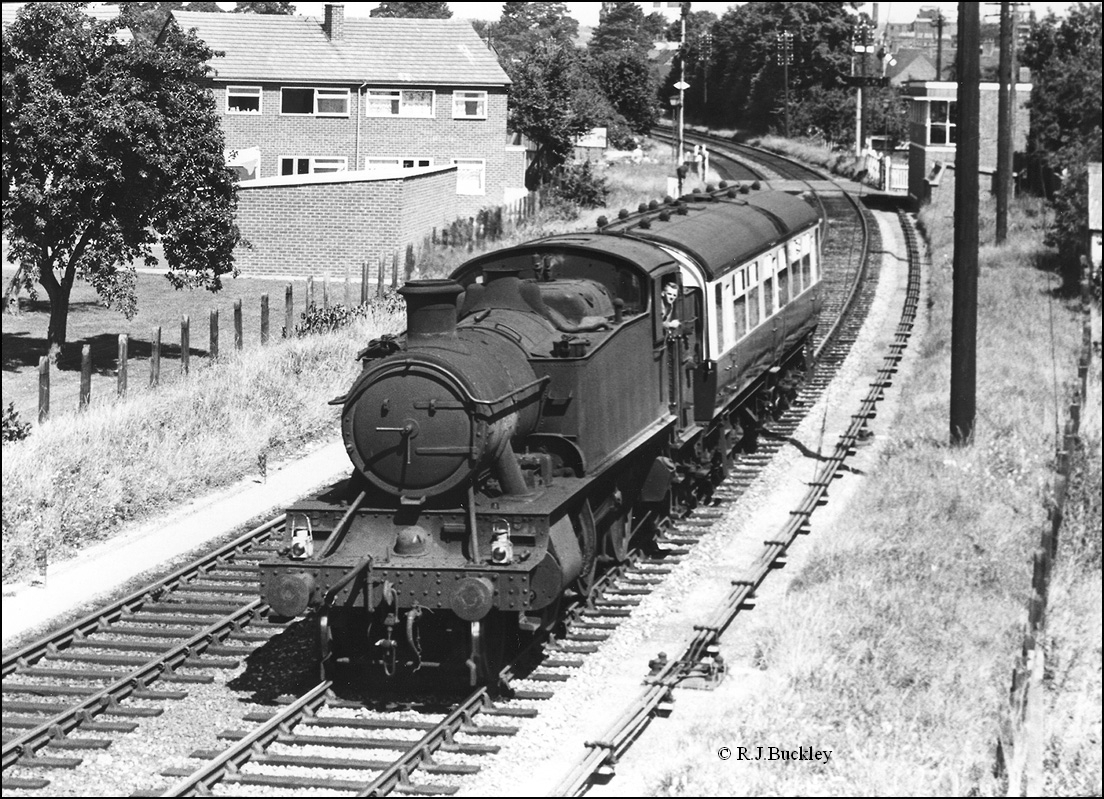 |
This picture dates from 30 July 1964 and shows the difference in the signalling layour near Sanctus Road once the 1960 signalbox was operational. The splitting bracket signal controlling the junction to the SMJ is now on the north side of the level crossing and, unusually, the arm showing that the road has been set for the SMJ is lowered, the train being routed to Fenny Compton via Kineton. The officers' inspection salon is hauled by small prairie tank No. 4165 which, by this time, had lost its smokebox number plate. It is apparent that some land has been sold in the left-hand background and a pair of semi-detached houses has been built on the site. R.J.Buckley |
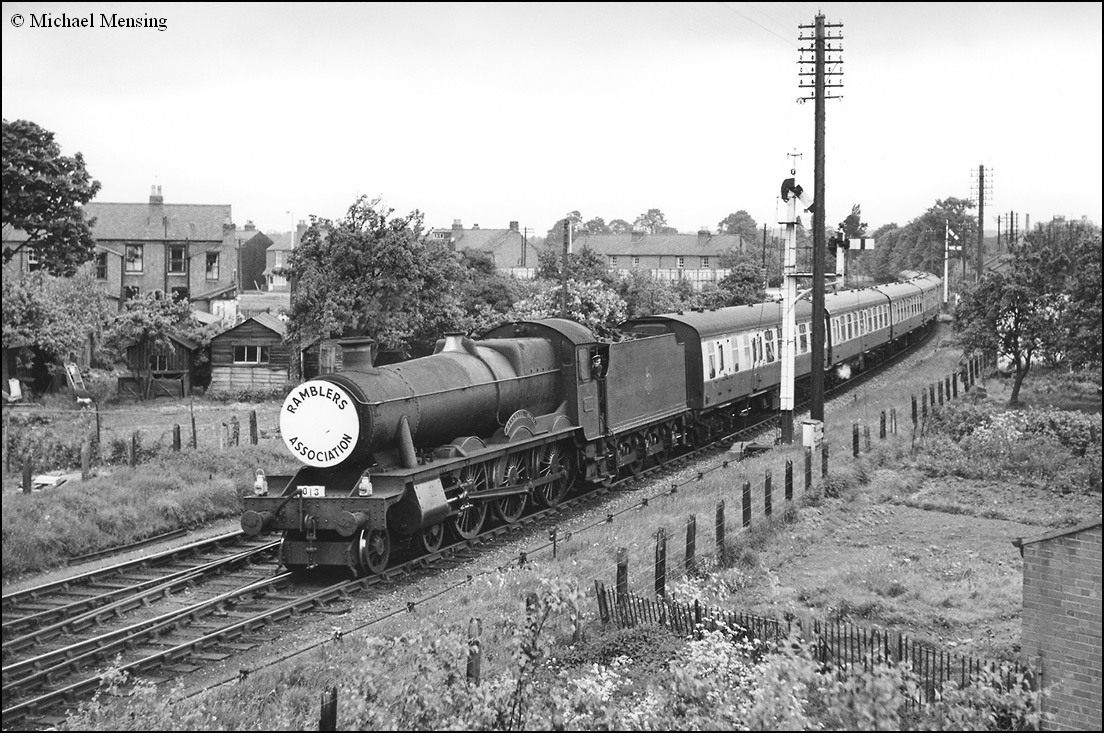 |
I can well imagine, and would enjoy, the outcry from photographers should a preserved locomotive carry a headboard such as this today! This marvellous picture was taken on Sunday 18 May 1958 and shows Modified Hall 7908 Henshall Hall shortly after leaving Stratford-upon-Avon with a Ramblers Association excursion from Birmingham Snow Hill to Gloucester. It was taken from the other side of Sanctus Road bridge than that from which the photograph of the DMU shown above was shot and the vegetation hides the older GWR-style signalbox that was still extant on this date. The splitting outer home signal controls the rarely used junction with the SMJ. This original junction was further to the north than the 1960 built curve and went round to the Old Town station in a northerly direction. Stratford-upon-Avon's GWR station had no turntable and it would have been possible to have used the triangular junction at Old Town to turn locomotives although, in my limited experience, the triangle which then existed at Bearley was more often used. Michael Mensing |
 |
This is the scene from the bridge over Sanctus Road on 7 February 2007, some 30 years after the railway was dismantled. It proved slightly more difficult than I envisaged to find some reference points from Michael's photograph of Henshall Hall and it was not possible to use an exactly similar angle because of the large silver birch tree. The row of cottages below the red crane is about the best reference although the row of Leylandii almost obscure them. The crane is working on a building site alongside the line immediately to the south of the station, almost opposite the viewpoint from which the first photograph in the section was taken. There are periodical letters in the Stratford-upon-Avon local newspaper demanding that the line here is re-opened, although for what purpose is not too clear. If one examines the layout of the roundabout in the background of this photograph, it is clear that space has been left for a single track railway to be constructed should it become strategically necessary. |
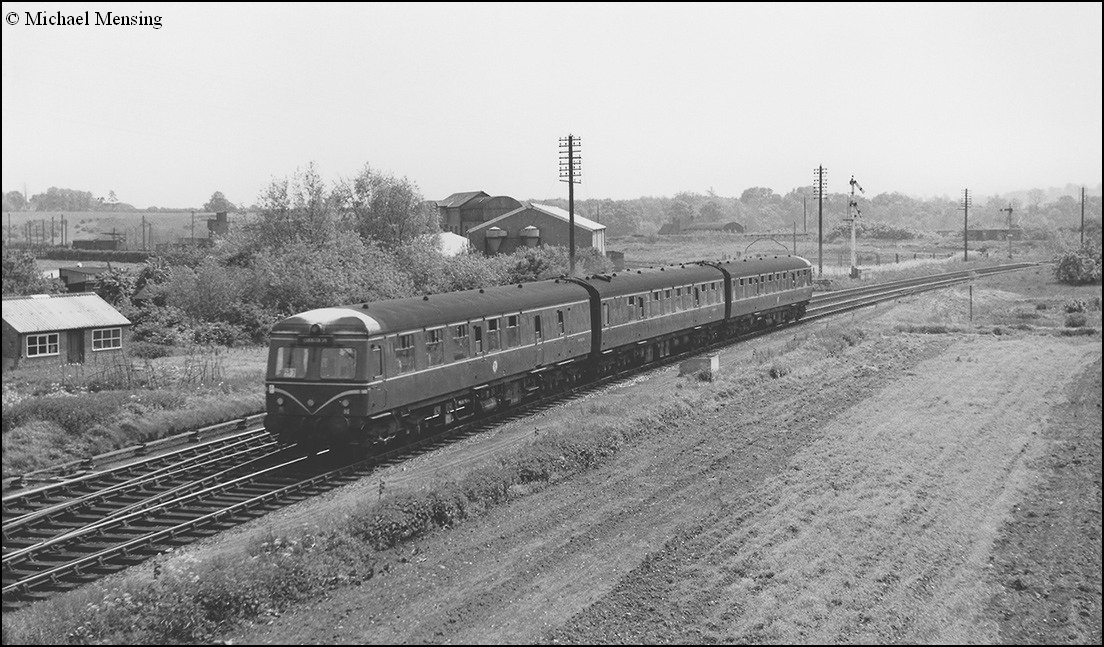 |
This was the view looking south from the Sanctus Road overbridge on 25 May 1963. It shows a 3-car Swindon-built Cross-Country DMU forming the 13.25 Worcester Shrub Hill to Leamington Spa (General) heading north towards Stratford-upon-Avon. Just visible above the rear two cars is the connection to the SMJ's Old Town station, a loading gauge on an adjacent siding and a multitude of long-gone buildings. There was, until 1960, a signalbox controlling the junction with the SMJ at this location, but this was made redundant when the new Evesham Crossing Box was commissioned. The old box was switched out for much of the time, but was brought into use on summer Saturdays to form an additional block post in order to cope with the very heavy traffic on such days. It is interesting to note that the points working the junction were still manually operated; those used for the spur from the SMJ were power operated in view of the distances involved, but even so, the SMJ junction was quite a way from the box and it must have been a heavy pull for signalman. Michael Mensing |
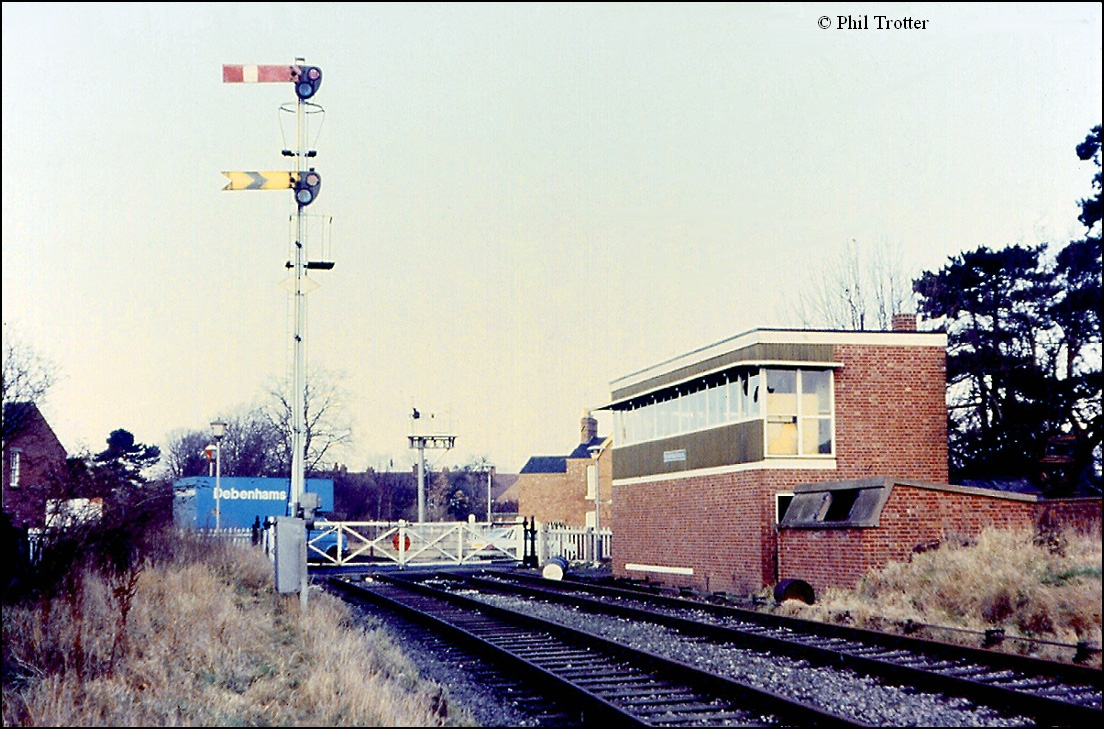 |
I have mentioned the Evesham Road Crossing Box in several of the captions to this section. Here is a photograph of the box taken after closure of the line south of Stratford-upon-Avon although before the signalling was dismantled. This is the 1960-built structure which replaced the earlier GWR building; the former box was much smaller and sat closer to the road than the new one. I have very fond memories of the road crossing here as it lay on my way to school from 1960 to 1971, although I never plucked up courage to ask if I might visit it. The gates were operated by the traditional capstan and I always hoped to see the signalman standing over the wheel carefully watching for a gap in the traffic as this meant that a train was imminent. There was a morning coal train which ran between 08.30 and 09.00 and I was just occasionally late for school when I had to wait for this to cross the road. I sometimes waited even if the gates were open when I arrived...Phil Trotter |
 |
Here is a closer view of the Evesham Road Crossing Box. In this picture the rods and cranks which operated the crossing gates can clearly be seen as can one or two signal wires. Although the line had been closed, the signalling was still intact at this time as occasional demolition trains were scheduled and these would would have occasioned the box to be be specially opened. This box was much larger than the previous one because it had to control the 1960-built connection from the SMJ to the GWR's Cheltenham line and therefore needed a larger frame. Unusually for 1960, the signalman here would not have been able to see the trains on this new curve; all movements were controlled by electrically operated points and signals, with track circuits giving the location of the trains. Phil Trotter |
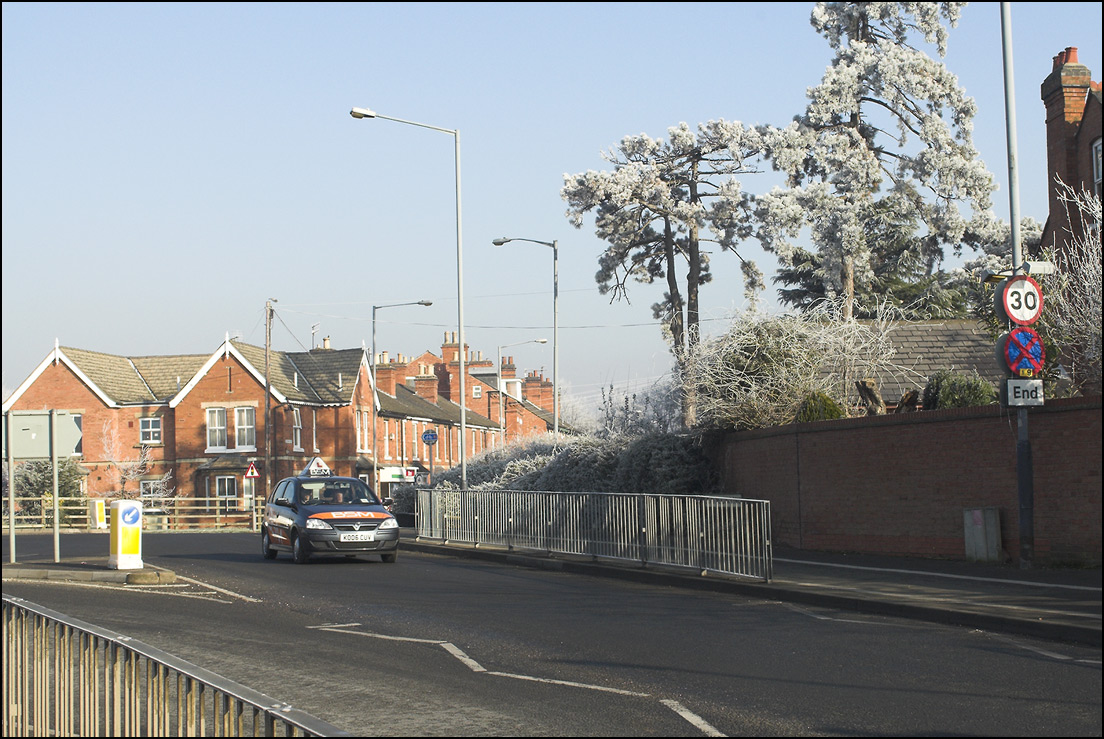 |
There is little to show that this is the same location as the picture of Evesham Road Crossing Box above. The only real reference point is the chimney in the top right hand corner; this belongs to a house just around the corner and it is a moot point whether the busy new road is more acceptable than the railway line to the owners of this property. |
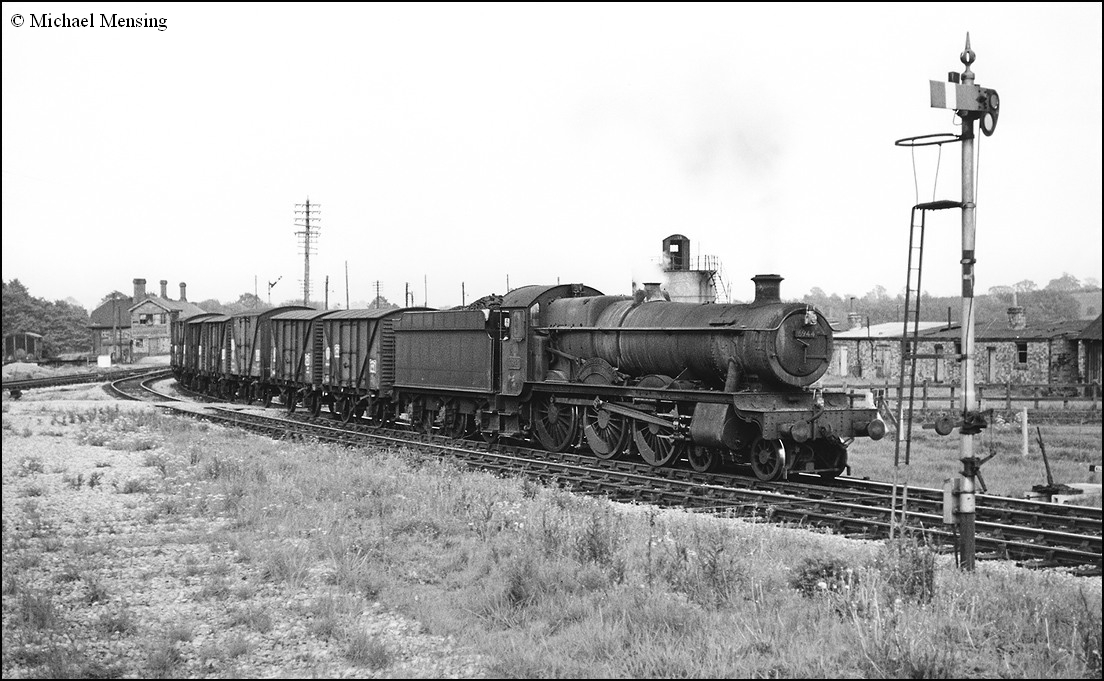 |
I mentioned above the 1960 curve built from the SMJ to the GWR Cheltenham line. Here is 6944 Fledborough Hall on the curve having just passed through the SMJ's Old Town station. Despite the limitations of a single track railway from Fenny Compton to Stratford-upon-Avon, this spur was heavily used for some 5 years after it was built. The route had value in that the stiff climb of Hatton Bank was avoided for northbound trains and it offered a more direct line for the iron ore trains from Banbury to South Wales. It was also valuable for any trains from the Oxford line needing access to the Cheltenham line as there was no direct connection between the two at Honeybourne. Any train running from Oxford to Cheltenham via Honeybourne would have had to make a long propelling move of almost a mile from Honeybourne station along the East Loop so that the locomotive was clear of the points by the East Loop signalbox. The train was then able to be routed over the junction to gain access to the Cheltenham line. The was clearly a procedure fraught with difficulty and which had the potential to cause delays and which was avoided by running from Fenny Compton to Stratford via the SMJ and the new spur. Michael Mensing |
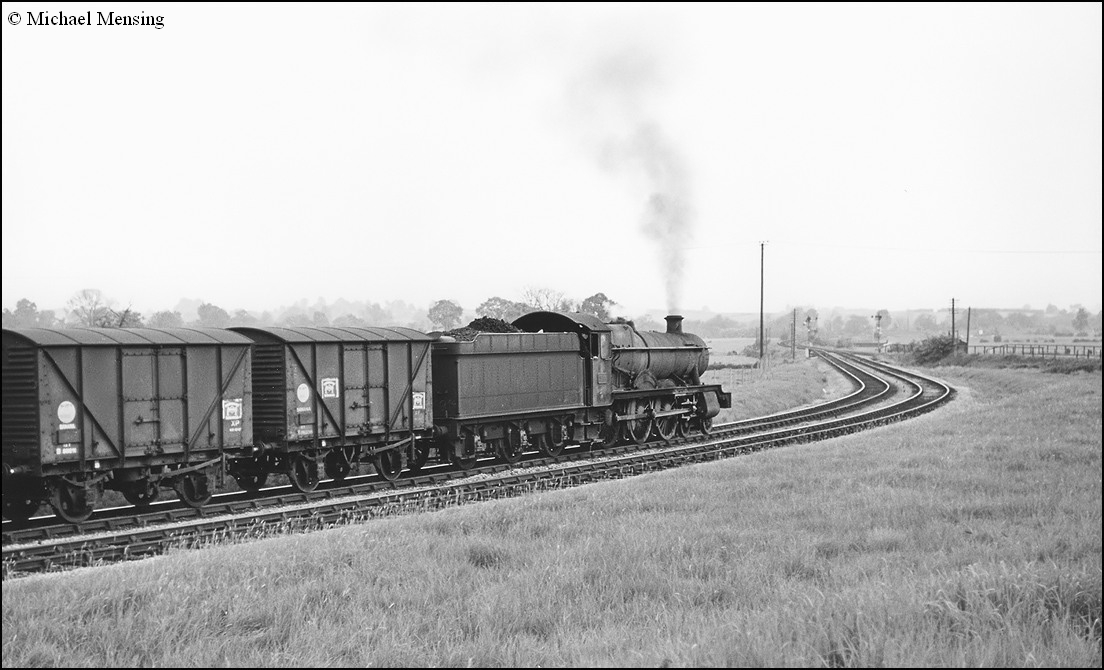 |
Turning around from the viewpoint used for the photograph above, here is 6944 going away under clear signals and about to join the GWR Cheltenham line. The junction was just to the south of the Racecourse platforms and the railings of this can just be made out to the right of the junction. It is interesting to note how close to the junction are the signals protecting it. These days, a much greater distance is required as a safety margin. It is very difficult to see any evidence of the line today; the main line is a popular walking and cycle path but all traces of the spur has gone. The site of the SMJ station has been obliterated by the building of modern housing and the trackbed has been used to construct a road to bypass the town for traffic coming from the Shipston-on-Stour direction. Michael Mensing |
 |
Going a little further south from the photograph above, here is one of the locomotives I saw more than most, Modified Hall 7918 Rhose Wood Hall, about to pass the platforms at Stratford-upon-Avon Racecourse which, on this day had been open for business. The train is the 17.45 Birmingham Snow Hill to Evesham service on 23 May 1964 with its usual load of six assorted carriages. The spur from the SMJ joins this line at the other end of the station and the footpath visible under the fourth coach is that to be seen behind the 3-car DMU in the picture of the northbound train taken from Sanctus Road. Michael Mensing |
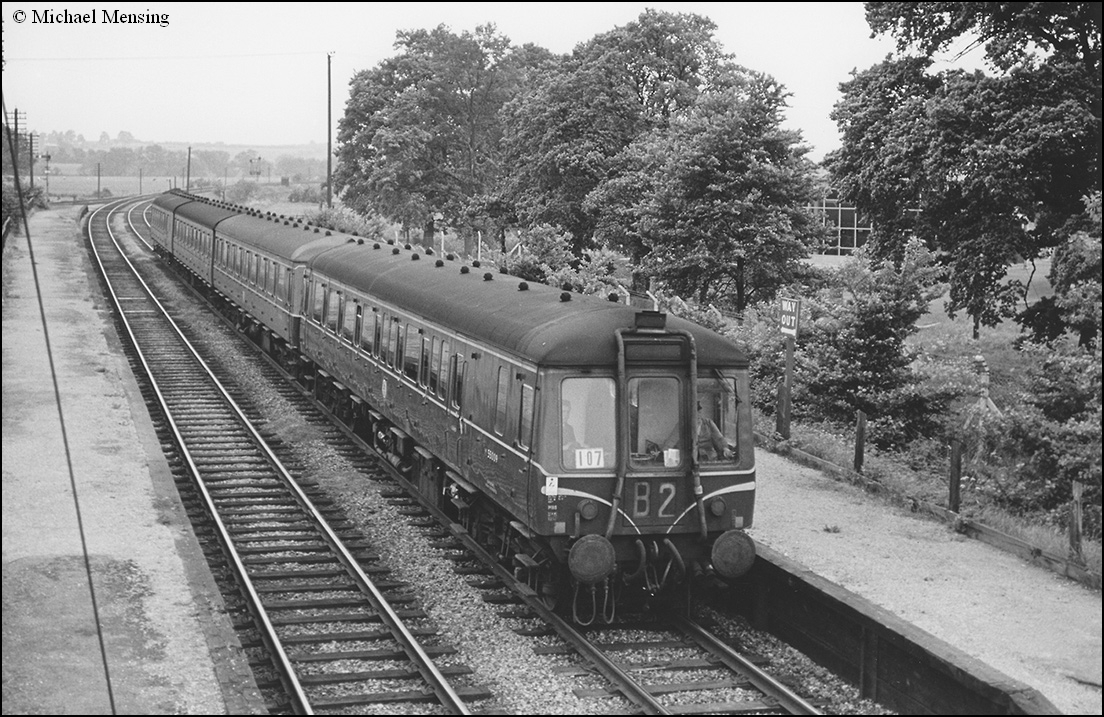 |
This is the view in the opposite direction from the one above on 23 May 1964. The northbound DMU, headed by single unit 55009 which was still in use in the area until withdrawal in the 1990s, is the 17.50 Worcester Shrub Hill to Stratford-upon-Avon. The train is passing through the Racecourse Station and the spur to the SMJ can be seen at the platform end and the splitting signal controlling the junction is visible above the third coach. The trackbed here is now a cycleway and footpath, but is very difficult to recognise any features to make an up-to-date comparison. Michael Mensing |
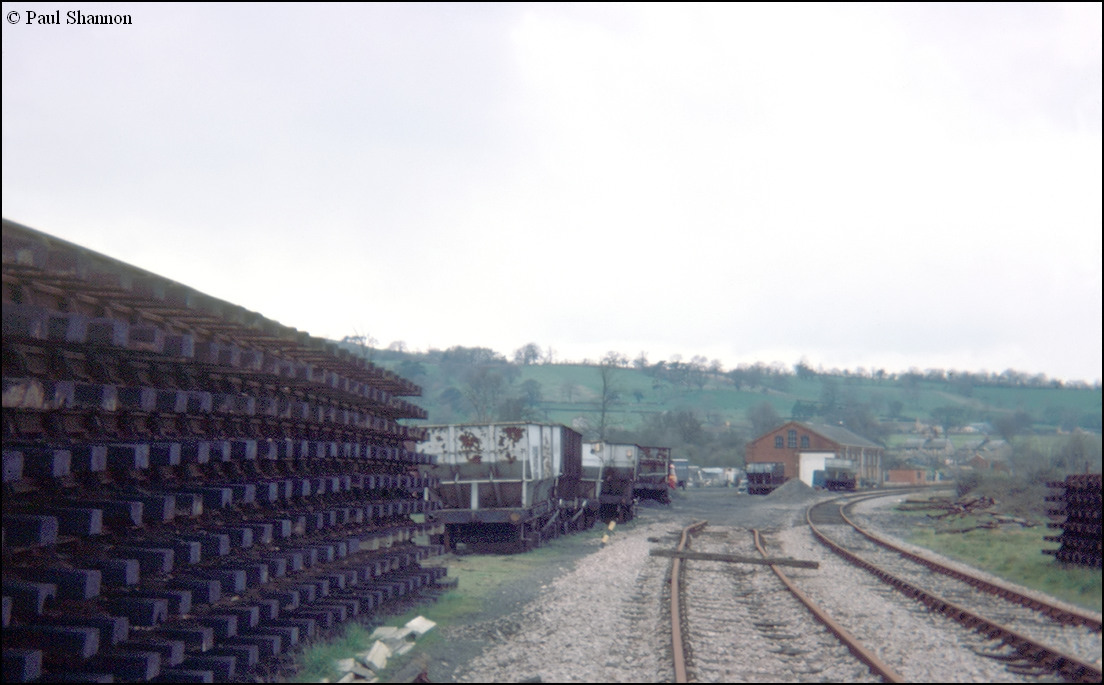 |
This is the sad result of the derailment at Winchcombe which sounded the death knell of the line from Stratford-upon-Avon to Cheltenham. On 25 August 1976 one of the wagons, an ex-LNER vehicle, in a southbound coal train was derailed, with several others becoming involved and doing severe damage to the track. Although one of the tracks received work from BR engineers and was fit to be used, that decision had been made to close the line. In this view, the derailed wagons were yet to be removed as are the piles of track panels. Paul Shannon |


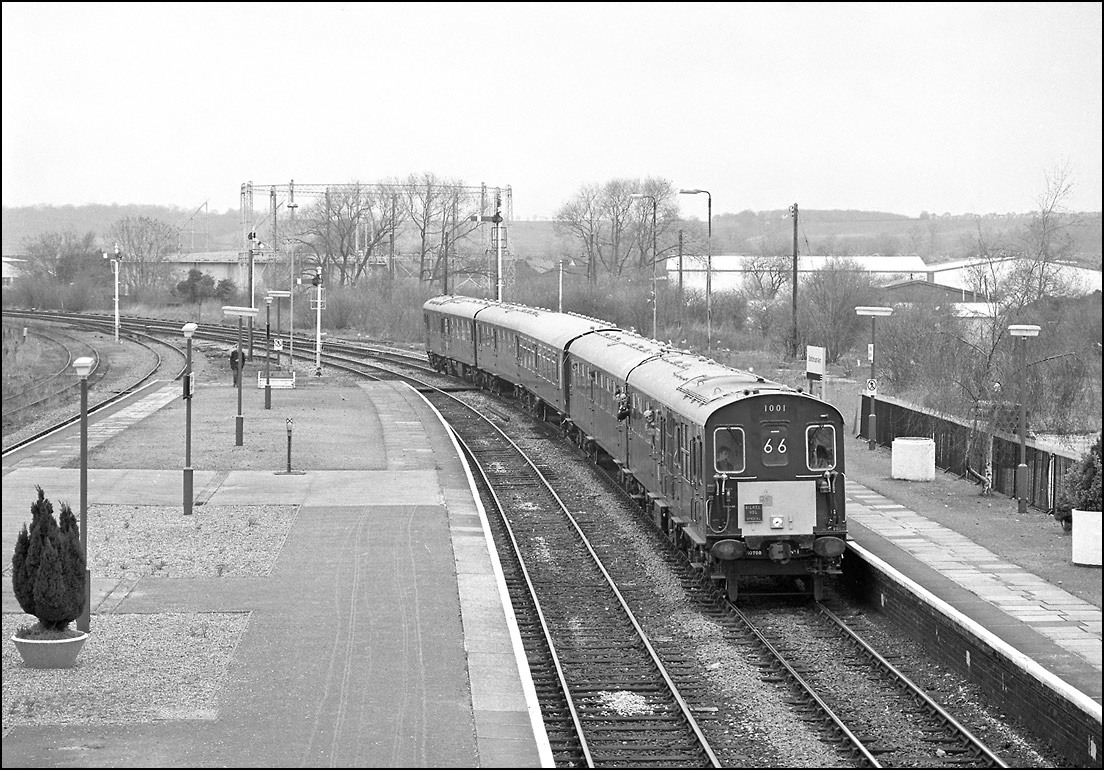
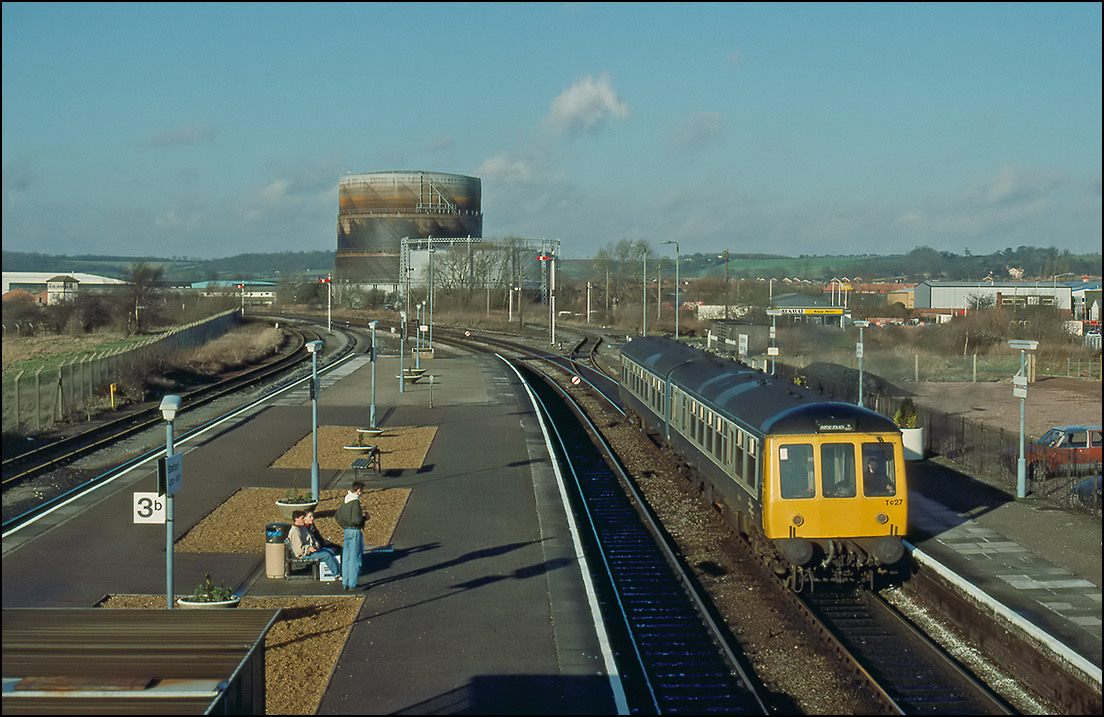
_SonA_300811.jpg)